



A materials team can spend days searching through spreadsheets, old lab reports, instrument exports, and an electronic lab notebook just to answer a basic question: which formulation should we test next? The information exists, but it's fragmented, inconsistently labeled, and often disconnected from processing conditions. Scientists then repeat familiar experiments, not because they lack expertise, but because the evidence needed for a better decision is difficult to assemble.
That situation captures the central challenge of advanced materials engineering. The field isn't defined only by discovering a remarkable polymer, composite, ceramic, or alloy. It's also about connecting composition, structure, processing, performance, manufacturing constraints, and lifecycle requirements into one reliable decision workflow. The global advanced materials market has been estimated at about USD 62.7 billion in 2025 and projected to reach USD 110.2 billion by 2035, with an implied 5.8% CAGR, illustrating that this is now a globally tracked industrial category rather than a narrow research niche (market estimate and projection).
The practical question is no longer, “What material can we invent?” It's, “How can we turn scattered evidence into a defensible next experiment, then carry that formulation into production?” The answer begins with material fundamentals, moves through the R&D workflow, and ends with data infrastructure, explainable models, and disciplined adoption.
Table of Contents
- Introduction to Advanced Materials Engineering Today
- From structure to useful engineering decisions
- Why specific properties matter
Introduction to Advanced Materials Engineering Today
Advanced materials engineering combines materials science with design, processing, characterization, modeling, and manufacturing decisions. A conventional materials project might begin with a known material family and focus on improving one property. An advanced materials program usually has a more demanding target: lower weight, higher temperature resistance, improved durability, better electrical behavior, reduced environmental impact, or a combination of goals that compete with one another.
That competition is why the work often feels less like finding a single “best” ingredient and more like balancing a recipe. A polymer may be easy to process but too soft. A ceramic may tolerate heat but fail under impact. A metal may provide reliable strength but add mass. A composite can combine advantages, yet its performance depends on reinforcement, interfaces, orientation, curing, and manufacturing consistency.
The modern lab also operates under pressure to reduce wasted effort. A formulation chemist may know that a certain additive improved flame behavior in an older project, while a process engineer knows that the same additive caused mixing or scale-up problems. If those observations remain in separate systems, neither person can use the full context when planning the next experiment.
Practical rule: Treat every experiment as both a scientific test and a future data point. Record what was attempted, how it was processed, what was measured, and what failed.
The field's data-driven direction has a clear historical marker. The 2011 announcement of the U.S. Materials Genome Initiative was highlighted by the U.S. National Academies as a significant development in modern materials research, helping push materials development toward computation, shared data, and faster discovery cycles (historical overview of the Materials Genome Initiative).
For an R&D leader, this shift changes the operating model. Success depends less on accumulating isolated results and more on building a traceable chain from hypothesis to validated material. That chain must preserve scientific judgment while making relevant evidence easier to find, compare, challenge, and reuse.
Understanding the Core Concepts Behind Material Performance
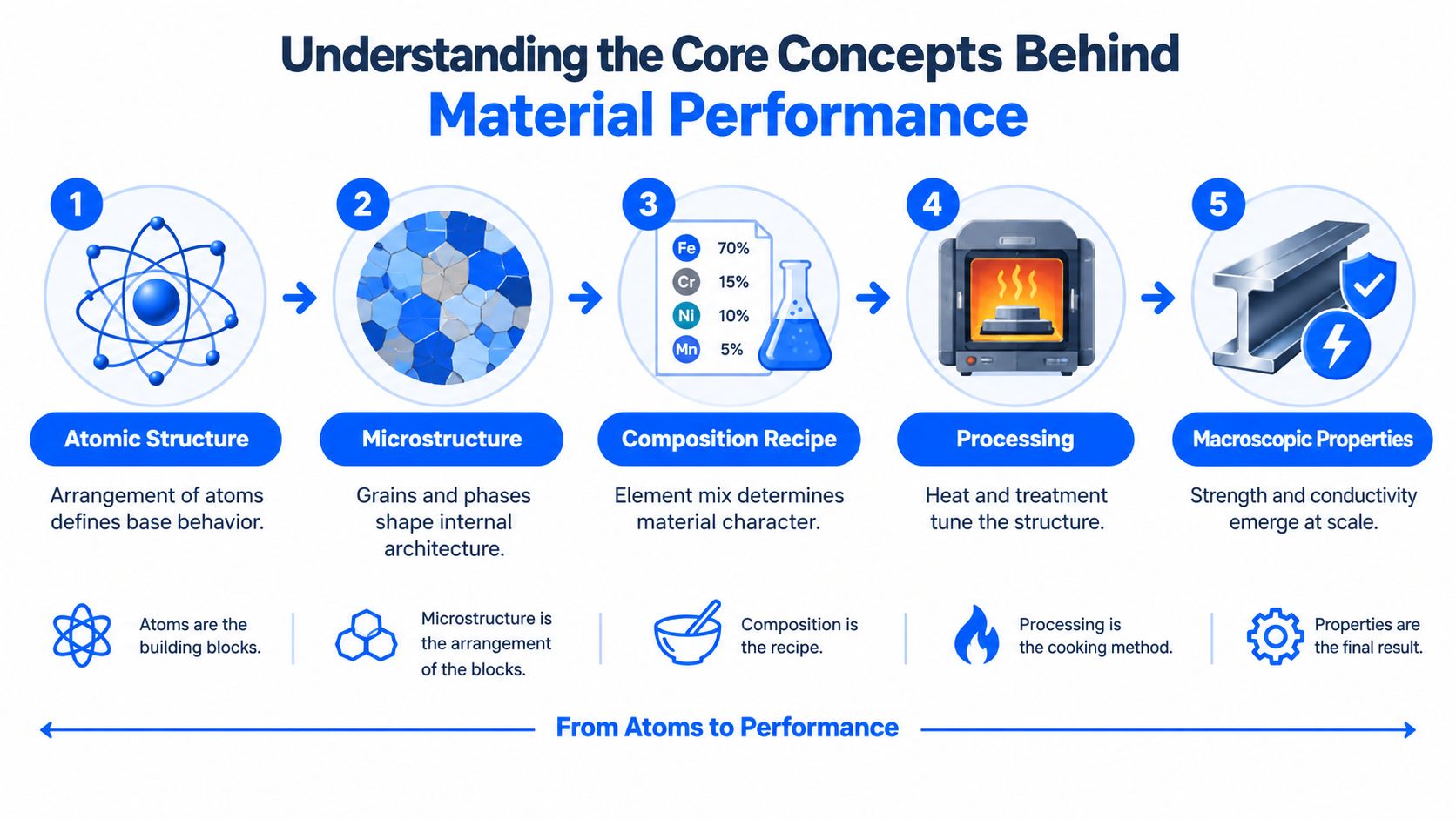
A development team may begin with a promising formulation, then discover that the finished part behaves differently after mixing, curing, cooling, or scale-up. The reason often lies below the scale of routine engineering tests. Atoms form arrangements, arrangements create phases and defects, phases form microstructures, and microstructures shape the properties measured in service. A building provides a useful analogy: performance depends on the bricks, their arrangement, the mortar, the construction method, and the loads applied later.
Composition is the recipe. Processing is the cooking method. Structure is the internal result, and properties describe what the finished material does. Change any one of these and performance can shift, even when the formulation appears identical on paper. That relationship also explains why fragmented laboratory records slow decisions. A property value without its composition, processing history, and structural context is like a test result without knowing how the sample was prepared.
From structure to useful engineering decisions
Start with composition. Elements, polymer backbones, fillers, plasticizers, fibers, and additives determine which interactions are possible. Microstructure then records how those ingredients organize, including grains, phases, pores, interfaces, crystallinity, and reinforcement orientation. Processing tunes that structure through temperature, pressure, mixing, curing, cooling rate, deposition, and other manufacturing conditions.
The result is a set of properties, not one universal score:
- Strength describes resistance to failure under a specified load.
- Stiffness describes resistance to deformation.
- Toughness describes the energy a material can absorb before breaking.
- Thermal stability describes how well performance persists as temperature changes.
- Processability determines whether the material can be mixed, formed, cured, coated, or manufactured consistently.
These properties can compete. Increasing stiffness may reduce toughness. Reinforcement can improve load-bearing capability while making processing more difficult. Raising ceramic content may improve heat resistance but also affect viscosity, density, or defect formation.
Why specific properties matter
Engineers often compare performance relative to weight. Room-temperature property data list aluminum 6061-T6 at about 2.7 g/cm³ density, 69 GPa tensile modulus, and 270 MPa tensile strength, while epoxy is much lighter at roughly 1.25 g/cm³ density but has about 3.5 GPa modulus (engineering material property data). The contrast shows why an epoxy matrix alone usually cannot carry a structural load comparable to aluminum. Polymer-matrix composites need reinforcement, such as fibers or particles, to supply additional stiffness and strength.
Alumina presents another trade-off. Its density is about 3.8 g/cm³, its modulus roughly 350 GPa, and it can survive temperatures around 1425–1540°C. High stiffness and thermal stability suit demanding environments, while lower toughness and difficult processing can limit its application.
The practical lesson is to choose a material architecture for its service environment, not for one attractive property. Characterization, structured data, and explainable models connect a measured result to the structural features that produced it. That connection helps R&D teams replace broad trial-and-error with targeted experiments and defensible decisions.
How Modern Materials R&D Workflows Actually Work
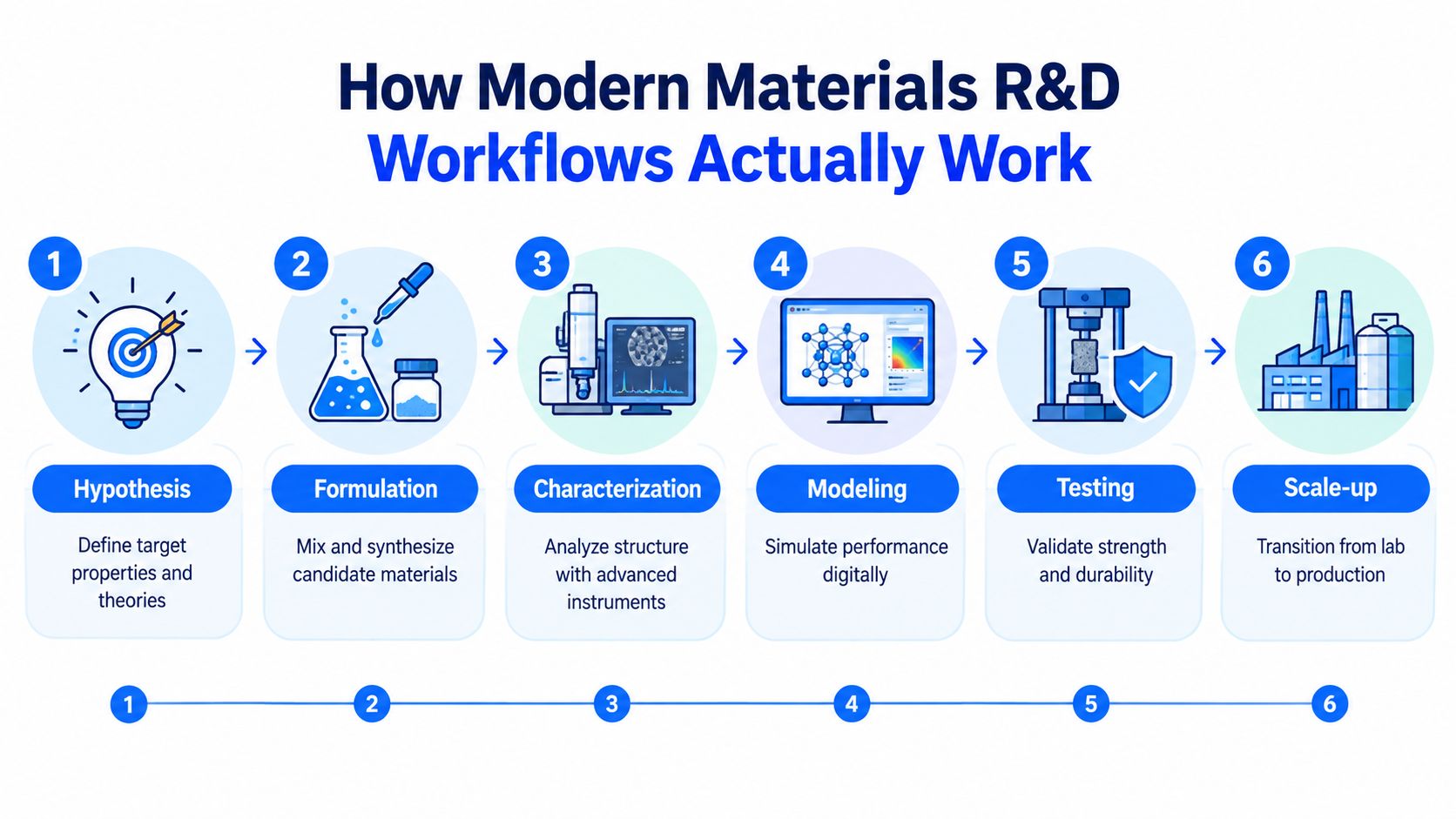
A materials program usually moves through a chain of decisions. The chain looks orderly in a process diagram, but in practice it loops constantly. A failed test can send the team back to formulation. An unexpected microstructure can force a revised hypothesis. A promising laboratory result can disappear during scale-up because the production process creates different heat flow, shear, moisture exposure, or defect levels.
The six linked stages
Hypothesis. The team defines the target properties, the intended application, and the physical or chemical reasoning behind a candidate approach. A useful hypothesis states what should change and why, rather than naming a new ingredient.
Formulation. Scientists mix, synthesize, cure, deposit, or otherwise create candidate materials. This stage includes the formulation itself and the process conditions used to make it. A composition without processing history is incomplete experimental knowledge.
Characterization. Instruments reveal what the material became. Measurements may describe chemistry, morphology, crystallinity, thermal behavior, mechanical response, defects, or other relevant attributes. The result should remain connected to sample identity and preparation history.
Modeling. Computational methods estimate behavior, screen candidates, or help interpret observed mechanisms. Modeling is most useful when its assumptions, training data, and uncertainty are visible to the scientist making the decision.
Testing. The team measures performance under conditions related to actual use. A material that passes a simple laboratory test may still fail under cyclic loading, moisture, temperature changes, or manufacturing variation.
Scale-up. Engineers translate a controlled laboratory procedure into a repeatable production process. Mixing energy, residence time, heat transfer, equipment geometry, raw-material variability, and quality controls can all change the final material.
Where information gets lost
The workflow breaks when handoffs lose context. A spreadsheet may contain the additive level but omit the mixing sequence. An instrument file may preserve a curve without a standardized sample identifier. An ELN may describe a failed batch in prose that a model can't interpret consistently. A process engineer may receive a successful formulation without the boundaries that made it successful.
R&D leaders should therefore track more than project milestones. Useful indicators include the time from hypothesis to validated formulation, the proportion of experiments that answer a defined decision question, reproducibility across batches, and the ability to connect laboratory results to scale-up outcomes. These are workflow measures, not merely scientific measures. They show whether the organization learns from each cycle.
A fast experiment that produces unusable or untraceable data isn't a fast experiment. It's deferred rework.
The goal isn't to eliminate iteration. Materials development requires iteration because the world contains interactions that models and initial hypotheses may miss. The goal is to make each loop more informative and prevent the team from repeating experiments whose evidence already exists elsewhere.
Key Challenges and KPIs That Define Success
A traditional trial-and-error program measures activity: experiments completed, results generated, and promising samples advanced. An AI-guided program measures information gained. It asks which experiment will reduce uncertainty most effectively or separate competing explanations.
Expert judgment remains necessary in both approaches. The difference lies in the evidence available for the next decision. A fragmented program relies on memory and local files. A connected program combines historical results, process limits, model predictions, and the reasons behind each recommendation.
Four measures leaders can use
| KPI | What it reveals | Common challenge |
|---|---|---|
| Quality | Defect rate and consistency under stress | Inconsistent sample preparation or incomplete batch context |
| Speed | Time from concept to validated prototype | Repeated experiments and slow data retrieval |
| Cost | Material and processing cost per unit | Expensive screening without a clear decision framework |
| Performance | Whether strength and thermal targets are met | Improving one property while damaging another |
Quality problems often start before testing. Different naming conventions, units, conditioning procedures, or acceptance criteria can make inconsistent measurement look like material variability. A data system can only correct this problem after the team defines the contents of a valid record.
Speed can be misleading too. More experiments do not automatically shorten development. If researchers cannot identify why a candidate succeeded or failed, they may repeat tests before making a confident choice. A better KPI tracks how quickly a defined question becomes a defensible decision, not how many samples pass through the lab.
A fast experiment that produces unusable or untraceable data isn't a fast experiment. It's deferred rework.
Diagnose the underlying constraint
Cost and performance must be evaluated together. A formulation may meet a laboratory target yet require an additive, process step, or curing condition that makes production unattractive. A lower-cost candidate may introduce durability or quality risks that appear only later.
The advanced materials market's projected expansion from about USD 62.7 billion in 2025 to USD 110.2 billion by 2035, with an implied 5.8% CAGR, reinforces the commercial importance of these trade-offs (advanced materials market estimate). Market growth does not identify the operational bottleneck. The team still needs to determine whether the limiting factor is experimental design, data readiness, model reliability, or production translation.
A practical diagnostic sequence asks:
- Can the team find comparable historical experiments?
- Can it separate formulation effects from processing effects?
- Can it measure target properties consistently?
- Can it explain why a model recommends a candidate?
- Can production reproduce the laboratory result?
If the first two answers are no, a more advanced model will not repair the foundation. The organization must first connect its records and establish disciplined experiments. Once those conditions are in place, explainable AI can turn scattered evidence into a recommendation that scientists can test, challenge, and refine.
Emerging Technologies Reshaping Materials Development
A materials team can have excellent instruments and still make slow progress if test results, processing conditions, and formulation histories remain in separate systems. The useful technology stack connects four layers. Digital twins and simulation represent materials, processes, or equipment virtually. Digital lab notebooks preserve experimental context. Automation and robotics carry out repeatable synthesis and testing. AI and machine learning detect patterns, estimate outcomes, and propose the next experiment.
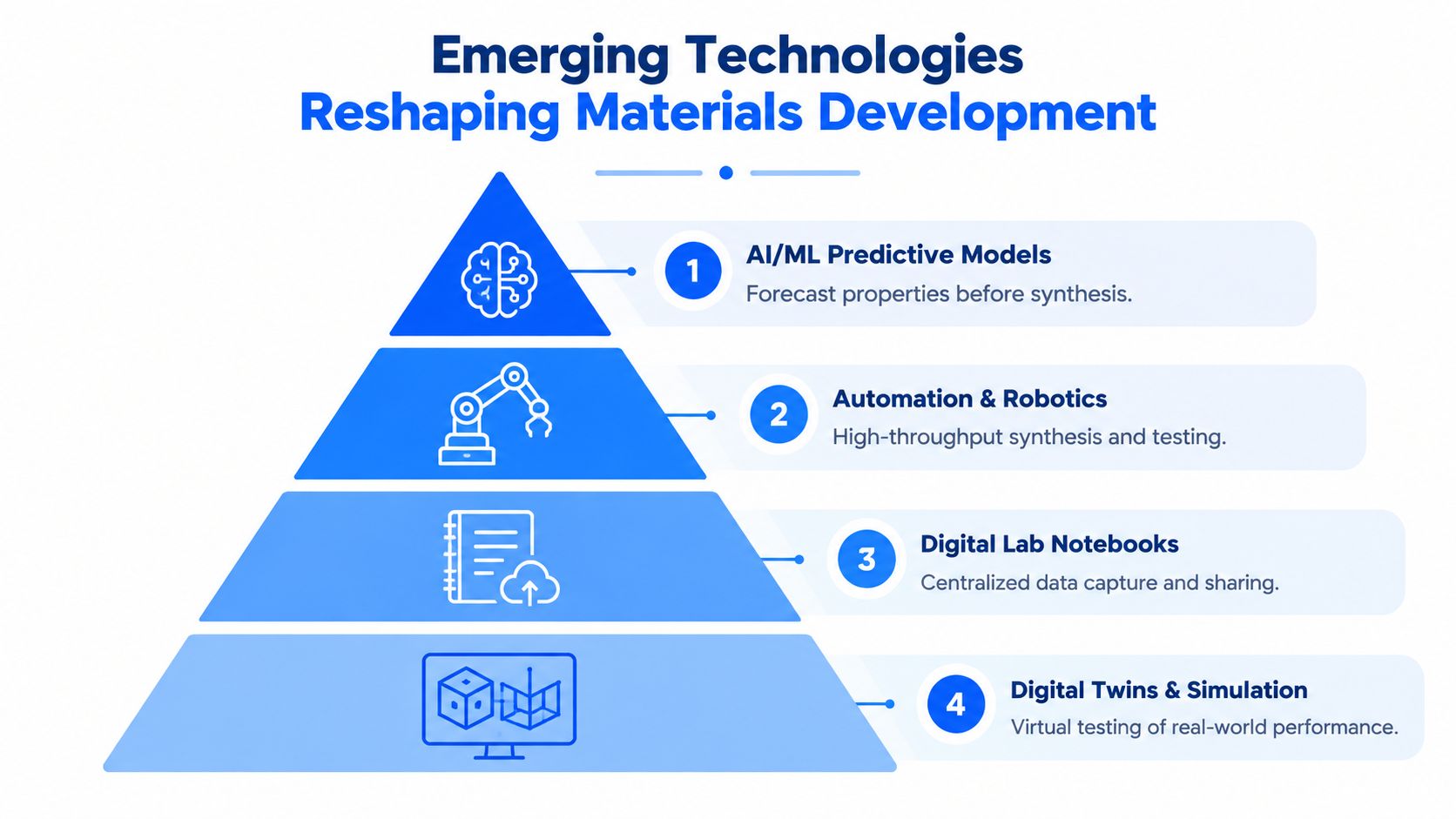
The pyramid shows a dependency chain. The top layer relies on the layers below it. A predictive model cannot replace missing processing conditions, and automation cannot make inconsistent measurements comparable. A digital twin becomes useful when it reflects validated physical behavior, not only an attractive visualization.
What explainable AI adds
A black-box prediction supplies a number. A useful materials model supplies that number with confidence, relevant historical precedents, influential variables, and warnings about extrapolation. Scientists can then decide whether to trust the recommendation, run a confirming experiment, or reject a candidate outside known chemistry or processing conditions.
Physics-informed methods help when data are sparse or noisy. They can incorporate relationships scientists already understand, including conservation principles, phase behavior, diffusion, reaction kinetics, and processing limits. Machine learning then supports physical reasoning rather than treating correlation as a substitute for it.
Benchmarking separates predictive value from internal overfitting. The JARVIS-Leaderboard reports more than 1,281 contributions across 274 benchmarks, using 152 methods and over 8 million data points (JARVIS-Leaderboard overview). These figures also show why comparisons depend on dataset quality, task definitions, and consistent ground truth. A model that performs well on a private dataset may fail on a new formulation family.
Connected systems extend into production settings. Teams assessing immersive interfaces for factory training, visualization, or operational collaboration can consult this overview of the tech stack for industrial VR. The practical goal is continuity, with experiment design, process understanding, and manufacturing knowledge represented in connected records.
The strongest architecture connects the workflow end to end. Clean experimental records feed models, models guide targeted experiments, automation executes repeatable work, and validated results improve the next recommendation. This turns fragmented evidence into decisions scientists can inspect, test, and refine.
Real World Examples of Accelerated Polymer Discovery
A polymer team may need one material to balance flame resistance, thermal stability, processing behavior, and emissions. In a conventional project, flammability results might sit in one system, thermal analysis in another, and formulation details in a spreadsheet controlled by one scientist. Progress remains possible, but reconstructing the links between ingredients, processes, and outcomes consumes time and can obscure which comparisons are trustworthy.
A data-centered workflow brings these records together. Each formulation connects to its ingredients, concentrations, mixing sequence, cure or processing history, specimen preparation, test method, and measured results. Historical data do not need to be flawless before they become useful. The immediate task is to separate reliable comparisons from ambiguous ones and record uncertainty rather than conceal it.
Multi-objective optimization in practice
A polymer-focused scientific discovery framework assembled performance datasets spanning polymer systems and covering limiting oxygen index, char residue, glass-transition temperature, decomposition temperatures, heat release, and smoke release metrics (polymer discovery framework and performance dataset). The breadth matters because polymer decisions rarely depend on one property. It gives researchers a common basis for examining competing objectives.
A useful recommendation therefore does more than maximize flame resistance. It ranks candidates that also preserve thermal stability, avoid unacceptable emissions behavior, and fit manufacturing constraints. The model narrows the experiment queue, while the scientist checks whether the proposed chemistry and process window make physical sense.
Composite development shows why process history belongs in the dataset. The matrix may provide adhesion and processability, while reinforcement supplies stiffness and strength. Composition alone can miss fiber orientation, dispersion, surface treatment, or cure history. A useful system joins formulation records with processing conditions and characterization results, so the model can distinguish a promising recipe from a promising recipe that is difficult to manufacture.
The best next experiment isn't always the candidate with the highest predicted property. It's often the candidate that tests whether the team's current explanation is correct.
Teams can apply this logic to their own project portfolio. Projects with repeated formulation cycles, interacting ingredients, consistent historical testing, and a clear economic cost for failed experiments are strong candidates. Projects with little comparable data can still benefit from structured capture, but predictions will carry greater uncertainty.
Acceleration means directing laboratory effort more intelligently. Targeted experiments clarify trade-offs, challenge uncertain assumptions, and move a formulation closer to manufacturability without treating model output as a substitute for validation.
Best Practices for Adopting AI Native Platforms Successfully
Adoption works best when leaders treat AI as a change to the decision process, not a software installation. Start with one high-value workflow, such as formulation ranking, property prediction, failure analysis, or scale-up comparison. Define the decision the model must improve and the evidence scientists need before they'll act on its recommendation.
The data foundation should connect spreadsheets, ELNs, instruments, and production records without forcing scientists to abandon every existing tool immediately. Establish naming conventions, units, version history, sample identifiers, and access rules. Protect intellectual property through role-based permissions and clear governance, especially when historical data span multiple teams or sites.
Explainability must be part of the user experience. Ask the platform to show confidence, relevant precedents, influential variables, and the limits of its training data. Scientists should be able to challenge a recommendation and record why they accepted, modified, or rejected it.
For teams standardizing technical requirements, guidance on how AI aids spec template design can also help connect structured specifications with downstream data capture. That connection matters because vague targets create ambiguous experiments and weak model labels.
A practical adoption checklist includes:
- Choose one decision bottleneck: Start where better evidence can change the next experiment.
- Audit historical data: Separate usable records from incomplete or incomparable ones.
- Keep scientists involved: Let domain experts define constraints and review recommendations.
- Validate outside the training set: Test whether predictions remain useful for new formulations.
- Measure operational impact: Track time to validated material, reproducibility, and scale-up readiness.
The guiding principle is straightforward. AI becomes valuable when it helps scientists make better, more explainable decisions with the data they already generate.
Polymerize offers an AI-native system for materials R&D that unifies experimental data and supports explainable predictions, formulation optimization, and next-experiment planning across polymers, chemicals, and advanced materials. If your team is ready to replace fragmented trial-and-error with a connected decision workflow, visit Polymerize to explore how the platform can support discovery through scale-up.
Put your R&D data to work
See how materials teams use Polymerize to plan fewer experiments and reach target properties faster.