



Accurate prediction alone isn't enough to justify the next materials experiment. A model may rank a formulation highly, yet a scientist still needs to know how confident the prediction is, which variables influenced it, whether similar experiments support it, and whether the recommendation fits cost, safety, equipment, and scale-up constraints. Without that context, AI can produce a polished answer that no one can responsibly act on.
That's why the most useful explainable AI use cases connect model output to a specific R&D decision. The question isn't whether a feature-attribution chart looks convincing. It's whether the explanation helps a team decide what to formulate, what to test next, why a batch failed, whether a laboratory result can transfer to production, or how to document the reasoning for colleagues and auditors.
Explainable AI became a formal research and government priority in 2015, when DARPA launched its Explainable AI program. That same year, researchers at TU Berlin, BIFOLD, and Fraunhofer HHI developed Layer-wise Relevance Propagation, one of the first systematic approaches for explaining neural-network decisions, as described by Fraunhofer HHI's account of explainable AI research. In materials R&D, the practical consequence is clear. Explainability should move teams from opaque predictions toward testable hypotheses.
A useful evaluation framework has five parts: the problem context, the explanation method, the measurable decision value, the implementation requirements, and a grounded precedent. Platforms such as Polymerize illustrate this direction by combining materials data, predictive models, confidence scores, feature attribution, causal analysis, and historical experiments in one R&D workflow.
Table of Contents
1. Property Prediction and Formulation Optimization
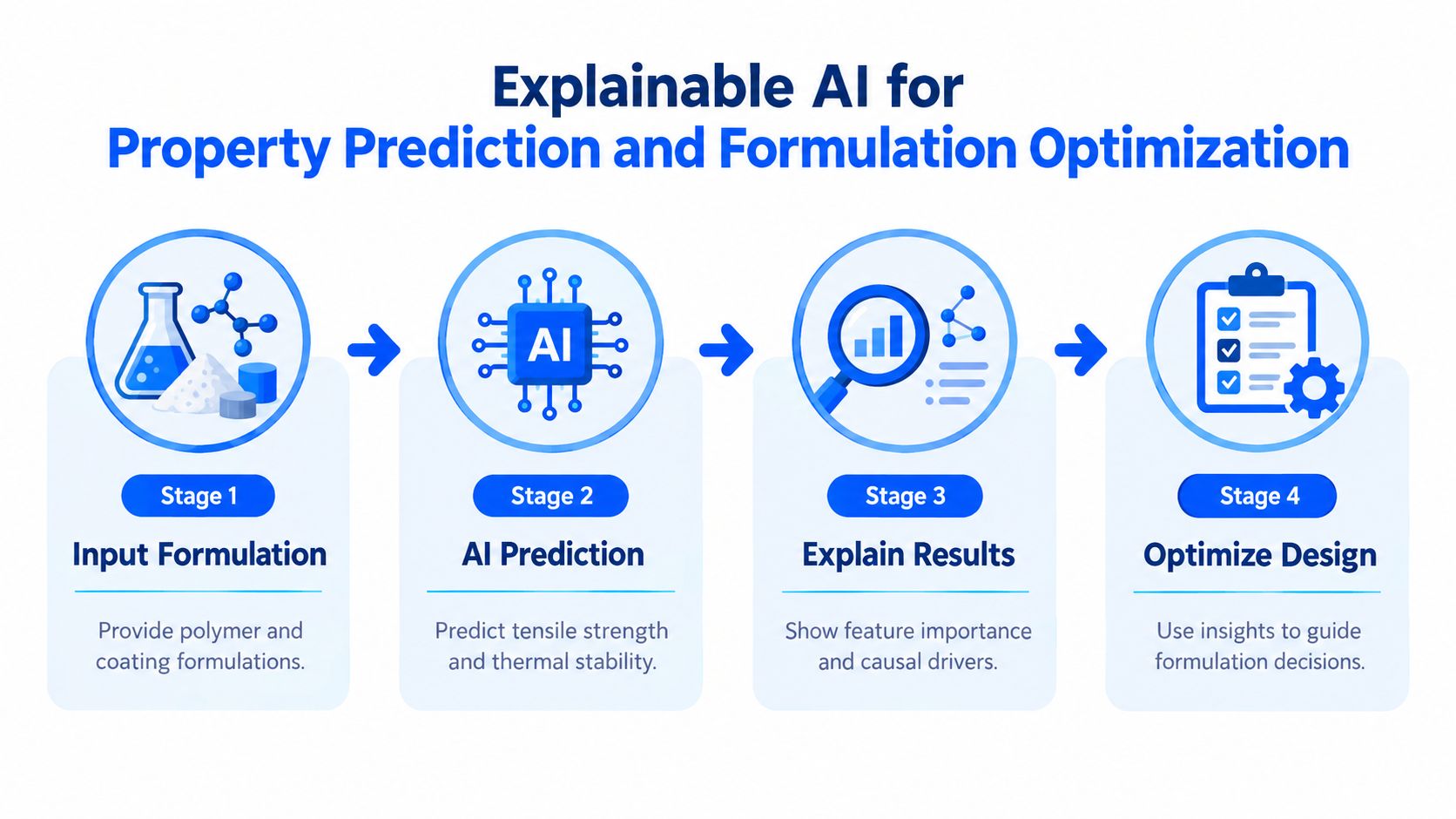
A formulation model becomes useful when it helps a chemist choose between credible recipes, not when it merely produces a property estimate. For example, a polymer team may want to balance tensile strength, thermal stability, and chemical resistance. A coating team may need adhesion without sacrificing UV durability. A battery developer may be comparing electrolyte compositions for ionic conductivity.
The model should show the predicted property, its uncertainty, the influential formulation variables, and comparable historical experiments. SHAP can attribute a prediction to individual inputs, while LIME can provide a local approximation around a specific formulation. Neither method proves a chemical mechanism by itself, but both can expose whether the model is relying on plausible variables or on suspicious proxies. The concrete precedent is a high-performance concrete study in which researchers compared Random Forest, XGBoost, Support Vector Regression, and Deep Neural Networks. XGBoost delivered the strongest predictive performance in that case, while SHAP and LIME revealed feature importance and interaction effects, as reported in the materials-design study published by Wiley.
From prediction to a formulation decision
Start with a well-characterized property category and check whether the historical records include consistent ingredient identities, concentrations, processing conditions, and test methods. A model trained on mixed testing protocols can produce explanations that look precise but reflect measurement differences rather than chemistry.
Use explanations to challenge the model:
- Domain alignment: Check whether influential ingredients and process variables fit established formulation knowledge.
- Constraint handling: Exclude recommendations that violate cost, availability, sustainability, safety, or manufacturability requirements.
- Experimental verification: Test high-value predictions and compare the observed result with the predicted range.
- Calibration review: Reassess the model when new experiments reveal systematic overprediction or underprediction.
Practical rule: Treat feature importance as a hypothesis about formulation behavior, not as proof of causation.
The best workflow combines property prediction with constraint-based optimization. It produces a shortlist a chemist can make, then records which recommendation was accepted, modified, or rejected and why.
2. Experiment Design and Next-Best-Experiment Recommendation
The next experiment should target the decision that remains uncertain, not merely fill another row in the database.
An explainable next-best-experiment system combines active learning, design-of-experiments principles, and uncertainty estimates to identify which result could change the team's formulation or testing plan. For example, a model may predict that two additives can improve barrier performance while the historical data covers only their individual effects. A controlled interaction study may then provide more useful evidence than another routine replicate. The recommendation should state the knowledge gap, the variables to vary, and the decision the result could support.
A recommendation is useful only when a scientist can challenge it. The interface should show why it selected a composition, temperature, curing condition, or characterization method. “The algorithm selected this point” does not justify laboratory time, material use, or instrument capacity.
Keep early recommendations within a design space the team understands. Frontier exploration can follow after the system demonstrates that its suggestions reflect known relationships and produce reliable learning. Uncertainty estimates also help distinguish a genuine knowledge gap from an area that lacks only repeated measurements.
Rather than forcing every project into the same review format, record the reasoning in a decision log:
- Recommendation basis: Which variables, predictions, and uncertainty estimates shaped the proposed experiment?
- Expert response: Did the chemist accept, modify, defer, or reject it?
- Override reason: Did safety, equipment, raw-material access, mechanism, or business priority change the plan?
- Learning outcome: Did the experiment reduce uncertainty, improve performance, or expose a faulty assumption?
Human veto authority protects the laboratory from recommendations that are unusual, unsafe, impractical, or poorly timed. Domain experts still assess sample availability, test capacity, process constraints, and interpretation. Their decisions should feed back into the recommendation system alongside experimental outcomes, with clear records of accepted and rejected suggestions.
The result is a defensible allocation of laboratory time. Each selected experiment connects to a formulation or process decision, and the explanation shows why that experiment was worth running.
3. Causal Driver Identification and Root Cause Analysis
A feature can correlate with a result without giving the team a useful intervention. Root-cause analysis becomes valuable when explainable AI connects a predicted outcome to a variable the materials team can deliberately change and test.
In a polymer process, average molecular weight may correlate with processability, while the model identifies molecular weight distribution as the stronger driver. The team can then vary distribution directly instead of repeatedly adjusting a broad proxy. For coatings, an explanation might expose an interaction between UV absorbers and flame retardants. In battery materials, it could indicate that dopant concentration has more influence than dopant identity. Each finding points to a different formulation or process decision.
Counterfactual analysis sharpens the next question: What would the model predict if this variable changed while the others remained controlled? The answer can support a mechanism hypothesis, but it does not prove chemical causation. Experimental validation remains necessary.
Use explanations to design the intervention
Start by defining the failure or performance outcome precisely. Then map candidate variables, likely confounders, and the operating conditions under which the result appears. Model explanations can rank plausible drivers and interactions, but the proposed intervention should change the suspected driver while holding credible alternatives constant.
Randomized, controlled experiments offer stronger evidence than unrelated historical campaigns. Teams should compare causal methods where feasible and check whether their conclusions agree with chemistry, process knowledge, and measurement quality. A practical test sequence is:
- Specify the outcome and decision affected by it.
- Rank candidate drivers and interactions with the model.
- Select a controllable variable and define the intervention.
- Control relevant alternatives and run the validation experiment.
- Record whether the result supports, weakens, or contradicts the mechanism hypothesis.
Store the outcome in a shared knowledge base with the supporting data, explanation method, assumptions, and validation result. This record lets another scientist assess why a formulation changed, which evidence supported the decision, and whether the insight is suitable for scale-up or only for the original process window.
The explanation earns its place when it identifies an actionable variable and specifies an experiment that can test the proposed cause.
A materials-focused review in Communications Materials notes that explainability is more useful when it checks consistency with domain knowledge, identifies variables scientists can act on, and supports the next testable hypothesis. That standard makes the output relevant to R&D decisions rather than a feature-ranking exercise.
4. Failure Mode Prediction and Quality Risk Assessment
A quality model earns operational value when it connects a risk signal to a specific decision. Engineers need to know which failure mode is likely, which conditions contributed to the risk, and what intervention is available before the material reaches a customer.
In polymer processing, a system might flag gel formation during extrusion and relate the risk to formulation composition, residence time, temperature, or shear. For composites, it could identify delamination risk and separate interface quality from cure conditions or material incompatibility. In chemical production, an early warning may justify holding a batch, running a targeted test, or checking an upstream condition before an off-spec material moves downstream.
The model should also explain why the alert fits the failure taxonomy. Routine datasets often contain many successful runs but few well-described failures. Preserve process context, severity, observed symptoms, and corrective action in the training record. A label such as “batch failed” gives the model little basis for choosing between additional testing, rework, or rejection.
Set thresholds around the cost of each decision
False negatives and false positives create different operational consequences. Missing a serious quality risk can cause production disruption and customer impact. Excessive false alarms can lead operators to disregard the system. Set thresholds by failure mode and decision consequence, then review them against confirmed outcomes rather than applying one generic probability cutoff.
Domain rules can strengthen the warning process. A viscosity outside an established operating range may justify a process-risk alert even when the model has limited examples of that condition. Keep the rule visible, versioned, and reviewable. Combining a model score with a documented process limit makes the release decision easier to defend.
Every alert should leave an auditable record:
- Predicted failure mode: What is likely to go wrong?
- Contributing conditions: Which variables raised the risk?
- Recommended response: What test, hold, adjustment, or escalation follows?
- Validation result: Did the predicted failure occur?
- Threshold performance: Did the system create false positives or miss confirmed failures?
A closed-loop workflow turns an explanation into a quality action. It lets teams compare predicted and observed failures, refine the next test, and document why a batch was released, held, reworked, or rejected.
5. Manufacturing Scale-Up Prediction and Process Transfer
Scale-up prediction should answer a production decision: can the formulation and process move to a larger vessel without changing material performance? Laboratory results alone cannot answer it. Mixing, heat transfer, residence time, shear, temperature gradients, vessel geometry, and ingredient sequence can all shift as volume increases.
Start with the failure mechanism that matters. For a specialty polymer, compare laboratory and pilot dispersion under their respective mixing profiles. For an exothermic reaction, assess whether heat removal changes enough with vessel geometry and batch volume to alter reaction behavior. For an adhesive, test whether production-scale mixing time changes cure behavior despite an unchanged nominal formulation.
A model explanation has value only when it is tied to comparable laboratory, pilot, and production runs. Linked records show whether the same variables remain influential across scales or whether the model is relying on correlations that apply only to one regime.
Combine model evidence with process mechanics
Mechanistic constraints make scale-up recommendations easier to test. Computational fluid dynamics can characterize mixing, while heat-transfer equations can constrain expected temperature behavior. The AI model can then flag departures between empirical results and process expectations, directing the next validation run toward the most uncertain operating condition.
Use a staged transfer rather than a single jump. At laboratory scale, record formulation, ingredient sequence, equipment geometry, mixing energy, temperature, and test results. At pilot scale, compare predicted risks with measured gradients, residence time, and product uniformity. At production scale, update the model only with approved process adjustments and monitor deviations from the validated window.
Bayesian uncertainty quantification separates known scale-up risks from regions with little comparable data. That distinction affects the decision: a known risk may require a defined control, while sparse evidence may require another pilot run before transfer approval.
Document each decision in a scale-up playbook. Record the explanation, process change, validation evidence, and conditions that limit the recommendation. The record supports later transfers when teams, equipment, or suppliers change, and gives manufacturing a clear basis for accepting, holding, or revising the process.
6. Regulatory Compliance, Patent Support, and Cross-Functional Decision Support
A model explanation is useful only when it helps a team make, defend, and revisit a materials R&D decision. The same formulation may require regulatory evidence, patent analysis, manufacturing approval, procurement review, and commercial justification. Each audience needs a different view of the evidence, while the underlying record must remain consistent.
Start with the decision record, not the presentation layer. Link the source data, model version, input conditions, prediction, uncertainty, explanation, expert review, and approved action. For a regulatory submission, this chain shows how the conclusion was reached and where limitations remain. For patent support, AI can organize prior-art analysis and surface formulation relationships, but patent counsel and technical experts must confirm the interpretation before it informs a filing or freedom-to-operate assessment.
The same explanation should answer different operational questions:
- R&D: Which formulation variables influenced the prediction, which experiments are comparable, and what mechanism should be tested?
- Manufacturing: Which process conditions create risk, what control range is supported, and when should production stop for review?
- Quality and regulatory: Which data support the claim, which model version generated it, and what assumptions limit its use?
- Business leadership: Which performance, supply, cost, and readiness trade-offs were accepted, and which risks remain open?
A dashboard can present these views without creating separate evidence bases. The R&D view may show feature attribution and uncertainty. The manufacturing view can translate the same result into process risk and escalation rules. Leadership may need a concise decision status, while auditors need the underlying records and approval history.
The guidance on tools for grounded AI applications applies to this workflow because recommendations should remain tied to evidence, review, and documented limitations. Generated text should support analysis, not replace technical judgment.
Governance principle: AI recommends, domain experts decide, and the organization records both the recommendation and the decision.
Build these controls into data preparation and experiment planning. A late feature-importance review cannot recover missing provenance, undocumented overrides, or the reasoning behind an earlier formulation choice. Define review thresholds, require sign-off for consequential decisions, and preserve the path from experiment to deployment. That record lets new team members understand why a material was approved, rejected, or held for further testing.
7. Sustainability and Green Chemistry Optimization
A sustainability score does not decide whether a formulation is greener. The decision depends on which trade-offs the team accepts and whether testing confirms them. A bio-based ingredient can reduce fossil feedstock use while adding supply variability, process changes, or performance loss. A lower-VOC coating may need a different cure profile, while a recyclable formulation may require additives that affect durability or separation.
Use explainable optimization to connect each recommendation to a formulation choice. The system can compare carbon footprint, water use, hazard profile, recyclability, and material performance, then show which ingredients or process assumptions drive the result. Analysts can distinguish a meaningful substitution from an unreliable supplier estimate or incomplete environmental data.
The output should be a set of testable options, not one “green” label.
Start with the decision, then test the trade-off
Pareto analysis keeps competing objectives visible. A team can compare formulations along a frontier rather than accept a single score that hides performance or manufacturing compromises. Chemists and sustainability specialists then select candidates that fit the product, market, and production context.
A coating team reducing VOCs, for example, might compare solvent or binder changes while protecting cure speed and durability. The model can identify likely performance penalties, explain the features behind those predictions, and recommend the experiment that best separates viable alternatives. Laboratory results should update the comparison before the team commits to a reformulation.
Environmental conclusions also depend on evidence quality. Supplier identity, concentration, origin, and environmental attributes affect ingredient assessments. Energy, temperature, solvent use, waste, and recovery conditions shape process impacts. Performance testing confirms that a sustainability gain does not undermine the required property.
Supplier collaboration can expose missing upstream information. Explanations should identify assumptions that materially change the recommendation and specify what evidence would reduce uncertainty. The final decision must also account for customer acceptance, regulatory fit, supply security, and measured product performance. That record makes the sustainability choice defensible during scale-up and later formulation reviews.
8. Materials Discovery and Chemical Space Exploration
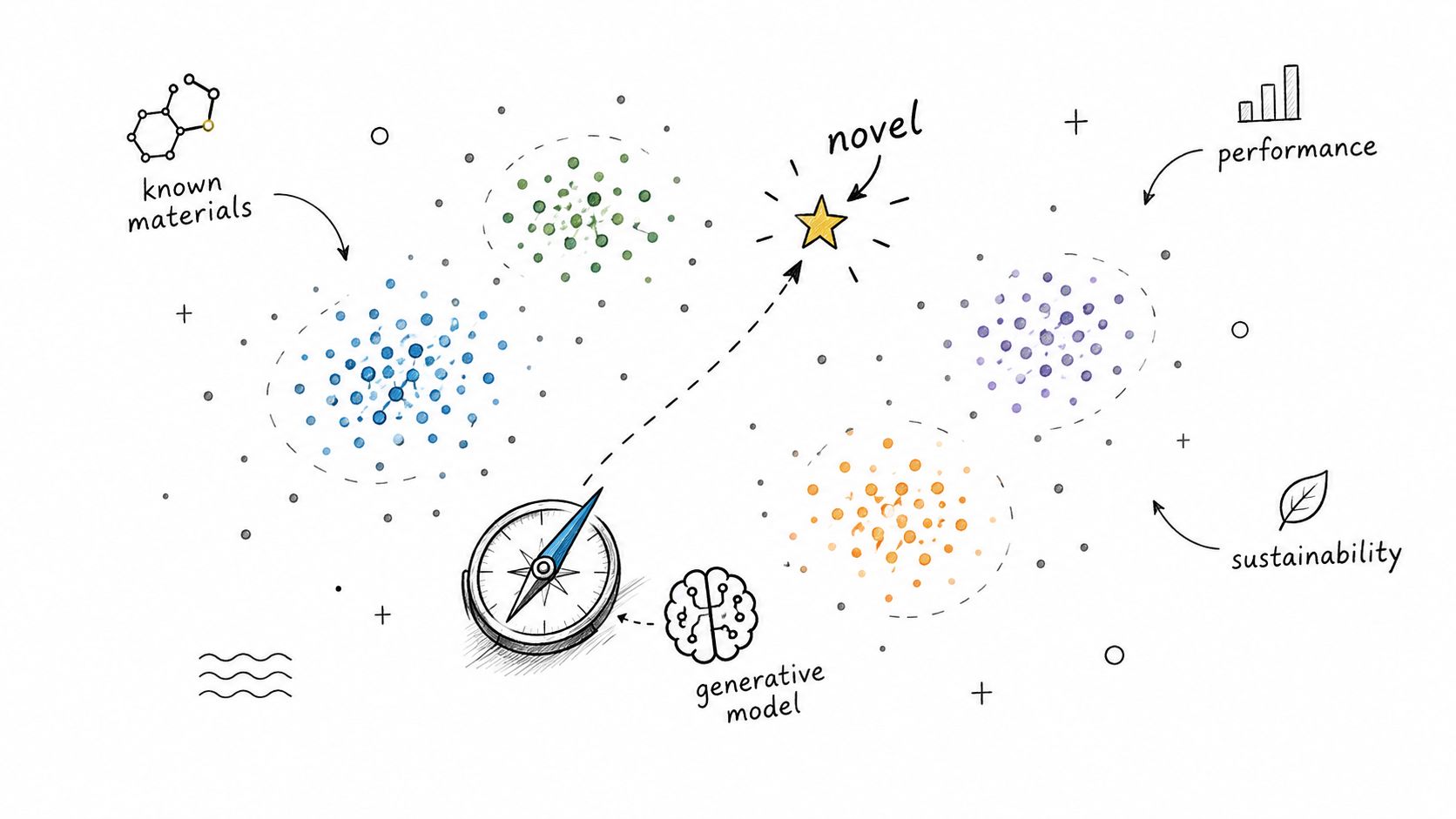
Generative models can produce candidate materials faster than laboratories can synthesize or formulate them. The practical decision is which candidates deserve scarce experimental capacity. Explainability helps chemists assess whether a prediction reflects a well-supported chemical pattern or an extrapolation into unfamiliar space.
For an electrolyte, a model may propose a composition associated with improved ion transport. A polymer-blend search may identify combinations balancing thermal stability with processability. For bio-based materials, the system can surface blends resembling a synthetic benchmark, while exposing unresolved questions about sourcing, compatibility, and processing.
Candidate ranking should therefore combine predicted performance, novelty, uncertainty, and precedent. A material supported by close historical analogues calls for confirmation testing. A highly novel candidate with limited precedent may justify exploration, but its first experiment should target the assumptions carrying the greatest risk.
Keep generation connected to the lab
Before synthesis or formulation, chemists need visibility into practical constraints. They can reject unstable structures, unavailable ingredients, unsafe combinations, or candidates that exceed equipment and process limits. Encoding those constraints in the generation workflow prevents a long list of theoretically attractive but unusable suggestions.
Use a discovery workflow that records both selection logic and experimental evidence:
- Constrained generation: Filter candidates by availability, cost, safety, manufacturability, and target application.
- Exploration balance: Maintain a route into novel chemical families while improving known high-performing families.
- Evidence review: Display influential structural or formulation features, uncertainty, and comparable experiments.
- Experimental validation: Prioritize candidates whose predicted value and novelty justify laboratory effort.
- Model updating: Return measured outcomes to the system, including failed and infeasible candidates.
Documentation matters as much as ranking. Store the explanation, constraints, selected experiment, and measured result so technical, manufacturing, and regulatory teams can review why a candidate advanced or stopped.
Research on explainable AI for kesterite thin-film photovoltaic devices illustrates the value of linking predictions to process decisions. The explanation layer identified structural properties of the i-ZnO and CdS layers as dominant factors behind efficiency and process reproducibility, making XAI useful for root-cause analysis and process optimization, as described in the Advanced Energy Materials research record.
Explainable AI: 8 Use Cases Comparison
| Use case | Implementation complexity 🔄 | Resource requirements ⚡ | Expected outcomes 📊⭐ | Ideal use cases 💡 | Key advantages ⭐ |
|---|---|---|---|---|---|
| Property Prediction and Formulation Optimization | Medium–High, supervised models + explainability pipelines | High data needs (>500 experiments), moderate compute, integration with workflows | Reduce experimental cycles 30–50%; confident multi-property predictions | Polymer/coating formulation tuning where historical data exists | Transparent feature importance; faster time-to-market; regulatory/IP support |
| Experiment Design & Next‑Best‑Experiment Recommendation | High, active learning + DoE integration | Moderate–High, standardized ELN, curated datasets, BO compute | Fewer experiments (up to 4× reduction); faster discovery velocity | Large screening projects; teams needing prioritized experiments | Prioritizes high‑information tests; reduces wasted resources |
| Causal Driver Identification & Root Cause Analysis | High, causal inference (DAGs, interventions) | High, well‑annotated experiments, domain expertise, compute | Actionable mechanisms; quantified intervention impacts; targeted experiments | Investigations of unexpected behaviors; mechanism validation; patent support | Moves beyond correlation to causation; supports regulatory justification |
| Failure Mode Prediction & Quality Risk Assessment | Medium, classification + risk scoring | Moderate, labeled failure data (class imbalance), monitoring | Early detection of likely failures; fewer recalls; improved robustness | Scale‑up QA, production risk mitigation, quality assurance | Predicts failure modes with explanations; enables proactive interventions |
| Manufacturing Scale‑Up Prediction & Process Transfer | Very High, multi‑scale + mechanistic/ML hybrid models | Very high, lab→pilot→prod datasets, mechanistic sims (CFD), heavy compute | Accelerated scale‑up (40–60%); fewer pilot failures; validated process changes | Transitioning lab formulations to pilot/production at scale | Identifies scale‑dependent phenomena; recommends process adjustments |
| Regulatory Compliance, Patent Support & Cross‑Functional Decision Support | High, audit trails, governance, translated explanations | High, integration with systems, documentation tooling, change management | Faster regulatory submissions; auditable decision chains; aligned teams | Regulated industries (pharma, chemicals); cross‑functional programs | Compliance‑ready explanations; traceability; stakeholder alignment |
| Sustainability & Green Chemistry Optimization | Medium, multi‑objective optimization + LCA integration | Moderate, environmental/supplier data, LCA tools, constraint data | Sustainable substitutions with quantified trade‑offs; maintained performance | Developing low‑VOC, low‑carbon formulations; supplier substitution projects | Balances performance, cost, sustainability; data‑backed substitution choices |
| Materials Discovery & Chemical Space Exploration | High, generative models + novelty/diversity metrics | High, compute‑intensive modeling, validation experiments, constraints | Novel candidates and IP; accelerated innovation (6–12 months faster) | High‑risk, high‑reward discovery of novel polymers/materials | Explores beyond known space; explains why candidates are promising |
Turn Explainability Into the Next Experiment
Explainable AI has strategic value only when it changes a concrete R&D decision. A feature ranking that no scientist trusts, a confidence score with no calibration record, or an audit log disconnected from experimental practice adds documentation without improving innovation.
The strongest adoption path moves from prediction to action. Start with a focused formulation problem where the inputs, outputs, test methods, and constraints are well understood. Connect each prediction to confidence, influential variables, and comparable historical experiments. Then turn the explanation into a causal hypothesis and validate it with a controlled experiment. If the model recommends a new additive ratio, the team should know what property it is expected to change, why the model believes that, and what result would confirm or weaken the hypothesis.
Teams should measure outcomes that reflect how materials work gets done. Useful measures include failed experiments, discovery velocity, scale-up readiness, decision traceability, quality escapes, and the time required to move validated work between R&D and manufacturing. The right measure depends on the workflow. A next-best-experiment system should show whether recommendations produced useful learning. A scale-up model should show whether it identified process risks early enough to change the pilot plan. A governance workflow should show whether another expert can reconstruct the decision from the record.
Enterprise adoption works best as a sequence:
- Centralize experimental data: Bring together spreadsheets, ELNs, test results, formulation records, process conditions, and sample metadata.
- Select one high-value workflow: Choose a decision with clear business value, such as property prediction, failure analysis, or next-experiment planning.
- Define expert review rules: Specify when users can accept a recommendation, when they must investigate, and when they can override it.
- Document decisions: Record accepted, modified, and rejected recommendations, including the reason for each outcome.
- Validate before expanding: Compare predictions with new experiments and review calibration, failure modes, and user behavior.
- Scale deliberately: Add new properties, sites, materials, and teams only after the initial workflow produces measurable evidence.
A 2024 McKinsey survey found that 40% of respondents identified explainability as a key risk in adopting generative AI, as reported in McKinsey's discussion of AI trust and explainability. For materials organizations, that concern is practical rather than abstract. Scientists need to know whether a recommendation is chemically plausible. Manufacturing needs to know whether it can be executed. Leadership needs to know who approved the decision and what evidence supports it.
Polymerize is one relevant option for teams building this workflow. Its platform combines centralized materials data with explainable models, confidence scoring, feature attribution, causal analysis, and historical precedents, allowing scientists to connect AI recommendations with experimental validation and enterprise review.
Polymerize helps materials R&D teams centralize fragmented experimental data and use explainable models to predict properties, optimize formulations, identify causal drivers, and plan better experiments. Explore how Polymerize can connect explainable AI to the formulation, validation, and scale-up decisions your team makes every day.
Put your R&D data to work
See how materials teams use Polymerize to plan fewer experiments and reach target properties faster.