

The Complete Guide to Materials Informatics in 2025
In 2025, materials informatics is no longer about experimenting with machine learning on the side. It has matured into a core R&D capability: one that helps teams decide what to test next, what really matters, and how to move forward with confidence.
The Complete Guide to Materials Informatics in 2025
Materials R&D has never been easy, but in 2025, it has become fundamentally more demanding.
Across chemicals, polymers, coatings, batteries, semiconductors, and advanced manufacturing, R&D teams are being asked to do the impossible: develop better materials, faster, with fewer experiments, lower cost, and higher confidence. At the same time, material systems are becoming more complex, datasets more fragmented, and development timelines more compressed.
For many organizations, traditional trial-and-error experimentation and classical statistical methods are starting to show their limits.
This is where materials informatics comes in, not as a buzzword, but as a practical response to a real problem.
In 2025, materials informatics is no longer about experimenting with machine learning on the side. It has matured into a core R&D capability: one that helps teams decide what to test next, what really matters, and how to move forward with confidence.
This guide is written for materials scientists, R&D leaders, and innovation teams who want a clear, realistic understanding of materials informatics today: what it is, how it works, what platforms actually do, and what it takes to use it successfully.
What Is Materials Informatics?
At its simplest, materials informatics is about learning from data to make better materials decisions.
More formally, materials informatics applies data science, machine learning, and AI to materials research and development. Instead of relying only on intuition, isolated experiments, or exhaustive testing, it uses existing and newly generated data to identify patterns, predict outcomes, and guide experimentation.
In practice, materials informatics connects three things that have traditionally lived apart:
- Materials data: formulations, compositions, process conditions, characterization results, and performance metrics
- Models: statistical or machine-learning models that capture relationships between inputs and outputs
- Decisions: predictions, insights, and recommendations that help researchers choose the next experiment
If you’re asking “what is materials informatics?” in 2025, the most important shift to understand is this:
Materials informatics is no longer just about building models, it’s about improving day-to-day R&D decisions.
It is designed for real laboratories, real constraints, and real-world data that is often incomplete, noisy, and imperfect.
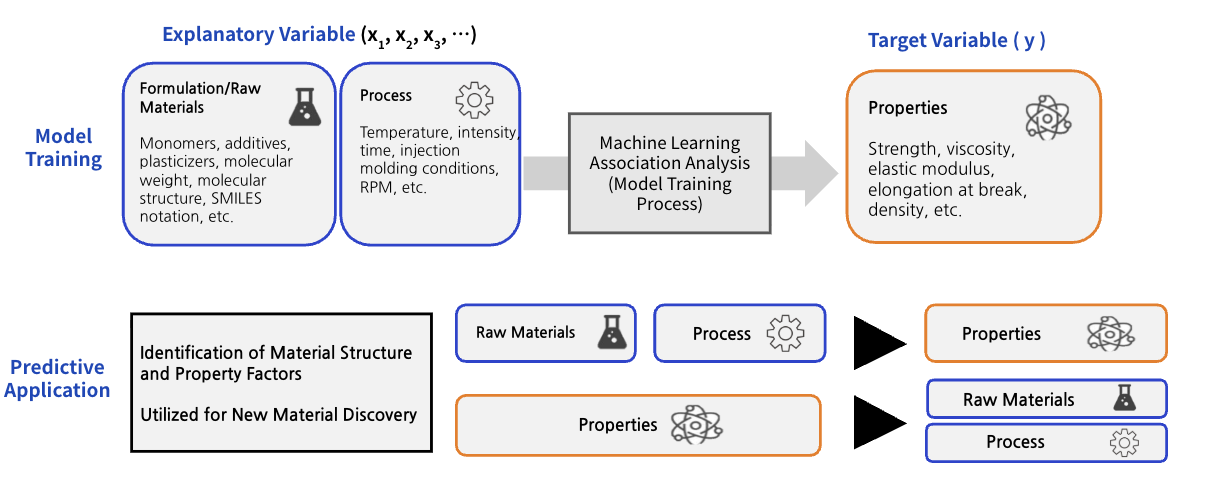
How Materials Informatics Differs from Traditional Materials R&D and DoE
Most materials R&D teams already use some form of structured experimentation, often based on experience, intuition, and classical Design of Experiments (DoE). These approaches still have value, but they struggle as systems become more complex.
Where Traditional Approaches Fall Short
- Trial-and-error doesn’t scale: As the number of ingredients or process variables increases, the number of possible combinations quickly becomes unmanageable.
- Classical DoE works best in low dimensions: Many DoE methods assume limited variables and simple interactions.
- Insights are hard to reuse: Knowledge often stays with individuals instead of becoming organizational learning.
What Materials Informatics Does Differently
Materials informatics changes the workflow rather than just improving the math:
- It can handle many variables at once, including nonlinear interactions.
- It learns from both successful and failed experiments.
- It helps teams explore the design space strategically rather than exhaustively.
In 2025, the most effective teams don’t treat materials informatics as a replacement for DoE. Instead, they use it to guide where DoE should be applied, combining human expertise, statistics, and AI into a single workflow.
What Data Does Materials Informatics Rely On in 2025?
One of the biggest misconceptions about materials informatics is that it only works if you already have huge, perfectly organized datasets.
In reality, most successful projects start with the data teams already have.
Common Data Used in Materials Informatics
Materials informatics typically works with:
- Formulation and composition data: ingredients, concentrations, ratios
- Process parameters: temperature, time, mixing order, curing conditions
- Characterization data: mechanical, thermal, electrical, rheological properties
- Performance data: application-specific outcomes such as durability or adhesion
- Historical and failed experiments: often overlooked, but extremely valuable
The Real Data Challenge
In 2025, the challenge is not data scarcity but data fragmentation:
- Information scattered across spreadsheets, ELNs, LIMS, and personal files
- Inconsistent naming, units, and test methods
- Missing context around how experiments were actually run
Modern materials informatics platforms are built with this reality in mind. They are designed to work with imperfect data, gradually improving structure and quality as part of normal R&D work rather than demanding a massive cleanup upfront.
How a Materials Informatics Platform Works
A materials informatics platform turns materials informatics from a concept into something teams can actually use.
Instead of offering isolated models or scripts, a platform supports the full experimental loop: from data to decision to learning.
Core Capabilities of a Materials Informatics Platform
- Data ingestion and organizationExperimental data is collected, structured, and made usable for modeling.
- Model building and validationModels learn relationships between formulations, processes, and outcomes.
- Prediction and optimizationThe platform estimates performance across unexplored combinations.
- Experiment recommendationThe system suggests which experiments are most valuable to run next.
- Closed-loop learningNew results feed back into the models, continuously improving them.
Importantly, modern platforms are designed for human-in-the-loop use. Researchers stay in control, which means AI supports decisions rather than replacing scientific judgment.
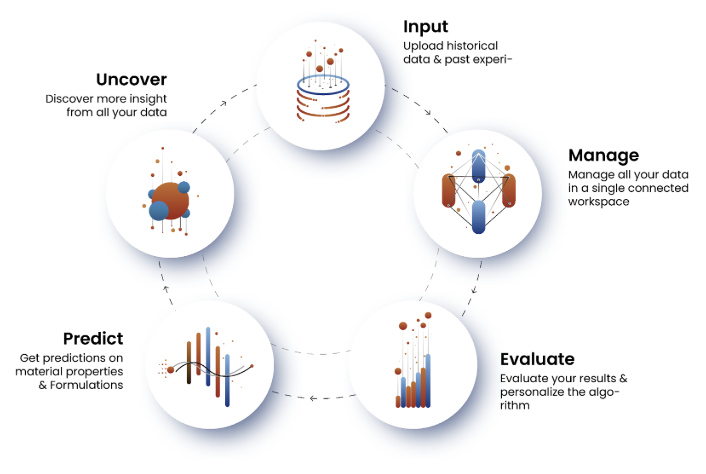
How Materials Informatics Platforms Reduce Experiments and Accelerate R&D
One of the most common questions R&D leaders ask is simple: Does this actually reduce experimental work?
In most cases, the answer is yes—but not by skipping rigor.
Materials informatics platforms reduce experiments by focusing effort where it matters most:
- Identifying variables that truly drive performance
- Avoiding redundant or low-information tests
- Prioritizing experiments that maximize learning
Instead of running large screening campaigns, teams converge faster on promising regions of the design space. The result is not just speed, but better understanding earlier in the project.
Why Explainability Matters in Materials Informatics
As materials informatics moves deeper into industrial R&D, explainability has become critical.
Pure black-box predictions raise understandable concerns:
- Can we trust this result?
- Does it make physical or chemical sense?
- How do we explain this decision to colleagues or management?
Explainable AI helps bridge this gap by showing which variables matter, how they interact, and why performance changes.
In 2025, the most widely adopted materials informatics platforms are those that combine strong predictive power with insights researchers can actually interpret and use.
Common Challenges in Adopting Materials Informatics and How to Overcome Them
The biggest obstacles to adoption are rarely technical.
Common challenges include:
- Resistance to changing established workflows
- Unclear ownership between R&D, IT, and data teams
- Unrealistic expectations of what AI can do immediately
Teams that succeed usually start small, focus on a real problem, involve domain experts early, and measure success in decision quality, not just model accuracy.
What Are the Best Materials Informatics Platforms in 2025?
As materials informatics becomes a core capability in industrial R&D, many teams ask a practical question: what is the best materials informatics platform to choose in 2025?
The answer depends not only on algorithms, but on how well a platform supports real-world materials workflows, that is working with imperfect data, guiding experimental decisions, and building long-term R&D intelligence rather than one-off models.
Below are several leading materials informatics platforms in 2025, starting with a platform purpose: built for formulation-driven materials innovation.
1. Polymerize: A Decision-Driven Materials Informatics Platform
Polymerize is a materials informatics platform designed specifically for complex, formulation-based materials R&D, where experiments are costly, data is sparse, and decisions must be made under uncertainty.
Unlike platforms that focus mainly on prediction accuracy, Polymerize is built around a clear principle:
AI should help materials scientists decide what to do next.
Key Features of Polymerize
- Built for real-world experimental data
- Polymerize works with sparse, noisy, and imperfect historical datasets, which is exactly the kind of data most industrial R&D teams already have.
- AI-driven experiment recommendation
- Instead of only analyzing past results, Polymerize actively recommends the next best experiments to run, balancing exploration and optimization to maximize learning per experiment.
- Explainable AI for researcher trust
- The platform provides interpretable insights that show which formulation components and process parameters drive performance, helping scientists validate and act on AI results.
- Closed-loop learning system
- Experimental results are continuously fed back into the models, allowing knowledge to accumulate and improve over time rather than remaining locked within individual projects.
- Beyond ELN and LIMS
- Polymerize does not replace ELN or LIMS systems. It adds an intelligence layer on top, turning stored experimental data into actionable insights and R&D decisions.
- Enterprise ready deployment
- Supports cloud, hybrid, and on-premise deployment options to meet data security, compliance, and IT requirements.
Benefits for Materials R&D Teams
Teams using Polymerize typically achieve:
- Faster convergence toward target material performance
- Fewer low value or redundant experiments
- Earlier identification of key trade-offs and constraints
- Better alignment between AI insights and domain expertise
- Stronger knowledge retention across teams and projects
For organizations looking to move beyond data management toward AI-guided materials innovation, Polymerize is often adopted as a long-term R&D platform rather than a short term analytics tool.
**Book a demo to see how Polymerize accelerates materials R&D**
2. Citrine Informatics
Citrine Informatics is a well-established materials informatics platform with a strong focus on materials data infrastructure and machine-learning-based prediction. It is commonly used by organizations with relatively structured datasets and a need for scalable model deployment.
3. Uncountable
Uncountable is a materials informatics and R&D data platform focused on helping materials teams organize experimental data and apply machine learning across formulation development workflows.
It is often adopted by organizations looking to centralize formulation data, standardize experimental workflows, and enable model-driven analysis on top of structured R&D datasets. Uncountable is particularly visible in formulation-heavy industries such as chemicals, food, and consumer products.
How to Choose the Right Materials Informatics Platform
When evaluating materials informatics platforms in 2025, teams should consider:
- How messy or limited their existing data is
- Whether explainability is required for internal trust and adoption
- If experiment recommendation is a core requirement
- Deployment, security, and integration constraints
Ultimately, the best materials informatics platform is the one that fits naturally into how scientists already work, while helping them make better, faster decisions.
The Future of Materials Informatics Beyond 2025
Looking ahead, materials informatics is moving beyond prediction toward decision intelligence.
Key trends include:
- Tighter integration with automation and self-driving labs
- Greater emphasis on sustainability and lifecycle performance
- Materials informatics becoming standard R&D infrastructure
Rather than replacing scientists, materials informatics will increasingly act as a thinking partner: helping teams explore faster, learn earlier, and innovate with confidence.
Materials Informatics FAQs
What is materials informatics?
Materials informatics is the use of data, machine learning, and AI to guide materials research and development decisions, helping teams design, optimize, and validate materials more efficiently.
Who should use a materials informatics platform?Any team developing complex materials under time or cost pressure.
How long does it take to see value?Many teams see impact within a few development cycles.
What problems does materials informatics solve in R&D?
It helps reduce trial-and-error experimentation, manage complex formulation spaces, uncover hidden relationships in data, and accelerate decision-making under uncertainty.
What types of companies benefit most from materials informatics?
Organizations developing complex materials—such as chemicals, polymers, composites, coatings, batteries, semiconductors, and advanced materials—benefit the most, especially when R&D cycles are long or costly.
Is materials informatics only useful for large enterprises?
No. While large enterprises were early adopters, modern materials informatics platforms are designed to scale—from small R&D teams to global organizations.
How much data is needed to start using materials informatics?
Many projects start with tens, not thousands, of experiments. Materials informatics is designed to extract value from limited and imperfect datasets.
Can materials informatics work with historical and failed experiments?
Yes. In fact, historical and failed experiments are often some of the most valuable data for materials informatics.
Final Thoughts
Materials informatics is no longer experimental, it’s practical, proven, and increasingly necessary.
In 2025, the question is no longer whether materials informatics works, but how effectively teams can integrate it into the way they already innovate.
For organizations willing to make that shift, materials informatics offers something rare in R&D: not just speed, but clarity, confidence, and better decisions.