

System of Intelligence for Polymer Development: Accelerating Innovation in 2026
In 2026, polymer R&D is entering a new phase. The era of manual iteration is ending. A System of Intelligence (SoI), powered by polymer AI, data-driven learning, and embedded scientific workflows, is redefining how polymers are designed, optimized, and scaled.
System of Intelligence for Polymer Development: Accelerating Innovation in 2026
For decades, polymer innovation has relied on a familiar cycle: formulate, test, fail, adjust, and repeat. While this trial-and-error approach has produced remarkable materials, it is increasingly incompatible with today’s realities, shorter development cycles, rising material complexity, sustainability pressure, and global competition.
In 2026, polymer R&D is entering a new phase. The era of manual iteration is ending. A System of Intelligence (SoI), powered by polymer AI, data-driven learning, and embedded scientific workflows, is redefining how polymers are designed, optimized, and scaled.
This article explores how System of Intelligence for polymer development is transforming R&D, why traditional approaches are no longer sufficient, and how AI-driven polymer software is accelerating innovation across industries.
Index
- What Is a System of Intelligence?
- Current Challenges in Polymer R&D
- Why Trial-and-Error No Longer Works
- How System of Intelligence Transforms Polymer Development
- System of Intelligence Property Prediction Models
- Case Studies: System of Intelligence in Action
- Competitive Landscape: Polymer AI Platforms in 2026
- FAQs
- Conclusion: The Future of Polymer Innovation
1. What Is a System of Intelligence?
A **System of Intelligence (SoI)** represents the next evolution of digital infrastructure in polymer R&D. It goes far beyond data storage, digital record-keeping, or workflow tracking. While traditional polymer software systems focus on capturing what happened, a System of Intelligence focuses on learning from what happened and guiding what should happen next.
In conventional R&D environments, data is often stored in spreadsheets, or standalone databases. As formulation complexity increases, this limitation becomes a critical bottleneck. A System of Intelligence addresses this gap by embedding ****AI directly into the R&D workflow. It continuously analyzes experimental, formulation, processing, and property data to uncover non-linear relationships that are difficult, or impossible, for humans to identify through intuition alone.
In polymer development, a System of Intelligence typically:
- Integrates diverse data types across experiments, formulations, processing conditions, and measured properties into a unified, structured foundation
- Applies domain-specific AI models to learn how formulation and process variables influence polymer performance
- Generates predictive insights, allowing teams to estimate material properties before running physical experiments
- Recommends optimal next experiments, shifting R&D from manual trial-and-error to AI-guided exploration
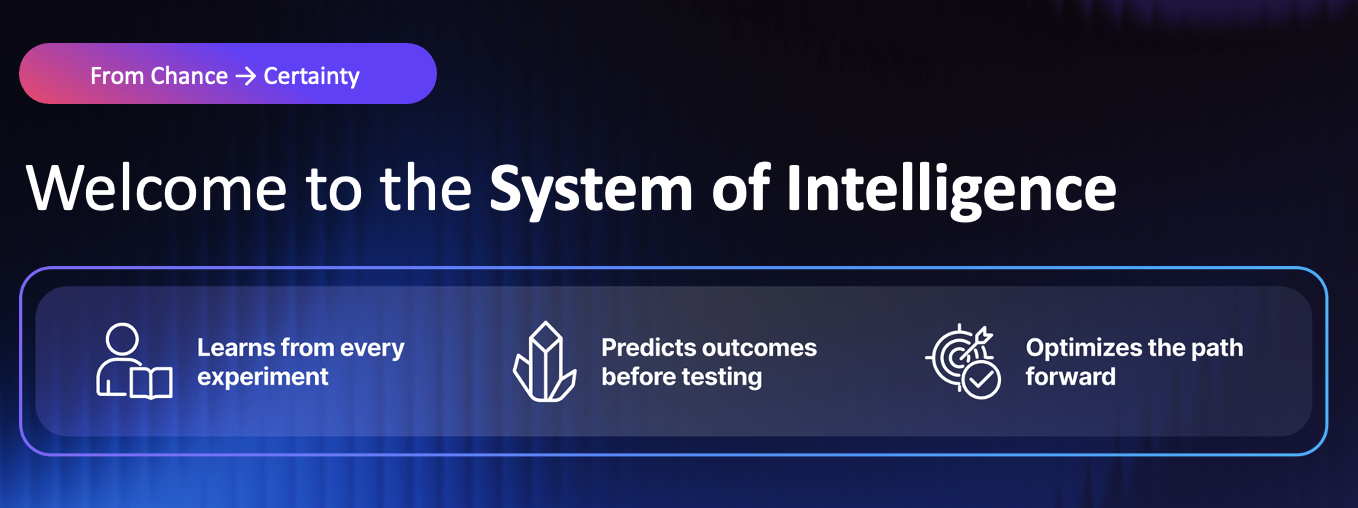
- Continuously improves over time, as every new experiment feeds back into the model and refines future predictions
In essence, a System of Intelligence transforms polymer data from static records into a living, learning system. It turns accumulated experimental results into actionable intelligence, enabling polymer R&D teams to move from reactive experimentation to predictive, design-driven innovation.
2. Current Challenges in Polymer R&D
Despite advances in materials science, polymer R&D teams face structural challenges:
2.1 Fragmented Data
Polymer data is scattered across spreadsheets, ELNs, LIMS, instruments, and individual notebooks. This fragmentation prevents systematic learning and reuse of historical knowledge.
2.2 High Experimental Cost
Formulation spaces are vast. Exploring combinations of resins, additives, fillers, and processing parameters through physical experiments alone is expensive and time-consuming.
2.3 Long Development Cycles
Traditional polymer development often takes years from concept to commercialization, creating a bottleneck for innovation.
2.4 Limited Predictability
Even experienced scientists struggle to predict non-linear relationships between formulation variables and polymer properties such as strength, adhesion, thermal stability, or durability.
2.5 Sustainability Pressure
Regulatory and market demands require faster development of low-carbon, recyclable, and bio-based polymers, often with less historical data available.
3. Why Trial-and-Error No Longer Works
Traditional polymer R&D has long relied on trial-and-error experimentation. The approach is simple in principle: adjust a formulation, run an experiment, observe the result, and iterate. This method implicitly assumes three things:
- Experiments are cheap
- Time is abundant
- Complexity is manageable
In modern polymer development, none of these assumptions are true.
3.1 Experiments Are No Longer Cheap
Each polymer experiment carries significant cost, raw materials, lab equipment usage, analyst time, characterization, and often scale-up trials. As formulations grow more sophisticated, a single experimental cycle can take days or weeks. Repeating this process hundreds of times is not just inefficient; it is economically unsustainable.
3.2 Time Is No Longer Abundant
Market pressure has compressed development timelines across industries, from specialty chemicals to advanced materials and electronics. Customers expect faster innovation cycles, while regulatory requirements continue to expand. Trial-and-error R&D, with its sequential and reactive nature, struggles to meet these expectations. Long development cycles are no longer a tolerable trade-off for incremental improvement.
3.3 Complexity Has Exceeded Human Intuition
Modern polymer formulations involve dozens of interacting variables: resin chemistry, additives, fillers, processing conditions, and environmental factors. These variables rarely act independently. Small changes in one parameter can produce disproportionate or unexpected effects elsewhere.
As formulation complexity increases, the number of possible combinations grows exponentially. Even the most experienced scientists cannot systematically explore this space using intuition alone. Trial-and-error becomes less about informed experimentation and more about guesswork.
3.4 Knowledge Does Not Accumulate Efficiently
Another critical limitation of trial-and-error is that learning remains fragmented. Experimental results are often interpreted locally, within a single project or team, and rarely generalized across programs. Valuable insights stay trapped in individual notebooks or spreadsheets, making it difficult to build institutional knowledge over time.
As a result, teams frequently repeat similar experiments, rediscover the same constraints, and relearn lessons that already exist in the organization.
3.5 The Cost of Failure Has Increased
In today’s R&D environment, failure is no longer a neutral outcome. Failed experiments consume budget, delay timelines, and slow sustainability progress. When development cycles stretch, opportunity cost becomes significant, missed markets, delayed partnerships, and lost competitive advantage.
Trial-and-error does not scale in this context.
3.6 A Paradigm Shift Is Required
These challenges do not mean experimentation is obsolete. Physical experiments remain essential. What has changed is how experiments should be designed and prioritized.
This is where AI for polymer development fundamentally changes the paradigm.
Instead of blindly exploring the formulation space, AI-driven systems learn from existing data, identify patterns across variables, and guide researchers toward the most informative and high-impact experiments. Rather than replacing experimentation, AI reduces unnecessary trials and amplifies scientific insight.
Trial-and-error was sufficient when complexity was low and time was flexible. In 2026, material innovation demands a smarter, more predictive approach, not chance.
4. How System of Intelligence Transforms Polymer Development
A System of Intelligence addresses the limitations of trial-and-error in polymer R&D by introducing a closed-loop R&D model, one that continuously learns, predicts, and guides decision-making across the entire polymer development lifecycle.
4.1 Digitize Data Foundation: From Fragmentation to Coherence
The first transformation begins with data.
In traditional environments, experimental results, formulations, process parameters, and property measurements exist in disconnected systems. This fragmentation prevents systematic learning and forces scientists to rely on memory, intuition, or manual analysis.
A System of Intelligence establishes a unified data foundation by:
- Structuring experimental, formulation, and process data in consistent formats
- Linking inputs (materials, compositions, conditions) directly to outputs (measured properties)
- Preserving context, not just results, so data remains scientifically meaningful
By consolidating data into a single governed foundation, the system ensures that every experiment contributes to cumulative knowledge, rather than remaining an isolated data point. This directly addresses the problem of lost learning and repeated trial-and-error identified in Section 3.
4.2 Deploy AI Prediction Models: Learning What Humans Cannot See
Once data is unified, polymer AI models can be applied to learn relationships between variables and outcomes.
Polymer systems are inherently non-linear. Interactions between ingredients, processing conditions, and environmental factors often produce effects that cannot be predicted through simple correlations or human intuition alone.
System of Intelligence platforms deploy domain-specific AI models that:
- Learn complex, multi-variable relationships from limited experimental data
- Identify key drivers that disproportionately influence performance
- Estimate material properties before physical experiments are conducted
This capability directly tackles the issue of unmanageable complexity. Instead of attempting to explore an exponential formulation space manually, R&D teams gain predictive visibility into how changes are likely to affect performance, before committing time and resources.
4.3 Guide Experimental Decisions: From Guesswork to Precision
Trial-and-error fails not because experiments are wrong, but because too many experiments are low-value.
A System of Intelligence changes how experiments are selected. Rather than relying on intuition or incremental adjustments, the system evaluates the current knowledge state and recommends:
- Formulations with the highest probability of meeting target properties
- Experiments that maximize learning when uncertainty is high
- Trade-off scenarios when multiple objectives must be balanced
This guidance transforms experimentation from reactive testing into purpose-driven exploration. Each experiment is designed to either achieve a goal or significantly improve model understanding. As a result, experimental cost is reduced, timelines are compressed, and failure becomes informative rather than wasteful.
4.4 Continuous Learning: Compounding Intelligence Over Time
In traditional R&D, learning often resets with each new project. Insights remain local, and teams repeatedly encounter the same limitations.
A System of Intelligence eliminates this reset.
Every new experiment feeds back into the system, refining predictions and improving future recommendations. Over time, the platform accumulates institutional knowledge that persists beyond individual projects or team members.
This continuous learning loop ensures that:
- Models improve as more data becomes available
- Past experiments inform future innovation
- R&D capability compounds rather than stagnates
This directly addresses the inefficiency of trial-and-error, where progress is linear at best. With a System of Intelligence, learning becomes cumulative and exponential.
4.5 From Reactive Experimentation to Proactive Design
Taken together, these four layers redefine how polymer development is conducted.
Instead of reacting to experimental outcomes, R&D teams proactively design formulations with a clear understanding of likely performance. Instead of exploring blindly, they navigate formulation space with AI-guided precision.
This is the fundamental shift enabled by a System of Intelligence:
from trial-and-error to predictive, design-driven polymer R&D.
In 2026, this shift is no longer optional, it is the foundation of competitive polymer innovation.

5. System of Intelligence Property Prediction Models
One of the most powerful applications of System of Intelligence is property prediction.
5.1 What Can Be Predicted?
System of Intelligence models can predict:
- Mechanical properties (tensile strength, modulus, elongation)
- Adhesion and bonding performance
- Thermal behavior (Tg, heat resistance)
- Rheological and processing characteristics
- Aging and durability trends
5.2 Why Domain-Specific AI Matters
Generic machine learning tools often fail in polymer science due to small datasets and complex interactions.
System of Intelligence platforms use domain-specific polymer AI, incorporating:
- Scientific constraints
- Materials descriptors
- Expert-in-the-loop validation
This leads to more reliable and interpretable predictions.
5.3 AI-Driven Formulation Optimization
Formulation optimization is where System of Intelligence delivers immediate ROI.
Instead of testing hundreds of formulations, polymer software powered by AI can:
- Identify high-impact variables
- Reduce experimental runs by 70–90%
- Balance multiple objectives (e.g., performance, cost, sustainability)
Multi-objective optimization allows R&D teams to explore trade-offs that are nearly impossible to manage manually.
6. Case Studies: System of Intelligence in Action
6.1 Accelerating Adhesive Development
A materials team applied Polymerize‘s system of intelligence to predict bonding strength and residue behavior. Using fewer than 30 experiments, they achieved performance targets that previously required months of iteration.
6.2 Optimizing Polymer Blends
By combining historical blend data with AI-driven formulation optimization, R&D teams identified optimal compositions with improved toughness and reduced cost.
6.3 Scaling from Lab to Production
System of Intelligence platforms help bridge lab-scale experiments and manufacturing by incorporating process parameters into prediction models.
7. Competitive Landscape: Polymer AI Platforms in 2026
The market for polymer AI and materials innovation software is rapidly evolving. As demand grows for faster development cycles, more accurate predictions, and smarter design workflows, a few distinct categories of platforms have emerged. These differ in purpose, capability, and the level of integration they provide between data, AI, and real-world polymer R&D workflows.
7.1 System of Intelligence Platforms: Closed-Loop R&D
These are purpose-built systems that go beyond prediction, they unify data, apply domain-aware AI models, and actively guide experimental decisions in a closed-loop system. They support iterative learning where each experiment improves both the model and future recommendations.
- Polymerize, A leading example of a System of Intelligence tailored for polymer development, Polymerize integrates experimental and formulation data, uses AI to predict properties and optimize formulations, and delivers actionable insights that reduce needless trials and accelerate innovation.
7.2 General-Purpose Machine Learning Platforms :Flexible but Require Expertise
These tools are centered on data-driven modeling but typically require significant customization, strong data science expertise, and integration work to be effective for polymers specifically.
- Citrine Informatics Platform: A mature AI-driven product development suite that helps companies screen materials (including polymers and composites), integrate structured and unstructured data, and accelerate innovation by reducing experimental cycles and improving sustainability outcomes.
- Nutonian-like Predictive Modeling Tools (e.g., automated pattern-finding and predictive library tools cited broadly in materials AI market reports): These tools offer automated predictive modeling for complex datasets, helping uncover hidden relationships but lacking built-in domain workflows specific to polymers.
7.3 Simulation-Based Platforms: Physics & Computation-Heavy Models
These platforms emphasize physics-based simulation and molecular modeling. They are powerful for deep mechanistic insight but tend to require high computational resources and specialist expertise.
- **Schrödinger Materials Science Suite:**A leading simulation and modeling platform that uses physics-based computational chemistry and molecular simulations to predict polymer properties and design materials at the molecular and atomic scale.
- Materials Studio (BIOVIA): A well-established materials modeling system with tools for molecular simulation, polymer structure prediction, and materials analysis used in advanced research settings.
7.4 Summary of Competitor Types
CategoryRepresentative ExamplesKey CharacteristicSystem of Intelligence (SoI)PolymerizeAI + data + workflow, proactive experiment guidanceGeneral-Purpose ML PlatformsCitrine Informatics, Nutonian-style toolsFlexible AI modeling, often non-specific to polymersSimulation-Based SoftwareSchrödinger, Materials StudioPhysics-driven modeling, computationally intensive
8. FAQs
What is a System of Intelligence in polymer R&D?
A System of Intelligence is a platform that learns from polymer data, predicts properties, and guides experimental decisions using AI.
Is polymer AI replacing scientists?
No. AI augments scientific expertise, allowing researchers to focus on insight, strategy, and innovation.
How much data is needed?
Modern polymer AI platforms are designed to work with small and imperfect datasets, common in R&D environments.
Can System of Intelligence work with existing LIMS or ELN?
Yes. It complements Systems of Record by adding intelligence on top of existing infrastructure.
What types of polymer development use cases benefit most from a System of Intelligence?
System of Intelligence platforms are especially effective in use cases with high formulation complexity and multiple interacting variables, such as adhesives, coatings, polymer blends, composites, and functional materials.
How does a System of Intelligence handle uncertainty in early-stage R&D?
In early-stage polymer development, data is often sparse and noisy. A System of Intelligence is designed to operate under these conditions by quantifying uncertainty, identifying the most informative experiments, and prioritizing learning over brute-force testing. This allows teams to make progress even when historical data is limited.
Is a System of Intelligence suitable for both research and scale-up?
Yes. While initially applied at the research stage, System of Intelligence platforms can incorporate processing and manufacturing parameters over time. This enables teams to extend learning from lab-scale experiments toward pilot and production conditions, improving scalability and reducing downstream risk.
9. Conclusion: The Future of Polymer Innovation
The shift from trial-and-error to System of Intelligence marks a fundamental transformation in polymer development.
In 2026 and beyond, competitive advantage will belong to organizations that:
- Learn faster from fewer experiments
- Use polymer AI to guide decisions
- Embed intelligence directly into R&D workflows
The era of trial-and-error is over.
Welcome to the age of System of Intelligence for polymer development.