

Only 11% of reported preclinical results were reproducible in the Amgen replication work, meaning approximately 89% failed to replicate under the tested conditions. Precedents are important because they give materials teams a documented, comparable starting point instead of forcing every experiment to repeat unknown mistakes.
That result should change how R&D leaders think about historical data. A lab notebook isn't just evidence of what happened once. It can show which variables were controlled, which measurements were trustworthy, where a formulation stopped working, and whether a promising result survived an independent test.
For materials discovery, this distinction affects both scientific quality and commercial risk. Teams that preserve experimental context can use prior work to narrow hypotheses, test causal drivers, and select the next experiment with greater discipline. Teams that store only final recipes and headline results inherit an archive that looks full but offers little dependable guidance.
Table of Contents
The Hidden Cost of Ignoring History
A failed experiment can save the next six, but only if the record captures what caused the outcome. In materials R&D, that means more than a final formulation and a pass or fail label. The useful part is the chain of conditions behind the result: raw-material grade, mixing order, residence time, cure profile, specimen geometry, test setup, environmental exposure, and any deviation the operator had to manage.
The Stanford Encyclopedia of Philosophy's review of scientific reproducibility makes a broader point that matters here. Reproducibility is not just about rerunning a study. It depends on whether later researchers can identify which features of the original work matter for comparison, which assumptions were built into the method, and which differences are large enough to break the inference. That problem shows up in materials work every week. A toughness result without the cure schedule that produced it, or a conductivity result without electrode preparation details, looks reusable until another team tries to build on it.
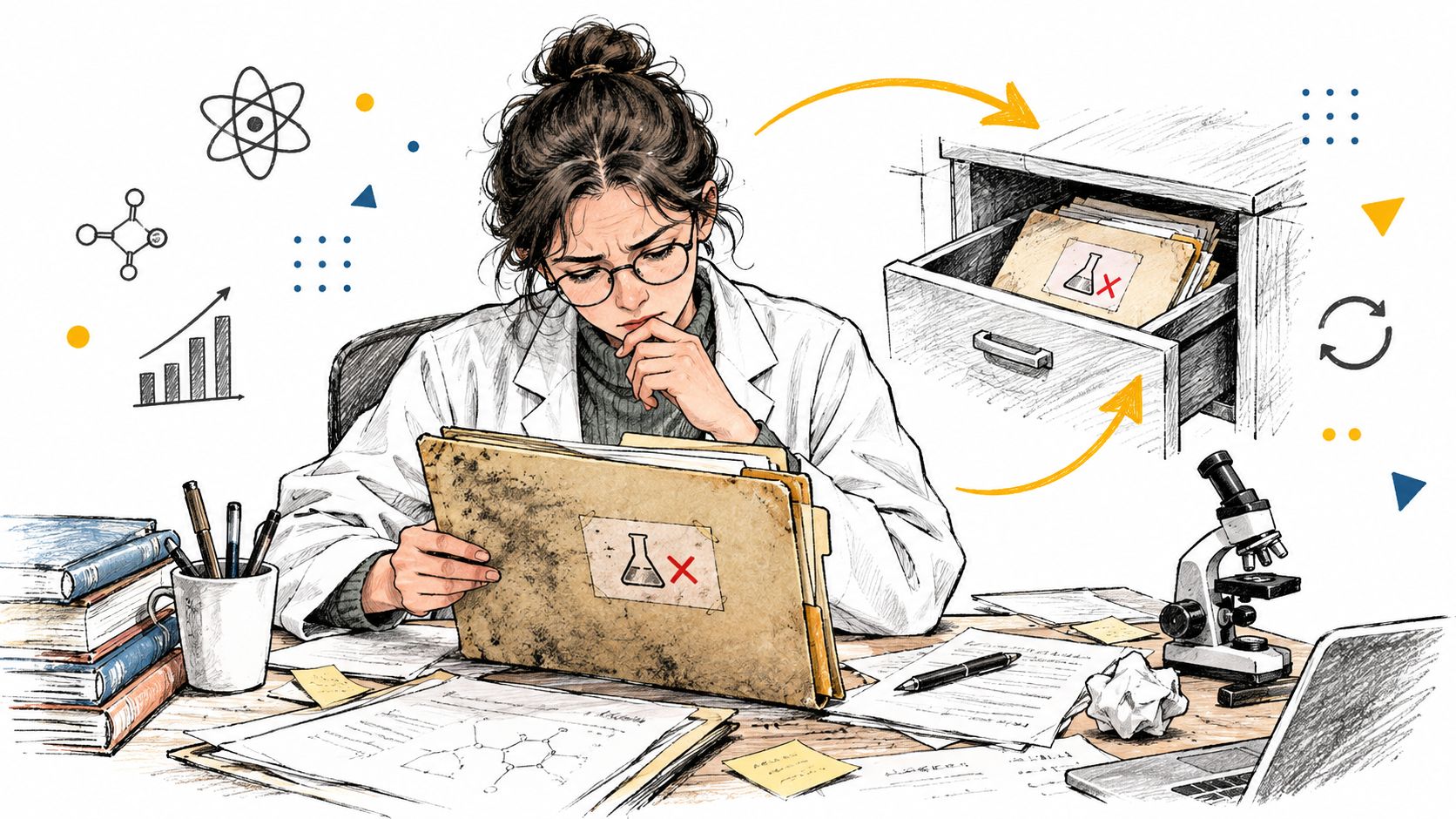
The archive is not the precedent
A stored record becomes a scientific precedent when another scientist can judge whether the old case is genuinely comparable to the new one. That is a higher bar than archiving results. A spreadsheet row saying “formulation passed” does not support a causal conclusion, and it does not help an AI system rank the next experiment well. The team needs the material identity, process history, metrology, protocol, boundary conditions, and uncertainty around the measurement.
Organizations lose years of work here. They retain outcomes but strip away the context that explains them. A recipe may look transferable even though the observed performance depended on a supplier lot, a calibration state, a narrow processing window, or a specimen-preparation choice that no one documented.
Practical rule: Treat every precedent as an evidence trail, not a result label.
Negative results matter just as much. A failed catalyst screen can define a mechanistic boundary. A disappointing scale-up can reveal a transport limit rather than a chemistry problem. A changed test method can explain why two data sets conflict. If those details are missing, the team does not just lose history. It loses the ability to separate correlation from cause, and it trains future decisions on records that look complete but are scientifically thin.
What Are Precedents in Scientific Discovery
In law, precedent provides a prior decision that guides later decisions. The U.S. Supreme Court's practice of stare decisis, following prior decisions unless there is strong justification to depart, illustrates the principle. Historical analysis summarized by the Legal Information Institute's overview of stare decisis found that from 1789 through 2020, the Court overturned its own precedent 145 times out of 25,544 opinions and judgments issued after oral arguments, or roughly 0.57%. Explicit reversals are exceptional, although the doctrine still allows correction when an earlier rule becomes unworkable, inconsistent, or plainly unjust.
Scientific precedent works differently, but the underlying discipline is similar. It provides a structured prior, meaning a bounded set of historical evidence that helps a team decide which outcomes are plausible before it commits to new work.
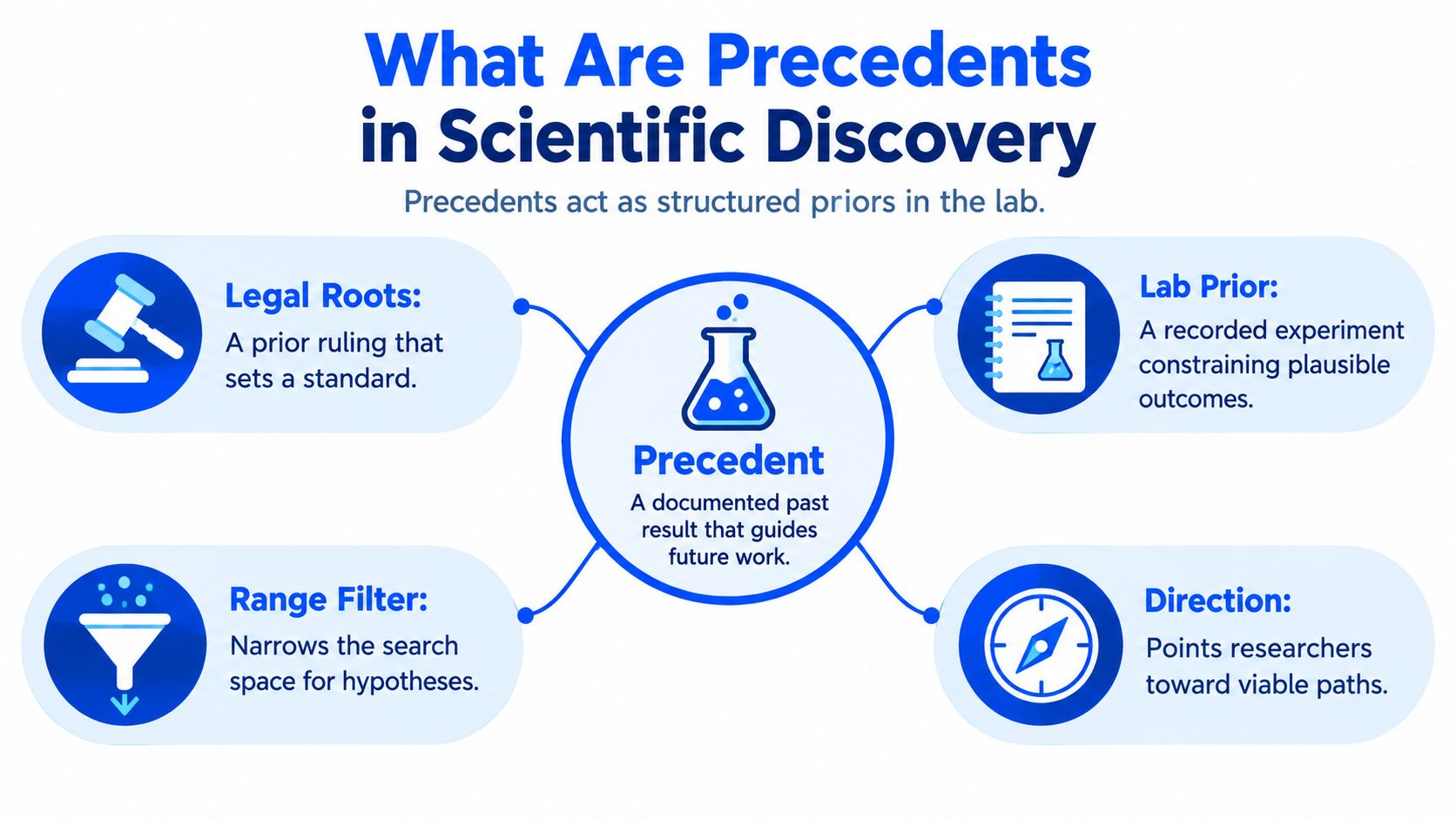
Four elements make a precedent useful
A practical precedent record should answer four questions:
- What happened? Capture the measured properties, pass or fail criteria, raw observations, and final interpretation.
- How did it happen? Preserve composition, processing sequence, equipment, protocol, batch identity, and environmental conditions.
- Where does it apply? Record the tested range, known boundary conditions, uncertainty, and scale limitations.
- Why should the next team trust it? Show whether the result was repeated, independently verified, compared with a baseline, or contradicted by later work.
This is why a precedent isn't just an old formulation. It can be a validated test method, a known failure mode, a successful processing window, or a scale-up limitation. The useful unit is the case with context.
That context reduces duplicated analysis. Instead of reopening every question from first principles, a scientist can identify the closest historical case, compare the differences, and decide whether the next experiment should confirm, refine, or reject the earlier conclusion.
A precedent also makes disagreement productive. If two experiments conflict, the team can examine changes in materials, process, measurement, or analysis rather than choosing the result that fits its preferred narrative. Historical evidence becomes a comparison framework, not an authority that ends discussion.
How Precedents Enable Causal Inference
A material that tests better after a process change has not yet explained itself. In polymer R&D, the observed gain may track the process step you changed, or it may come from a different additive lot, a shift in cure time, specimen geometry, operator handling, or a test method change. Association is easy to record. Causation is harder.
Precedents matter here for a specific reason. They let a team ask a narrower scientific question. If the closest earlier case used the same composition, batch source, specimen preparation, and measurement protocol, while the cure profile changed, then the process variable becomes a plausible causal candidate rather than one item in a long list of possibilities.
That is a better starting point, not a finished answer.
In practice, I treat a precedent as a comparison frame for intervention. Legal precedent aims for consistency across judgments. Scientific precedent serves a different job. It helps define what stayed fixed, what moved, and which difference is worth testing next. Without that frame, teams often discuss “the result” as if one data point can carry a mechanism. It cannot.
A common failure mode is easy to recognize. A formulation once met a target property inside a known processing window. A new trial changes several ingredients at once and reports an improvement. The result may still matter commercially, but it says little about cause because the intervention was bundled. No one can tell which change produced the effect, whether two changes interacted, or whether the gain would survive replication under the earlier protocol.
A useful workflow breaks that bundle apart:
- Find the closest comparable historical case.
- Make every difference explicit, in formulation, process, sample preparation, and test conditions.
- Judge which differences are most likely to shift the measured property, and which ones introduce uncertainty.
- Run the next experiment so one informative variable changes while the rest stay controlled.
- Record whether the new result supports, sharpens, or rejects the earlier explanation.
This is why fixed comparison protocols matter so much. Inter-laboratory round-robin work in polymer testing shows the same principle. A claimed improvement has meaning only when the comparison protocol is fixed and another lab can examine the same contrast on the same terms.
A precedent doesn't prove a mechanism. It makes the next mechanism test more disciplined.
That distinction becomes even more important in AI-guided experimentation. Models learn patterns from prior cases, but causal use depends on how those cases were framed. If historical records mix incompatible protocols or omit variables that changed the outcome, the model may rank a correlation highly and still point the lab toward the wrong experiment. Precedents reduce that risk by preserving the controlled comparisons that turn historical results into testable causal hypotheses.
Powering AI-Guided Next Best Experiments
AI-guided experiment planning only works when past experiments preserve the conditions that make comparison meaningful. In materials R&D, that matters for causal inference, not just record-keeping. A model can rank candidate formulations, but if the historical cases mix different prep routes, test methods, or missing process variables, the recommendation may reflect correlation rather than mechanism.
That is the key difference between legal precedent and scientific precedent. In law, a prior case helps interpret the present one. In the lab, a prior experiment helps decide which next change is most informative under controlled conditions.
A good workflow uses precedents as constrained evidence. The model retrieves related experiments, checks composition and process similarity, estimates plausible property ranges, and exposes uncertainty. The scientist still has to ask the harder questions. Are these runs comparable enough to support transfer? Did the earlier result depend on a hidden processing effect? Is the highest predicted outcome less useful than the experiment that would separate two competing explanations?
What matters most is the quality of the precedent behind the recommendation:
- Comparable inputs: chemical identity, grade, concentration, formulation ratios, and relevant material attributes.
- Process detail: mixing order, temperature, residence time, curing, drying, and scale.
- Measurement traceability: instrument, test protocol, units, specimen preparation, and raw values.
- Outcome context: successful and failed trials, acceptance criteria, uncertainty, and later verification.
- Human interpretation: the reason a team accepted, rejected, or qualified the result.
Explainability matters because scientists need to inspect the cases behind a prediction, not just the score. If the suggested next experiment depends on weak analogies, a visible chain back to the historical examples gives the team a chance to reject it before spending material, tool time, and effort.
Platforms such as Polymerize implement this by linking recommendations to prior experimental cases, but the operating principle is broader than any one tool. AI should narrow the search space. Scientists should judge comparability, mechanism, and risk, then choose the next experiment that teaches the lab something causal, not just something new.
Reducing Risk Through Validated Comparisons
Two R&D teams can have the same volume of historical data and very different decision quality. One team compares experiments through shared protocols, metadata, and traceable baselines. The other searches for a similar formulation, ignores test-method changes, and treats the nearest numerical result as proof that the new material should work.
The first team has a validated comparison. The second has an analogy that may be misleading.
What a defensible comparison includes
The JARVIS-Leaderboard study shows why materials-design methods need systematic and reproducible comparison. A reference distribution built from standardized cases can reveal whether an apparent improvement reflects a genuine material change or merely a different test condition.
Before using a precedent, check:
| Comparison area | Question to ask |
|---|---|
| Material identity | Are the ingredients, grades, and batch characteristics comparable? |
| Process history | Did the formulation experience the same sequence, temperatures, times, and scale? |
| Measurement method | Are the instrument, protocol, units, and specimen preparation aligned? |
| Data quality | Are raw values, uncertainty, failed trials, and exclusions available? |
| Transferability | Has the result worked beyond the original laboratory or setup? |
A successful precedent-based team doesn't merely find a higher-performing historical sample. It determines whether the sample is comparable enough to support a decision. That takes more effort at the start, but it protects the team from false confidence later.
The alternative is attractive because it feels fast. Researchers can pull a promising result from an old report, reproduce the headline formulation, and move directly to scale-up. If the original result depended on undocumented environmental conditions or a changed test method, the team may discover the problem only after committing more material, equipment time, and process development effort.
The operational benchmark isn't “find a similar formulation.” It's “find a comparable, traceable experiment that supports a defensible prediction.”
A repository should therefore make weak evidence visible. Missing metadata, contradictory outcomes, and unverified measurements shouldn't disappear from search results. They should lower confidence and prompt a validation experiment.
Avoiding the Innovation Trap
Teams that rely heavily on precedent often get a narrower search space than they realize. In materials R&D, that matters because historical success is not the same as causal understanding. An AI system trained on past wins will usually rank well-documented chemistries, process windows, and test setups above thinly sampled alternatives. That is useful for reducing wasted runs, but it can also bias the program toward what has already been tried enough times to look safe.
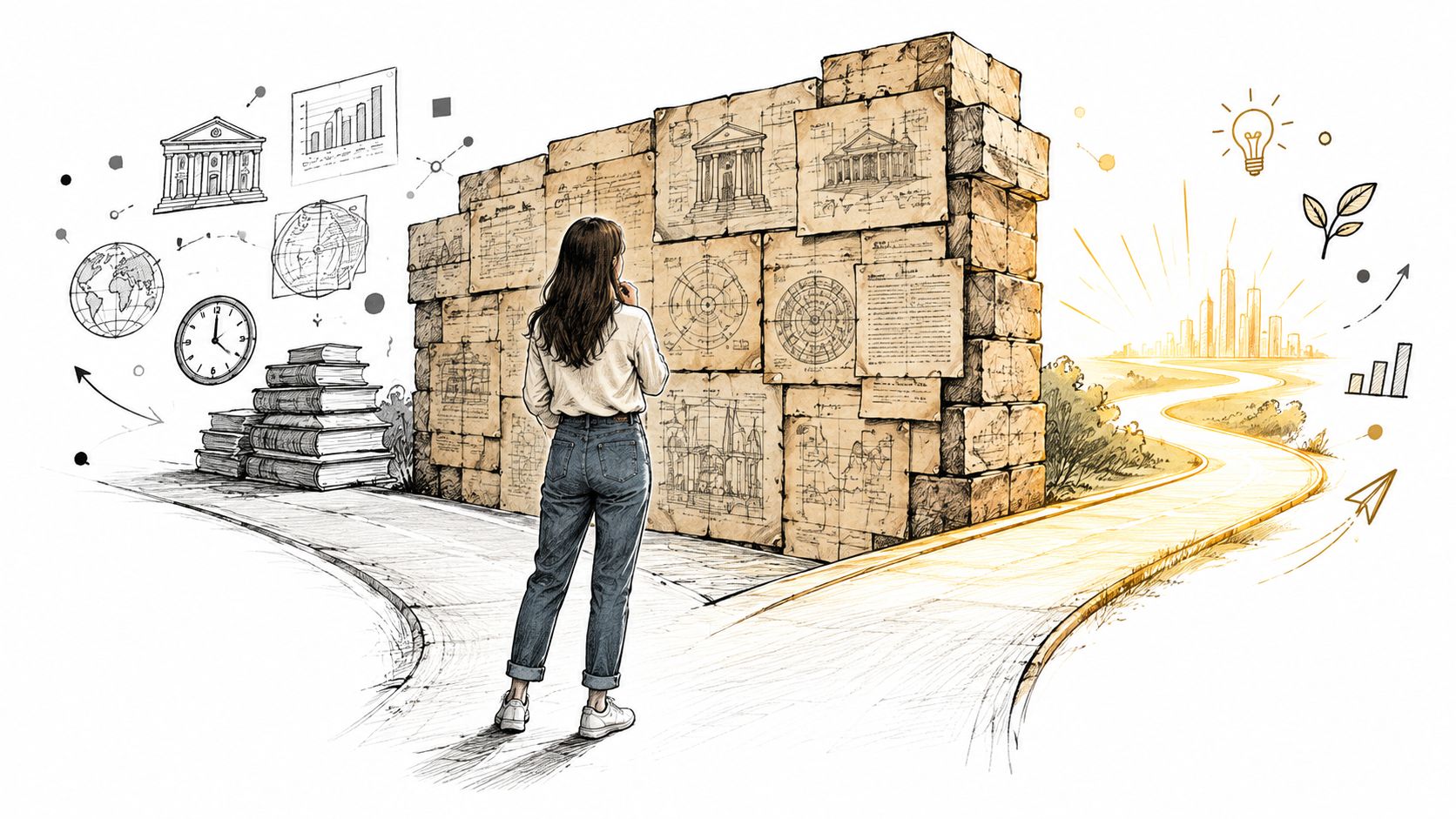
The practical answer is portfolio design, not blind trust in either history or novelty.
In my experience, the strongest teams assign experiments to distinct jobs. Some confirm a high-confidence precedent under the exact operating conditions that matter. Some refine a known system by changing one controlled factor to test mechanism, not just performance. Some explore sparse regions of composition or process space where the model has weak support. Some challenge a trusted precedent directly, because a rule that never gets stress-tested turns into dogma.
That mix matters for causal inference. If every recommended run sits close to the historical center of the dataset, the team gets more local optimization and less insight into what drives the property of interest. Deliberate departures from precedent create the contrast needed to separate correlation from cause, especially when AI-guided experiment selection is steering the queue.
Legal reasoning offers a limited but useful comparison. George Mason University's analysis of precedent explains how systems that require justification for departing from precedent tend to change incrementally. In scientific work, the lesson is operational. Record why a recommendation follows history, why it departs, and what result would change the next decision.
Otherwise, a workflow built to reduce uncertainty can inadvertently suppress discovery.
Building a Precedent-First Culture
A precedent-first culture gives historical evidence a defined job in experimental design, review, and scale-up. Scientists record enough context for another team to compare results, reuse validated cases to frame hypotheses, and keep explicit room for experiments that test beyond the current record. In materials R&D, that discipline matters because precedent is not only archive value. It is the basis for causal comparison and for judging whether an AI recommendation is grounded or speculative.
Start with the evidence trail
The first upgrade is usually data hygiene, not a new model. Set a shared minimum record for any experiment that should remain reusable: formulation identity, process conditions, test method, batch information, raw measurements, uncertainty, and the reasoning behind the outcome call.
Provenance has to stay visible. A researcher should be able to see who generated a result, what transformations were applied, which variables were held constant, and whether later work confirmed or contradicted the finding. Without that chain, teams cannot tell whether two runs are true precedents or only surface-level matches.
In practice, that is where many programs lose scientific value. Results exist, but the metadata needed for comparison does not. That makes it harder to separate causal signals from procedural noise, especially when multiple labs, instruments, or operators are involved.
Put precedent into the workflow
Use a short review before a proposed experiment enters the queue:
- Find the nearest case. Search by material, property, process, and test method, not only by formulation name.
- Compare the differences. List changes in composition, equipment, scale, environment, and measurement.
- Classify confidence. Distinguish validated precedents from weak analogies and incomplete records.
- State the purpose. Label the run as confirmation, refinement, exploration, or challenge.
- Capture the decision. Record why the team chose it and what result would change the next choice.
This makes AI-guided experimentation more auditable. Scientists can inspect whether a recommendation follows a well-supported precedent, extends a mechanism under controlled variation, or jumps into sparse territory where confidence should be lower. Teams that want to boost AI adoption with learning should tie tool use to visible scientific reasoning inside the lab workflow, not treat adoption as a software exercise separate from experimental judgment.
Measure learning, not only output
A useful R&D review asks more than how many experiments were completed. It asks whether the team reduced uncertainty, isolated a likely causal driver, ruled out a failed path, improved transferability, or strengthened a precedent that later work can trust.
That changes how failed experiments are valued. A failed trial with complete context can contribute more than an undocumented success because it defines where a mechanism, material, or process window does not hold. Over time, the organization learns cumulatively instead of relying on personal memory and informal handoffs.
Precedents matter for a practical reason. They make decisions more predictable, comparisons more causal, AI recommendations more auditable, and innovation more intentional. They do not replace expert judgment or dictate every next move. They give experts a defensible starting point, a record of what has already been learned, and a clearer basis for deciding when the next experiment should confirm the past or depart from it.
Polymerize helps materials teams centralize experiments, formulations, test results, and historical precedents so scientists can evaluate comparable evidence before selecting the next experiment.
Put your R&D data to work
See how materials teams use Polymerize to plan fewer experiments and reach target properties faster.