
Your team already has the same conversation every quarter. The lab generated promising results, but the dataset is still too small, too noisy, and too fragmented to support a reliable model from scratch. One polymer family has decent historical data. Another has barely enough repeat measurements to trust. A third sits across spreadsheets, instrument exports, and ELN notes that no model can use cleanly without weeks of prep.
That's where transfer learning becomes practical, not academic. If you're asking what is transfer learning, the short answer is simple: it lets a model reuse knowledge learned on one problem to perform better on a related one. In materials and chemical R&D, that matters because waiting for massive labeled datasets usually means waiting forever. The better route is to start from existing knowledge, then adapt it carefully to your formulation, property, or process question.
Table of Contents
- Reaction prediction from small chemistry datasets
- Property prediction across related formulation programs
- Visual inspection for defects and morphology
Why Transfer Learning Is a Game-Changer for Materials R&D
Materials R&D rarely fails because scientists lack ideas. It stalls because experiments are expensive, cycle times are long, and labeled data arrives slowly. A team may have years of formulation history, but only a narrow slice is consistent enough for supervised learning. Training a deep model from scratch under those conditions usually turns into an exercise in overfitting and disappointment.
Transfer learning changes that starting point. Instead of building a model with no prior knowledge, you adapt a model that already learned useful patterns elsewhere. As Built In's overview of transfer learning notes, this approach addresses the bottleneck of data scarcity in deep learning by reusing a pre-trained model on a new problem, allowing organizations to train deep neural networks with comparatively little data while reducing computational cost and iteration burden.
For a CTO or lead scientist, the strategic implication is straightforward. You don't need millions of new measurements before AI becomes useful. You need a related source of knowledge and a disciplined transfer strategy.
Where the value shows up first
In materials programs, transfer learning is most valuable when the target dataset is hard to expand quickly. Common examples include:
- New polymer grades: You may have broad data on historical resin families, but only a small dataset for a new variant under development.
- Cross-formulation work: Adhesives, coatings, elastomers, and composites often share useful structure-property patterns even when the exact formulation space changes.
- Sparse characterization tasks: Mechanical, thermal, barrier, and rheological properties are expensive to measure consistently, so every prior dataset matters.
Practical rule: If collecting more target data requires weeks of synthesis, aging, characterization, or scale-up, you should at least evaluate transfer learning before approving a from-scratch model.
Why this matters operationally
The usual alternative is trial-and-error with light statistical support. That still works, but it doesn't scale. Transfer learning lets teams use public datasets, prior internal programs, legacy experiments, and neighboring problem domains as a head start.
That head start is often the difference between a model that is useful in the lab and one that never leaves a notebook. In materials development, speed matters, but so does using scarce experimental data intelligently. Transfer learning does both when the source problem is chosen well.
Understanding the Core Concepts of Transfer Learning
Transfer learning is the reuse of learned patterns from one modeling problem to improve performance on another. In materials and chemical R&D, that usually means starting with representations learned from a broader source dataset, then adapting them to a smaller, noisier target dataset that would struggle to support a high-quality model on its own.

What matters is not the model artifact by itself. What matters is the structure it has already learned. A model trained on molecular strings, formulation records, spectroscopy data, or microscopy images can carry forward information about relationships, patterns, and invariances that still help on a related downstream task.
The USC CAIS++ explanation of Pan et al.’s framework defines transfer learning as using knowledge from a source domain and task to improve learning in a different target domain or task. That definition is useful because it separates two questions teams often blur together. What knowledge was learned, and how similar is the new problem to the original one?
That second question is where many materials teams get into trouble. If the source and target problems are close enough, transfer learning can reduce data requirements and stabilize training. If they are mismatched, you can get negative transfer, where the reused model biases learning in the wrong direction and performs worse than a simpler baseline trained only on the target data.
If you want a broader applied overview before going deeper, this guide can help you understand transfer learning for AI development in practical product and engineering terms.
A quick visual explanation helps when aligning technical and non-technical stakeholders:
The terms that actually matter
Typically, only four terms are needed to discuss transfer learning clearly:
- Source domain: the original data environment where the model learned useful structure, such as a large corpus of chemical text, historical formulation data, or broad microscopy datasets.
- Target domain: the new problem you need to solve, such as predicting modulus for a new polymer platform or classifying defects from one production line.
- Pre-trained model: a model that has already been fit on the source domain and carries reusable representations.
- Fine-tuning: updating part or all of that pre-trained model so it fits the target task and target data distribution.
A practical way to evaluate these terms is to ask where the reusable signal probably lives. In chemistry language models, it may be in learned representations of molecular syntax or reaction context. In materials property models, it may be in broad structure-property relationships. In imaging models, it may be in texture, morphology, or defect geometry.
The goal is to reuse the parts that generalize and retrain the parts that are too specific to the original problem.
For scientific teams, this distinction has direct operational value. A model pre-trained on broad chemical data may help with a reaction screening task. A model trained on one polymer family may partially transfer to a neighboring formulation space. Neither result should be assumed. Similarity has to be tested, and transfer has to be benchmarked against a from-scratch baseline, because in small experimental datasets, a weak transfer choice can waste time while giving the team false confidence.
How Transfer Learning Actually Works
Transfer learning works by reusing representations that were expensive to learn and selectively adapting them to a new scientific problem. In practice, that means a model trained on broad chemical, structural, or imaging data already contains patterns your lab would struggle to learn from a few hundred measurements.

Models transfer in parts
Neural networks do not store knowledge uniformly. Earlier layers tend to capture broad structure. Later layers are usually more tied to the original task.
That split is what makes transfer possible.
For materials R&D, the reusable signal depends on the data type. In microscopy, lower-level representations may capture edges, particle boundaries, porosity, texture, or defect morphology. In molecular and polymer models, they may encode substructures, sequence patterns, or relationships between composition and measured behavior. In spectroscopy, they may capture peak shapes and local correlations before the model learns the specifics of a given instrument or assay.
This is also why transfer learning can fail. If the source model learned patterns that do not carry over to the target problem, the transferred features can bias the model in the wrong direction. In small, noisy experimental datasets, that kind of negative transfer is easy to miss because the model may still look good on a limited validation split.
What teams change during transfer
There are three common ways to adapt a pre-trained model.
Feature reuse
Freeze most of the model and train a new prediction head on top of it. This is usually the right starting point when target data is scarce, labels are expensive, and the source problem is reasonably close to the new one.
It is also the cheapest option computationally. You keep the general representations and only learn the task-specific mapping your lab needs.
Partial fine-tuning
Unfreeze the upper portion of the model and let those layers adapt to the target dataset. This gives the model more flexibility, which can improve performance when the target task differs in meaningful ways from the source task.
The trade-off is risk. With limited experimental data, unfreezing too much of the network can erase useful prior structure or fit noise from inconsistent assays, batch effects, or narrow formulation ranges.
Domain adaptation
Keep the task similar but adjust for a shift in how the data was generated. This comes up often in industrial science. A model trained on one lab's microscopy pipeline, one supplier's raw materials, or one instrument calibration may degrade quickly in a new environment even if the label definition stays the same.
In those cases, the problem is not only learning the property or class label. The problem is correcting for differences in sample preparation, equipment, preprocessing, and measurement context.
A practical rule works well here.
- Feature reuse fits the lowest-data setting.
- Partial fine-tuning fits related tasks with enough target labels to support adaptation.
- Domain adaptation fits cross-lab, cross-instrument, or cross-process deployment where distribution shift is the main obstacle.
I usually recommend starting with the smallest change that could plausibly work, then expanding only if the baseline transfer setup underperforms a from-scratch model. That keeps compute costs down, reduces overfitting risk, and makes negative transfer easier to detect before a team builds confidence in the wrong model.
Exploring Transfer Learning Techniques
A materials team usually faces a practical choice, not a theoretical one. You have a model that learned something useful elsewhere, a small target dataset, and a deadline tied to experiments, scale-up, or formulation decisions. The question is which transfer setup fits the data you have.
For a practitioner, the choice boils down to this:
| Technique | Source Data | Target Data | Common Use Case in R&D |
|---|---|---|---|
| Inductive transfer learning | Source data with learned task knowledge | Labeled target data | Predicting a new material property from a small internal dataset |
| Transductive transfer learning | Labeled source data | Mostly unlabeled target data | Adapting a model across labs, instruments, suppliers, or process conditions |
| Unsupervised transfer learning | Unlabeled or self-structured source data | Unlabeled target data | Learning useful representations before clustering, anomaly detection, or exploratory screening |
Inductive transfer learning fits the common case where a team has at least some labeled target data but not enough to train a strong model from scratch. In materials work, that often means transferring a representation learned from one property prediction problem into another related one, such as moving from viscosity to stability or from one polymer family to an adjacent formulation space. It can work well, but only if the source task learned chemistry or structure signals that still matter in the target setting.
Transductive transfer learning fits deployment problems. The task stays the same, but the data distribution changes because the target samples come from a different lab, instrument, supplier, synthesis route, or preprocessing pipeline. This is common in spectroscopy, microscopy, and process-monitoring models. A model can look strong in development and then degrade fast when the operating context shifts.
Unsupervised transfer learning is often the best option when labels are scarce, inconsistent, or too expensive to generate at scale. Teams use it to pretrain useful representations from unlabeled spectra, images, formulations, simulation outputs, or reaction records, then apply those learned features to ranking, anomaly detection, similarity search, or a later supervised model. In practice, this is often the only realistic path when assay capacity is the bottleneck.
The hard part is not memorizing these categories. It is avoiding negative transfer. A source model trained on data that is only superficially related can inject the wrong inductive bias, which lowers accuracy and gives teams false confidence because the transferred model still looks statistically polished.
That risk is one reason materials transfer learning still lacks standardized practice. A 2024 analysis of 120 materials science ML papers found that only 12% explicitly discussed transfer learning protocols designed for chemical structure-property relationships, and none provided reproducible pipelines for handling heterogeneous source populations such as data from different labs or synthesis methods.
For R&D leaders, that gap has a direct cost. The challenge is usually not whether transfer learning can improve a benchmark. The challenge is choosing a transfer setup that matches the label regime, the source-target similarity, and the messiness of real experimental data.
Transfer Learning in Action Real-World Materials Science Examples
A formulation team has six years of data for one resin system, a few dozen validated measurements for a new adjacent program, and pressure to decide what to synthesize next quarter. Training from scratch usually produces a model that looks unstable, overfits fast, and adds little to scientist judgment. Transfer learning changes that starting point. It lets teams begin with representations learned from related chemistry, processing, images, or text, then adapt them to the narrower problem that matters now.

Reaction prediction from small chemistry datasets
One useful reference point comes from chemistry language modeling. DataCamp's transfer learning guide describes a case where fine-tuning a pre-trained transformer on a domain-specific chemistry text corpus with only 2,000 annotated reaction examples reached 88% prediction accuracy for reaction outcomes, while a model trained from scratch on the same dataset reached 62%.
The practical takeaway is straightforward. If the source model has already learned syntax, context, and recurring chemical patterns from a large corpus, a small supervised dataset can go much further. In R&D terms, that can mean getting a useful reaction-outcome model before a team has the budget or time to label tens of thousands of examples.
It also comes with a boundary condition. A model pre-trained on pharmaceutical reaction text may transfer poorly to inorganic synthesis, electrochemistry, or process-heavy materials workflows unless the underlying chemistry is related.
Property prediction across related formulation programs
This is the use case I see leaders care about most. One program has accumulated years of formulation, process, and test data. Another program is strategically important but early, with sparse labels and inconsistent measurement history. Transfer learning lets the second model inherit signal from the first instead of starting as a statistical blank slate.
The same source also reports that organizations using transfer learning for material science property prediction saw 50% fewer failed experiments within three months. Whether that exact figure holds in a given lab depends on source-target fit, assay noise, and how decisions are made. The direction of benefit is the point. Better starting representations usually improve candidate ranking earlier in the program.
That matters operationally:
- Screening gets tighter: teams send fewer low-probability candidates into expensive assays.
- Prioritization starts earlier: scientists can rank formulations before the target dataset is mature.
- Legacy data becomes usable: old projects contribute signal, even if the new program has limited labels.
Used well, transfer learning does not replace experiments. It improves the odds that the next experiment is worth running.
Visual inspection for defects and morphology
Imaging is another strong fit, especially in labs that rely on microscopy, line inspection, or failure analysis. A pre-trained vision model can contribute general visual features such as edges, textures, and spatial patterns. The lab then fine-tunes the upper layers to classify coating defects, particle morphology, voids, grain structure, or process artifacts with a much smaller labeled image set.
The value here is speed. Senior scientists do not need to label enough images to build an entire model from zero before the system becomes useful.
There is still a real transfer question. Natural-image pretraining can help for some microscopy tasks, but not all. SEM, optical microscopy, hyperspectral imaging, and inline manufacturing images have very different feature distributions. If the source images are too far from the target modality, teams can end up with weak features or misleading confidence scores. In practice, the best results often come from pretraining on adjacent technical images, not generic image corpora.
Across these examples, the pattern is consistent. Transfer learning earns its place when it reduces time to a usable model, cuts waste in experimental selection, and makes prior R&D data productive again. In materials and chemical work, those gains matter because data is expensive, labels are noisy, and every bad experiment carries a real cost.
Common Pitfalls and Best Practices for Success
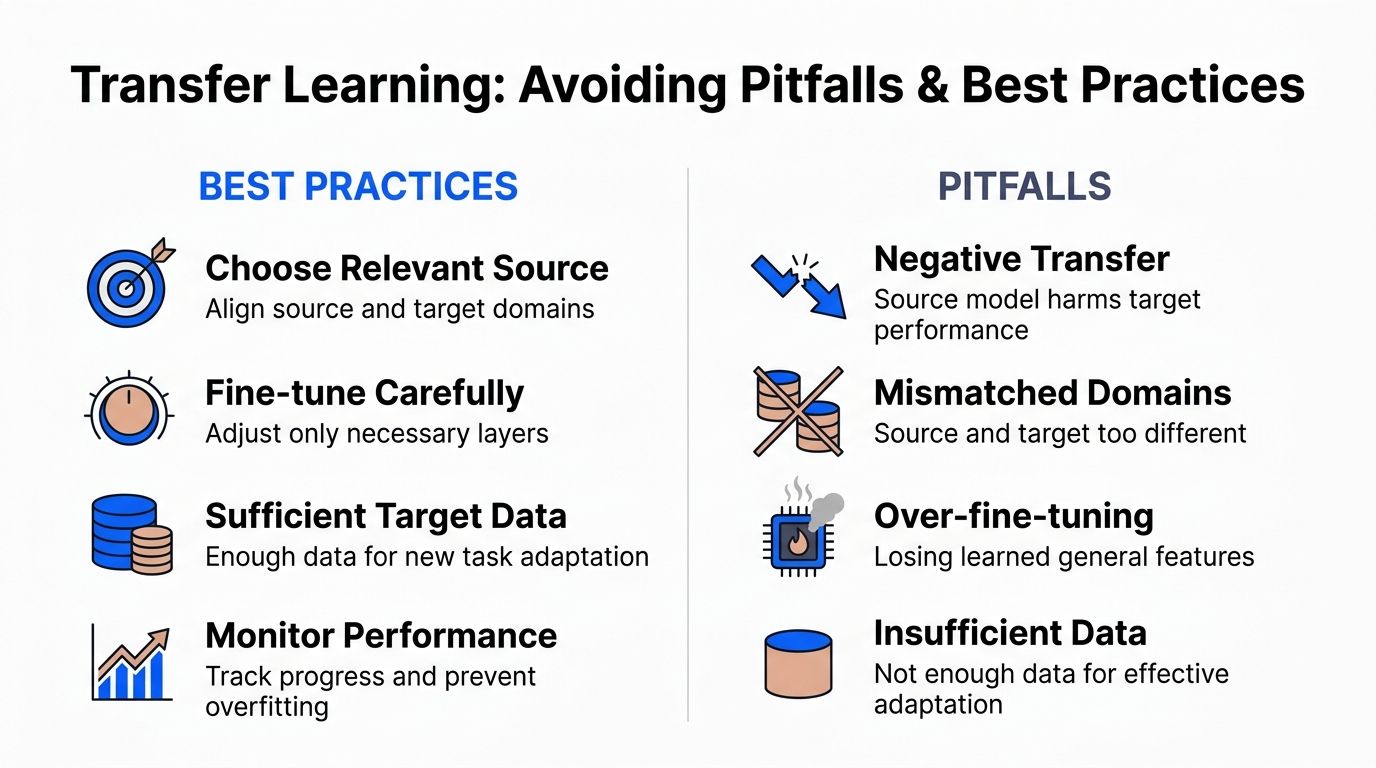
Transfer learning is powerful, but teams get into trouble when they treat it like a universal shortcut. The failure mode that matters most in materials R&D is negative transfer. That's when the source model doesn't help. It actively makes the target model worse.
Where transfer learning breaks
This risk is not hypothetical. A study on high-dimensional regression with scarce target data found that standard transfer methods can degrade performance by up to 40% when the angle between source and target model parameters exceeds a threshold, as described in this PMC discussion of negative transfer risk. In materials R&D, where datasets are often small and noisy, that's a serious warning.
The practical translation is simple. If your source and target problems are too dissimilar, transfer can import the wrong bias. A model trained on one chemistry family, one processing regime, or one lab's measurement behavior may mislead you in another.
Other common failures are less dramatic but just as costly:
- Over-fine-tuning: Teams unfreeze too much of the model and let a small dataset overwrite useful general knowledge.
- Weak source selection: The pre-trained model is “large” or “popular” but not meaningfully related to the target problem.
- Messy target labels: Replicate disagreement, protocol drift, and untracked preprocessing noise get blamed on the model when the underlying issue is data quality.
- No transfer diagnostics: Teams compare final metrics only after training, instead of testing whether the transferred representation is helping early in the workflow.
Key caution: In materials AI, a related source domain beats a prestigious source domain.
What careful teams do differently
Teams that succeed with transfer learning usually follow a more conservative process.
- Assess scientific similarity first: Ask whether the source and target share mechanisms, representations, or measurement logic. Similar file formats don't count.
- Begin with freezing, not full retraining: Start by reusing more of the source model. Unfreeze only when validation results justify it.
- Use strong validation splits: Hold out target data by chemistry family, process window, supplier class, or time period when possible. Random splits can hide transfer failure.
- Inspect model behavior, not just score: Check whether the model's drivers make scientific sense. A slightly lower but more stable model is often the safer one.
- Treat cross-lab transfer as a domain-shift problem: Don't assume one lab's “same test” is equivalent to another's.
The best practice that gets ignored most often is restraint. Teams should earn confidence in transfer layer by layer, dataset by dataset, and use case by use case.
A Practical Guide to Adopting Transfer Learning in Your Lab
Most labs don't need a grand AI program to begin. They need one use case where transfer learning has a real chance to outperform spreadsheets, heuristics, and from-scratch modeling.
A workable adoption path
Start with the data you already trust most, not the data you have most of. A small, well-curated historical dataset from a related program is often a better transfer source than a larger, inconsistent archive.
Then move in this order:
- Define one target decision. Pick a specific prediction or ranking problem, such as candidate selection, formulation screening, or defect classification.
- Identify the nearest source knowledge. That may be a prior internal project, a public model, or a pre-trained chemistry or vision model.
- Run a baseline first. Compare transfer learning against a simple non-transfer baseline so you can see whether transfer is helping.
- Choose a modest transfer strategy. Begin with feature reuse or light fine-tuning before attempting aggressive adaptation.
- Validate on real operational splits. Use holdouts that reflect how the model will be used in the lab.
What to pilot first
The best first pilots usually have three characteristics:
- Clear business cost of failure: Failed experiments, rework, and slow iteration are visible and meaningful.
- Related historical data exists: Even if imperfect, there's enough prior signal to transfer.
- Scientists can judge plausibility: The model's recommendations can be checked against domain intuition and experimental outcomes.
If your organization is still early in AI adoption, it helps to frame transfer learning inside a broader implementation plan. A practical resource for leadership teams is this guide to Develop an AI roadmap, which can help align data readiness, governance, and pilot selection before you scale.
Transfer learning works best when it's treated as part of a scientific operating model, not just a modeling trick. The payoff comes when your lab can reuse prior knowledge systematically, validate carefully, and convert fragmented historical work into a better next experiment.
If your team wants to put transfer learning to work in polymers, chemicals, or advanced materials, Polymerize provides an AI-native system built for that environment. It helps enterprises unify fragmented R&D data, apply domain-specific explainable models, and turn sparse experimental history into faster, more targeted development decisions.
Put your R&D data to work
See how materials teams use Polymerize to plan fewer experiments and reach target properties faster.