



A test method is a documented procedure that specifies how a test is performed so the result can be repeated and compared across people, labs and time.
But if a laboratory gets nearly identical results every time, does that mean its test will help you choose the right material? Not necessarily. Consistent measurements can still answer the wrong question, overlook a production condition, or hide a difference introduced during sample preparation.
For materials R&D teams, the useful question isn't whether a procedure exists. It's whether the whole measurement system supports the decision you're making.
Table of Contents
What a Test Method Is and Why It Matters
Think of a baking recipe. Flour weight, oven temperature and resting time help bakers produce something they can compare fairly. Without those instructions, a difference in texture might come from the ingredients, or from how someone baked the cake.
A laboratory test method serves a similar purpose. It controls how scientists turn a material into a measurement, rather than leaving critical choices to individual habit. The National Institute of Standards and Technology glossary distinguishes the method, which specifies how testing is performed, from the result, which is the measured outcome.
That distinction matters when someone asks for a material's tensile strength, viscosity or chemical composition. A property name tells you what someone wants to investigate. It doesn't tell you enough about how they measured it.
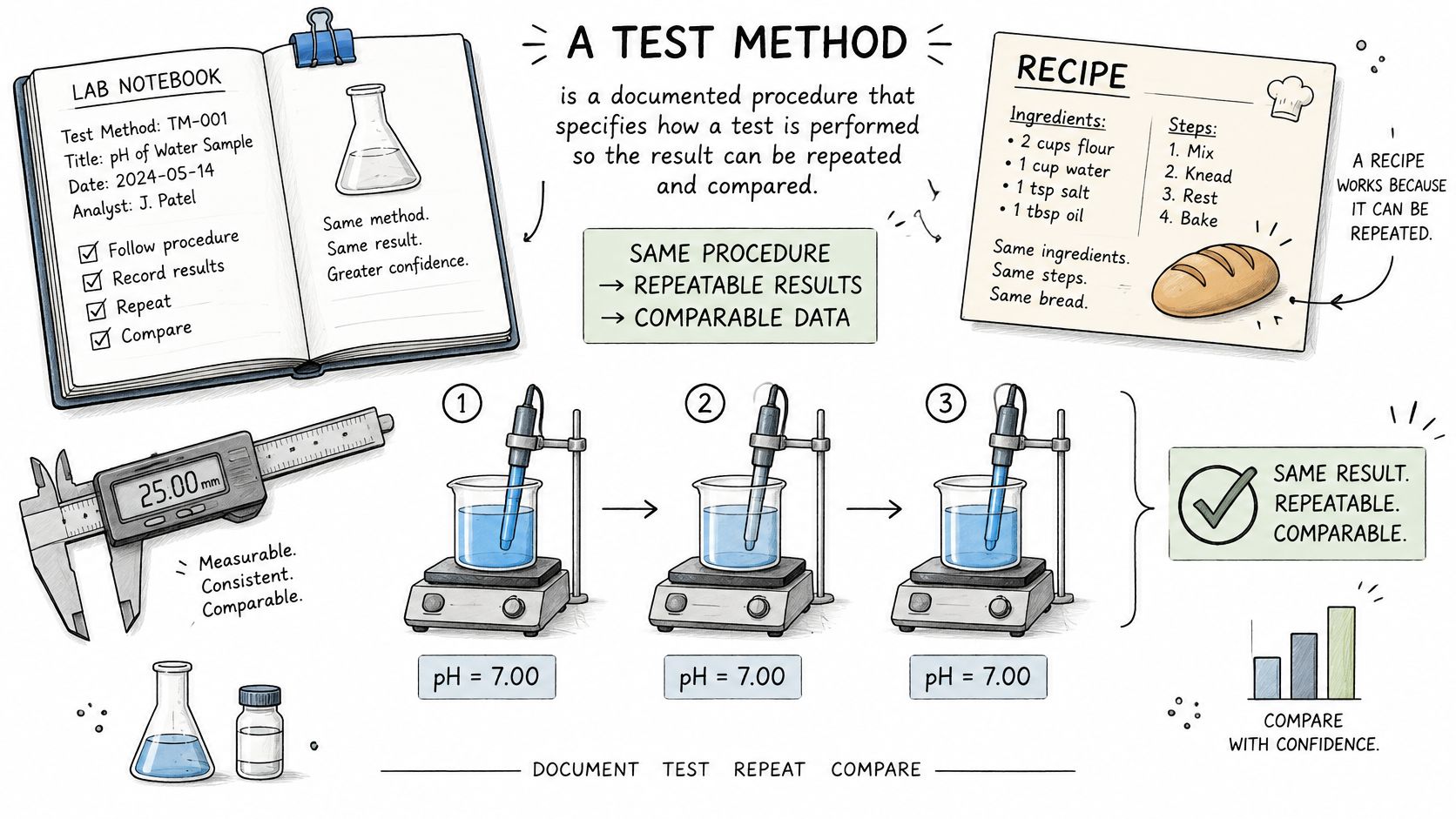
The measurement needs context
Consider laboratories comparing a polymer's tensile strength. Both may pull specimens until they break, yet use different specimen shapes, conditioning environments or pulling speeds. Their reported values don't automatically describe equivalent tests.
A complete method connects the material, preparation, equipment, operating conditions, measurements, calculations and reporting rules. Scientists can then investigate whether a difference reflects the material rather than an undocumented testing choice.
Practical rule: Treat a test result as a number plus the conditions that produced it, not as a number alone.
This also separates a test method from a specification. The method explains how to obtain the measurement. A specification establishes the acceptance requirement against which someone judges that measurement.
The central principle is reproducibility, supported by clear operational instructions. Documentation doesn't guarantee that every laboratory will agree, but it makes disagreement investigable: scientists can identify which conditions matched, which differed and which need tighter control. That makes test methods useful not just for reporting properties, but for deciding what to develop, manufacture or investigate next.
Standard, Non-Standard and Lab-Developed Methods
| Method type | Published or created by | Typical use | Example |
|---|---|---|---|
| Standard test method | National or international standards body, such as ASTM or ISO | Release testing and comparisons across labs and suppliers | Published standard for tensile properties of plastics |
| Non-standard published method | Entities other than standards organizations, such as industry associations or equipment vendors | Niche sectors or emerging technology without a standard | Vendor application note for a rheometer setup |
| Laboratory-developed method | One laboratory or laboratory system | Screening new formulations and early development | In-house viscosity protocol for a new resin family |
Standard methods give laboratories a shared reference. The standards organization maintains the published procedure, while the laboratory controls its implementation, training and records. They're a sensible starting point when customers, suppliers or production sites need comparable evidence.
Their main trade-off is scope. A published procedure may not suit an unusually soft specimen, a reactive resin or a material that can't be prepared in the required form. Adopting it also requires suitable equipment and trained operators, not just access to the document.
Published doesn't always mean standardized
A non-standard published method comes from another type of organization. An equipment vendor, for example, might describe a rheometer setup for an emerging resin application. The publisher maintains that document, but the laboratory must evaluate its suitability before relying on it.
Such methods can offer useful practical detail where formal standards haven't caught up with an application. Their limitation is that another laboratory may use a different implementation or may not recognize the procedure as an agreed comparison basis.
For a coating-specific example, the APEX NANO salt spray testing guide from APEX NANO - Titan Coatings is a useful companion when exploring corrosion testing. Use explanatory guides to understand the application, then establish the actual controlling procedure and acceptance criteria separately.
In-house methods have a legitimate role
A laboratory-developed method is created and maintained within a laboratory or laboratory system. It's often the practical choice when scientists need to screen a new formulation family before an established procedure fits.
The advantage is flexibility: scientists can adapt preparation, sample quantities and measurement conditions to the development question. The responsibility is equally clear. The laboratory must document those choices and establish performance before treating the results as transferable evidence.
A team can reasonably use an in-house screen during discovery and a standard method for release testing. Those methods serve different decisions, so their results shouldn't be treated as interchangeable.
Default to an applicable standard when results must travel across sites or suppliers. Document deviations explicitly, and don't describe a modified procedure as unmodified standard testing.
What Every Test Method Must Specify
A tensile-testing machine doesn't define a tensile test on its own. Scientists also need instructions for everything that happens before loading the specimen and after recording the force.
Use the following elements as a writing checklist. Each should contain executable instructions, not phrases such as prepare appropriately or use the usual settings.
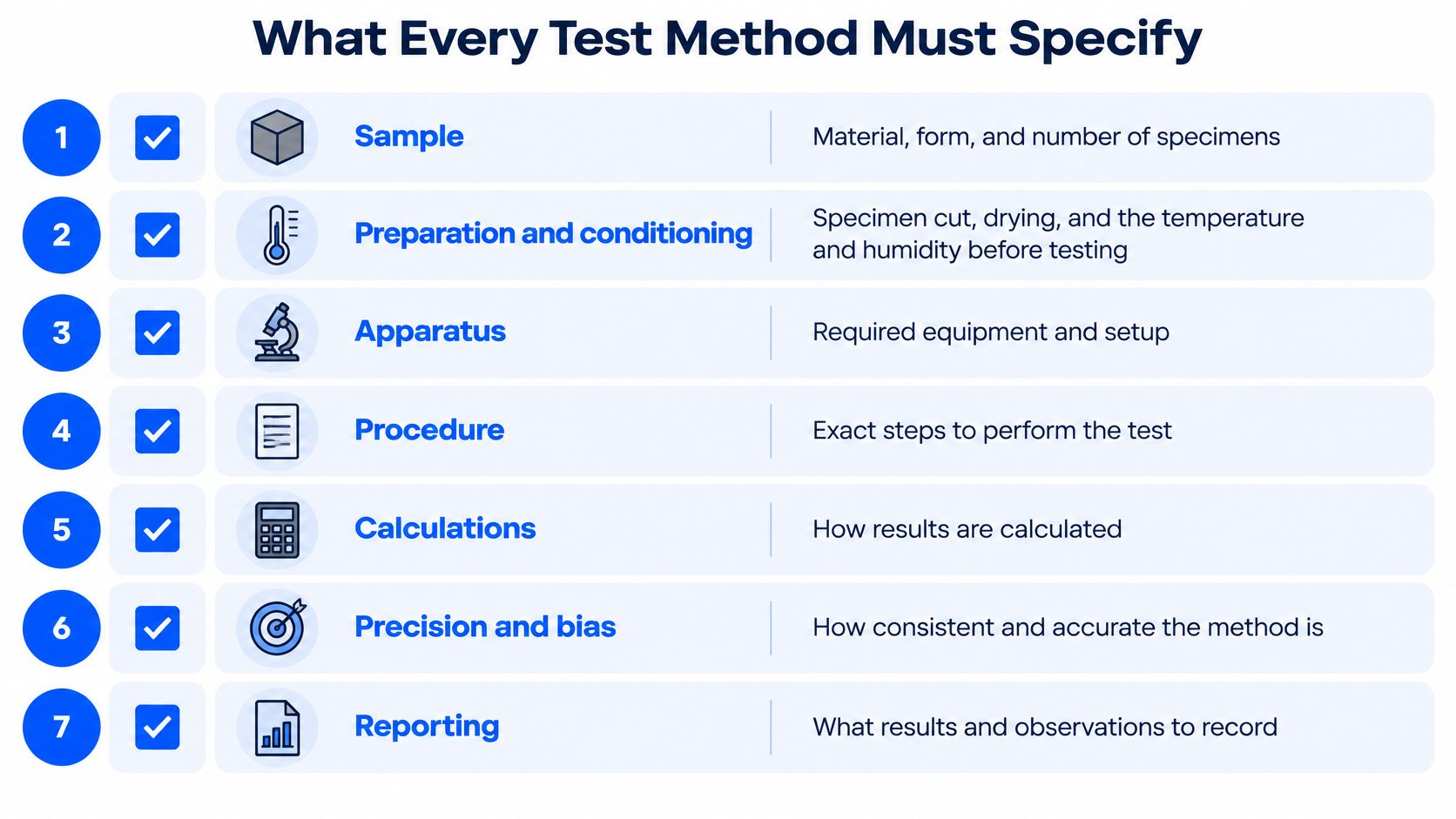
Write the complete measurement chain
Sample. Identify the material, batch, physical form, sampling location and required specimen count. For a molded polymer, record specimen orientation and geometry so a colleague doesn't unknowingly compare different material directions.
Preparation and conditioning. Describe cutting or molding, edge inspection, drying, storage and the temperature and humidity hold before testing. State how the operator confirms that conditioning is complete, because an instruction without an endpoint invites interpretation.
Equipment. Specify the testing-machine requirements, suitable load cell, grips, extensometer and calibration status. Include setup checks for alignment and slippage, since a correctly calibrated sensor doesn't prevent poor specimen mounting.
Operating conditions. Set the test speed, test environment, preload where applicable, strain limits and stopping rules. If the procedure changes speed during the test, define the transition rather than leaving it to the operator.
Measurement. State which signals to record, the acquisition frequency and how dimensions are measured. Distinguish crosshead movement from extensometer strain when the calculation requires a particular measurement.
Calculation. Define tensile strength as the maximum applicable force divided by the original cross-sectional area, consistent with the chosen procedure. State rules for invalid breaks, outlier investigation, aggregation and rounding before reviewing results.
Reporting. Require units, specimen details, individual results, summary statistics, method version, deviations and relevant uncertainty information. Preserve observations such as grip slippage or unusual fracture location, even when the software produces a plausible final value.
Small omissions can change the conclusion
Say a scientist compares candidate resins, but conditions one batch and tests another directly from storage. If moisture history affects their response differently, the apparent strength ranking may reflect preparation rather than formulation.
The fix isn't to assume that conditioning always increases or decreases strength. It's to control the condition relevant to the intended comparison and record departures from it.
The instrument is only part of the measurement system. Give preparation, calculations and reporting the same scrutiny you give machine settings.
Before approving the document, hand it to a trained colleague: could they reproduce your measurement without asking which unwritten convention you used?
Matching Validation to the Decision You Need
| Decision | Main question | Performance to prioritize |
|---|---|---|
| Screening | Can weak candidates be discarded quickly? | Throughput and detection capability |
| Formulation ranking | Does the method order close candidates correctly? | Precision and selectivity between similar candidates |
| Release testing | Does this batch meet the specification? | Accuracy, bias and uncertainty against the limit |
| Failure analysis | What mechanism caused the failure? | Selectivity and relevance to the failing mechanism |
| Scale-up | Does lab data predict plant behavior? | Relevance to production conditions and cross-site bias |
Validation establishes whether a method meets specified requirements. The FDA guidance on analytical procedures connects the measurement procedure, from sample preparation through measurement, with demonstrating performance for its intended purpose. The requirements should therefore follow the decision, not a universal demand for the most elaborate test.
For screening, speed matters because scientists are eliminating clearly unsuitable candidates. Detection capability must still be adequate to distinguish a meaningful response from an absent or weak one. A quick screen isn't useful if it discards promising formulations because an interfering ingredient masks the property.
For formulation ranking, the difficult task is separating close candidates. Precision describes agreement among repeated measurements; selectivity concerns whether the procedure distinguishes the intended property or component from interfering effects.
For release testing, scientists need confidence in the comparison with an acceptance limit. Accuracy concerns agreement with an appropriate reference, while bias is a systematic offset. Measurement uncertainty describes the range of doubt associated with the reported value.
Match the experiment to the consequence
For failure analysis, selectivity and mechanism matter more than obtaining a tidy average. A room-temperature strength measurement might be repeatable yet irrelevant to a failure driven by heat exposure, chemical attack or sustained loading.
For scale-up, the question is whether the laboratory measurement represents the production situation. Sample history, particle size, cure state, temperature, matrix effects and operator technique can change the response even when the nominal formulation remains unchanged.
Consider a screening campaign with clearly separated candidates. Measurement scatter may not affect which formulations survive the initial cut. Use the same procedure to rank closely matched finalists, however, and that scatter may reverse their apparent order.
Precision isn't proof of relevance. A tightly grouped result can still describe a property that doesn't control performance in service.
How do you know whether a method is good enough? Define the smallest difference that would change your action, assess whether the method can resolve it, and examine the consequences of being wrong.
If a mistaken ranking only triggers another screening experiment, a modest method may suffice. If it releases an unsuitable batch or commits a plant trial, you'll need stronger evidence. Fitness for purpose is a risk judgment supported by measured performance.
Repeatability, Reproducibility and Method Transfer
Why do two labs get different numbers from the same written procedure? A test method works like a measurement system, and that system includes the operator, the instrument, the environment, and the sample history. Change any part and the result can shift.
Repeatability describes agreement under closely controlled conditions, typically the same operator, instrument and laboratory over a short interval. Reproducibility describes agreement when conditions change across laboratories or locations. Neither term means every reading must be identical.
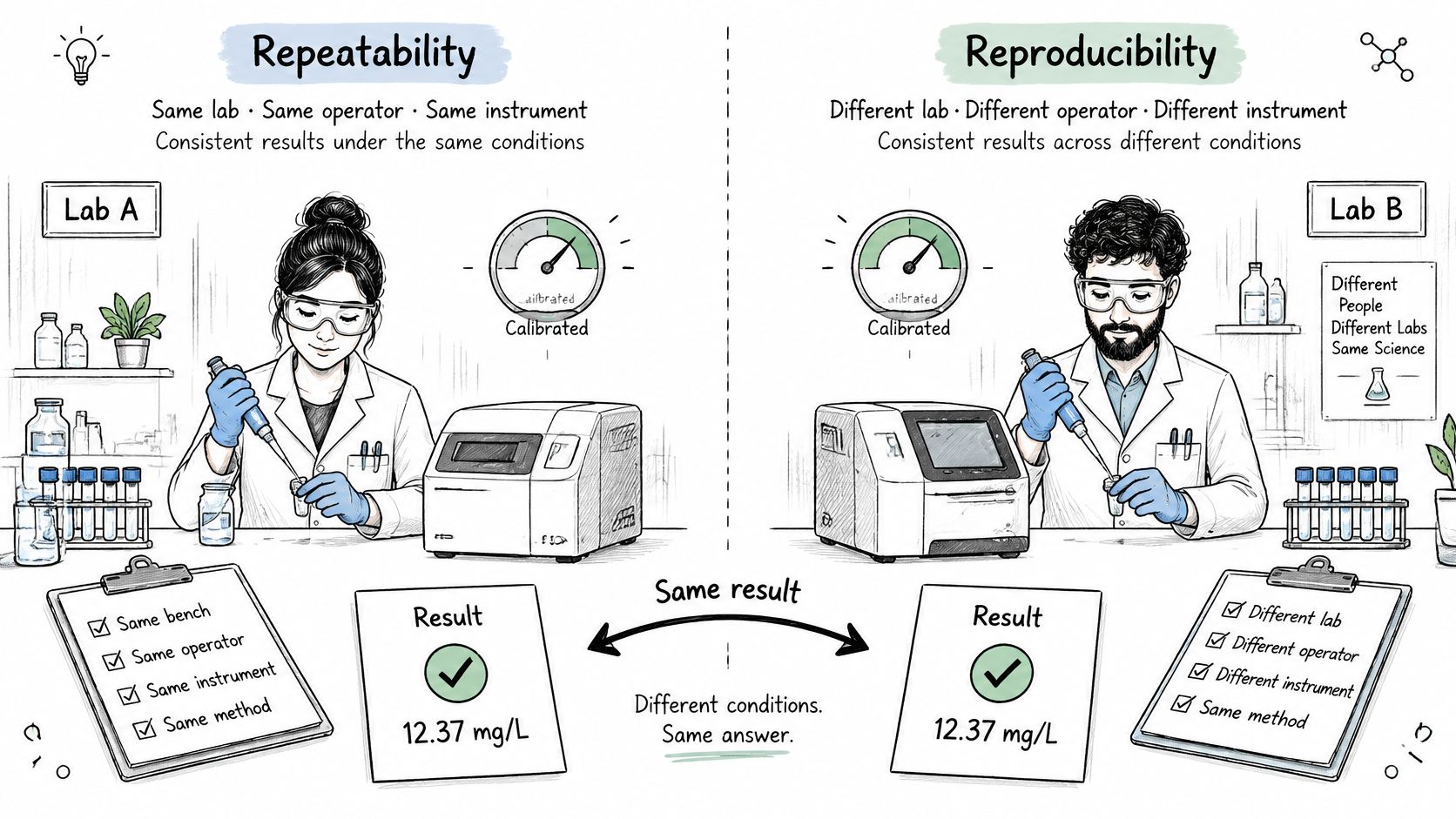
A shared test name does not establish that agreement. Moving results into a database does not create it either. Differences in calibration traceability, units, conditioning and preprocessing stay in the data after digitization.
Think of transfer as moving a whole system. A new site needs the same sampling, storage, transport, preparation, analysis and reporting controls, not only the final analytical step.
Transfer the system, not just the document
- Document the full journey. Include sampling, storage, transport, preparation, analysis and reporting.
- Agree on implementation. Resolve units, instrument capabilities, conditioning and data-processing conventions before comparing results.
- Exchange reference materials. Use stable reference materials or suitably matched samples that allow a meaningful comparison.
- Run parallel testing. Have each site test the agreed materials under its documented implementation.
- Estimate disagreement. Assess cross-site bias and uncertainty, with an agreed confidence level and acceptance criteria.
- Control the released version. Record the method revision and relevant metadata with every result.
Do not remove a consistent site offset by adjusting database values without investigating its cause. The team needs to know whether it comes from equipment, preparation or a genuine difference in the samples.
For a complementary visual explanation, use the video below.
Can sites pool results because they share a test name? Only after assessing equivalence, including reference-material performance, uncertainty and cross-site bias. Where equivalence is not established, retain the site and method distinctions rather than hiding them inside a combined average.
What ISO/IEC 17025 Accreditation Proves
ISO/IEC 17025 is the international standard for the competence of testing and calibration laboratories. The USDA Food Safety and Inspection Service explanation of ISO accreditation describes a framework that addresses technical competence as well as management systems.
An independent accreditation body recognizes a laboratory's competence for a defined scope of activities. That's more meaningful than a laboratory stating that it follows a written procedure, but narrower than a blanket guarantee covering everything it might test.
Competence evidence generally includes method validation, technical assessment, certified reference materials and proficiency testing. These address whether the laboratory can perform reliable work, not merely whether its documents look complete.
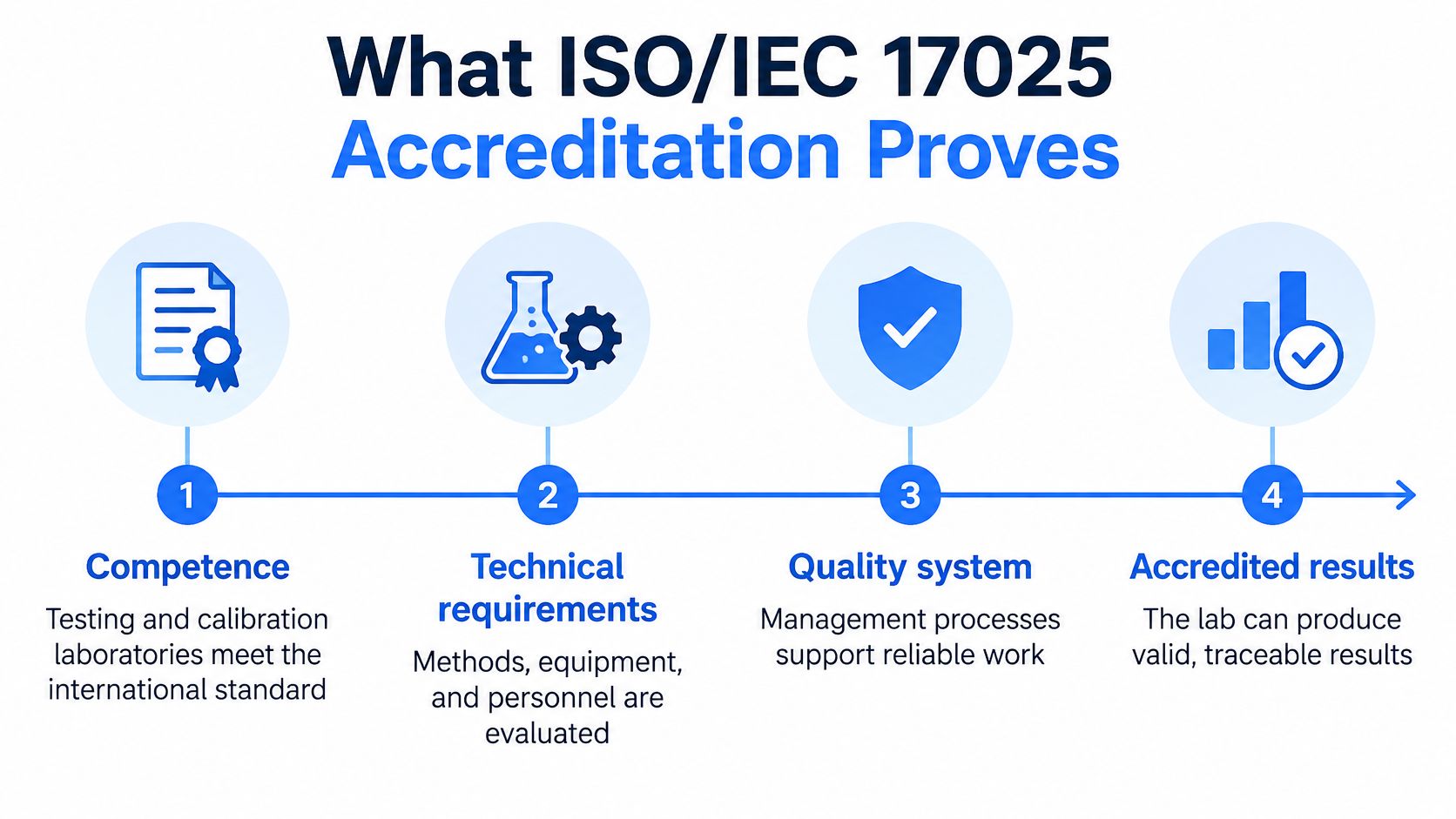
Check the scope before commissioning work
- Locate the certificate and scope schedule. Confirm the laboratory identity, location and accreditation status rather than relying on a logo in a quotation.
- Match the requested method. Check the listed procedure and applicable version; clarify how the laboratory handles revisions or a flexible scope.
- Check the material and range. Confirm that the matrix, property and measurement or concentration range cover your sample and requested work.
Ask the laboratory to identify whether the specific result will be reported within its accredited scope. A laboratory may competently offer other services that aren't included in that scope.
Accreditation supports confidence in the laboratory's competence. It doesn't establish that you've chosen the right question.
For example, an accredited test on a fully cured coating doesn't automatically predict the behavior of an incompletely cured production coating. The laboratory may perform the listed test correctly while the commissioning team chooses an unrepresentative specimen.
Keep those responsibilities separate: laboratory competence and decision relevance both matter.
Common Pitfalls and How to Avoid Them
Most method problems begin with a reasonable shortcut. A familiar test name, a current calibration certificate or a passing trial can feel like sufficient evidence when a team needs to move quickly.
The difficulty is that each shortcut answers a narrower question than scientists sometimes assume.
| Misconception | Why it misleads | Fix |
|---|---|---|
| A test name identifies the method | Labs share names but use different preparation or conditions | Record the full method version with every result |
| A calibrated instrument means a valid method | Calibration covers the machine, not sample preparation or conditioning | Audit preparation and conditioning steps as well |
| One passing run proves the method | Performance can drift after operator, reagent or equipment changes | Track control samples and assess revalidation after changes |
| Using a published standard guarantees fitness | The standard may not cover your material or concentration range | Check the scope and run a fit-for-purpose comparison |
Audit the assumptions behind a passing result
We both measured viscosity sounds reassuring, but it leaves unanswered questions about temperature, shear conditions and sample history. Before comparing values, inspect the actual procedure records rather than resolving the discussion through the property label.
The machine is calibrated is also necessary but incomplete. An operator can use a calibrated load cell while measuring specimen thickness incorrectly or mounting the specimen off-axis. Audit the operations that connect the sample to the sensor.
A successful validation exercise isn't permission to stop monitoring. Suppose a laboratory periodically tests a retained polymer control specimen and notices a shift in mean strength. Investigate conditioning, grip condition, dimensional measurement and control-material stability before concluding that the production resin changed.
Respond proportionately to changes
Not every change requires rebuilding the validation package from the beginning. Assess what the change could affect, document that assessment and test the relevant performance characteristics.
Replacing a grip may require evidence about slippage and fracture location. Changing a preparation solvent may require a broader assessment of extraction or matrix effects.
The best preventive habit is simple: record what changed and what evidence permits continued use. That gives the next scientist a defensible basis for trusting the result, rather than a history reconstructed from memory.
Choose and Standardize Your Test Method
Start with the decision, then build the measurement system around it. Buying a more advanced instrument before defining the required evidence can leave a team with excellent measurements that don't resolve its development problem.
Use this sequence to turn an experimental need into a controlled practice.
- Define the action. State whether the result will support screening, ranking, release or scale-up. Write down what outcome would change your next step.
- Find an applicable published standard. Examine its scope against your material, physical form and expected measurement range, not just its title.
- Develop an alternative where necessary. If no procedure fits, establish a laboratory method and evaluate it against the decision's performance requirements.
- Write and approve the procedure. Complete the sample-to-report instructions, assign a version and make responsibilities for review and authorization explicit.
- Establish cross-site requirements. Identify which conditions must match, exchange reference samples and assess bias before treating sites as interchangeable.
- Maintain competence. Schedule suitable proficiency checks and review validation needs after changes to equipment, reagents or sample sources.
Make the evidence reusable
A documented, transferred method gives scientists a defensible basis for comparing a new formulation with historical results. It also helps teams use external testing capacity without losing the context needed to interpret the measurements.
A resin-industry customer reduced its new polymer development lead time by 50% by using a global network of national research institutes and outsourcing testing and prototyping. External capacity can accelerate development, but teams still need clear testing requirements and interpretable results.
Start this week with a high-impact test. Assign an owner, write its sample-to-report procedure and arrange a cross-check with another laboratory this quarter. Record the bias you find, investigate its cause and decide whether the agreement is adequate for the decision that test supports.
Polymerize offers a materials R&D platform that brings fragmented experimental data together and supports AI-guided formulation development, alongside expert support and prototyping networks. Visit Polymerize to discuss how your team can organize test-method context with experimental results and build a stronger foundation for material-development decisions.
Put your R&D data to work
See how materials teams use Polymerize to plan fewer experiments and reach target properties faster.