


Enterprise governance is the system by which an organization is directed, controlled, and held accountable, covering relationships among the board, executives, shareholders, employees, regulators, and other stakeholders. It sets out who can make important decisions, how those decisions are checked, and how the organization responds when risks or problems arise.
A materials R&D team may have test results split across spreadsheets, lab notebooks, and personal drives, while a predictive model recommends a new formulation without making its reasoning or source data easy to trace. The immediate question might seem technical: which result should the team trust? But underneath it is a governance question: who owns the records, who can approve the model's use, and who is responsible for reviewing its recommendation?
Table of Contents
- Why Enterprise Governance Matters Beyond the Boardroom
- Building the Core Structure of Enterprise Governance
- Naming Owners, Decision Rights and Escalation Paths
- Turning Policies Into Risk-Tiered Controls
- Data and AI Governance in Materials R&D
- Comparing Governance Models and Where Platforms Fit
- Starting Your Governance Program This Quarter
Why Enterprise Governance Matters Beyond the Boardroom
Governance can sound like something that happens in a board meeting or a compliance review. In practice, it shapes everyday work. When a chemist changes a formulation, an analyst trains a model, or a team moves a material from laboratory trials toward production, governance determines who has authority, what evidence they need, and how others can review the decision.
The OECD describes corporate governance as the structures and systems that guide a company's direction and relationships with stakeholders, supporting trust, transparency, accountability, and long-term economic activity (OECD overview of corporate governance). Enterprise governance applies that idea across the organization. It includes financial reporting, but also decision rights, risk management, internal controls, ethical standards, information flows, and how executives are held accountable.
In the team with scattered experiment records, the issue isn't that files are untidy. If researchers can't establish which dataset trained a model, which version of a formulation it evaluated, or who approved an experiment, they can't reliably reproduce or challenge the recommendation. That can lead to duplicated work, weak evidence, and decisions that are difficult to defend.
Practical rule: If a decision can affect safety, product quality, intellectual property, or a customer commitment, make its owner and evidence trail clear.
Governance also isn't meant to replace scientific judgment with paperwork. A well-designed system helps scientists work with confidence by defining sensible boundaries: researchers can explore within an approved environment, while decisions with greater safety or commercial consequences receive more review. Leaders, meanwhile, can see how R&D work aligns with strategy and risk appetite.
For organizations clarifying who decides, who reviews, and how accountability is tracked, strengthen accountability with governance frameworks offers additional context on connecting responsibilities to organizational goals. The useful starting point is not a thicker policy manual. It's a clearer way to make, document, and review consequential decisions.
Building the Core Structure of Enterprise Governance
Think of enterprise governance as a working system, not a document sitting on a shared drive. Its parts must connect: leaders set direction, managers carry it out, control functions check how work is proceeding, and reporting gives decision-makers evidence of what happened.
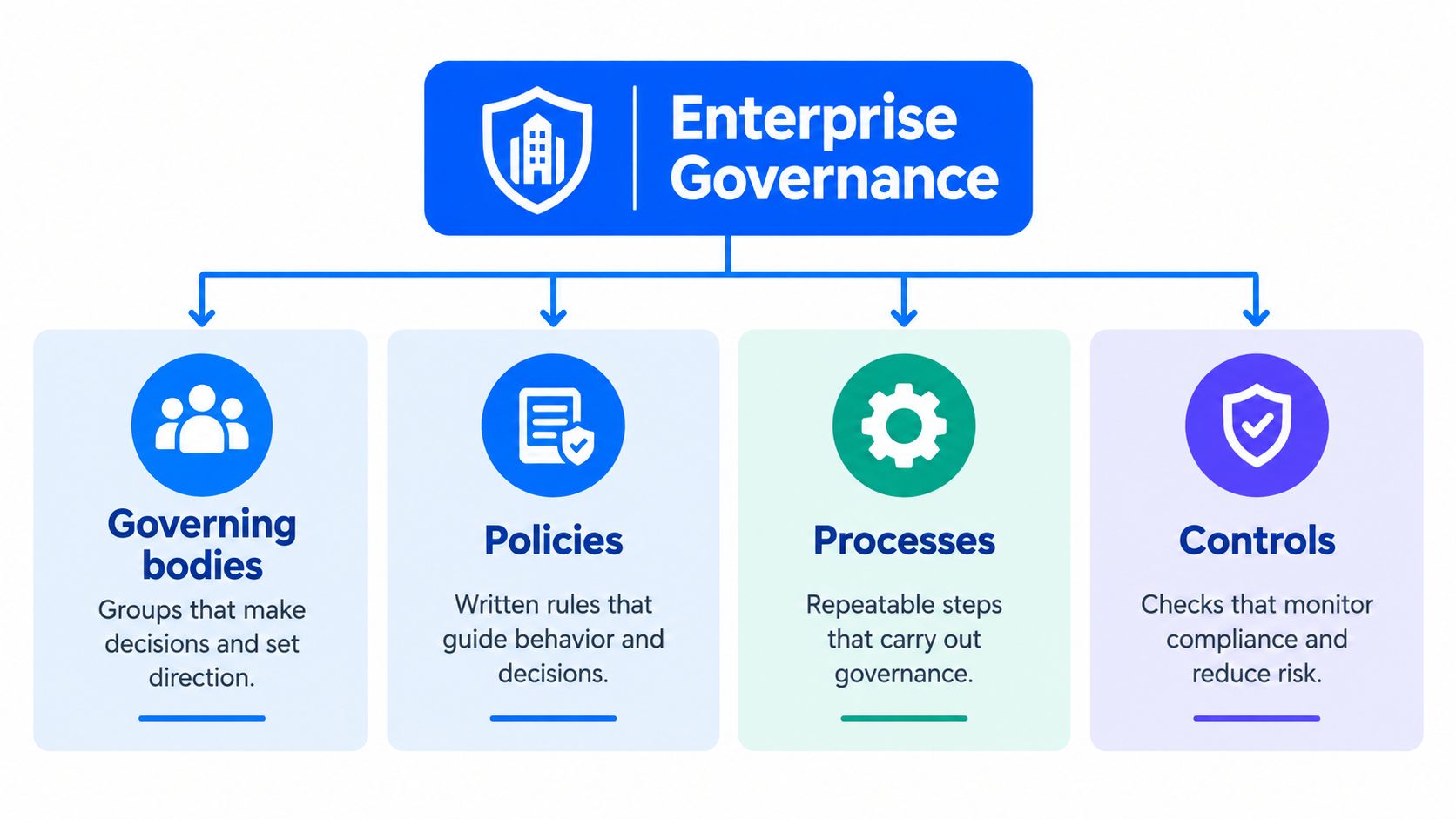
A practical architecture has four connected layers:
- Governing bodies set objectives and risk appetite. A board might decide how much risk the organization is prepared to accept when launching a new polymer for a demanding application.
- Management processes turn those objectives into action. R&D leaders manage the formulation pipeline, assign resources, and determine which experiments move forward.
- Control functions check whether activities follow requirements and whether risks are being addressed. Quality, safety, legal, or data teams may review testing practices, access permissions, or regulatory evidence.
- Reporting mechanisms bring evidence to executives, boards, regulators, and other stakeholders. A decision record could show which data informed a formulation change, who approved it, and whether the validation criteria were met.
These layers depend on information moving in both directions. A governing body sets expectations; management translates them into a workflow; controls check that the workflow is followed; reporting returns evidence that helps leaders assess performance and adjust direction.
For example, a team seeking approval to scale a formulation shouldn't have to rely on someone's memory of earlier experiments. The relevant records, model output, validation results, and approval should be connected well enough for reviewers to follow the reasoning. Deloitte describes governance infrastructure as the people, processes, and technologies that govern daily activity and build information for board and stakeholder reporting (Deloitte's governance framework).
A useful design test is whether the system can answer three questions: What was the decision? What evidence supported it? Who had authority to make or approve it? If any answer depends on searching individual inboxes or asking around, the architecture needs clearer information flows.
Naming Owners, Decision Rights and Escalation Paths
A policy can describe what an organization expects. It can't make a decision on anyone's behalf. Governance becomes operational when each consequential decision has a named owner with authority to act and an escalation route for exceptions.
In materials R&D, different decisions need different owners. A data steward might approve access to proprietary formulation records. A model owner might be responsible for validation and monitoring. A formulation lead might approve a proposed composition change, while a quality leader decides whether the evidence supports a release or transfer toward manufacturing. The same person needn't own all of these decisions, but responsibility shouldn't be left implicit.
This distinction matters especially when AI touches multiple teams. EY's 2025 survey of executives across countries found that 72% said AI was integrated and scaled across most or all initiatives, while only about one-third reported protocols covering all elements of EY's responsible-AI framework (EY's 2025 survey on AI adoption and governance). The figures point to a practical challenge: an organization may use AI broadly without having a clear answer to who is accountable for a model-supported decision.
A useful ownership map identifies the people involved and the part each plays:
- Business owner: defines the purpose and acceptable use of a model or workflow.
- Technical owner: manages implementation, access, validation records, and changes.
- Risk and legal partners: advise on the controls relevant to safety, compliance, and intellectual property.
- Frontline users: follow the approved process and raise concerns when results or conditions change.
Then define what happens when a model's recommendation conflicts with an experiment, a user finds an unexpected result, or a system's performance changes. The escalation path should identify who pauses use, who investigates, and who can authorize a return to service.
More rules won't fix an ownership gap. A short decision record with a named approver and clear escalation path is often more useful than another broad policy that leaves those responsibilities unstated.
Turning Policies Into Risk-Tiered Controls
A written policy is a starting point, not proof that governance is working. Teams need controls that operate within the workflow: approvals, checks, monitoring, and a way to respond when an issue appears.
A 2025 survey of 351 participants found a gap between policies and operational controls: 75% of organizations had AI-use policies, while 54% had incident-response playbooks and 48% monitored production AI for accuracy, drift, and misuse (2025 AI governance survey). For an R&D leader, the lesson is practical: ask not only whether a policy exists, but whether the organization can detect and address a problem in the systems people use.
Governance should also match the potential consequences of a decision. A scientist exploring relationships in a dataset doesn't need the same approval route as a model guiding a safety-critical material choice or supporting a regulatory submission. Applying one identical process to every use case can burden low-risk work while failing to add the right safeguards to high-impact decisions.
| Risk tier | Typical R&D use | Governance requirements |
|---|---|---|
| Exploratory | Looking for patterns in historical experiment data | Record the dataset and purpose, restrict access as needed, and make limitations visible to users. |
| Decision-support | Ranking candidate formulations or recommending the next experiment | Validate against suitable data, document performance and uncertainty, and require a qualified scientist to review recommendations. |
| High impact | Influencing safety-critical properties, scale-up, regulatory evidence, or customer specifications | Require stronger provenance, formal validation, defined approval authority, change control, and ongoing monitoring. |
The table is a starting point, not a universal classification. A model that looks exploratory can become high impact if its output starts influencing product release or customer claims. Review the actual use, data sensitivity, and possible consequences when assigning a tier.
For teams formalizing their risk controls, frameworks for managing compliance risk can provide a useful reference point. The goal is proportionate oversight: keep routine exploration moving while strengthening review where an error could affect safety, compliance, or commercial commitments.
Data and AI Governance in Materials R&D
Data governance and AI governance are parts of enterprise governance, not features that a software platform can provide on its own. ISO/IEC 38505-1 treats data governance as a subset of IT governance, applying it to data created, collected, stored, or controlled through IT systems (ISO/IEC 38505-1 overview). For R&D, that means decisions about records and models need owners, rules, and evidence, just like other consequential organizational decisions.
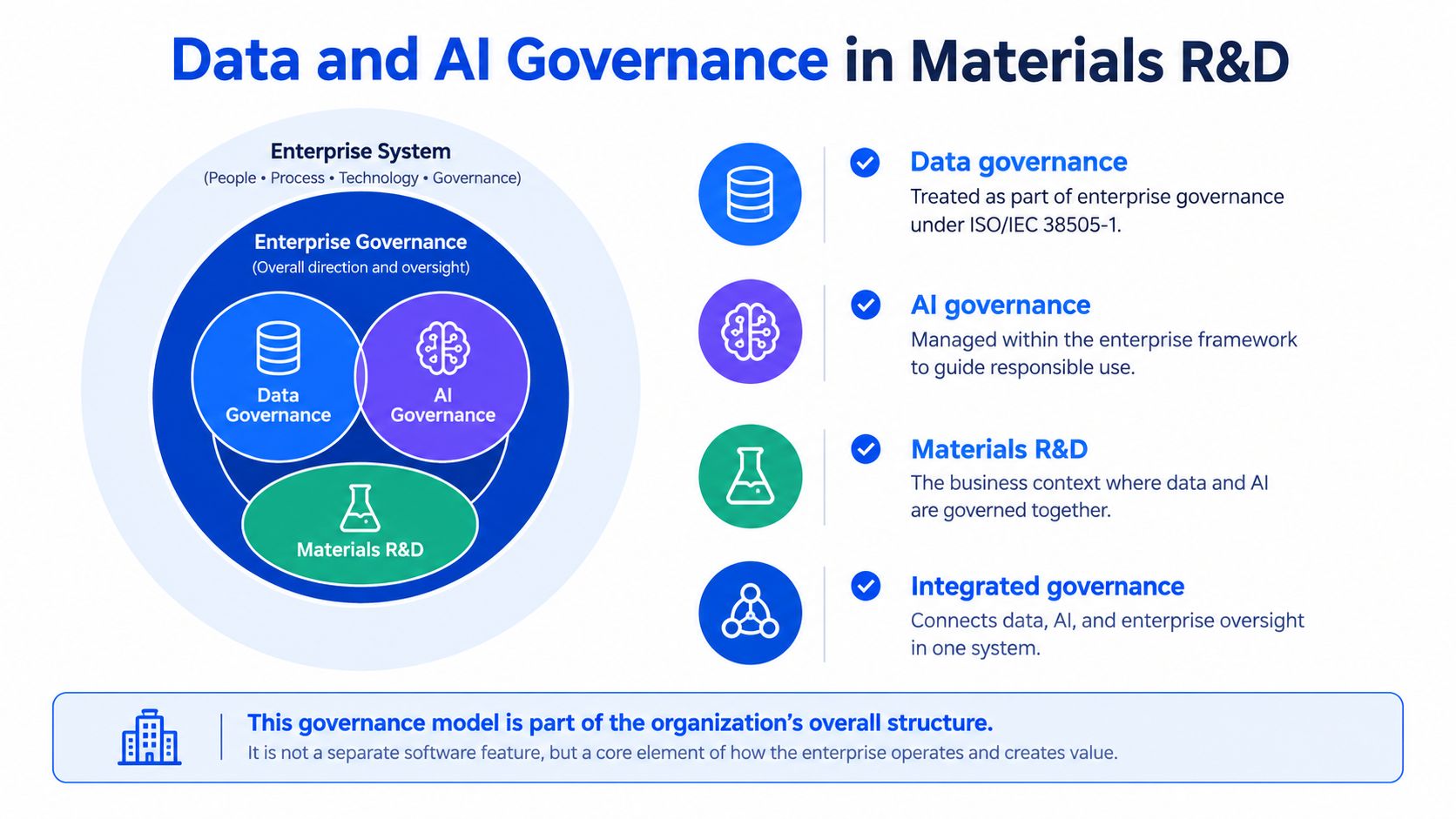
NIST's AI Risk Management Framework organizes trustworthy-AI work around four functions: Govern, Map, Measure, and Manage. In practical terms, teams set accountability and policies, understand the context and risks of a use case, choose how to evaluate it, and act on the results. Trustworthiness considerations include validity, reliability, safety, security, transparency, explainability, privacy, and fairness.
A materials team can apply those ideas through a sequence of everyday controls:
- Preserve provenance. Keep raw experimental records connected to their source, author, relevant conditions, and later revisions. Versioning helps researchers distinguish an original measurement from a corrected or transformed record.
- Limit access appropriately. Use role-based permissions for proprietary formulations and sensitive project data. Researchers should have the access needed for their work, not automatic access to every dataset.
- Separate training and validation data. Keep evaluation records distinct from training inputs where appropriate. This helps teams test whether a model generalizes instead of merely recalling information it has already encountered.
- Set model-use criteria. Define suitable performance and uncertainty thresholds for the intended use, and specify when a scientist must review the recommendation.
- Monitor after deployment. Watch for drift or changed operating conditions that could make earlier validation less relevant. Document the response when performance falls outside approved limits.
Suppose a model appears to predict a polymer property accurately. If records from the same production batch appear in both training and validation data, the result may reflect a batch-specific pattern rather than a reliable materials relationship. Good lineage and separate evaluation data give scientists a way to investigate that possibility before they rely on the prediction.
The following video provides an additional perspective on how data and AI governance fit into an organization's broader operating structure.
Comparing Governance Models and Where Platforms Fit
Organizations can arrange governance in different ways. The right operating model depends on how much consistency the business needs across teams and sites, how close decisions should sit to R&D work, and how clearly the organization can assign accountability.
| Model | Decision speed | Consistency | Accountability |
|---|---|---|---|
| Centralized | Can be slower when every decision waits on a central function | Easier to apply common standards | Clear central ownership, but local teams may not know who can resolve day-to-day issues |
| Federated | Local teams can respond quickly | Standards may vary unless shared rules are enforced | Business-unit ownership is visible, but cross-functional responsibility can become uneven |
| Hybrid | Local decisions can proceed within centrally defined boundaries | Shared standards support alignment across sites | Central teams set guardrails, while named local owners manage approved decisions |
A centralized model may suit a company that needs close control over sensitive information or standardized review. A federated model can work where R&D teams operate with meaningful local authority and have the experience to manage their own data and workflows. A hybrid model combines shared requirements, such as access rules and validation expectations, with local ownership of routine experimentation.
Materials companies don't have to choose one model for every decision. They can set common enterprise rules for confidential data and high-impact model use, while allowing a laboratory team to manage lower-risk exploratory work under local procedures. The key is to make exceptions and escalation routes explicit, so local autonomy doesn't become an untracked departure from shared standards.
Platforms can support these arrangements, but they don't replace organizational decisions about ownership or acceptable risk. Polymerize, for example, is a materials R&D platform that brings fragmented experimental data into a centralized data backbone with role-based access. Its explainable models surface confidence scores and historical precedents, giving teams information they can document and review as part of their decision process.
When assessing any platform, ask whether it supports the governance practices the organization has chosen: controlled access, traceable changes, relevant evidence, and a way to review model-supported decisions. The tool should fit the operating model, not define it.
Starting Your Governance Program This Quarter
Start with the R&D decisions that carry the most consequence. List approvals for data access, model use, formulation changes, and laboratory-to-manufacturing transfer. For each, name the accountable owner, record the evidence required, and define where concerns should go.
Then choose one model or dataset for a focused pilot. Apply a risk tier, set a review or monitoring control that fits its use, and record how the team handles exceptions. Track whether reviewers can trace model-supported decisions and whether low-risk work can proceed without unnecessary delay.
A practical governance program rests on three connected ideas: a structure that links direction to evidence, named owners who can act, and controls proportionate to risk. When those pieces fit the work, governance can protect scientific autonomy and intellectual property without treating every experiment as a high-stakes approval.
Polymerize helps materials R&D teams bring experimental data together and apply role-based access and explainable models within their workflows. If you're reviewing how your organization governs data and AI in materials development, explore Polymerize and consider which R&D decision you could make more traceable first.
Put your R&D data to work
See how materials teams use Polymerize to plan fewer experiments and reach target properties faster.