

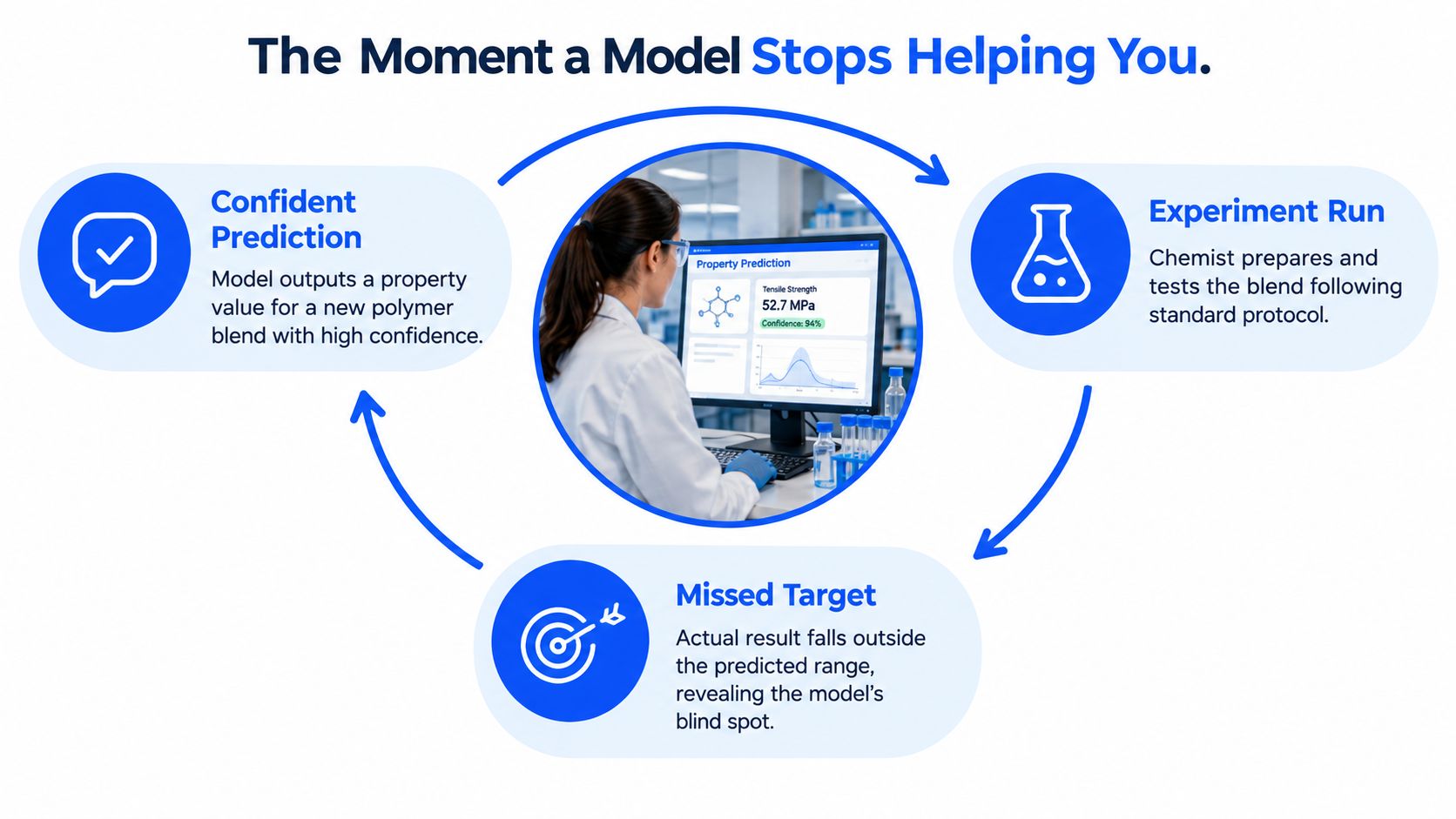
A formulation chemist receives a property prediction for a new polymer blend. The number sits neatly inside the project dashboard, confidence appears high, and the candidate moves into the lab. After compounding and testing, the measured result misses the target badly enough to trigger a review. The immediate question is often, “What went wrong with the model?”
A better question is, where did the model's reliable territory end? In materials R&D, a model limitation isn't just an annoying defect. It's a boundary in the input data, chemical space, operating conditions, or physical assumptions where the output stops being a dependable guide. Once that boundary is visible, it can help you choose the next experiment instead of merely explaining the last failure.
Table of Contents
- Start with the evidence
- Match the model to the science
- Spend experiments where uncertainty is informative
The Moment a Model Stops Helping You
A supervised model learns relationships from examples. If its training set contains familiar polymer backbones, additive ranges, curing conditions, and test protocols, it can interpolate between those examples with useful discipline. It has no equally reliable basis for predicting a formulation built from sparsely represented chemistry or processed under conditions it has never seen.
That's why a limitation is different from a bug. A bug might incorrectly convert units or drop a feature during inference. A limitation is structural. The model may be operating exactly as designed, yet the requested prediction lies beyond the evidence that shaped it.
It's also different from misuse. Asking a model trained on lab-scale viscosity measurements to rank production-scale mixing conditions may be a misuse if the deployment context was never represented. The model's limitation is the gap between those contexts. Your workflow creates the misuse when it treats a laboratory prediction as a production decision without checking that gap.
A practical definition
Use this working definition:
A model limitation is a condition under which the model's output no longer provides reliable decision support.
The condition might involve a new monomer architecture, a filler surface treatment absent from the training set, a missing processing variable, noisy property labels, or a confidence score that doesn't reflect actual error. The important point is that the limitation can often be described in observable terms.
Ask four questions about any prediction:
- Chemical territory: Does the candidate resemble compounds and formulations represented during training?
- Process territory: Were temperature, shear, residence time, humidity, and batch conditions recorded and represented?
- Property territory: Does the target value fall inside the range the model learned?
- Evidence quality: Were the historical measurements comparable, consistent, and properly documented?
A prediction inside those boundaries may still be wrong. A prediction outside them isn't automatically useless either. It should be treated as a hypothesis that requires deliberate validation, not as a shortcut to scale-up. Research on materials models trained on the Materials Project 2018 database found unexpected performance degradation on newer data, especially when formation energies fell outside the training range, and showed that uncertainty thresholds could misclassify some poorly predicted structures as safe in the reported analysis.
The model hasn't “failed” merely because it encountered unfamiliar chemistry. It has shown you where its learned map becomes incomplete.
Seven Common Families of Model Limitations
A useful taxonomy turns a vague concern into a quick diagnostic. The following seven families cover most limitations a formulation team will encounter, although a single failure can belong to several families at once.
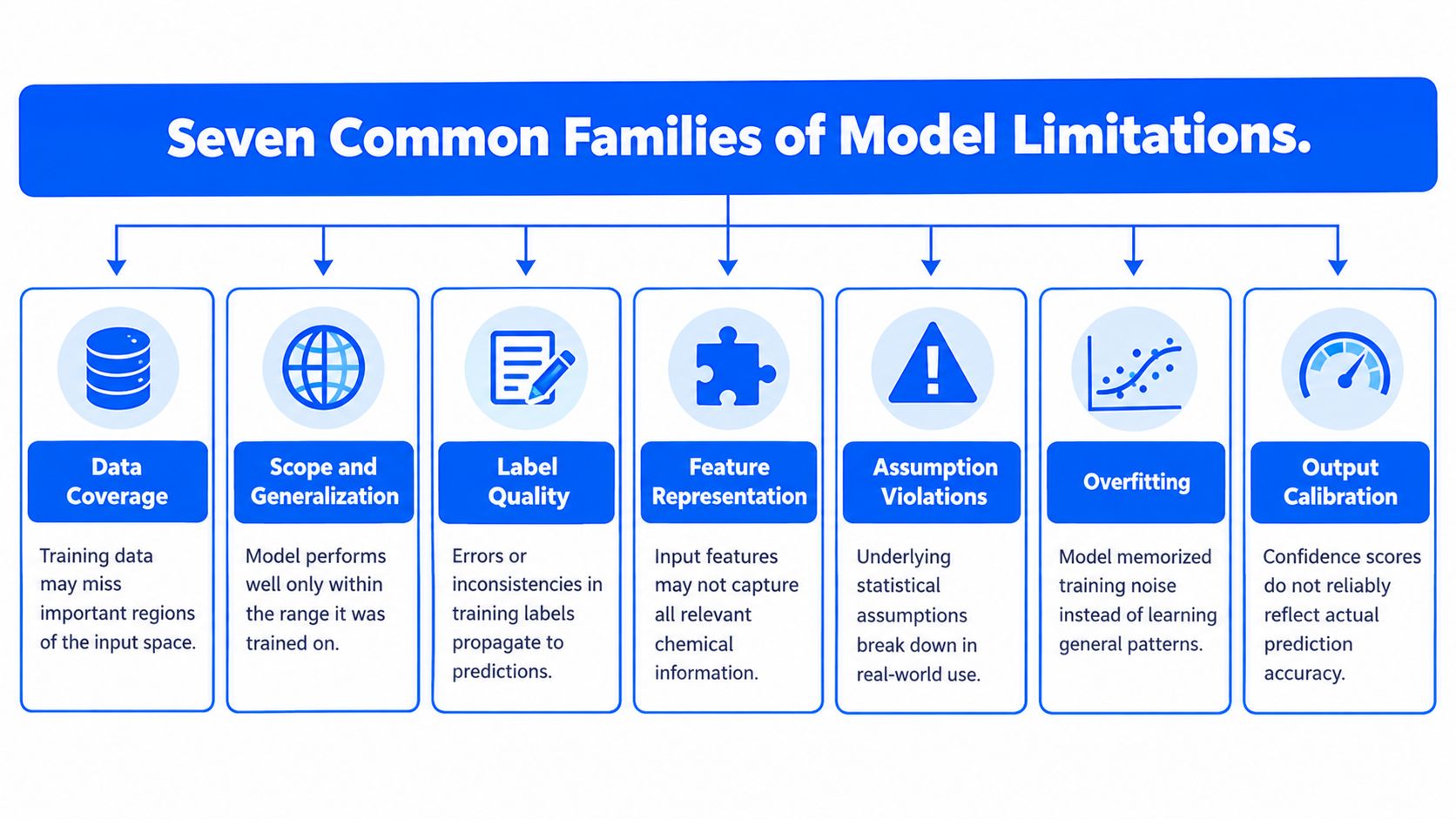
The seven boundaries
Data coverage: The training set leaves important regions of chemistry, composition, or processing unrepresented. The symptom is a prediction for a candidate that looks numerically precise but has few close historical analogues.
Scope and generalization: The model performs well within one chemical family or property range but weakens when the formulation crosses into another. A model trained on acrylic coatings may not transfer cleanly to silicone-modified systems because both are called coatings.
Label quality: Inconsistent test protocols, missing metadata, transcription errors, and publication bias become part of the learning signal. The model can reproduce a pattern that reflects laboratory practice rather than material behavior.
Feature representation: The inputs omit information that matters. Monomer identity alone may not capture molecular-weight distribution, morphology, filler dispersion, cure history, or the interaction between them.
Assumption violations: The model relies on statistical conditions that don't hold during use. Correlated variables, changing suppliers, nonstationary batches, or hidden process factors can make a familiar relationship unstable.
Overfitting: A high-capacity model learns noise or accidental correlations instead of a transferable mechanism. It may look strong on random splits while failing on new formulations. A low-capacity model has the opposite problem, underfitting hierarchical behavior across molecular, microstructural, and processing scales. This is the bias–variance trade-off, not a contest where more complexity always wins. The broader uncertainty can also come from missing metadata, model selection, and inconsistent experimental protocols, as discussed in this review of uncertainty and machine learning in materials science.
Output calibration: The predicted value may be useful while the confidence estimate isn't. A narrow interval can imply safety where the model has little evidence, while a wide interval may discourage a promising experiment.
These families interact. Poor data coverage makes extrapolation more likely. Weak feature representation can look like model error. Overfitting can hide behind random train/test splits when related formulations appear on both sides. Calibration can fail even when average accuracy appears acceptable.
Run the taxonomy against a current project by asking one simple question for each family: what would this limitation look like in our laboratory records? If the team can't answer, the model isn't yet ready for unsupervised decision-making.
Where Limitations Show Up in Polymer and Formulation Work
A polymer property model can appear reliable across an established grade portfolio. The trouble starts when a chemist introduces a new monomer architecture, changes the comonomer balance, or adds a compatibilizer that has little historical representation. The feature vector may still look complete to the software, but the chemistry has moved beyond the model's familiar neighborhood.

Suppose a model predicts tensile strength for a new thermoplastic blend. It knows the resin identities and nominal composition, but the training records contain little information about phase morphology, mixing energy, cooling history, or molecular-weight distribution. The model may be learning a convenient average over those hidden variables. Change the dispersion state or interfacial adhesion, and the measured result can move even though the recorded inputs look similar.
The senior scientist's first questions wouldn't be about choosing a more fashionable algorithm. They'd be:
- Which historical formulations are similar?
- Were the measurements generated with comparable specimen preparation and test conditions?
- Does the candidate introduce a chemistry or property range missing from training?
- Which unrecorded process variable could explain the discrepancy?
A second failure appears during formulation transfer. A model trained on laboratory batches predicts viscosity, cure response, or dispersion quality for a production reactor. The recipe may be identical on paper, but scale changes mixing patterns, heat transfer, addition timing, residence time, and local concentration gradients. If those variables weren't captured in the training data, the model is being asked to infer a process regime it hasn't learned.
The distinction matters because the model may still rank laboratory candidates correctly while failing to forecast production behavior. A strong result in one operating regime doesn't establish reliability in another.
The following video can help teams connect model behavior with practical materials-development decisions:
These examples show why limitations stack. A formulation can be chemically unfamiliar, poorly described by the available features, measured with inconsistent protocols, and transferred across scale at the same time. Treating the outcome as one generic “prediction error” hides the boundary that should guide the next experiment.
Diagnostics and Metrics That Reveal Each Limitation
A model review should answer four practical questions: where was it trained, how was it validated, what does it recognize as unfamiliar, and what evidence would show that it has drifted? Each question needs a different diagnostic.
Match the diagnostic to the boundary
Applicability-domain checks compare a new formulation with the chemistry, composition, property range, and process conditions represented in training. Similarity can be calculated from molecular descriptors, formulation fingerprints, or process variables. The output shouldn't be a vague green light. It should identify which part of the candidate is familiar and which part is novel.
Out-of-distribution detection flags inputs that differ materially from the training distribution. Distance measures, density estimates, and embedding-based methods can expose a new polymer family even when the model produces a normal-looking numerical output. This directly addresses the dangerous case of confident extrapolation.
Grouped and time-based validation tests whether the model transfers across meaningful boundaries. Group by polymer family, formulation lineage, supplier, batch, or project, then keep related examples together. Time-based splits can reveal whether a model trained on earlier work survives newer chemistry and changing process conditions. Random cross-validation can look strong when near-duplicate formulations appear in both training and test sets, so good validation performance alone doesn't establish discovery capability, as explained in this review of extrapolation in materials machine learning.
Calibration analysis compares predicted uncertainty with observed error. If cases assigned narrow intervals fail frequently, the confidence estimate is not calibrated. Track error by chemical family and operating regime rather than relying only on an aggregate score.
Look beyond one confidence number
A single confidence score can combine several different uncertainties. Aleatoric uncertainty reflects variability inherent in the material or measurement process. Epistemic uncertainty reflects limited data, unfamiliar chemistry, or model choice and may shrink when you collect better evidence.
A formulation with unstable viscosity because of batch variability needs a different experiment from one that is uncertain because no similar chemistry exists. NIST emphasizes that measurements contain uncertainty and that deployed AI needs transparent uncertainty communication and monitoring for data drift in its measurement-science guidance.
For teams formalizing this review process, problem solving frameworks from Machine Marketing can provide a useful structure for defining the problem, isolating evidence, and choosing a focused response. The materials-specific work still belongs to the formulation team, but the discipline of linking symptoms to causes prevents metric collection from becoming an end in itself.
Mitigations That Actually Address Each Limitation
Mitigation works only when it targets the boundary causing the failure. Adding more data won't automatically fix a missing process feature. A more complex architecture won't repair inconsistent labels. A dashboard won't compensate for validation that leaks related formulations across train and test sets.
Start with the evidence
For data coverage and label quality, build provenance into every record. Capture raw materials, supplier and lot identity, instrument, operator, specimen preparation, environmental conditions, processing history, and failed experiments. Preserve the negative results. A model trained only on successful formulations learns a distorted picture of feasible chemistry.
For scope and extrapolation, define an applicability boundary before ranking candidates. Use chemical similarity, property ranges, and process conditions together. A candidate that resembles historical chemistry but requires unfamiliar cure conditions is not fully in-domain.
Match the model to the science
Domain priors and physical constraints can reduce physically implausible predictions. Conservation relationships, monotonic behavior where justified, composition constraints, and known processing limits can keep a model from exploiting accidental correlations. These controls don't make the model universally reliable, but they narrow the ways it can be wrong.
Feature engineering should represent the material at the scale where the property emerges. For a polymer blend, that may include descriptors for molecular architecture, composition, morphology, filler interaction, and processing history. If the decisive variable isn't recorded, the model can't recover it through algorithmic sophistication.
Spend experiments where uncertainty is informative
Active learning is valuable when it selects experiments that reduce the most important uncertainty rather than merely confirming easy predictions. Choose candidates near a chemical boundary, in a poorly represented process regime, or where competing models disagree. Prospective validation should include boundary cases, not only comfortable in-domain examples.
Practical rule: Use confidence to decide what to test next, not to decide what never needs testing.
Interpretability tools can support this process, but they have limits. Feature attribution may show which inputs influenced a prediction, yet it doesn't prove that those inputs caused the material response. Pair explanations with controlled comparisons, mechanism-based reasoning, and experiments that distinguish competing hypotheses.
A slightly less accurate model that reliably identifies when it is extrapolating can be more useful than a polished model that hides its uncertainty. The objective is not a leaderboard score. It's a decision system that helps scientists choose safer, more informative experiments.
Communicating Limitations to Stakeholders Without Losing Trust
Stakeholders rarely need a lecture on model architecture. They need to know whether a prediction supports a decision, what could make it wrong, and what the team will do next. Present the limitation as a boundary with an action attached.
Use this structure in a project update:
- Name the boundary. “This candidate sits outside the chemistry and process conditions represented in the training records.”
- Show one concrete example. “The model has close analogues for the resin family, but not for this compatibilizer and cure schedule.”
- State the consequence. “The predicted property is a hypothesis, not a scale-up commitment.”
- Propose the next experiment. “We'll test an in-domain reference, the new candidate, and a boundary formulation that separates chemistry effects from process effects.”
- Report calibrated uncertainty. Give the expected range, the evidence behind it, and the conditions under which confidence should change.
This language protects trust because it replaces false certainty with a plan. Avoid saying that validation accuracy is a deployment contract. A model can perform well on historical splits and still fail on a new supplier, formulation lineage, instrument, or production regime.
The political failure modes are predictable:
- Leaderboard overreach: A strong benchmark result gets presented as proof of universal reliability.
- Uncertainty suppression: The team shares the predicted value but omits the conditions behind the confidence estimate.
- Caveat overload: Every possible limitation appears in a slide, but none is connected to a decision.
- Blame transfer: A missed target gets described as user error when the system never exposed its applicability boundary.
For teams designing scientist-facing AI workflows, UX research methods for AI startups offers useful perspective on how to test whether users understand system feedback, uncertainty, and recommended actions. In a materials setting, that means checking whether a chemist can interpret an applicability warning without needing to inspect the underlying code.
A concise update might read: “The model predicts improved barrier performance, but the candidate is outside the historical formulation neighborhood. We'll treat the result as exploratory, run a targeted comparison against the closest validated analogue, and update the model with the measured outcome before making a scale-up recommendation.”
Designing a Next-Best-Experiment Loop Around Limitations
A limitation becomes valuable when it changes the experiment you choose. The operating loop is straightforward:
- The model ranks candidate formulations.
- Applicability and drift checks identify which predictions sit near or beyond the reliable boundary.
- The scientist selects an experiment that tests the most decision-relevant uncertainty.
- The result, including failure and provenance, enters the evidence base.
- The model is revalidated against the expanded data and the boundary is updated.
The key is to avoid choosing experiments only by predicted performance. A candidate with the highest predicted tensile strength may be less informative than a nearby formulation that distinguishes whether the gain comes from polymer architecture, filler loading, or processing history.
For a polymer blend, the next-best experiment might hold the resin and additive constant while varying the mixing protocol. For a coating, it might compare a familiar binder with the new binder under the same cure schedule. For scale-up, it might reproduce a laboratory formulation under production-like shear and heat-transfer conditions before committing to a full manufacturing run.
A working checklist
- Define the decision: What must the experiment help you choose?
- Locate the boundary: Is the uncertainty chemical, procedural, measurement-related, or scale-related?
- Select the contrast: Which pair or small group of experiments can separate the leading explanations?
- Record the full context: Preserve raw materials, process history, failed outcomes, and test conditions.
- Update the boundary: Recalculate applicability, error, calibration, and drift after new evidence arrives.
This is the practical meaning of an explainable, domain-aware system of intelligence. The system doesn't only return a property value. It shows which historical precedents support the prediction, where the candidate differs, and which experiment would most efficiently close the evidence gap.
Polymerize fits this workflow by combining centralized experimental data through Polymerize Connect with explainable materials models in Polymerize Labs, including property prediction, formulation optimization, confidence scores, and historical precedents. Used properly, such a platform supports the scientist's judgment rather than replacing it. The organization improves not because its models never fail, but because each visible limitation produces better evidence for the next decision.
Polymerize helps materials R&D teams organize fragmented experimental data, evaluate formulation predictions, and plan targeted experiments around uncertainty and historical precedent. Visit Polymerize to see how your team can turn model limitations into a more disciplined next-best-experiment workflow.
Put your R&D data to work
See how materials teams use Polymerize to plan fewer experiments and reach target properties faster.