

The most common advice about stage gate reviews is to define the stages, standardize the slides, and ask leadership for a Go or No-Go. That's not enough. A polished packet can conceal weak experiments, while a rigid approval checklist can eliminate promising materials work before scientists have tested the right hypothesis.
Treat each gate as an evidence system, not a presentation milestone. Scientists must show what they know, managers must decide what that knowledge justifies, and both must distinguish an unresolved question from a disproven proposition.
Table of Contents
- Establish plausibility before optimizing performance
- Separate material performance from manufacturing readiness
What a Stage Gate Review Is and Why Materials Teams Use One
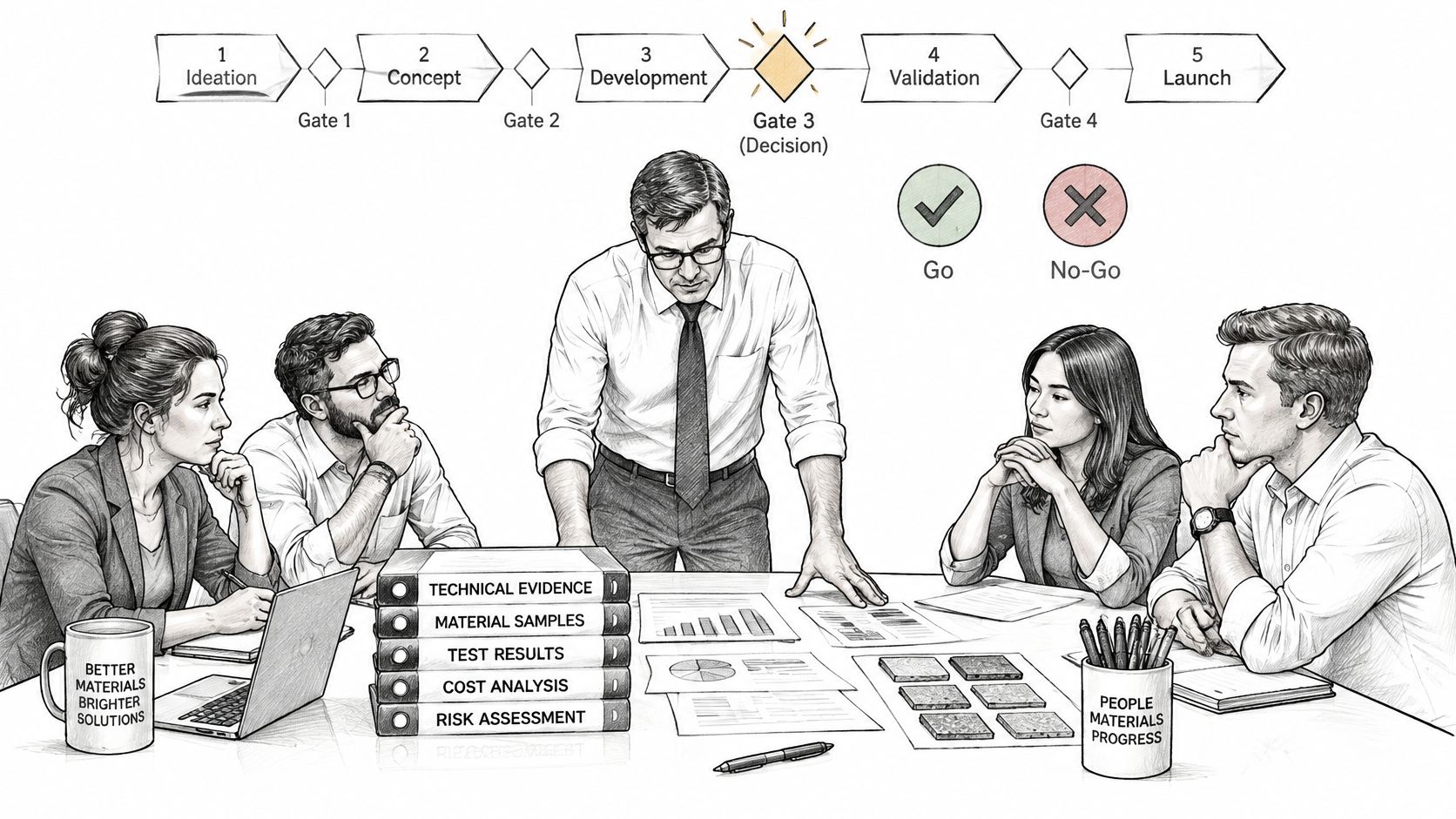
A bridge isn't opened to traffic because the construction crew says work is going well. Engineers need evidence that the structure can carry its intended load. A stage gate review applies that decision logic to development: the project team presents evidence at a scheduled checkpoint, and leadership decides whether money and people move into the next stage.
The meeting should look like a working decision session, with reviewers examining results rather than watching a progress presentation.
The approach grew out of formal engineering reviews: NASA used phase-based reviews in the 1960s, while Robert G. Cooper's commercial development work in the 1980s included publication of Winning at New Products in 1986, according to the NASA-hosted history of development and readiness frameworks. A 2025 Stage-Gate International overview cites APQC benchmarking finding that 88% of U.S. firms involved in new-product development apply Stage-Gate from idea to launch.
Why materials evidence needs particular care
Consider a formulation that performs well in a laboratory flask. Moving it into a production vessel changes mixing, heat removal, residence time, and exposure to raw-material variation. Passing a property test doesn't establish that operators can manufacture the material consistently.
A status update asks whether activities are on schedule. A gate asks whether the organization should authorize the next commitment, given the evidence and unresolved risks.
Apply this test to your current project meeting:
- Decision: What specific commitment are reviewers being asked to authorize?
- Evidence: Which results support that commitment?
- Reversal: What finding would change the recommendation?
If nobody can answer those questions, keep the meeting as a status update. Don't call it a gate.
Typical Gates in Materials R&D and What Each Must Deliver
Gates, questions and deliverables in materials R&D
| Gate | Question It Answers | Key Deliverables | Possible Decisions |
|---|---|---|---|
| Gate 0: Idea screen | Is the target property plausible and is the need real? | Concept brief, literature check, rough cost and risk estimate | Go to feasibility, Kill or Hold |
| Gate 1: Feasibility | Can the material be made and measured at lab scale? | Reproduced results from independent runs, gap to property target, IP scan | Go, Recycle or Kill |
| Gate 2: Prototype and property validation | Does it meet specification limits across batches? | Characterization against specification, multi-batch yield, failure modes with mitigations | Go, Recycle or Hold |
| Gate 3: Scale-up | Does acceptable performance hold at pilot scale? | Pilot batch data, process window, raw-material sourcing plan | Go, Hold or Recycle |
| Gate 4: Process qualification | Can it be made reliably in the plant? | Process capability data, quality-control limits, applicable regulatory sign-off | Go to launch or Hold |
| Gate 5: Commercial readiness | Are economics, supply and freedom to operate secure? | Cost of goods, customer trial results, freedom-to-operate assessment, launch plan | Launch, Hold or Kill |
Use this as a working gate architecture, not a universal naming convention. Define the evidence required before the team starts the work, including the conditions under which a seemingly successful result would be rejected.
Establish plausibility before optimizing performance
At the idea screen, require a customer problem expressed as a material requirement. “Better sustainability” isn't specific enough. Identify the application, the incumbent material, the desired improvement, and the performance trade-off customers will tolerate.
Feasibility then asks whether the team can make and measure the proposed material. Record preparation conditions, analytical methods, controls, and independent synthesis results. Repeated instrument readings from the same specimen don't establish synthesis reproducibility.
Property validation raises the standard. Review results against specification limits across batches, not just the best sample. Include yield losses, conditioning procedures, outliers, and failure modes. A formulation that achieves the target only after selective sample exclusion needs investigation, not approval.
Separate material performance from manufacturing readiness
Scale-up tests whether the proposed manufacturing route preserves acceptable performance. Require the team to explain which variables must remain controlled and which will change with equipment geometry.
Say an adhesive meets laboratory peel-strength requirements but produces inconsistent bonds after transfer to a pilot mixer. Longer mixing may change temperature history or air entrainment. That's a different question from whether the laboratory formulation can achieve the target property.
Practical rule: A successful specimen validates that specimen under its preparation and test conditions. It doesn't validate the production route.
Process qualification moves into operating reality: equipment limits, cleaning, sampling, quality-control methods, and operator instructions. Capability conclusions require a stable process and a defensible sampling plan, not an impressive-looking calculation from selected batches.
Commercial readiness adds customer acceptance, credible manufacturing costs, supply continuity, and freedom to operate. An early IP scan identifies obvious obstacles; it doesn't replace a later assessment of the actual formulation and process.
Small programs can combine adjacent reviews when the same people and evidence support both decisions. Merge meetings, not questions. Map your current project to the earliest row whose required evidence is incomplete, then identify the next commitment that evidence must justify.
Must-Meet Criteria and Weighted Scores That Drive Gate Decisions
Must-meet criteria determine eligibility. Weighted criteria determine priority. Mixing them lets commercial enthusiasm compensate for an unacceptable technical or compliance result.
The NIST analytical framework for technology-based manufacturing supports distinguishing essential requirements from comparative criteria when evaluating development readiness. For a materials program, the essential criteria should reflect the intended use and the current development stage.
Use this distinction when building the review checklist.
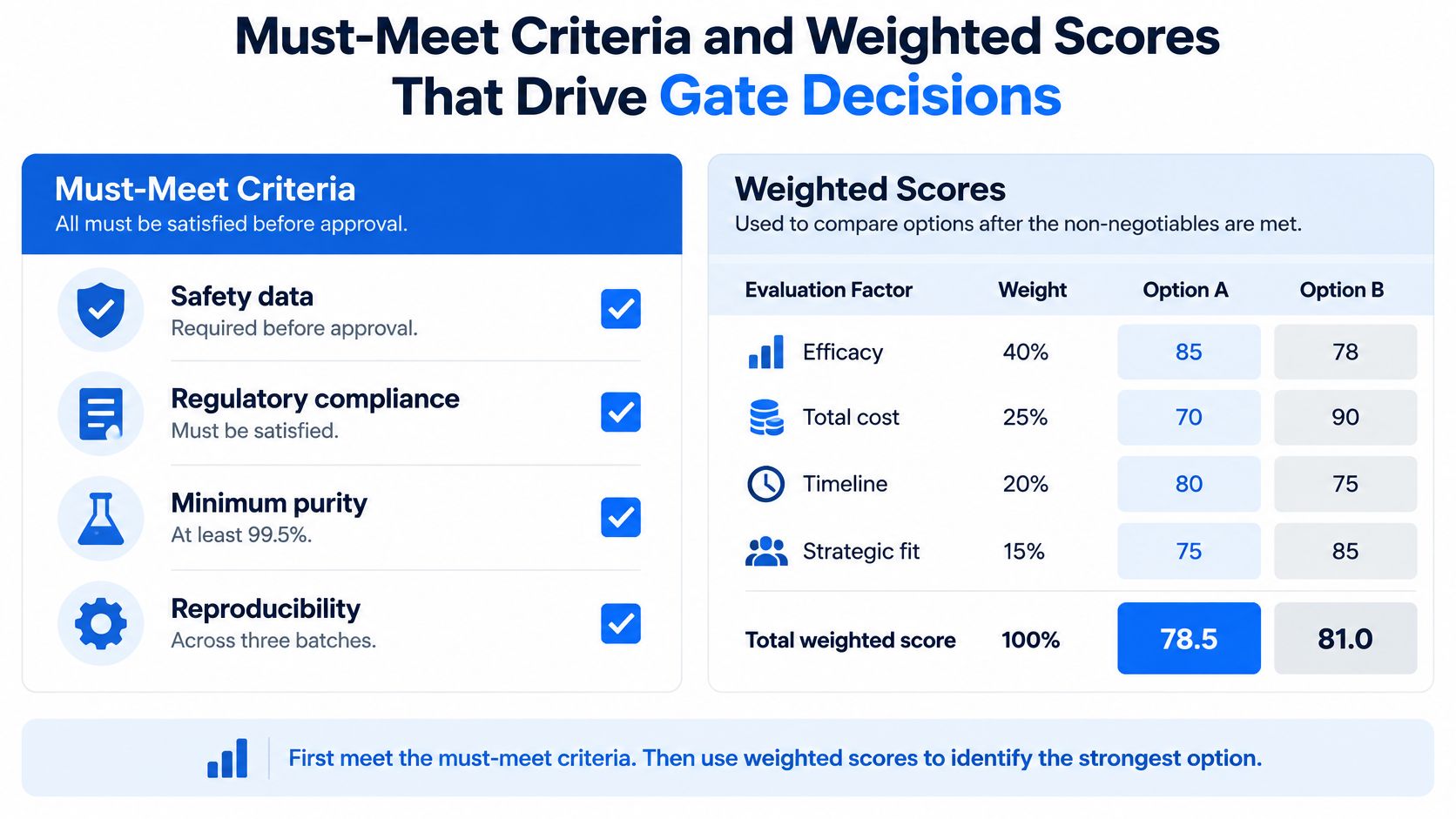
Safety evidence, applicable regulatory requirements, minimum purity, reproducibility, and fundamental feasibility belong on the must-meet side. Set application-specific thresholds with the responsible technical and compliance owners. A purity target suitable for one application may be irrelevant to another.
Rank viable projects without manufacturing precision
The following is a hypothetical allocation, not a validated scoring standard.
Example weighted scorecard for a materials gate
| Weighted criterion | Weight (out of 100) |
|---|---|
| Cost position | 25 |
| Customer value | 25 |
| Intellectual property strength | 20 |
| Strategic fit | 20 |
| Scale-up readiness | 10 |
| Total | 100 |
Agree on what a strong or weak score means before reviewing projects. Otherwise, reviewers can assign different meanings to the same rating and produce a misleading total.
For example, a bio-based plasticizer might rank highly for customer value and strategic fit but fail an applicable migration requirement. That failure blocks advancement regardless of its weighted total. Choose Recycle if a credible reformulation route exists, or Kill if the constraint defeats the concept.
For downstream manufacturability questions, Genpire's guide to manufacturing design is a useful companion when translating design choices into production constraints. Our Polymerize One offering optimizes resource allocation with predictive analytics, but resource recommendations still need to respect the gate's requirements.
Use this setup checklist:
- List the must-meets: Include only requirements necessary for the commitment being requested.
- Declare the weights: Explain why the comparative criteria matter to this portfolio.
- Write acceptance rules: Specify the threshold, method, and treatment of uncertainty.
- Assign verification: Name the person authorized to confirm each result.
Choosing Go, Kill, Hold, Recycle or Keep Learning
Gate decisions and the evidence each requires
| Decision | Use When | Evidence Needed | Next Action |
|---|---|---|---|
| Go | Must-meet criteria are met and remaining risks are acceptable | Reproducible data within specification and a costed plan | Release next-stage funding with named owners and dates |
| Kill | A must-meet criterion is disproven and no credible recovery route remains | Repeated failed results with an identified root cause | Stop spending and archive data and lessons |
| Hold | Evidence or an external dependency is missing, but the hypothesis isn't disproven | A named list of gaps, each with an owner | Pause irreversible spending and set reassessment |
| Recycle | The concept has merit but needs a changed route | Partial results supporting a revised approach | Return to the appropriate earlier gate |
| Keep Learning | The hypothesis is unproven and information gain is high | A defined experiment capable of changing the decision | Fund bounded, reversible experiments with a learning target |
Killing projects is normal portfolio management. A Booz Allen & Hamilton study cited in Cooper's Stage-Gate literature found that, on average, only 1 in 7 idea-stage projects became a commercial success; later research summarized by Cooper found build-test-feedback-revise cycles at 44.8% of best-performing firms versus 26.3% of average-performing firms.
Those findings support selection and iteration, not a mandatory kill quota. Noncommercial outcomes can include useful knowledge, and stopping a weak route needn't mean abandoning the underlying customer problem.
Protect discovery without funding indefinite ambiguity
Conventional gates become problematic when reviewers demand a settled business case before scientists understand the material. The Industrial Marketing Management study on Stage-Gate limitations discusses rigidity, early specification freezes, and the risk of terminating uncertain concepts prematurely.
“Not yet proven” and “disproven under a valid test” require different decisions.
Consider a catalyst concept whose experimental attempts fail while moisture exposure remains uncontrolled. Those results don't isolate the catalyst hypothesis. Keep Learning is justified if a controlled-moisture experiment can discriminate between explanations at an acceptable cost.
Hold is different: use it when work must wait for an instrument, feedstock, approval, or other dependency. Don't label active experimentation as Hold to avoid acknowledging its budget.
A learning authorization needs an experiment, a spending boundary, an interpretation rule, and a stopping condition. Every outcome must record what evidence would change the decision and when that evidence will be available. Without those limits, Keep Learning becomes a polite name for continued funding.
Running the Gate Meeting So It Rewards Evidence Over Slides
A project can report green at successive gates without adding meaningful raw data. That's a warning about the review process, not proof that the project is healthy. Ask what changed in the evidence before accepting a revised completion percentage.
Use the following reminders to keep the discussion grounded.
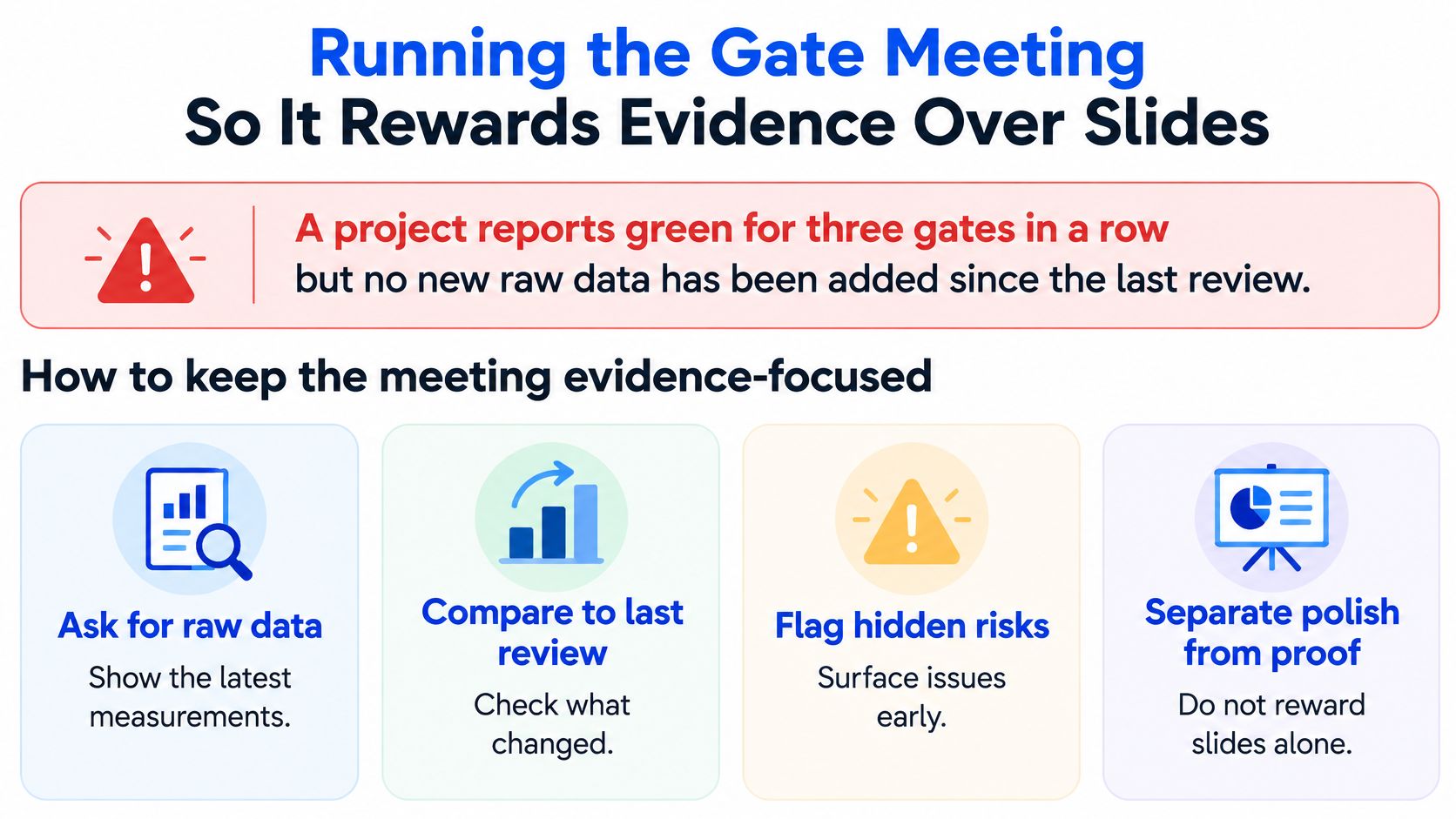
The Prometheus critique of Stage-Gate identifies weaknesses including limited gatekeeper knowledge, financially dominated criteria, and bureaucracy. Adding more slides won't fix those weaknesses. Reviewers need the expertise and authority to challenge the recommendation.
Assign roles before circulating the packet
The decision owner must understand enough of the domain to recognize an unsupported claim and have authority over the requested resources. The project lead owns the recommendation and explains the evidence, including unfavorable results.
Bring in an independent challenger who isn't accountable for securing approval. That person should inspect the packet before the meeting, identify alternative explanations, and distinguish missing evidence from genuine disagreement.
Include a manufacturing or scale-up representative whenever the decision commits the organization to a production route. Customer evidence also needs a voice: a technically impressive property improvement is weak justification if customers won't accept its processing or application trade-offs.
Run a decision agenda
- Open with the request: State the proposed outcome, requested commitment, and consequences of delay.
- Resolve must-meet status: Identify failures and unresolved requirements before debating comparative attractiveness.
- Challenge the evidence: Discuss alternative explanations and assign high, medium, or low confidence to consequential claims.
- Record the outcome: Capture the rationale, dissent, authorized work, and evidence that would reverse the recommendation.
Confidence describes the support for a claim, not the presenter's certainty. Say a formulation appears stable after a short observation period on an isolated sample. Report that as preliminary evidence, identify the untested storage conditions, and schedule the stability work needed for the intended application.
A process overview can support a shared discussion about gate responsibilities.
Make disagreement safe and specific
Don't require unanimous enthusiasm. Require reviewers to state the disputed claim, the alternative interpretation, and the evidence needed to resolve it. The decision owner can authorize a bounded path while recording unresolved dissent.
Across sites, use common readiness definitions so equivalent labels represent equivalent evidence. Local teams can retain appropriate test methods, but they must disclose differences that affect comparability.
Governance test: If a scientist receives less support for surfacing a valid risk than for presenting an optimistic forecast, change the incentives before changing the dashboard.
Gate Review Templates and Checklists for Materials R&D
Gate packet template for materials R&D
| Packet Section | Contents | Evidence Standard |
|---|---|---|
| Decision request | Gate name, decision requested, funding requested | Exact decision and consequences of delay |
| Must-meet status | Each non-negotiable criterion and its result | Measured values with method and sample count |
| Weighted scorecard | Scores for cost, IP, strategic fit, customer value, and relevant readiness factors | Each score linked to supporting evidence |
| Evidence register | Raw records, replicates, predicted versus measured values | Every consequential claim traced to a notebook or dataset ID |
| Risks and failure modes | Known risks, mitigations, owners | Confidence in each risk assessment and mitigation |
| Open items and reassessment | Evidence that could change the recommendation and its availability | Reassessment date and named owner |
Write the decision request first. This forces the team to identify the actual choice before assembling supporting material. “Approve pilot development using the proposed mixing route” creates a reviewable request; “review progress” doesn't.
Describe the consequences of delay. A missed customer trial window may matter, but an internally preferred date isn't automatically a commercial deadline. Separate contractual commitments, equipment availability, and management preferences.
Make the evidence register usable
For every must-meet requirement, enter a result, an explicit failure, or an open status. Never omit a line because its evidence is inconvenient or incomplete. Missing information should remain visible.
Give experimental records enough context for another scientist to interpret them: formulation version, raw-material lot, preparation conditions, conditioning history, method revision, and excluded observations. Distinguish independent preparations from repeated measurements of the same preparation.
For predicted properties, record the model version, input conditions, confidence information, and whether the formulation sits within the model's relevant experience. Don't place a predicted value beside a measured specification result without labeling the difference.
The evidence register should point to the controlled record rather than duplicate it into another spreadsheet. Broken links, ambiguous filenames, and overwritten datasets make later challenge difficult even when the original experiment was sound.
Pre-meeting release checklist
Use a defined circulation deadline that gives the challenger enough time to inspect the evidence, not merely read the summary.
- Circulate the packet early: Allow technical reviewers to investigate consequential claims before the decision.
- Test the raw-data links: Check access permissions as well as whether the files open.
- Inspect every must-meet line: Confirm the result, method, sample count, and acceptance rule are present.
- Assign every open item: Name a person, not a department.
- Check the first page: Make the requested decision and commitment unmistakable.
Keep a controlled template for each program, with a common core across the portfolio. Preserve old packet versions so reviewers can compare what the team believed at the time with what it later learned. A template is useful when it makes scrutiny easier, not when completing it becomes the project's largest administrative task.
Confirm the Gate Decision and Set Your Next Review
A gate decision matters only when people change their work accordingly. Finish the meeting with a record that someone outside the room can act on.
- Write the decision: Include the gate, outcome, accountable owner, and reassessment date.
- Distribute the record promptly: Send it while the rationale and action boundaries are clear.
- Update the portfolio tracker: Show authorized work, stopped commitments, and open dependencies.
- Check the packet: Record evidence omissions that must be corrected.
- Book reassessment: Put the review in the calendar before participants leave.
Audit the predictions, not just completion
After a predefined learning interval or experimental campaign, compare the packet's predictions with actual outcomes. Check whether expected properties, manufacturing risks, and resource requirements were reasonably forecast. Preserve the original prediction rather than replacing it with the latest estimate.
Keep an evidence register per project so that audit doesn't depend on reconstructing decisions from email and scattered notebooks. Use forecast errors to improve criteria, confidence judgments, and experimental design, not to punish teams for disclosing uncertainty.
This week, pick your current gate, complete its decision request and must-meet status, and send both to your independent challenger.
Polymerize brings fragmented materials R&D data together and supports property prediction and formulation optimization, helping teams prepare evidence for development decisions. Visit Polymerize to request a live demo of Polymerize Labs or use the Start free trial option, and assess it against the evidence gaps in your next gate review.
Put your R&D data to work
See how materials teams use Polymerize to plan fewer experiments and reach target properties faster.