

A formulation scientist needs to share an experimental record with a process engineer. A quality reviewer needs read access to results but not the ability to alter them. An external collaborator needs access to one customer program, while an IP administrator must protect confidential formulations across several sites. In many materials R&D organizations, those permissions have accumulated through a mixture of team groups, individual grants, project folders, and manual exceptions.
The arrangement usually works until a scientist changes projects, a customer-owned dataset requires tighter controls, or an auditor asks who can view, edit, approve, or export a sensitive record. That's when the practical question becomes urgent: should access follow the resource, as it does with an ACL, or the user's job function, as it does with role based access control?
The strongest enterprise answer usually isn't a binary choice. RBAC should establish baseline access for normal laboratory and production workflows, while narrowly governed ACL exceptions should protect unusually sensitive resources. The design must also account for project context, data classification, collaboration expiry, and evidence that permissions remain appropriate over time.
Table of Contents
- Authorization location
- Administration at scale
- Exceptions and precision
- Auditability and effective access
- Establish precedence before granting exceptions
- Make every exception temporary by design
- Reconcile roles and direct grants
Why Access Control Choices Matter in Materials R&D
Materials data rarely stays inside one application or one team. Formulation records, experimental logs, process conditions, analytical results, specifications, and customer-owned datasets often move between scientists, laboratories, manufacturing teams, quality functions, and external partners. Each group needs useful access, but not necessarily the same ability to view, change, approve, or export information.
A common failure starts with convenience. An administrator grants a project group access to a broad workspace, then adds an individual exception for a confidential formulation. Later, a scientist changes programs, a contractor remains associated with an old project, or a quality reviewer receives editing rights because the platform doesn't distinguish review from modification. No single decision looks reckless. Together, they create effective permissions that nobody can explain confidently.
Practical observation: The access model becomes visible when the organization has to answer not only “who can enter?” but also “why can this person perform this action on this record?”
The scientific workflow is the policy
A generic IT role such as “employee” or “manager” rarely describes the authorization needs of a materials team. A formulation scientist may need to create and revise recipes, while a lab technician needs to record observations and results. A process engineer may need access to scale-up conditions, and a quality reviewer may need approval rights without unrestricted editing authority.
The risk is equally specific. A confidential formulation can expose intellectual property. A customer-owned dataset can carry contractual restrictions. An experimental record may need to remain traceable after review. A production specification may require a controlled change path rather than informal sharing.
That makes access control a scientific workflow requirement, not merely an infrastructure setting. The model should reflect how teams conduct experiments, collaborate across sites, transfer work to production, and protect ownership boundaries.
Collaboration and control must coexist
Overly restrictive permissions slow legitimate research. Scientists may duplicate records, send files outside the platform, or ask administrators for routine access. Overly broad permissions create the opposite problem, particularly when project boundaries and customer restrictions matter.
The right design makes normal collaboration predictable. Stable job functions receive consistent baseline permissions, sensitive projects receive explicit boundaries, and exceptional grants have an owner, a reason, and an end condition. That structure supports smoother work while giving security and compliance teams evidence they can review.
Selecting between role based access control vs ACL should therefore begin with the operating model of the R&D organization. The choice needs to align with how a materials platform stores experiments, how teams change, and how the enterprise expects access decisions to be governed.
What Is ACL and What Is Role Based Access Control
An Access Control List, or ACL, is object-centric. Each protected object, such as a formulation record, experiment, folder, database entry, or application function, carries a list of permitted users or groups and the operations they can perform. The authorization question is, “Which subjects can access this object, and what can they do with it?”
Role-Based Access Control, or RBAC, is function-centric. Permissions belong to roles, users or service identities receive role assignments, and access is granted through an active, authorized role. The authorization question becomes, “Which permissions belong to this job function, and which users currently perform that function?”
| Decision point | ACL | RBAC |
|---|---|---|
| Where access is stored | On each protected object | In roles and role assignments |
| Primary organizing principle | Individual users or groups and their rights | Job functions and assigned responsibilities |
| Natural strength | A narrow, object-specific exception | Consistent access across teams and systems |
| Materials R&D example | One scientist can read one confidential formulation | Formulation scientists can create and edit assigned workflow records |
| Main governance concern | Scattered grants and difficult reconciliation | Roles that become too broad or poorly maintained |
In an ACL-centered model, permissions are commonly attached directly to individual users or groups for each protected object. The RBAC model proposed by David Ferraiolo and Richard Kuhn reorganized authorization around roles, with users assigned to roles, permissions assigned to roles, and access granted through an active authorized role. NIST describes this approach as reducing the cost of privilege administration and addressing weaknesses in ACL-based administration through role hierarchies and constraints, including separation-of-duty controls. See the NIST RBAC FAQ for the foundational distinction.
For a materials platform, roles might include formulation scientist, lab technician, process engineer, quality reviewer, and IP administrator. The role carries the normal permissions, while the user receives access by being assigned to that role. That is different from maintaining a separate permission entry for every user across every experimental record.
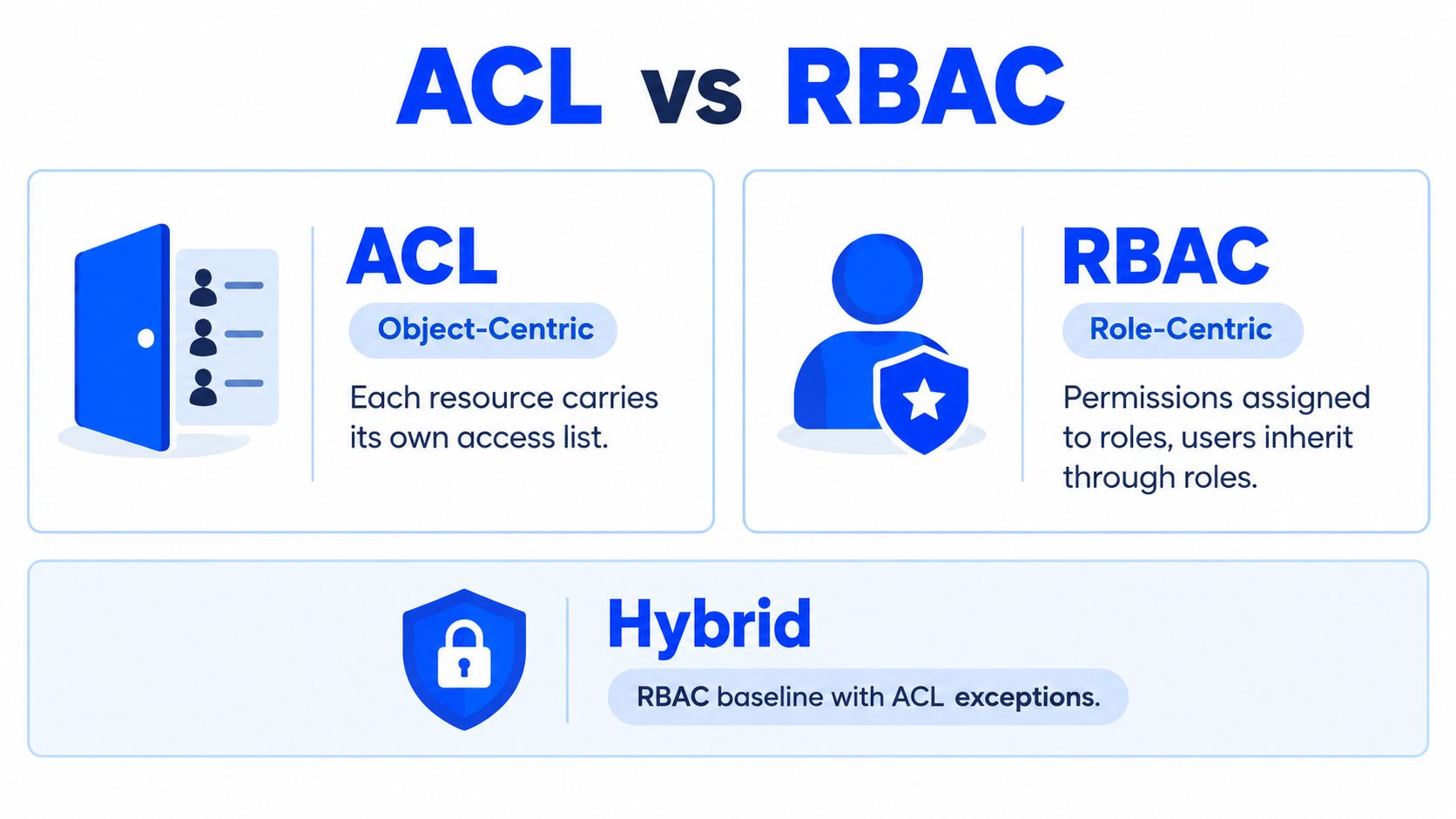
The distinction isn't merely technical vocabulary. It determines where administrators make changes and where auditors look for the explanation. ACL administration asks teams to inspect resource-level entries. RBAC administration asks them to inspect role definitions, assignments, constraints, and exceptions.
A short explainer can reinforce the object-versus-role distinction:
Neither model automatically produces least privilege. A role can grant more access than a scientist needs, and an ACL can grant an exception that nobody reviews. The model is only the starting point. Governance determines whether the resulting permissions remain defensible.
Core Differences Between RBAC and ACL
The most useful comparison focuses on how each model behaves after the initial configuration. Materials R&D environments change constantly. Projects start and end, teams move between sites, customer programs introduce restricted datasets, and experimental records progress from discovery to validation and production.
Authorization location
ACLs store the relationship on the resource. The formulation record, project workspace, or experiment contains entries identifying subjects and permitted operations. That structure offers direct precision, particularly when a resource has an unusual confidentiality requirement.
RBAC stores permissions in roles and maps users or service identities to those roles. A change to a role can update the effective permissions of its members without editing every protected object. The Barkley analysis of RBAC and ACL administration describes per-resource ACL configuration as cumbersome when organizations manage large resource populations or differentiated access for many users.
Administration at scale
ACLs are easy to understand when the scope is narrow. An administrator can grant one scientist read access to one confidential formulation and leave the rest of the workspace unchanged. The same approach becomes difficult when teams maintain many resources with overlapping users and groups.
RBAC carries the baseline policy more efficiently when job functions are stable. Assigning a new lab technician to the appropriate role is more coherent than editing permissions across many experimental records. The benefit disappears if the organization creates a separate role for every project, customer, site, and temporary circumstance. That pattern turns role design into a disguised ACL system.
Exceptions and precision
RBAC is effective for normal workflows, but broad roles can become blunt. A general “R&D manager” role may expose every project when a manager only needs access to one facility or customer program. Adding more roles can express the distinction, but excessive specialization makes the role catalog hard to understand.
ACLs handle object-specific exceptions naturally. They can restrict one confidential formulation to a defined project team without changing the baseline permissions for other records. That precision is useful, but every exception creates an additional relationship that requires ownership, review, and eventual removal.
Auditability and effective access
RBAC gives reviewers a clear path from user to role to permission. That structure supports consistent reviews, provided the organization documents role purpose, assignment authority, and separation of incompatible responsibilities.
ACLs require reviewers to evaluate resource-level entries. That can be appropriate for sensitive records, but it makes the overall answer harder when access is distributed across many objects. A complete review must account for direct grants, group membership, inherited permissions, and changes in project ownership.
Direct ACL grants can bypass role review, survive job changes, and make effective permissions difficult to audit.
The operational conclusion is straightforward. Use RBAC for stable, repeatable responsibilities. Use ACLs for limited exceptions where object-level precision is genuinely necessary. Neither model should be treated as a substitute for permission lifecycle management.
Hybrid Authorization and Hidden Privilege Risk
A hybrid design combines the strengths of both models, but it also introduces a governance risk that teams often underestimate. Once direct ACL grants exist alongside role permissions, a user's effective access no longer appears in one place. The user may receive baseline access through a role and additional rights through an object-level exception.
That can be the right outcome for a confidential customer program. It becomes dangerous when the exception has no expiry, no accountable owner, or no review trail. A scientist may move to another project while retaining access to an old formulation. A contractor may remain on a project group after the engagement ends. An administrator may grant export rights for a one-time handoff and never remove them.
NIST distinguishes RBAC from ACL-supported identity-based access control and emphasizes least privilege, meaning users and processes should receive only the access necessary for assigned tasks. Its guidance on combining access approaches supports a disciplined model in which ACLs remain available for narrow exceptions while the baseline policy stays centralized. The relevant guidance is available in NIST's least-privilege publication.
Establish precedence before granting exceptions
An enterprise policy should answer what happens when RBAC and ACL decisions differ. For example, the organization might define RBAC as the default source for normal permissions, allow ACLs only on designated sensitive resources, and prohibit an exception from expanding a denied operation without explicit approval.
The technical rule matters less than consistency. Security teams, platform administrators, and application owners need the same interpretation when they investigate an access decision. The platform should also show the reason for effective access, whether it came from a role, a group, an exception, or a combination.
Make every exception temporary by design
An ACL exception should have:
- A defined purpose: State why the person needs access and which task requires it.
- A resource boundary: Limit the grant to the specific formulation, experiment, project, or dataset.
- An accountable owner: Assign responsibility to a project or data owner, not an unowned administrative queue.
- An expiry condition: Remove access when the collaboration, experiment stage, or approved task ends.
- A review record: Preserve evidence of approval, change, and subsequent reconciliation.
This approach prevents the hybrid model from becoming a collection of invisible privileges. It also supports investigations because reviewers can distinguish standard job-function access from an approved project exception.
Reconcile roles and direct grants
Lifecycle automation should cover joiners, movers, and leavers. The same discipline should apply to temporary access, ownership reviews, orphaned resources, and periodic comparisons between effective permissions and role membership. A review that checks only role assignments will miss direct ACL grants. A review that checks only resource lists may miss an overly broad role.
For materials R&D, reconciliation should be sensitive to project confidentiality, customer ownership, regulatory restrictions, experimental stage, and site. The key outcome isn't the number of roles created. It's a reduction in standing privilege and stale exceptions.
Mapping Access Models to ISO 27001 and SOC 2 Controls
Security leaders often encounter RBAC and ACL decisions through audit preparation rather than architecture workshops. ISO 27001 and SOC 2 discussions typically require an organization to demonstrate that access is authorized, limited to business need, reviewed, and changed through controlled processes. A platform's role list alone won't provide that evidence.
RBAC supports an evidence-ready structure because the organization can document why a role exists, which permissions it contains, who may approve assignments, and how incompatible responsibilities are separated. NIST's RBAC material specifically describes role hierarchies and constraints, including separation-of-duty controls, as part of the model. Those concepts map naturally to workflows where a person who creates or changes a formulation shouldn't automatically hold every review or approval privilege.
ACLs still have a legitimate place in audit evidence. A confidential formulation or customer-owned dataset may require an object-specific restriction that doesn't fit a normal role. The organization should be able to show who approved that exception, why it was necessary, what actions it permits, and whether it remains active.
Evidence auditors can actually use
A practical evidence set includes:
- Role definitions: A documented purpose, owner, permission scope, and approval authority for each role.
- Assignment records: Evidence showing who received a role, who approved it, and when changes occurred.
- Permission reviews: Periodic review outputs that identify inappropriate, excessive, or stale access.
- Exception records: ACL grants with resource scope, business justification, owner, and expiry.
- Change history: Timestamped records showing who changed permissions and what changed.
- Reconciliation results: Comparisons between effective access, current responsibilities, and approved project participation.
SOC 2 evidence expectations around logical access, least privilege, and change management are better served by these records than by a static screenshot of a permissions page. Similarly, an ISO 27001 audit benefits from a repeatable access policy and proof that the organization operates it, rather than a claim that roles were designed once.
The important distinction is between having a control design and operating the control. A role catalog without reviews can leave excessive permissions untouched. An ACL system with detailed entries can still fail if nobody knows who approved them. Audit readiness comes from traceability, ownership, review, and controlled change.
When to Choose RBAC, ACL, or a Hybrid Approach
Start with the organization's recurring access patterns, not the feature list of a security product. If a materials team has stable functions across laboratories and sites, RBAC should carry the normal policy. If a resource has unusual confidentiality or ownership requirements, an ACL may be appropriate for the exception. If both conditions exist, a hybrid model is the practical choice.
Choose RBAC as the baseline when formulators, technicians, process engineers, quality reviewers, and administrators perform repeatable responsibilities. It fits multi-site laboratories, shared enterprise platforms, and environments where onboarding, transfers, and offboarding must be controlled consistently. RBAC also provides a clearer foundation for role documentation and permission reviews.
Use ACLs selectively when a small number of resources require unique treatment. A confidential formulation for one customer program, a restricted experiment, or a limited external collaboration can justify an object-level rule. ACLs shouldn't compensate for vague role design. If administrators keep creating direct grants for ordinary workflow access, the role model needs attention.
Adopt hybrid authorization when job function and context both determine access. A scientist may need formulation permissions because of their role, but only for a particular legal entity, facility, project, experiment stage, or data classification. NIST's discussion of layered authorization describes this direction as RBAC for stable responsibilities, attributes or policy conditions for context, and narrowly scoped ACLs for exceptional resources. See these RBAC best practices from Church Extension Funds for additional guidance on designing and governing roles.
A decision checklist for R&D leaders
Ask these questions before selecting the model:
- Are permissions mostly predictable? Use RBAC where job functions explain normal access.
- Does access depend on a specific resource? Consider an ACL exception for a narrowly bounded object.
- Do project and site context change the decision? Add attributes or policy conditions rather than creating a role for every combination.
- Will teams change frequently? Prioritize joiner, mover, leaver automation and temporary access.
- Must the organization produce audit evidence? Require role ownership, review history, exception tracking, and effective-permission visibility.
- Can the platform explain access? Reject designs that show only the final allow decision without its source.
Fast-moving R&D organizations need flexibility, but flexibility without expiry and review creates authorization drift. Static roles can become too broad, while unmanaged ACLs can become too numerous to govern. The durable pattern is RBAC baseline, contextual policy where needed, and ACL exceptions under explicit control.
Implementing Access Controls on Materials R&D Platforms
Implementation should begin with a permission inventory, not with role names. List the actions that matter in the scientific workflow: view, create, edit, approve, export, manage membership, and administer policy. Then map each action to resources such as projects, experiments, formulations, analytical results, process conditions, and individual sensitive fields.
Create roles around stable responsibilities. A formulation scientist may create and revise formulations within assigned projects. A lab technician may record experimental observations and results without changing approved recipes. A process engineer may access scale-up conditions and manufacturing context. A quality reviewer may review and approve records without unrestricted editing rights. An external collaborator should receive a constrained role tied to an approved collaboration boundary.
Build the baseline before exceptions
The baseline role model should answer the ordinary workflow without direct grants. Define which teams can discover a project, which users can edit experimental records, who can approve changes, and who can export data. Keep administrative permissions separate from scientific permissions, and use separation of duty where combining responsibilities would weaken review integrity.
Then introduce project and context conditions. Useful policy attributes can include:
- Project: Limits access to the approved research program.
- Legal entity: Separates records owned by different corporate entities.
- Facility: Restricts site-specific process and laboratory information.
- Experiment status: Changes what users can do after review or approval.
- Data classification: Distinguishes ordinary research data from confidential IP or customer-owned information.
- Collaboration expiry: Ends external or temporary access when the approved collaboration closes.
Use ACLs only where the baseline cannot express a legitimate exception. Each exception should identify the resource, permitted operation, approver, owner, reason, and expiry. Avoid a system where scientists or project owners can create unmanaged grants that never enter the review process.
Operate the model continuously
Access governance needs operational routines. Automate access removal when users leave, trigger reviews when responsibilities change, identify resources without current owners, and reconcile effective permissions against current project membership. Review export rights separately from view rights because data movement can create a different IP exposure than ordinary platform access.
For platform selection, evaluate whether the system supports role-based workflows, granular project or experiment permissions, field-level restrictions where required, and timestamped records of access, changes, and exports. Polymerize offers a materials R&D environment that centralizes experimental data and provides role-based access with granular permissions across projects, experiments, and individual fields, alongside audit tracking for sensitive-data activity.
Ask vendors to demonstrate an actual access decision, not just a configuration screen. Request a walkthrough of a scientist changing projects, an external collaborator receiving temporary access, a quality reviewer approving a record, and an administrator producing evidence for an audit. The useful test is whether the platform can explain effective access and remove stale privilege without manual detective work.
Protecting materials IP requires more than choosing between RBAC and ACL. Polymerize helps materials R&D teams centralize experimental data with role-based access, granular permissions, and audit tracking for sensitive activity. Visit Polymerize to evaluate whether its governance capabilities fit your formulation, laboratory, and scale-up workflows.
Put your R&D data to work
See how materials teams use Polymerize to plan fewer experiments and reach target properties faster.