

Your battery team has years of coin cell tests in spreadsheets. Your coatings group keeps microscopy files on an instrument PC. A polymer chemist tracked formulation tweaks in an ELN, but the processing conditions for the same batch live in a slide deck sent over email. Six months later, someone asks a simple question: “Can we reuse the data from that promising run and train a model on it?”
The room goes quiet.
Not because the science was weak. Usually the opposite. The experiments were expensive, carefully run, and often impossible to repeat exactly. The problem is that the data trail is broken. Sample names changed. Units weren't standardized. Instrument settings weren't captured consistently. Nobody is fully sure which transformed file came from which raw measurement. So the team either spends days reconstructing history or reruns work it already paid for.
That's where research data governance stops being a policy topic and becomes a lab productivity topic.
Table of Contents
- Introduction Why Research Data Governance Matters Now
- A practical definition
- Why storage and backup aren't enough
- Why FAIR matters in materials work
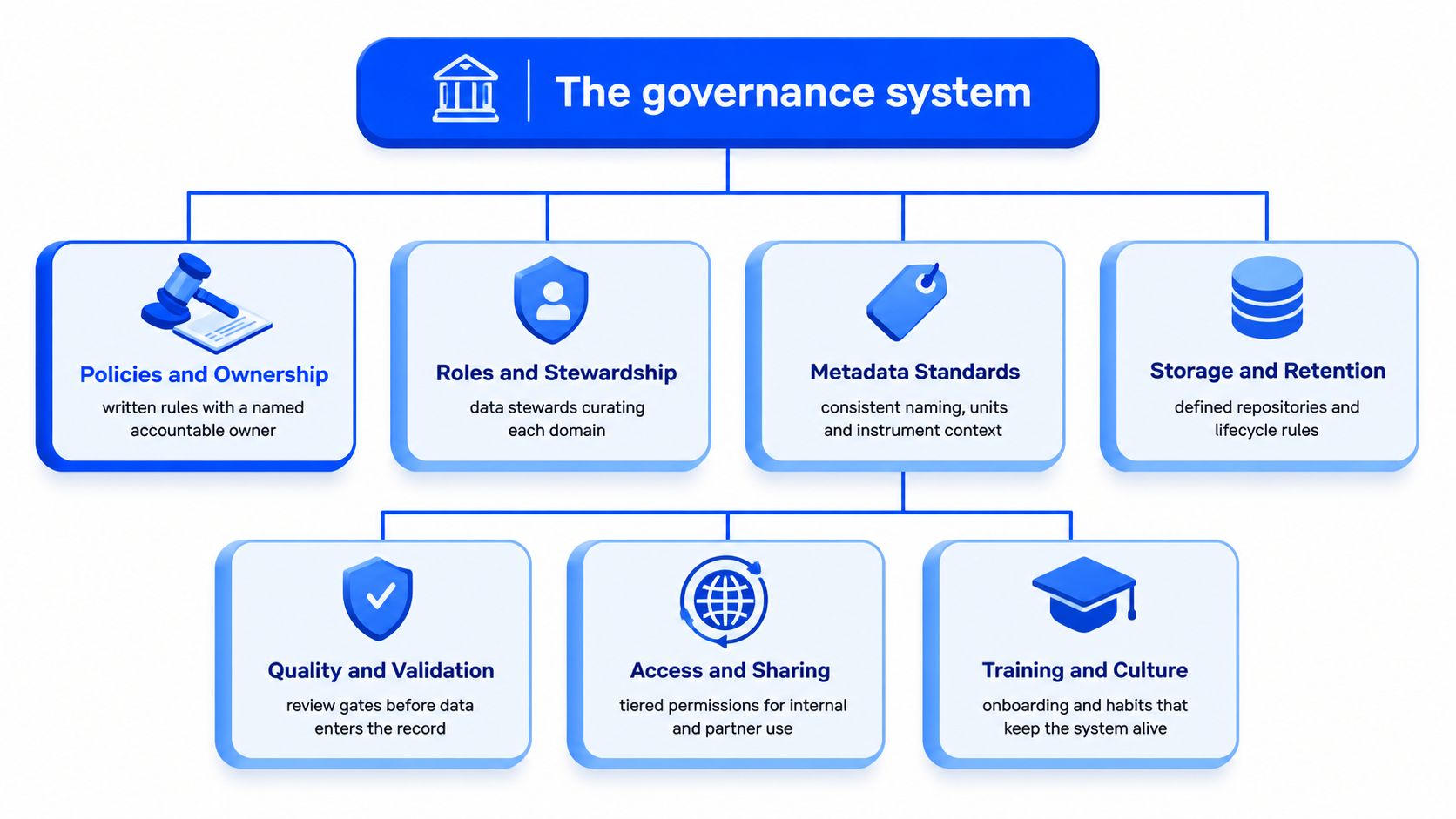
- The seven components
- Why metadata and provenance are the backbone
- Governance fails when operations stay vague
- Example one from formulation to characterization
- Example two for AI readiness
- Example three for collaboration and protection
Introduction Why Research Data Governance Matters Now
Materials R&D has always generated messy data. What changed is the ambition we now place on that data. Teams don't just want to archive experiments. They want to compare across programs, transfer learning from one formulation family to another, and build AI models that suggest the next experiment with confidence.
That only works when the underlying record is trustworthy.
A major reason governance now matters so much is that the field has moved from passive storage to active stewardship. A foundational milestone was the 2016 FAIR Guiding Principles, which set out that research data should be Findable, Accessible, Interoperable, and Reusable and established a shared framework for scientific data stewardship across research environments, as described by Cornell's overview of the FAIR principles.
In a materials lab, this shift is easy to recognize. A raw DSC file on a laptop is stored. A dataset with a persistent identifier, searchable metadata, sample history, processing context, and clear provenance is governed.
Good science can still be lost if nobody can find, interpret, or trust the data later.
Governance also matters because AI raises the stakes. Models don't understand tribal knowledge. They can't infer that “HT-Run7-final-final2.xlsx” contains post-cure modulus data unless a person explains it with structure. If your team wants machine learning to guide formulation, process optimization, or scale-up, your data has to be organized for both humans and machines.
Three signs the issue is already affecting your group:
- You repeat experiments because prior results are hard to locate or validate.
- You hesitate to share data across sites because ownership and access rules feel unclear.
- You can't tell which context is missing when a dataset looks promising but won't support reuse.
Research data governance fixes those failure points. It gives R&D teams a way to turn scattered experimental records into reusable scientific assets.
What Research Data Governance Means for Materials R&D
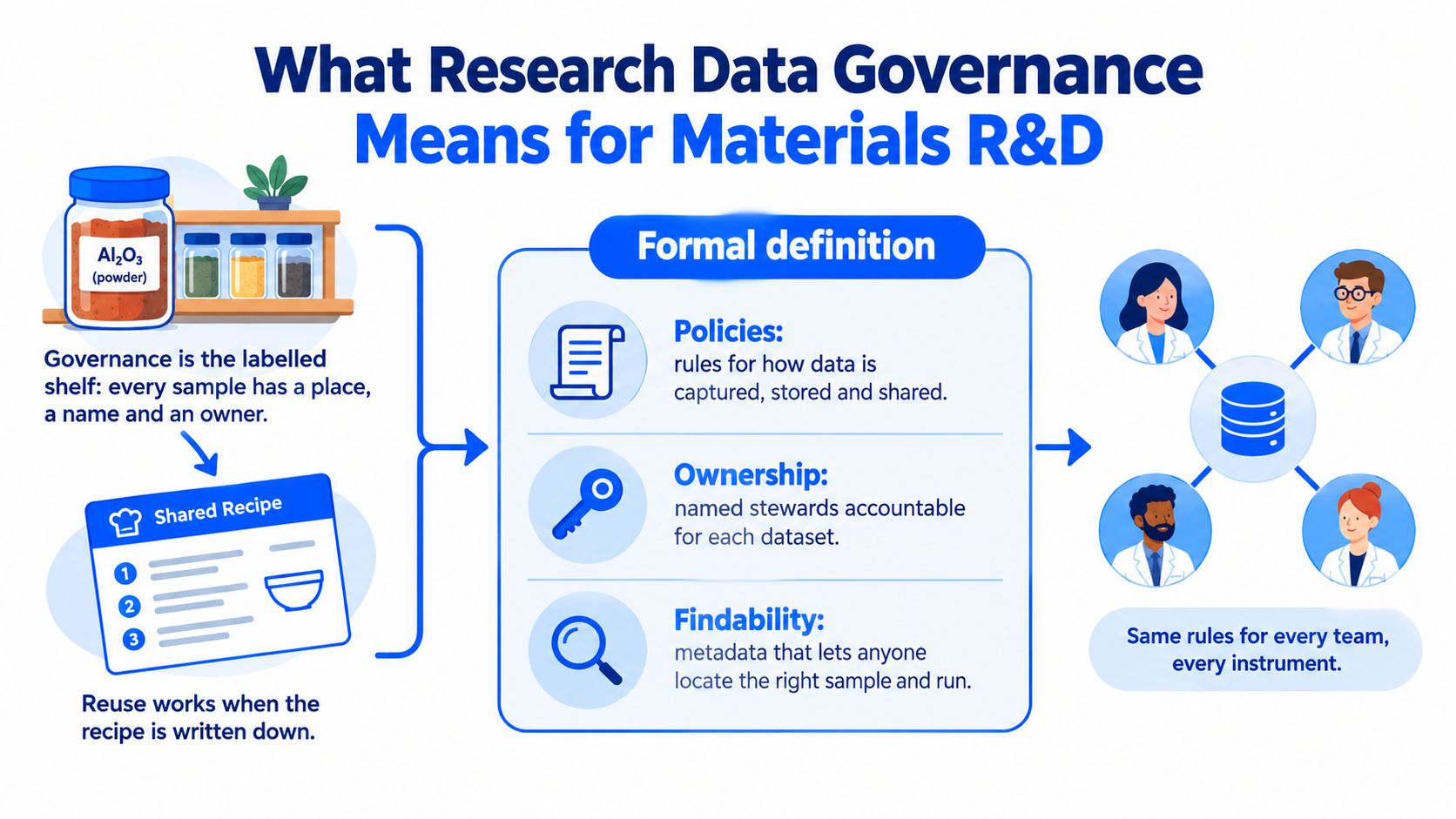
Think of governance like the labeled shelving system in a busy lab storeroom. Storage alone means boxes exist somewhere. Governance means every box has a name, an owner, a location, handling rules, and enough description that another scientist can retrieve the right one without guessing.
That same idea applies to data.
A practical definition
Research data governance is the set of rules, roles, standards, and controls that determine how research data is captured, described, reviewed, stored, accessed, shared, and reused across its lifecycle.
That definition sounds formal, but the day-to-day version is simpler. Governance answers questions such as:
- What counts as the official record?
- Who is responsible for dataset quality?
- Which metadata must be recorded for each experiment?
- Where should raw and processed files live?
- Who can see, edit, export, or share the data?
If those questions don't have clear answers, teams rely on habit. Habit works inside one scientist's notebook. It breaks across programs, sites, and years.
Why storage and backup aren't enough
Many teams confuse governance with IT hygiene. Backups matter. Repositories matter. But neither tells you whether a tensile result is linked to the correct resin batch, cure profile, specimen geometry, or software version used for analysis.
Governance sits above storage. It creates the operating rules that make data usable later.
A simple comparison helps:
| Situation | What you have | What you don't have |
|---|---|---|
| Files saved to a shared drive | Storage | Context, accountability, standard naming |
| Instrument exports copied to ELN | Capture | Cross-project consistency and reuse rules |
| Repository with metadata templates and named stewards | Governed data | Far less ambiguity |
Why FAIR matters in materials work
The FAIR principles gave research organizations a shared language for stewardship. In practice, FAIR means data shouldn't just exist. It should be easy to discover, understand, connect, and reuse.
For materials R&D, that's especially important because datasets are rarely simple. One result may depend on:
- Formulation details such as monomer ratios, additives, solvents, fillers, or catalysts
- Process history such as mixing order, shear conditions, temperatures, dwell times, and cure schedules
- Characterization context such as instrument model, calibration state, test method, atmosphere, and sample preparation
If you miss any of that, reuse becomes guesswork.
Practical rule: If another scientist can't understand a dataset without emailing the original author, the data isn't governed well enough for AI or broad reuse.
Benefits and Risks of Strong Versus Weak Governance
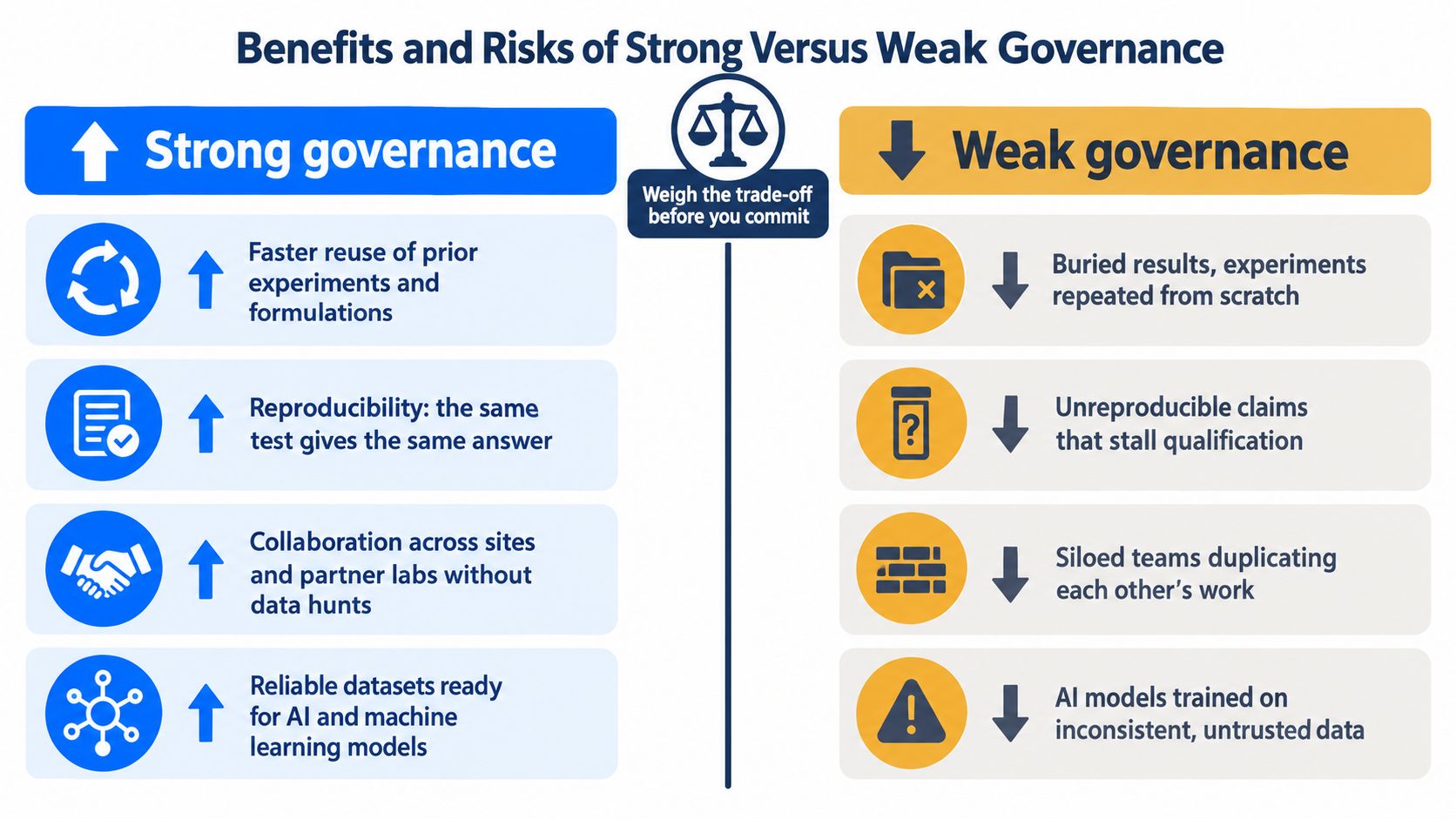
When leaders hear “governance,” they often think of slower work. In research settings, weak governance is what usually slows work down. Scientists spend time hunting, reconciling, rechecking, and rerunning because the record can't support confident reuse.
Strong governance changes the economics of experimentation.
What strong governance unlocks
In practical lab terms, governed data gives teams four advantages.
- Faster reuse: Scientists can find previous work and understand whether it applies to a new project.
- Better reproducibility: Colleagues can rerun methods because the original conditions and transformations were recorded.
- Cleaner collaboration: Internal groups and external partners can work from a shared record rather than conflicting local copies.
- More reliable AI input: Models can train on structured experimental histories instead of a patchwork of loosely documented files.
At the enterprise level, governance is now mainstream, but maturity is still uneven. An industry summary reports that 65% of organizations had implemented data governance programs by 2023, up from 52% in 2020, while only 3% of companies' data met basic governance standards in a 2022 survey of 2,400 executives. The same summary says poor data quality costs organizations an average of $12.9 million annually and notes that 68 nations and the EU are actively governing data used to create AI and other data-driven technologies, according to this data governance statistics roundup.
That combination should sound familiar to R&D leaders. Governance is widely recognized as necessary, yet many organizations still don't have data that's consistently ready for reuse or AI.
What weak governance costs
Weak governance usually doesn't fail loudly. It leaks value across projects.
A few common failure modes:
- Buried results: A team repeats a screening campaign because nobody trusts the old naming convention.
- Unstable conclusions: A scale-up decision stalls because sample lineage can't be reconstructed cleanly.
- Siloed know-how: One site learns a formulation lesson that never becomes reusable institutional knowledge.
- Fragile AI efforts: A model appears to perform well until scientists notice the training data mixed incompatible test methods.
Here's the trade-off in plain language: governance adds discipline early so teams can move faster later.
Warning signs worth taking seriously
If you're trying to judge whether governance is already a problem, listen for phrases like:
“I know the data exists somewhere.”
“We have the file, but not the conditions.”
“We can't use that dataset in the model because we don't know how it was processed.”
Those aren't minor annoyances. They're symptoms that experimental knowledge isn't turning into durable R&D capability.
Core Components That Make Governance Work
Good governance isn't a single policy document. It's a working system. In materials R&D, that system only holds if several parts support each other. Miss one, and the rest starts to wobble.
The seven components
Start with policies and ownership. Every dataset class needs rules for capture, review, retention, and sharing, but rules alone aren't enough. Someone has to be accountable. If ownership is vague, quality drift is almost guaranteed.
Then define roles and stewardship. Principal investigators, lab managers, data stewards, informatics leads, and IT all touch the lifecycle differently. One reason governance programs stall is that everyone assumes someone else owns the handoff.
The operational side also depends on metadata standards. In materials work, metadata should cover identifiers, compositions, units, batch relationships, processing conditions, instrument context, and method versions. Consistent templates matter because two technically correct datasets can still be unusable together if one records temperature in a free-text note and the other uses structured fields.
Storage and retention come next. Teams need an agreed system of record for raw files, processed outputs, and reportable results. Retention rules should say what gets preserved, for how long, and in which repository.
Quality and validation act as the gate before data becomes part of the trusted record. That can include template checks, unit normalization, method review, or approval steps before datasets are reused broadly.
Access and sharing determine who can see what, who can export it, and under which conditions collaboration happens. This matters in industrial R&D, where broad reuse and IP protection have to coexist.
Finally, training and culture keep the system alive. Scientists won't adopt governance because a slide deck exists. They adopt it when templates are usable, responsibilities are clear, and the workflow saves them time.
Why metadata and provenance are the backbone
Among all components, two deserve special attention: metadata and provenance.
NIST's Research Data Framework states that metadata define, describe, and link datasets to other datasets, while provenance captures historical information about the data and the experimental conditions used to generate it, as described in this NIST-aligned governance and metadata standards document.
For materials teams, provenance should capture at ingestion:
- Source information such as instrument, operator, or upstream batch
- Processing steps such as smoothing, normalization, filtering, or feature extraction
- Software and environment context including analysis scripts or platform version
- Experimental conditions such as atmosphere, ramp rate, test standard, and specimen prep
If that information is reconstructed later, errors creep in fast.
Governance fails when operations stay vague
Many strategy documents break. They describe principles well, but they don't convert them into operating habits. Teams trying to make that transition often benefit from frameworks focused on closing the strategy gap, especially when they need to turn policy into named owners, review routines, and measurable controls.
A governance system works when each component answers a daily lab question clearly, not when the policy sounds impressive.
Implementation Roadmap and KPIs for R&D Teams
Most governance programs fail by trying to fix everything at once. A better approach is to start where reuse pain is highest, create a few standards that stick, and then expand.
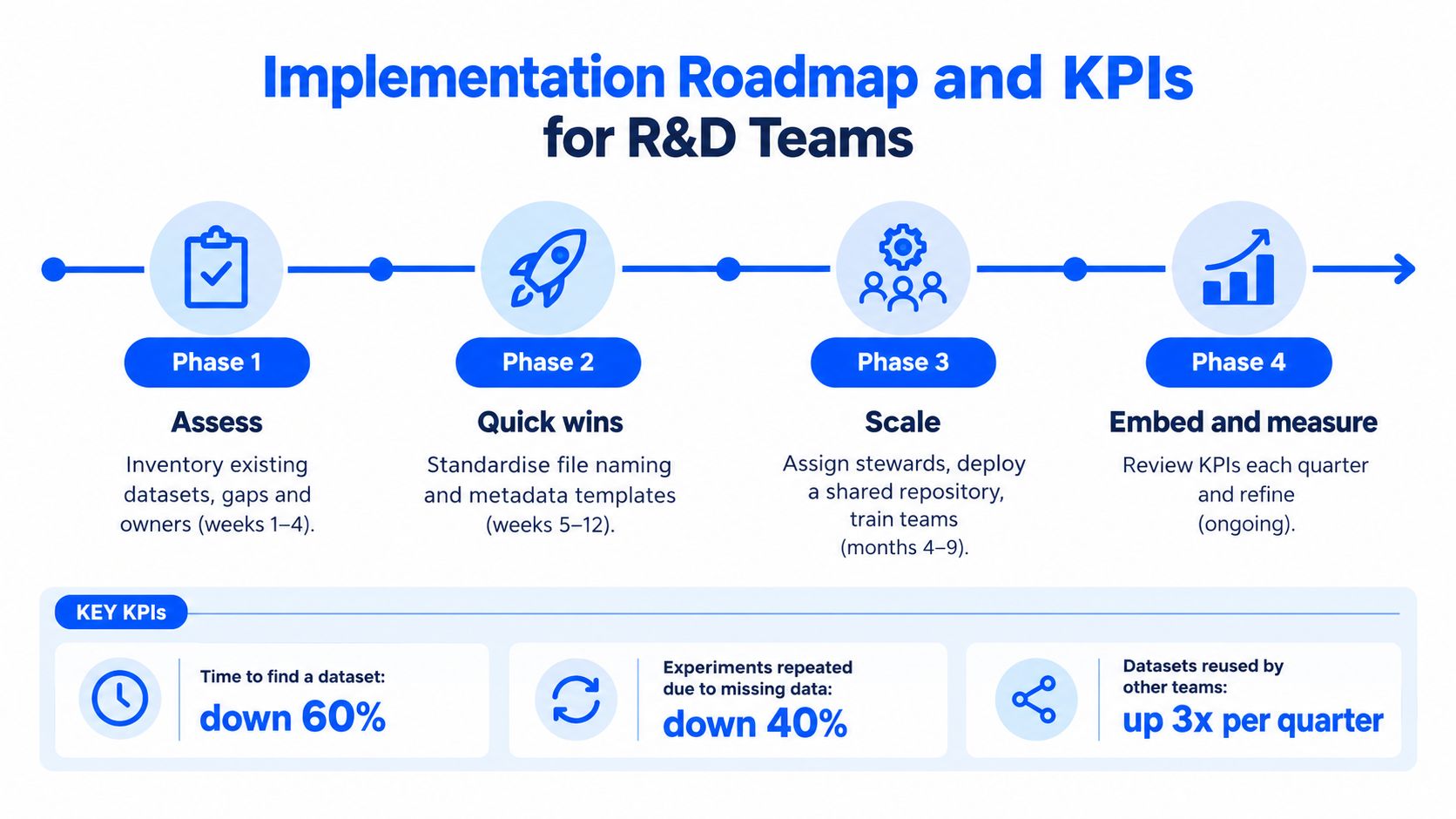
Use a phased roadmap.
Phase 1 and Phase 2
Phase 1 is assessment. Inventory the datasets you already depend on for decision-making. Don't start with every file in the company. Start with the data used for formulation choices, qualification decisions, and model training.
Map each dataset against a short set of questions:
- Owner: Who is accountable for it?
- Location: Where is the authoritative version?
- Structure: What metadata exists today?
- Trust: Can another team interpret and reuse it?
Phase 2 is quick wins. Naming conventions, sample identifiers, metadata templates, and minimum required fields start paying back quickly. Pick one or two high-value workflows, such as thermal characterization or formulation screening, and standardize them first.
A practical target is to make every new dataset more reusable than the last one, rather than cleaning all historical data at once.
Phase 3 and Phase 4
The next phase is scale. Assign stewards by data domain, centralize the system of record, and connect instruments, ELNs, and analysis outputs where possible. This is also the point where some teams evaluate platforms that unify experimental records, metadata, and permissions. In materials R&D, one example is Polymerize, which centralizes fragmented experimental data into a structured backbone for reuse and AI preparation.
This phase should also reflect external expectations. The FAIR principles require detailed provenance, and the NIH data management and sharing policy expects applicants to specify data types, standards, preservation timelines, access and reuse conditions, and responsible oversight. OECD guidance similarly emphasizes transparent access mechanisms and clear stewardship responsibilities, as summarized in NIST Special Publication 1500-18r2.
The final phase is ongoing review. Governance has to be measured or it drifts.
A short training primer can help teams align terminology and rollout expectations:
KPIs that are worth tracking
Avoid vanity metrics like “number of policies written.” Track indicators that reveal whether data is becoming more usable.
| KPI | What it tells you |
|---|---|
| Dataset find time | Whether scientists can retrieve the right record quickly |
| Metadata completeness | Whether required scientific context is being captured |
| Provenance coverage | Whether raw-to-processed lineage is traceable |
| Cross-team reuse frequency | Whether data is actually supporting new work |
| Access request turnaround | Whether collaboration is frictionless but controlled |
| Model-ready dataset count | Whether AI programs have trustworthy inputs |
Measure behavior, not paperwork. A governance program is healthy when scientists can find, interpret, and reuse data with less back-and-forth.
Common Pitfalls and How to Avoid Them
One of the most common mistakes is assuming that a formal policy equals functioning governance. It doesn't. A policy can be perfectly written and still fail the first time a scientist needs to transfer a dataset to another site or explain how a processed result was produced.
The gap usually appears in daily workflow.
Pitfall one to three
Pitfall one is diffuse accountability. Institutions often put heavy responsibility on researchers while leaving support structures unclear. Recent analysis of scientific governance practice highlights fragmentation, inconsistent practices, insufficient security, and ambiguity around support, hosting, ethics pathways, and transfer rules in real research environments, as discussed in this CODATA article on governance fragmentation.
Avoid that by naming a steward for each major data domain and documenting who handles review, repository administration, sharing approvals, and retention decisions.
Pitfall two is treating metadata as clerical work. Scientists often defer documentation until the end of a project. By then, key details are gone. The fix is to capture required context at the point of data creation or ingestion, using templates that match the actual experiment.
Pitfall three is designing governance away from the bench. If templates don't fit how a chemist runs a formulation screen or how an engineer records process conditions, people will route around the system. Build standards around real workflows, not idealized ones.
Pitfall four and five
Another trap is overestimating maturity, especially when AI programs start. A 2025 study found that 83% of enterprise respondents faced governance and compliance challenges even though they rated their maturity at 4.13 out of 5. The same study reported that only 17% had fully implemented AI governance frameworks and less than 35% had compliance automation in place, according to the Actian study on governance maturity and AI risk.
That matters because teams often confuse isolated successes with operational readiness. A few well-curated pilot datasets do not mean the broader experimental record is ready for model development.
A final pitfall is thinking governance can be added later. It usually can't, at least not cheaply. Once sample lineage and processing history are lost, no policy can recover them perfectly.
Real World Examples of Governance in Materials R&D
Consider a polymer formulation group working across three sites. One site develops new resin blends, another runs rheology and thermal testing, and a third handles pilot processing. Before governance, each site records sample identity differently. One tracks batch codes by project, another by instrument sequence, and the pilot team renames material after extrusion. The science is real, but the chain connecting formulation to properties is fragile.
A governed setup changes that.
Example one from formulation to characterization
The team starts by assigning one persistent sample identifier at formulation creation. That identifier follows the material through mixing, curing, characterization, and scale-up. Every record includes structured metadata for composition, additive levels, lot information, process conditions, and test method version.
Now when a scientist looks at a DMA curve, they can also see:
- which formulation generated it
- which specimen prep route was used
- what cure schedule was applied
- whether the curve came from a raw export or a processed file
That makes the dataset reusable for both human comparison and model training.
Example two for AI readiness
Now take a battery materials program trying to build a model for cycle stability. Without governance, the dataset may blend coin cells made with slightly different drying protocols, electrolyte naming conventions, and formation schedules. The model learns patterns, but nobody can tell whether those patterns reflect chemistry or documentation noise.
With governance, provenance is captured at ingestion. The team links raw cycler files to electrode batch, slurry composition, coating conditions, drying profile, cell assembly route, and analysis script version. When the model identifies a promising factor, scientists can inspect the underlying history instead of treating the output like a black box.
AI for experimental science is only as trustworthy as the lineage behind the training data.
Example three for collaboration and protection
Governance also helps when external partners are involved. A ceramics company might want one supplier to view test summaries but not full formulation details. Role-based access solves that by exposing the right layer of data to the right user. Internal teams keep the complete scientific record. Partners see only what the collaboration requires.
This is also where platform design matters. Teams often need a combination of centralized records, structured metadata, permission controls, and explainable model outputs. In environments like Polymerize Connect, Labs, and One, the point isn't just data collection. It's creating a traceable path from experiment to insight to next experiment, without losing ownership or context along the way.
When governance works well, the change feels almost boring. Scientists stop asking where the data is and start asking what the data means.
Conclusion Your Next Steps Toward Trusted AI Ready Data
Research data governance sounds abstract until you view it from the bench. Then it becomes concrete very quickly. It's the difference between a result that sits in a folder and a result that can be found, trusted, reused, and learned from.
For materials R&D teams, that difference is now strategic. AI models, cross-site collaboration, and faster scale-up all depend on experimental data that carries context with it. Not just numbers, but lineage. Not just files, but metadata. Not just storage, but stewardship.
If you're deciding where to begin, keep the checklist short:
- Identify one high-value workflow where poor data reuse is already slowing work.
- Define the minimum metadata and provenance required for that workflow.
- Name accountable stewards for the datasets that matter most.
- Choose KPIs tied to usability such as findability, completeness, and reuse.
- Build governance into daily capture rather than trying to reconstruct it later.
The main point is simple. Governance isn't bureaucracy added on top of science. It's the operating discipline that turns experimental history into a reliable foundation for future decisions.
Teams that do this well don't just become more compliant. They become easier to collaborate with, easier to scale, and far better prepared for explainable, trustworthy AI.
Polymerize helps materials R&D teams turn fragmented experimental records across spreadsheets, ELNs, and lab silos into a centralized, governed data backbone that's ready for reuse and AI. If you're working to connect provenance, metadata, access control, and explainable modeling in one environment, visit Polymerize to see how that approach fits materials discovery and scale-up.
Put your R&D data to work
See how materials teams use Polymerize to plan fewer experiments and reach target properties faster.