
In 72.2% of organizations in a 2017 study of 36 established R&D departments, information-management problems and loss of essential knowledge followed when key employees left. The same study found that 66.7% of those organizations needed several days before a new hire could acquire the relevant R&D knowledge, because it wasn't sitting in a system anyone else could open.
A formulation chemist leaves on a Friday. The next Monday a colleague opens a folder named "final" and finds a property table, a photo of a DSC curve, and a note that says "try the slower ramp." Nobody can tell which grade, which lot, which oven, or why the earlier ratio was abandoned. The experiment gets run again. That is the cost of knowledge that lives in a person's head.
R&D knowledge management is the practice of making a record trustworthy enough that someone who wasn't in the room can tell what was measured, under which conditions, and whether it can be relied on. Storage location is the easy part. Trust is the job.
Table of Contents
- What R&D Knowledge Management Covers and Why It Matters
- Knowledge Types to Capture and Where Each Belongs
- How to Build a Capture Routine for Every Experiment
- Keeping Experimental Records Reproducible and Auditable
- Deciding Which Legacy Results Are Safe to Reuse
- Connecting Tools and Teams Without Replacing Them
- Confirm Your Knowledge Gaps Before Choosing a Platform
What R&D Knowledge Management Covers and Why It Matters
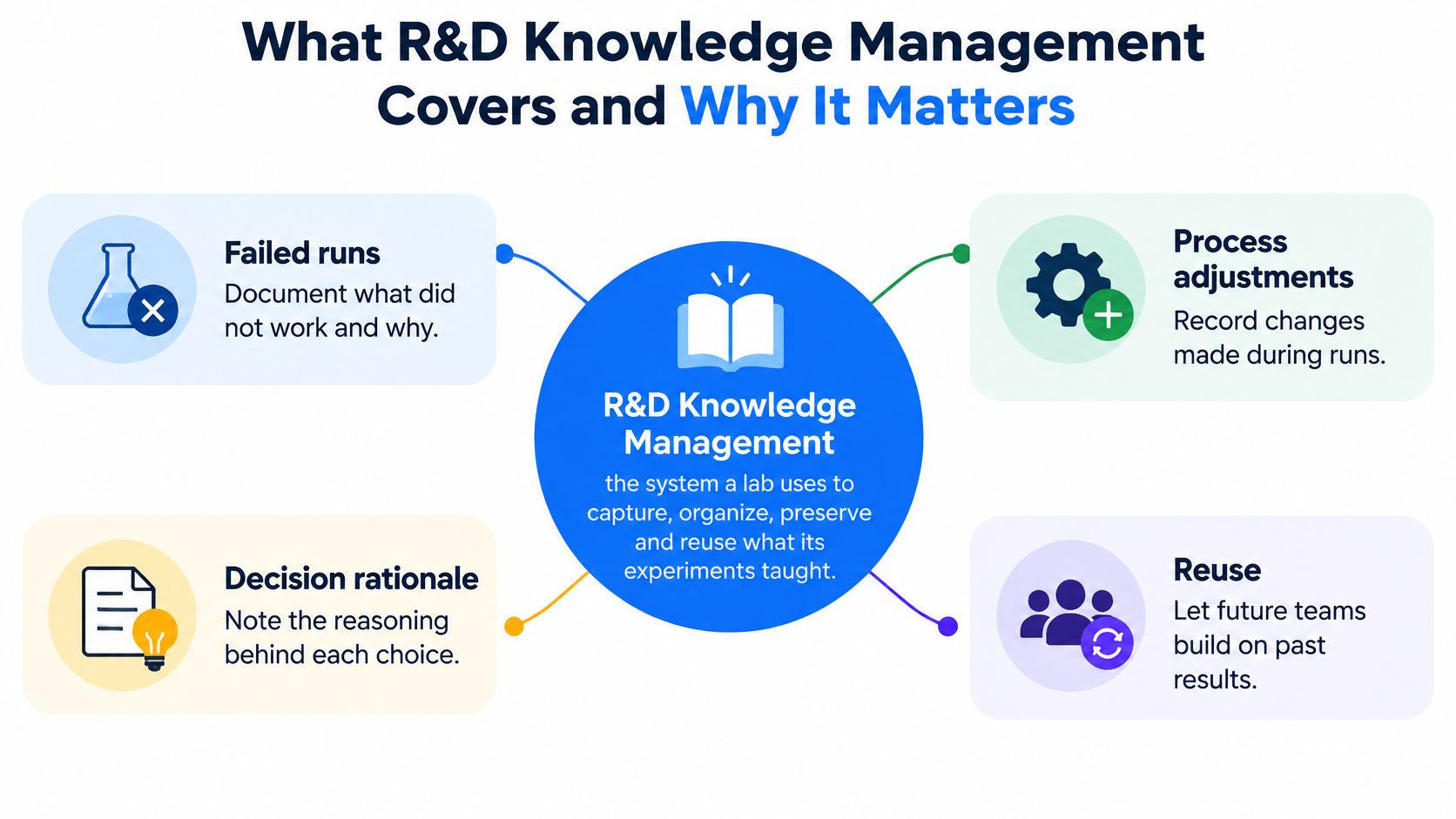
Treat R&D knowledge management as the system a lab uses to capture, organize, preserve, and reuse what its experiments taught. That includes failed runs, process adjustments, and the reason a decision was made, not only the slide that went to management.
A head chef who keeps the house recipe in memory takes the dish with them when they leave. The useful version is written down, the jars are labeled, and the note says what burned last time. Labs lose the same three things when they skip that work.
Repeated experiments come first. If the off-spec batch isn't findable, the next chemist rediscovers the same miss. Slow onboarding comes next, which is why new people spend days reconstructing what a method already knew. Tacit adjustments go last and hurt most: a mixing-order change, an oven-ramp tweak, a hold time that only one operator remembered. Those details don't survive a resignation.
The same study is a modest sample, so those percentages are diagnostic signals, not universal benchmarks. Half of the respondents still named unwillingness to share as the biggest cultural barrier, and 83.3% of the organizations spent less than 5% of expenditure on knowledge management. Money and culture both fail before the software does.
What a system cannot fix
A database won't make a scientist write down a deviation they consider obvious. We built Polymerize because scientists were losing insights in spreadsheet graveyards and repeating experiments that had already been run. Software can hold the record. It can't supply the habit, the vocabulary, or the approval that says a result is fit to reuse. The practical work is what to capture, how to record it so another person can verify it, and which older results are safe to build on.
Knowledge Types to Capture and Where Each Belongs
Six kinds of knowledge show up in a materials lab, and each one has a home. If you drop every row into one shared drive, search gets worse, not better.
| Knowledge type | Typical examples | Home system |
|---|---|---|
| Final results | Property tables, release decisions | Database or LIMS |
| Failed experiments | Off-spec formulations, aborted runs | Shared experiment database |
| Tacit process adjustments | Mixing order changes, oven ramp tweaks | ELN entry tied to the method |
| Raw instrument files | Spectra, micrographs, DSC curves | Instrument store or data lake with record IDs |
| Decisions and rationale | Why a formulation was dropped or scaled | Project wiki linked to results |
| Supplier and grade data | Lot numbers, certificates, grade codes | Materials master list |
Start with what teams skip
Final property tables usually get saved, because someone has to report them. Failed experiments and tacit adjustments usually don't. A formulation that missed spec tells the next chemist which ratio to avoid, so it is worth as much as the success that followed. An oven ramp written only in a lab notebook is gone the week that notebook stays on a desk.
Practical rule: If losing it would force a repeat run, it gets a named home before the project ends.
No single tool holds every row well. A LIMS is a poor place for a paragraph about why scale-up was deferred. A wiki is a poor place for a raw spectrum. Mapping each type to one home stops the gap where the number lives in one system and the reason lives in another.
How to use the map
When a record is created, name its type before you pick the folder. Tie the ELN note to the method ID, not to a person's name. Point the wiki decision at the result IDs it rests on. Keep lot numbers on the materials master list so every formulation row can look them up instead of retyping them. The capture routine and the audit checks that follow both assume this map is already agreed.
How to Build a Capture Routine for Every Experiment
A useful minimum metadata model for materials work covers persistent identifiers, units, instrument and method details, processing conditions, provenance, and links from raw measurements to derived results and decisions. A Scientific Data paper on materials metadata frames that set as the practical way to make records findable, accessible, interoperable, and reusable. For polymers, a hierarchical schema should also hold grades, ratios, processing history, specimen prep, test conditions, properties, and uncertainty. Without shared terms, the same word can mean different units or material states, and models inherit the mistake.
The routine
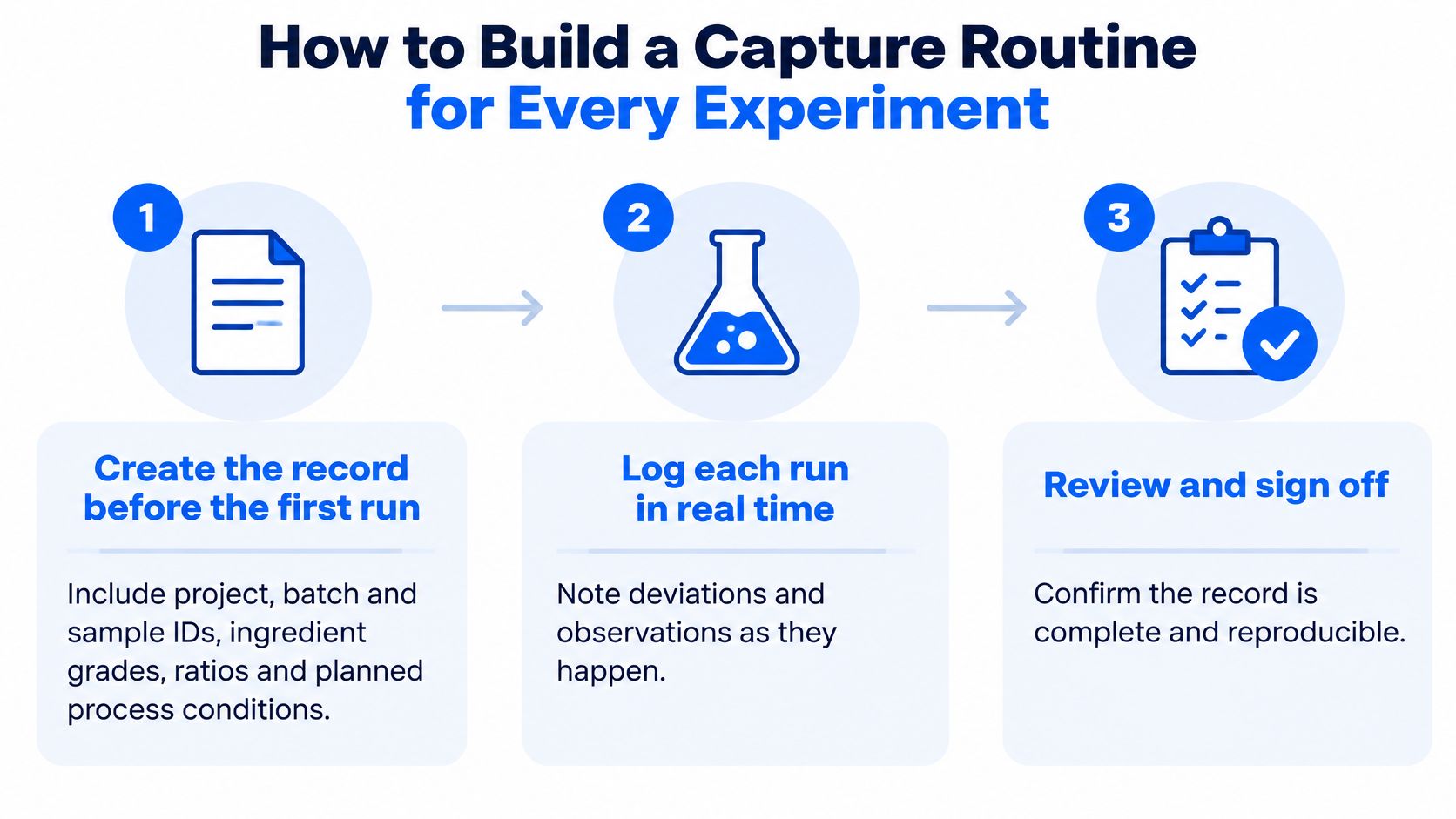
- Open the record before the first run. A note written afterward loses grades and ratios. Capture project, batch, and sample IDs, ingredient grades, ratios, and the planned process conditions. Make those fields mandatory at creation, and assign an immutable record ID.
- Put units and instrument settings on the measurement itself. A bare "45" can be °C, minutes, or shore hardness. Store method, calibration state, and unit in the same entry as the value.
- Save raw files unmodified, then log the file name, save time, and a checksum. Derived numbers can be recomputed. Edited raw data cannot be trusted. Record provenance for every later transformation, including code or workflow version.
- Write deviations at the bench, with the time and the reason. Memory of a changed step fades within days. "Held an extra 8 min because the melt looked grainy" is a record. "Adjusted process" is not.
- Enter the outcome, pass or fail, and the cause if you know it. Failures stay in the shared experiment database, not in a personal "didn't work" tab.
- Link the decision and the approver within a week. If scale-up waits a month for a rationale, the rationale will be reconstructed.
- Tag ingredients and test methods with controlled vocabulary. Searches should return one material under one name, not five spellings of the same grade.
What complete looks like
The common slip is "add 3 phr polymer," with no grade and no conditions. A complete line reads: Polymer P-114, grade G2, lot L-2291, 3 phr of resin, mixed at 40 rpm for 12 min at 23 °C, DSC run with the calibration check logged. A colleague can rebuild that step without calling the author. That is the difference between a file and a scientific record.
Keeping Experimental Records Reproducible and Auditable
Can a colleague who wasn't present rebuild the result from the record alone? If the answer is no, the record isn't knowledge yet. It's a prompt for a conversation.
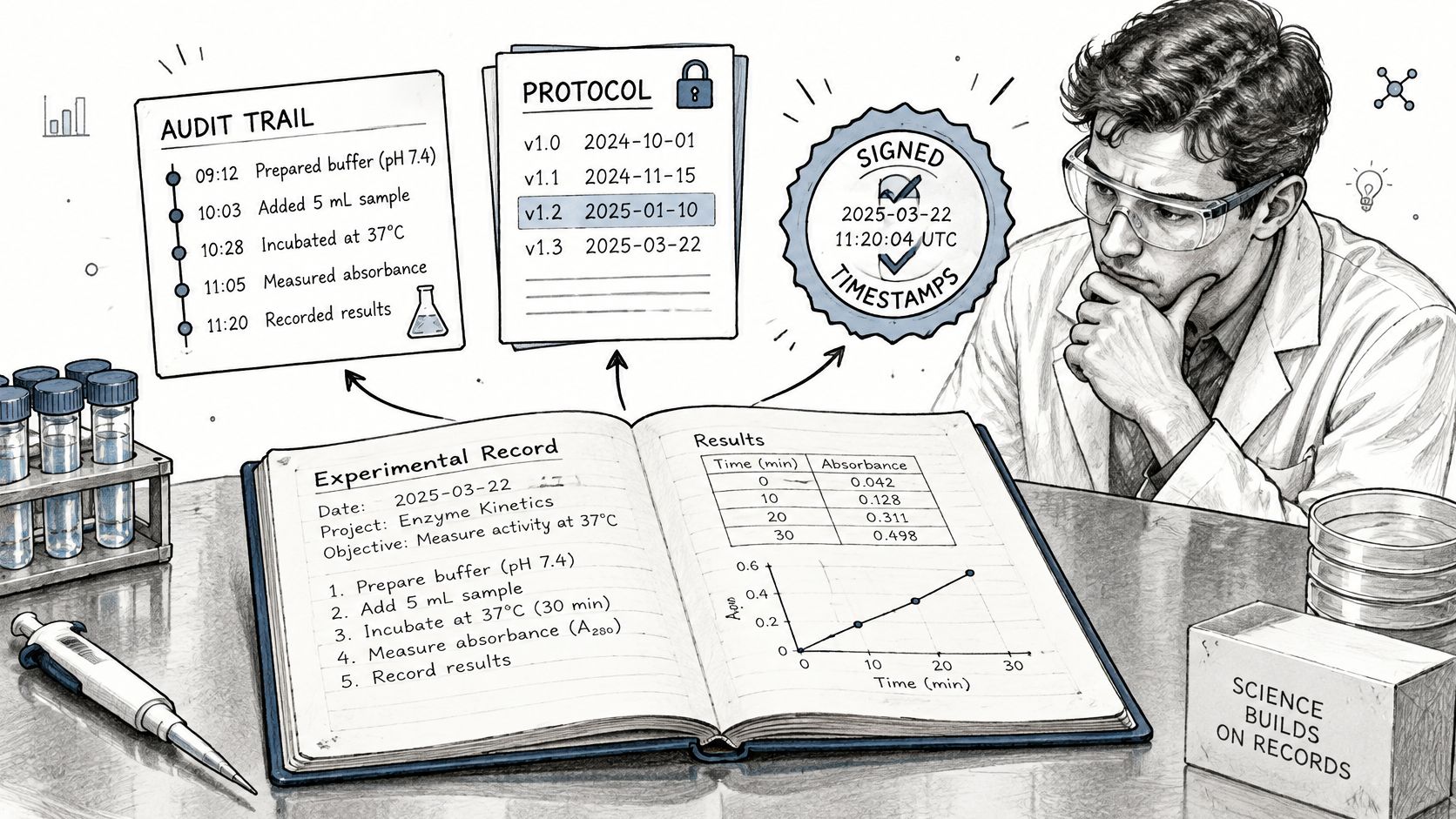
Three controls make a yes possible. An immutable audit trail logs every change to values and files. Checksums, or an equivalent tamper check, show whether a raw file still matches what was saved. Structured metadata stores each measurement as a property, a value, and a unit, so "modulus" can't change meaning between sheets.
A pattern that already works
An experimental materials-science electronic lab notebook described in Advanced Engineering Materials stores measurements as explicit property–value–unit tuples, detects file changes with checksums, and exports a whole project as an RO-Crate with a JSON-LD manifest. When raw files, identifiers, units, and provenance travel together, another scientist or a downstream model can see what was measured, under which conditions, and whether the file changed. When those pieces sit in spreadsheets, instrument PCs, and personal folders, reuse means retyping, and transcription and version errors come with it.
Before a result is released, check four things against the capture routine: batch and sample IDs, calibration and instrument state, a version on every calculation or model, and a dated, role-based approval. Failed runs stay beside the successes. The same packaging habits that make a project exportable also support keeping project files secure and shareable when more than one site needs the record.
Scale-up is where this pays. Two tensile results can look alike and still be incomparable if one used a different strain rate or an unlogged conditioning step. Algorithms, and people, can only separate comparable experiments from lookalikes when method and state travel with the number.
Deciding Which Legacy Results Are Safe to Reuse
A central repository doesn't make a result true. Materials-characterization analyses reportedly contain errors in 20–30% of cases, and the underlying data are often noisy, incomplete, inconsistent, and hard to compare across laboratories, as a 2025 materials-science review lays out. Trust has to be graded.
What you want is a governed data trail: provenance, metadata, version history, uncertainty, validation status, and a named person who is accountable. Quality, in that framing, means completeness, accuracy, consistency, and timeliness, plus enough context to explain a number and to show it meets the rules you set.
| Evidence grade | What it requires | Reuse rule |
|---|---|---|
| A: Verified | Independent repeat, documented calibration, units checked | Reuse for scale-up and specification decisions |
| B: Replicated | Two or more runs, method recorded, uncertainty stated | Reuse for screening and model training |
| C: Single run | One run with method partly recorded | Use only to suggest the next experiments |
| D: Unverified | Missing units, unknown instrument state, or AI-derived without review | Quarantine until checked |
Rules to write down
Trust isn't binary. A single-run result can still point at the next experiment. It should not set a production specification.
- Reuse threshold: State which grade may enter a scale-up pack. Grade C stays in the lab notebook of ideas.
- Contradictions: When two labs disagree, keep both measurements, record the method difference, and don't average them into a false precision.
- Synthetic and model output: Label AI-generated or synthetic rows at creation. They don't become Grade A because a dashboard looks clean.
- Approval: Name who may promote a result before it is treated as a basis for scale-up. The rule matters more than the software that enforces it.
A plausible curve with no units, no instrument state, and no owner is not a legacy asset. It is a risk with a file name.
Connecting Tools and Teams Without Replacing Them
Spreadsheets, ELNs, simulation tools, plant historians, supplier files, and the systems you inherited in an acquisition don't share a format. Entries are incomplete. The same additive has three names. A recent review of data practice in the National Science Review treats heterogeneous formats, incomplete entries, and semantic inconsistencies as structural barriers: consolidation gets expensive, and reuse stays unreliable. Cleaning a project only after it ends is the expensive version of the same mistake. Link and structure the data while the work is happening.
The higher-value spend is usually connective infrastructure, shared metadata, and incentives, not a more advanced model. That holds in data-poor chemical spaces too. Standardized records and negative results improve the next experiment even when the set is too small for a broad AI claim.
A phased roadmap
- Map the sources that hold results. Include the instrument PCs and the spreadsheets everyone insists are temporary.
- Agree minimum metadata and a controlled vocabulary. Name one owner for the shared taxonomy. Committees without an owner drift.
- Connect, don't migrate. APIs or scheduled exports beat a big-bang replacement that scientists will route around.
- Leave local workflows in place. People keep the ELN or the instrument software they already trust.
- Measure outcomes, not logins. Count failed experiments avoided, cycle time, reproducibility, and lab-to-production transfers that succeed.
Proprietary formulations need tiered access. A partner can see a test method and a pass/fail without seeing the full recipe. Put a named budget line and an owner on the connectors before the first integration is built. Adoption fails when knowledge management is an unfunded side task.
Confirm Your Knowledge Gaps Before Choosing a Platform
Pick the last three completed projects and walk each one through the six knowledge types. Mark every type retrievable, partly retrievable, or lost. Then count how many results a colleague could not rebuild from the record alone.
Rank the gaps by what they cost. A lost failed formulation means a repeated campaign. A missing approval trail means a delayed scale-up. A missing lot number means a quality argument you can't settle.
Match the gap to the fix
- Capture gaps are habit and fields. Mandatory IDs, units, and a bench note for deviations can be built on the ELN and LIMS you already run. Buying a platform won't write the deviation nobody logged.
- Verification gaps need checksums, versioned calculations, and role-based release across sites. That is harder to fake with shared folders.
- Connection gaps sit between systems. Exports and a shared vocabulary come before any new model.
Build internally when the audit says the holes are habits. Evaluate a platform when results can't cross sites, or when approval and audit have to span geographies. Score every option, including an internal build, on the same list: interoperability with current tools, role-based access, an export such as RO-Crate, and whether failed runs are first-class records.
Polymerize Connect, a centralized data backbone that unifies experiments, formulations, and results for every team and geography, is one option to score on that list. Polymerize reports 500+ R&D teams across 12 industries as its users. Finish the audit before any purchase conversation. A platform chosen to impress a steering committee will not repair a method that still says "add 3 phr polymer."
Polymerize gives materials teams a single, governed place for experiments, formulations, and results, so the next project can see what was measured, under which conditions, and whether it is safe to reuse. If repeated runs and spreadsheet graveyards are costing your lab time, see how Polymerize structures that record before you buy another disconnected tool.
Put your R&D data to work
See how materials teams use Polymerize to plan fewer experiments and reach target properties faster.