

Your team probably already feels the problem. One formulation scientist logs process conditions in a spreadsheet. Another stores spectroscopy files in a shared drive. A pilot plant engineer adds scale-up notes in an ELN. Six months later, someone tries to train a model or reproduce a promising result and discovers that half the context lives in disconnected systems, the units aren't consistent, and the protocol version is unclear.
That isn't just messy documentation. It's a structural barrier to faster R&D, reliable scale-up, and any serious AI program. In materials organizations, protocol standardization is the work of turning experiments into a system instead of a trail of artifacts. Done well, it gives teams a common design language for how experiments are planned, executed, captured, and reused.
Table of Contents
- The real cost shows up in daily decisions
- Why this is a strategy problem, not a documentation problem
- Start with a protocol portfolio audit
- Design templates that machines can use
- Embed standards inside daily lab tools
- Govern versioning and drift
The High Cost of Inconsistent R&D Data
Most materials R&D groups don't suffer from a lack of experiments. They suffer from a lack of usable experiment history. Valuable work exists, but it's scattered across spreadsheets, ELNs, instrument exports, slide decks, and legacy databases that were never designed to work together.
That fragmentation changes how teams operate. Scientists repeat work because prior runs can't be found or trusted. Process engineers inherit incomplete handoffs. Data teams spend more time cleaning records than learning from them. The organization keeps generating data, but not knowledge.
A core issue is that many labs standardize reporting after the experiment, while the breakdown starts much earlier in experimental design. Existing guidance has noted that 60 to 70% of materials data remains unstructured and incompatible with AI models across spreadsheets, ELNs, and legacy systems, which undermines the AI-ready foundation enterprises need (standardized protocols and KPIs for comparing results and experiments).
The real cost shows up in daily decisions
When protocol fields are optional, scientists interpret them differently. When units aren't enforced, downstream analysis breaks. When sample lineage isn't tied to the procedure used to create it, teams can't tell whether a result changed because of chemistry, equipment, operator judgment, or a hidden protocol change.
Those failures don't always look dramatic. They show up as slower troubleshooting, uncertain model outputs, and meetings where people debate which dataset is “the right one.”
Practical rule: If two scientists can run the same experiment and create records that can't be compared directly, the protocol isn't standardized.
Why this is a strategy problem, not a documentation problem
A lot of organizations treat protocol standardization as lab administration. That's too narrow. In practice, it's the mechanism that converts experimental work into an enterprise asset.
Consider the difference:
| Without protocol standardization | With protocol standardization |
|---|---|
| Data capture depends on individual habits | Data capture follows a defined structure |
| Metadata quality varies by team and site | Required context is captured consistently |
| Analysis starts with cleanup | Analysis starts with comparable records |
| Historical experiments are hard to reuse | Historical experiments become searchable and reusable |
The organizations that make progress here don't begin by trying to standardize everything. They identify the experimental families that matter most to scale-up, customer timelines, quality risk, or model development. Then they standardize those workflows end to end.
That's the shift. Protocol standardization isn't about making labs more bureaucratic. It's about making experimental output usable across people, systems, and time.
Defining Protocol Standardization in Materials R&D
In materials R&D, protocol standardization means defining a repeatable, machine-readable structure for how experiments are designed, executed, captured, and governed. It's less about writing longer instructions and more about creating rules that people and software can both follow.
The easiest analogy comes from networked systems. The historical move from proprietary, isolated systems to universal standards like WiFi and Internet Protocol shows that standardization is what makes large-scale interoperability possible. The same logic applies in R&D, where a centralized, AI-ready data backbone depends on shared rules rather than local conventions (historical shift to universal standards like WiFi and IP).

Protocol standardization is not just a test method
A standard test method tells a scientist how to perform a specific measurement. That matters, but it's only one slice of the problem.
A standardized protocol in a digital R&D environment also defines:
- Experiment intent: what the run is meant to test and under which design assumptions.
- Required inputs: materials, grades, lot identifiers, pretreatment state, and dependencies.
- Controlled variables: what must be fixed, what may vary, and what ranges are acceptable.
- Mandatory metadata: operator, equipment, calibration context, environmental conditions, and sample lineage.
- Result structure: how outputs, units, derived values, and exceptions are recorded.
That's why a conventional SOP and a standardized protocol aren't the same thing. An SOP is often optimized for human compliance. A standardized protocol is optimized for human execution and data interoperability.
What a standardized protocol actually contains
Teams usually get traction when they treat the protocol as a digital object rather than a document. In practical terms, that means it has fields, states, rules, and version history.
A good protocol definition usually includes the following components:
- A template layer that defines the experiment family.
- A parameter layer that specifies variables, units, allowed ranges, and dependencies.
- A metadata layer that captures context needed for comparison and reuse.
- A governance layer that controls versioning, approval, retirement, and exceptions.
Standardization works when it removes avoidable choices. It fails when it adds forms but leaves interpretation untouched.
The mistake I see most often is over-focusing on harmonized testing while leaving experiment setup informal. If the design logic, metadata requirements, and output structure still vary by team, the organization hasn't really standardized the protocol. It has only standardized the final report.
The Strategic Value of Standardized Protocols
Leaders usually approve protocol standardization for one of four reasons. They need faster development cycles, more reliable decisions, smoother scale-up, or cleaner collaboration across sites. In practice, they get all four when the implementation is done well.
The strongest business case comes from reuse. In clinical research, implementing data standards from the protocol stage through analysis has been shown to reduce study start-up times by 70% to 90% because case report forms, edit checks, and validation documentation can be reused rather than rebuilt for each new effort (data standards from protocol stage through analysis). Materials R&D isn't identical, but the operational logic is familiar. Teams move faster when foundational structures are already in place.
Why leadership should care
Standardization changes the economics of experimental work.
Instead of rebuilding naming conventions, result tables, and review logic for each project, teams can start from approved templates. Instead of debating whether two datasets are comparable, they can focus on whether the chemistry is different. Instead of pushing analysts into cleanup mode, they can push them toward interpretation and model development.
The strategic gains usually show up in these areas:
- Speed: Teams spend less time assembling studies and more time running them.
- Reliability: Reproducibility improves because execution and capture rules are explicit.
- Transferability: Methods move more cleanly from discovery to pilot and manufacturing support.
- Collaboration: Global labs can contribute to the same body of evidence without reformatting every handoff.
What changes in day-to-day lab operations
At the bench level, the benefit isn't abstract. Scientists stop guessing which fields matter. Reviewers stop chasing missing metadata after the fact. Data engineers stop building one-off parsing pipelines for every instrument export.
Here's what usually works versus what doesn't:
| What works | What doesn't |
|---|---|
| Reusable templates for common experiment classes | Reinventing protocol structure for each project |
| Mandatory core metadata with limited optional fields | Large free-text sections for critical variables |
| Approved units and controlled vocabularies | Synonyms and local naming habits |
| Shared review criteria across sites | Team-specific acceptance rules |
Leadership test: If your best scientist leaves, the protocol should still produce usable, comparable data.
The deeper value is institutional memory. Standardized protocols preserve how the organization learns, not just what it did once. That matters when product timelines tighten, staff rotate, and AI initiatives depend on consistent historical evidence rather than anecdotes.
Your Framework for Implementing Standardized Protocols
Most protocol standardization programs fail for one simple reason. Teams start by writing standards before they understand where variation is helping and where it's hurting. A workable rollout is narrower and more disciplined.
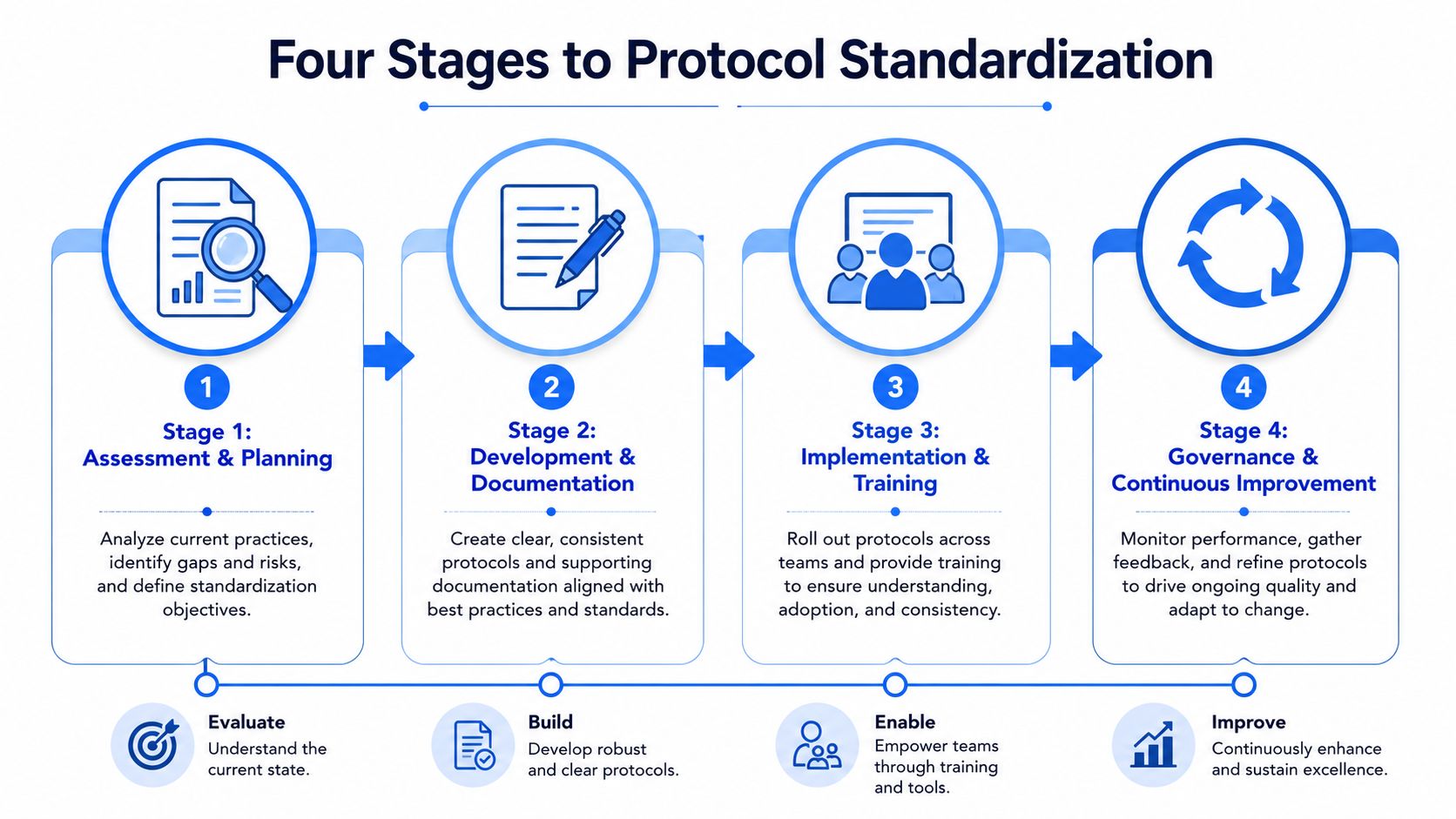
Start with a staged framework. Build around high-value experiment families, encode standards inside lab tools, and put governance in place before the first exception request arrives.
Start with a protocol portfolio audit
Don't begin with every lab. Begin with the workflows that create the most downstream pain.
A useful audit asks:
- Which protocols drive key decisions: formulation release, candidate selection, scale-up, regulatory support.
- Where are repeatability issues showing up: rework, conflicting results, missing metadata, or failed transfers.
- Which experiment classes generate reusable learning: screening, stability, rheology, compounding, aging, or surface treatment.
Map each protocol family against three dimensions: business importance, current variability, and digital maturity. That usually reveals a short list worth standardizing first.
A portfolio view also helps separate healthy scientific flexibility from unhelpful inconsistency. Discovery teams may need freedom in hypothesis generation. They do not need freedom in sample identifiers, unit conventions, or batch traceability.
Design templates that machines can use
Once priorities are clear, define protocol templates as structured assets, not static PDFs.
Strong templates usually specify:
- Required fields: material identity, composition basis, equipment, environmental conditions, operator, and timestamps.
- Controlled vocabularies: approved names for properties, methods, failure modes, and sample states.
- Unit rules: one canonical unit per parameter, with conversion handled systematically.
- Decision logic: acceptable ranges, branching steps, and exception paths.
Many teams often under-design. They document procedure steps but skip data architecture. If the result can't be parsed consistently later, the protocol hasn't solved the underlying issue.
To make the implementation more concrete, it helps to see how teams think about workflow transformation in practice.
Embed standards inside daily lab tools
A protocol standard doesn't stick because it exists in a quality binder. It sticks when the ELN, LIMS, instrument interface, and review workflow enforce it.
That means operators should encounter the standard at the point of work:
- Select an approved protocol template.
- Enter only values allowed for that method or experiment class.
- Complete mandatory metadata before results can be finalized.
- Trigger review and signoff against predefined criteria.
This is also where integrations matter. If balances, reactors, spectrometers, and test rigs all export data differently, the protocol layer needs a common mapping model. Otherwise, scientists will keep repairing records manually after the fact.
Govern versioning and drift
Governance is where mature programs separate themselves from pilot projects. Without it, standards degrade quickly.
Recent industry data indicates that 45% of material testing errors stem from protocol drift or unversioned procedures, and there still isn't a widely adopted framework that pushes versioned, mandatory protocols directly to operator stations with automated audit trails (material testing lab data reliability). That's the practical reason to treat version control as an operational requirement, not a documentation nicety.
A sound governance model includes:
- Change control: who can propose, review, approve, and retire protocol versions.
- Effective dating: when a new version becomes mandatory and for which sites or product families.
- Exception handling: how deviations are recorded, reviewed, and fed back into protocol improvement.
- Auditability: a clear record of which version governed each result.
The fastest way to lose trust in a dataset is to discover that nobody can prove which protocol version produced it.
How Standardization Unlocks AI and Machine Learning
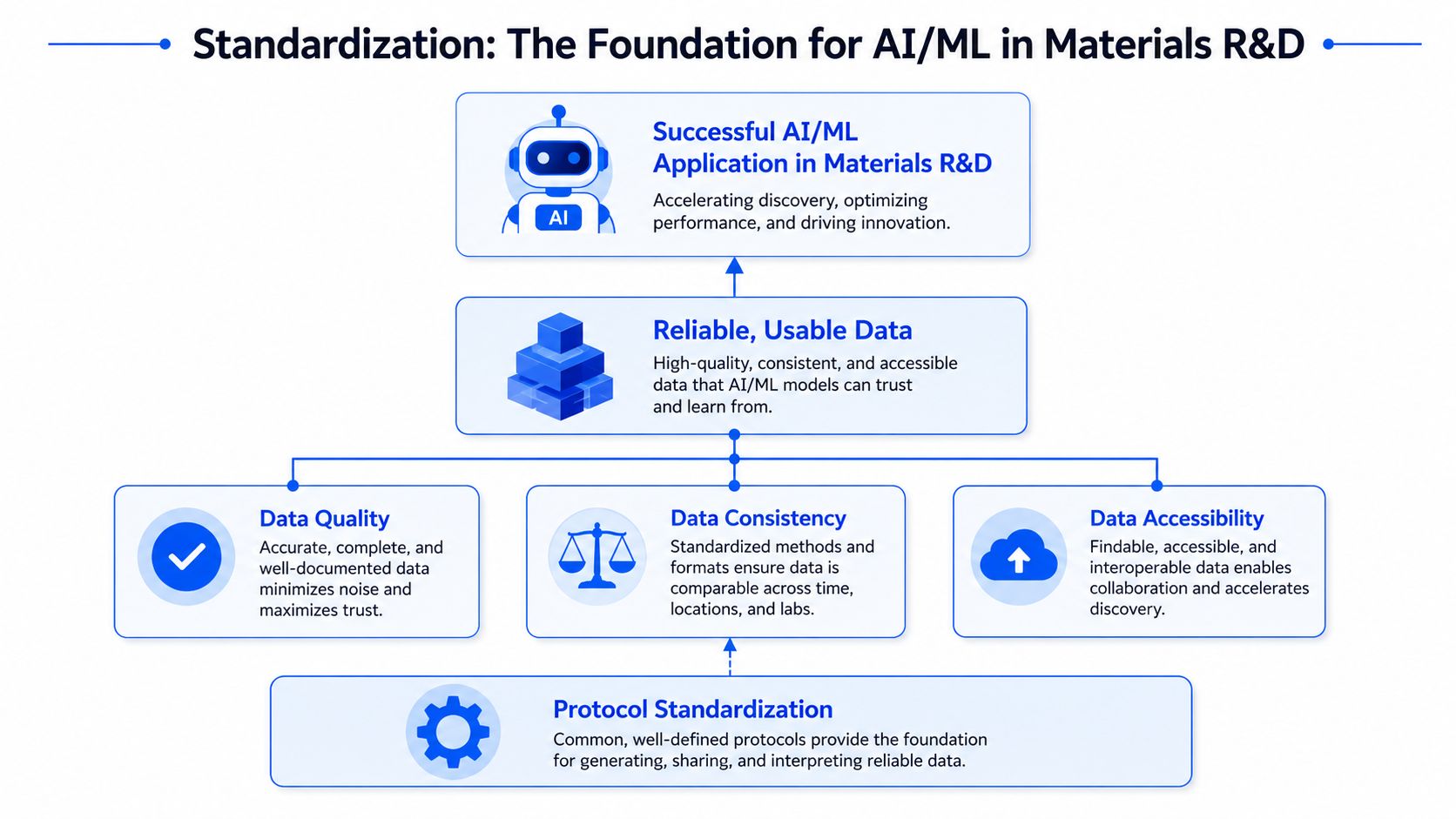
Most AI programs in materials R&D stall for a mundane reason. The models aren't the first bottleneck. The data is. Specifically, the context around the data is incomplete, inconsistent, or trapped in formats that force experts to interpret every record before a machine can use it.
That's why protocol standardization matters so much. It produces data that isn't merely stored, but structured for reuse. The output becomes consistent enough for feature extraction, model training, causal analysis, and closed-loop experimentation.
AI needs context, not just data volume
A model can't infer what your organization failed to record. If property labels vary by team, if unit conversion happens inconsistently, or if environmental conditions are buried in notes, the training set becomes noisy before any algorithm touches it.
Standardization addresses this at the source. Where teams define strict schemas and ontologies, property labels, experimental conditions, and unit conversions become consistent. In that setting, causal inference models can achieve confidence scores above 0.85 instead of the 0.4 to 0.6 range typical of siloed, heterogeneous datasets, and non-standardized formats cause a 30 to 50% increase in manual data curation time (technology standardization and why it matters).
That's a major operational distinction. Data scientists stop spending cycles on interpretation and start spending them on model quality, feature engineering, and deployment.
From usable records to usable models
The practical AI pipeline in materials R&D usually looks like this:
- Standardized protocol capture: experiments generate consistent records.
- Unified data layer: records from ELNs, spreadsheets, and instruments map into one structure.
- Feature generation: variables can be extracted without repeated manual cleanup.
- Modeling and guidance: prediction, optimization, and causal analysis become credible enough to influence real decisions.
This principle extends beyond materials science. In other knowledge-heavy fields, teams are also learning that AI becomes more useful when workflows are structured, searchable, and reusable. For a simple example from a very different domain, LegesGPT's recommended AI tools are useful to review because they show how tool quality depends on the quality and clarity of the underlying task structure, not just model availability.
Better AI doesn't start with a better prompt. It starts with a better record of what actually happened in the lab.
The important trade-off is this: strict standardization can feel limiting to bench scientists if it's implemented clumsily. The answer isn't to relax standards everywhere. It's to separate what must be fixed for comparability from what should remain flexible for discovery. Lock down identifiers, metadata, units, and result schemas. Leave room for scientific exploration in hypotheses, factor ranges, and iterative design choices.
That balance is what turns protocol standardization into an AI enabler instead of a bureaucratic layer.
Implementation Checklist and Common Pitfalls
By the time an organization decides it needs protocol standardization, the technical case is usually clear. The harder part is execution discipline. Teams need a starting checklist and a realistic view of what commonly derails adoption.

A practical checklist
Use this as a working launch list for your first implementation wave:
- Define scope and business intent: Pick a narrow set of high-value protocol families tied to scale-up, quality risk, or model readiness.
- Name decision owners: Put R&D, quality, digital, and lab operations in the same governance group from the start.
- Document current-state variation: Identify where fields, units, instrument outputs, and review criteria differ across sites.
- Specify minimum mandatory metadata: Keep it lean. Capture what's required for comparison, traceability, and reuse.
- Build digital templates first: Don't standardize on Word files alone if execution happens in ELNs and connected systems.
- Train on why, not just how: Scientists adopt standards faster when they see how better structure improves reproducibility and searchability.
- Set review cycles: Standards need maintenance. Version retirement, exception review, and protocol updates should already have owners.
Some teams also benefit from creating internal prompt packs for scientists and data teams so protocol drafting, metadata review, and experiment summarization follow a common language. If you're looking for a practical example of how organizations structure reusable AI instructions, building an AI prompt library is a useful reference.
Where teams go wrong
The first failure mode is trying to standardize every experiment at once. That creates fatigue, slows approvals, and usually produces generic templates that nobody likes using.
The second is over-documentation. If every protocol asks for too many fields, operators will either resist or fill records with low-quality placeholders. Standardization should remove ambiguity, not multiply form burden.
The third is weak adoption design. Good governance on paper won't matter if scientists must leave their primary tools to find the current version, check acceptable ranges, or understand what's mandatory.
Here's a concise watch list:
| Pitfall | What to do instead |
|---|---|
| Standardizing too broadly | Start with a few high-value protocol families |
| Treating it as a quality-only project | Co-own it across R&D, operations, and digital teams |
| Capturing too much optional information | Make the core dataset mandatory and concise |
| Leaving version control manual | Tie protocol access to governed digital workflows |
| Ignoring user feedback | Refine templates based on real execution friction |
A practical example helps. One specialty materials team I've seen approach this well began with only a handful of recurring formulation and characterization workflows. They didn't try to redesign the entire lab. They locked down sample IDs, units, metadata, and review gates first. Only after adoption stabilized did they expand into adjacent protocols and instrument mappings. That sequencing is usually what works.
The right mindset is steady, not heroic. Protocol standardization succeeds when teams make experiments easier to compare, easier to trust, and easier to reuse.
Protocol standardization turns scattered lab activity into a durable R&D asset. If your organization is trying to unify experimental data, create an AI-ready backbone, and move from trial-and-error to guided development, Polymerize is built for that job. It helps materials teams connect fragmented data, structure it for analysis, and put it to work across discovery, development, and scale-up.
Put your R&D data to work
See how materials teams use Polymerize to plan fewer experiments and reach target properties faster.