

A chemist can produce an excellent copolymer in a flask, confirm its molecular weight, and still face an unpleasant surprise when the same recipe moves into a production vessel. Reaction heat accumulates differently, mixing takes longer, viscosity changes during conversion, and the wall may remove heat far less effectively than it did at the bench. The chemistry may be sound. The process may still be unsafe, unstable, or too expensive to run.
Polymer process development is the discipline that closes this gap. It connects molecular design with a reproducible manufacturing route by answering practical questions about reaction mechanism, reactor geometry, heat transfer, formulation, analytical control, and data quality. Modern synthetic polymer chemistry gained its industrial foundation during the rapid breakthrough period from 1930 to 1945, when laboratory discoveries began moving into scalable production routes for materials including polymethyl methacrylate, Nylon 66, polystyrene, polyethylene, and polyurethanes. This historical survey of polymer development describes that period as a springboard because process knowledge became commercially decisive alongside the chemistry.
Table of Contents
- What Polymer Process Development Really Means
- Start with monomers and catalysts
- Build a bench-scale synthesis
- Profile kinetics and heat release
- Optimize formulation and isolation
- Test the pilot reactor
- Translate to production
What Polymer Process Development Really Means
Product development asks, “What molecule or formulation should we make?” Manufacturing engineering asks, “How should the plant, equipment, utilities, and controls be designed?” Polymer process development sits between those questions. It determines whether the proposed material can be made safely, consistently, and economically before the plant design becomes difficult to change.
Start with the chemistry, but don't stop there. A team may need to decide:
- Reaction route: Which monomers, catalyst, initiator, solvent, or chain-transfer agent create the required structure?
- Operating window: Which temperature, pressure, feed rate, and residence time produce acceptable conversion without runaway heat or excessive degradation?
- Reactor environment: Does the chemistry need intense dispersion, gentle agitation, controlled feeding, or a narrow residence-time distribution?
- Isolation route: Should the polymer remain in solution, precipitate, form particles, or leave the reactor as a melt?
- Quality evidence: Which measurements prove that a process change altered the intended property rather than creating an unrelated defect?
These decisions compound. A solvent chosen for easy laboratory handling may create a difficult recovery burden. An initiator that decomposes at a convenient temperature may limit achievable molecular weight. A formulation that looks fluid in a flask may become difficult to pump after conversion raises viscosity.
Practical rule: Treat every early process choice as a constraint on the decisions that follow.
The scale-up problem is not that a larger reactor is harder to operate. The larger vessel changes the balance among heat generation, heat removal, mixing time, shear, mass transfer, and residence time. A process developer therefore shouldn't ask only whether the reaction works. The better question is whether the mechanism of success remains intact when the physical environment changes.
This is why polymer process development isn't a linear ladder from laboratory to plant. It is a sequence of hypotheses. Each experiment should reveal which variable controls the next decision, what evidence is still missing, and which assumptions are no longer safe to carry forward.
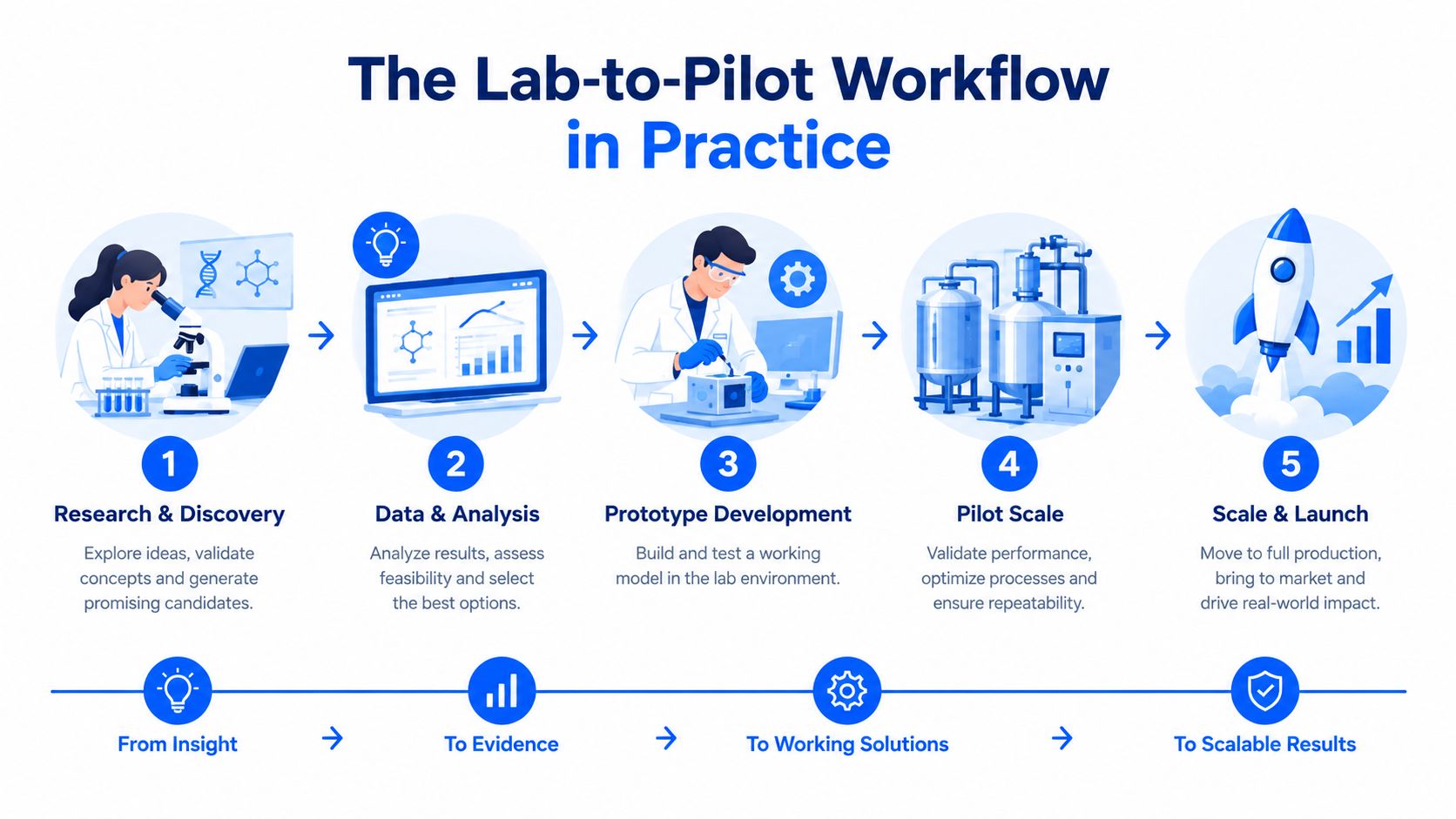
The Lab-to-Pilot Workflow in Practice
A useful workflow begins with the decision that each stage must enable. The chemist isn't collecting data for its own sake. They're reducing a specific uncertainty before committing more material, equipment time, or capital.
Start with monomers and catalysts
Screening should establish more than conversion. It should reveal sensitivity to impurities, catalyst loading, feed sequence, temperature, solvent, and mixing. The useful output is a short list of viable reaction routes with known risks, not merely the formulation that produced the highest isolated yield.
Build a bench-scale synthesis
A bench reaction tests whether the proposed route produces the required molecular architecture and preliminary performance. Record the complete thermal history, addition timing, agitation, appearance, viscosity behavior, and work-up conditions. GPC or SEC traces, conversion measurements, and residual monomer profiles become the evidence used to design the next experiment.
Profile kinetics and heat release
Kinetic and calorimetric work determines how quickly the reaction accelerates, when heat generation peaks, and how much cooling capacity the process may require. These results set safe temperature ramps and feed strategies. They also identify whether a seemingly mild recipe depends on heat transfer that won't exist in the pilot vessel.
Optimize formulation and isolation
Formulation screening isn't only about final polymer performance. It also determines viscosity, phase behavior, particle formation, solvent recovery, filtration, drying, and downstream handling. A solvent system that gives excellent molecular weight control may still fail the economic test if stripping or recycling is difficult.
Test the pilot reactor
Pilot work examines mixing, heat removal, feed distribution, fouling, sampling, and control response under more representative conditions. An agitator study may show that the laboratory stirrer created uniform dispersion while the pilot vessel left concentration gradients. That finding can change the impeller, feed location, addition rate, or even the reactor class.
Translate to production
Production translation requires a defined operating window, critical process parameters, sampling plan, cleaning approach, and acceptance criteria. It should also include a clear explanation of which variables are particularly scale-sensitive. A pilot run that reveals an exotherm missed by bench calorimetry isn't a failure of the project. It's evidence that the heat-transfer model or experimental setup needs revision.
The handoff artifacts matter as much as the reaction recipe. Keep kinetic datasets, GPC traces, DSC thermograms, residual monomer results, rheology curves, raw material information, and process sensor records linked to the same experiment. Without that connection, the team may know that a batch failed but not which process condition caused the failure.
Reactor and Formulation Choices That Shape Everything
The reactor should match the chemistry, not the other way around. A stirred tank may be the right development platform because it offers flexible charging and sampling. It may also hide residence-time behavior that becomes critical in continuous production.
| Reactor Class | Best-Fit Polymer Families | Heat Removal | Molecular Weight Control | Typical Pilot Scale |
|---|---|---|---|---|
| Batch stirred tank | Flexible radical, solution, and specialty polymerizations | Flexible, dependent on jacket and viscosity | Strong recipe control, batch history matters | Pilot batch |
| Semi-batch stirred tank | Exothermic radical reactions and condensation routes | Good when feeds control heat release | Strong control through feed timing | Pilot batch |
| CSTR | Continuous systems with stable feed and product behavior | Continuous, but affected by mixing and viscosity | Residence-time distribution can broaden properties | Continuous pilot |
| Tubular reactor | Fast, well-characterized continuous reactions | High area-to-volume potential | Narrower residence-time behavior when flow is controlled | Continuous pilot |
| Loop reactor | Polyolefin and slurry processes | Effective circulation can aid heat transfer | Dependent on circulation, solids, and catalyst behavior | Process-specific pilot |
| Suspension or emulsion reactor | Particle-forming polymerizations | Often favorable through dispersed phases | Particle size and molecular weight depend on dispersion control | Process-specific pilot |
For radical polymerization, batch or semi-batch operation often gives the developer more control over initiator exposure, monomer feed, and exotherm management. Condensation processes may benefit from staged feeds, removal of by-products, or vacuum operation to shift the reaction toward the desired product. Polyolefin processes commonly require specialized loop or gas-phase designs because circulation, solids handling, and heat management are central to operation.
Formulation route creates another decision layer:
- Solution polymerization simplifies viscosity control but introduces solvent recovery and residual-solvent requirements.
- Bulk polymerization avoids solvent handling but can become difficult as viscosity and heat generation rise.
- Suspension polymerization creates manageable particles when droplet breakup and stabilization are controlled.
- Emulsion polymerization offers strong heat-transfer characteristics, but surfactant balance and particle nucleation become important.
- Dispersion polymerization depends on solvent, stabilizer, and phase behavior that may be sensitive to small composition changes.
A stirred-tank pilot is sufficient when the reaction is well mixed, heat removal is representative, and the production process will use similar hydrodynamics. Specialty geometry is justified when the chemistry depends on rapid gas-liquid transfer, narrow residence time, high solids circulation, controlled particle formation, or heat-transfer behavior that a general-purpose vessel can't reproduce.
The trade-off is straightforward. A simple reactor gives cheaper, more flexible learning. A specialty reactor gives faster answers when the chemistry depends on a physical environment that simpler equipment cannot imitate.
Characterization Methods That Connect Process to Properties
A process change is only useful when the analytical plan can show what changed in the polymer. Final tensile strength or melt flow alone rarely explains the mechanism. The developer needs a structure-property loop that connects operating conditions to molecular architecture, thermal behavior, flow, and composition.
| Technique | Property Measured | Typical Process Question Answered | Deployment Mode |
|---|---|---|---|
| GPC or SEC | Molecular weight and dispersity | Did feed rate or temperature alter chain growth and distribution? | Off-line, with at-line potential |
| NMR | Conversion, composition, and tacticity | Did monomer incorporation or sequence structure shift? | Usually off-line |
| DSC | Glass transition, melting, and crystallization behavior | Did thermal history or formulation change phase behavior? | Off-line, sometimes at-line |
| TGA | Thermal stability and decomposition profile | Does the material tolerate the proposed processing window? | Off-line |
| Rheology | Viscosity, viscoelasticity, and processing response | Will the polymer mix, pump, coat, or mold as expected? | At-line or off-line |
| FTIR or Raman | Chemical composition and conversion indicators | Is composition drifting during the reaction or feed? | At-line or in-line potential |
GPC or SEC is useful when a temperature shift may have changed chain length or broadened dispersity. NMR helps distinguish incomplete conversion from altered composition. DSC and TGA connect thermal history and stability to processing decisions. Rheology becomes essential when molecular weight data looks acceptable but pumping, mixing, extrusion, or coating behavior has changed.
Spectroscopy can shorten the feedback loop, especially when conversion or composition can be correlated with a reliable signal. That doesn't make off-line testing obsolete. It means the team should decide which measurements need immediate process control and which are better suited to confirmation and release.
Sampling lag creates a common blind spot. If a batch is sampled only after cooling and work-up, the result may conceal the process event that caused the deviation. At-line measurements can preserve the connection between a feed change, a temperature excursion, a viscosity shift, and the resulting polymer.
Teams often skip rheology, detailed molecular weight distribution, or residual monomer testing when schedules tighten. That saves time in the current batch but transfers the uncertainty to scale-up, troubleshooting, or customer qualification. Tools that support an auditable workflow for sensitive data can help preserve raw results, analysis history, access records, and decision context alongside the process record.
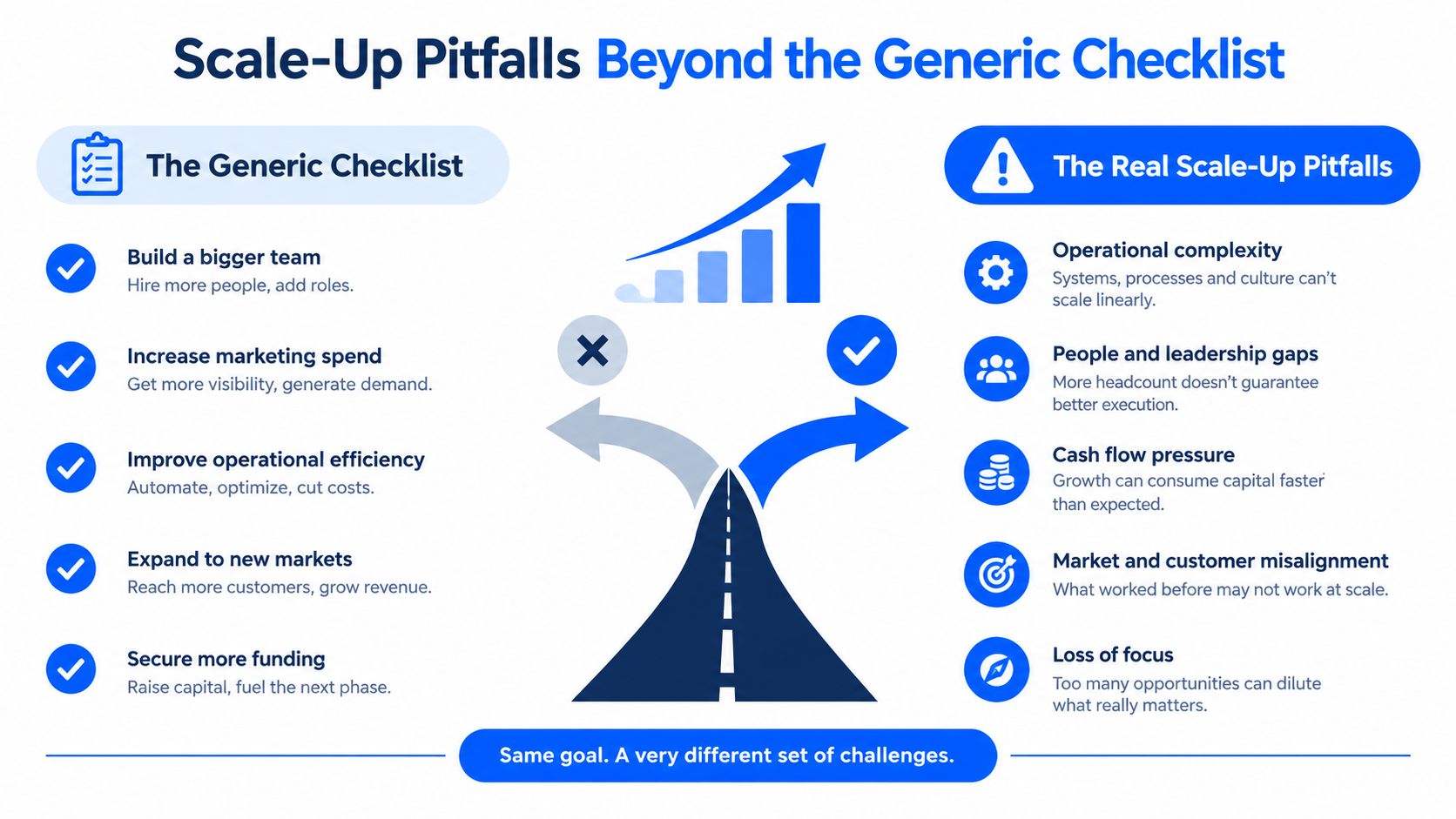
Scale-Up Pitfalls Beyond the Generic Checklist
Constant power per volume, constant impeller tip speed, and geometric similarity are useful starting points. They aren't guarantees that a polymerization will behave the same way at a larger scale. Polymer reactions generate heat while viscosity, phase behavior, and mass transfer can change during the reaction itself.
A recent review found that the simplified Glicksman scaling law performed poorly for predicting polymerization rates and called for combined models to evaluate scaling laws in multiphase reactors. The same review of kinetic and CFD approaches to reactor scale-up argues that integrating kinetic models with computational fluid dynamics can improve reactor design and industrial scale-up decisions.
Where the simple rules break
A viscous solution may limit mass transfer even when the agitator meets a nominal power target. A suspension or emulsion may develop a different droplet or particle population because local shear and feed dispersion changed. A temperature excursion may remain harmless in a small vessel but overwhelm cooling capacity when the reaction hold-up grows.
Residence-time distribution creates another failure mode. A stirred tank can expose material to a wider range of reaction histories than a tubular or plug-flow system. That spread may broaden molecular weight distribution, increase compositional drift, or create a tail of material that receives too much thermal exposure.
Fouling often appears late because small deposits alter heat transfer, reduce working volume, and create local hot spots. Production hold-up can also expose impurities, dead zones, and cleaning weaknesses that a short pilot campaign never reveals.
Pre-scaling checks
Before committing to a larger vessel, compare the heat-transfer area-to-volume relationship, measure mixing and residence-time behavior at pilot scale, and track impurities as process variables rather than background notes. Link these checks to the actual failure modes expected for the chemistry.
A scale-up model is valuable when it states where it may fail. A model that hides its boundary conditions creates false confidence.
For multiphase systems, define the particle, droplet, or bubble behavior that must remain comparable. For shear-sensitive polymers, examine whether agitation can cause chain scission or alter dispersion. For strongly exothermic reactions, test the control response rather than relying only on a steady-state heat balance.
Designing Experiments and Capturing Data for ML
Machine learning can't recover information that an experiment never recorded. A collection of isolated notebook entries may contain valuable chemistry, but inconsistent names, missing baselines, and unlinked analytical results make the knowledge difficult to reuse.
Begin with experimental design. Factorial designs reveal interactions among variables. Response-surface designs help map curvature within a defined operating region. Mixture designs are appropriate when component proportions must sum to a fixed total. The aim isn't to test every possible combination. It's to choose experiments that distinguish competing explanations and produce a model with a useful predictive range.
One-factor-at-a-time records usually underperform for this purpose because they hide interactions. A catalyst may behave differently at another solvent ratio. A formulation change may only matter at a particular mixing speed. If those variables were never varied together, the historical record can't reliably estimate their combined effect.
Capture the context, not only the result
A practical schema should connect:
- Material identity: Monomer, additive, catalyst, solvent, supplier, and lot information.
- Equipment context: Reactor, instrument, agitator, sensor, and equipment status.
- Operating history: Set points, actual values, feed timing, alarms, and temperature traces.
- Analytical evidence: Raw files, processed results, methods, units, and analyst identity.
- Outcome status: Success, failure, deviation, rejection reason, and follow-up action.
Negative results deserve deliberate preservation. A failed batch can identify a dangerous interaction, a boundary condition, or a region that the model should avoid. Don't overwrite failed experiments with corrected values. Store the original record and link any interpretation or rework as a separate event.
A small team doesn't need to begin with a full LIMS replacement. It can standardize material names, define mandatory fields, assign stable experiment identifiers, store raw instrument files beside summarized results, and create a controlled vocabulary for units and failure modes. Above all, it should link analytical outputs to the exact process record that produced the sample.
A 2026 industry-oriented overview describes polymer data as scattered across spreadsheets, ELNs, LIMS, instruments, and notebooks, while recent reviews identify data scarcity, transferability, and explainability as recurring AI barriers. This overview of polymer data and AI challenges supports a practical conclusion: data curation is part of process development, not administrative work added afterward.
AI-Enabled Workflows, KPIs, and Quality Oversight
AI works best when it sits inside the experimental feedback loop. A Bayesian optimizer can use prior results to propose the next experiments, while a surrogate model estimates likely molecular weight distribution or formulation performance within the validated data range. Online process analytical technology can then test whether the batch is following the predicted trajectory.
The model must show uncertainty. A prediction without a confidence range encourages false precision, especially when the proposed condition lies outside the training data. Confidence bands can support decisions about whether to continue a batch, take an additional sample, repeat an experiment, or hold material for review.
KPIs become more useful when each one answers a process question.
| KPI | AI Workflow Touchpoint | Quality or Regulatory Anchor |
|---|---|---|
| Dispersity target | Predict distribution shifts and propose feed or temperature experiments | Batch consistency and specification control |
| Residual monomer ceiling | Combine conversion trends with release testing | Safety, purity, and material acceptance |
| Cycle time | Identify conditions that shorten processing without reducing quality | Process capability and production control |
| Energy intensity per kilogram | Compare routes and operating windows | Resource use and process sustainability |
| Off-specification frequency | Detect recurring conditions and rank likely causes | Deviation investigation and corrective action |
| Sensor and sample agreement | Flag drift between PAT and laboratory methods | Method reliability and data integrity |
Quality oversight isn't a separate project from AI governance. A model needs version control, documented training data, defined intended use, access controls, audit trails, and review of changes. Those requirements overlap with the structured batch records needed for cGMP environments and with the process and product understanding described by the ICH Q8, Q9, and Q10 framework.
A model should not rewrite a batch record or replace a qualified analytical method without human oversight. It can prioritize experiments, identify unusual combinations of variables, and surface historical precedents. A qualified scientist still decides whether the evidence is chemically plausible and whether the process remains within its validated state.
Governance principle: Let AI rank options and expose patterns. Keep release, safety, and mechanism-based decisions under accountable scientific and quality review.
Where to Start and What to Let Go Of
The first phase of a data-driven program should be deliberately narrow. Choose one pilot reactor and instrument it well before attempting to connect every vessel, spreadsheet, and laboratory system. A complete record from one reactor teaches more than sparse, inconsistent data from many locations.
Use the initial program to establish:
- A controlled vocabulary: Standardize names for materials, units, process steps, failure modes, and analytical methods.
- A linked experiment record: Connect recipe, raw material lots, equipment identity, sensor traces, samples, and results.
- A measurement hierarchy: Decide which variables need in-line, at-line, or off-line control.
- A curated historical set: Keep original records, document missing fields, and mark inferred values instead of presenting them as measured facts.
- A review rhythm: Have chemists, process engineers, data specialists, and quality personnel inspect model recommendations together.
Retire the assumption that old notebooks can become training data through scanning alone. Historical records need interpretation, normalization, and uncertainty labels. Also retire the idea that scale-up is a sequence of stage gates where each team hands a finished package to the next. Parallel laboratory and mini-pilot work can reveal scale-sensitive behavior earlier and create a more useful active-learning cycle.
AI doesn't replace polymer chemists. It reduces the tedious search through scattered experiments and broad parameter spaces, giving scientists more time for mechanism, formulation intuition, safety judgment, and the exceptions that models can't yet handle reliably. Platforms such as Polymerize can unify experimental data and apply explainable models to formulation and process decisions, but the scientific team still defines the questions, validates the evidence, and owns the outcome.
A practical next step is to select one scale-up problem, define the decision it must support, instrument the relevant process variables, and preserve every result, including the disappointing ones. Visit Polymerize to explore how its materials R&D platform can organize fragmented experimental knowledge and support AI-guided planning for polymer development. Use that evaluation to decide whether its data backbone and modeling workflows fit the reactor, formulation, and quality decisions your team needs to make.
Put your R&D data to work
See how materials teams use Polymerize to plan fewer experiments and reach target properties faster.