

Polymer Chain Structure: From Architecture to Properties
Why can two polymers made from the same monomer behave like a rubbery adhesive, a stiff optical plastic, or a high-temperature dielectric? The answer isn't chemistry alone. It lies in how the chains are sized, shaped, connected, and packed.
That is the practical meaning of polymer chain structure. Molecular weight, branching, crosslinking, tacticity, backbone rigidity, topology, and order across length scales all influence what your team sees in the lab, from melt viscosity and crystallization to modulus, transparency, solvent resistance, and dimensional stability. Treating these features as design variables turns formulation from trial and error into a more targeted R&D discipline.
Table of Contents
- Molecular weight changes the opportunity for entanglement
- Branching changes packing and flow
- Crosslinking creates a network
- Map the target to structural levers
- Build prediction into experiment selection
- Keep the loop anchored to physical evidence
Why Polymer Chain Structure Decides Material Performance
A polymer sample doesn't behave like an isolated repeat unit. It behaves like a population of long molecules interacting with one another, becoming entangled, folding into conformations, separating into domains, and sometimes organizing into ordered regions. The monomer supplies the chemical possibilities, but chain structure determines which of those possibilities become visible in the final material.
Consider two formulations with similar chemical composition. One may contain relatively flexible chains that slide and rearrange during processing. Another may contain rigid backbones, regular stereochemistry, or a network of permanent connections. The first may flow readily and deform easily. The second may retain its shape, resist solvents, or remain mechanically stable under demanding conditions. Both outcomes can be chemically plausible, yet their processing windows and failure modes will be very different.
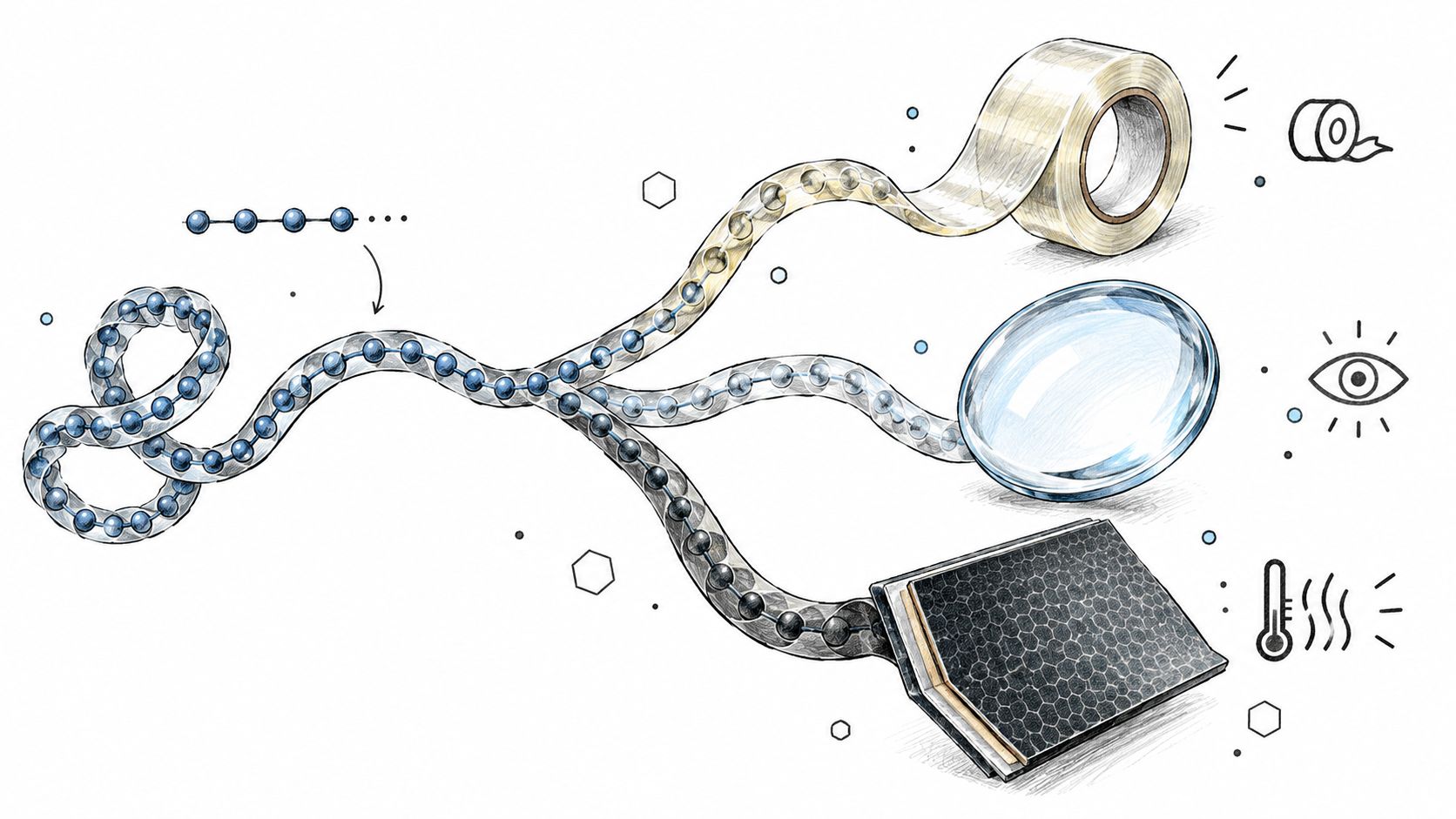
The structure to property connection
Start with the chain variables that most directly control motion:
- Molecular weight changes chain length and the opportunity for entanglement.
- Branching changes packing efficiency, chain mobility, and melt flow.
- Crosslinking changes separate molecules into a connected network.
- Tacticity changes the spatial sequence of side groups and the ability to pack regularly.
- Backbone rigidity limits bond rotation and alters conformation.
- Topology and hierarchical order determine how local features combine into larger-scale morphology.
Each variable affects more than one property. Increasing chain length may improve toughness while making the melt harder to process. Introducing branches may disrupt crystallization while changing viscosity and elasticity. Adding crosslinks may improve shape retention and solvent resistance while removing conventional melt reprocessability.
Practical rule: Don't ask only whether a polymer is linear, branched, or crosslinked. Ask which structural feature controls the property that currently limits your application.
This distinction matters during troubleshooting. If a film is hazy, the cause may not be “the wrong polymer architecture.” It could be local crystallization, stereochemical irregularity, phase separation, or a rigid segment that promotes ordered domains. If an adhesive fails under load, average molecular weight may not be the only issue. Entanglement density, branching, and network formation may be more important than the nominal chemistry on the datasheet.
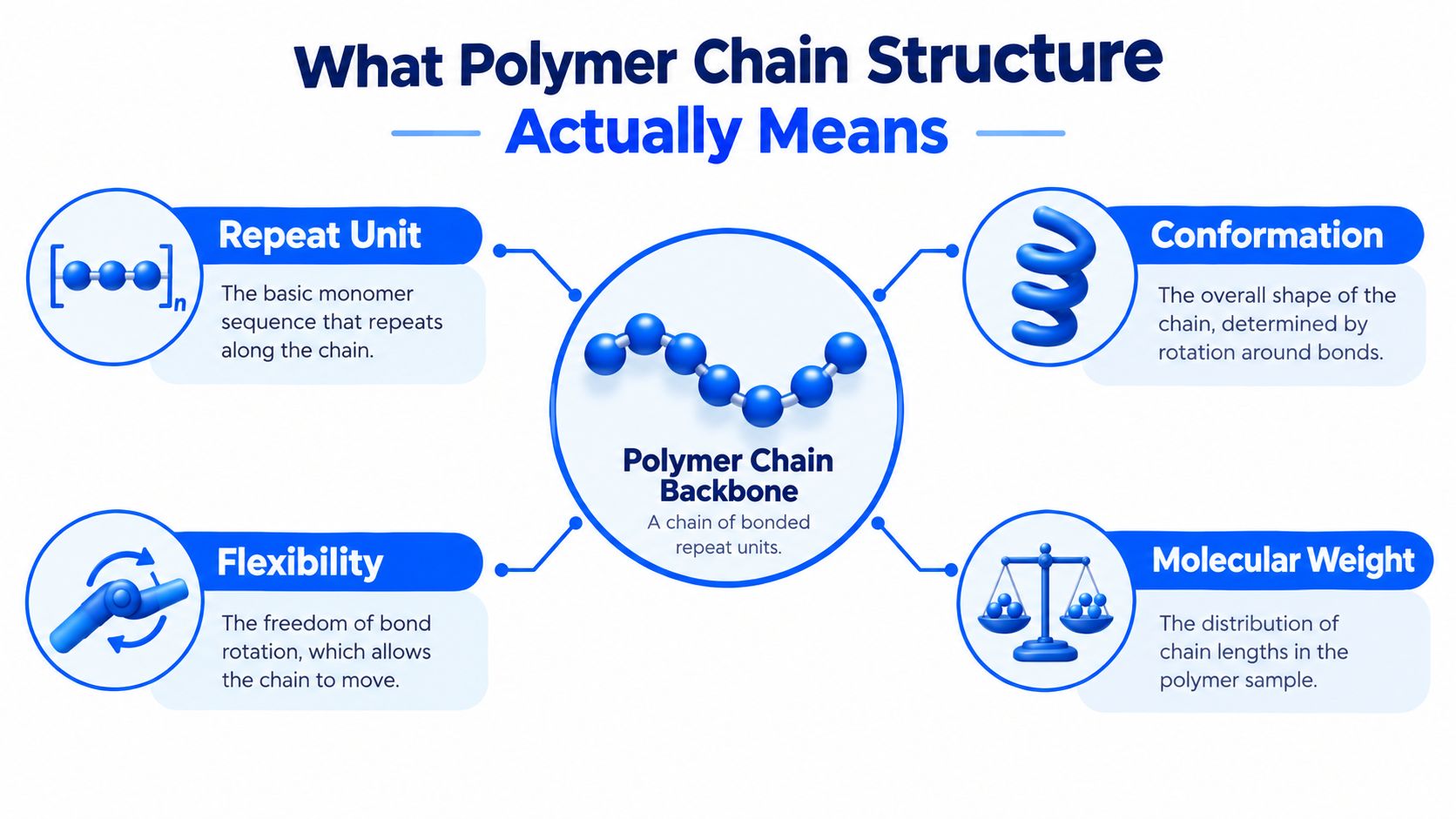
What Polymer Chain Structure Actually Means
A useful mental model begins with a backbone, the connected sequence of atoms formed from repeating chemical units. Side groups, functional groups, and pendant segments extend from that backbone and modify its interactions with neighboring chains. Molecular weight describes the mass of a chain, but it doesn't fully describe its shape or the way that shape changes during processing.
Think of the backbone as a string of connected beads. The beads aren't free-floating, because chemical bonds constrain their movement, but many bonds can rotate within energetic limits. A chain can therefore adopt a family of conformations rather than one fixed shape. In a melt or solution, it may look like a tangled coil. In a strongly ordered region, segments may align more like a bundle of rods.
Conformation is not the same as chain length
Two chains with similar molecular weight can occupy different spatial volumes. A flexible chain can fold and coil, while a rigid chain may remain extended. The radius of gyration describes how the chain's mass is distributed around its center of mass. The end-to-end distance describes the separation between the two chain ends. Neither value is a permanent molecular dimension, because both respond to solvent quality, temperature, neighboring chains, and local chemical constraints.
The difference is easy to visualize with food. Cooked spaghetti bends and folds with little resistance. An uncooked piece of stiff pasta behaves more like a short rod. Both have a recognizable length, but their response to confinement, mixing, and packing is different. Polymer chains show the same distinction, only with molecular interactions and thermal motion added to the problem.
Persistence length gives flexibility a physical meaning
Persistence length measures how far a chain tends to remember its previous direction. For a wormlike chain, orientation correlations decay exponentially along the contour. When bond rigidity or stereochemical constraints increase, the persistence length increases, and the chain becomes less flexible. The resulting chain has a larger end-to-end correlation length, which can change its radius of gyration, melt rheology, and packing behavior, as described in the research on persistence length and polymer chain conformation.
This concept prevents a common mistake. A chain with a high molecular weight isn't automatically stiff, and a short chain isn't automatically flexible. Length and local stiffness are separate structural variables. A long, flexible chain may form extensive entanglements, while a shorter rigid chain may occupy space more like a rod and pack into ordered arrangements.
For formulation work, that distinction points to the right measurements. If the problem is poor flow, investigate chain length distribution and relaxation as well as backbone stiffness. If the problem is unexpected haze or shrinkage, examine conformation and packing rather than relying on a simple architecture label. For a broader application of chain-level design in composite surfaces, the polymer nanocomposite coatings guide offers useful context on how polymer structure interacts with dispersed phases.
Molecular Weight, Branching, and Crosslinking
These three variables form the familiar architectural toolkit, but they shouldn't be treated as interchangeable. Each changes chain mobility through a different mechanism, so two materials can reach a similar modulus while responding very differently to heat, solvents, stress, or shear.
Molecular weight changes the opportunity for entanglement
Longer chains have more contour available for neighboring chains to interpenetrate and become entangled. Entanglements slow relaxation and can increase melt elasticity, toughness, and resistance to deformation. They also make processing more demanding because the material takes longer to rearrange and can show stronger sensitivity to shear history and temperature.
Shorter chains generally move and relax more readily. That can help filling, coating, mixing, or impregnation, but insufficient chain length may reduce toughness or cohesive strength. The useful target is rarely “maximum molecular weight.” It is a distribution that provides enough connectivity and mechanical integrity without creating an impractical processing window.
Branching changes packing and flow
A linear chain resembles a strand that can align alongside its neighbors. A branched chain occupies space differently, with side arms interrupting close packing and changing how the molecule moves through the melt. Branching can reduce the efficiency of crystallization, alter melt viscosity, and modify elastic recovery during extrusion or coating.
The effect depends on branch length, branch frequency, and the relationship between the branches and the backbone. A small amount of branching may change processing without changing the material's response. Long-chain branching can create strong melt elasticity even when the material doesn't form a permanent network. In a formulation, that distinction matters because elastic recovery can improve dimensional control while also producing die swell or coating defects.
Crosslinking creates a network
Crosslinking ties separate chains together at junctions. The result behaves less like a bowl of loose spaghetti and more like a fishing net. Under load, the network can retain its shape and resist chain slippage. Solvent molecules may enter and swell the material, but they can't dissolve it in the same way they can dissolve an uncrosslinked polymer.
The trade-off is processing. A permanently crosslinked thermoset doesn't flow as a conventional melt after network formation. Teams must therefore control conversion, gelation, cure shrinkage, and the timing of shaping. Crosslink density also affects elasticity, brittleness, swelling, and thermal stability, so “more crosslinking” isn't a universal route to better performance.
| Structural Variable | Strength | Processability | Crystallinity | Thermal/Solvent Resistance |
|---|---|---|---|---|
| Molecular weight | Longer chains often improve toughness and cohesive strength through entanglement | Higher viscosity and slower relaxation can narrow the processing window | Depends on chain regularity, mobility, and thermal history | Longer chains can improve resistance to deformation, but chemistry remains decisive |
| Branching | Can change toughness and elastic response; the result depends on branch architecture | May alter melt elasticity, flow, and die swell | Branches often disrupt regular packing and crystallization | Can improve dimensional response in some systems, but doesn't replace network formation |
| Crosslinking | Improves shape retention and resistance to chain slippage | Limits melt flow after network formation; cure must be controlled | Can suppress or reorganize crystallization depending on network constraints | Usually improves solvent resistance and high-temperature shape stability |
A long branched chain and a short crosslinked network may show a similar modulus in one test, but they won't have the same relaxation, swelling, recyclability, or failure behavior.
The most reliable development plans vary these levers separately where possible. Measure molecular weight distribution, identify branching or network formation, and record thermal history alongside mechanical data. Otherwise, a change blamed on “molecular weight” may come from altered branching, incomplete cure, or a different degree of crystallization.
Tacticity and Entanglement as Hidden Design Levers
Tacticity describes how side groups are arranged along a chain. The chemistry of the repeat unit can stay the same while the three-dimensional sequence changes. A useful analogy is a row of people wearing identical backpacks. If every backpack points to the same side, the row may pack differently than one in which the direction alternates or appears irregularly.
In an isotactic arrangement, substituents follow a regular spatial pattern. In a syndiotactic arrangement, the pattern alternates. An atactic chain has a less regular sequence. These arrangements affect the chain's ability to adopt repeating conformations and pack with neighboring chains.
Stereoregularity controls order
Regular chains can often organize more efficiently than irregular chains, although the outcome depends on the full repeat-unit geometry and processing history. Better packing can promote crystalline domains. Less regular packing can favor amorphous material or frustrate crystallization. Those changes influence stiffness, thermal transitions, optical appearance, toughness, and dimensional stability.
The key point for an R&D colleague is that tacticity isn't just a structural diagram to include in a report. It can change how much of the sample behaves as an ordered phase and how much remains mobile and disordered. The same nominal chain length can therefore produce different modulus and flow behavior when stereoregularity changes.
Entanglements add a second layer
Long chains in a melt form a temporary entanglement network. The chains aren't chemically bonded at these points, but their interpenetration restricts movement and gives the melt much of its elastic response. That network slows dynamics, which can help the solid resist deformation while making the molten material harder to process.
Entanglements also complicate crystallization. A chain may contain chemically regular segments that could fit into a crystal, yet neighboring chains and topological constraints can prevent complete rearrangement. This is why crystallizable polymers are commonly semicrystalline, with ordered and amorphous regions rather than a perfectly crystalline bulk.
Evidence from PMMA shows that plateau modulus and entanglement molecular weight depend strongly on tacticity, while showing much less dependence on molecular weight when low-molecular-weight fractions are absent. The analysis of tacticity, entanglement, and PMMA rheology supports a useful design conclusion: stereoregularity can tune entanglement density, modulus, and processability without requiring a change in chain length.
That lever is easy to miss in formulation work. If a target modulus is reached by increasing molecular weight alone, viscosity may rise more than necessary. Adjusting stereochemical regularity may offer another route, particularly when the process already operates near its flow or mixing limit.
Chain Rigidity, Topology, and Order Across Length Scales
The labels linear, branched, and crosslinked become less predictive when a material contains several structural levels at once. A chain may have a rigid segment, a flexible spacer, oriented side groups, temporary associations, and local ordered regions embedded in a larger amorphous matrix. The final property reflects their combined effects, not one architecture word.
Conjugated polymers make this clear. Restricted rotation along the backbone can increase persistence length and limit the conformations available to the chain. Such polymers often remain glassy or crystalline at room temperature rather than behaving like flexible coils, because the backbone resists the local motions needed for unrestricted rearrangement. Their side chains also do more than improve solubility. They influence spacing, orientation, packing, aggregation, and the way the material flows during solution processing.
Rigidity changes under realistic conditions
Backbone stiffness shouldn't be evaluated in isolation. Solvent quality and temperature can change how a rigid chain explores its conformational space. Coarse-grained molecular dynamics has shown that stronger backbone bending stiffness systematically changes conformation, while solvent quality and temperature interact with that rigidity. A chain that appears extended in one processing environment may contract, aggregate, or reorganize in another.
Dipole placement adds another design variable. Recent polymer work summarized by the University of Minnesota found that stronger main-chain dipoles increased glass-transition temperature and flow activation energy, with dipole orientation perpendicular to the backbone further strengthening intermolecular interactions. The implication is practical: side-chain orientation and polar-group placement can reprogram flow and thermal behavior, not merely modify compatibility.
Hierarchical order can dominate the label
Crosslinked polymer dielectrics provide a second example. Research on one sample reported periodic structure content in the range of 42 to 78 nanometers, and compared that structure with non-rigid crosslinked polyimides in relation to dielectric behavior and scattering signatures. The study of multiscale structure in crosslinked polymer dielectrics illustrates why architecture labels alone become insufficient.
The right question is no longer, “Is this polymer branched?” Ask instead:
- Which local features control chain mobility?
- Which domains carry load or block transport?
- Does order persist from the molecular scale into larger periodic structures?
- Is the observed property controlled by rigidity, topology, interfaces, or their coupling?
Better design question: Which structural feature dominates the property I need to improve, and at what length scale does that feature operate?
That question changes the experiment. Instead of screening broad architecture classes, the team can test backbone stiffness, dipole orientation, branch placement, or network uniformity as separate hypotheses.
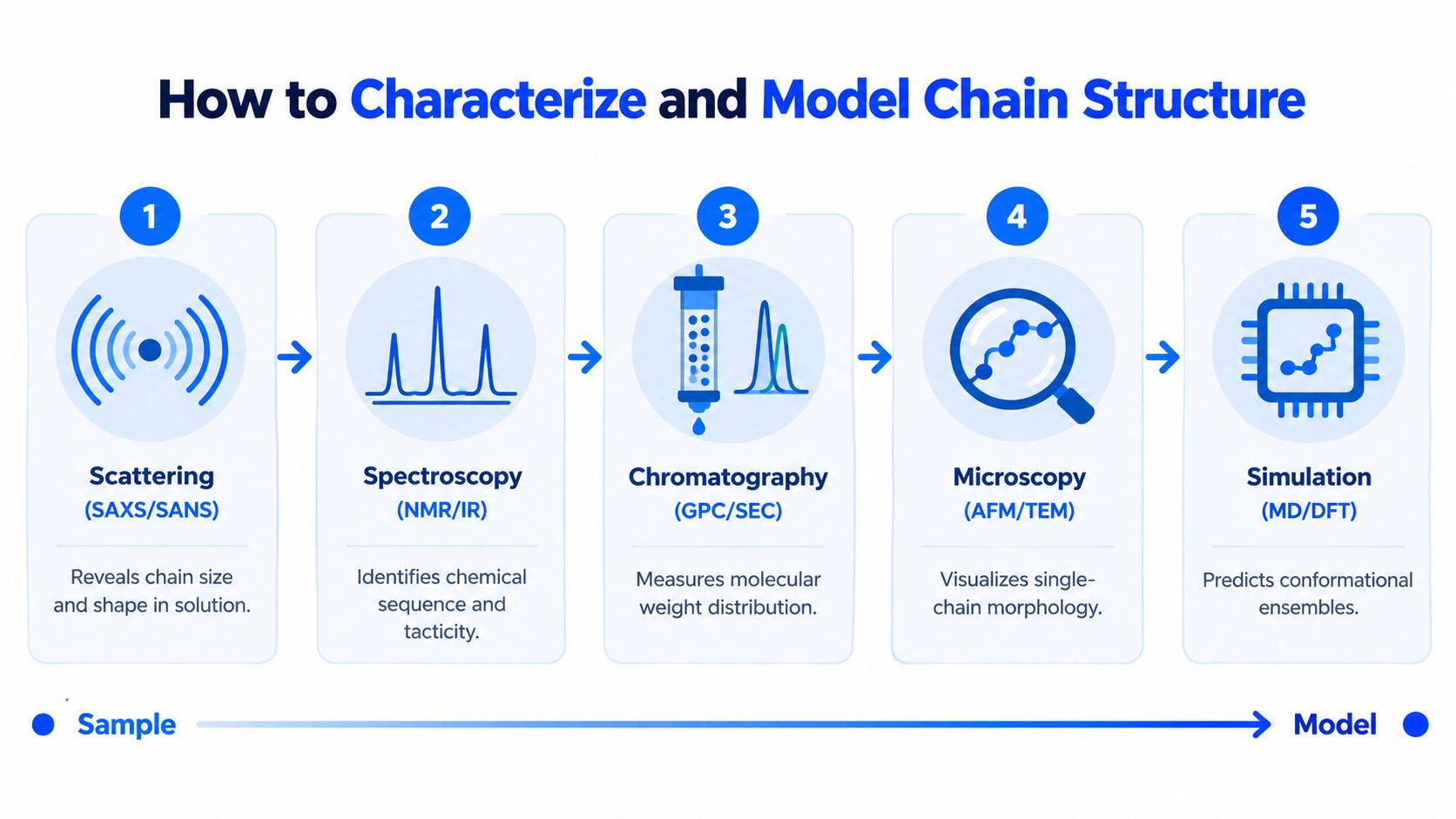
How to Characterize and Model Chain Structure
Structural intuition becomes useful only when it can be tested. The most efficient characterization plan starts with the property failure and works backward to the structural feature most likely to control it.
| Suspected controlling feature | Useful measurement | Question answered |
|---|---|---|
| Chain dimensions and conformation | SAXS, SANS, and related scattering methods | How large, extended, or ordered are the chains or domains? |
| Chemical sequence and tacticity | NMR and IR spectroscopy | What is the local chemical arrangement and stereochemical regularity? |
| Molecular weight distribution | GPC or SEC | How are chain lengths distributed, and are low-molecular-weight fractions present? |
| Local morphology and interfaces | AFM or TEM | Where do domains, aggregates, or network features appear? |
| Entanglement and viscoelastic response | Rheology and mechanical testing | How do chains relax, and what temporary or permanent connectivity carries stress? |
| Thermal transitions and order | DSC, DMA, and thermal analysis | How do glass transition, melting, crystallization, and relaxation respond to structure? |
The methods answer different questions. SEC can reveal whether a batch has shifted toward shorter chains, but it won't directly show whether a rigid segment is producing nanoscale order. Scattering can identify characteristic dimensions or periodic features, while spectroscopy can distinguish chemical sequence and local conformation. Microscopy adds spatial context, though the image must be connected carefully to bulk behavior.
Match the model to the structural question
Modeling is most valuable when it isolates couplings that experiments struggle to separate. Coarse-grained molecular dynamics can explore how bending stiffness, solvent quality, and temperature alter conformational ensembles. Density functional theory can help examine local interactions and dipole arrangements. Larger-scale simulations can then connect those local inputs to packing, diffusion, or mechanical response.
The model shouldn't be treated as a substitute for characterization. Use it to rank plausible mechanisms, identify variables worth measuring, and narrow the experimental matrix. Then compare predicted trends with molecular weight distribution, scattering signatures, thermal transitions, rheology, and mechanical results.
A practical workflow looks like this:
- Define the failure mode. Separate poor flow, low toughness, haze, creep, swelling, and dielectric loss rather than treating them as one “performance” problem.
- Assign candidate structural causes. Link each failure to chain length, stiffness, tacticity, branching, network density, or multiscale order.
- Choose orthogonal measurements. Pair a bulk test with a molecular or morphological measurement so that a property shift has structural evidence behind it.
- Use simulation to test couplings. Explore variables such as rigidity and solvent quality before committing every formulation to the lab.
- Update the next experiment. Treat each result as evidence for or against a structural mechanism, not as a pass or fail.
Designing With Chain Structure in Modern R&D Workflows
A structure-driven workflow starts with the target property, not the polymer category. “Need a stronger material” is too broad to guide an experiment. Specify whether the limiting issue is tensile strength, impact toughness, creep, melt elasticity, solvent swelling, optical clarity, dielectric performance, or thermal shape retention.
Map the target to structural levers
Use the failure mode to create a short list of mechanisms:
- Poor melt strength may point toward molecular weight distribution, long-chain branching, or temporary associations.
- Insufficient toughness may require longer chains, flexible segments, or a better balance between ordered and amorphous regions.
- Excessive solvent swelling suggests insufficient network connectivity or an unfavorable interaction between solvent and polymer.
- Unexpected crystallization or haze calls for attention to tacticity, backbone regularity, cooling history, and nucleating interfaces.
- High flow resistance may reflect chain length, entanglement, backbone rigidity, dipole interactions, or a combination of these variables.
Don't change several levers at once unless the interaction itself is the hypothesis. A design that increases molecular weight, changes branching, and alters cure conditions may produce a better modulus, but it won't tell the team why.
Build prediction into experiment selection
A useful R&D system combines historical data, explainable property models, and characterization results. The model should rank candidate experiments and show which structural features drive the recommendation. Confidence matters as much as the predicted value, because a low-confidence result may justify a confirmation experiment rather than an immediate scale-up.
Polymerize is one example of a materials R&D platform that centralizes experimental data and applies domain-specific models to property prediction, formulation optimization, and identification of causal drivers. Used alongside SEC, spectroscopy, scattering, rheology, and thermal analysis, that kind of system can help teams connect structural descriptors with measured outcomes instead of leaving the explanation in disconnected spreadsheets and lab notes.
Keep the loop anchored to physical evidence
The development loop is straightforward:
- Define the property target and processing constraint.
- Select the structural levers most likely to control both.
- Rank experiments using available data and model explanations.
- Measure chain, morphology, thermal, rheological, and mechanical responses.
- Compare the observed structure with the predicted mechanism.
- Update the formulation and repeat with a narrower hypothesis.
The central lessons are equally practical. Chain structure is the bridge between monomer chemistry and bulk material behavior. Every structural lever carries trade-offs. Hierarchical features can matter as much as linear, branched, or crosslinked labels. Teams that connect molecular measurements to property prediction can make more informed decisions than teams that rely only on formulation intuition.
The next stage of polymer development will combine richer structural descriptors with AI-assisted experiment planning. The useful systems won't replace polymer scientists. They'll help scientists identify which structural feature is worth changing, which measurement can confirm it, and which experiment should come next.
If your team needs to connect polymer chain descriptors with experimental results, Polymerize can centralize R&D data and support explainable property prediction and experiment planning. Visit Polymerize to explore how a structure-driven workflow could fit your materials development process.