



An optimization formula is decision variables plus one or more objectives, subject to hard constraints and bounds, and materials work usually returns a trade-off set rather than one winner. In 2025, 84% of commercial mathematical-optimization users already called optimization mission-critical, so the useful output is a shortlist you can run, not a single peak number on a lab report.
Popular advice still says to hunt the one best recipe. Maximize tensile, minimize cost, or chase the highest score a solver can print, then lock that formula. That advice fails as soon as a coating, adhesive, or compound has to clear more than one gate at once. A grade that wins on strength can miss the coater's viscosity window, blow the cost ceiling, or fall apart when a raw-material lot shifts a few percent. The feasible region is the set of recipes that pass every hard limit. Inside that region, competing goals draw a frontier. Your job is to pick a reliable point on that frontier, then check whether it still holds when the equipment gets bigger.
Table of Contents
- Why One Best Recipe Misleads Formulation Teams
- The Parts of an Optimization Formula
- Single Scores Weighted Goals and Pareto Sets
- How to Encode a Formulation Brief
- A Worked Compounding Example with Three Recipes
- When the Lab Optimum Fails at Scale
- Select the Robust Formulation and Plan the Next Experiment
Why One Best Recipe Misleads Formulation Teams
Say a flexible coating has to reach a customer tensile floor while the coater only runs between 800 and 1500 mPa·s. The resin that pushes tensile to 24 MPa also thickens the mix, slows cure, and prices the batch above the commercial target. The lab champion looks perfect on one column of the data sheet and fails the line. Improving stiffness often hurts impact. A tighter barrier film is often harder to recycle. Faster cure usually shortens pot life. Those pairs don't have a single winner. They have a region of acceptable compromises.
The architecture you can use the same day is simple. Decision variables are the measurable knobs, an objective is the score you maximize or minimize, and constraints define what is allowed. Anything outside those constraints is not a candidate, no matter how good the objective looks.
That structure is already how serious users run the business. In 2025, 84% of commercial mathematical-optimization users surveyed by Gurobi said optimization was mission-critical to their organizations. Generative models are not doing that balancing in production yet. Classical formulas still carry the constraints, the objective, and the trade-off.
Practical rule: If a recipe fails a hard constraint, it is not "almost optimal." It is infeasible, and it should leave the shortlist before anyone debates its score.
A highest tensile number is often the wrong commercial formula. The coating still has to stay inside cost, viscosity, cure window, regulatory caps, and supply limits. A slightly lower tensile with margin on every floor will ship. The peak will sit in a notebook.
The Parts of an Optimization Formula
| Element | What it encodes | Materials example | Role |
|---|---|---|---|
| Decision variables | Ingredient levels and process settings | Resin A, filler and plasticizer weight fractions; mix speed and temperature | Choices the solver sets |
| Objective | Quantity to maximize or minimize | Cost per kg, or tensile strength in MPa | Score to improve |
| Hard constraints | Limits that cannot be violated | VOC at or below the regulatory cap, no banned food-contact substance, viscosity from 800 to 1500 mPa·s | Must pass |
| Bounds | Allowed range for each variable | Each fraction from 0 to 1 and all fractions sum to 1 | Keeps recipes physical |
| Pareto set | Non-dominated trade-offs when goals conflict | Higher strength paired with worse recyclability or cost | Shortlist, not one winner |
Decision variables and the objective
Decision variables are the knobs. For a coating, that means weight fractions of resin A, filler, and plasticizer that sum to 100%, plus mix speed, temperature, and time. If the extruder screw speed changes dispersion, it belongs in the variable list too. Leave it out and the formula describes a beaker, not a process.
The objective is the score you push. Minimize cost per kilogram, or maximize tensile strength at break. One score is enough only when every other requirement is already a pass-or-fail floor. Write the score in the units the business uses. A dimensionless "performance index" with no owner becomes a debate instead of a decision.
Constraints, bounds, and the frontier
Hard constraints are fixed. A regulatory VOC cap, a food-contact ban, and the viscosity window the coater can run are all hard. Soft wishes, such as "prefer a lower odor," don't belong in the same bucket. If you mark a wish as hard, you throw away good recipes. If you mark a legal cap as soft, you can "optimize" your way into a noncompliant batch.
Bounds keep each variable inside a tested or purchasable range. Each fraction from 0 to 1, with all fractions summing to 1, stops the solver from inventing a recipe that is 140% resin. Tighter bounds, taken from the last design space you measured, keep the search near data the model has seen.
A Pareto set shows up when two goals conflict and no single number can stand for both. Higher strength paired with worse recyclability or higher cost is a frontier of non-dominated recipes. Each point on it is best in some sense. None of them is best in every sense.
A chemist can read a linear sketch of the same skeleton:
minimize cost = 2.4 × resin A + 1.1 × filler
subject to tensile ≥ 18 MPa, viscosity between 800 and 1500 mPa·s, and fractions summing to 1.
INFORMS traces that architecture to Leonid Kantorovich's foundational linear-programming work in 1939, aimed at production planning and resource allocation, and to George B. Dantzig's primal simplex algorithm in 1947. Simplex searches feasible corner-point solutions and improves the objective until it reaches an optimum or shows that no finite optimum exists. Kantorovich and Tjalling Koopmans jointly won the 1975 Nobel Memorial Prize in Economic Sciences for the theory of optimum allocation of resources. Dantzig showed that thousands of problems in business, government, and military planning could be written as linear programs.
Real materials problems usually need nonlinear, mixed-integer, or multi-objective extensions of that same skeleton. Viscosity, cure, and impact rarely move in straight lines with ingredient level. The skeleton doesn't change. You still name variables, write limits, and state what "better" means.
Single Scores Weighted Goals and Pareto Sets
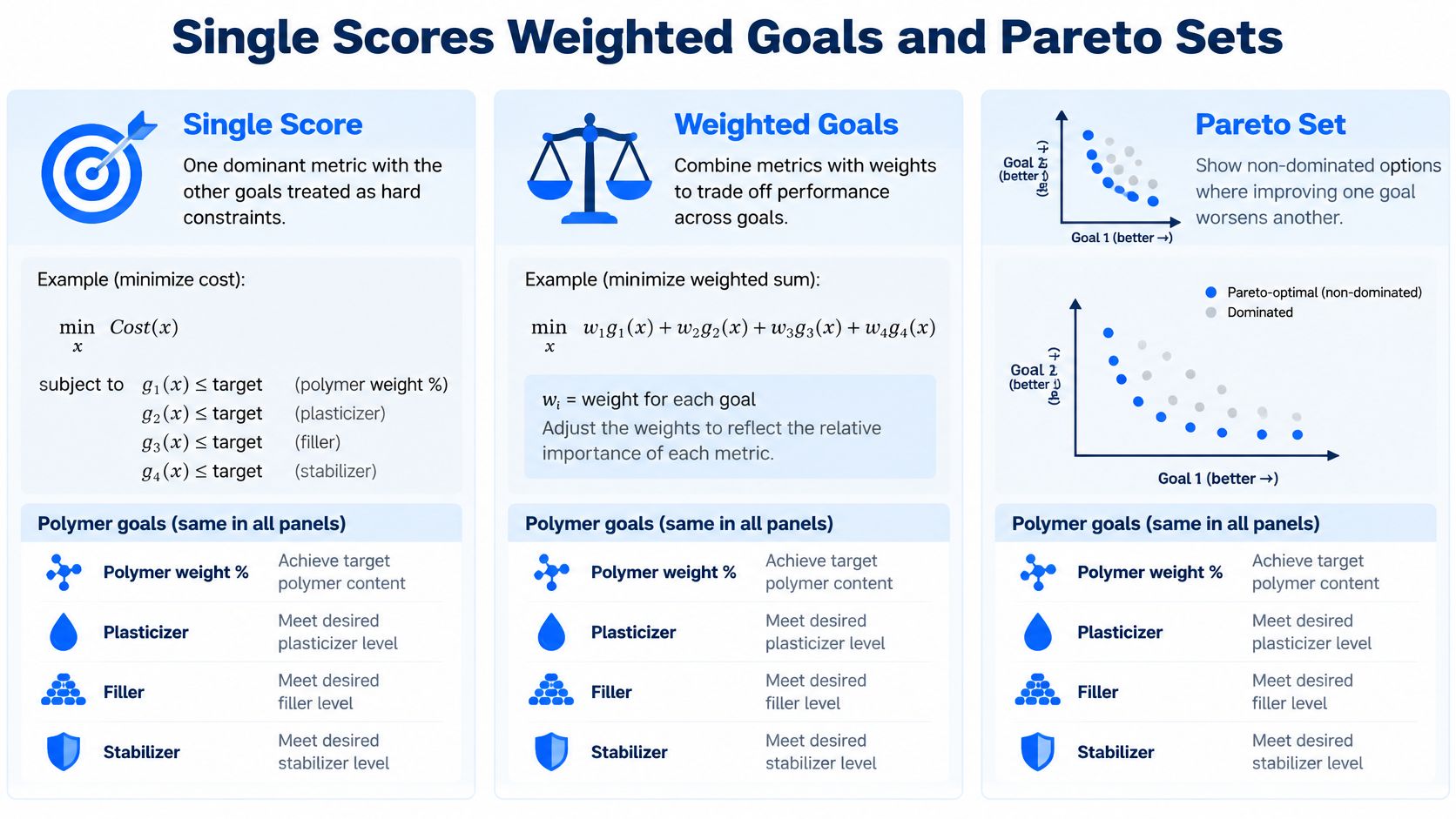
Three ways to write the objective use the same polymer goals. Polymer, plasticizer, filler, and stabilizer stay fixed as the chemistry. Only the math changes. The wrong form hides the trade-off you needed to see.
One score when the rest are floors
A single objective is right when one metric dominates and the rest are hard floors. Minimize euros per kilogram subject to tensile of at least 18 MPa and elongation of at least 200%. The team sees one recommended recipe. Near-misses that were 0.2 MPa under the floor, and much cheaper, disappear. That is fine when the floor is a real customer spec. It is a bad fit when "18 MPa" was a round number nobody will defend.
Weights when leadership will own them
A weighted sum collapses goals into one score. One version is 0.5 times normalized strength, plus 0.3 times normalized cost savings, plus 0.2 times a recyclability index. You get one score and a ranked list, which is easy to put in a slide. The weights are opinions. Shift strength from 0.5 to 0.6 and a different recipe can take the top slot. Normalize before you weight. Tensile in MPa and cost in euros per kilogram don't share a scale, and an unnormalized sum lets the biggest unit win by accident.
A frontier when goals truly compete
A Pareto set keeps every recipe that isn't worse on all goals at once. The team sees the strength-versus-cost frontier instead of a fake optimum. There is no automatic pick. Someone still has to say whether the next 2 MPa is worth the extra euros. That is a business rule, and it should be written before the results arrive.
| Form | Best when | What the team sees | Main failure |
|---|---|---|---|
| Single objective with hard floors | One metric matters and the rest are pass or fail | One recommended recipe | Hides value in the rejected near-misses |
| Weighted sum | Leadership can defend explicit weights | One score and a ranked list | A small weight change crowns a different winner |
| Pareto or multi-objective | Two or more goals truly compete | A frontier of non-dominated recipes | No automatic pick without a business rule |
Recent materials research treats this as Pareto-frontier optimization. Competing objectives are modeled together, and experiments are chosen to expose useful trade-offs rather than a single theoretical optimum. In polymers and chemicals, a gain in strength, conductivity, barrier, or cure speed can worsen recyclability, viscosity, durability, or cost. Mathematical optimality isn't manufacturing feasibility. A slightly lower-performing grade can be the better commercial choice if it is more stable, cheaper, easier to process, or less sensitive to raw-material variation.
Goals that teams commonly stack, and shouldn't smash into one number without a decision, are performance, cost, sustainability, processability, regulatory limits, supply risk, and manufacturability. Mark the hard items as constraints. Mark the soft items as objectives. Do that before any solver runs.
Read the frontier at the knee. That is the point where the next bit of strength, barrier, or cure speed costs a disproportionate amount of money or recyclability. Left of the knee you are leaving performance on the table. Right of it you are paying a lot for a property the customer may not value.
A short walk-through of how a frontier is built, and why a weighted score can hide it, is worth ten minutes before you lock weights:
How to Encode a Formulation Brief
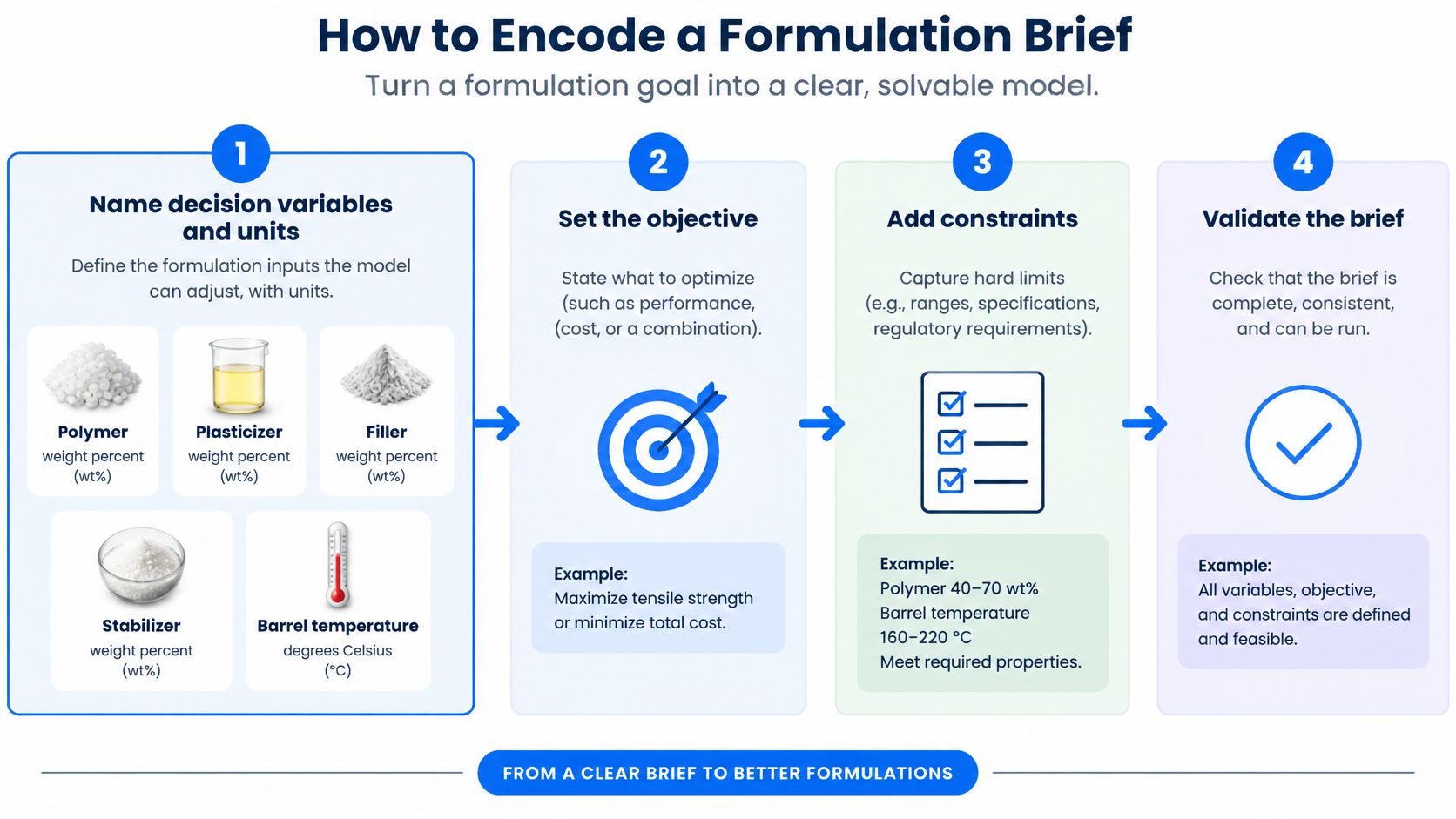
Treat the brief like a recipe card that lists amounts, a taste target, and rules you can't break. A weight-based kitchen formula, the kind used in DIY bath bombs with hidden surprises, fails the same way a polymer brief fails if the parts don't sum to the batch and a banned ingredient sneaks in. Allergen rules and oven temperature are constraints. "Delicious" is not a single number. Neither is "high performance."
- Name the decision variables and their units. Write weight percent of polymer, plasticizer, filler, and stabilizer, plus barrel temperature in °C and screw speed in rpm. A missing unit is how 15 phr and 15 wt% get mixed in the same model.
- Write the balance constraints. Fractions must sum to 100%. If a curative has a fixed stoichiometric ratio to the resin, write that ratio as an equality. A solver that ignores stoichiometry will happily under-cure a "cheaper" batch.
- Separate hard constraints from wishes. Regulatory bans, machine torque limits, and the customer's minimum property specs are hard. Maximum cost is hard only if finance will reject the batch. "We'd like it cheaper" is a wish, so it belongs in the objective.
- Choose the objective form and normalize. Pick a single floor-based objective, a weighted sum, or a Pareto set. If you weight, put strength, cost, and recyclability on a 0 to 1 scale first. Otherwise the property with the largest raw number dominates the score.
- Set bounds from the last successful design space. Don't run every ingredient from 0 to 100. If the last ten good batches sat between 55% and 70% polymer, start there. Wide bounds invite extrapolation into a region where the model has never seen a measurement.
- Declare what is linear and what isn't. A linear cost equation is a fair first screen. Viscosity, cure, and many mechanical responses are nonlinear, so a linear program is only a first screen. Use it to cut the space, then fit a nonlinear model where the response curves.
- Add a stability check. Re-score the top candidates after shifting a key ingredient by the supplier's lot tolerance, often a few percent. Drop any recipe that falls off spec. A formula with no margin is a formula that fails on the next lot.
- Hand the shortlist to the next experiment, not to production. The encode step produces candidates and a test plan. It doesn't authorize a plant trial by itself.
A brief you can run names the knobs, states the score, lists the rules you can't break, and says which responses are curved. If any of those four is missing, you don't have an optimization formula yet. You have a wish list.
A Worked Compounding Example with Three Recipes
A team compounding a flexible polymer grade has a clear brief. Tensile must reach at least 18 MPa. Elongation must reach at least 200%. Melt flow has to stay inside the extruder window. Lower cost and a higher recyclate share are preferred, not required. Three recipes survive the hard constraints. Everything else was already thrown out.
Recipe A is the lab champion. Tensile lands at 24 MPa, recyclate is zero, and the resin package is the most expensive in the set, with a cost index of 100. It stays on spec if the virgin resin lot shifts by 3%. It wins the single-property contest and loses the commercial one.
Recipe B gives up a little strength. Tensile is 20 MPa, still clear of 18 MPa, and elongation stays above 200% with margin. Recyclate is 15 wt%. Cost sits below A's index. The durability check doesn't push it off either floor.
Recipe C maximizes recyclate at 40 wt% and still clears the nominal floors, with tensile at 19 MPa. A 3% shift in recyclate quality drops elongation under 200%. On the average lot it looks clever. On a bad lot it is scrap.
| Recipe | Cost index | Tensile (MPa) | Recyclate (wt%) | Robustness note |
|---|---|---|---|---|
| A lab peak | 100 | 24 | 0 | Stays on spec if resin lot shifts 3% |
| B commercial pick | Below 100 | 20 | 15 | Keeps margin above 18 MPa and 200% |
| C high recyclate | 82 | 19 | 40 | Elongation falls under 200% if recyclate quality shifts 3% |
The decision rule is short. Discard anything that fails a hard constraint or the variability check. Then choose on the frontier using the business priority that was written down in advance. Here that priority is lowest cost at equal spec margin. B wins, even though A has the best single property. C is feasible on the mean and infeasible under variation, so it doesn't get a vote.
Edge cases change the pick, and they should. A regulated food-contact grade may ban C's recyclate stream entirely, which removes C before cost is discussed. A premium mechanical spec that moves the floor to 22 MPa eliminates B and leaves A. The formula's job was to expose that choice, not to hide it inside one score. If the priority changes after the table is built, say so out loud and rerun the rule. Don't reweight until A "wins."
When the Lab Optimum Fails at Scale
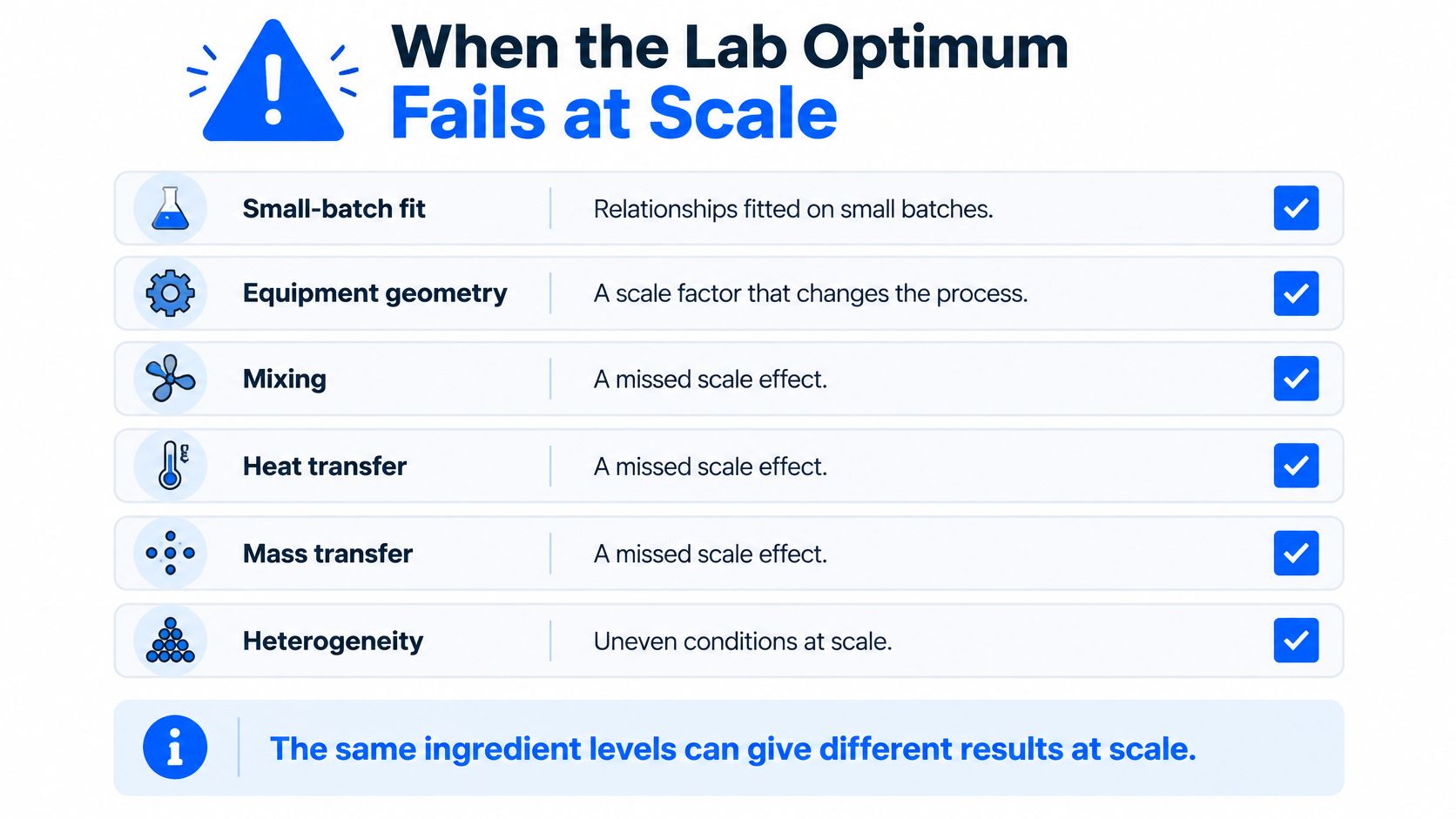
Relationships fitted on small batches often miss equipment geometry, mixing, heat transfer, mass transfer, and heterogeneity. The same ingredient levels can give a different viscosity, dispersion, or cure on a production line. A 200 g cup sees nearly uniform temperature. A production extruder does not. The center of the melt and the wall can sit far enough apart to change cure and color in the same lot.
A recent review of scale-up treats this gap as a persistent failure point. Lab-scale models may not account for changes in equipment geometry, mixing dynamics, compression, heat transfer, mass transfer, or process heterogeneity. Scalability data remain scarce. Air entrapment, temperature sensitivity, and ingredient variability can undermine reproducibility. The same review frames the practical question directly. You don't know a lab optimum will stay optimal at pilot or commercial scale until you treat scale-up as a multi-fidelity optimization problem, not as a final checkbox.
What to add before you call it optimal
Use lab data to shrink the feasible region. Spend pilot runs on the interactions a beaker can't see, such as screw design, residence time, and cooling rate. Methods that combine information from different scales are built for sparse, noisy, nonlinear data, which is what a pilot campaign produces.
Define scale-dependent critical quality attributes before the pilot. Dispersion quality, residual solvent, and batch temperature spread belong in the formula as constraints or noise factors. If they show up as a surprise at the end, the optimum was never scale-ready. When a property is measured one way in the lab and another way on the line, compare ultrasonic solution test results against the original method before you blame the recipe. A changed test can look like a failed formula.
Run a resilience test on the shortlisted recipe. Vary mix energy, peak temperature, and a key raw-material lot inside realistic ranges. Keep the recipe only if properties stay inside spec across that box. One center-point pilot batch isn't a scale confirmation.
If the formula's variables don't include at least one equipment or process parameter, it isn't yet a scale-ready optimization formula.
Select the Robust Formulation and Plan the Next Experiment
Freeze the hard constraints. Don't reopen them to rescue a pretty objective value. A recipe that misses 18 MPa or 200% elongation doesn't get back in because its cost index looks good.
From the feasible Pareto set, drop candidates that fail the lot-variability check or the scale check. Apply the priority the business wrote down before anyone saw results. Lowest cost at a stated spec margin, or highest recyclate at equal cost, are both usable rules. "We'll know it when we see it" is not.
Plan the next experiment on the remaining uncertainty, not on a random grid. Confirm the chosen recipe at the scale where heat transfer or mixing changed. Measure the property with the smallest safety margin first. If elongation cleared 200% by only a few points, that is the measurement that can kill the pick. Don't spend the pilot on a property that already has a wide gap.
In 2025, 6% of respondents surveyed for Gurobi's State of Mathematical Optimization report said their organizations were already combining optimization with generative AI or large language models. Many groups are not in that 6%. The reliable next step is still an explicit formula plus targeted tests.
Where historical formulation data already exist, our multi-objective work in Polymerize Labs can build that shortlist from the data you already have. You still own the constraints and the business priority. Labs cuts reformulation cycles by 75% with first-time-right formulations, and stated results include 3x faster discovery, 50% faster experiments, and 90% fewer trials. A Japanese TPU manufacturer hit precise targets for 10 material properties across two process flows, with over 95% prediction accuracy. The model proposes. The brief decides.
Write the formula, shortlist the recipes, and book the confirming run at the scale that can still change the answer.
Polymerize helps materials teams turn a formulation brief into a constrained, multi-objective search instead of another round of one-factor trials. Labs predicts properties, balances competing targets, and points to the next experiment from the data you already hold. Visit Polymerize to put a real brief through that workflow.
Put your R&D data to work
See how materials teams use Polymerize to plan fewer experiments and reach target properties faster.