


Media Formulation and Optimization in R&D
The popular advice in media formulation and optimization is to add a more complex machine-learning model. That advice is incomplete. A model can't rescue formulation records that omit component grades, preparation order, culture conditions, batch identity, or the reason an experiment failed. In practice, the fastest route from trial-and-error to reliable discovery usually starts with better evidence, then applies the right statistical or AI method to that evidence.
Media development is a constrained, multi-objective problem. Component proportions interact, biological responses can be nonlinear, and a laboratory optimum may be too viscous, unstable, sensitive to process variation, or difficult to manufacture. The practical question is not just which formulation scores highest in a plate or flask. It's which formulation delivers the required performance inside a traceable, reproducible, and scalable operating window.
Table of Contents
Why Better Models Cannot Fix Bad Formulation Data
A new model can process more variables, search a larger design space, and recommend the next experiment. It still depends on the quality of the observations supplied to it. Recent reviews on AI in formulation identify sparse, noisy, and heterogeneous datasets, weak experimental validation, and limited interpretability as persistent barriers. They also point toward tighter data governance and standardized experimental design, rather than larger model stacks alone, as the practical route to better optimization (recent review of AI in formulation).

A formulation dataset often looks larger than it really is. One spreadsheet may contain ingredient concentrations, another may record only a formulation code, and an ELN may hold the preparation notes as free text. Historical notebooks can lack consistent units, supplier information, passage details, inoculation state, equilibration time, or assay version. Once these records are combined, the algorithm may treat materially different experiments as comparable, or unrelated experiments as evidence for the same relationship.
What makes a formulation record decision-grade
A useful record describes more than the recipe. It should connect composition, process, context, measurement, and outcome in a way another scientist can audit.
- Composition: Store component identity, concentration, unit, grade, lot, supplier, and permitted substitution status.
- Process: Capture order of addition, mixing energy, temperature, hold time, filtration, sterilization, and storage conditions.
- Biological context: Record cell source, passage information, inoculation state, culture format, and relevant handling history.
- Measurement: Preserve assay method, instrument, operator, run date, replicates, detection limits, and failed or excluded observations.
- Outcome: Separate raw measurements from transformed values, derived scores, acceptance decisions, and scientist comments.
Missing metadata doesn't always make an experiment useless. It does make the experiment less trustworthy for causal interpretation and automated recommendation. A model might correctly detect that one formulation performed well while remaining unable to explain whether the response came from composition, process conditions, cell state, or an unrecorded batch effect.
Practical rule: Treat every experiment as a traceable event, not just a row containing ingredient concentrations and a result.
Validation must be part of the dataset
Teams also need to distinguish prediction from confirmation. A fitted model can look convincing within the observed design space while failing at the proposed optimum. Replicates that disagree shouldn't be averaged away without notice. They should trigger an investigation into assay precision, mixing, material variability, biological drift, and hidden process factors.
Standardized experimental design helps because it creates comparable observations deliberately. It also makes uncertainty visible. That matters more than a polished dashboard. A formulation scientist needs to know where the model is supported, where it is extrapolating, and which missing variable could change the recommendation.
The result is a less glamorous but more productive starting point: define the formulation schema, standardize units and response definitions, preserve raw data, label confidence, and design experiments that answer specific questions. Once the record is reliable, advanced models become useful. Before that, they mostly automate uncertainty.
The Statistical Foundation of Mixture Design
Media components don't behave like independent switches. In a mixture experiment, changing one proportion affects the available proportion for others because the components are constrained by the total formulation. The response therefore depends on relative composition, not on independent factor levels treated in isolation.
That principle became formalized in the 1950s, when Henry Scheffé introduced foundational models for mixture experiments. He later extended the work with the simplex-centroid design in 1963, creating a mathematical framework that remains relevant to formulation optimization in chemicals, food, pharmaceuticals, and advanced materials (historical review of mixture design).
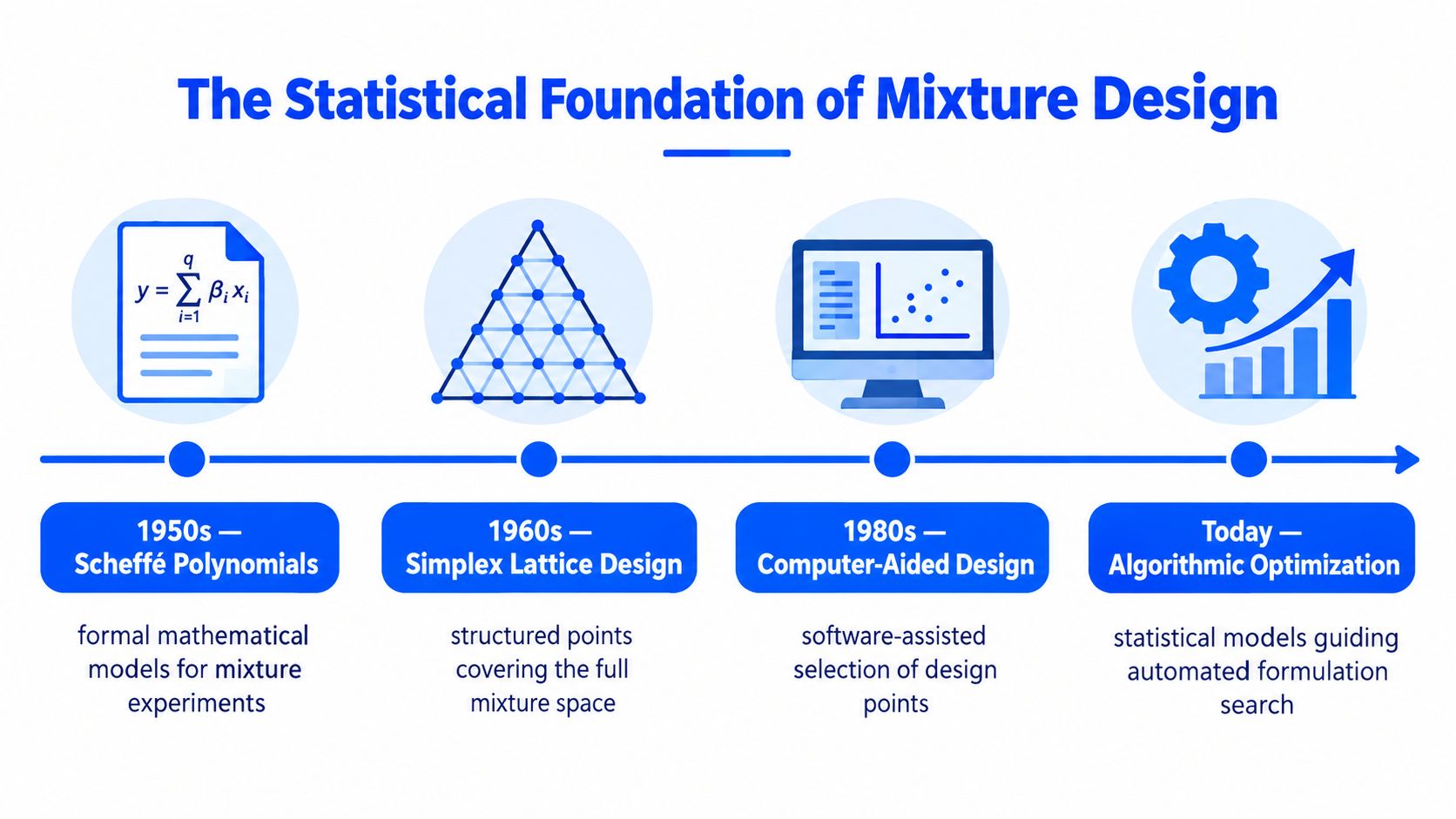
A conventional regression workflow can misrepresent a mixture if it ignores that constraint. The model must reflect component relationships, including interactions and, where justified, nonlinear behavior. A formulation that performs well at one composition may fail when a seemingly minor substitution changes the balance among buffers, nutrients, salts, surfactants, or stabilizers.
Select the design around the question
The design should follow the decision the team needs to make.
- Use mixture designs when proportions are the central variables. Simplex-based designs help cover a constrained composition region rather than pretending each ingredient can vary independently.
- Add process factors when preparation affects performance. Temperature, mixing time, order of addition, filtration, and culture conditions may need to be modeled alongside composition.
- Use response-surface methods when curvature matters. A linear approximation can screen broad behavior, but it won't describe a meaningful optimum if responses bend or interaction effects dominate.
- Use optimal designs when the feasible region is irregular. D-optimal and I-optimal approaches can select informative points when practical constraints exclude large parts of the theoretical mixture space.
The field expanded substantially in the late twentieth century. Multiple linear regression was once predominant, but mixture constraints required special model forms. Later developments included partial least squares and optimal design methods that focus experimental effort where it can provide the most information. The historical literature identifies Kirstine Smith's 1918 work as an early precursor to optimal design and cites Lambrakis' 1968 work in the formal development of I-optimality for special mixture designs (review of mixture optimization methods).
Why one-factor-at-a-time fails
Changing one ingredient while holding everything else fixed can identify a local response, but it often misses interaction effects. It also consumes runs without describing the broader feasible region. For media formulation and optimization, that creates a dangerous illusion of progress. The team may find a better result at one tested point without learning whether the result is reliable, whether another combination would perform better, or how close the recipe is to a manufacturing boundary.
A statistically designed experiment doesn't eliminate scientific judgment. It gives that judgment a more informative set of observations. Scientists still define plausible ranges, exclude chemically impossible combinations, choose meaningful responses, and inspect residuals. The design supplies structure, while domain knowledge determines whether the structure represents a credible formulation space.
Executing a High-Confidence Optimization Workflow
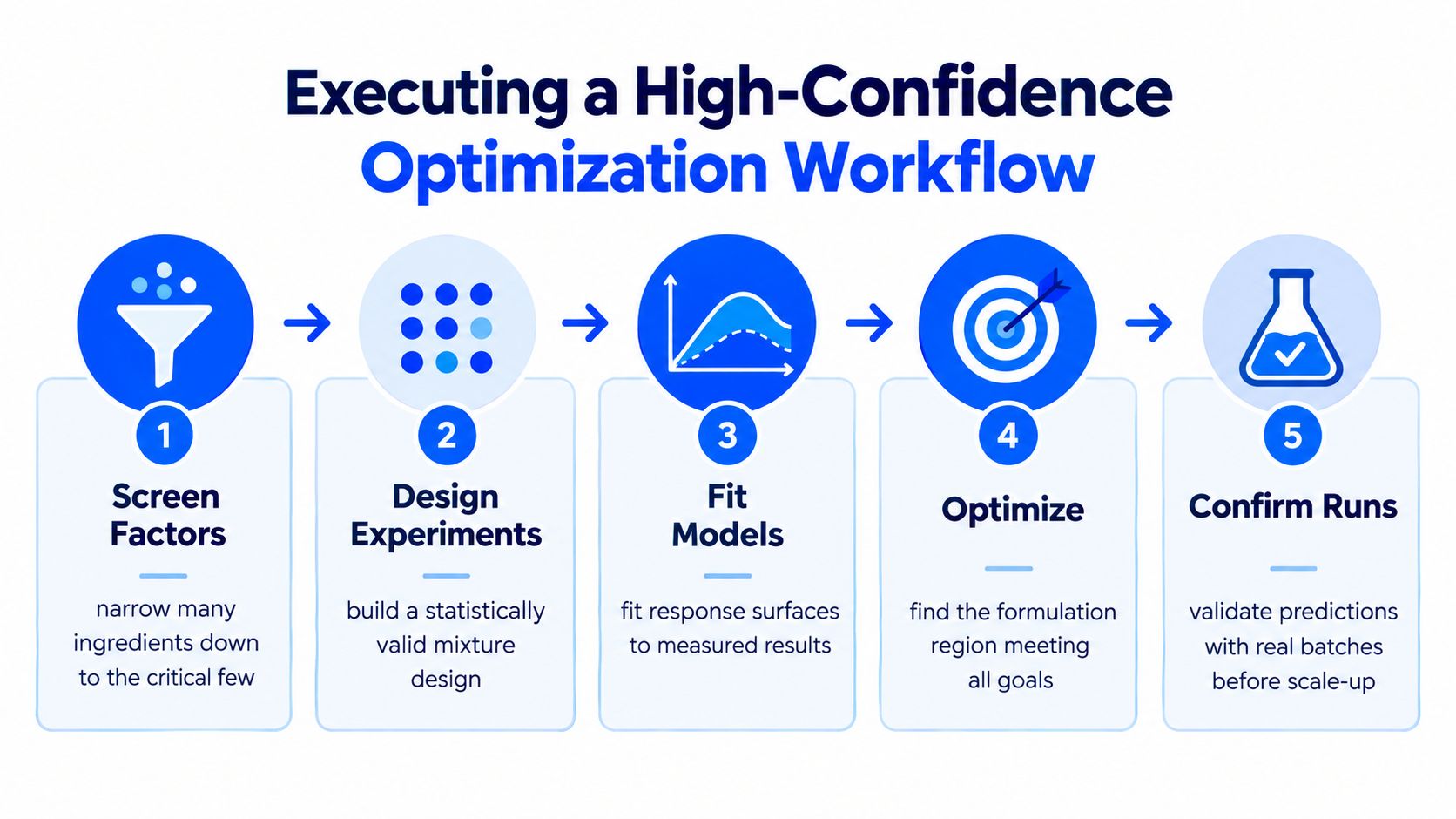
A reliable workflow moves from broad learning to focused optimization, then checks whether the predicted answer survives real experimentation. It shouldn't begin by asking an algorithm for the best recipe. It should begin by defining the feasible region, the responses that matter, and the factors that could confound interpretation.
Start broad, then spend experiments where they matter
Screening comes first when the candidate space contains many ingredients or process factors. The objective is to identify the few influential variables that deserve deeper modeling. Screening isn't the stage for claiming a final optimum. It establishes which factors appear consequential and which can be fixed, grouped, or removed from the next design.
A response-surface design, such as a central composite or Box–Behnken design, can then characterize curvature and interaction among the retained factors. For mixtures, the design must respect composition constraints. For mixture-process experiments, the formulation and process regions need to be represented together rather than analyzed as unrelated studies.
The model should be checked before optimization. Review the residuals, assess lack of fit, inspect influential observations, and compare predicted behavior with the actual response pattern. A strong statistical fit doesn't prove that the mechanism is correct or that the proposed optimum is safe to manufacture.
The predicted optimum is a hypothesis until a real batch confirms it.
The final stage is confirmation. Experts recommend three confirmation replicates at the predicted optimum before scale-up, so the team can test whether the observed result agrees with the model and estimate variation around the candidate formulation (applied optimization workflow and confirmation guidance).
Common shortcuts that create false confidence
Skipping confirmation is the most visible failure, but it isn't the only one. Teams also select designs that don't match the factor space, fit a model to responses with inconsistent definitions, and optimize beyond the range supported by the data. Each shortcut can produce a recommendation that looks precise while resting on weak evidence.
A practical review gate should ask:
- Is the candidate inside the validated region? If not, run experiments that expand the design rather than presenting extrapolation as optimization.
- Did the response definitions remain stable? A change in assay method or endpoint can make historical and current results incomparable.
- Did the process remain controlled? A composition effect is difficult to separate from preparation variation when the batch procedure changes.
- Did confirmation meet the acceptance criteria? If it didn't, update the model and investigate the cause instead of forcing approval.
Designed experiments reduce waste compared with one-factor-at-a-time work because each run contributes to a structured estimate of the response surface. They don't reduce the need for laboratory discipline. The value comes from combining a valid design, careful execution, model checking, and confirmation.
Accelerating Discovery with Active Learning and Bayesian Search
Static design of experiments is valuable when the team needs broad coverage and interpretable estimates. It becomes less efficient when experiments are expensive, the design space is sparse, and each result should determine what happens next. Active learning and Bayesian optimization address that situation by updating the search after each batch of observations, balancing promising regions against areas where uncertainty remains high.
A formulation-oriented comparison reported 5 target-satisfying runs out of 15 total runs, or about 33% efficiency, for an active-learning approach. A non-active-learning DOE workflow produced 2 successful runs out of 22, or about 9% efficiency (formulation-oriented active-learning study). These figures illustrate a useful advantage in sparse spaces, but they don't make active learning a universal replacement for designed experiments.
| Method | Efficiency / Hit Rate | Best Use Case | Primary Risk |
|---|---|---|---|
| Traditional DOE | 2 successful runs out of 22, about 9% in the cited comparison | Broad, structured learning and interpretable factor effects | Spending runs in regions that later appear unpromising |
| Active learning | 5 target-satisfying runs out of 15, about 33% in the cited comparison | Iterative search when each result can guide the next experiment | Over-exploiting early winners and missing hidden variables |
The strongest workflow uses each method for what it does well. A screening or mixture design can establish coverage and expose major interactions. An uncertainty-aware optimizer can then select promising candidates, especially when the team has a clear target and limited experimental capacity. Confirmation remains necessary because a high hit rate in an iterative search does not guarantee stability, transferability, or manufacturing readiness.
Control the optimizer's appetite
Active-learning systems can over-exploit early winners. If the first successful formulation is favored too aggressively, the search may stop exploring nearby compositions that offer better stability or process tolerance. The system also needs constraints that reflect reality, including ingredient availability, allowable concentration ranges, preparation limits, batch size, and assay capacity.
Hidden variables create another failure mode. A recommendation can appear faster because the workflow accidentally benefits from a favorable batch, operator, cell state, or measurement threshold. Teams should log these variables and include them in the decision process whenever they plausibly affect the response.
Batch-size effects need explicit attention. A small exploratory batch may behave differently from a larger preparation because mixing, heat transfer, hold time, filtration, or container geometry changes. The optimizer should not treat every result as interchangeable without checking whether the process context supports that assumption.
Use Bayesian search to choose the next informative experiment, not to bypass experimental controls.
The right question is whether the AI loop improves decisions under known uncertainty. If it recommends candidates that satisfy a target but fail on repeatability, the loop needs better constraints, better metadata, or a different objective. Speed is useful only when the search remains scientifically defensible.
Optimizing for Manufacturability and Scale-Up Constraints
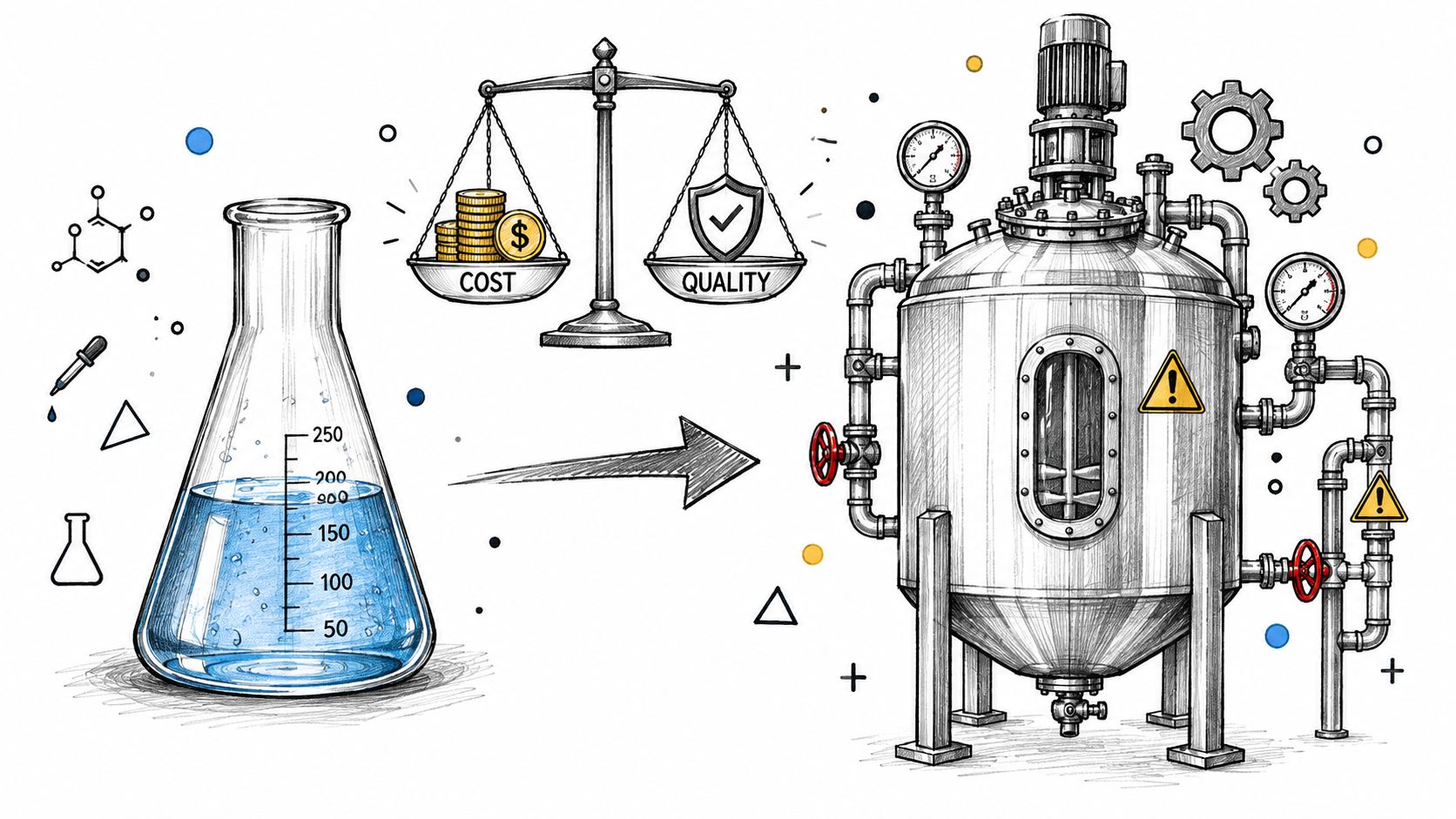
A laboratory winner can be a manufacturing loser. The formulation may deliver excellent biological performance under tightly controlled conditions yet become difficult to mix, filter, fill, store, or administer when the process grows. A useful optimization target therefore includes performance and operating margin, not performance alone.
Formulation design is a multi-criteria problem involving competing targets such as stability, viscosity, injectability, and process reliability. High-concentration formulations can increase viscosity and aggregation risk, which makes a wide design space more valuable than the highest single laboratory metric (review of AI in pharmaceutical formulation and drug delivery).
Define the design space before selecting the winner
Start by converting vague goals into measurable criteria and acceptable ranges. A formulation might need to meet a biological activity target while remaining within viscosity limits, maintaining stability through storage, tolerating normal process variation, and using ingredients that procurement and quality teams can support.
Those criteria often conflict. Increasing one component may improve activity but raise viscosity. Reducing a stabilizer may simplify processing but weaken storage performance. A formulation with the best central result may be a poor choice if a small composition or temperature change pushes it outside specification.
A more useful decision compares candidates across the feasible region. Look for a plateau or operating window, not just a peak. The preferred formulation may sit slightly away from the theoretical maximum because it offers greater tolerance to weighing error, raw-material variability, mixing differences, or temperature shifts.
Choose experiments that expose scale-up risk
The next experiment should answer the most consequential uncertainty. If viscosity is the concern, test relevant concentration and temperature conditions. If aggregation is the concern, examine stress and storage conditions. If mixing is uncertain, model order of addition, shear, hold time, and vessel behavior instead of assuming laboratory handling will transfer automatically.
The same logic applies to digital operations. Teams working across laboratories, plants, and security-sensitive environments can find useful process principles in resources such as enabling secureops with Rite NRG, particularly when access control and operational traceability must support scale.
Acceptance ranges should be agreed before the final comparison. Otherwise, teams may move the goalposts toward the most attractive result. Record which objectives are hard constraints, which are preferences, and which trade-offs require technical or quality approval.
A scalable formulation is one that remains acceptable when the process stops being ideal.
Scale-up validation should include representative preparation conditions and realistic variability. It should also preserve the connection between composition and process data. Without that link, a team may know that a production batch failed but not whether the cause was the recipe, the procedure, the equipment, or the raw material.
Building an AI-Ready Data Backbone for Continuous Iteration
Continuous optimization requires more than moving spreadsheets into a shared folder. The data backbone must preserve relationships among formulations, materials, processes, assays, batches, and decisions. Scientists should be able to trace a recommendation back to the observations that support it and identify where uncertainty enters the chain.
A practical implementation can begin with a controlled schema and expand over time.
Build the foundation in a deliberate order
- Create a canonical vocabulary. Standardize component names, units, concentration basis, material grades, supplier identifiers, process steps, and response definitions. Preserve the original value as well as the normalized value.
- Connect records with stable identifiers. Link formulation versions to experiments, batches, instruments, operators, and assay runs. Don't rely on filenames or manually typed formulation names.
- Separate raw and interpreted data. Store the original measurement, transformation, normalization, exclusion reason, and final analysis value as distinct fields.
- Capture negative evidence. Failed experiments, out-of-specification results, and abandoned candidates contain information about boundaries. Label them rather than deleting them.
- Record provenance and permissions. Maintain who changed a record, when, why, and under which approval. Use role-based access where intellectual property or regulated data requires it.
- Design for explainability. Store the features, training population, confidence information, and historical precedents used to generate a recommendation.
Quality by Design principles fit naturally into this structure because they force the team to define critical quality attributes, critical material attributes, process parameters, and acceptable design space. The data system should make those relationships visible rather than leaving them in disconnected reports.
A centralized system also supports actionable media data insights when teams need to convert operational records into decisions rather than retrospective charts. The important test is simple: can a scientist identify the next best experiment, understand why it was selected, and reproduce the evidence behind it using actionable media data insights?
Polymerize can support this type of workflow by unifying experimental data from spreadsheets, ELNs, and other silos, then applying explainable models for property prediction, formulation optimization, and next-experiment planning. It should be evaluated as one component of a broader operating model that includes experimental design, governance, validation, and scale-up controls.
Polymerize offers a centralized data backbone and AI-guided formulation workflow for teams working across polymers, chemicals, and advanced materials. If your media formulation and optimization program is constrained by fragmented records or uncertain scale-up decisions, visit Polymerize to assess how the platform could support traceable, targeted experimentation.