



A new elastomer has cleared the usual quality gates. Its tensile strength is within specification, its density is stable, and a short chemical soak shows no obvious damage. Months after launch, however, seals begin to crack. The laboratory results weren't wrong. They were incomplete because the material experienced heat, fluid exposure, pressure, and repeated movement together, while the test program examined each factor separately.
That situation is common in polymer, coating, seal, packaging, medical-device, and energy applications. Material compatibility testing is not just placing a specimen in a liquid and checking whether it changes color. It's a structured decision process for understanding how a material behaves across the chemical, thermal, mechanical, and environmental conditions it will really encounter.
Table of Contents
Why Material Compatibility Testing Matters
A material can pass an individual test and still fail in service because real products rarely experience one stress at a time. An elastomer exposed to a fuel may swell. The same elastomer may remain stable at room temperature but lose strength during heating. Add compression, vibration, or repeated thermal cycling, and the failure mechanism can change again.
The first task is therefore to define the service envelope. That envelope includes the fluid or gas, temperature range, pressure, contact duration, mechanical load, surface contact, cleaning process, radiation, humidity, and expected use cycles. If the team can't describe those conditions, it can't design a test that represents the product.
Compatibility is a decision pipeline
A sound program usually moves through connected stages:
- Screening: Remove materials that show obvious chemical or physical incompatibility.
- Characterization: Measure how exposure changes dimensions, mass, chemistry, and mechanical properties.
- Simulation: Combine the important stressors under conditions that resemble actual service.
- Qualification: Compare the results with predefined acceptance criteria and document the decision.
- Monitoring: Revisit the conclusion when the formulation, supplier, process, or service environment changes.
NASA's historical work illustrates this progression. Its compatibility procedure for concentrated hydrogen peroxide began with rough screening, then moved to more detailed analytical tests. NASA describes substantial materials testing during the 1950s and 1960s, while the associated procedure evolved through handbook revisions in 1974, 1981, 1991, and 1998. The test was first published in 1971 and last updated in 2011. These milestones are documented in NASA's materials compatibility procedure.
Practical rule: A compatibility result is only as useful as the service condition it represents.
Where teams lose information
Formulation chemists often know which additives, fillers, plasticizers, or curing agents may migrate. Product engineers understand stress, geometry, and assembly. Regulatory specialists know which evidence must support release. Field-service teams see the actual failure environment.
Failures occur when those groups work from different assumptions. A test plan based only on the resin datasheet may miss a processing change. A mechanical test performed on dry specimens may ignore fluid uptake. A regulatory test may satisfy a standard while saying little about a new combined-stress application.
For a focused introduction to how compatibility questions apply to peptide-related materials and labware, peptide material compatibility explained provides useful application context. The broader lesson is the same across sectors: compatibility is a relationship between a material, an environment, and a use condition.
What Material Compatibility Testing Really Measures
Think of a compatibility program as a medical checkup. A doctor doesn't declare someone healthy after measuring only body temperature. Blood pressure, cardiac rhythm, blood chemistry, symptoms, and history reveal different parts of the same system. Material testing works in the same way.
A useful program examines four interlocking dimensions:
- Chemical resistance: Does the material absorb the exposure medium, release constituents, react, oxidize, hydrolyze, or lose additives?
- Physical response: Does it swell, shrink, soften, crack, warp, or change mass and volume?
- Mechanical integrity: Does it retain tensile strength, elongation, modulus, compression resistance, flexural behavior, or hardness?
- Durability: Does it continue to perform after repeated exposure, cleaning, cycling, abrasion, pressure, or thermal change?
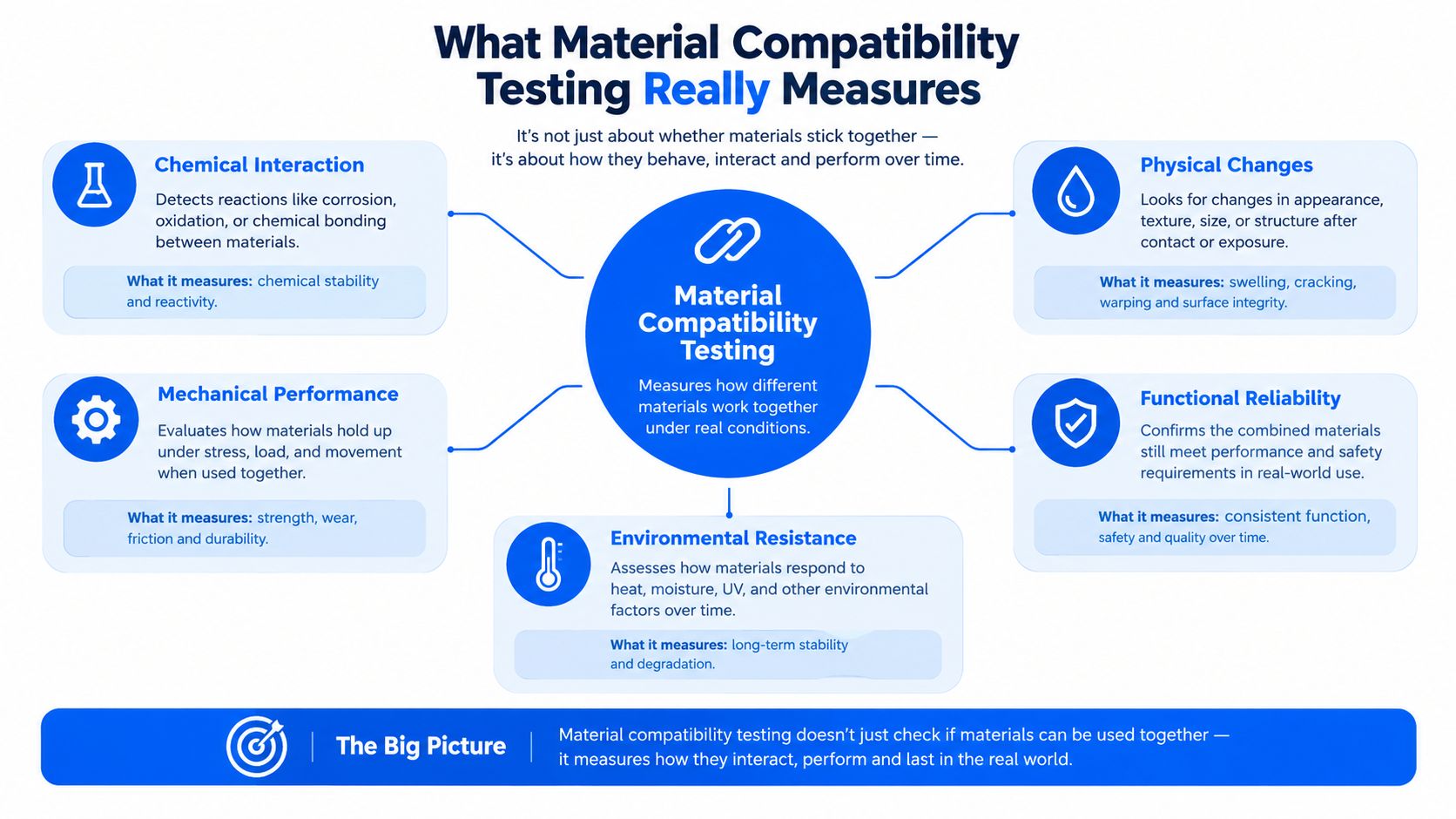
The output shouldn't be reduced to one pass or fail value. It should be a behavioral data set that shows how the material changes across a defined operating envelope. A small mass increase may be acceptable for one gasket but unacceptable for a precision valve. A modest hardness shift may not matter in a flexible seal, yet it could prevent a closure from maintaining pressure.
Why formulation history matters
Two samples made from the same base resin can behave differently. The difference may come from additive selection, cure state, crystallinity, moisture history, pigment, filler dispersion, surface finish, molding conditions, or annealing. That's why a supplier's generic chemical-resistance chart can support screening but rarely replaces testing on the actual grade and process.
Polymer-rich systems also create a timing problem. Exposure may first cause uptake or swelling. Later, extraction of an additive may leave the material harder and more brittle. In another system, chemical attack may weaken the polymer network before visible damage appears.
The polymer chemical resistance testing guidance from Element describes programs that combine immersion over periods ranging from days to months with mass or volume change, visual inspection, and retention testing such as tensile, compression, and hardness measurements. That combination matters because appearance alone can miss property loss.
The right question isn't “Did the specimen survive the soak?” Ask instead:
- What changed?
- When did it change?
- Which property changed first?
- Did the change reverse after conditioning?
- Can the product still perform under load?
The Five Core Test Families You Need to Understand
The five test families are different lenses on the same material. They're not interchangeable, and a strong program selects each one according to the dominant failure risk.
Chemical tests
Chemical testing examines interaction with liquids, gases, solvents, fuels, cleaning agents, sterilants, or process chemicals. Immersion can reveal uptake, extraction, discoloration, swelling, softening, or cracking. Extractables and leachables work from the opposite direction by examining what leaves the material and enters the surrounding medium. Permeation testing asks whether a fluid or gas can pass through the material at an unacceptable rate.
A static soak is useful for ranking candidates, but it may not represent flow, pressure, abrasion, or repeated contact.
Thermal tests
Thermal methods identify transitions, decomposition behavior, dimensional change, viscoelastic response, and heat-aging effects. Differential scanning calorimetry, thermogravimetric analysis, thermomechanical analysis, and dynamic mechanical analysis each answer different questions. A material may remain chemically intact while becoming too soft at operating temperature, or it may retain stiffness while becoming brittle after heat exposure.
Mechanical tests
Mechanical testing reveals whether exposure changes the material's ability to carry load. Tensile, flexural, compression, hardness, creep, fatigue, and seal-force measurements can be relevant. The critical comparison is usually not the exposed value alone, but property retention relative to an unexposed control.
A seal that swells but remains resilient may function well. A seal that shows limited swelling but loses compression recovery may fail sooner.
Environmental tests
Ultraviolet radiation, humidity, ozone, salt exposure, corrosion environments, and cyclic temperature can change the surface and the bulk material. These tests become especially important when outdoor exposure, electronics, transportation, or infrastructure service adds environmental stress to chemical contact.
Accelerated aging
Accelerated aging combines stressors such as temperature, humidity, fluid exposure, and mechanical load to reveal trends sooner than real-time observation. Models based on temperature dependence can help organize the analysis, but they don't turn an unrealistic test into a reliable service-life prediction. The accelerated condition must activate the same failure mechanism expected in use.
| Test Family | What It Measures | Typical Methods | Engineering Question Answered |
|---|---|---|---|
| Chemical | Uptake, extraction, degradation, permeation | Immersion, extractables, permeation | Will the exposure alter the material or contaminate the product? |
| Thermal | Transitions, decomposition, softening, dimensional stability | DSC, TGA, TMA, DMA, heat aging | Will temperature change structure or performance? |
| Mechanical | Strength, deformation, hardness, fatigue, retention | Tensile, compression, flexural, fatigue | Can the material still carry its service load? |
| Environmental | UV, humidity, ozone, salt, corrosion effects | Cyclic environmental exposure | Will the surroundings accelerate damage? |
| Accelerated aging | Cumulative change under combined stress | Temperature, humidity, fluid, and load cycles | What failure trend may emerge during extended service? |
The mature approach is to run complementary families in parallel where the risk justifies it. A static chemical screen can eliminate poor candidates quickly, while thermal and mechanical measurements explain whether the survivors remain suitable under realistic use.
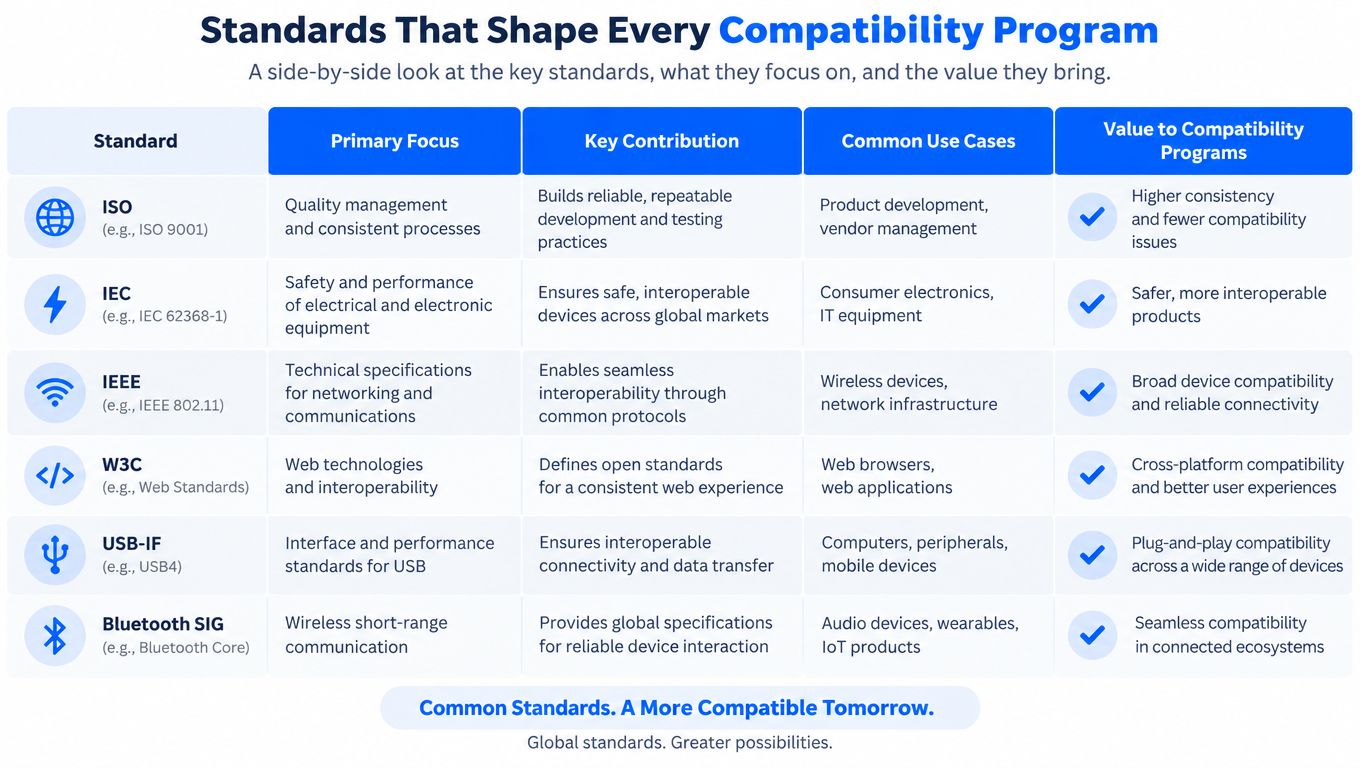
Standards That Shape Every Compatibility Program
Standards provide the architecture for a defensible test plan. They help laboratories control specimen geometry, conditioning, exposure, measurement, and reporting so that results can be compared. They don't remove engineering judgment.
A team may draw from ASTM and ISO methods for chemical resistance, tensile behavior, flexural performance, and aging. It may also need sector-specific frameworks for flammability, food contact, medical-device materials, electronics, hydrogen, or energy storage. The correct selection depends on the product, the exposure, and the evidence required for release.
Read standards as test architecture
Don't treat a standard as a title to place in a report. Extract the operational decisions:
- What specimen shape and surface condition are required?
- How should the material be conditioned before exposure?
- Which fluid concentration and temperature apply?
- How long must the specimen remain exposed?
- Should the test use static contact, flow, pressure, or cycling?
- Which measurements are mandatory?
- How should variation and invalid specimens be reported?
Hydrogen applications show why standards continue to evolve. A CSA/AM standard published on 1 January 2014 established uniform methods for evaluating materials in compressed-hydrogen applications. Related work has continued to address permeability, physical stability, property change, frictional wear, contamination, static exposure, cycling, and aging. The CSA/AM compressed-hydrogen compatibility standard is a useful reference point for understanding how an application moves from informal testing toward codified practice.
NASA's materials work offers another lesson. Formal procedures can be revised repeatedly as new materials, fluids, and safety expectations emerge. A standard is therefore a controlled starting point, not a permanent substitute for technical reasoning.
Where standards stop
Standards may not fully describe a novel fluid, a multi-material assembly, a new additive package, or simultaneous chemical, thermal, and mechanical stress. They may also provide limited guidance on how to compare results from different exposure regimes.
That gap is where internal protocols matter. Write down the deviations, justify them, preserve the raw data, and define how the custom method relates to the closest recognized procedure. A reviewer should be able to understand not only which standard was selected, but why its conditions represent the product.
Designing a Test Plan That Actually Predicts Performance
A test plan is a hypothesis about service behavior written in a form that a technician can execute and an engineer can challenge. Start with the product, not the available instrument.
List the operating conditions first:
- Temperature range and thermal cycling
- Fluid, gas, vapor, or cleaning chemistry
- Pressure, flow, and contact geometry
- Static and dynamic mechanical load
- UV, humidity, ozone, salt, or radiation
- Storage duration and use cycles
- Sterilization or sanitation conditions
- Required appearance, dimensional, chemical, and mechanical limits
Then map each stressor to a measurement. If swelling threatens a seal, measure dimensions and mass. If embrittlement threatens assembly, measure tensile or compression retention. If contamination matters, analyze the exposure medium as well as the specimen.
Control the specimen
Specimen preparation can create larger differences than the exposure itself. Record whether samples are molded, machined, coated, printed, annealed, dried, or conditioned. Preserve the relevant surface finish and orientation. Test the production-representative state when the process changes crystallinity, porosity, cure, residual stress, or additive distribution.
Use unexposed controls from the same batch. Where possible, include a material with known acceptable behavior and a material that represents a known risk. These controls help distinguish a true exposure effect from instrument drift or specimen variability.
Match instruments to decisions
FTIR can help identify chemical changes. DSC can reveal shifts in thermal transitions. DMA can show changes in viscoelastic response across temperature. Tensile frames, compression fixtures, hardness equipment, pressure cells, and flow loops each become valuable when they reproduce the failure mechanism under investigation.
Define acceptance criteria before reviewing the results. Possible criteria include:
- Mass or volume change
- Dimensional tolerance
- Visual damage rating
- Hardness shift
- Tensile or compression retention
- Permeation rate
- Extractable concentration
- Seal force or leakage behavior
| Operating Condition | Test Method | Reference Standard | Acceptance Criterion |
|---|---|---|---|
| Fluid contact | Immersion with mass, dimensions, and visual inspection | Selected chemical-resistance method | Predefined change limits and no unacceptable damage |
| Thermal exposure | Heat conditioning with post-exposure characterization | Selected thermal-aging method | Retained properties within product requirements |
| Mechanical load | Tensile, compression, flexural, or fatigue testing | Selected mechanical method | Required retention under service-relevant load |
| Pressure or flow | Dynamic exposure in a representative cell or loop | Application-specific protocol | No leakage, cracking, or unacceptable property loss |
| Repeated use or cleaning | Combined exposure and cycling | Internal protocol linked to the closest standard | Performance remains within the defined lifecycle limit |
A complete plan records requirements, methods, controls, acceptance criteria, and decision gates. If a result falls outside the expected range, the team should know in advance whether to repeat the test, investigate the procedure, requalify the material, or reject the candidate.
Reading the Data and Recognizing Common Failure Modes
Compatibility data often looks reassuring when viewed as isolated values. The more informative view is a set of curves aligned on the same exposure timeline.
Suppose an elastomer gains mass during fluid contact and later returns close to its original dimensions. That pattern may indicate reversible uptake. Another specimen may show a smaller dimensional change but lose elongation and become brittle because an additive has been extracted. The second material can be more dangerous even though its swelling result appears better.
Look for sequences, not snapshots
Common signatures include:
- Chemical attack: Mass change, tackiness, discoloration, surface cracking, or detectable chemical shifts.
- Hydrolysis: Loss of molecular integrity, changing thermal behavior, and declining mechanical performance.
- Oxidation: Embrittlement, discoloration, and progressive deterioration during heat or oxygen exposure.
- Stress cracking: Damage that appears only when chemical contact combines with strain or pressure.
- Thermal fatigue: Accumulated damage after repeated transitions between temperatures.
A specimen can pass static exposure and fail under cycling. Hydrogen compatibility frameworks, for example, distinguish among permeability, property change, wear, contamination, static exposure, cycling, and aging. The UNECE polymer compatibility material demonstrates why a single static result can't represent every service condition.
A practical review sequence
- Compare baseline and exposed specimens: Confirm that the controls behaved as expected.
- Plot retention over time: Don't rely only on the final measurement.
- Check replicates and variation: A mean value can hide unstable behavior.
- Align chemistry, physical, and mechanical data: Identify which property changed first.
- Inspect the failure location: Surface damage, edges, interfaces, and molded features may reveal the mechanism.
- Choose the next decision: Retest, modify the formulation, change the exposure, requalify, or reject.
A passing endpoint doesn't erase a damaging trend. If strength is falling steadily, the trajectory deserves attention even when the current value remains inside the limit.
How AI-Enabled Data Systems Change the Picture
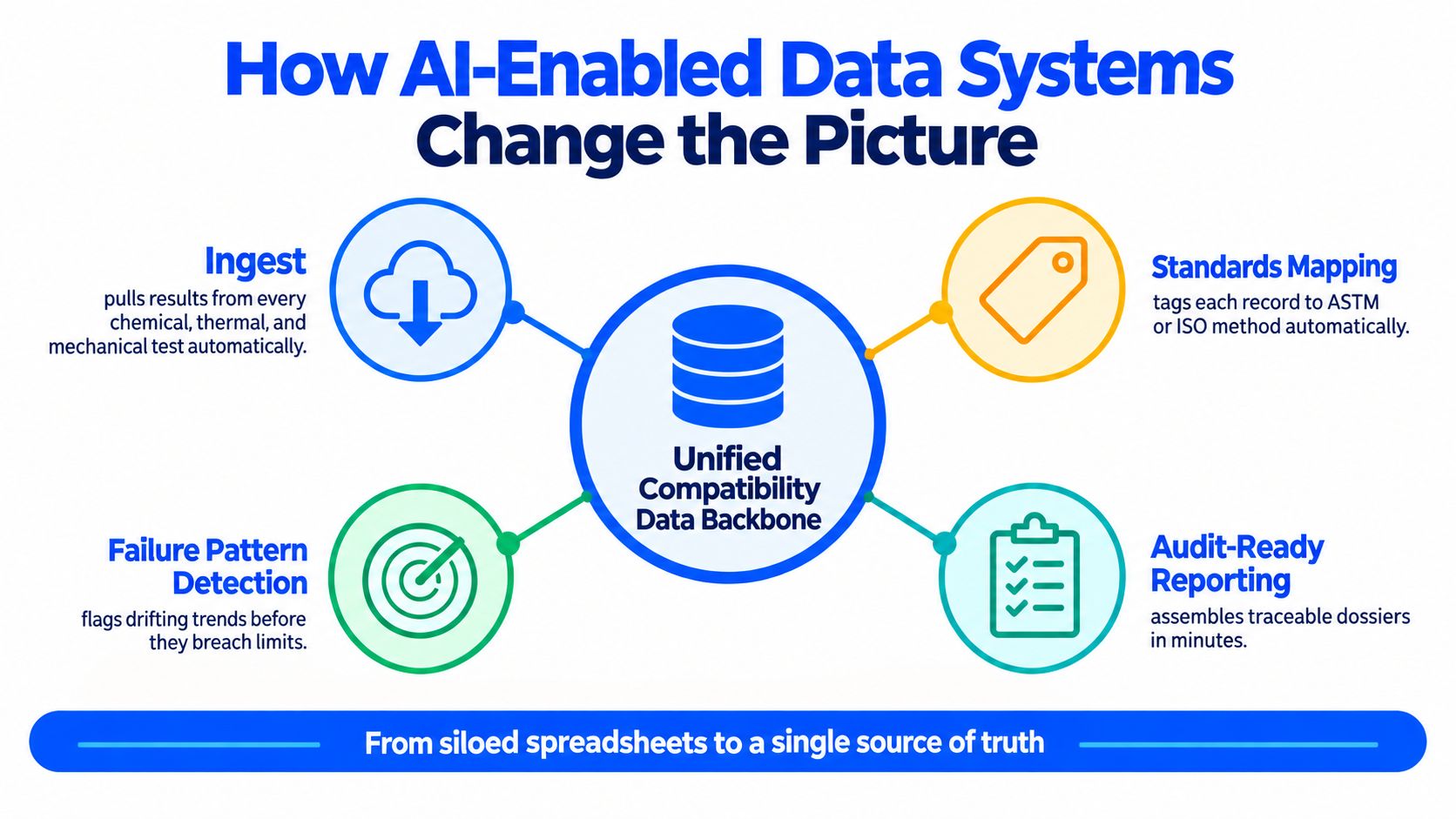
A compatibility program rarely produces one clean dataset. Chemistry may sit in a laboratory report, tensile results in a spreadsheet, thermal profiles in instrument software, specimen preparation notes in an electronic lab notebook, and acceptance decisions in email. Before engineers can compare materials, they may need to reconcile identifiers, units, batch names, exposure conditions, and document versions.
A unified compatibility data backbone preserves the context around every result. Each record should connect the formulation, supplier, batch, specimen state, exposure medium, temperature, time, load, instrument, method, operator, raw measurement, and decision. That structure matters because similar numbers can arise from different causes. Two specimens may show the same mass change, for example, while one absorbed fluid and the other lost extractable material.
Where models can help
AI and machine learning can support practical work across the qualification pipeline:
- Similarity discovery: Group formulations with comparable swelling, softening, permeability, or aging behavior.
- Early risk estimation: Flag candidates resembling materials that previously embrittled or became chemically unstable.
- Trend detection: Identify unusual drift that may indicate specimen preparation or instrument problems.
- Experiment selection: Recommend the next exposure or measurement most likely to reduce uncertainty.
- Knowledge retrieval: Find prior tests involving a similar fluid, additive, polymer family, or service condition.
- Traceable reporting: Assemble the evidence behind a qualification decision while retaining the underlying records.
The model should prioritize work, not replace physical validation. A prediction becomes useful when it shows the conditions that shaped it, the historical precedents behind it, and its uncertainty. Engineers still need representative testing because chemical, thermal, mechanical, and aging behavior can interact in ways that a training record does not fully capture.
A structured system also keeps negative results available. Rejected formulations, failed cleaning cycles, unexpected interactions, and invalid specimens can guide later decisions when their conditions are recorded consistently. Over time, the organization builds a searchable map of how chemical structures, processing states, and service conditions relate to risk.
Polymerize is one example of a materials R&D platform that unifies experimental information across spreadsheets, electronic lab notebooks, and other sources, then applies domain-specific models to formulations, properties, and processing conditions. In a compatibility workflow, this type of system can connect scattered test results with formulation history and help teams choose the next experiment.

The conceptual shift is straightforward. AI does not make soak testing unnecessary. It turns each result into reusable evidence by making it searchable, comparable, and explainable across the full qualification program.
Putting It All Together for Faster Scale-Up
Faster scale-up doesn't come from removing tests. It comes from making every test answer a defined question and preserving the answer for the next project.
Start the next program with this checklist:
- Define the full service envelope, including combined stresses.
- Identify the most credible failure mechanisms.
- Select relevant ASTM, ISO, sector, or internal methods.
- Build a sample matrix with production-representative specimens and controls.
- Set acceptance criteria before exposure begins.
- Capture raw data, metadata, deviations, and observations in a structured repository.
- Compare chemical, physical, thermal, and mechanical trends on a shared timeline.
- Use models to prioritize the next experiment, then validate the recommendation physically.
- Create a qualification dossier that another engineer can audit and reproduce.
The final step is organizational. Materials knowledge should survive the project that created it. A new supplier, additive package, cleaning agent, or manufacturing process should be evaluated against prior evidence rather than treated as a blank page.
For teams connecting laboratory evidence to broader development and production decisions, biotech scaling engineering criteria offers a useful perspective on translating technical requirements into scale-up criteria. The same discipline applies to material compatibility: define the requirement, measure the relevant behavior, control the uncertainty, and document the decision.
Your next action can be small and concrete. Take one current material qualification, list every service stress it will encounter, and map each stress to a measurement, control, acceptance limit, and data record. That exercise will show whether your program is testing compatibility or merely collecting isolated results.
Polymerize helps materials R&D teams unify compatibility results, formulation history, and property data so scientists can compare candidates and prioritize the next experiment with greater context. Visit Polymerize to see how an AI-enabled materials data backbone can support qualification from early screening through scale-up.
Put your R&D data to work
See how materials teams use Polymerize to plan fewer experiments and reach target properties faster.