

You're probably in one of two situations right now. Either your team has outgrown spreadsheets, legacy ELNs, and disconnected analysis scripts, or a vendor has shown a polished demo that makes AI for materials R&D look almost frictionless. In both cases, the risk is the same. A software decision that looks reasonable in procurement can fail the moment a formulation chemist tries to trace a prediction back to raw experimental context, or when a process engineer realizes the platform can't represent the constraints that matter on the plant floor.
That's why software selection criteria for materials R&D can't be borrowed from a generic enterprise IT checklist. Scientific software has to earn trust differently. It has to handle imperfect historical data, support domain logic, and make model outputs inspectable enough that scientists can challenge them. If it can't do those things, the platform may still be usable as a repository or dashboard, but it won't become part of how teams make decisions.
If your current discussion is stuck on UI polish, licensing structure, or who gave the best demo, you're still too early in the process. The harder questions sit underneath.
Table of Contents
- Beyond the Demo A Modern Framework for R&D Software Selection
- Start with the decision that matters in the lab
- Build a scorecard around scientific work, not vendor categories
- Separate required capabilities from ranking factors
- What materials science teams often miss
- Why integration claims break down in real labs
- Questions that expose data debt risk early
- What good looks like during migration planning
- The migration test many teams skip
- Explainability is a scientific control, not a nice-to-have
- What to inspect inside the model layer
- How to test trust during evaluation
- Design the proof of concept around one hard use case
- Due diligence on the vendor, not just the product
- Use the final review to document trade-offs openly
Beyond the Demo A Modern Framework for R&D Software Selection
A vendor demo goes well. The workflow looks clean, the dashboard is polished, and the model surfaces a promising formulation in seconds. Two months later, the evaluation team is arguing about whether the platform can ingest ten years of partially labeled test data, whether the ranking logic can be explained to senior scientists, and whether anyone can trace what changed between model versions. That is where software selection usually breaks down in materials R&D.
Enterprise software for finance, HR, or CRM can often be judged on process fit, usability, and integration effort. AI-native R&D platforms have a different burden. They sit inside scientific decision-making, where weak data lineage, opaque recommendations, or poor representation of experimental context can distort project priorities and waste lab cycles.
That changes the evaluation frame.
The first question is not whether the platform looks modern. It is whether it can become part of daily scientific work under real conditions: messy historical data, inconsistent metadata, mixed instrument outputs, evolving taxonomies, and teams that need to compare model suggestions against domain knowledge. A system that performs well only with curated demo data may still be useful as a repository or dashboard, but it will not become integral to how teams make decisions.
In practice, strong selection criteria for materials science software need to test three things at once. Scientific fit. Data reality. Model trust. Generic procurement checklists usually cover only part of that terrain, which is why many evaluations produce a technically acceptable purchase that fails to change how R&D operates.
Many lab leaders benefit from clarifying system boundaries before vendor comparison starts. If your team is still sorting out where an ELN ends and a broader R&D intelligence layer begins, this guide for lab managers is a useful framing resource because it forces clearer thinking about workflow ownership before you evaluate platforms.
The goal is not to pick the product with the best demo. The goal is to document a defensible decision under scientific, operational, and commercial pressure, especially when the platform will influence experiment design, candidate ranking, and the credibility of AI-assisted recommendations.
Laying the Foundation with Requirements and Stakeholders
The selection goes off course long before procurement gets involved. A polymer team asks for an AI platform to speed formulation work. Six weeks later, the chemists expect ranked candidates with scientific rationale, the data science group expects a configurable modeling environment, manufacturing expects process-aware recommendations, and IT expects a governed enterprise system. Everyone approved the same objective. They were not talking about the same product.
That kind of false alignment is common in materials science because the software is being asked to support scientific judgment, not just recordkeeping. AI-native platforms raise the stakes further. The question is no longer whether the system has the right modules. It is whether different functions agree on what a valid recommendation looks like, what evidence is needed before acting on it, and where human review must remain in the loop.
Start with the decision that matters in the lab
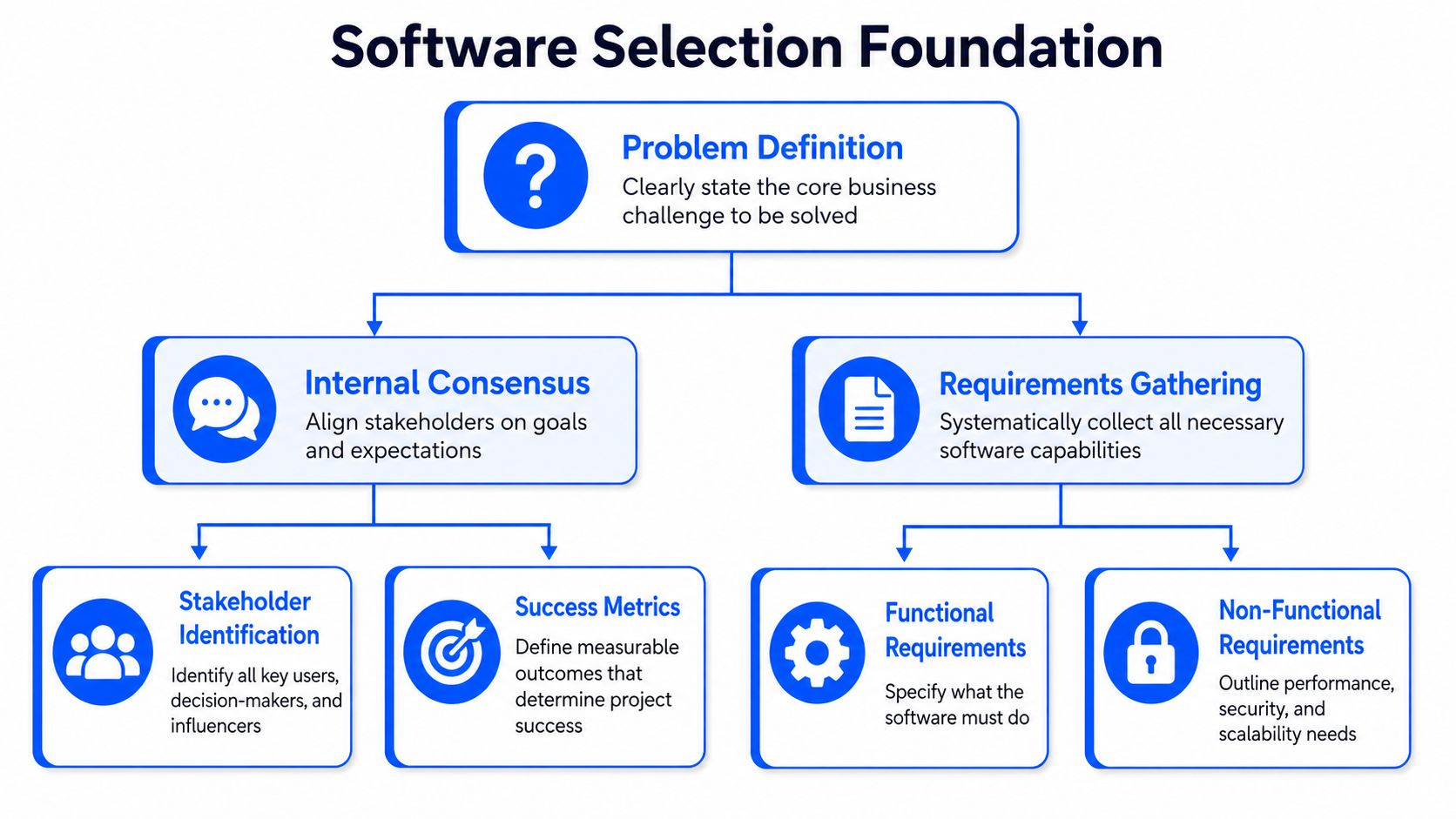
Define the decision before you define the platform. In practice, that means writing a short problem statement tied to an R&D outcome with economic weight. Reduce failed formulation rounds in adhesives. Identify substitute raw materials without degrading thermal performance. Connect early-stage screening data to scale-up constraints so promising candidates do not fail at transfer.
A useful problem statement names three elements:
The decision to support
Examples include ranking candidate formulations before synthesis, selecting the next experiment, or screening substitutes for a constrained ingredient.The person accountable for that decision
This may be a formulation chemist, computational materials scientist, process engineer, or technical program lead.The evidence required before the decision is trusted
In AI-native environments, that usually includes traceability to source experiments, confidence estimates, model applicability boundaries, and enough explanation for a scientist to challenge the output.
That third point deserves more attention than it usually gets. If a vendor cannot show how the system handles sparse data, conflicting historical records, or predictions outside the training domain, the evaluation team is still looking at product marketing, not scientific decision support.
Stakeholder mapping should happen at the same time. The core group in materials R&D usually includes bench scientists, data scientists, informatics or IT, process or manufacturing representatives, quality or regulatory if claims support matters, and the leader responsible for portfolio value. Leave one out and the scorecard will drift toward whoever speaks most often in the meetings.
Build a scorecard around scientific work, not vendor categories
Many evaluation templates flatten the problem. They score features, security, price, and usability as if each category carries the same operational risk. In R&D, that is rarely true. A pleasant interface does not compensate for weak data lineage. A broad API story does not help if the platform cannot represent formulations, process conditions, and test context in a way scientists recognize.
Use a scoring matrix, but write the criteria in the language of project teams and technical reviews. A practical matrix usually has two levels. One covers what the platform must do for scientific and operational workflows. The other covers the conditions under which those workflows remain reliable in production.
| Evaluation area | What to score |
|---|---|
| Scientific workflow fit | Can the platform support hypothesis generation, experiment planning, results review, and iteration in the way your teams actually work |
| Data model suitability | Can it represent formulations, compositions, process parameters, test conditions, and outcome measures without forcing awkward workarounds |
| AI and modeling depth | Can the system generate useful predictions, show why a recommendation was made, and support scientist review before action |
| Integration practicality | Can it connect to the systems, instrument outputs, and data structures already present in your environment, including support from AI-driven system integration services if required |
| Usability by role | Can chemists, engineers, and analysts complete routine tasks without relying on a specialist intermediary |
| Governance and security | Can you control access, preserve traceability, and meet enterprise requirements without slowing scientific work to a crawl |
| Scale and adaptability | Can the system support more users, sites, datasets, and use cases without a fresh implementation each time |
Weighting matters. So does discipline. If the stated objective is better decision quality in formulation development, then explainability, scientific fit, and data structure support should outrank cosmetic usability criteria. Teams will tolerate training effort. They will not trust a platform that produces high-confidence answers with no visible path back to the underlying evidence.
Equal scoring across all categories usually signals that the team has not agreed on where failure would hurt most.
Separate required capabilities from ranking factors
A long wishlist is not a requirements document. It is a parking lot for unresolved opinions. Good evaluations sort requirements into distinct buckets so the team can eliminate weak fits early and compare viable options on the right terms.
Use three groups:
Core requirements
These determine whether the platform is even credible for your use case. Examples include support for your material and process data structures, auditability of experiment history, role-based review, and visible model confidence or rationale where AI outputs influence decisions.Priority differentiators
These separate acceptable vendors from strong ones. Examples include domain-specific ontology support, better handling of iterative design of experiments, stronger support for uncertainty quantification, or easier scientist feedback loops that improve model performance over time.Operational expectations
These include implementation quality, training, admin controls, vendor support responsiveness, and release discipline. They matter because weak delivery can ruin a good product. They should not outrank scientific fit.
It also helps to document negative requirements. State what the platform must not force your team to do. It must not require spreadsheet exports for routine formulation comparison. It must not hide model logic behind a single score when scientists need to assess plausibility. It must not depend on custom services every time a new instrument or assay workflow is added.
What materials science teams often miss
The gaps are predictable.
Some teams focus heavily on prediction accuracy during a demo and spend too little time on applicability boundaries. A model can look impressive in a narrow chemistry space and fail subtly when new chemistries, process windows, or microstructural factors enter the problem.
Others underweight processing context. In materials work, equivalent composition does not guarantee equivalent performance. Particle size distribution, mixing sequence, cure conditions, surface treatment, and manufacturing route can alter behavior enough to invalidate naive similarity logic.
Cross-functional usability is another common blind spot. If the platform works only for data scientists, bench teams will treat it as a service desk. If it works only for scientists, the modeling layer will become hard to maintain and harder to govern.
Library and ontology support also deserves direct testing. Units, test methods, synonyms, composition hierarchies, and material class vocabularies are not housekeeping details. They determine whether the system can accumulate reusable knowledge or just store disconnected records.
Finally, evaluate model verification paths before contract signature. Ask how scientists review feature influence, uncertainty, training provenance, failed predictions, and version changes between model releases. If those answers are vague, trust will erode as soon as the first recommendation conflicts with domain intuition.
A strong requirements process ends with test scenarios that a vendor must execute against. If a requirement cannot be turned into a realistic evaluation task, it is still too abstract to guide a high-stakes software decision.
The Data Integration and Migration Litmus Test
“Integration” is one of the most abused words in software buying. In many demos, it means a clean API connection between two modern cloud systems. In actual R&D environments, it often means extracting meaning from instrument files, inconsistent naming conventions, archived spreadsheets, legacy ELNs, and partial records that only make sense to the scientist who created them.
That gap is where expensive mistakes hide.
Why integration claims break down in real labs
The hardest part of adopting an AI-native platform usually isn't model performance. It's whether the system can turn fragmented history into usable context. The hidden burden is often called data debt. According to this practical software selection playbook, 60 to 80 percent of R&D and manufacturing data remains unstructured or trapped in isolated legacy systems. That's the number procurement teams need to keep in mind when a vendor says migration will be straightforward.
If your historical data can't be ingested, normalized, and linked, the platform may still look impressive in a workshop. But the AI layer won't have enough trustworthy context to produce recommendations scientists will rely on.
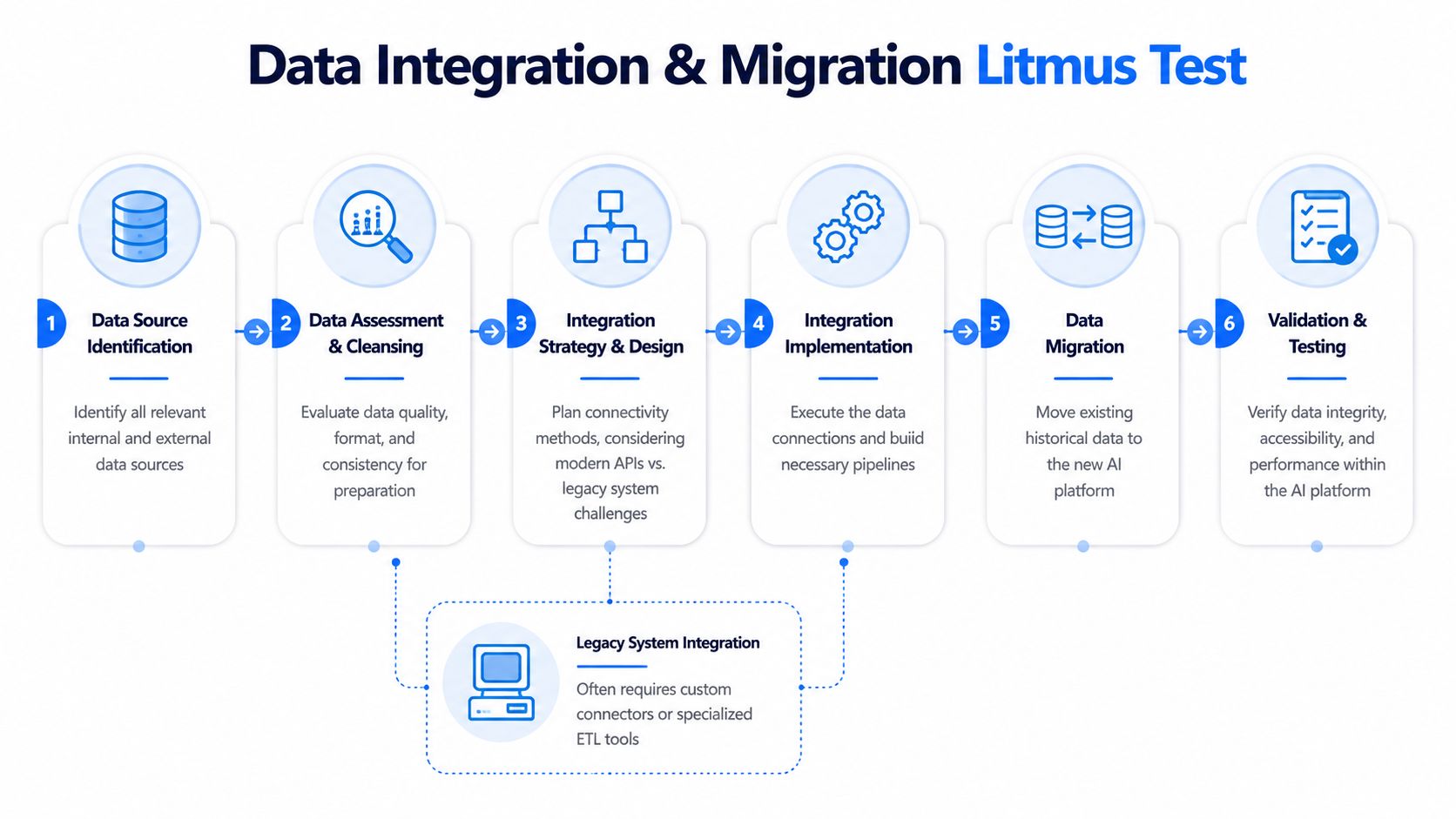
A materials organization should treat migration capability as a first-order selection criterion. Not an implementation detail. Not a post-signature workstream. A criterion.
Questions that expose data debt risk early
Don't ask a vendor whether they “support integration.” Ask them to walk through your ugliest data reality.
Use prompts like these in workshops and written responses:
Historical spreadsheet ingestion
Show how the platform handles multi-year experimental spreadsheets with inconsistent headers, units, and naming conventions.Legacy record mapping
Explain how old ELN entries, PDF attachments, and instrument exports become searchable, structured records.Entity resolution
Demonstrate how the system reconciles repeated materials, formulations, ingredients, and test methods that were named differently over time.Provenance preservation
Confirm whether migrated data retains source lineage, version history, and enough context for scientific auditability.Cleansing responsibility
Clarify who owns data transformation logic. Your team, the vendor, an implementation partner, or some combination.Failure handling
Ask what happens when source data is incomplete, contradictory, or impossible to classify confidently.
If the answer to messy-data questions is “we'll build a custom connector,” you still don't know whether the vendor understands scientific data normalization.
For organizations that need to pressure-test integration architecture before selection, outside specialists can be useful. Teams comparing technical approaches often review examples of AI-driven system integration services to sharpen their own questions around connectors, orchestration, and migration design, especially when internal IT mostly supports business apps rather than scientific systems.
What good looks like during migration planning
Good vendors don't romanticize your current data estate. They show where the hard parts are.
A credible migration approach usually includes a staged inventory of source systems, explicit treatment of structured and unstructured records, and a visible method for resolving units, entities, and metadata gaps. It also distinguishes between what can be automated and what needs domain review by your scientists.
A weak approach sounds generic. A strong approach sounds specific.
| Weak answer | Strong answer |
|---|---|
| “We integrate with most systems” | “We'll start by profiling your spreadsheets, ELN exports, and instrument files, then map entities and units before loading model-ready records” |
| “The platform is flexible” | “Here is how formulation components, process conditions, and test outputs are represented in the schema” |
| “Migration is part of onboarding” | “These data classes can be automated, these require curation, and these won't be reliable enough for model training until cleaned” |
The migration test many teams skip
Ask each shortlisted vendor to process a limited but representative sample of your real historical data before final selection. Not a full migration. Just enough to answer three questions:
- What percentage of the sample becomes usable without manual rescue work?
- Where do definitions, units, and entities break?
- Can scientists recognize the migrated output as faithful to the original experimental context?
That exercise changes conversations quickly. Vendors who looked similar in demos often separate sharply when confronted with real data debt.
Evaluating AI Explainability and Model Integrity
Materials R&D has no room for decorative AI. If a platform gives a recommendation but can't show why, scientists will either ignore it or, worse, trust it for the wrong reasons. Both outcomes are expensive.
The evaluation standard has to be higher than “does it have machine learning.” In scientific environments, the question is whether the AI behaves like a disciplined research assistant or like an opaque ranking engine.

Explainability is a scientific control, not a nice-to-have
In this category, buyer priorities have real consequences. According to analysis on software selection process criteria, success rates for AI-native platforms in materials R&D improve by 55% when buyers prioritize AI/ML depth and explainable model confidence scores over generic ease of use. That's a useful correction for teams who are tempted to rank a smooth interface above model transparency.
Explainability matters because scientific work is conditional. A formulation recommendation isn't useful on its own. The chemist needs to know what variables are driving the prediction, how certain the model is, what comparable historical cases support it, and where the prediction is likely to break down.
A black-box recommendation may look efficient in a demo. In a lab, it creates another experiment to verify the software rather than the hypothesis.
In materials science, this gets even more practical when shape factors, processing routes, or manufacturing constraints change the outcome. A theoretically attractive candidate may fail in industrial settings if the model doesn't represent those realities. That's why explainability and model integrity belong in the same conversation. You're not only judging whether the system predicts. You're judging whether it predicts in a way that survives scientific scrutiny.
What to inspect inside the model layer
A serious evaluation should ask vendors to expose the machinery behind the prediction. Not proprietary code, necessarily, but observable behavior.
Focus on a handful of concrete criteria:
Confidence visibility
Does the platform provide confidence scores or uncertainty indicators alongside predictions?Driver identification
Can it surface which variables most influenced the recommendation?Historical grounding
Does it connect new suggestions to prior experiments, adjacent materials, or comparable outcomes?Validation logic
Can your team inspect how models were checked for errors, inconsistencies, or out-of-scope inputs?User challenge paths
Can scientists question, override, or annotate outputs without breaking the workflow?
Use contradictory test cases during evaluation. Feed the model a candidate that looks promising in composition terms but is poor in processability. Feed it sparse historical data. Feed it records with known edge conditions. Watch whether the platform presents those outputs with appropriate caution or with false confidence.
This short explainer is worth using as a prompt for cross-functional review during evaluations:
How to test trust during evaluation
The fastest way to assess trust is to put the model in front of the people who would challenge it for a living.
Set up a review session with a bench scientist, a process-aware engineer, and a data or modeling lead. Give them a shared use case and ask each to probe the output from their own perspective.
A useful review sequence looks like this:
Show the recommendation without commentary
Let the scientists react first. Do they understand what the platform is suggesting?Open the evidence trail
Ask the vendor to reveal confidence, drivers, and linked precedents.Probe domain realism
Challenge assumptions around manufacturability, geometry, or test conditions.Check recovery behavior
See how the platform responds when the team identifies missing context or a flawed assumption.
What you want isn't blind confidence. You want productive skepticism that the system can answer. If scientists leave saying, “I can see when I'd trust this and when I wouldn't,” that's a strong sign. If they leave saying, “maybe the model knows something we don't,” that's not trust. That's opacity dressed up as sophistication.
From Demo to Decision with a Proof of Concept and Vendor Due Diligence
A polished demo rarely shows the failure mode that will matter six months after rollout. In materials R&D, that failure mode is often mundane and expensive. The model performs well on curated examples, then breaks when it hits inconsistent assay names, partially documented formulations, inherited spreadsheets, or process metadata that was never captured in a structured way.
That is why the final stage has to do two jobs at once. The team needs evidence that the platform can support a real scientific decision under normal operating conditions. The team also needs evidence that the vendor can handle the operational burden that starts after procurement, when legacy data, user friction, and governance questions show up in full.
Design the proof of concept around one hard use case
A good proof of concept is narrow enough to finish and difficult enough to expose risk. Ask the vendor to work on a live decision that has blocked progress before. In materials science, that might mean ranking candidate formulations against a target property window, tracing why historical scale-up attempts failed, or screening substitutes that meet both performance and processing limits.
According to the enterprise software selection study from SciTePress, teams that skip proof-of-concept validation are more likely to miss integration and usability problems until after deployment. That finding matches what many R&D groups learn the hard way. A strong interface and a persuasive workflow story do not tell you whether the system can survive your data conditions.

The PoC should end with a decision your scientists can judge, not a feature tour. That changes the conversation. Instead of asking whether the product looks modern, the team asks whether it handled missing context, conflicting source records, and edge cases without hiding uncertainty.
Use pass-fail criteria from day one:
Data realism
Require the vendor to use a representative slice of your actual data, including bad labels, sparse metadata, and duplicated records. AI-native platforms often look strongest before they confront data debt.User realism
Have bench scientists, informatics staff, and engineering users complete the core tasks themselves. If vendor staff has to drive every step, the product has not passed the usability test.Decision realism
End the PoC with an output that affects a real program decision. For example, which candidate advances, which experiment is deprioritized, or which historical result should be excluded from training.Model behavior under stress
Deliberately introduce awkward cases. Hold out known records. Ask for predictions on sparse data. Change one processing condition and see whether the recommendation shifts in a scientifically plausible way.Traceability
Require every important result to resolve back to source data, transformation steps, and model logic that a technical reviewer can inspect.
Within AI-native platforms, weak products separate from serious ones. Some systems can generate plausible rankings but cannot show training provenance, feature importance in domain terms, or the basis for confidence under low-data conditions. In materials R&D, that is not a minor flaw. It makes root-cause review, auditability, and scientist adoption much harder.
Due diligence on the vendor, not just the product
A successful PoC only answers part of the selection question. The harder question is whether the vendor can support the platform once your team starts loading more data sources, expanding to new material systems, and asking for model updates that reflect actual lab learning.
I look for five diligence areas.
Implementation ownership
Ask who does the work after signature. Is onboarding led by experienced technical staff, or handed to a general customer success team with limited understanding of scientific data structures, ontologies, and experiment context?Data and model governance
Review how the vendor manages data lineage, model versioning, retraining controls, and approval workflows. If a recommendation changes after retraining, your team should be able to explain why.Security and IP handling
Examine access controls, tenant separation, audit logs, deployment options, and data retention policies. Proprietary formulation data and process knowledge change the risk profile compared with generic enterprise software.Scale beyond the first team
Ask what happens when the platform expands across sites, business units, or material classes. A product that works for one polymer team may struggle when analytical methods, naming conventions, and governance standards vary across the company.Domain depth
Test whether the vendor understands scientific ambiguity, not just workflow automation. Teams should ask informed questions about failed experiments, censored data, outliers, and the difference between correlation and mechanism.
Reference calls matter here, but they need to be specific. Do not ask whether the customer is happy. Ask how long data mapping took, who maintained the ontology, how model updates were governed, and what happened when scientists challenged a recommendation.
Use the final review to document trade-offs openly
The final review should read like an investment memo, with trade-offs stated in plain language.
One platform may have better explainability and weaker enterprise connectors. Another may integrate cleanly with identity and governance systems but require more work to make model outputs scientifically interpretable. A third may perform well on one business unit's data and still be the wrong choice for a multi-site rollout because standardization effort will be too high.
A concise final review can use a structure like this:
| Decision lens | Question |
|---|---|
| Scientific fit | Does the platform improve a high-value R&D decision with evidence the team trusts |
| Data readiness | Can it absorb and organize the data estate you actually have |
| Operational durability | Will it hold up under enterprise governance, security, and scale |
| Partner viability | Is the vendor credible enough to support the platform over its useful life |
| Adoption risk | Will scientists, engineers, and managers actually use it in live programs |
Good selection teams do not chase a perfect score. They choose the platform whose weaknesses are visible, manageable, and acceptable for the use cases that matter most.
Making a Defensible High-ROI Decision
A weak software decision rarely fails in the procurement meeting. It fails six months later, when scientists stop trusting the recommendations, data pipelines need constant manual repair, and program leaders realize the platform cannot support the next formulation campaign without another round of customization. That is the point where ROI disappears.
A defensible decision starts with the value of a better R&D decision, not with license price. In materials science, the primary upside is shorter cycle time to a validated candidate, fewer wasted experiments, better use of historical data, and more consistent decisions across sites and teams. The main downside is data debt locked into a new system, black-box models that cannot survive technical review, and adoption that stalls because the platform fits IT policy better than laboratory work.
For AI-native R&D platforms, standard vendor criteria still matter. Reliability, compatibility with the existing stack, security, cost control, and the vendor's ability to support an enterprise rollout all affect long-term performance. They are not enough on their own.
The harder question is whether the platform improves decisions your scientists already struggle to make. Can it rank formulations in a way chemists can interrogate. Can it trace a recommendation back to source experiments, processing conditions, and metadata quality. Can it handle sparse, inconsistent, and partially labeled datasets without producing polished but misleading outputs. Those points separate an AI-native materials platform from a generic enterprise software purchase.
I advise teams to make the final decision with a weighted business case that includes four cost buckets. Upfront implementation cost. Data preparation and ontology work. Ongoing model governance and validation effort. Change management inside R&D. Vendors often price the first bucket clearly and leave the other three vague. In practice, those hidden costs determine whether year-one ROI is real or fictional.
A strong final decision memo also states where the platform is weak. If explainability is strong but lab instrument integration is immature, write that down. If the platform performs well for one materials class but has limited evidence in adjacent chemistries, write that down too. Senior leadership does not need a perfect scorecard. They need a clear record of what risks are being accepted, why they are acceptable, and what controls will be put in place after launch.
If your team is evaluating platforms for polymers, chemicals, or advanced materials, Polymerize is worth a close look. It is built for materials R&D, with a focus on unifying fragmented experimental data, supporting explainable AI workflows, and helping scientists move from trial-and-error toward faster, better-informed experimentation.
Put your R&D data to work
See how materials teams use Polymerize to plan fewer experiments and reach target properties faster.