


A polymer team can clear every lab milestone and still discover that production has a different opinion. The resin meets its target properties in small reactor batches, the formulation looks stable, and the characterization report is complete. Then a pilot batch runs through a larger mixer, drying conditions shift, a feedstock lot behaves differently, and viscosity or dispersion moves outside the acceptable range.
That failure doesn't mean the chemistry was wrong. It means the team proved that the material could work, but hadn't yet proved that the organization could make it repeatedly. Manufacturing readiness is the discipline that connects those two realities, from lab validation to pilot execution and eventually to dependable production.
Table of Contents
Why Manufacturing Readiness Matters for Advanced Materials
Advanced materials programs often enter scale-up with a strong technology story and a weak manufacturing story. A polymer may show the desired flame resistance, adhesion, modulus, or thermal behavior in a controlled laboratory setting. The pilot line introduces different shear, heat transfer, residence time, drying behavior, feed systems, operator decisions, and raw-material variation. Each difference can alter the final material.
For a materials development lead, the central question isn't merely, “Does the formulation work?” It's, “Can the process produce conforming material when the conditions are no longer ideal?” That question separates technical feasibility from manufacturing readiness. Regulatory compliance matters too, but compliance alone doesn't establish that a batch can be made consistently, that equipment can hold the required process window, or that operators can respond to deviations without losing traceability.
Why advanced materials are especially vulnerable
Polymers and composites amplify small changes. A modest formulation adjustment can influence rheology, crystallization, dispersion, cure behavior, drying time, or downstream conversion. A chemistry model may predict a property shift, but it usually can't capture every interaction among mixer geometry, thermal gradients, feedstock history, and line scheduling.
A useful readiness review therefore examines the complete production system:
- Process behavior: Can the team reproduce the formulation and control critical parameters?
- Equipment behavior: Does the pilot or production asset provide comparable mixing, heating, feeding, and residence-time conditions?
- Material continuity: Are raw-material specifications, approved suppliers, and lot controls defined?
- Quality evidence: Can the team connect each result to a batch, recipe version, operator, equipment state, and test method?
- Execution discipline: Can the plant identify and manage exceptions while the batch is still running?
Practical rule: A successful lab batch is evidence of possibility. A controlled pilot campaign is evidence of manufacturability.
Readiness is a live handoff
Manufacturing readiness shouldn't be treated as a document prepared just before a gate review. It's a live operating condition that changes as the formulation, equipment, suppliers, and work instructions change. A process can be ready for one pilot configuration and unready after a feed system, drying step, or raw-material source changes.
That's why readiness deserves attention before the lab-to-pilot handoff, not after the first failed campaign. The team needs defined process windows, repeatability evidence, scale-relevant data, and clear ownership for unresolved risks. Without those elements, the program enters the familiar valley between an encouraging experiment and a repeatable product.
The historical Manufacturing Readiness Level framework formalized this thinking by turning manufacturing maturity into a structured 1-to-10 scale for judging whether a process is mature enough for production. The U.S. Government Accountability Office's manufacturing readiness guidance describes how the U.S. government recommended using MRL criteria to assess, report, and communicate manufacturing risk, with the broader aim of identifying manufacturability problems earlier.
From Defense Benchmark to Industrial Standard
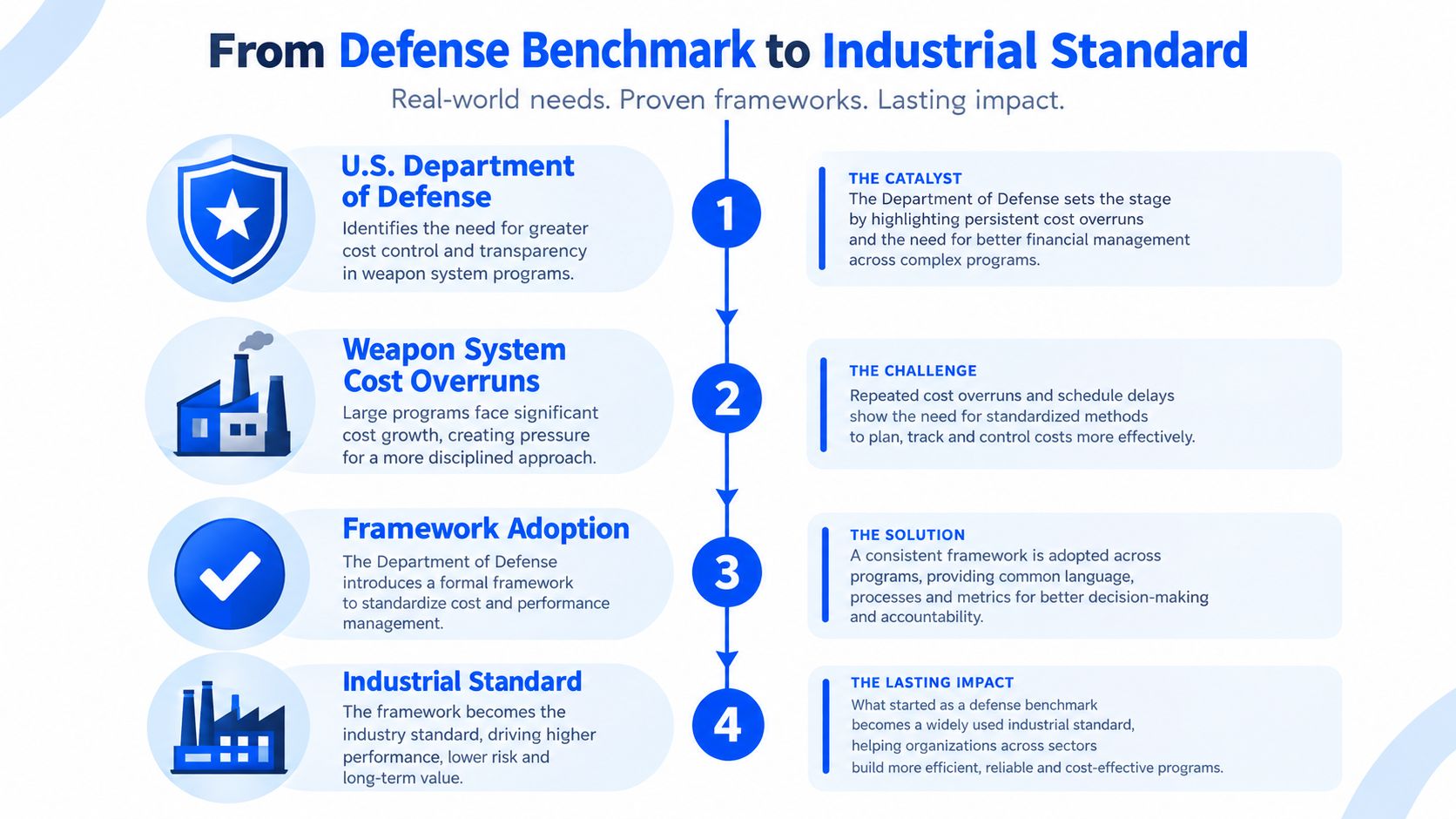
Manufacturing readiness became formalized because complex programs repeatedly encountered the same expensive surprise: a design could work technically, yet the production system couldn't deliver it consistently. Defense acquisition made that gap especially visible. Programs had to coordinate specialized materials, complex assemblies, qualified suppliers, production equipment, inspection methods, and trained workforces. A late discovery in any one of those areas could affect cost, schedule, and field performance.
The MRL framework converted that broad concern into staged evidence. Instead of asking whether a program “felt ready,” teams could assess whether manufacturing implications had been identified, whether a process concept existed, whether prototype production was possible, and whether full-rate production had been demonstrated. The U.S. Government Accountability Office's 2010 recommendation helped establish MRL criteria as a way to communicate manufacturing risk in a consistent format. Manufacturing storage solutions for defense environments illustrate the same underlying principle, production infrastructure and material handling conditions are part of readiness, not separate from it.
Why the framework transferred well
MRL thinking spread beyond defense because the manufacturing problem is not unique to military hardware. Chemical, polymer, composite, additive, and industrial-equipment programs all face the same separation between a working concept and a repeatable production process. A pilot line must control materials, equipment, process parameters, quality checks, operators, and data regardless of the end market.
The framework also works because it encourages staged investment. A team doesn't need full production infrastructure while the material concept is still uncertain. It does need to identify manufacturing implications early enough that equipment, supply, quality, and workforce risks can mature alongside the technology.
The Department of Defense MRL and TRL definitions describe MRL as a 10-step maturity scale, progressing from manufacturing concepts through prototype, pilot, low-rate production, and full-rate production with lean practices. That vocabulary gives program managers a shared language for discussing a material's production risk without reducing the conversation to optimism or intuition.
From procurement tool to smart-manufacturing benchmark
Modern smart-manufacturing assessments extend the same logic into digital infrastructure. A plant can have capable equipment and skilled operators but still struggle to scale if its data is fragmented, its legacy systems cannot exchange context, or its cybersecurity controls are incomplete.
This evolution matters for advanced materials. The handoff now includes not just a recipe and work instruction, but also data structures, identifiers, electronic records, sensor context, change histories, and exception workflows. Manufacturing readiness has therefore moved from a defense procurement benchmark toward a broader industrial question: can the organization transfer technology into a controlled, observable, and repeatable operating system?
Mapping MRL Against TRL in Materials Development
Technology Readiness Level, or TRL, measures whether the technology works. Manufacturing Readiness Level, or MRL, measures whether the organization can build it consistently. These are related questions, but they aren't interchangeable.
A polymer can reach a mature technical demonstration using carefully prepared feedstock, experienced scientists, and hands-on adjustments. That same material may remain manufacturing-immature if the process window is narrow, the equipment isn't qualified, or suppliers can't support the required material specifications. A scale-up decision should therefore review both axes independently.
The dual-lens view
The MRL framework progresses through ten levels:
- MRL 1: Basic manufacturing implications are identified.
- MRL 2: Manufacturing concepts are characterized.
- MRL 3: A manufacturing proof of concept is developed.
- MRL 4: The technology can be produced in a laboratory environment.
- MRL 5: Prototype components can be produced in a production-relevant environment.
- MRL 6: A prototype system or subsystem can be produced.
- MRL 7: Production-representative manufacturing capability is demonstrated.
- MRL 8: Pilot-line capability is demonstrated and the program is ready for low-rate initial production.
- MRL 9: Low-rate production is demonstrated, with capability in place for full-rate production.
- MRL 10: Full-rate production is demonstrated with lean practices and continuous improvement in place.
TRL follows a different path, from observed principles through a system proven in an operational environment. The two scales should be reviewed together, but a high TRL shouldn't be used to imply a high MRL.
| Readiness Level | Technology Focus (TRL) | Manufacturing Focus (MRL) | Typical Polymer Milestone |
|---|---|---|---|
| Early concept | Principles and concept | Manufacturing implications | Material mechanism and likely production route identified |
| Proof of concept | Experimental validation | Manufacturing proof of concept | Bench-scale synthesis demonstrates target behavior |
| Laboratory validation | Technology validated in the lab | Laboratory production capability | Repeatable lab batches with a baseline test suite |
| Relevant environment | Technology demonstrated under relevant conditions | Production-relevant prototype capability | Formulation tested with scale-relevant equipment or conditions |
| Prototype demonstration | Prototype shown in an operationally relevant setting | Production-representative capability | Prototype pilot campaign produces conforming material |
| Qualification | System complete and qualified | Pilot-line capability and low-rate readiness | Initial qualification lots support process and quality review |
| Operational proof | Actual system proven in operation | Full-rate production and lean control | Production process is stable, monitored, and continuously improved |
A practical mapping might place bench-scale synthesis around TRL 3 and MRL 3, repeatable laboratory batches around TRL 4 and MRL 4, prototype pilot campaigns around TRL 6 and MRL 6, pilot-line demonstration around TRL 7 and MRL 7, and initial qualification lots around TRL 8 and MRL 8. These pairings are useful orientation points, not permission to skip evidence.
Readiness question: What manufacturing evidence exists at the same maturity point as the technology evidence?
If the answer is “the formulation works, but the process has only been run by the development team,” the program may have technical maturity without manufacturing maturity. That gap should become a managed workstream, not a footnote in the next review.
The Variables That Actually Drive Readiness
A single readiness score can hide the reason a program is exposed. A process may be well characterized while its data records are inconsistent. Equipment may be available while maintenance requirements disrupt the schedule. Operators may be experienced while decision rights during deviations remain unclear.
A practical assessment should treat readiness as a multi-variable system. One benchmarked framework uses a 0-to-100 readiness view, identifying facilities below 50/100 as lacking foundational infrastructure and scores above 70/100 as indicating strong readiness for Industry 4.0 investment; the smart-manufacturing readiness assessment checklist provides that benchmark context. For a program-level review, a simpler 0-to-5 scale can make the discussion easier to run without pretending that one average score captures every risk.
| Variable | Score 0-1 (Not Ready) | Score 2-3 (Developing) | Score 4-5 (Production Capable) |
|---|---|---|---|
| Process maturity | Results depend on undocumented adjustments | Key parameters are documented, but repeatability or yield remains uncertain | Process window, yield behavior, cycle time, and controls are demonstrated |
| Equipment capability | Asset or scale differs materially from the intended process | Equipment is available, with open qualification or maintenance questions | Equipment is qualified, monitored, maintained, and representative of production |
| Data infrastructure | Records sit in disconnected files or notebooks | Core data is captured, but identifiers and context are inconsistent | Batch, recipe, equipment, test, and change data are traceable |
| Cybersecurity posture | Access and system boundaries are unclear | Basic controls exist, with gaps in connected assets or suppliers | Role-based access, auditability, segmentation, and response procedures are established |
| Workforce capability | Only a few specialists can run the process | Operators are trained, but escalation and handoffs vary | Qualified operators follow controlled work instructions and defined decision paths |
How to use the matrix
Don't average away a critical weakness. A strong process score can't compensate for a data system that prevents traceability, or for equipment that can't sustain the required operating window. Review each variable separately, identify the evidence behind the score, and assign an owner to every gap.
Quality deserves particular attention because it converts process behavior into release decisions. Teams working with additive processes can use resources such as quality control in additive manufacturing to think through inspection, repeatability, and documentation principles that also apply to polymer and composite production.
The useful question isn't “What is our readiness score?” It's “Which subsystem would fail first during a difficult production week, and what evidence would show that we fixed it?”
A Lab to Pilot to Production Checklist
Readiness becomes actionable when each handoff has a defined exit condition. A checklist shouldn't describe good intentions. It should identify the evidence a team needs before asking the next organization, plant, supplier, or quality group to accept more production risk.
Lab to pilot
Before moving from laboratory development into pilot work, the team should establish a baseline that the pilot can challenge without making interpretation impossible.
- Reproduce the formulation: Run at least three independent lots and compare critical properties, process behavior, and observed variability.
- Define process parameters: Document the operating conditions that matter, including mixing, heating, feed, drying, residence time, and any controlled additions. Record acceptable tolerances rather than relying on informal operator knowledge.
- Lock raw-material specifications: Identify critical feedstock attributes, approved sources, incoming checks, and lot-handling rules.
- Set the characterization baseline: Agree on the tests, methods, sample preparation, acceptance criteria, and data format that will be used to compare lab and pilot material.
The point isn't to eliminate every unknown before the pilot. The point is to distinguish a scale effect from an uncontrolled lab variable.
Pilot to pre-production
The pilot should produce evidence about the process, not just material for another round of testing.
- Study equipment capability: Examine whether the equipment can hold critical parameters and whether its maintenance burden affects runnability. Use capability studies where appropriate, including Cp and Cpk analysis.
- Demonstrate pilot yield: Track input, output, scrap, rework, downtime, and batch interruptions. A property pass without an explanation of material losses is incomplete readiness evidence.
- Profile waste and energy: Capture the operating costs and environmental burdens that could change the production route or equipment choice.
- Start failure analysis: Conduct an early failure modes and effects analysis, then connect high-risk failure modes to controls, detection methods, and owners.
Pre-production to full production
The final transition tests whether the entire production system can operate without special treatment from the development team.
- Validate the supply chain: Confirm supplier capability, material continuity, incoming quality controls, and change-notification procedures.
- Qualify operators: Verify training, practical demonstration, shift coverage, escalation rules, and authority to stop or hold a batch.
- Establish cybersecurity controls: Define access, system boundaries, audit records, and response procedures for connected equipment and manufacturing data.
- Deliver the data handoff package: Transfer recipe versions, batch identifiers, process histories, test results, deviations, approvals, and change records in a format the receiving systems can use.
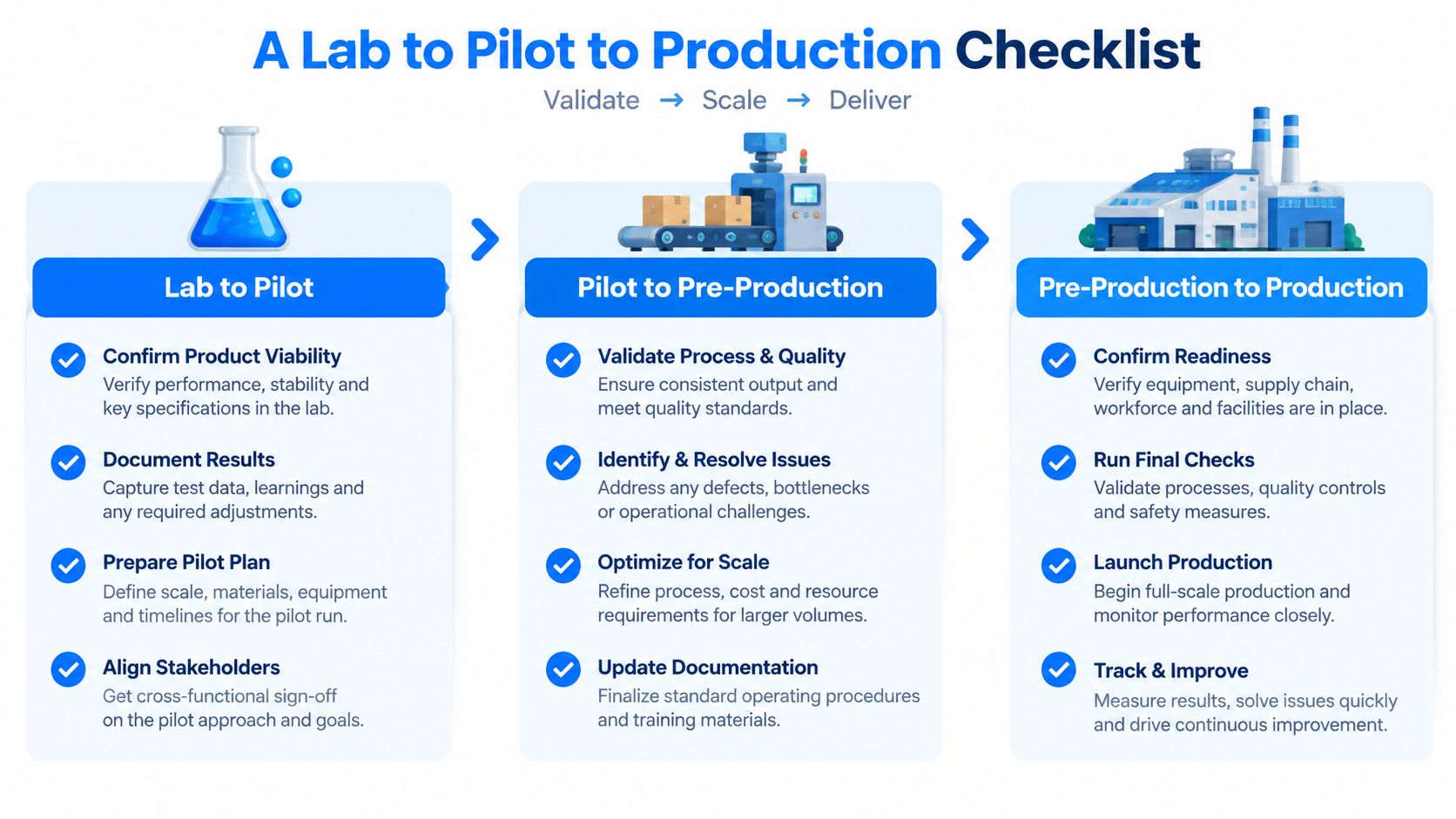
Every item needs a named owner, an evidence location, and a dated sign-off. Without those fields, a checklist becomes a meeting artifact rather than a control mechanism.
AI Pilots Are Not the Same as AI Readiness
A materials company can run a successful machine-learning pilot on one extrusion cell, mixer, or curing step and still be unprepared for plant-wide deployment. The model may detect anomalies under the conditions used during development, but the surrounding operation may lack consistent identifiers, governed data, model monitoring, or a workflow for acting on predictions.
The distinction is visible in recent manufacturing evidence. In a 2026 study of 150 senior decision-makers at global discrete manufacturers, 75% said supply plan failures were most likely during factory-specific execution rather than forecasting, while 93% said their ERP couldn't reliably show actual execution outcomes even when material visibility existed, according to the study's manufacturing execution coverage. The lesson for AI programs is direct: a prediction has limited value if the plant can't connect it to the right batch, priority, operator, material state, and response action.
What a pilot proves
An AI pilot can show that a model detects a pattern, predicts a property, or identifies an unusual sensor signature. That's useful. It can help the team determine whether the signal is worth pursuing and which data sources deserve investment.
It doesn't automatically prove that the model will survive:
- Feedstock changes: A new supplier or lot may shift the input distribution.
- Equipment changes: Different mixers, dies, dryers, or sensors may produce different signatures.
- Process drift: Maintenance, ambient conditions, recipe revisions, and operator adjustments can change the baseline.
- Workflow variation: A model alert may be ignored if nobody owns the response.
- Data gaps: Missing context can make a correct model appear unreliable.
Consider an extrusion line where an anomaly model performs well on one unit. If feedstock behavior changes and the data pipeline doesn't preserve lot identity, recipe version, screw configuration, and ambient conditions, the team can't determine whether the model failed or the operating context changed.
What readiness requires
The 2026 manufacturing AI and automation outlook reports that 98% of manufacturers were exploring AI-driven automation, but only 20% felt fully prepared to use it at scale. It also reports that 78% had automated less than half of critical data transfers and only 40% had automated exception handling. Those figures describe the gap between experimentation and operating discipline.
True AI readiness requires three connected capabilities:
- A governed data foundation: The organization knows what each data field means, who owns it, and how it relates to a material, batch, asset, or event.
- A model lifecycle: Teams can validate, version, monitor, update, and retire models as process conditions change.
- Operational integration: Predictions enter the same workflows used for scheduling, quality decisions, maintenance, and deviation response.
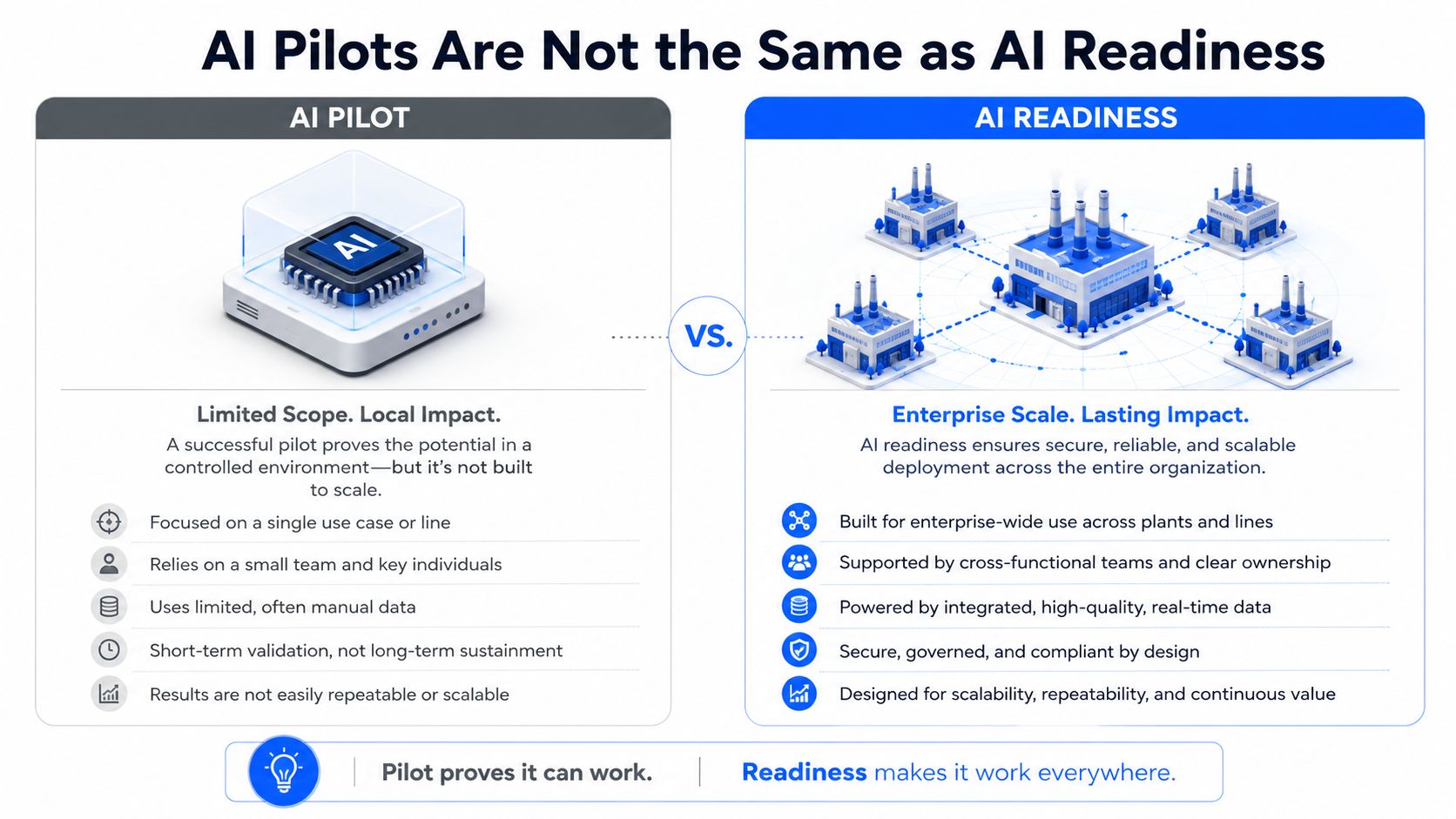
The same outlook states that only 58% of manufacturing organizations said all or nearly all of their data was fully governed, and 20% identified weak integration of AI and analytics into operational workflows as the leading reason initiatives failed to deliver expected ROI. An AI pilot demonstrates potential. AI readiness demonstrates repeatability under changing production conditions.
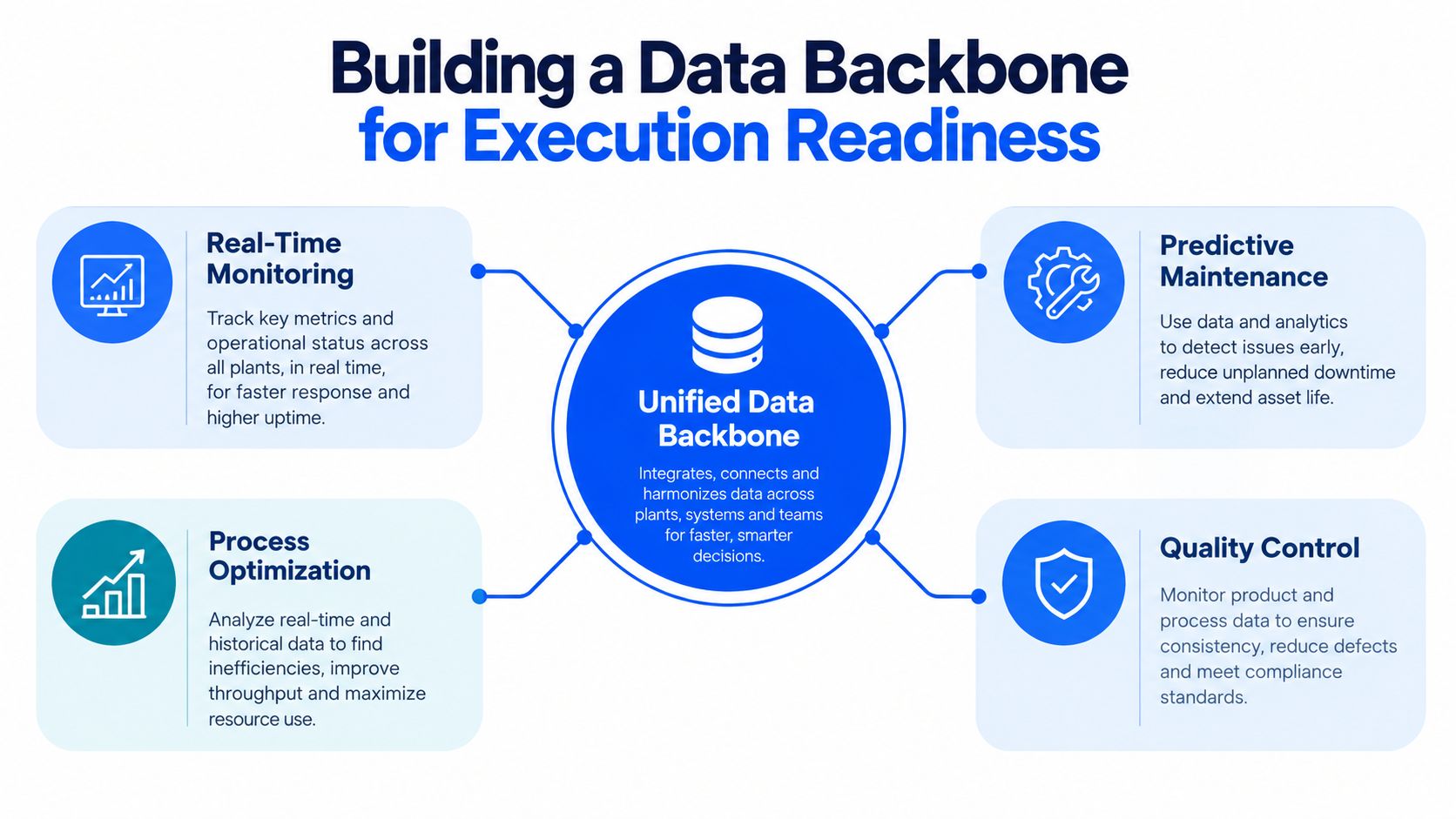
Building a Data Backbone for Execution Readiness
Execution readiness begins when a plan reaches the factory. At that point, someone must know which materials are available, which supplier lots are approved, which recipe version applies, which equipment is ready, which orders take priority, and what to do when the process departs from the expected path.
A unified data backbone is the governed layer that connects those answers. For a materials organization, it should link lab informatics such as LIMS and ELN records with pilot MES data, supplier quality information, and production historians. The aim isn't to force every system into one application. It's to preserve consistent identifiers, definitions, relationships, and access rules across the systems that teams already use.
Start with identity
A polymer lot should remain identifiable from synthesis through compounding, conversion, testing, release, and customer-specific production. Standardize identifiers for:
- Materials and lots: The same material and lot identity must survive transfers between lab, pilot, supplier, and plant records.
- Recipes and revisions: Each result should point to the formulation and process version used at the time.
- Equipment and configurations: The record should distinguish assets, tooling, sensor sets, and relevant setup conditions.
- Quality results: Test methods, sample preparation, analyst, result, and disposition need durable relationships to the batch.
Without those connections, teams can have plenty of data and still lack usable evidence. A spreadsheet may contain the viscosity result, while a shift log contains the dryer adjustment and a supplier portal contains the lot information. The records exist, but the production story remains fragmented.
Add context to the signal
Sensor readings become more useful when they carry the context needed to interpret them. Capture recipe version, equipment configuration, ambient conditions, operator intervention, maintenance state, and deviation status alongside process streams. That context supports investigation today and makes future analytical or machine-learning work more reliable.
Protect and govern the backbone
The backbone also has to support cybersecurity. Role-based access limits who can change recipes, approve results, or view sensitive intellectual property. Audit trails show what changed, who changed it, and when. Clear system boundaries and supplier access rules help the organization protect data without blocking legitimate production work.
Kyndryl's 2024 Manufacturing Readiness Report found that only 31% of manufacturing leaders said their IT infrastructure was ready to manage future risks, compared with 39% across all industries. It also found that manufacturing leaders rated IT infrastructure readiness below every other industry. The result is a practical warning: physical scale-up and digital scale-up now depend on each other.
Before the next MRL review, schedule a pilot-line data audit. Trace one representative material lot from lab record to pilot batch to quality disposition, identify every broken handoff, and assign owners to repair the gaps before increasing production exposure.
Polymerize helps materials teams unify experimental data, connect formulation and process records, and create a governed data backbone for the lab-to-pilot-to-production handoff. Visit Polymerize to see how its materials R&D platform can support repeatable scale-up, clearer process windows, and better execution readiness.
Put your R&D data to work
See how materials teams use Polymerize to plan fewer experiments and reach target properties faster.