

A lot of materials labs are in the same place right now. Sample IDs live in a spreadsheet. Method details sit in a scientist's notebook. Instrument files are buried in shared folders. A formulation decision gets discussed in email, then someone later tries to reconstruct what happened from fragments.
That setup works until the lab grows, a customer asks for traceability, a team tries to reuse old experimental knowledge, or leadership wants to apply AI to R&D. Then the underlying problem appears. The lab doesn't just lack software. It lacks a connected record of what was done, why it was done, what was tested, and which result belongs to which version of the experiment.
That's where LIMS and ELN come in. Many teams treat them like competing choices. In practice, they usually solve different parts of the same problem. One manages structured sample and test workflows. The other captures the scientific story around the experiment. If you want AI-ready materials R&D, the question usually isn't “Which one wins?” It's “How do these two systems fit together without creating new silos?”
Table of Contents
- Think sample record versus lab notebook
- Why they evolved differently
- What each system looks like in daily use
- Why ELN adoption now matters more
- LIMS vs ELN at a Glance for Materials R&D
- Where overlap causes trouble
- A practical boundary for materials teams
- The second source of truth problem
- What lineage must survive the handoff
- Integration is also a governance choice
- Start with workflow shape, not vendor category
- Use enterprise criteria that survive growth
- Choose for AI readiness, not just record digitization
- What regulated labs need to preserve
- The practical governance model
- Security and governance have to be operational
Why Materials Labs Need More Than Spreadsheets
A spreadsheet is good at holding values. It's bad at holding meaning.
In a materials lab, that distinction matters more than people expect. “Tensile strength = X” isn't enough if no one can tell which resin lot was used, which mixing sequence the scientist followed, whether the method changed, or whether the result came from a screening trial or a controlled validation run. In polymers, coatings, batteries, adhesives, and specialty chemicals, the context around the number often matters as much as the number itself.
Where spreadsheets break first
Most labs don't abandon spreadsheets because spreadsheets are terrible. They abandon them because the lab becomes more connected, more regulated, or more distributed.
A familiar pattern looks like this:
- Samples multiply: One project becomes many, and naming conventions drift.
- Methods evolve: A test gets modified, but older results still sit beside new ones with no clear distinction.
- People change roles: The scientist who “just knows” the background moves on.
- Instruments stay isolated: Raw data exists, but no shared system links it cleanly to the experiment record.
Once that happens, teams start spending time on detective work instead of science. They search folders. They compare notebook pages. They ask colleagues which sample version was sent for testing.
Practical rule: If your team regularly has to ask “Which version was this?” or “Where's the original file?”, you already have a data backbone problem.
Digitizing paper isn't the same as building usable knowledge
Many labs take a first step by replacing paper notebooks or adding a sample log. That helps, but it doesn't solve the larger issue. Digital records can still be fragmented. A PDF of a notebook page is more searchable than paper, but it still doesn't automatically connect formulation intent, sample lineage, instrument output, and final interpretation.
That's why lab informatics evolved into specialized systems instead of one giant generic database. Labs needed one layer for structured operational control and another for scientific narrative and experiment context.
For materials R&D leaders, this is the important mindset shift. LIMS and ELN aren't just software purchases. They're the beginning of a shared memory for the lab. If they stay disconnected, the lab becomes digitally documented but operationally fragmented. If they work together well, the same records become reusable for scale-up, quality handoff, search, and eventually AI.
What LIMS and ELN Actually Do in the Lab
The simplest way to understand LIMS and ELN is to stop thinking about software categories and start thinking about jobs.
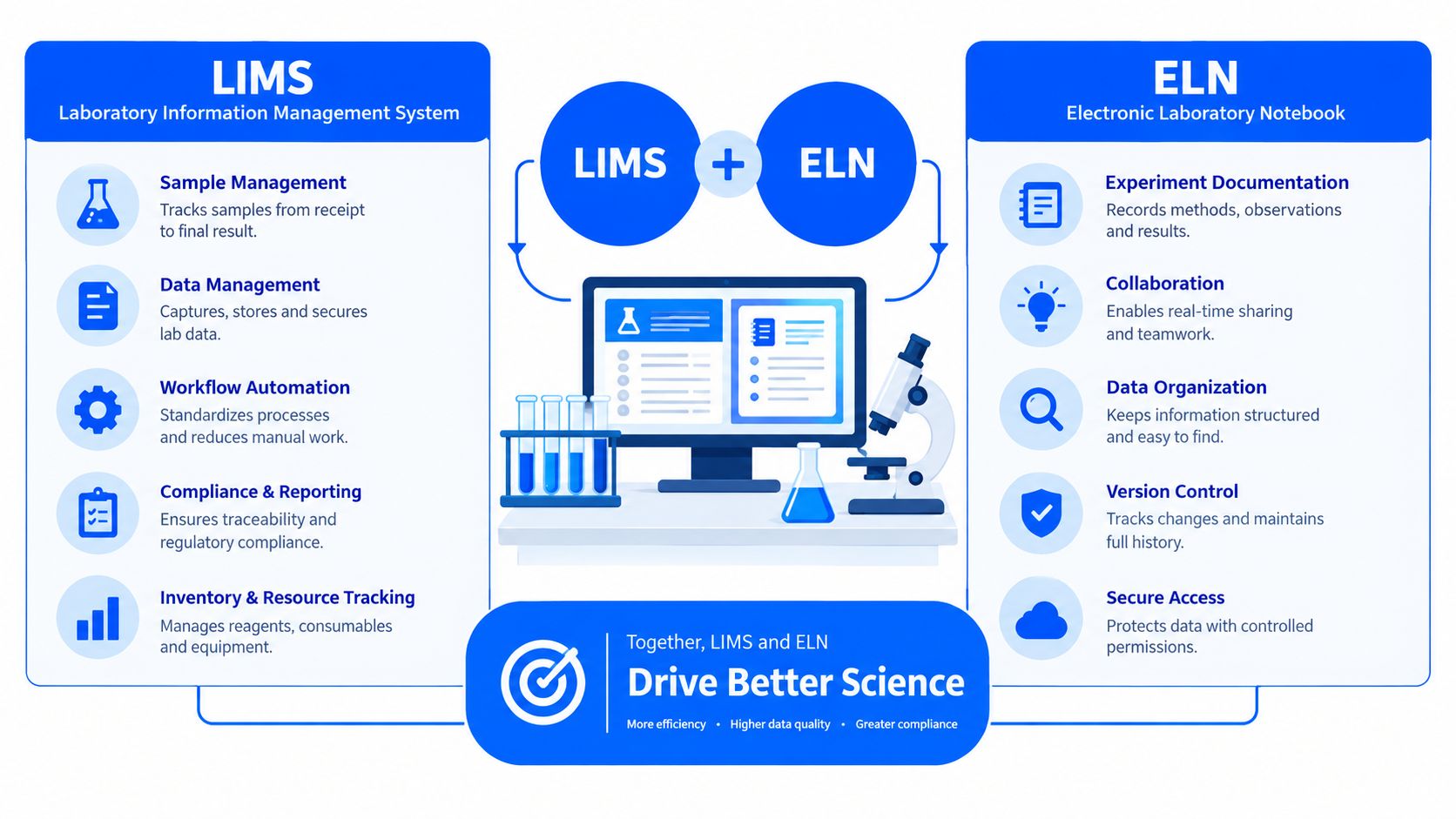
A LIMS is built to control and track structured lab operations. An ELN is built to capture how scientists think, plan, run, and interpret experiments.
Think sample record versus lab notebook
If you work in polymer or chemical R&D, here's a practical analogy.
A LIMS is like the lab's air traffic control system. It knows what sample arrived, where it should go, what tests it needs, which specification applies, and what result came back. It's structured, orderly, and designed so nobody loses track of a sample or confuses one result with another.
An ELN is closer to the scientist's research notebook with memory. It captures the aim of the experiment, the rationale behind the formulation, the exact protocol, observations during mixing or curing, deviations, images, and conclusions. It's where researchers explain what they were trying to learn, not just what value came out of a test.
Why they evolved differently
Their history explains their different strengths.
Laboratory data started becoming computerized in the 1970s. The first standalone LIMS appeared in the 1980s. ELNs arrived later in the mid-1990s because scientists needed something more flexible for narrative-style R&D documentation, especially where protocols, observations, and intellectual property context mattered (history of laboratory informatics and ELN adoption).
That timeline matters. LIMS came first because regulated, sample-centric workflows needed structure early. ELNs followed because exploratory R&D needed flexibility that sample systems weren't designed to provide.
What each system looks like in daily use
A materials team often uses them like this:
- LIMS handles: sample registration, test assignment, result entry, specification checks, chain of custody, and status tracking.
- ELN handles: experiment design, formulations, protocols, observations, attachments, discussion of failures, and sign-off on scientific work.
A formulation chemist might write in an ELN that a dispersant was added earlier than usual because the slurry looked unstable. The same work might create three physical samples that move into LIMS for particle-size, viscosity, and thermal testing.
That's not duplication when designed well. It's division of labor.
For teams trying to improve how experimental knowledge gets cited, organized, and reused in research-heavy environments, tools adjacent to ELN workflows can also help. Resources on citation tools for academics are useful when scientists are managing literature, notes, and experimental references alongside formal lab records.
Why ELN adoption now matters more
ELNs aren't niche anymore. A 2025 Lab of the Future survey reported that 81% of organizations used an ELN, up from 66% the year before, while 80% were using cloud-based data platforms, up from 70% (ELN and cloud platform adoption figures). That shift tells you something important. Labs increasingly expect experiment records to be digital, collaborative, and connected.
The remaining challenge isn't whether digital notebooks are real infrastructure. It's whether those records become structured enough, and connected enough, to support reuse beyond the original experiment.
How LIMS and ELN Compare and Where They Overlap
The confusion around LIMS and ELN usually starts when people ask one system to behave like the other.
A LIMS can store notes. An ELN can track samples. But those overlap areas don't erase the core difference in design intent. If a lab ignores that distinction, it often ends up with duplicate entry, uneven ownership, and endless debates about which record is “official.”
LIMS vs ELN at a Glance for Materials R&D
| Dimension | LIMS | ELN |
|---|---|---|
| Primary purpose | Control and trace samples, tests, and results | Capture experiment intent, protocol, observations, and conclusions |
| Core data shape | Structured, field-driven, sample-centric | Flexible, narrative, experiment-centric |
| Typical users | QC analysts, lab operations, analytical teams, regulated workflows | Formulation scientists, R&D chemists, research teams |
| Strongest use case | Repetitive or governed workflows with clear test steps | Exploratory work where methods and observations evolve |
| Record focus | What sample was tested, when, by whom, with what result | Why the experiment was run, what changed, what was observed |
| Compliance emphasis | Chain of custody, status control, result traceability | Authorship, scientific rationale, protocol history, IP context |
| Main risk when overextended | Becomes too rigid for creative R&D work | Becomes too loose for controlled sample management |
One quick explainer is worth watching before teams choose tools or boundaries:
Where overlap causes trouble
The overlap usually shows up in three places.
First, sample references inside experiments. Scientists need sample IDs in the ELN so their notes point to something real. But if they start manually recreating sample status, test queues, or final approved results there, the ELN begins shadowing the LIMS.
Second, methods and protocols. R&D teams often draft or adapt methods in the ELN. Operational teams may enforce approved test execution in LIMS. If nobody defines which system owns the approved operational version, method drift follows.
Third, result interpretation. The LIMS may hold the released result. The ELN may hold the scientist's interpretation of what that result means for the next formulation round. Both records matter. They just shouldn't compete to be the same record.
Labs rarely fail because they chose the “wrong” category. They struggle because they never drew a clean boundary between experimental context and operational control.
A practical boundary for materials teams
A good operating rule is simple:
- Use LIMS when the lab needs consistency, traceability, queue control, and governed results.
- Use ELN when scientists need to record changing ideas, formulations, observations, and decisions.
Many materials organizations need both. The key decision isn't whether one has more features. It's whether the combined setup makes work clearer or more confusing.
Integration Patterns That Prevent a Second Source of Truth
Buying both systems is the easy part. Keeping them from drifting apart is the hard work.
A lot of teams assume integration means “the API is connected.” That's only a small part of the job. The harder part is deciding what originates in each system, what gets synchronized, who owns changes, and how the organization will keep those rules consistent over time.
The second source of truth problem
The most common failure mode is simple. A scientist records an experiment in the ELN, then retypes parts of it into LIMS. Later, a test method changes in one place but not the other. A sample gets renamed. A result gets corrected after review. Weeks later, two systems tell slightly different stories.
That isn't just annoying. It weakens trust in the record.
Independent 2026 coverage has emphasized that linking LIMS, ELNs, and instruments is now a top integration priority, with one survey reporting that 62% of small and medium organizations and 50% of all organizations prioritize linking LIMS, ELNs, and instruments (integration priorities in modern labs). The useful lesson isn't the number by itself. It's that the hardest work has shifted from acquiring software to connecting operating systems without creating duplicate truth.
What lineage must survive the handoff
When ELN and LIMS exchange records, certain details must travel with the record so teams can reconstruct exactly what happened later.
The critical lineage elements include:
- Original ELN identity: the ELN record ID and version
- Approval context: ELN approval status and approver identity
- Method traceability: the method version used
- Raw evidence reference: the original raw-data file reference
- LIMS acknowledgement: a delivery confirmation and the LIMS-assigned record ID
Those fields matter because they preserve record lineage across systems and support validated workflows under GAMP 5 (required lineage metadata for ELN to LIMS integration).
Integration test: If your team can't answer “Which exact experiment version produced this analytical result?” from the combined record, the integration is incomplete.
Integration is also a governance choice
Two architectures often show up in materials R&D.
One is a best-of-breed model, where ELN and LIMS remain distinct and exchange data through controlled handoffs. This works well when exploratory formulation science and formal testing workflows are both mature and both need specialized depth.
The other is a unified platform model, where one environment covers more of the workflow with one data model. This can reduce translation work, but only if the platform handles both flexible experiment capture and controlled sample processes.
In both cases, the operating model matters more than the demo. Someone has to own identifiers. Someone has to own method masters. Someone has to decide which edits are allowed after transfer. Those are business rules, not integration settings.
How to Choose the Right LIMS and ELN Setup for Your Enterprise
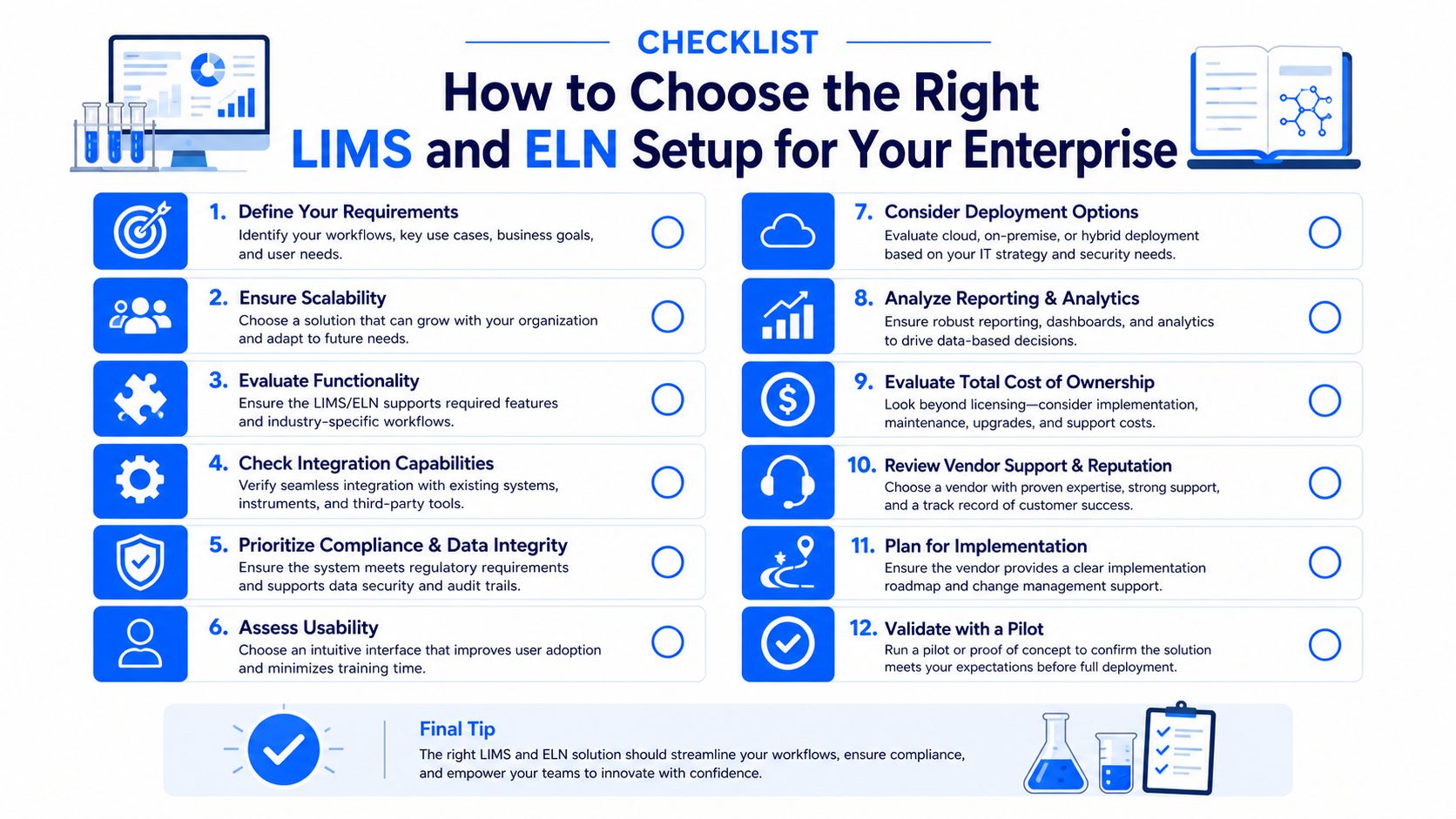
Most buying mistakes happen because teams compare screens instead of workflows.
A vendor demo can make every system look capable. The better question is whether the setup fits the way your materials organization works across research, testing, scale-up, and cross-site collaboration.
Start with workflow shape, not vendor category
A battery materials group, a specialty chemicals QC lab, and a polymer formulation team can all say they need “lims and eln,” but they may need very different setups.
Ask these questions early:
- How repetitive is the work? High-volume, governed testing pushes harder toward strong LIMS control.
- How exploratory is the work? Rapid formulation cycles and changing protocols need ELN flexibility.
- How often do records cross boundaries? If R&D, analytics, and quality exchange data constantly, integration quality becomes a board-level issue, not an IT detail.
Use enterprise criteria that survive growth
Selection gets sharper when teams score systems against future operating reality.
Consider a short enterprise checklist:
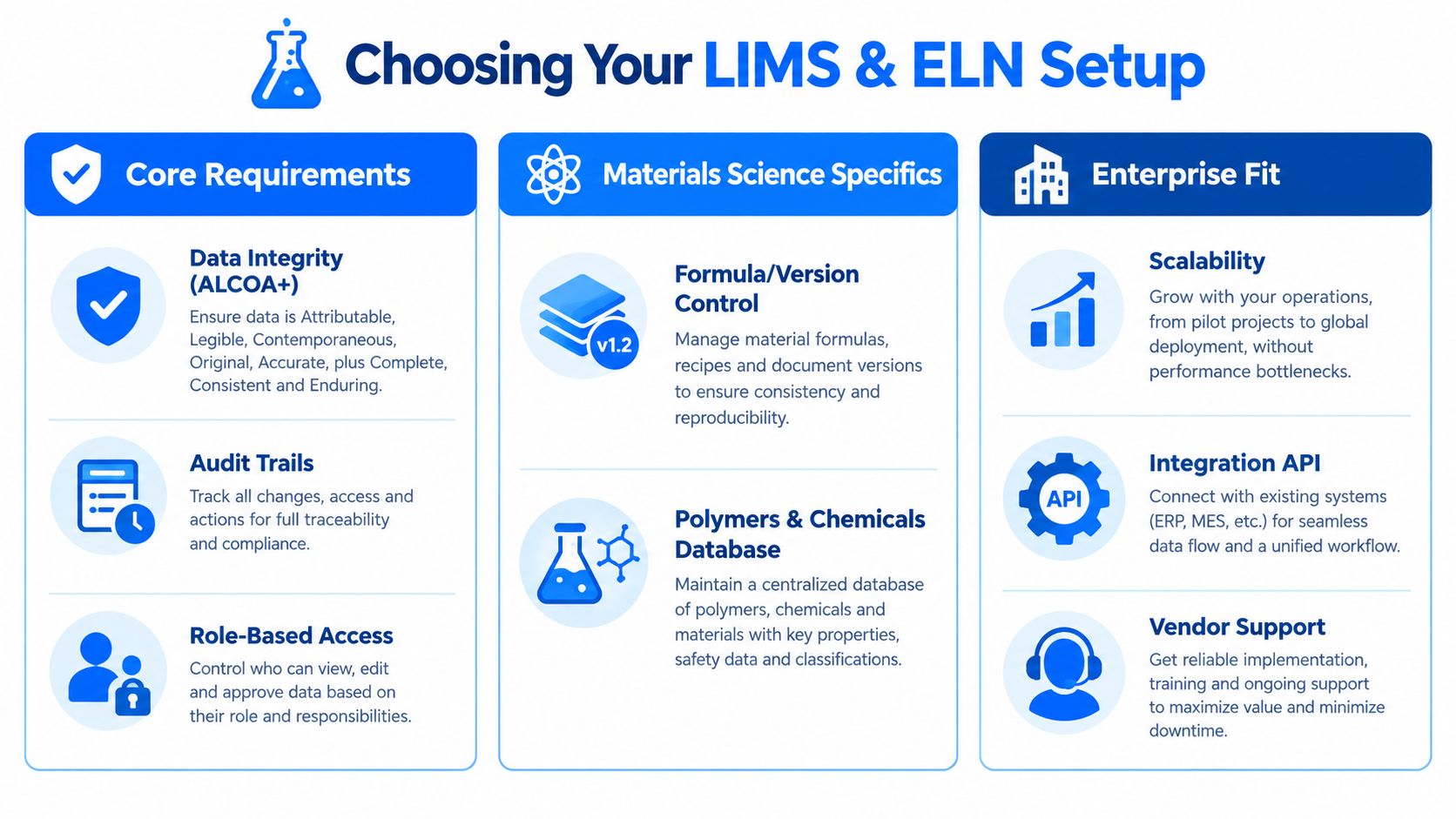
- Cross-site scalability: Can the same data model work across labs without forcing every site into awkward local workarounds?
- Instrument connectivity: Can instrument outputs connect to records without routine manual re-entry?
- Formula and version control: Can the system cope with iterative materials development where composition, process, and method all change?
- Interoperability: Does the architecture support clean data exchange with surrounding systems?
- Administrative maintainability: Who will maintain templates, master data, permissions, and workflow rules after go-live?
These questions matter because the market itself shows this is no longer a small software niche. Independent estimates place the global LIMS market at about USD 1.48 billion in 2025 and project USD 5.84 billion by 2031, while ELN forecasts place the category at USD 0.6 billion in 2025 and USD 1.1 billion by 2035, with another estimate at roughly USD 650–700 million in 2025. A related estimate places the broader lab automation software market at USD 2.9 billion in 2025 and above USD 5 billion by 2030 (laboratory informatics market projections). That level of spending reflects long-term infrastructure choices, not convenience software.
Choose for AI readiness, not just record digitization
Many evaluations stay too shallow.
A setup that merely stores digital records may still be poor at search, reuse, and modeling. A more useful selection lens is whether the architecture leaves you with connected, queryable, well-governed experimental knowledge.
For some enterprises, that points to a strong LIMS plus a strong ELN with disciplined integration. For others, especially those trying to centralize fragmented materials data for downstream analysis, a connected data layer such as Polymerize Connect can sit across spreadsheets, ELNs, and other silos to unify records into a secure backbone for later modeling and search.
That isn't a category argument. It's a reminder that the true target is an operating environment where today's experiment becomes tomorrow's reusable knowledge.
Data Governance Security and Compliance Essentials
A lab can digitize quickly and still end up with records nobody fully trusts.
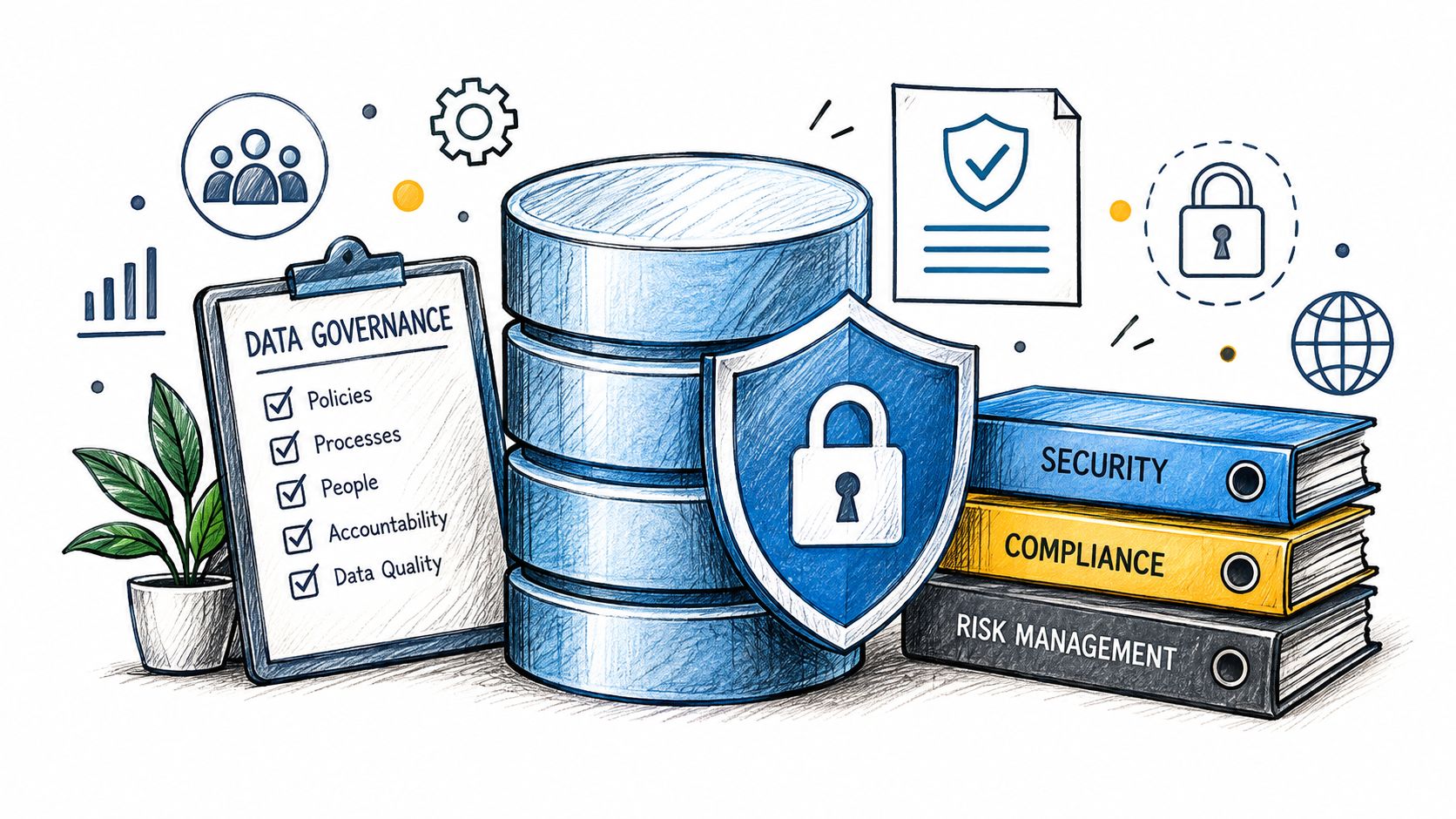
Trust comes from governance. Not abstract policy documents. Practical controls that tell you who created a record, who changed it, when it changed, what was approved, and whether the lab can still retrieve that information in a readable form years later.
What regulated labs need to preserve
In regulated environments, 21 CFR Part 11 applies when electronic records or signatures replace paper records, or when those digital records are relied on for regulated activity. That makes audit trails, e-signatures, role controls, and human-readable retention essential for both systems (21 CFR Part 11 compliance essentials for electronic records).
For materials organizations, even outside the most heavily regulated settings, those controls still matter because they support IP protection, defensible decisions, and clean handoffs between teams.
The practical governance model
The strongest pattern is usually not “store everything everywhere.” It's “connect records without duplicating responsibility.”
A defensible setup links ELN experiment narratives to LIMS sample and result records through shared identifiers, synchronized permissions, and audit trails so the same underlying data doesn't have to be re-entered or copied unnecessarily. That reduces mismatch risk and strengthens ALCOA+ data integrity, as noted in the Part 11 guidance linked above.
A practical governance checklist looks like this:
- Shared identifiers: the experiment, sample, and result should relate cleanly across systems
- Controlled approvals: signature and review steps should match the actual process, not sit outside it
- Role-based access: scientists, analysts, reviewers, and admins shouldn't all have the same authority
- Readable retention: records must remain understandable to humans, not just technically archived
- Change visibility: teams should be able to see what changed and why
Good governance doesn't slow science. It removes the future argument about what the record means.
Security and governance have to be operational
R&D leaders sometimes separate security from workflow design. In practice, they're linked. Weak permission models create informal workarounds. Poor version control leads to side files. Missing review logic pushes decisions into email.
That's one reason teams often benefit from structured operational planning around governance design, especially when workflows cross multiple systems. Resources on governance workflows with MakeAutomation can help teams think through how approvals, ownership, and data control should function in day-to-day operations rather than only in policy language.
For enterprise materials R&D, the test is simple. Can your team trace a result back to its method, raw evidence, scientific context, approvals, and responsible people without relying on memory? If not, the data may be digital, but it isn't yet dependable.
Unifying LIMS and ELN Data for AI Driven Materials Discovery with Polymerize
Many labs think they're preparing for AI because they've digitized records. That's only the first layer.
AI doesn't learn well from fragmented notebooks, inconsistent sample names, disconnected instrument files, and half-structured observations. A model can only reason across the data foundation it receives. If your ELN holds rich narrative but weak structure, and your LIMS holds strong structure but narrow context, the intelligence layer still sees partial truth.
Why digitized silos still block discovery
Recent discussion around lab systems has become more nuanced. ELN use is broad, but fragmented records, unstructured notes, OCR issues, and inconsistent metadata still block search, reuse, and AI workflows (why data readiness now matters more than simple digitization). That's the inflection point for materials R&D.
A scientist trying to design the next adhesive, membrane, cathode slurry, or polymer blend doesn't just need access to old files. They need connected knowledge. They need to ask: have we tried something similar, under what process conditions, with which failures, and what does the historical pattern suggest we test next?
What a usable AI backbone looks like
A unifying data layer matters here.
When LIMS and ELN records connect into one governed backbone, teams can do more than retrieve history. They can search across experiments, compare method versions, trace scale-up outcomes back to formulation decisions, and support explainable models that point to likely drivers rather than producing unsupported guesses.
For materials organizations, that shift changes the role of lab software. LIMS handles operational truth. ELN preserves scientific context. A unifying intelligence layer turns both into reusable institutional knowledge.
That's the more useful way to think about modern lab informatics. Not as a software showdown, but as stacked layers:
- LIMS for controlled sample and result workflows
- ELN for experiment context and scientific reasoning
- Connected governance for trusted lineage
- An intelligence layer for search, modeling, and next-experiment support
When those layers are aligned, years of trial-and-error stop behaving like archived history and start functioning like a decision asset.
If your team is trying to connect LIMS and ELN records into an AI-ready materials R&D backbone, Polymerize offers a practical path. It unifies fragmented experimental data across spreadsheets, ELNs, and silos, then supports explainable modeling and next-experiment planning for polymers, chemicals, and advanced materials. If that's the gap you're dealing with today, it's worth seeing how your current records could become usable research intelligence rather than better-organized archives.
Put your R&D data to work
See how materials teams use Polymerize to plan fewer experiments and reach target properties faster.