



The most popular advice about lightweight composite materials is also the least useful: make the part lighter, stronger, and more sustainable, then scale it. In production, those goals rarely move together without friction. A laminate that looks excellent in a coupon test can produce unacceptable scrap, unstable resin flow, difficult inspection, or a qualification burden that erases its apparent cost advantage.
The practical question isn't whether composites can deliver impressive specific performance. They can. The question is whether your team can control the material, interface, process, data, and qualification chain well enough to produce a reliable part repeatedly. That's where programs succeed or stall, especially as composites move deeper into transportation, wind energy, automotive, and industrial applications.
The worldwide composites market reached 12.7 million metric tons in 2022, representing approximately US$41 billion in material value, according to the JEC Observer industry report. That scale makes lightweighting commercially important, but it also exposes the limits of laboratory thinking. R&D leaders must choose material families, manage structure-property compromises, match manufacturing routes to demand, build credible qualification plans, and account for scrap and end-of-life impacts.
Table of Contents
- Polymer matrices offer the broadest manufacturing base
- Metal and ceramic matrices have narrower operating envelopes
Why Lightweight Composite Materials Are Harder to Scale Than They Look
A test coupon can meet its target while the production program remains unworkable. Production readiness means repeating the same architecture and critical properties across realistic process variation, inspection limits, and material history.
The value of lightweighting depends on the application. In aviation, lightweight materials, including metals, plastics, and composites, account for roughly 80% of all materials used. McKinsey's analysis of lightweighting reports that composites can exceed 50% by weight in aviation. Automotive programs face a different business case. One European assessment projected composite use in automotive semi-structural members from 1.6% to 2.2% by weight, while valuing weight savings at approximately US$7 per kilogram, compared with about €800 per kilogram in aerospace. The application determines how much process complexity the program can absorb.
The gap between a strong coupon and a qualified part
Laboratory work tightly controls fiber placement, cure conditions, surface preparation, and specimen selection. A production line adds batch variation, operator or robot behavior, tooling temperature gradients, humidity, storage history, resin-viscosity drift, and defects that small specimens may miss.
Qualification requires evidence that the part withstands realistic loads, environmental exposure, manufacturing variation, and damage scenarios. A lightweight design built around near-perfect fiber alignment may deliver excellent tensile performance yet fail impact or damage-tolerance requirements.
Scrap yield belongs in the material down-select, not in a later manufacturing review. A formulation that performs well but produces inconsistent flow, voids, or difficult inspection results can erase its apparent weight and cost advantage before the part reaches qualification.
What R&D leaders need to control
The key decisions connect four questions:
- Variability: Which inputs change the property distribution, rather than only the average result?
- Yield: How much usable part comes from each unit of incoming material?
- Qualification: Which failure modes require physical evidence before release?
- Economics: Does the complete material and process system work at the intended production volume?
Interfacial design often determines whether nominal fiber and matrix properties survive manufacturing. Scale-up also exposes interactions that isolated coupon studies miss. AI-guided experimentation can reduce the number of formulation and process combinations teams must test, but it does not replace physical validation, process control, or qualification evidence.
The practical standard is simple: select materials against repeatable production behavior, not peak laboratory performance.
The Material Families Behind Modern Composites
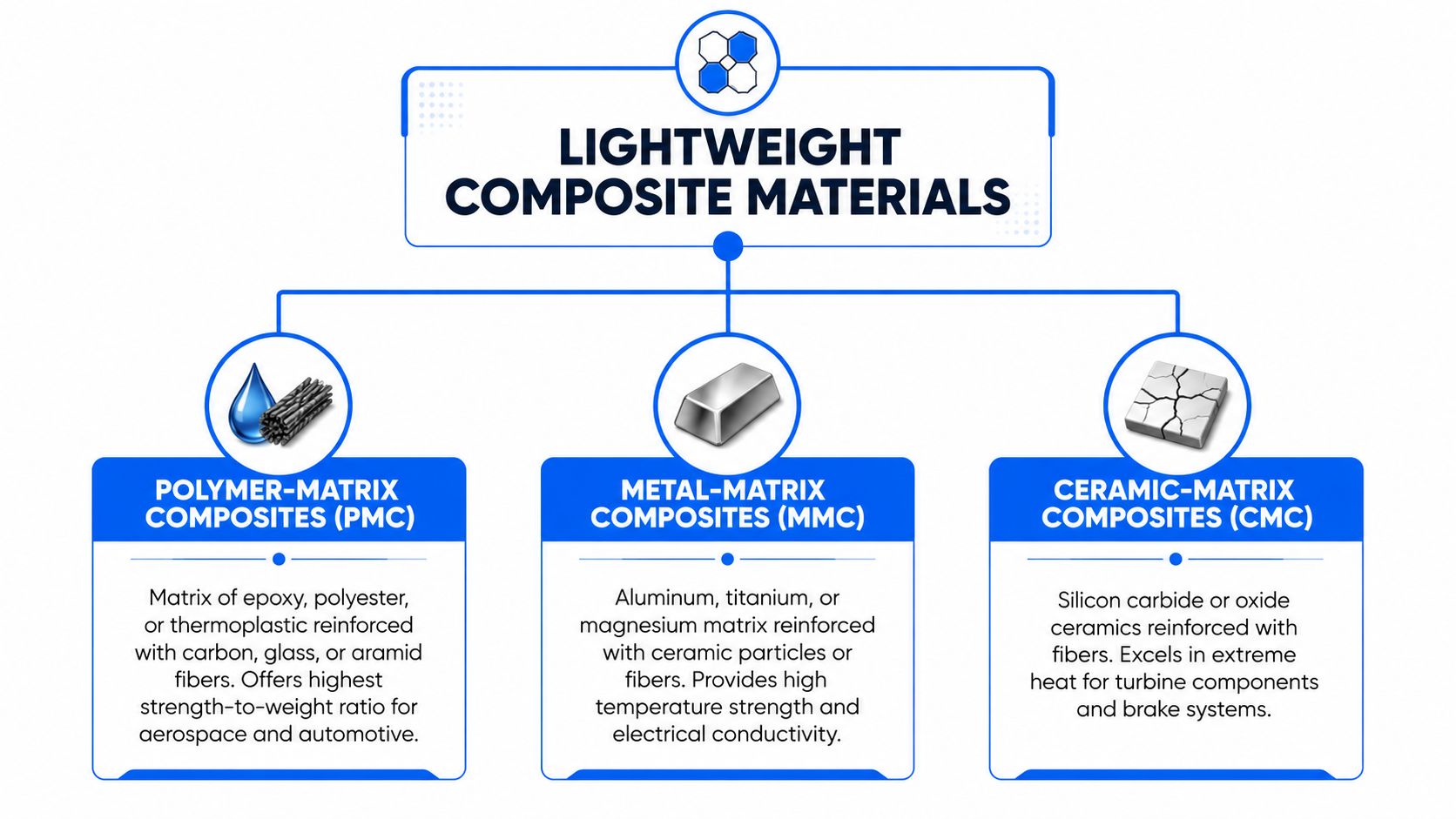
Material families should be selected against the production problem, not ranked by headline strength. Polymer-matrix composites cover most lightweight structural work because they combine low mass, useful specific performance, and established forming routes. Metal-matrix composites fit applications that need more thermal stability, conductivity, or wear resistance than polymers can provide. Ceramic-matrix composites address extreme heat, oxidation, and wear, where polymer systems reach their operating limit.
Polymer matrices offer the broadest manufacturing base
Carbon-fiber-reinforced polymers earn consideration when stiffness-to-weight or strength-to-weight controls the design. Carbon fiber delivers high tensile performance at low density, yet its directional behavior, cost, and sensitivity to processing variation can create production problems. Glass fiber is often the better choice when cost, impact toughness, electrical behavior, or throughput matters more than maximum specific stiffness. Aramid fibers suit some impact- and abrasion-focused designs, although cutting, joining, and load transfer require careful attention.
Matrix chemistry changes both the process window and the factory economics. Thermosets, especially epoxy systems, benefit from established reinforcement formats, cure methods, and structural performance. Thermoplastics can support faster forming, welding, and potential recyclability benefits. They also demand higher processing temperatures in many cases, controlled consolidation, and equipment that can manage viscosity and thermal history.
The industry's development shows why these options remain in use. High-strength carbon fiber development accelerated in Japan, England, and the United States in the late 1960s. Early fibers cost more than US$400 per pound, while continuous manufacturing processes in the early 1970s lowered cost and widened adoption. Carbon consumption reached about 26 million pounds by 1997 and exceeded 40 million pounds by 2004, as use expanded from aerospace and defense into sports, automotive, and industrial applications, according to the JEC Observer report.
Metal and ceramic matrices have narrower operating envelopes
Metal-matrix composites use aluminum, magnesium, titanium, or other metals reinforced with particles or fibers. They can improve wear, thermal, or electrical behavior, but processing, joining, machining, and recycling may be more difficult than with polymer systems. The added burden is justified only when those properties affect the part's service life or operating capability.
Ceramic-matrix composites occupy a more specialized role. Silicon carbide and oxide systems can retain useful performance at extreme temperatures, including turbine and braking applications. Their advantage is not only lower density. They remain viable in conditions where polymer matrices cannot survive.
A practical down-selection uses a system scorecard:
- Performance: Which load, temperature, impact, and fatigue requirements control the design?
- Processability: Can the selected route preserve alignment, consolidation, cure, and dimensional accuracy?
- Cost: Do material, tooling, inspection, and production requirements fit the program?
- End-of-life: Can scrap and retired parts enter a credible recovery pathway?
The screening winner is not always the production winner. Interfacial quality, scale-up variation, and scrap yield can change the ranking before qualification. AI-guided experiments can reduce formulation and process combinations worth testing, while physical validation and process control still determine whether a material family survives production.
Structure-Property Trade-Offs That Define Performance
Lightweight performance comes from engineering the full load path, not just selecting carbon fiber. Reinforcement type, orientation, packing, matrix chemistry, interface quality, geometry, and manufacturing history all affect the final part.
Carbon fiber makes the trade-off clear. A review table lists intermediate-modulus carbon fiber at approximately 1.51 g/cm³ density, 2,500 MPa tensile strength, 151 GPa tensile modulus, 1,656 specific strength, and 100 specific modulus. High-modulus carbon fiber is listed at 1.54 g/cm³, 1,550 MPa, 212 GPa, 1,006, and 138, respectively. The same comparison lists steel at 7.8 g/cm³, 1,300 MPa tensile strength, and a specific strength of 167, as shown in this composite materials and automotive applications review.
| Material | Density (g/cm³) | Tensile Strength (MPa) | Specific Strength | Specific Modulus |
|---|---|---|---|---|
| IM carbon fiber | 1.51 | 2,500 | 1,656 | 100 |
| HM carbon fiber | 1.54 | 1,550 | 1,006 | 138 |
| Steel | 7.8 | 1,300 | 167 | Not listed |
The comparison explains carbon reinforcement's appeal where mass efficiency controls the design. It also separates strength from stiffness. Intermediate-modulus carbon provides the higher listed tensile strength and specific strength. High-modulus carbon provides the higher listed modulus and specific modulus. Choosing between them depends on the governing load case, not on a general ranking of fiber grades.
Alignment improves one property while exposing another
Aligned fibers create efficient load paths, and a well-designed interface transfers matrix stress into the reinforcement. The resulting gains in tensile stiffness and strength are directional. A unidirectional laminate can perform exceptionally along the fiber axis while remaining vulnerable to impact, through-thickness loading, holes, joints, and manufacturing defects.
The hierarchical CFRP review and CNT laminate study describes this trade-off: CFRP systems can provide higher tensile and flexural strength while showing lower impact strength and more brittle characteristics. The same source reports CNT laminates with specific tensile strength up to 1.71 GPa/(g/cm³) and specific modulus up to 256 GPa/(g/cm³), exceeding state-of-the-art unidirectional carbon-fiber laminates on specific modulus. For development teams, the practical opportunity lies in controlling dispersion, packing, hierarchy, and interfacial chemistry, rather than automatically purchasing a higher-grade fiber.
The interface is part of the structure
A weak interface limits load transfer. An excessively strong or brittle interface can suppress useful energy dissipation. The appropriate design depends on the intended failure mode, so an aerospace panel, automotive crash component, and wear-resistant industrial part will not share one optimum.
Qualification therefore requires more than headline tensile values. Teams should connect microstructure and processing history with damage initiation, propagation, residual strength, fatigue, moisture response, and inspection sensitivity. Specific performance is a starting point, not a qualification strategy. Scrap yield and scale-up variation also belong in the material decision, because a promising coupon can lose its advantage when defects, rework, or inconsistent interfaces reduce usable part output.
Manufacturing Routes and the Scale-Up Reality
Manufacturing route selection is a production commitment, not a procurement detail. Each process makes a different promise about volume, geometry, labor, tooling, dimensional control, and scrap.
Hand layup remains valuable for prototypes, development hardware, repairs, and low-volume parts. It gives technicians flexibility over complex geometry, but repeatability depends heavily on workmanship, and the process can be labor-intensive. It's a poor choice when the design requires tight, repeatable placement and high throughput.
Automated fiber placement makes sense for large, contoured structures where programmed placement can justify expensive equipment and tooling. Its strengths include repeatable fiber paths and access to complex curves. Its weaknesses include tow drops, gaps, steering limits, material waste, and the need to validate robot settings against actual consolidation and cure behavior.
Match the route to the production profile
Resin transfer molding offers a more enclosed process with potential for repeatable geometry and higher-volume production. The difficult work lies in mold design, preform permeability, resin flow control, venting, cure kinetics, and dimensional stability. A simulation that predicts ideal filling won't protect the team from a real permeability shift or a blocked flow path.
Pultrusion dominates continuous profiles because it aligns reinforcement efficiently through a die and supports steady production. It's powerful for beams, rods, channels, and other constant or near-constant cross-sections, but it's not a universal answer for variable geometry.
Additive manufacturing provides geometric freedom and can be useful for prototypes, tooling, repair concepts, and selected secondary structures. Primary load-bearing parts still face restrictions around material systems, build size, anisotropy, voids, surface finish, and qualification evidence.
| Route | Best fit | Main scale-up risk |
|---|---|---|
| Hand layup | Low-volume and development parts | Labor variation and slow cure |
| Automated fiber placement | Large, contoured structures | Waste, steering defects, tooling cost |
| Resin transfer molding | Repeatable molded parts | Resin flow and mold control |
| Pultrusion | Continuous profiles | Limited geometry |
| Additive manufacturing | Prototypes, tooling, selected structures | Material and qualification limits |
Production teams also need a reliable record of material lots, work instructions, nonconformances, rework, and shipment status. A structured order management for manufacturing workflow can help connect those operational records to the technical decisions made during scale-up.
Scale-up test: Don't ask whether a process can make one good part. Ask whether it can make an acceptable distribution of parts while preserving traceability and yield.
Design, Simulation, and Qualification in Practice
Composite qualification works best as a staged evidence-building exercise. The team starts with a material and architecture hypothesis, then progressively tests whether that hypothesis survives larger scales, more realistic loads, and more manufacturing variation.
Start with the load path
Define the governing failure modes before optimizing the laminate. A stiffness-limited panel may need a different fiber schedule from an impact-limited enclosure. A joint may be controlled by bearing, bypass, delamination, fastener interaction, or environmental degradation rather than by the nominal laminate strength.
Build the initial stacking sequence around load paths, manufacturing constraints, inspection access, and joining strategy. Finite element analysis can then identify strain concentrations, buckling behavior, load redistribution, and areas that require local reinforcement. The model must represent anisotropy and relevant damage behavior. A highly detailed mesh won't compensate for weak material data.
Use the building-block approach
A practical sequence usually moves through:
- Material coupons: Measure tensile, compression, shear, fracture, fatigue, thermal, and environmental response appropriate to the application.
- Laminate coupons: Check stacking sequence, thickness effects, joints, open holes, impact response, and process defects.
- Elements and subcomponents: Test bonded regions, stiffeners, frames, cutouts, and load introductions.
- Full-scale hardware: Validate the assembled load path, manufacturing interfaces, inspection plan, and repair assumptions.
Each stage answers a different question. Coupon testing tells you how the material behaves in controlled specimens. Subcomponent testing tells you whether the architecture and joints work together. Full-scale testing reveals interactions that simplified specimens can miss.
Make the model earn trust
Design allowables should come from representative material and process data, not idealized lab results. Teams need to define how batch variation, void content, cure state, fiber waviness, environmental exposure, and damage affect the allowable property set.
Digital tools can reduce unnecessary physical iteration when they're connected to credible experiments. They can prioritize the next test, flag sensitive variables, and identify where uncertainty remains high. They can't remove the need for validation, especially where failure consequences are severe.
The most reliable programs connect simulation, test data, nondestructive inspection, and manufacturing records. That creates a feedback loop in which a failed specimen improves the model and the model improves the next experiment.
Sustainability, Scrap, and the End-of-Life Question
A lightweight composite earns a sustainability claim only when its complete material and process system supports it. Lower mass can reduce use-phase energy or improve vehicle efficiency, yet resin chemistry, reinforcement production, manufacturing yield, service life, recycling access, and the displaced material all affect the result.
The factory often exposes the largest opportunity. A 2026 process life-cycle assessment of thermoplastic composite automotive parts found that approximately 82% of the initial material mass became production scrap, while closed-loop recycling reduced global warming potential by up to 25%, according to the process LCA published in ScienceDirect. For production teams, the practical response is clear: measure yield and recover usable scrap before assuming a different reinforcement or matrix will solve the environmental burden.
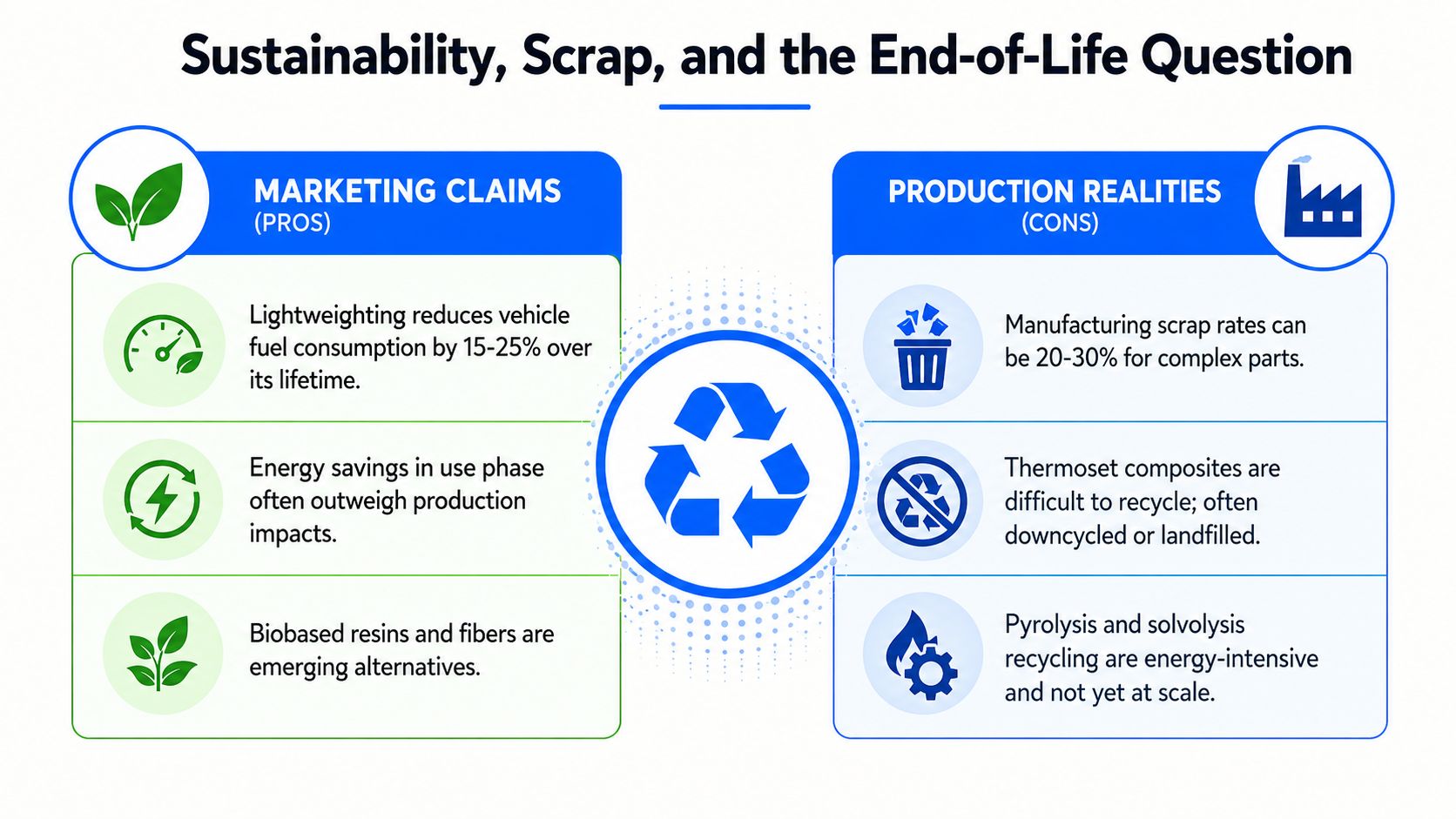
Production scrap is the easier stream to control. Cutting, forming, trimming, failed cure, and inspection can each generate traceable losses. End-of-life parts are less predictable because they may be contaminated, joined to other materials, damaged, or scattered across recovery systems.
The recycling route also sets a hard constraint. Closed-loop recycling returns material to a comparable application. Downcycling creates a lower-value feedstock, while disposal leaves embedded material value unused. All three options carry different energy, quality, logistics, and market requirements.
An LCA of fiber-reinforced composite cross-car beams found that replacing approximately 40% of the aluminum mass did not by itself determine the environmental outcome. Residual aluminum supply dominated upstream impacts, while end-of-life recycling credits shaped resource-depletion results, as reported in the cross-car beam life-cycle study.
Design sustainability into the process window
The 2025 composites industry report notes that thermosets still account for over 70% of revenue, while glass fiber remains the largest segment. Cost, processability, established supply chains, and application requirements help explain that market structure.
A useful sustainability plan follows the material through the line and beyond:
- Material yield: Record consumed material, usable part mass, trim, rejects, and rework.
- Scrap route: Specify whether scrap enters closed-loop recycling, downcycling, or disposal.
- Life-cycle boundary: Include upstream materials, manufacturing energy, use-phase benefits, and recovery credits.
- Design compatibility: Confirm that the selected matrix meets process and service requirements before prioritizing recyclability.
Green claims become defensible when procurement and LCA teams can connect them to measured material flows.
How AI-Driven Platforms Accelerate Discovery and Scale-Up
The practical value of AI in composites is not a longer list of candidate formulations. It is a better choice of next experiment, made with viscosity, cure behavior, fiber compatibility, equipment limits, scrap yield, and qualification requirements in view.
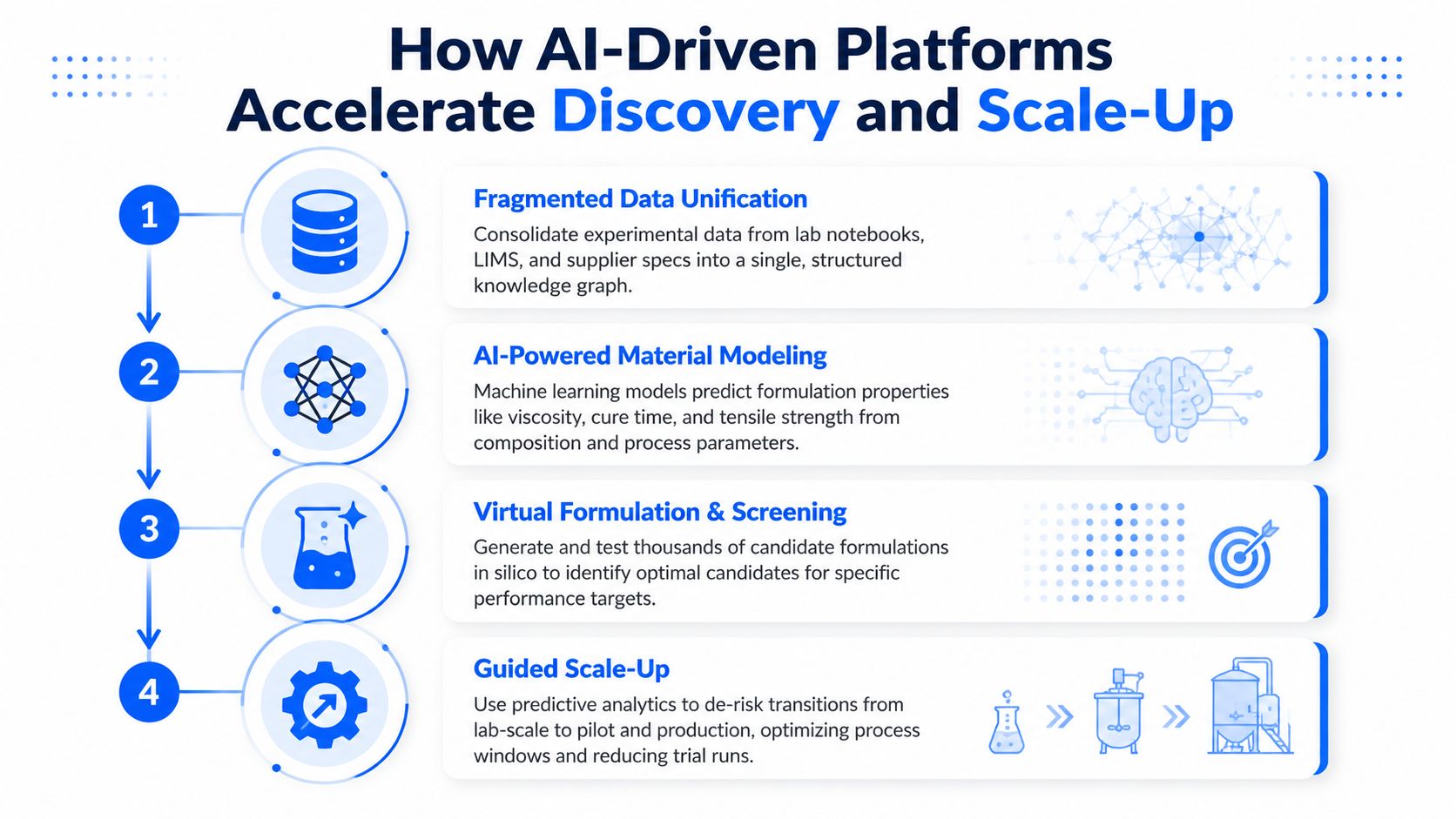
That requires a usable data foundation first. Results are often spread across spreadsheets, lab notebooks, supplier documents, ELNs, and disconnected databases. Model performance depends on consistent material names, units, test conditions, formulation versions, process parameters, and failure annotations.
Start with traceable experimental data
A domain-specific platform such as Polymerize can organize experimental information through Polymerize Connect. Its Polymerize Labs layer uses 35+ domain-specific explainable models to predict properties, optimize formulations, and identify causal drivers with confidence scores and historical precedents.
For composite R&D, a tensile prediction alone is not enough. The useful result is a ranked view of which resin, fiber treatment, cure condition, or process parameter merits the next physical test, and why.
Scientists can then connect composition, process history, measured properties, and prior failures without reconstructing every detail from old files. They still decide whether a proposed formulation makes physical and commercial sense. The gain is less searching and a clearer record of how each decision was made.
Use AI to shorten the experiment loop
A productive workflow links virtual screening to targeted physical tests:
- Unify records: Normalize historical formulations, test methods, and process conditions.
- Model sensitive properties: Predict viscosity, cure time, tensile response, and other program-specific targets.
- Choose the next experiment: Balance expected performance, uncertainty, material compatibility, and manufacturability.
- Update the process window: Feed new results back into the model as development continues.
Scale-up is where this discipline earns its place. Laboratory and production conditions rarely match exactly. AI can flag the variables most likely to shift during pilot transfer, while engineers and prototyping partners test those risks in a controlled sequence. That helps expose interfacial or processing problems before they become expensive production scrap.
Polymerize reports customer outcomes including up to 50% fewer failed experiments within three months, alongside faster movement from laboratory development to production. These are reported platform outcomes, not universal guarantees. Teams should test them against their own data quality, workflow maturity, and material system.
The enterprise controls matter as much as the models. Materials data can contain valuable intellectual property, so role-based access, auditability, and security controls must accompany prediction tools. AI accelerates discovery only when scientists trust the underlying records and can explain why a recommendation entered the development workflow.
Where Lightweight Composites Earn Their Place Next
Lightweight composites earn their place when the system-level benefit outweighs the added complexity of material handling, manufacturing, joining, inspection, qualification, and recovery. Aerospace remains a natural fit because high value per unit mass can justify complex processes. Automotive, energy, and industrial programs require a sharper focus on throughput, yield, repairability, and total life-cycle impact.
The next generation won't be won by the team that chooses the lightest fiber in isolation. It will be won by teams that connect formulation, reinforcement architecture, process control, simulation, qualification, and data governance from the beginning. Decarbonization pressure and electrification increase the value of mass reduction, but they also make manufacturing energy, scrap, and end-of-life accounting harder to ignore.
Digital systems will become part of that engineering stack. Organizations evaluating aerospace digital transformation should include materials data and qualification workflows, not only factory automation or enterprise systems.
Start with three practical actions:
- Audit existing experimental data for missing conditions, inconsistent units, and untracked failures.
- Map the trade-offs that control your part, such as impact tolerance, cure time, scrap yield, or joining.
- Run a focused AI-guided formulation sprint against a defined performance and process target.
That sequence gives R&D leaders a more realistic path from promising material to repeatable part.
Polymerize helps materials teams unify fragmented experimental data, apply explainable models to formulation and process decisions, and identify the next best experiments for lightweight composite development. Visit Polymerize to assess how an AI-native R&D workflow could help your team reduce failed iterations and move qualified materials toward production with greater control.
Put your R&D data to work
See how materials teams use Polymerize to plan fewer experiments and reach target properties faster.