
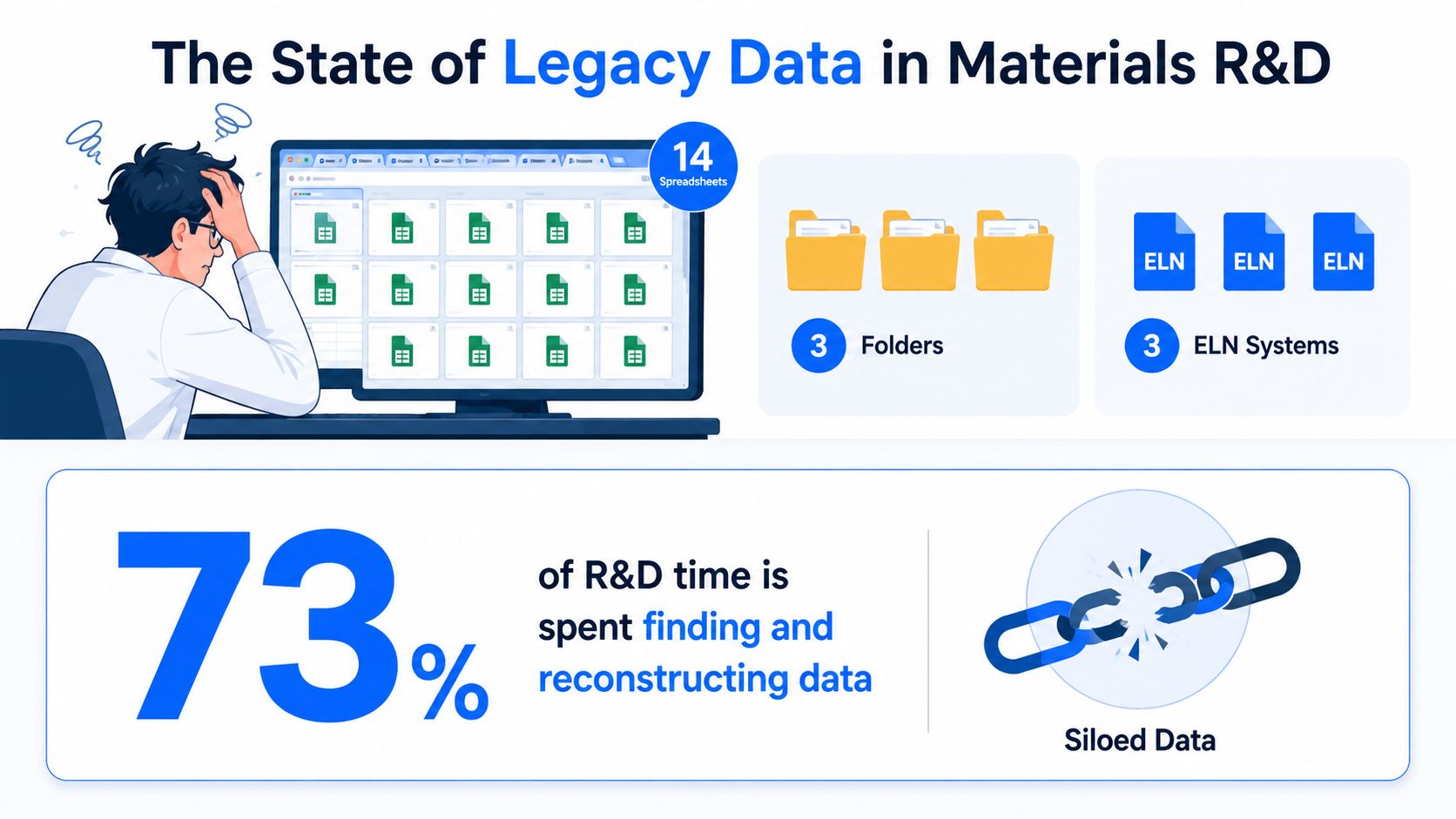
A materials scientist can spend a morning reconstructing one synthesis campaign from 14 Excel files, SharePoint folders, and three ELN instances. The synthesis parameters may live in a workbook, XRD spectra on a local drive, sample metadata in a LIMS that few people were trained to use, and characterization results as email attachments. By lunchtime, the scientist still may not know whether two records refer to the same sample.
That isn't just an information-retrieval problem. It's the central risk in legacy data migration for materials R&D. If the team moves disconnected, ambiguous records into a new platform without resolving their meaning, it creates a cleaner interface around the same unreliable evidence. An AI-ready backbone requires governed identities, units, methods, lineage, and relationships before models can learn from the history.
Table of Contents
The State of Legacy Data in Materials R&D
The fragmentation usually becomes visible during a simple question: Which formulation changes improved the target property, and under what processing conditions? A researcher might search a spreadsheet for a sample ID, open an ELN entry for the synthesis procedure, locate an instrument export on a shared drive, and ask another lab whether a PDF contains the final characterization result. Each source can be useful on its own, but none provides the complete experimental context.
The defects are rarely dramatic at first. One scientist writes Sample-4471, another uses 4471-A, and a third records the same material under a project nickname. A workbook mixes SI and CGS units. An instrument CSV has shifted columns after a software update. A sample points to a parent batch that no longer exists in the active system. Links lead to instruments retired years ago, while free-text notebook entries hold the only record of a synthesis step.
Why consolidation is strategic
Consolidation matters because materials organizations want to do more than search old files. Property prediction, knowledge graphs, formulation optimization, and cross-project learning all depend on consistent entities and comparable measurements. A model can't reliably connect two experiments when the material name, unit convention, or processing stage changes from one source to another without documentation.
This is why modernizing legacy systems in 2026 should be treated as a data-governance decision, not just an infrastructure refresh. The target backbone needs to preserve experimental evidence while making its meaning explicit.
A practical migration therefore starts by asking what each record means, which relationships must survive, and which historical content still has operational value. The technical transfer comes later. The objective isn't to create a larger archive. It's to create a queryable, traceable, model-ready substrate that scientists can trust when planning the next experiment.
Why Most Migration Projects Fail Before They Start
Legacy data migration projects often fail before engineers write the first extraction script. One 2025 industry report found that only 36% of projects stayed within forecast budget and only 46% were delivered on time, according to industry guidance on legacy-system data migration. The same guidance cites another benchmark in which 83% of projects either fail outright or exceed their original budget and timeline, with 60% failing on the first attempt.
The materials R&D version of this problem is easy to recognize. A team may extract every workbook correctly and still preserve hidden sample-naming conventions, free-text synthesis steps, inconsistent temperature fields, and contradictory composition references. The new database then contains more accessible defects, which makes the failure harder to detect because the system appears modern and complete.
A separate benchmark reports that data quality accounts for 69.16% of migration success, as summarized in this data migration guide. The practical lesson is clear: ETL plumbing is necessary, but it isn't the main source of confidence.
Four failure vectors
| Failure Vector | Manifestation in R&D Sources | Typical Impact |
|---|---|---|
| Incomplete source profiling | Unknown workbook versions, undocumented ELN exports, shifted instrument columns | Records are omitted, misread, or loaded into the wrong structure |
| Missing data contracts | No agreed definition for sample identity, units, methods, or required fields | Labs produce records that look valid but can't be compared |
| No incremental validation | The team checks results only after the full load | Systemic mapping errors appear during cutover, when correction is expensive |
| One-time migration mindset | The pipeline has no lineage, ownership, or change process | New experiments reintroduce the same defects after launch |
Practical rule: A migration that preserves ambiguity has succeeded technically and failed scientifically.
The most damaging assumption is that source data is merely waiting to be moved. In practice, the team must decide which defects change scientific interpretation, which prevent reliable joining, and which are cosmetic. It must also assign ownership for unresolved records. Without those decisions, the project becomes a large-scale reproduction exercise.
Assessing, Profiling, and Mapping Your Source Data
Assessment should produce evidence before transformation begins. Start with an inventory that names every spreadsheet, ELN export, LIMS table, instrument feed, shared-drive folder, and reporting database in scope. Record the owner, business purpose, update pattern, file version, access method, and whether the source remains active during migration.
Pass one, profile the sources
For each source, capture:
- Structure: Row count, column count, headers, data types, and repeated worksheet patterns.
- Completeness: Null rates for important fields and the frequency of blank or placeholder values.
- Identity: Distinct sample IDs, batch IDs, material names, project codes, and operator values.
- Consistency: Unit labels, date formats, decimal conventions, controlled terms, and unexpected value ranges.
- Traceability: A sample of 10 rows from each source, retained with the original object name and location.
The sample matters because schema drift often hides in workbooks that appear identical. One lab's Temp_C may contain numeric values, while another's field includes entries such as ambient, RT, or 150 deg C. Profiling exposes that difference before a transformation converts it into a null.
Pass two, define good data
The target backbone needs a written baseline. For a synthesis record, required fields might include sample ID, composition, synthesis date, instrument, operator, and units. The team should define controlled vocabularies for material families, process steps, instruments, and measurement methods, along with unit conventions and acceptable numeric ranges.
This baseline should distinguish validation from enrichment. A missing operator may block auditability, while a missing project description might only reduce search quality. The rule should reflect the downstream decision, not an abstract preference for completeness.
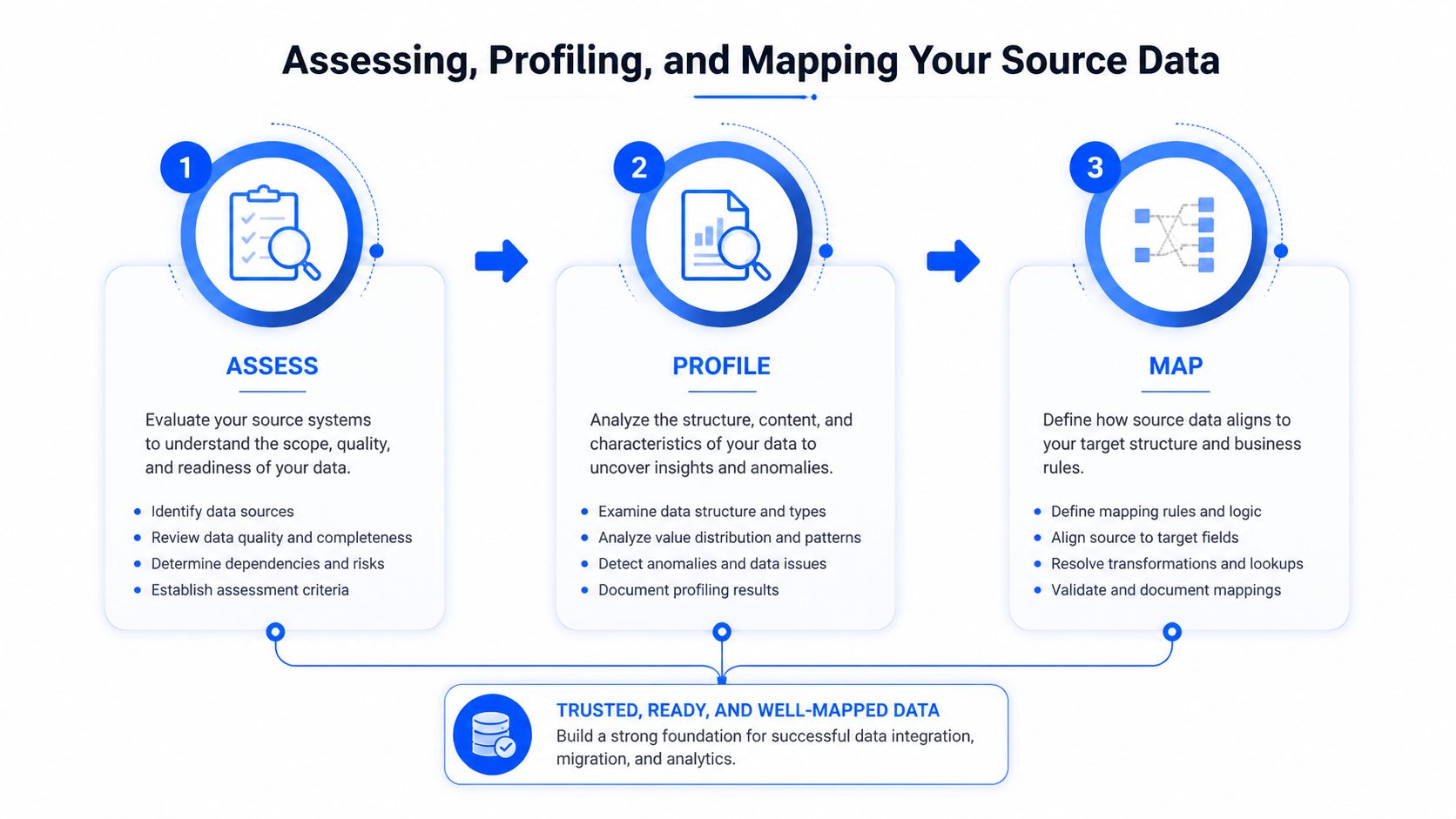
Pass three, map source to target
A source-to-target map translates messy structures into explicit entities and relationships:
| Source Pattern | Target Representation | Transformation Decision |
|---|---|---|
Temp_C in a synthesis workbook | synthesis_temperature.value | Store the numeric value with degC as the canonical unit |
| ELN step table | Experiment rows plus ordered step rows | Preserve step sequence, author, timestamps, and free-text context |
| Repeated sample ID in two workbooks | One canonical sample entity | Link source records after reviewing composition, batch, date, and provenance |
The map should include source field, target field, rule ID, data type, unit behavior, null behavior, and review owner. A reusable profiling report can then show the source inventory, field statistics, identity collisions, unit variants, orphan relationships, transformation exceptions, and unresolved decisions. Writing this report before code gives scientists and engineers a shared artifact for reviewing what will change.
Cleaning and Transforming Data for an AI-Ready Backbone
Cleaning shouldn't mean scrubbing every irregularity until the source loses context. It should mean prioritized defect triage. The team needs to separate records that could change scientific conclusions from issues that only affect presentation.
Triage by scientific consequence
A useful operating model has three levels:
- P1 defects: Safety or methodology errors that can change interpretation, such as a temperature attached to the wrong synthesis step or a measurement linked to the wrong specimen. These require subject-matter review and should block promotion.
- P2 defects: Structural problems that prevent reliable analysis, including inconsistent units, duplicate identifiers, missing required fields, and unresolved parent-child relationships.
- P3 defects: Cosmetic issues such as column ordering, capitalization, or display formatting. These can usually be automated or deferred.
Consider compound identity. If two ELNs contain duplicate records, the system shouldn't merge them solely because their names look similar. A stronger resolution may use CAS Number plus InChIKey, then retain both source references and record the matching decision. Where the identifiers conflict, the record should enter a review queue rather than disappear into a deduplication rule.
Unit normalization needs the same discipline. A yield field may appear as mass_percent, %, or a free-text phrase. The canonical store should hold a normalized value and unit, while the transformation log preserves the original representation and rule that produced the new value.
Make every rule reviewable
Orphan records deserve explicit treatment. If a measurement points to a parent batch or sample ID that doesn't resolve, the pipeline should flag it, retain the original record, and explain why it wasn't linked. Dropping it hides a source defect. Linking it to the nearest-looking entity can be worse because it creates false scientific evidence.
Use versioned, idempotent transformation scripts. Running the same version twice should produce the same result, and a later rule version should be able to explain what changed. For each defect class, retain the rule ID, an example of the bad record, the corrected output, the confidence or review status, and the responsible owner.
This approach keeps human attention on ambiguous chemistry and process context. Repeatable fixes belong in code. Interpretive decisions belong in a review workflow with an auditable outcome.
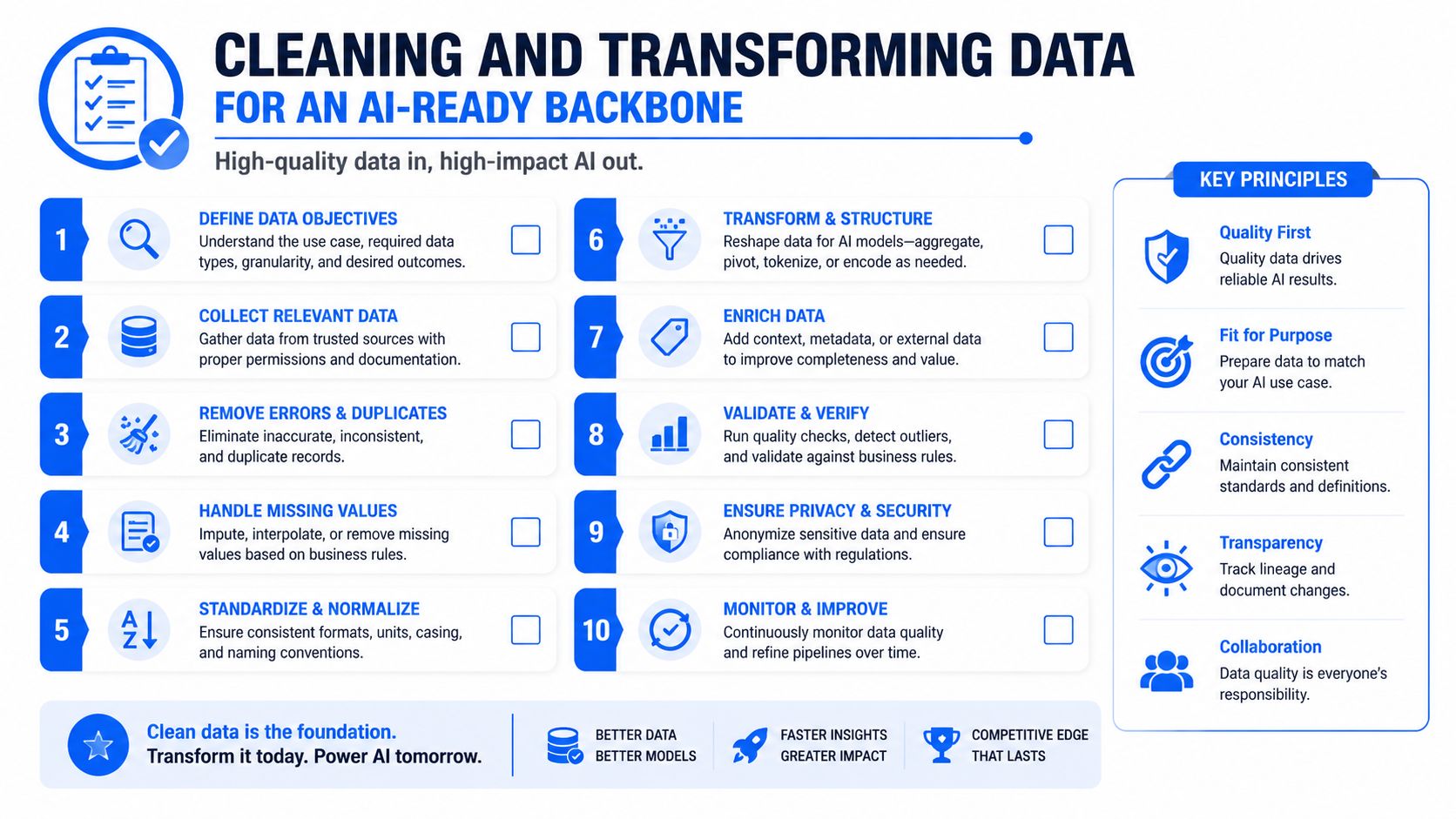
Cleaning pipelines also need to support future source changes. A newly exported instrument file can introduce a renamed column or different decimal convention. Schema checks should fail loudly, quarantine affected records, and notify the data owner instead of allowing a plausible-looking load to continue.
Incremental ETL, Validation Checkpoints, and Provenance
A big-bang cutover hides risk until the moment the organization has the least room to respond. Move data in cohorts instead, grouped by instrument, project, experiment type, or another boundary that scientists understand. A practical sequence uses 10%, 25%, 50%, and 100% checkpoints, with each wave treated as a controlled experiment rather than a simple transfer.
The first wave should be representative, not merely easy. If it contains only clean spreadsheets, it won't test the difficult ELN, LIMS, and instrument cases that will determine whether the design works.
Gates that catch systemic errors
| Wave | Gate | Pass Criterion | Owner |
|---|---|---|---|
| 10% | Structural and identity validation | Source and target structures align, required identifiers resolve, and exceptions are classified | Data engineering plus lab data owner |
| 25% | Measurement and relationship validation | Measurements retain units and methods, while sample, batch, and experiment links remain intact | Domain scientist plus quality representative |
| 50% | Reconciliation and replay test | Counts, payload checks, business rules, and lineage checks pass across representative cohorts | Migration lead |
| 100% | Cutover readiness | Open exceptions have owners, rollback is tested, and downstream queries operate against the target | Program owner plus lab sign-off |
At each gate, compare source and target row counts, calculate payload checksums where appropriate, and run business assertions. Every sample should resolve to a valid material reference. Every measurement should carry units. Referential integrity sweeps should identify records that point to missing experiments, batches, specimens, or instrument runs.
Write first to a staging schema, validate there, and promote accepted data atomically. This prevents partially transformed records from appearing as authoritative while the rest of the wave is still under review.
Preserve the chain of evidence
Every migrated record should carry fields such as source_system, source_object_id, extracted_at, transform_version, and a lineage pointer to prior records. For a spreadsheet, that lineage may need to identify the workbook, worksheet, row, and original column. For an ELN, it should point to the experiment and entry from which the value came.
Teams evaluating the surrounding integration context may also review Donely platform integrations when deciding how external systems and operational workflows connect to the migration pipeline. The important design question remains ownership. Someone must be able to replay a record back to its source and explain every transformation applied to it.
Making the New Data Backbone AI-Ready
AI readiness is decided in the schema, not added after migration. A warehouse full of cleaned but awkwardly shaped records still forces every analyst and data scientist to rebuild the same joins. The backbone should represent measurements, samples, batches, methods, instruments, and processing history in forms that downstream consumers can query consistently.
A useful foundation includes a long-format measurements table with fields such as sample_id, property, value, unit, method, and instrument. A denormalized samples-and-batches view can support retrieval and exploration, while a curated feature store can hold approved inputs for supervised learning. These layers should remain connected to the canonical records and their provenance.
Resolve identity before modeling
A single materials registry should determine how the system represents a compound, formulation, phase, grade, batch, or lot. The model must see Al2O3, alpha phase, and a specific lot as the same governed entity regardless of whether the legacy source used a shorthand, project nickname, or vendor description.
Consider a tensile-test workbook. Its rows shouldn't remain as a single opaque table. The migration can create linked records for:
- Samples, representing the material identity and batch relationship.
- Specimens, representing the physical test pieces prepared from a sample.
- Measurements, representing properties, values, units, and methods.
- Instrument runs, representing the device configuration, operator, and raw-file lineage.
This structure supports more than model training. A scientist can query which processing conditions preceded a result, a quality engineer can trace a value to its instrument run, and a data steward can correct a material identity without rewriting every historical measurement.
Design test: If a model feature can't be traced to a source record and a documented transformation, it isn't ready for production use.
The target should also preserve uncertainty and context. A value without method, instrument, specimen state, or unit may be searchable, but it shouldn't automatically enter a training set. AI readiness means making inclusion criteria explicit, not labeling every migrated record as usable.
Testing, Cutover, and Pre-Go-Live Checklist
Cutover should run like an experiment with hypotheses, owners, and pass or fail evidence. The final 72 hours need a written war-room plan, not a collection of informal assurances that the data “looks fine.”
Before the cutover
Run reconciliation reports between source and target and review exceptions by severity. Freeze writes to the source systems, take backup snapshots, confirm access to the original records, and walk through the rollback runbook with the people who would execute it.
The team should also confirm:
- Source freeze: No untracked edits can enter the legacy environment during final extraction.
- Reconciliation: Counts, key identities, relationships, units, and recent records agree within documented rules.
- Rollback: The team knows what gets restored, by whom, and under which trigger.
- Ownership: Every unresolved exception has a named decision-maker.
- Operational readiness: Authentication, permissions, monitoring, support contacts, and incident procedures are tested.
After promotion
Post-cutover validation should use real laboratory work, not only database queries. Check row-count parity, spot-check recent experiments, verify that provenance metadata opens the correct source context, and obtain sign-off from at least one principal investigator per lab.
User acceptance testing is easy to skip because transformed records often look reasonable in a table. A 48-hour shadow window, where scientists run real searches and queries against the new backbone while the legacy systems remain available, exposes missing relationships and unusable terminology before archival.
Confirm AI readiness
The final verification should answer practical questions:
- Do downstream models and dashboards reference the target schema?
- Are ontology and material identity tags populated where required?
- Does a sample-query notebook return expected experiments, measurements, and provenance?
- Does a dashboard smoke test work against migrated datasets?
- Can users distinguish curated records from unresolved or quarantined data?
Cutover marks the beginning of steady-state governance. Establish owners for new fields, source changes, vocabulary updates, exception queues, and periodic quality reviews. Without that operating model, the clean backbone will gradually absorb the same inconsistencies it was created to remove.
For materials organizations planning legacy data migration, Polymerize offers a centralized R&D data backbone that can unify historical information from spreadsheets, ELNs, and other silos while preserving the structure needed for governed experimentation and AI workflows. Visit Polymerize to discuss the data sources you need to import, the migration scope, and how your team can turn fragmented experimental history into a traceable foundation for materials discovery.
Put your R&D data to work
See how materials teams use Polymerize to plan fewer experiments and reach target properties faster.