

Most advice about legacy data integration starts with connectivity: connect the systems, move the records, and centralize everything. That's the wrong starting point for materials R&D. A pipeline can run perfectly while combining measurements that don't mean the same thing.
A spreadsheet field called “tensile strength” may differ from a LIMS property with the same label in units, specimen geometry, test method, or experimental context. Until scientists can verify those differences, moving the data only makes uncertainty easier to query. The right goal is not connected systems. It's trusted evidence that teams can trace back to its source.
Table of Contents
- Give important entities stable identities
- Model relationships and experimental context
- Make provenance queryable
- Phase one, inventory and value ranking
- Phase two, semantic scaffolding
- Phase three, federated access with coexistence
- Phase four, selective retirement
Why Legacy Data Integration Is Really a Trust Problem
The hard part of legacy data integration isn't getting records from an old database into a new one. It's establishing whether each record means what downstream users think it means. A 2025 manufacturing survey found 54% of firms have duplicate data across systems and 51% consider their data siloed. Only 36% feel able to make informed decisions from current data, while 44% report failed AI projects attributed to poor data quality (KPMG's intelligent manufacturing report). Those figures point to a trust problem, not just an access problem.
In a materials lab, two records with the same property name may represent different test methods, instruments, specimen preparation, or units. A transformation that converts or overwrites those distinctions can make the database look cleaner while making its evidence less reliable. Scientists then have to guess whether a model's result reflects a genuine materials relationship or a mismatch buried in historical records.
Practical rule: Never resolve ambiguity by deleting it. Preserve the original value, store any normalized value separately, and record how the mapping was made.
Build an evidence layer, not a data dump
A conventional ETL pipeline can extract, transform, and load records into a shared destination. It's useful for reconciling historical data, but it shouldn't be treated as permission to flatten every source into one schema. Keep raw files and source records intact. Add a governed layer that maps their fields to agreed concepts, records lineage, and makes unresolved conflicts visible.
That distinction matters for AI. If a model receives a normalized property value without its method, units, or source, the model can't distinguish comparable observations from lookalikes. The integration team may have delivered rows successfully, yet the scientist still can't defend a prediction or reproduce the analysis.
Make uncertainty visible
The useful outcome is not a claim that every legacy record is clean. It's a system that shows which records have complete context, which have been mapped with confidence, and which need expert review. Domain scientists should approve definitions when teams disagree, because a canonical label is only useful if it reflects experimental practice.
Treat each mapping as a versioned decision, not a one-time cleanup. That gives teams a way to improve interpretation without rewriting or concealing the historical record.
How Materials R&D Ended Up With Decades of Silos
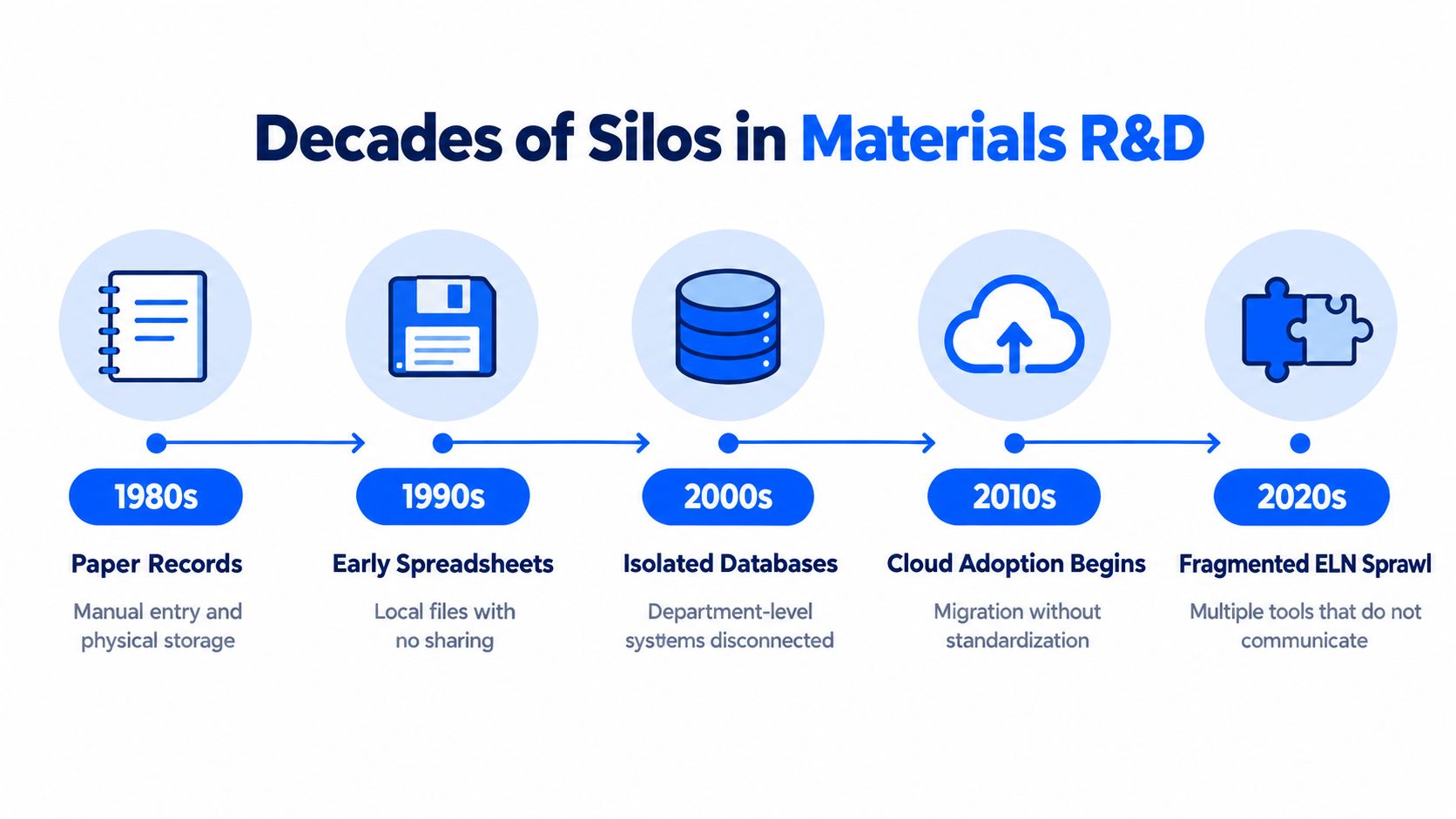
Materials labs didn't set out to create a maze of disconnected files. Teams adopted tools to solve immediate problems: capture instrument output, track a project, share results, or satisfy a local reporting need. A spreadsheet often stayed in use because it worked for the people who created it, even after the project or its original owners moved on.
The same pattern appeared across enterprise data. Data warehouses emerged in the late 1980s and early 1990s, but departments often chose different ETL tools for different warehouses. Mergers added more systems and duplicated integration practices, leaving enterprises with multiple integration environments that were themselves difficult to connect (SAS's overview of ETL). Materials R&D inherits this history in miniature: laboratory databases, production records, spreadsheets, and enterprise platforms evolve with their own fields and definitions.
Why a quick replacement plan misreads the problem
Some systems persist because they contain years of experimental context that nobody has fully documented. Others remain authoritative for operational tasks, even if their reporting functions are awkward. Replacing a platform doesn't automatically translate its implicit rules, instrument configurations, naming conventions, or local workarounds into a new system.
That's why a short rip-and-replace schedule is often a planning failure, not a sign of weak execution. Teams underestimate the time needed to identify owners, reconcile definitions, and confirm that migrated records still support actual lab workflows. The older system may be technically unattractive, but it can still be the only reliable place to retrieve a result with its context.
Treat history as a dependency
A realistic inventory includes more than applications. It should capture which teams use each source, what decisions depend on it, who understands its fields, and whether its data can be read without disrupting operations. Include spreadsheets and instrument exports alongside formal databases. Their status as “just files” doesn't make their contents disposable.
The practical conclusion is straightforward: modernize around the dependencies that exist, not the architecture you wish the lab had. Preserve systems that still serve a clear purpose while making their data interpretable and reusable through a governed layer.
Architectural Patterns Worth Choosing Between
Don't pick an architecture because its name sounds current. Choose the pattern that fits the source, the workflow's freshness requirement, and the team that can govern the result. Historical spreadsheet reconciliation rarely needs the same design as a process that must reflect changes from a LIMS promptly.
| Pattern | Best fit | Governance owner | Latency | Schema change cost |
|---|---|---|---|---|
| ETL | Historical reconciliation and scheduled loads | Central data team with domain review | Batch | Moderate, because mappings need updates |
| ELT | Loading source data into a platform for transformation there | Data platform team and domain stewards | Batch or scheduled | Lower for raw ingestion, but semantic work remains |
| CDC | Tracking database changes for downstream use | Source-system owner and integration team | Near real time when supported | Moderate, with source schema monitoring required |
| Data fabric | Unified access across distributed repositories | Shared platform governance | Depends on source and connector | Often lower than physical consolidation, but mappings still need care |
| Data mesh | Domain-owned data products across teams | Individual data domains under shared standards | Set by each product | Distributed, with coordination costs across domains |
Match the pattern to the phase
Use ETL when the job is to reconcile historical records on a controlled schedule. Use ELT when the organization has a suitable analytical platform and wants to retain source data before applying transformations. Neither approach settles what a historical field means. Domain review and documented mappings remain necessary.
Choose change data capture when a database's updates need to flow downstream without repeatedly exporting full tables. It's not a substitute for semantics, and it won't solve missing experimental context. A data fabric can provide a common access layer across repositories without forcing every record into one physical database. A data mesh makes sense when domain teams can take responsibility for the definitions, quality, and ongoing maintenance of their data products.
For leaders assessing which workloads to modernize first and how to stage the work, data modernization insights from Software Modernization Intelligence offer a useful strategic complement to the architecture choices above.
Don't over-engineer the first workflow
Start with the narrowest pattern that can answer a real R&D question. If a team needs to compare historical tests across spreadsheets and a laboratory database, a governed batch pipeline or federated query may be enough. Don't introduce continuous replication, distributed ownership, and a new platform layer before the workflow has proven that it needs them.
Revisit the choice when the operational requirement changes. The right design is the one the lab can maintain and trust, not the one with the most architectural vocabulary.
Building the Semantic Layer That Makes Data AI-Ready
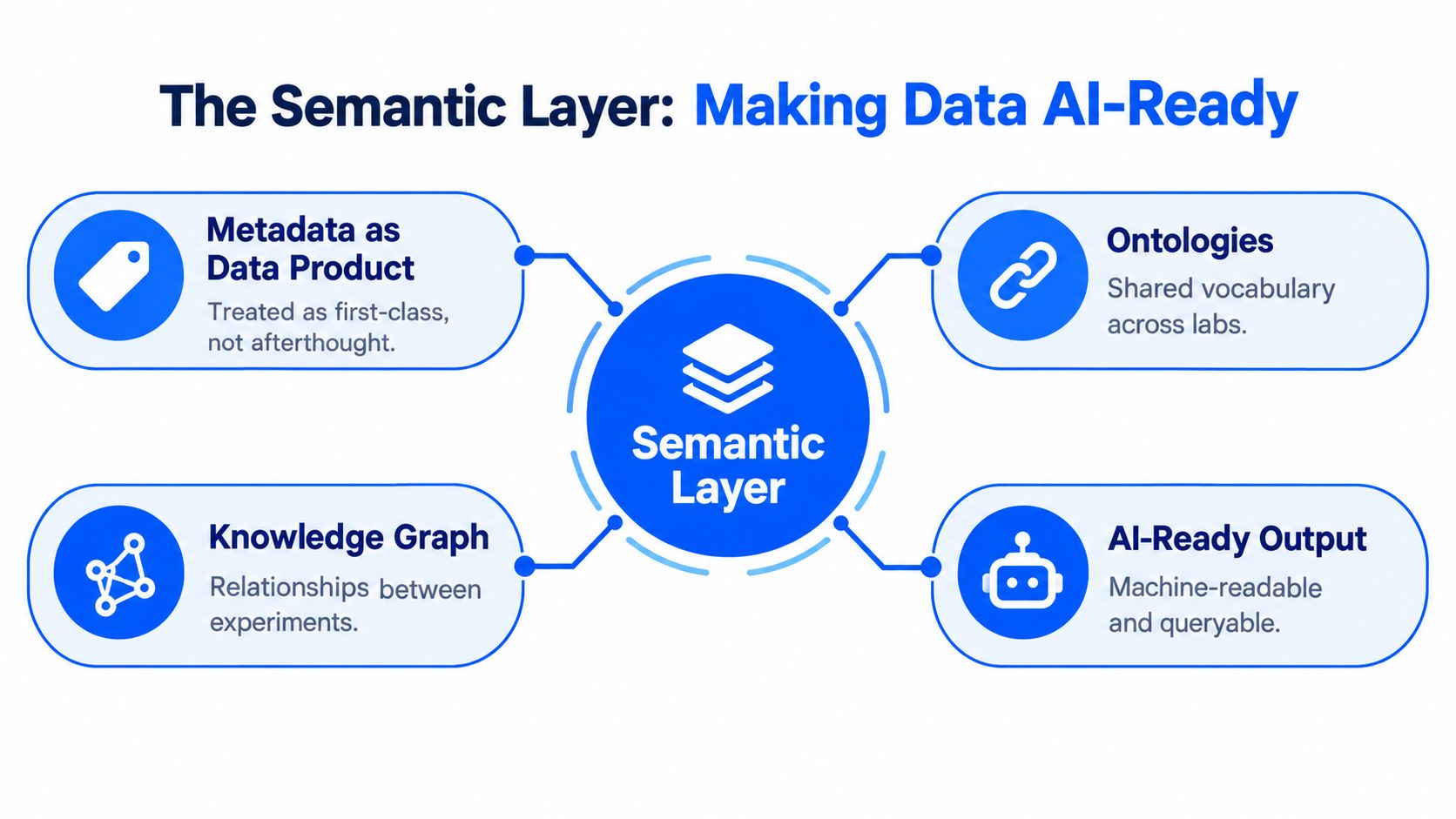
Legacy data integration succeeds when teams can verify what records mean, not merely connect the systems that hold them. Build a semantic layer that gives scientists and analytical tools consistent interpretations while preserving each record's original context. Treat metadata as a data product. Materials-data recommendations call for persistent identifiers for datasets and metadata, APIs for querying records, shared formal ontologies, and complete metadata for inputs and outputs, including parameters stored inside specialized software (materials-data recommendations in Scientific Data).
Give important entities stable identities
Assign canonical identifiers to materials, formulations, batches, tests, and instruments. Keep an identifier stable even when source systems use different names for the same formulation. Retain source identifiers as well, so scientists can trace a canonical record back to its original system.
Map local labels and free text to controlled vocabularies or ontologies without deleting source terminology. Store the historical label, mapped concept, and mapping version together. This lets teams query across systems while preserving the evidence needed to understand how an interpretation changed.
Model relationships and experimental context
A knowledge graph can link a formulation to measured properties, a batch to process conditions, and a result to its source document or system. One peer-reviewed materials-informatics architecture combines federated storage, where repositories retain formats suited to their data, with a knowledge-graph fusion layer that gives users a logical interface across sources (the materials-informatics architecture). This approach avoids forcing experimental results, simulations, images, and process records into one physically uniform database.
Consider two labs with a field labeled “tensile strength.” One stores values in a spreadsheet; the other uses a LIMS. Preserve the original fields and values. Map them to a shared property concept only after confirming units, test method, specimen geometry, and relevant context. If those details are absent, mark the records as uncertain. Do not present them as comparable.
A normalized value without its method is not a trustworthy experimental result.
Make provenance queryable
Define metadata requirements for units, measurement method, instrument configuration, specimen preparation, environmental conditions, operator or workflow version, uncertainty, and source-file links. Whenever a value is normalized, record the transformation rule and retain the original field beside it. Scientists can then check whether a model input is comparable to the experiment they plan to run. Keep the layer focused: add definitions and relationships that support real queries, and require verification before treating records as equivalent.
A Phased Migration Roadmap That Finishes
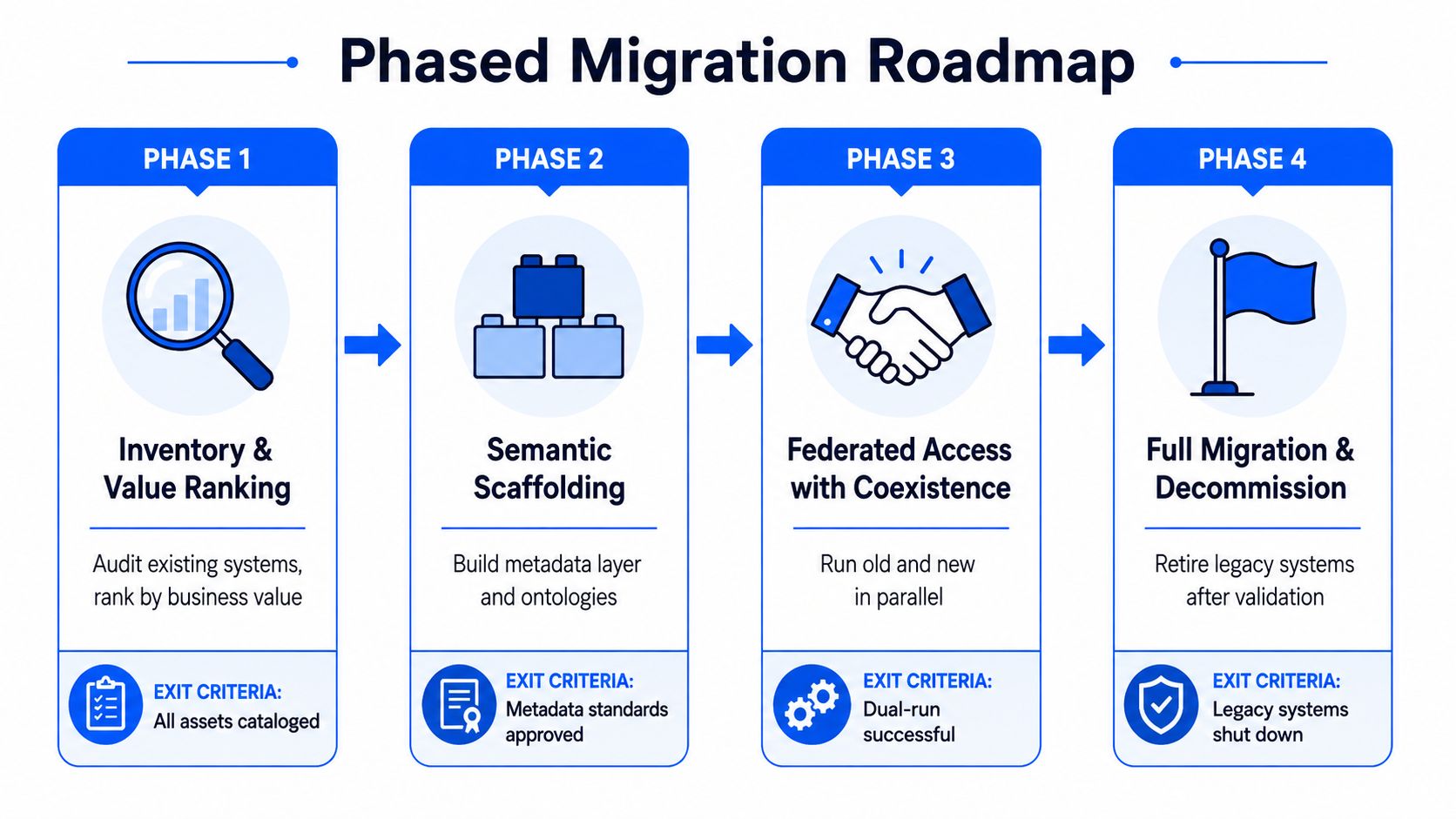
Treat coexistence as the default, not a temporary inconvenience. A migration should advance only when the new path preserves operational continuity and improves a defined R&D workflow. Keep repositories in place while users query them through a shared semantic layer, and set a value gate for each stage before expanding the work.
Phase one, inventory and value ranking
Catalog spreadsheets, ELNs, LIMS, instrument outputs, and relevant enterprise systems. For each source, record its owner, dependent workflows, access method, and the questions it could help answer. Rank candidates by scientific or operational value, balanced against the risk of disrupting current work. Exit when important assets have owners, known dependencies, and a defensible priority order.
Phase two, semantic scaffolding
Set identifiers, metadata requirements, naming conventions, and stewardship responsibilities. Test each standard against real records from the selected workflow. Avoid designing an ontology in isolation. Exit when participating teams can use the identifiers and definitions in a real query or analytical workflow and trace results to their source records.
Phase three, federated access with coexistence
Connect selected sources without changing their existing roles. A federated architecture can keep each repository suited to its data type while a knowledge graph supports discovery across sources, avoiding the need for one consolidated store. Run old and new access paths in parallel, compare results, investigate mismatches, and make rollback practical before teams depend on the new path.
For infrastructure choices within this staged approach, the SourceX cloud migration guide offers context for planning legacy-system transitions.
Phase four, selective retirement
Retire a legacy component only after its replacement has been validated against supported workflows, its records remain traceable, and responsible teams agree the old system is no longer authoritative. Keep systems in service when replacement costs or operational risks outweigh the value of retirement. Require evidence of safe continuity, not a calendar date, before switching off a system.
Governance, Security, and Compliance as Enablers
In materials R&D, governance protects the conditions that make data useful. Formulations and experimental results can be valuable intellectual property, so broad access isn't a shortcut to reuse. The integration design should specify who can see source records, who can approve semantic mappings, and how every change is audited.
Tie access to people, projects, and data lineage
Use role-based access tied to project and material ownership. A formulation chemist may need direct access to their team's experiments, while an approved analytical workflow may use aggregated data under controls that prevent exposure of another team's raw formulation details. Where the architecture supports it, apply controls at the record or relationship level, not only at the database or application level.
Audit trails should capture access decisions and changes to mappings, vocabularies, and transformations. If a historical field is reinterpreted, the organization needs to know who approved the change, which records it affects, and which derived analyses may need review. That's how teams preserve scientific accountability while improving data reuse.
Treat compliance as part of the design
Define retention and deletion rules for source files, transformed records, derived features, and backups before connecting sensitive repositories. Make sure the organization's security and privacy controls align with its obligations, including applicable requirements such as GDPR and CCPA. Certifications and control frameworks such as ISO 27001 and SOC 2 can inform enterprise expectations, but they don't replace a review of the actual data flows, access model, and contractual commitments.
Governance shouldn't mean that every reuse request waits for a committee. Assign clear owners: domain experts approve definitions, system owners control source access, and platform teams maintain enforcement and audit mechanisms. That division makes safeguards practical instead of ceremonial.
Success Metrics and the Pitfalls That Inflate Timelines
Measure whether integration improves the work scientists do, not how much data the platform ingests. Track the share of experiments that can be traced to canonical identifiers, the time from capture to an AI-ready record, and the cycle time from a lab result to a validated scale-up decision. For a selected workflow, monitor failed experiments over a consistent period and define what counts as a failure before using the measure.
The need for better data handling is not abstract: 70% of manufacturers surveyed identified data challenges as their main barrier to AI adoption, with ROI uncertainty, security concerns, and difficulty connecting generative AI to older proprietary technologies also cited as obstacles (AWS's manufacturing discussion). Use that context to make the case for a focused pilot, not to justify an enterprise-wide rebuild without a value test.
Watch for the traps that look like progress
- Overdesigning the vocabulary: Don't attempt to settle every possible materials concept before a useful workflow exists. Start with the terms needed for the first query, then extend the vocabulary when real use exposes gaps.
- Treating data quality as a cleanup event: Validation needs to continue as sources and methods change. Keep rules visible, assign owners, and preserve a route for scientists to challenge a mapping.
- Centralizing without semantics: A single destination doesn't guarantee consistent meaning. If source definitions remain unresolved, users still encounter the same conflicts after loading, only in a different interface.
- Counting volume instead of value: Records ingested are a delivery measure. Connect the program to a decision or workflow, then ask whether teams can reach it with less rework and more confidence.
Your First 90 Days and How to Decide Build, Buy, or Wait
Keep the first commitment narrow enough to finish. In the first 30 days, inventory the systems behind the highest-value experimental workflow and choose one question the integration should answer. Name the scientists, data steward, and system owner who will approve its definitions.
By 60 days, put canonical identifiers and a governed query into use for that workflow. Preserve original fields, document mappings, and make unresolved conflicts visible. By 90 days, review the agreed outcome measures with the scientists who use the result. Expand only if the workflow has improved and the team can explain why.
Buy, build, or wait
Buy when the bottleneck is a reliable semantic layer, governed integration, or explainable analytics, and the organization doesn't want to maintain those capabilities from scratch. Build when the organization has a distinctive data asset, stable domain ownership, and the engineering capacity to support the system over time. Wait when no team owns the definitions, the use case is vague, or source access and data rights remain unresolved.
Modernization also takes governance, not just engineering. A 2019 GAO review examined 65 federal legacy systems and highlighted 10 critical systems ranging from 8 to 51 years old, with about $337 million in annual operation and maintenance costs across the agencies responsible for them. The lesson for R&D is to make progress in controlled increments while the systems remain in use, rather than assume replacement can happen all at once.
Polymerize Connect helps unify and standardize materials R&D data from spreadsheets, ELNs, databases, instruments, and laboratory silos, while Polymerize Labs provides explainable models for exploring properties and formulations. If you're ready to assess a focused legacy-data workflow and decide what should coexist, migrate, or remain authoritative, visit Polymerize.
Put your R&D data to work
See how materials teams use Polymerize to plan fewer experiments and reach target properties faster.