

You're probably living this already. A promising formulation moves through the lab, the data looks strong, and then the work starts, because the sample ID sits in one system, the assay result in another, and the context for why the run changed ends up buried in someone's inbox or a spreadsheet with no clear owner. In materials R&D, that kind of fragmentation doesn't just slow reporting, it breaks the chain between experiment, interpretation, and the next decision.
Laboratory workflow management is the discipline of designing that chain on purpose. It connects how samples enter the lab, how methods get executed, how data gets captured, how results get reviewed, and how decisions move toward scale-up. In materials teams, the cost of weak workflow design is especially high because the science is iterative, the variables multiply quickly, and the learning from one run only matters if the next person can find it, trust it, and reuse it.
Table of Contents
- Phase one, make the current state visible
- Phase two, standardize before you integrate
- Phase three, connect the core systems
- Phase four, add AI-guided experimentation
- AI-native systems will replace trial-and-error with targeted learning
- The strategic shift is already underway
Why Laboratory Workflow Management Matters in Materials R&D
A formulation chemist can do everything right at the bench and still lose the project in the paperwork. I've seen the pattern too many times, a polymer screening run is completed, the ELN has the method, a shared drive holds the characterization plots, and a colleague's spreadsheet carries the pass-fail notes that explain why the second batch behaved differently. By the time the team comes back to compare batches, the context has already leaked away.
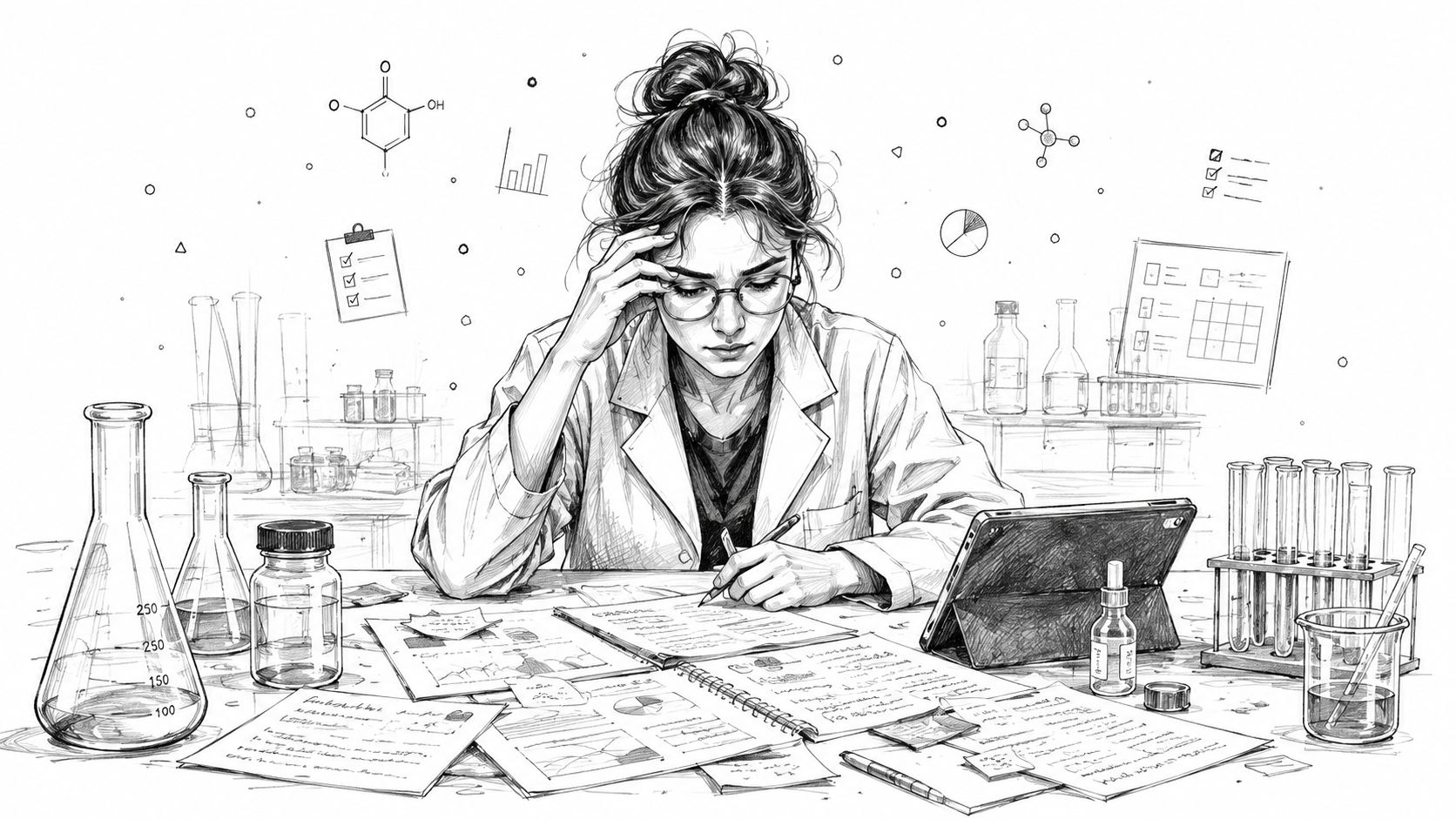
That's why laboratory workflow management matters in materials R&D. It's not a software category first, it's an operating discipline that decides whether your lab can preserve experimental meaning across people, systems, and time. When that discipline is weak, scientists spend their energy reconstructing what happened instead of advancing the material.
Materials R&D has a different workflow burden
Clinical and production labs often optimize around repeatability and throughput, and that's reflected in the history of laboratory performance indicators. A 2019 critical review found turnaround time in 63% of the indicator lists it analyzed, resource utilization in 48%, throughput in 25%, and cost in 18%, which shows how the field moved toward measurable control of time, capacity, and expense critical review of laboratory performance indicators. Materials R&D inherits those priorities, but it also has to handle more formulation branching, more analytical context, and a stronger need to connect microstructure signals to final properties.
Practical rule: if the experiment can't be reconstructed by someone who wasn't in the room, the workflow is already failing.
The same review also showed why traceability is central, not optional. It reported frequent tracking of identification errors (33%), sample hemolysis (26%), inadequate sample volume (25%), and labeling errors (21%) across the workflow-risk lists it studied performance-indicator review. In materials labs, the error types differ, but the underlying lesson is the same, if handoffs don't preserve metadata and intent, the science becomes harder to trust.
A well-run materials lab therefore treats workflow as a traceable innovation engine. That means every sample, result, and decision should survive beyond the individual scientist who generated it. It also means the lab can later train AI on a data trail that hasn't been broken by ad hoc notes and disconnected tools.
Core Components of a Modern Laboratory Workflow
The strongest material programs I've worked with don't treat workflow as a single system. They treat it as a chain, and they know exactly where the chain usually snaps. Sample intake, experiment design, execution, data capture, review, and scale-up handoff each need their own rules, but they also need to pass cleanly into the next stage without losing context.
Where the chain actually breaks
The highest-risk failures usually happen at the handoffs between disconnected systems, not during the analytical step itself. Labs often split SOPs, sample data, assay results, and team communication across shared drives, spreadsheets, ELNs, email, and messaging tools, and that's where context loss starts Labkey on workflow gaps. Every transition increases the chance that status, chain-of-custody, or metadata won't make it downstream.
A modern workflow therefore has to be designed around continuity. ELNs capture intent and experimental context, LIMS environments track sample identity and status, instruments produce primary data, and a centralized backbone keeps the connections intact. If one of those layers is isolated, the lab starts forcing people to retype, reformat, or reconcile information by hand, which creates rework and weakens auditability.
The lab doesn't usually fail because one step is bad. It fails because too many steps are invisible to the next person.
What a connected workflow looks like
A connected workflow starts before the sample reaches the bench. Intake should assign identity and metadata once, not repeatedly. Experiment design should reference existing work rather than forcing people to rebuild the same setup logic in another tool. Execution should push data directly into analysis and review, with minimal manual transcription.
For teams comparing platforms, it helps to separate orchestration from recordkeeping. A LIMS is useful for sample control, but workflow management has to coordinate requests, approvals, exceptions, and communication across the whole process. If you need a broader market view before choosing tooling, compare workflow automation options and evaluate which systems handle handoffs cleanly rather than just logging events.
The practical test is simple. Can you follow one material from intake to scale-up without asking three people where the latest version lives? If the answer is no, the workflow is still fragmented, even if every individual system looks advanced.
The Hidden Costs of Fragmented Lab Data
The biggest mistake in workflow modernization is assuming the main problem is speed. In materials R&D, the cost is often hidden in the time scientists spend finding context, checking version conflicts, and translating between systems that were never designed to talk to each other. That's not a minor inconvenience, it's a throughput tax.
Data silos turn science into reconstruction work
A 2026 IDBS survey of 856 biopharma professionals found poor integration (30%), limited scalability (34%), and data silos (26%) among the top frustrations with lab informatics IDBS survey on lab operations challenges. Materials labs face the same pattern, even if the specific tools differ. When data is spread across instruments, notebooks, spreadsheets, and messaging threads, the team spends more time stitching the story together than advancing the study.
That fragmentation also changes behavior. Scientists start creating local workarounds because the official process is too slow, and then the workarounds become the new process. Once that happens, the lab has multiple versions of truth and no reliable way to know which one is current.
Why more automation can make the problem worse
Automation isn't a cure if the process is unstable. Recent lab-management guidance stresses mapping the current state, removing unnecessary handoffs, and standardizing SOPs before buying technology, because poorly designed workflows can create “islands of automation” instead of real continuity modernizing lab workflow guidance. That warning matters in materials R&D, where teams often try to automate one step while leaving the surrounding process fragmented.
The faster route is to instrument the workflow itself. Measure cycle times, queue times, and error rates, then trace where the work waits. If a run is blocked because someone has to copy metadata from one tool into another, the bottleneck isn't the analysis, it's the handoff.
Here's the trade-off most leaders miss. A new tool can speed up a local step while increasing the number of places where data can diverge. That's why the first investment should usually be in process visibility and integration discipline, not in adding another layer of software.
Building an AI-Ready Data Backbone
AI in materials R&D is only as useful as the data it can trust. If experimental context is scattered across spreadsheets, ELNs, instrument folders, and personal notes, the model doesn't get a coherent learning signal, it gets noise with a label on top. The core project is not “add AI,” it's “make the data backbone worthy of AI.”
Why a unified backbone changes the workflow math
A centralized backbone turns fragmented records into a connected system of intelligence. It lets teams link design intent, formulation inputs, assay outputs, and decision history in one place, which means the next experiment can be informed by what happened before. That matters because the value of AI in materials work comes from surfacing causal patterns, not from generating generic recommendations.
Polymerize Connect is one example of that approach in practice, because it unifies experimental information into a secure, AI-ready structure rather than leaving it split across separate tools. For teams handling sensitive formulations, the governance side matters too, and a useful reference point is the 2026 data classification guide, since data structure and access control need to be defined before a backbone can support scale.
Good AI starts with good operational memory. If the lab can't retrieve the full history of a result, it can't learn from it reliably.
What separates AI-native systems from bolt-on AI
An AI-native System of Intelligence doesn't sit on top of broken processes and pretend they're fixed. It depends on clean, connected data, explainable models, and historical precedents that scientists can inspect before they act. That's a very different posture from dropping a generic assistant into a workflow that still relies on email attachments and manual consolidation.
In materials development, that difference changes day-to-day decisions. Instead of asking a scientist to guess which formulation branch to test next, the system can surface the next best experiment using the connected history of prior work. Instead of treating every data point as isolated, it can relate outcomes to formulation families, processing conditions, and failure patterns.
The broader benefit is compounding. Once the backbone exists, the lab can improve workflow management and AI readiness at the same time, because the same structure that reduces handoff friction also gives models a clean substrate to analyze. That's why the sequencing matters so much, first connect, then standardize, then layer intelligence.
A Phased Implementation Roadmap for Lab Teams
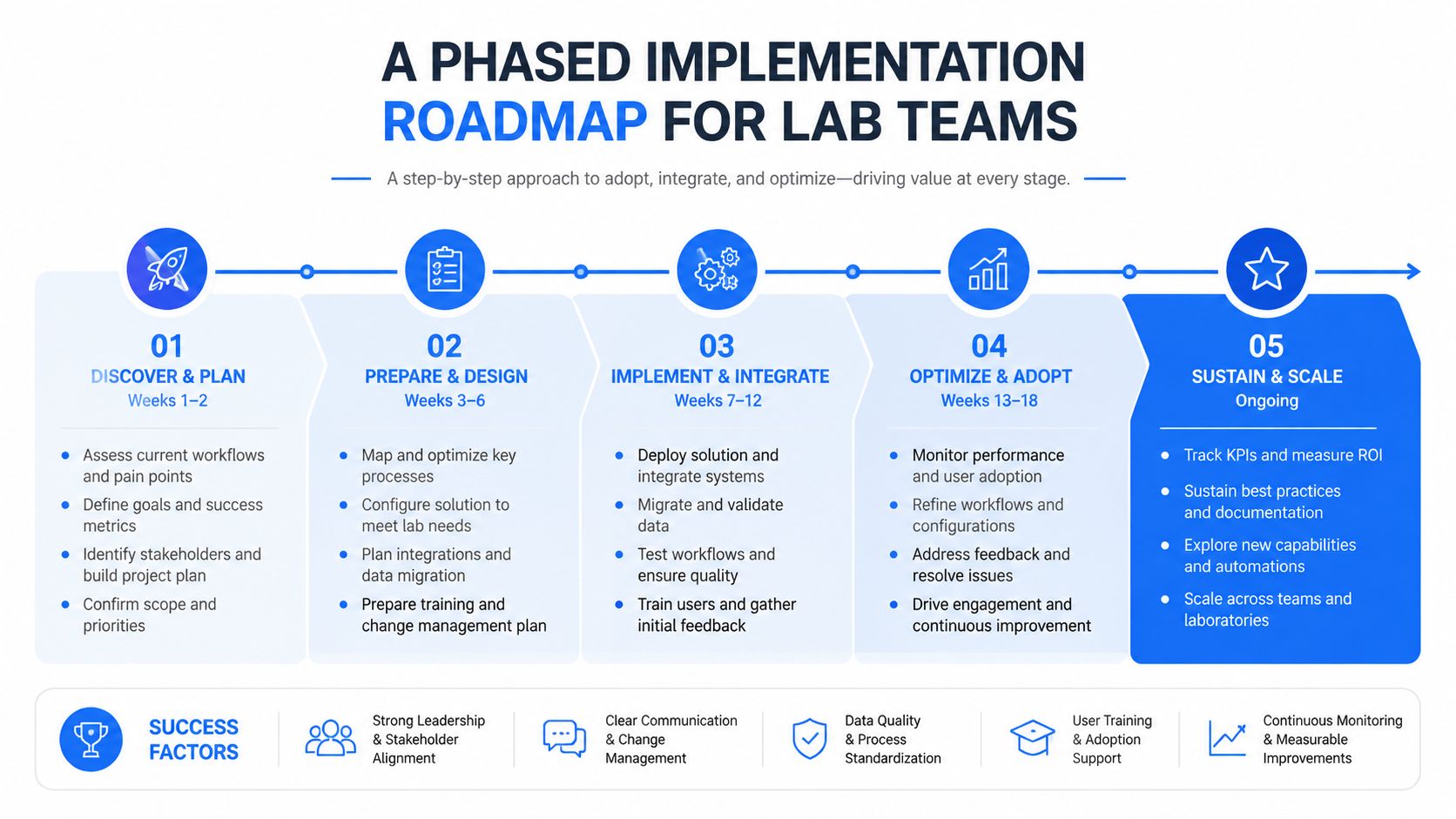
The safest way to modernize a materials lab is to earn trust in layers. Teams that jump straight to automation usually inherit old process chaos and put it behind a shinier interface. Teams that start by mapping the work, removing unnecessary transitions, and standardizing execution usually get traction faster because people can see what changed and why.
Phase one, make the current state visible
Start by mapping sample flow, data flow, and decision flow as they exist today. The goal isn't elegance, it's honesty. Find every place where a scientist, technician, or manager has to move information by hand, especially where the work leaves one system and enters another.
Success here looks like a shared process map, not software installed. If people can agree on the handoffs, they can also agree on which ones should disappear. If they can't agree, the lab isn't ready to automate yet.
Phase two, standardize before you integrate
Once the current state is visible, lock down the routine steps that should stop changing every week. Standardized SOPs, templates, and metadata rules reduce variation before technology gets involved. That matters because software can enforce discipline, but it can't invent it.
If every team defines a sample differently, integration just moves confusion faster.
Phase three, connect the core systems
After the process is stable, connect ELN, LIMS, and instrument data flows so the lab doesn't have to rekey what already exists. Queue visibility, exception handling, and status updates now matter because planners can finally see what's blocked and what's ready. The warning sign is an automated system that still needs constant manual rescue.
Phase four, add AI-guided experimentation
Only after the backbone is clean should the lab lean on AI to suggest next steps, highlight hidden drivers, or prioritize candidates. At this stage, the goal is not automation for its own sake, it's targeted decision support. If the system can't explain why it recommended a formulation path, scientists won't trust it, and they shouldn't.
The sequence matters because each phase lowers implementation risk for the next one. Skip the early stages, and the lab gets fragile automation. Follow them, and the technology starts working with the team instead of around it.
Measuring ROI Beyond Turnaround Time
Workflow teams love turnaround time because it's easy to count, but it's not enough to judge whether the lab is improving. A faster process that creates more rework, more fatigue, or more compliance exposure isn't a success. In materials R&D, the better question is whether the new workflow makes the lab more reliable, more scalable, and easier to learn from.
Compare the familiar KPIs with the ones that predict durability
Historically, laboratory performance indicators have centered on turnaround time, resource utilization, throughput, and cost critical review of laboratory performance indicators. Those metrics still matter, but they don't tell you whether the process is sustainable across different project types or teams. For that, you need leading indicators that expose friction before it becomes visible in final output.
| Category | Traditional KPIs | Advanced Leading Indicators |
|---|---|---|
| Speed | Turnaround time, queue time | Handoff frequency, blocked-task aging |
| Efficiency | Throughput, samples per FTE | Manual transcription count, rework loops |
| Quality | Error rate, pass rate | Data completeness, exception closure time |
| Capacity | Resource utilization | Instrument idle time tied to poor scheduling |
| Risk | Cost, compliance events | Chain-of-custody gaps, missing metadata |
That comparison matters because it changes what managers watch every week. A lab can look efficient on paper while still accumulating hidden failure risk if metadata is incomplete or if handoffs keep multiplying.
Measure the work staff actually feel
The most useful ROI metrics usually sit close to the people doing the work. If a workflow reduces searching, copying, and reconciliation, the team feels it immediately even if the overall project cycle hasn't closed yet. Those gains are often more meaningful than a single headline number because they determine whether adoption sticks.
A useful practice is to separate vanity metrics from operational proof. Vanity metrics tell you the system is active. Operational proof tells you the system is reducing failure, preserving context, and making throughput more predictable.
For materials teams, that means watching the data as closely as the science. If the workflow change doesn't improve completeness, traceability, or the amount of time scientists spend on non-value-added consolidation, the ROI case is weak no matter how polished the dashboard looks.
The Future of Laboratory Workflow Management
The next phase of laboratory workflow management won't be defined by more tools. It'll be defined by fewer gaps between tools, clearer data ownership, and AI systems that can reason over connected experiments instead of isolated files. For materials R&D, that shift is strategic, because the group that learns faster also gets to scale faster.
AI-native systems will replace trial-and-error with targeted learning
When a lab has a unified backbone and explainable models layered on top, the pace of experimentation changes. Teams stop running broad, unfocused screens and start using the data trail to narrow hypotheses before they spend time and material on the bench. In practice, that can mean fewer failed experiments, faster handoff from lab to production, and faster payback on the workflow investment, as customers using Polymerize report in their own programs.
Security can't be an afterthought in that model. Enterprise labs need ISO 27001 and SOC 2 controls, role-based access, and GDPR/CCPA compliance to protect valuable IP and keep regulated teams comfortable with the system. Without that layer, even a strong AI strategy will stall at the governance review.
The strategic shift is already underway
The change is that workflow management is no longer just an operations problem. It now decides whether a materials organization can turn experimental history into institutional memory, and institutional memory into faster innovation. The labs that win will be the ones that treat data flow, process discipline, and AI readiness as one program instead of three disconnected initiatives.
If you're trying to cut handoff waste, unify lab data, and make your materials R&D process AI-ready, Polymerize is built for that kind of workflow foundation. Explore Polymerize to see how a secure, connected system can support better experiment planning, cleaner data capture, and more reliable scale-up decisions.
Put your R&D data to work
See how materials teams use Polymerize to plan fewer experiments and reach target properties faster.