

The common advice on ISO 9001 vs ISO/IEC 17025 is to pick the standard that best describes your organization. That's the wrong starting point. A materials company and its laboratory can need different kinds of assurance at the same time, because managing a process and defending a measurement are different jobs.
ISO 9001 asks whether the organization controls and improves how it works. ISO/IEC 17025 asks whether a laboratory can produce technically valid results for specific tests or calibrations. Choose based on what a result will be used to decide, then consider its scope, technical depth, assessment, evidentiary value, and fit with your data systems.
| Decision area | ISO 9001 | ISO/IEC 17025 |
|---|---|---|
| Primary purpose | Confidence in organizational processes | Confidence in laboratory competence and results |
| Applies to | A defined organization, site, or management-system scope | A laboratory's defined testing or calibration activities |
| Technical methods | Doesn't establish that laboratory measurements are technically valid | Assesses technical competence for methods in the accredited scope |
| Best evidence for | Controlled workflows and continual improvement | Defensible results for specified tests or calibrations |
| Data concern | Controlled organizational records and processes | Traceable technical records that support valid, repeatable results |
Table of Contents
Why ISO 9001 and ISO/IEC 17025 Are Not the Same Question
ISO 9001 and ISO/IEC 17025 aren't competing badges. They address different layers of organizational assurance: ISO 9001 evaluates whether an organization has defined, implemented, monitored, and improved processes for consistent delivery, while ISO/IEC 17025 evaluates laboratory competence, method validity, traceability, impartiality, equipment control, personnel competence, and technically valid results (ILAC's overview of laboratory accreditation).
That distinction matters when a polymer result drives a business decision. A controlled procedure for tensile testing may show that the company manages its workflow. It doesn't prove that the method was suitable, the instrument was fit for use, or the resulting value is technically defensible. If that value supports a customer certificate, supplier dispute, or formulation release, process control alone may not be enough.
Start with the decision the result supports
Ask what someone will do with the result. If it's used to coordinate internal experiments or manage a change-control process, ISO 9001 may provide the right organizational backbone. If it will substantiate a specific property claim, ISO/IEC 17025 accreditation for the relevant test may provide more appropriate evidence.
The practical difference comes down to five questions:
- Scope: Does the assurance cover the organization's workflow or a defined laboratory activity?
- Technical depth: Does the evidence need to demonstrate method and measurement competence?
- Assessment: Is the review focused on the management system, or does it examine technical performance too?
- Evidentiary weight: Must a customer or other decision-maker be able to rely on the result as accredited?
- Digital-data fit: Can the organization trace how the result was produced and reviewed?
For teams evaluating external testing partners, a resource on how to find third-party tested peptide suppliers can help frame the difference between general quality claims and evidence tied to laboratory testing. The same discipline applies inside a materials organization: choose the assurance that matches the claim, not the label that sounds more thorough.
Scope and Applicability Across Materials Organizations
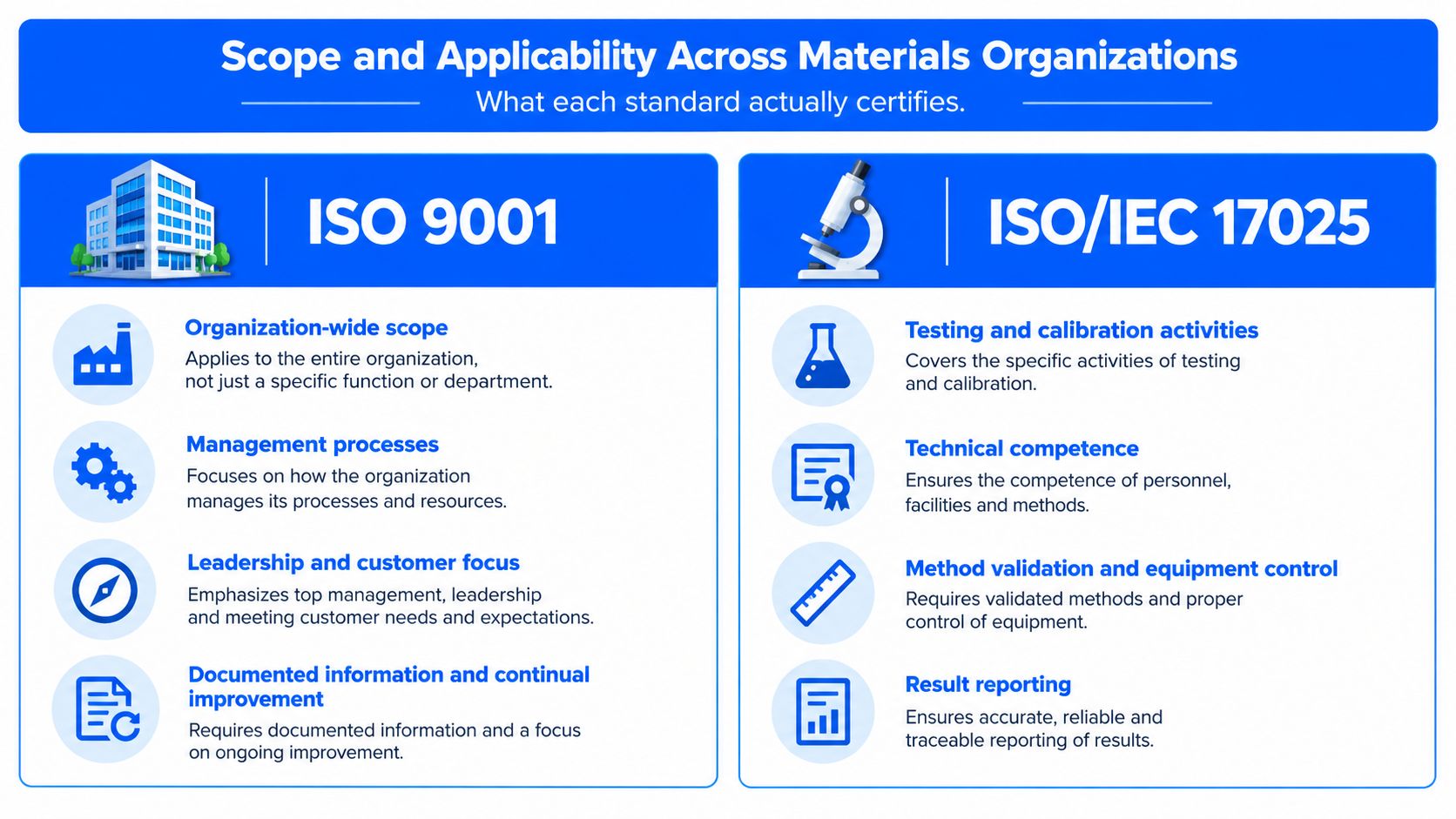
ISO 9001 is built for an organization's quality management system. Its scope can include leadership, customer focus, process control, risk-based thinking, documented information, performance evaluation, and continual improvement. A materials company might use it to govern sample intake, supplier qualification, change control, nonconformance handling, and corrective action.
ISO/IEC 17025 is narrower and more technical. It applies to testing and calibration laboratories, and accreditation covers the activities listed in the laboratory's defined scope. A lab might be accredited for a particular polymer characterization method without every test it performs falling under that accreditation. Verify the scope before treating a result as accredited.
Scope and certification model at a glance
| Dimension | ISO 9001 | ISO/IEC 17025 |
|---|---|---|
| Scope | Organization's defined quality management system | Laboratory testing or calibration activities |
| Scope-specificity | Covers a stated organizational scope and sites | Limited to tests or calibrations on the accreditation scope |
| Assessment model | Certification by an independent certification body | Accreditation by an accreditation body |
| Typical scope statement | Management of design, production, or service processes | Named measurement or testing activities, methods, and relevant capabilities |
The scale of adoption reinforces the difference, but the figures aren't directly comparable. ISO's 2023 Survey reported more than 837,000 valid ISO 9001 certificates covering roughly 1.25 million sites; an ILAC MRA report listed 60,900 accredited testing-laboratory bodies across 99 signatories and 12,100 accredited calibration-laboratory bodies across 87 signatories in 2020 (ISO's survey results). One set counts management-system certificates and sites, while the other counts accredited laboratory bodies by category.
The point isn't that one standard matters more. ISO 9001 offers a broad organizational framework; ISO/IEC 17025 provides technically focused assurance for specified laboratory work. A video overview of the standards can offer a visual companion to that distinction:
Clause Mapping and Where ISO/IEC 17025 Goes Deeper
ISO 9001 gives an organization a structure for managing quality. It addresses leadership, customer focus, process control, risk-based thinking, documented information, performance evaluation, and continual improvement. Those requirements can make a laboratory's surrounding operations more consistent, but they don't establish that its measurements are technically valid (ISO 9001's requirements overview).
ISO/IEC 17025 includes management-system requirements, but adds the laboratory-specific evidence needed to support competent testing and calibration. The shared ground helps a lab organize its system. The additional technical requirements answer a different question: can this laboratory perform this method, with this equipment and personnel, and report a valid result?
What the technical layer changes
Personnel competence isn't only a record that someone attended training. The laboratory needs evidence that people are qualified and competent for the work they're authorized to perform. A general training process can be well managed while leaving uncertainty about whether an analyst can execute a specific polymer test correctly.
Method validation or verification establishes whether the method is suitable for its intended use. A written procedure doesn't show that the method can produce appropriate results for the sample and property in question. That distinction matters when methods are adapted for a new formulation or material.
Equipment control and metrological traceability connect a reported value to suitable equipment and measurement references. Measurement uncertainty helps characterize the limits and relevant influences on a result. Without those controls, a number may look precise while its technical basis remains unclear.
Sampling and quality control of results also matter. A measurement can be competently performed and still mislead if the sample doesn't represent the material or if the lab fails to monitor whether results remain valid.
Practical rule: If you need to defend a particular tensile-strength or molecular-weight result, ask for evidence about the method, personnel, equipment, and result controls. A general process certificate can't answer those technical questions.
ISO/IEC 17025 makes the laboratory demonstrate competence for its defined activities. ISO 9001 remains useful for managing the wider system around those activities, but it isn't a substitute for technical evidence.
Implementation, Certification, and Audit Differences
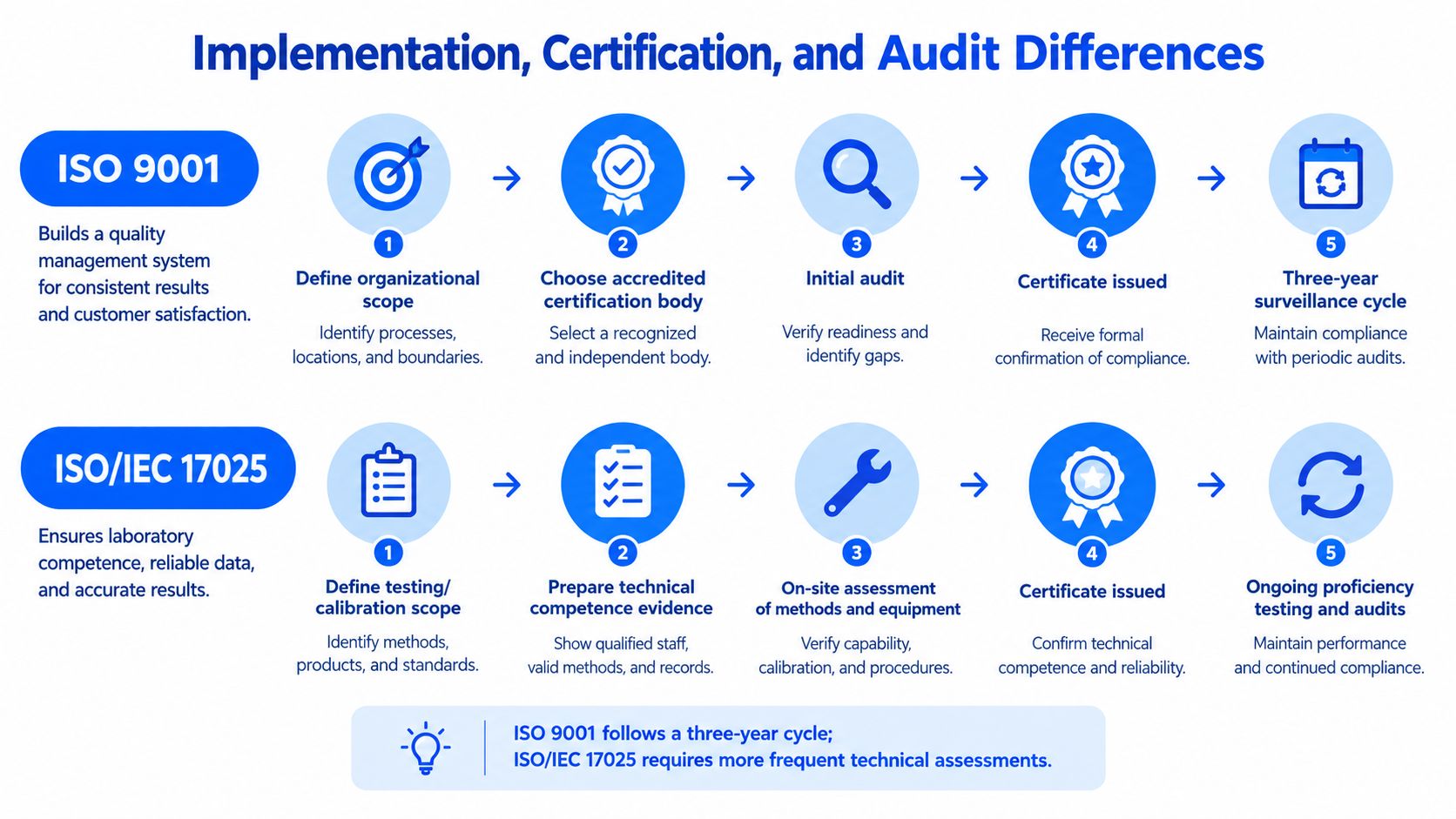
The implementation paths differ because the standards ask assessors to examine different things. ISO 9001 certification is performed by an independent certification body against a defined organizational scope. ISO/IEC 17025 accreditation is granted for a laboratory's specified tests or calibrations, with assessment of technical competence as well as management-system controls.
A 9001 auditor typically examines how the organization manages processes, records, corrective action, and improvement. A 17025 assessor also asks whether the lab can perform the claimed work competently. That can mean reviewing method records, observing staff, examining equipment control, and checking how the laboratory validates results.
Prepare evidence for the work you actually do
For either path, start with a scope that accurately describes the organization or laboratory activities. Overly broad wording creates a gap between what the certificate or accreditation implies and what the evidence supports. Then build records around the actual work, not around a generic audit checklist.
Before assessment, confirm that you can retrieve:
- Controlled procedures: Current versions of relevant processes and methods.
- Competence evidence: Training, authorization, and qualifications tied to assigned work.
- Equipment records: Calibration, maintenance, and status information relevant to results.
- Technical records: For laboratory work, records that connect the sample, method, analyst, equipment, calculations, and reported result.
- Quality actions: Nonconformities, corrective actions, internal review, and follow-up.
ISO 9001 certification commonly follows a three-year cycle with annual surveillance audits. The specific assessment program and accreditation-body requirements should be confirmed with the relevant body. Don't treat the calendar as the implementation plan. First make sure the scope, processes, and evidence match the claims your organization intends to make.
For ISO/IEC 17025, a broad statement such as “our lab is accredited” is incomplete without the scope. Check whether the exact test or calibration, method, and relevant capability appear on the accreditation schedule. Accreditation doesn't automatically extend to every activity performed under the laboratory's roof.
Which Activities Each Standard Should Govern in a Materials Lab
A materials lab shouldn't try to assign every activity to only one standard. Use ISO 9001 to govern how work moves through the organization, and use ISO/IEC 17025 where the technical validity of a defined measurement must be demonstrated. Accreditation covers method-specific competence, equipment and traceability, uncertainty evaluation, quality control, and reporting within its scope (ISO's ISO/IEC 17025 publication).
Govern workflows with ISO 9001
Sample intake, change control, supplier qualification, nonconformance handling, corrective action, and experiment documentation benefit from an organization-wide process system. ISO 9001 can help teams define who receives a sample, how changes are approved, how deviations are recorded, and what happens when a process fails.
That discipline also supports scale-up. If a formulation changes between laboratory and production work, the organization needs a controlled way to review the change, update relevant instructions, and record the decision. These are management-system questions, not proof that a measurement method is technically competent.
Use accredited evidence for high-stakes measurements
The higher the consequence of a wrong result, the more directly the organization should examine whether accredited technical evidence is needed. Tensile strength, viscosity, molecular-weight distribution, thermal transitions, or chemical composition may support customer claims, supplier qualification, formulation release, or disputes. When decision-makers need results that are technically defensible and comparable, accreditation for the relevant test can be important.
| Materials activity | Management-system role | Technical-evidence question |
|---|---|---|
| Sample intake | Define identity, routing, and handling processes | Does sampling affect the validity of the result? |
| Formulation prototyping | Control experiment documentation and changes | Are measurements being used for external claims or critical decisions? |
| Polymer characterization | Manage workflow and review | Is the specific method within the accredited scope? |
| Mechanical or thermal testing | Control scheduling and nonconformities | Are method competence and measurement controls demonstrated? |
| Batch release | Govern approvals and records | Does the release value require accredited evidence? |
| Customer reporting | Control review and communication | Is the reported result covered by the lab's scope? |
Stability studies and scale-up decisions need the same risk-based treatment. Internal exploration may call for good process governance and reliable methods without requiring every exploratory activity to be accredited. A result used in a customer certificate or regulated submission deserves a closer look at method scope, technical records, and traceability.
The useful question isn't “Which standard covers this department?” It's “What assurance must this decision-maker have about this specific result?”
What Compliance Looks Like When Data Live in Spreadsheets, ELNs, and AI
A laboratory's data trail often crosses spreadsheets, instruments, electronic lab notebooks (ELNs), and analysis tools. ISO/IEC 17025 requires controls for identifying, storing, protecting, backing up, retrieving, retaining, and disposing of records, as well as confidentiality and electronic transmission. Technical records also need enough information to identify factors affecting uncertainty and allow a test or calibration to be repeated (ISO/IEC 17025 text on laboratory records).
Buying a laboratory information management system doesn't solve this by itself. Nor does an ISO 9001 document-control procedure automatically establish the technical lineage of a result. The lab must be able to connect sample identity, method version, instrument state, raw signals, calculations, analyst actions, corrections, review, and the reported value.
Make the record traceable across tools
When results move between systems, assign responsibility for how each record is created, reviewed, retained, and corrected. A spreadsheet can be part of a controlled workflow, but uncontrolled copies and undocumented formula changes weaken the explanation of how a result was produced. An ELN can capture experimental context, but it must preserve the links to the underlying measurements and methods.
Batch records offer a useful comparison for teams thinking about how production evidence follows materials through a process. Resources on Peptide Warehouse USA batch records can prompt questions about what a complete record needs to connect. In a testing lab, make sure that connection runs from sample and method through raw data to reviewed result.
AI predictions introduce another boundary. Models can help scientists prioritize experiments, explore formulation options, or identify patterns in historical data. But a prediction isn't a laboratory measurement, and it can't replace a validated method, controlled primary data, uncertainty evaluation, or an auditable record of how a result was generated.
Keep the evidence chain intact: A reviewer should be able to move from the reported value back to the underlying records and understand who did what, with which method and equipment, and how the result was reviewed.
Treat data lineage as part of laboratory competence, not merely an IT concern. That means aligning organizational controls with technical records, access, backups, change history, and reproducibility.
Which Standard to Adopt and When Both Make Sense
Choose the standard by the decision your evidence must support. If the priority is consistent workflows across R&D, operations, and scale-up, build an ISO 9001-aligned management system. If customers or other decision-makers need confidence in particular laboratory measurements, pursue ISO/IEC 17025 accreditation for the tests that support those claims.
For materials organizations, the case for technical accreditation becomes stronger when results support tensile-strength claims, viscosity specifications, molecular-weight characterization, thermal transitions, formulation release, supplier qualification, litigation exposure, or regulated submissions. Don't assume that every exploratory experiment requires accreditation. Do decide deliberately which measurements need that level of assurance.
Build a combined system without duplicating work
Running both standards can make sense when an organization needs enterprise-wide process control and accredited laboratory evidence. Map shared management-system practices so the lab doesn't maintain duplicate procedures for document control, corrective action, internal review, or management responsibilities. Then keep the technical evidence distinct where ISO/IEC 17025 requires it.
The order of adoption should follow business exposure and readiness:
- Start with customer requirements: Identify which clients require a certified management system or accredited test results.
- Assess regulatory and commercial risk: Prioritize measurements used for external claims, release decisions, or disputes.
- Check method maturity: Accreditation is a poor first step if methods, equipment controls, and technical records are still inconsistent.
- Choose an achievable scope: Begin with the laboratory activities for which demand and technical evidence are clear.
ISO/IEC 17025 accreditation doesn't necessarily demonstrate fulfillment of every ISO 9001 requirement, as the International Accreditation Service explains. That's why accreditation isn't a blanket replacement for organizational quality management. Conversely, ISO 9001 certification doesn't prove that each laboratory test is technically valid.
My recommendation is direct: build the process system that governs how the organization works, then seek accreditation for the measurements whose results must carry technical weight.
Practical Decision Path and Common Questions
Before choosing, write down the result, the decision it supports, and the person who will rely on it. Then ask whether that person needs evidence of a controlled process, demonstrated laboratory competence, or both.
Is ISO 9001 alone enough for a materials-testing lab?
It may be enough for managing the organization's processes, but it doesn't by itself establish that measurements are technically valid. If results support customer or regulatory decisions, examine whether the relevant tests need accredited evidence.
Does ISO/IEC 17025 satisfy every customer audit demand?
No. Accreditation can support confidence in the tests within its defined scope, but a customer may also ask about broader organizational controls. Confirm the customer's requirements instead of assuming one credential answers every question.
How long does it take to implement both systems?
There isn't a reliable universal timeline. The work depends on the scope, maturity of methods and records, and how well existing processes are controlled. Assess gaps before committing to a schedule.
Can an AI prediction count as a measurement?
No. Use predictions to guide experiment selection, not as a substitute for controlled measurements and their supporting technical records.
The right starting point is the highest-risk decision you make with laboratory data, then the assurance needed to defend it.
Polymerize helps materials R&D teams unify experimental data from spreadsheets, ELNs, and other systems, creating a more connected foundation for analysis and AI-guided experimentation. Explore how Polymerize can support traceable, data-informed materials development alongside your quality and laboratory controls.
Put your R&D data to work
See how materials teams use Polymerize to plan fewer experiments and reach target properties faster.