
A vendor can hold both ISO 27001 and SOC 2 and still fail your security review on the first page. That's not a paradox. It's what happens when the certificate covers a corporate office, the report describes a different cloud service, and neither artifact names the AI platform that'll store your formulations. The ISO 27001 vs SOC 2 question isn't which badge is stronger. It's which artifact your security, legal, and procurement teams will accept, for which scope, and for what period.
Table of Contents
ISO 27001 and SOC 2 Side by Side
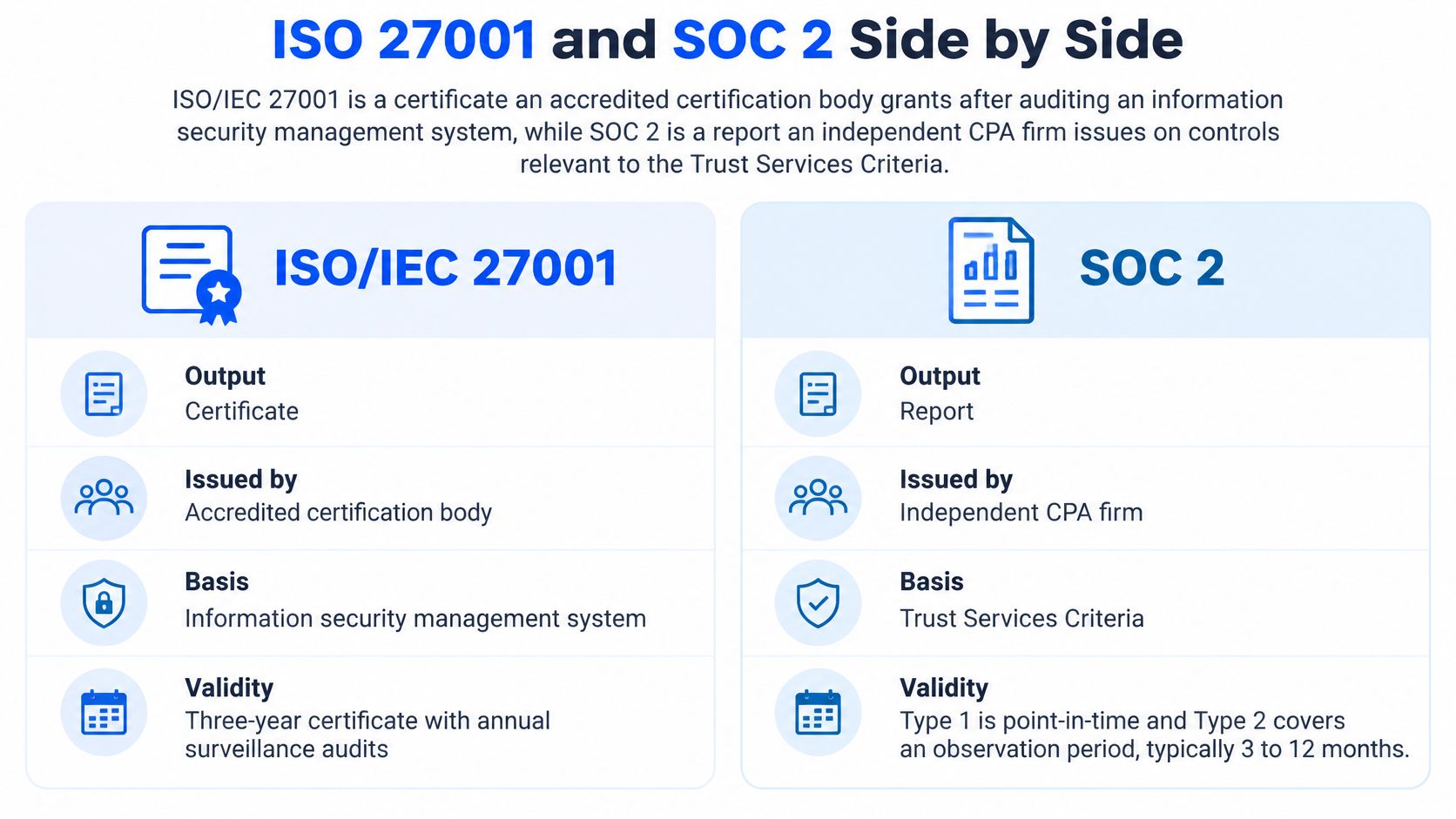
ISO/IEC 27001 is a certificate an accredited certification body grants after auditing an information security management system, while SOC 2 is a report an independent CPA firm issues after testing a described service against the AICPA Trust Services Criteria. One certifies a management system. The other attests to controls. Treating them as interchangeable is where reviews stall.
ISO 27001 and SOC 2 at a Glance
| Factor | ISO/IEC 27001 | SOC 2 |
|---|---|---|
| What you receive | Certificate issued by an accredited certification body | Attestation report issued by an independent CPA firm |
| Governing source | ISO/IEC 27001 standard with Annex A controls | AICPA Trust Services Criteria |
| Scope unit | Information security management system within a defined scope | Service or system described by the provider |
| Audit model | Two-stage certification audit, then annual surveillance | Type I (design at a stated date) or Type II (design and operating effectiveness over a period) |
| Validity | Three-year certificate with annual surveillance audits | No formal expiry; buyers usually expect a report covering the last 12 months |
| Geographic weight | Common with international and EU-facing buyers | Common with North American buyers |
| Recognition | Internationally standardised | Widely requested in the US, not an international standard |
Adoption explains the geographic split. The ISO Survey 2024 counted 96,709 valid accredited ISO/IEC 27001 certificates covering 179,877 sites worldwide as of 2024, a figure published by the International Organization for Standardization. A certificate base that large runs through international supply chains, so European and Asian buyers often request ISO 27001 by name. North American enterprise buyers more often ask for a SOC 2 Type II report they can read in detail.
The table compares artifacts, not quality. A detailed SOC 2 report and a narrow ISO certificate can both fail if the scope doesn't cover the service you're buying.
Teams preparing customer-facing reviews can use guidance on security due diligence for sales platforms to align what sales promises with what evidence exists. Turn each table row into a vendor question. Who issued it, what system does it describe, and is the evidence still current?
What Each Framework Actually Certifies
ISO 27001 doesn't certify a company in the abstract. As RINA's ISO/IEC 27001 overview describes it, the standard requires an organization to define an information-security scope, assess and treat risks, establish documented controls and governance, and demonstrate continual improvement. That scope can cover selected information, systems, processes, locations, and organizational units rather than automatically covering the entire company.
Where the ISO Boundary Sits
The organization draws the ISMS boundary itself. It then records which controls apply in a statement of applicability and justifies exclusions. Certification normally involves a two-stage audit, first assessing readiness and documentation, then testing practical implementation and effectiveness, followed by recurring surveillance audits, commonly annually.
That means the certificate measures the maturity and repeatability of the security-management system inside the stated boundary. It doesn't attest to a fixed percentage of controls or a universal technical architecture. Two certified vendors can run very different stacks and both conform, because each selected controls based on its own risk assessment.
Where the SOC 2 Boundary Sits
SOC 2 works from a system description written by management. The report names one service system, states which Trust Services Criteria are included, and carries both management's written assertion and the auditor's opinion. Security is always in scope. Availability, Processing Integrity, Confidentiality, and Privacy are added only when they're relevant to the engagement and the vendor's commitments.
Say a materials R&D SaaS provider shows you an ISO certificate. You read the scope statement and find it covers the corporate office, HR systems, and internal IT. It doesn't name the cloud data backbone storing formulation recipes, the data pipelines importing ELN exports, or the support engineers who can access customer tenants. The certificate is genuine. It just doesn't cover the thing you're buying.
The same gap appears in SOC 2 through subservice organizations. If the cloud host or an external AI model provider is carved out of the report, the auditor hasn't tested that provider's controls as part of this engagement. You're expected to review that provider's own evidence separately, and to run the complementary user-entity controls the report assigns to you.
Ask four questions before you accept either document:
- Platform named: Does the scope explicitly include the AI platform and customer data backbone?
- People named: Are support and engineering staff who can reach customer data inside the boundary?
- Suppliers named: Are cloud, ELN integration, and model providers included or carved out?
- Exclusions explained: Does the statement of applicability justify every excluded control?
If a vendor can't answer in writing, the label on the slide deck isn't evidence yet.
Controls Each Framework Checks Differently
ISO 27001 and SOC 2 start from opposite control philosophies. ISO 27001 Annex A lists 93 controls grouped into organisational, people, physical, and technological themes, and the organization selects what applies. SOC 2 publishes no fixed control list. The Common Criteria under Security are mandatory, and the auditor tests whatever controls the company designed to meet those criteria.
Control Areas Mapped Across Both Frameworks
| Control area | Evidence a buyer checks |
|---|---|
| Access control and least privilege | Periodic access reviews and removal logs |
| Privileged access | Admin account inventory and approval records |
| Cryptography | Encryption at rest and in transit, key handling |
| Change management | Release approvals and test evidence, including model updates |
| Incident management | Response plans and drill or incident records |
| Backup and recovery | Restore test results against recovery objectives |
| Supplier and subservice management | Vendor risk reviews, including cloud and AI model providers |
| Data classification and privacy | Labelling of formulation IP and personal data handling |
The practical payoff is reuse. A single backup restore test supports ISO control A.8.13 and the SOC 2 Availability criterion A1.2 at once, because both ask whether you can recover data, not whether a backup job reported success. A quarterly access review with dated removal tickets serves ISO access controls and SOC 2 logical access criteria in the same evidence pack.
Rows That Matter Most for Formulation IP
For an R&D platform, weight three rows above the rest. Access control decides who can open a customer's formulation library, and role-based permissions need to separate one tenant's scientists from another's. Privileged access decides whether a support engineer can reach production data without a ticket, an approval, and a logged session. Cryptography decides whether experimental records stay encrypted at rest, in transit between lab systems, and in backups someone could copy.
Review habit: Ask for the removal log, not the access policy. Policies describe intent. Logs with dates and approver names show the control ran.
SOC 2 Type II usually demands more recurring evidence on these rows. The auditor samples access reviews, change approvals, and incident tickets across the whole observation period, so a control that ran once in January and never again shows up as an exception. ISO surveillance audits also sample records, but the certificate itself won't show you the sample results. That's why buyers who need operating detail ask for the SOC 2 report even when a certificate exists.
Audit Timelines and Report Lifecycles
The ISO path runs in a fixed order. You start with a readiness gap assessment, implement controls, then face Stage 1, where the auditor reviews ISMS documentation, and Stage 2, where the auditor tests whether controls operate in practice. A successful Stage 2 produces the certificate, followed by annual surveillance in years one and two and recertification at year three.
This timeline view shows how the two lifecycles run side by side.
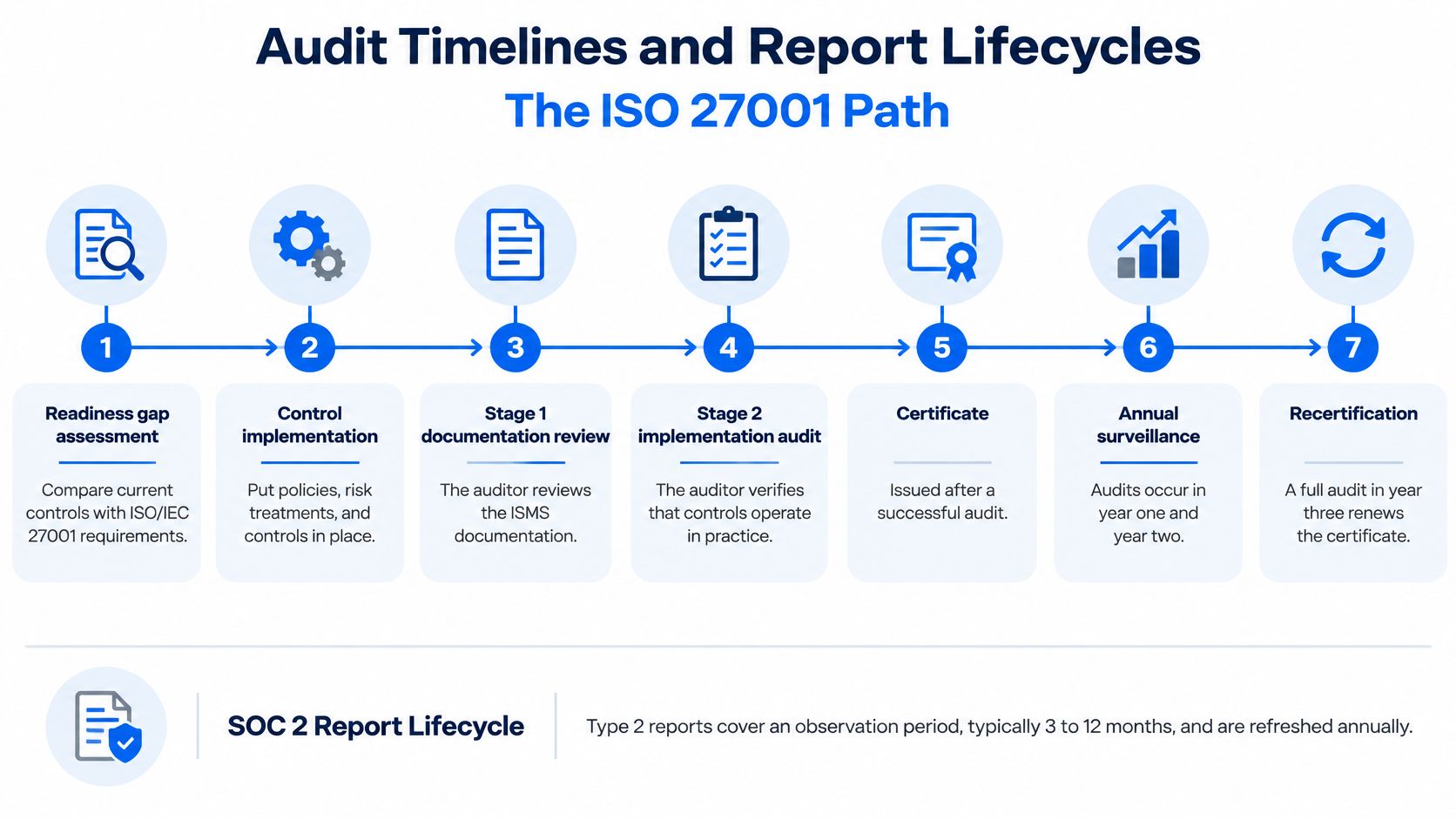
The SOC 2 path is built around a different distinction. Under the AICPA Trust Services Criteria, a Type I report assesses whether controls are suitably designed at a stated date, whereas a Type II report also tests whether controls operated effectively throughout a defined review period. For R&D software, Type II evidence can address recurring access reviews, privileged-account controls, change management, incident response, backup and recovery, vendor monitoring, and logical segregation over time. Type I shows the design existed on one date.
Readers who want the buyer-side view of that testing can work through the vendor control assessments explained by Loopfour before their next review meeting.
Typical Timeline by Phase
| Phase | ISO 27001 | SOC 2 Type II |
|---|---|---|
| Readiness gap assessment | 1 to 3 months | 1 to 3 months |
| Control implementation | 3 to 6 months if starting from scratch | 3 to 6 months if starting from scratch |
| Auditor fieldwork | Stage 1 document review, then Stage 2 implementation audit, typically weeks apart | Fieldwork typically 2 to 6 weeks |
| Evidence window | Controls operated continuously from certification onward | Observation period commonly 6 to 12 months |
| Output | Certificate after a successful Stage 2 | Report with auditor opinion and exceptions list |
| Recurring obligation | Annual surveillance audit; recertification at year three | Annual report; bridge letter covers any gap before the next report |
Say a team has a US enterprise deal closing in six months and no report today. It can't compress a 12-month observation window, so it gets a Type I report first for immediate design evidence, starts the Type II window, and issues a bridge letter covering the gap between reports. The buyer's security team accepts that sequence when it's disclosed early, not discovered late.
This walkthrough explains how auditors sequence fieldwork and evidence requests.
Most timeline slippage comes from controls you have to build from scratch, not from the audit firm's calendar.
Cost and Internal Effort Behind Each Path
No reliable fee figure exists without a quote against your scope, so price each path from its drivers instead. Count the in-scope systems, sites or products, staff with access to customer data, and AI or third-party model providers, then multiply external audit fees by the number of audit cycles you'll run. That sizing method beats any generic estimate.
External Costs by Framework
- ISO 27001 certification body fees: Stage 1, Stage 2, each annual surveillance audit, and recertification at year three, plus optional consultant support to build the ISMS.
- SOC 2 CPA firm fees: A Type I or Type II examination, with Type II priced higher because testing samples controls across the full observation period, plus readiness tooling to collect evidence.
- Remediation costs: Engineering and policy work to fix exceptions a Type II report lists, often discovered only after the first testing pass.
Internal Effort Buyers Underestimate
Internal effort often exceeds the external invoice. You need a named ISMS owner, control owners for access, change, and vendor management, and staff time to pull screenshots, tickets, logs, and approval records into an evidence pack auditors can sample. Every additional site, product line, or model provider adds owners and evidence, not just audit days.
The saving move is to map shared controls once. One access review process, one change approval workflow, and one vendor risk register can feed both frameworks, so the second artifact reuses evidence instead of duplicating it. Teams that run two separate evidence collections pay twice for the same control.
Which Framework Fits Materials R&D Platforms
Materials R&D data carries unusual value in a small footprint. A single tenant may hold formulation recipes, experimental records, supplier specifications, and customer test results, all flowing from spreadsheets and ELNs into AI models and external cloud services. Losing confidentiality doesn't just trigger a notification duty. It can hand a competitor years of trial and error.

Which Artifact to Prioritise by Buyer Situation
| Situation | Artifact to prioritise | Why it fits |
|---|---|---|
| EU chemicals or pharma customers with international procurement | ISO 27001 certificate with the AI platform named in scope | Procurement reads scope and certificate first |
| US enterprise customers running vendor security reviews | SOC 2 Type II report covering the data platform | Auditor-tested operating evidence over a period |
| Global buyers across both regions | Both, mapped to one shared scope | Removes gaps when one geography reviews a single artifact |
| Early-stage R&D software with a near-term US deal | SOC 2 Type I with bridge letter, progressing to Type II | Fast first evidence while the observation window runs |
| Platform hosting customer formulations in shared cloud | ISO 27001 plus SOC 2 Type II covering the data backbone and suppliers | Covers governance and operating evidence for IP-sensitive data |
The AI Governance Gap Neither Framework Closes
Neither framework certifies that an AI model is scientifically valid, unbiased, explainable, or safe for autonomous decisions. Both govern the processes around the system, not the quality of its predictions. Framework possession is also getting less differentiating, since Secureframe's compliance statistics compilation notes that 81% of surveyed organizations reported current or planned ISO 27001 certification in 2025, versus 67% in 2024. When most vendors hold or plan the same certificate, buyers shift attention to evidence quality and AI-specific governance.
A static compliance statement doesn't tell you whether model access, training-data lineage, input retention, or human approval are controlled. You have to ask.
Put four concrete questions to any R&D platform:
- Export control: Who can export proprietary formulations, and does export require approval?
- Permission logging: How are permission changes logged, and who reviews them?
- Model providers: How are third-party model providers assessed before customer data reaches them?
- Change notice: How are customers notified of material system changes, including model updates?
Polymerize, for example, states it holds ISO 27001 and SOC 2 controls alongside GDPR and CCPA compliance. A buyer evaluating it should still confirm that the certificate scope and SOC 2 system boundary cover its Labs models and Connect data backbone before relying on either artifact. That confirmation step applies to every vendor, whatever the slide deck claims.
Confirm the Right Evidence Before You Sign
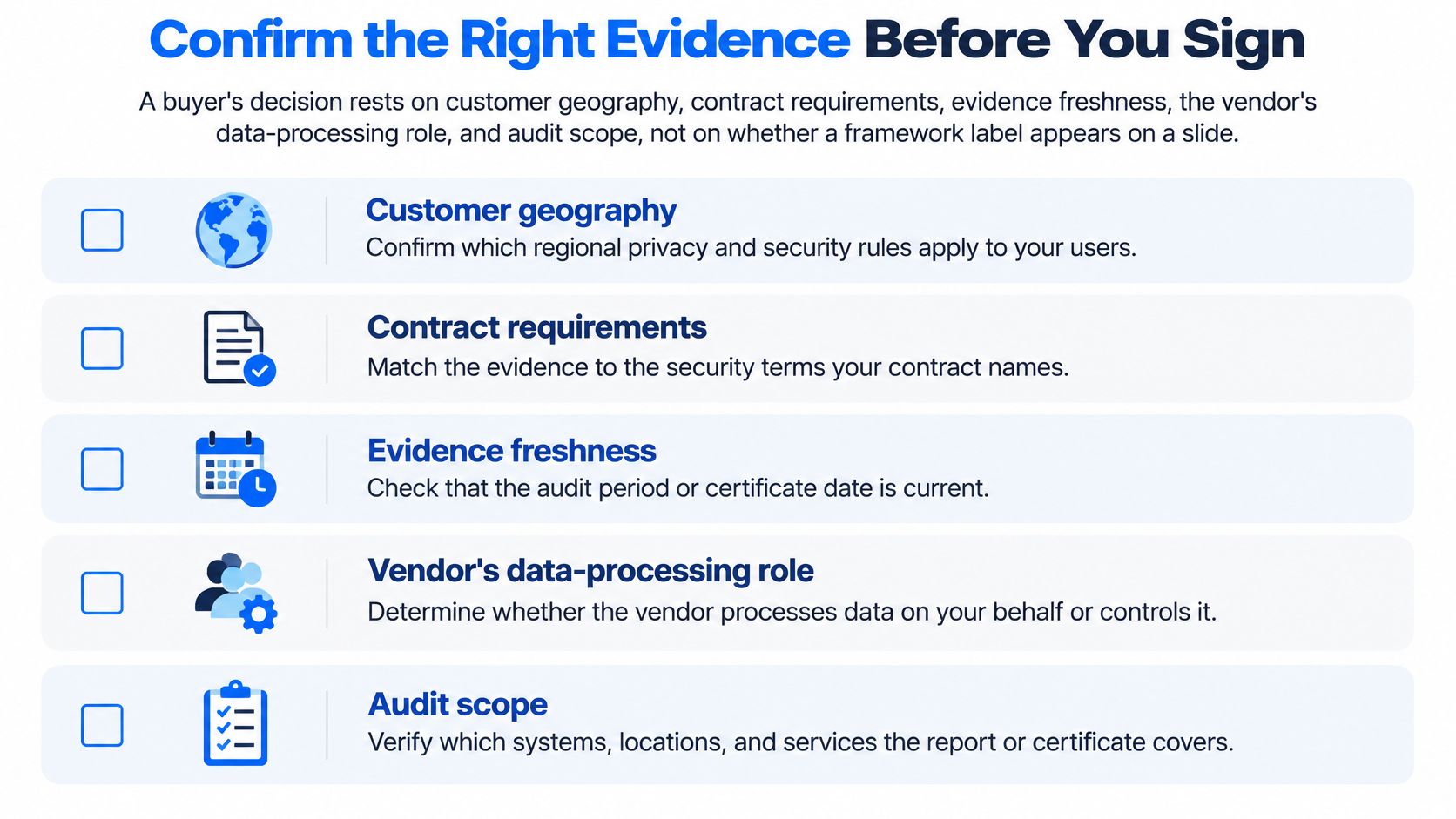
Your decision rests on customer geography, contract requirements, evidence freshness, the vendor's data-processing role, and audit scope, not on whether a framework label exists. As Vanta's ISO 27001 certification guidance supports, ISO's 2024 survey counted 96,709 valid certificates covering 179,877 sites, yet certificate counts don't prove control effectiveness for a particular product. A vendor may hold both frameworks while covering only a defined cloud service or business unit.
This checklist turns that principle into a procurement step you can run before contract review.
Documents to Request for ISO 27001
- Certificate and scope statement: Confirm the AI platform, predictive models, customer data backbone, and suppliers fall inside the boundary.
- Statement of applicability: Read every exclusion and its justification, especially around access control and supplier security.
- Accreditation: Confirm the certification body is accredited, so the certificate carries weight with your own auditors.
Documents to Request for SOC 2
- Report period: Confirm it covers the last 12 months, or request a bridge letter for the gap.
- Criteria included: Check whether Confidentiality and Availability sit alongside Security.
- Exceptions: Read each exception and the remediation status, not just the opinion paragraph.
- Your controls: List the complementary user-entity controls you'll have to run yourselves, such as your own access reviews.
- Subservice organizations: Identify carve-outs and request those providers' reports separately.
Use the buyer-situation table to decide which artifact to prioritise, then request both documents under NDA and compare their scopes line by line. Where the scopes don't overlap, you've found the gap your contract needs to close with specific security terms, notification duties, and audit rights.
Polymerize unifies fragmented experimental data into a secure, AI-ready backbone and layers explainable models on top, so your scientists can plan the next best experiment without exposing formulation IP. If you're evaluating an AI platform for materials R&D, ask for the certificate scope and SOC 2 system description early, then visit Polymerize to see how the platform is built for enterprise security reviews.
Put your R&D data to work
See how materials teams use Polymerize to plan fewer experiments and reach target properties faster.