


A formulation chemist changes projects, a quality engineer needs to approve release data, and a plant operator needs the validated formulation to run production. Meanwhile, the platform still contains raw experiments, proprietary process data, and records owned by other sites. If access is managed through individual permissions or buttons hidden in a web interface, one urgent request can create a permanent exception or expose data through an API the interface never displays.
That's the practical problem behind how to implement role based access control in materials R&D. The difficult work isn't creating roles named “Scientist” and “Manager.” It's connecting those roles to project scope, workflow state, intellectual-property sensitivity, and separation of duties, then proving that the policy survives real requests, role changes, and direct API calls.
Table of Contents
Why Materials R&D Needs Structured Access Control
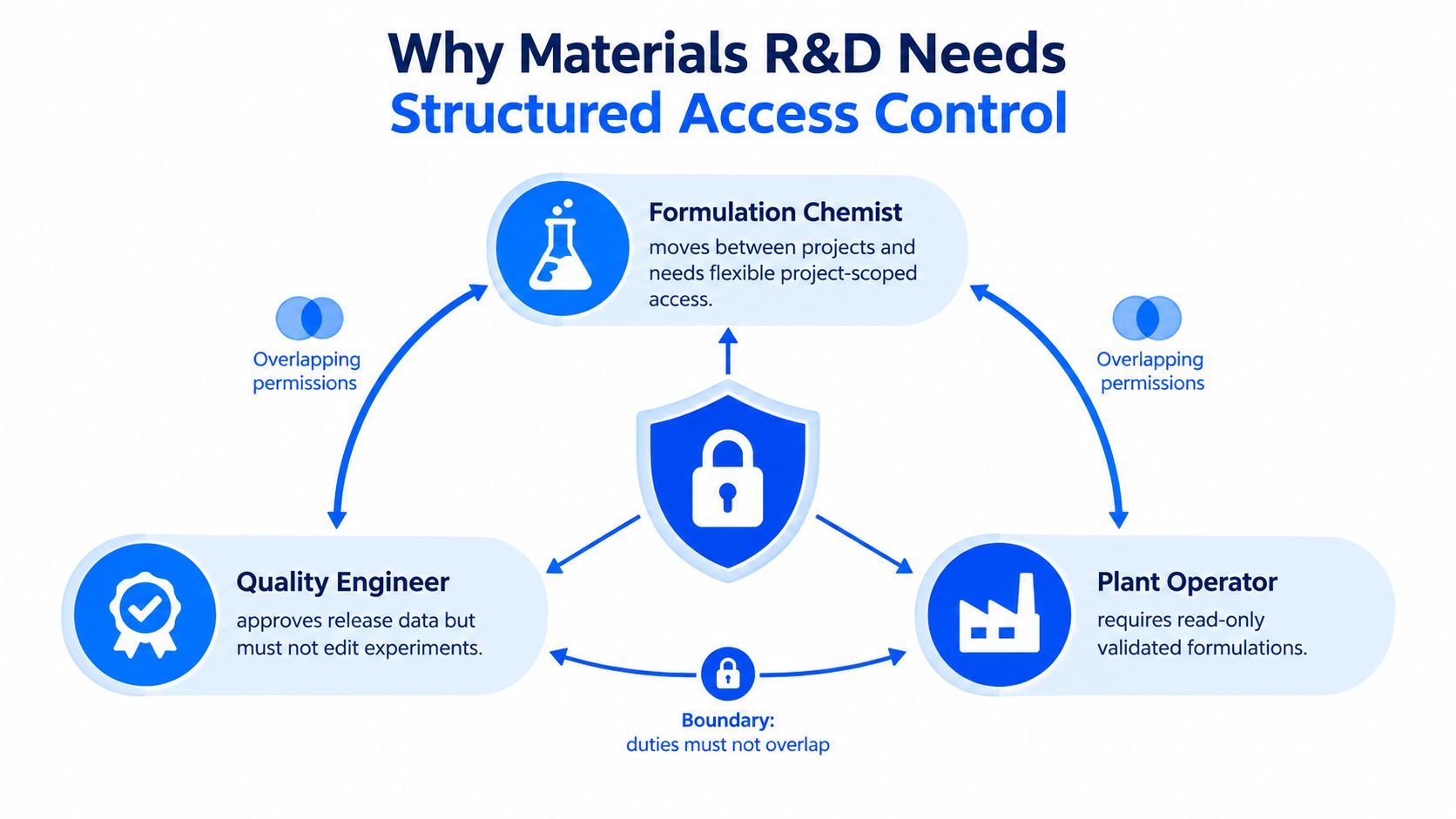
A formulation chemist begins the week editing experiments for a new polymer program. Midweek, the same person supports another project and needs to review results from a different site. A quality engineer must approve release data, but shouldn't alter the experimental record that produced it. On the manufacturing side, a plant operator needs read access to validated formulations, while raw research records remain outside the operator's responsibilities.
A poorly designed system treats those needs as a list of people and exceptions. One administrator grants edit access to a chemist, another copies permissions from a colleague, and a third hides an approval button from a scientist while leaving the approval endpoint reachable. The result is either excessive access or a workflow so restrictive that scientists create unofficial exports and duplicate files to keep work moving.
Roles must reflect responsibility
Role-based access control, or RBAC, attaches permissions to organizational roles rather than directly to individual users. NIST describes the model through roles, role hierarchies, authorization mappings, and constraints. Its foundation was introduced by NIST researchers David Ferraiolo and Richard Kuhn in 1992, unified with the RBAC96 framework in 2000, and adopted as ANSI/INCITS 359-2004 on February 11, 2004. These milestones and the model's core elements are documented in the NIST RBAC FAQ.
That structure matters because scientific work crosses departmental boundaries. A scientist can create an experiment without approving it. A reviewer can approve a result without rewriting the raw record. A production engineer can retrieve a validated formulation without changing the research history. RBAC creates a stable authorization baseline, while constraints and resource attributes handle the context that job titles alone can't express.
Why individual permissions fail
Direct grants look convenient during a deadline, but they make joiner, mover, and leaver processes difficult to control. A person who changes projects may retain access to the old program. A contractor may keep a copied role after the engagement ends. An experiment that becomes confidential may remain visible to people who were authorized under an earlier workflow state.
RBAC isn't a compliance checkbox. It's a way to keep collaboration usable without turning every scientist into an administrator or every sensitive record into an isolated silo. The model works when policy owners define responsibilities clearly, enforce decisions centrally, and add project and data context without encoding every variation into a new role.
Building the Permission Matrix for Scientific Roles
Start with a permission matrix, not with application screens. Inventory user populations, protected resources, and operations such as read, create, update, delete, approve, export, and administer. Then map the minimum operation set to each business function.
For materials R&D, resources might include experimental records, formulation definitions, test results, release records, production-scale data, project metadata, and audit logs. The same person may need different access to each resource. A formulation scientist might update experiments but not approve release data. A quality engineer might approve release data but not edit raw experimental records. A data steward might export governed datasets without changing scientific content.
A practical starting matrix
| Role | Create | Read | Update | Delete | Approve | Export |
|---|---|---|---|---|---|---|
| Formulation scientist | Experiments and observations | Assigned project records | Experimental records within scope | Only where policy explicitly permits | No release approval | Governed project data where permitted |
| Quality engineer | Review comments and quality records | Results and release packages | Quality records, not raw experiments | No | Release data within assigned scope | Approved quality datasets where permitted |
| Plant operator | Operational entries where required | Validated formulations and instructions | Operational fields only | No | No | No, unless explicitly assigned |
The table is a design artifact, not the complete policy. Each row should become a set of role-to-action-to-resource tuples, with resource scope evaluated separately. A tuple might state that the formulation scientist role can update an experimental record when the record belongs to an assigned project and remains in an editable workflow state.
Practical rule: Define the smallest useful permission first. Add authority only when a documented responsibility requires it.
NIST's model supports hierarchical roles, so a senior role can inherit permissions from a junior role. Use that inheritance only when the authority is intentional and easy to explain. A quality lead might inherit review permissions from a quality engineer and add approval rights. Don't use hierarchy to conceal unrelated access or compensate for a confusing matrix.
Avoiding role explosion
Stable business roles should represent job responsibilities. Project, site, geography, classification, and workflow state should usually remain attributes or resource conditions. Creating a separate role for every formulation, program, or facility makes governance harder and obscures why someone has access.
This distinction also applies outside laboratory platforms. Teams designing access control in crypto infrastructure face the same basic challenge, permissions must map to meaningful responsibilities while sensitive operations remain explicit and auditable. The lesson transfers well to R&D: keep the role vocabulary understandable, and make exceptional scope visible in the policy rather than burying it in role names.
Enforcing Server-Side Authorization Decisions
A permission matrix has no security value if the application enforces it only through interface behavior. A hidden button isn't an authorization control. A scientist can alter a request, call an endpoint directly, or use an integration that never renders the interface at all.
The server should evaluate every request through one authorization layer. The decision path should be consistent:
- Authenticate the principal. Establish which user, service account, or integration is making the request.
- Load current role assignments. Don't assume a cached role reflects the current project or employment state.
- Resolve intentional inheritance. Apply senior-role permissions only where the hierarchy is defined.
- Evaluate resource scope. Check project ownership, tenant boundaries, site assignment, data classification, and workflow state.
- Return allow or deny. Permit the action only when an explicit policy matches.
Use deny by default. If the policy doesn't explicitly allow a formulation scientist to update a record in a particular project, the request should fail. The same decision must apply whether the request comes from a browser, an AJAX call, a background integration, or a server-side service. OWASP's Authorization Cheat Sheet specifically emphasizes consistent server-side validation across request types and warns against relying on client-side controls.

Put the policy at the request boundary
For an experiment update, the API should authenticate the user, load the experiment and its project, resolve the user's current assignments, and evaluate the update policy. It shouldn't accept a project identifier supplied by the client as proof of access. The server must establish the relationship between the principal and the resource.
The same discipline applies to approvals. A scientist may be allowed to create an experiment and submit it for review, but the approval endpoint must check the reviewer's role and the record's workflow state. A plant operator's read request should return validated formulations within the operator's permitted site, not raw research drafts that happen to share a material identifier.
Authorization and authentication solve different problems, and confusing them creates gaps. A concise authorization versus authentication engineering guide can help teams keep identity verification separate from the decision about what an authenticated principal may do.
Testing for Privilege Escalation in R&D Workflows
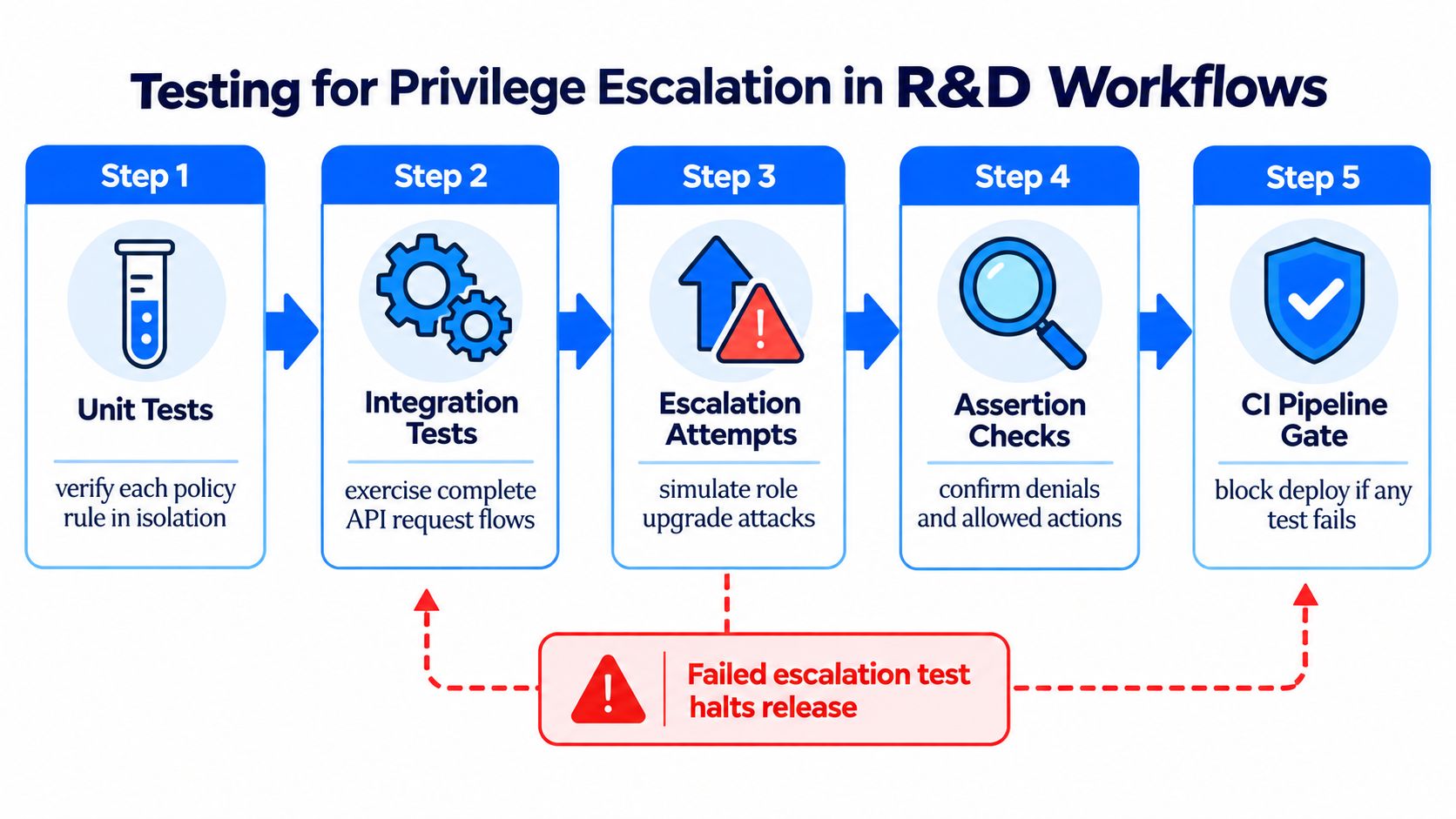
RBAC should be treated as executable policy, not documentation. Before deployment, write unit tests for individual rules and integration tests that exercise complete API flows. Build a matrix covering every sensitive role, resource, and operation, then include both allowed and denied outcomes.
Test horizontal escalation
Horizontal privilege testing uses two users with equivalent roles. Give each user access to a different project or resource, then attempt to substitute one user's resource identifier or session context for the other's. The expected result is denial.
For example, two formulation scientists may both have permission to update experiments, but each should be limited to assigned projects. Test the experiment update endpoint, search filters, download routes, report generation, and bulk APIs. A common failure is securing the detail page while leaving an export or batch endpoint to trust an identifier without repeating the scope check.
Test the less obvious paths too:
- Direct object references: Replace a permitted experiment identifier with one from another project.
- Bulk operations: Submit a list containing both authorized and unauthorized records.
- Background jobs: Confirm queued exports and analysis tasks recheck authorization when they execute.
- Session context: Reuse stale project context after a user changes assignments.
- Post-logout tokens: Verify that a revoked session can't continue calling sensitive endpoints.
Test vertical escalation
Vertical testing moves between adjacent privilege levels. Use a scientist account to invoke quality approval, deletion, export, and role-management endpoints. Use a quality engineer account to attempt raw experiment edits. Use a plant operator account to request draft formulations or administrative functions.
OWASP's authorization testing guidance recommends testing both horizontal and vertical bypasses, including reserved functions and resources. The test suite should also cover unauthenticated requests, expired sessions, malformed claims, alternate HTTP methods, and integrations that bypass the main user interface.
A failed escalation test should block deployment, not become a ticket for later cleanup.
NIST's approach also treats policy writing, validation, and management as part of RBAC itself. Runtime enforcement without a maintained test suite leaves the most important assumptions unverified. Record the expected decision, actual decision, policy version, and resource scope for each test so a change can be reviewed rather than guessed at.
Scoping Access by Project, Site, and Data Sensitivity
Pure RBAC answers, “What may someone with this job responsibility do?” Materials R&D also needs to answer, “Where, to which data, under which conditions, and at what point in the workflow?” That second question is where project-scoped and object-level controls become necessary.
A formulation chemist may edit experiments in one program, view results in a collaboration program, and access production-scale data only after a release decision. A site engineer may need validated formulations for one facility but shouldn't automatically see proprietary work from another location. Encoding every combination into role names produces a catalogue no one can reliably govern.
Keep roles stable and attributes specific
Use a hybrid model:
- Roles express job responsibility, such as formulation scientist, quality engineer, data steward, or plant operator.
- Attributes express context, such as project assignment, site, geography, data classification, tenant, and workflow state.
- Constraints govern exceptional access, such as explicit approval, an expiry time, or a separation-of-duty rule.
The policy might read conceptually as follows: a formulation scientist may update an experiment when the user's role permits editing, the experiment belongs to an assigned project, the user is authorized for its site, and the record is still editable. A quality engineer may approve a release package when the package has reached the review state and the engineer isn't also the person who created the underlying record.
This design keeps the business role understandable while allowing the resource decision to remain precise. It also gives auditors a clearer explanation than “Scientist, Project A, Site 2, Confidential Draft,” which is really a collection of attributes disguised as a role.
Test legitimate work and unwanted exposure
A useful test pair combines a valid action with an invalid scope:
- Allow a chemist to update an experiment in the assigned polymer program.
- Deny the same update against an unrelated program.
- Allow read access to an approved result in the permitted site.
- Deny access to a confidential formulation from another site.
- Allow a plant operator to read a validated formulation.
- Deny access to the raw research record and approval action.
The 2025 authorization survey summarized by Permit.io's State of Authorization 2025 report found that 86.6% of surveyed engineers used RBAC, while 62.2% had built authorization in-house and 58.2% worked with distributed or microservices architectures. The same survey reported that 55% didn't evaluate authorization in real time, and 52.6% had never used major policy languages such as Rego, Cedar, or Alfa/XACML. Those findings reinforce a practical choice: start with policies the team can test and revoke reliably, rather than adopting a complex language without operational ownership.
Managing Access Through Role Lifecycle Events
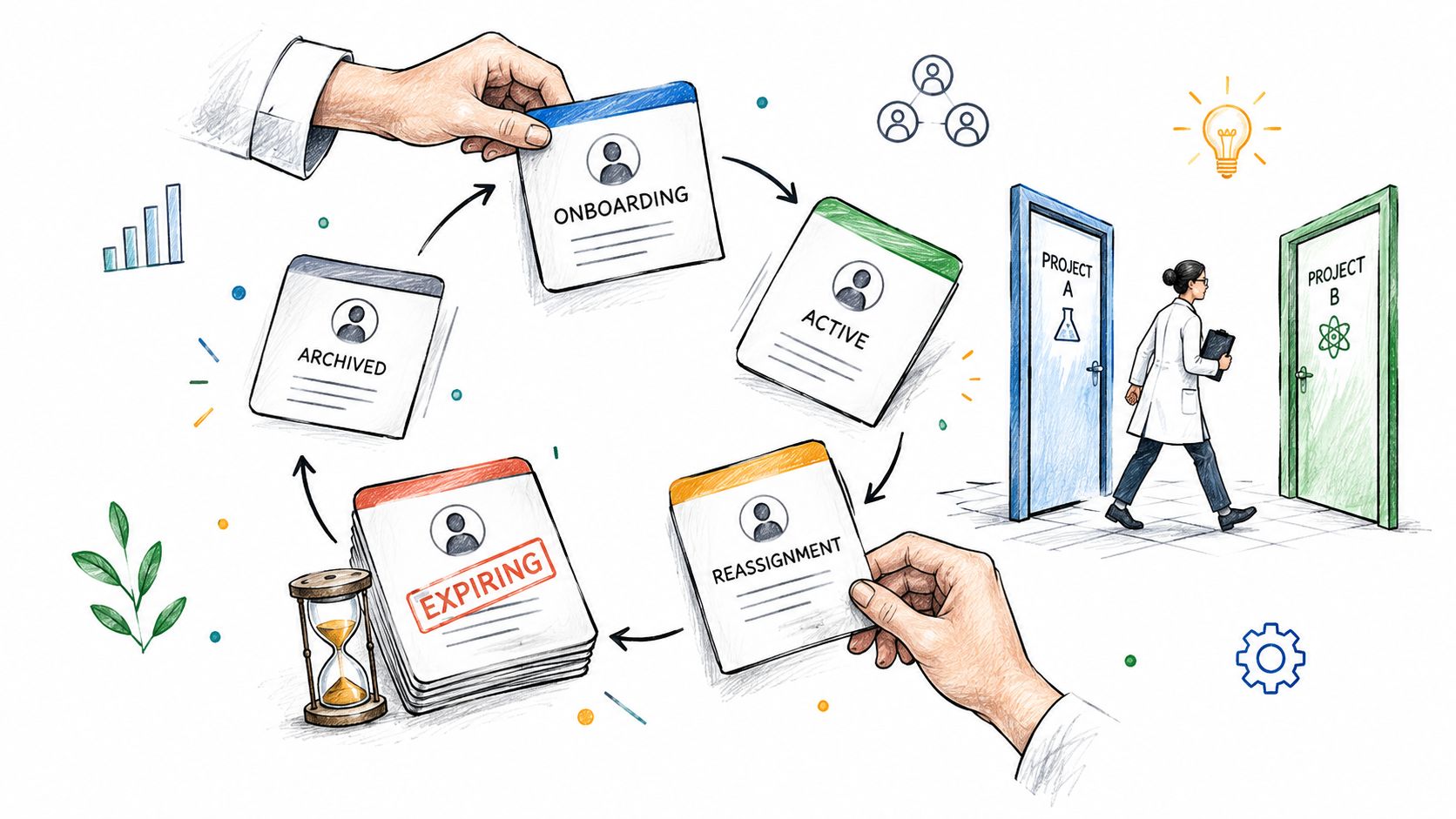
The initial role design is visible and satisfying. The failures usually arrive later, when a scientist changes projects, a contractor's engagement expires, an experiment becomes confidential, or an employee leaves. RBAC stays safe only when role assignments and resource attributes change with the business.
Treat access as a managed lifecycle
Assign an owner to every role. That owner should be accountable for its business purpose, permission set, conflicts, and retirement. Connect joiner, mover, and leaver events to an authoritative identity provider, then define an explicit maximum time to revoke access for departures, project changes, and expired temporary grants.
Temporary access should carry an automatic expiry. Don't create a permanent “special project scientist” role for a short review assignment. Issue a constrained grant with an approver, a reason, a scope, and an end time. When the project closes or the data classification changes, the policy should remove access without depending on someone remembering an old ticket.
Run periodic access reviews that examine both sides of the relationship. Managers should confirm that users still need their assigned roles, while role owners should confirm that the role still grants the right permissions. Review dormant privileges, conflicting combinations, unused exports, and assignments that span projects or sites without a current business reason.
Real-time revocation deserves separate attention. The 2025 survey cited above reported that 55% of respondents didn't evaluate authorization in real time, relying instead on tokens, cached decisions, or assumptions that permissions remain stable. In a collaborative, multi-tenant R&D environment, a decision that was valid earlier may no longer be valid after a project move or confidentiality change.
A useful audit event should capture:
- Subject: The user, service, or integration.
- Role: The role assignments used in the decision.
- Resource: The experiment, formulation, project, or dataset.
- Action: Read, update, approve, export, or administer.
- Decision: Allow or deny.
- Policy version: The rule evaluated at request time.
- Correlation ID: The trace connecting related service calls.
This record explains why access was granted or refused. Logging only the resulting API call leaves investigators to reconstruct the policy after the fact.
The lifecycle also needs rollback procedures. If a role change exposes an unintended permission, pause the assignment workflow, revert the policy version, invalidate affected sessions where necessary, and review logs for access during the exposure window. Operational discipline matters more than a complex policy language that no one can safely modify.
Making RBAC Work for Your R&D Platform
A durable RBAC implementation follows a clear chain:
- Inventory roles, users, resources, and operations.
- Build the permission matrix around minimum necessary authority.
- Keep job roles stable and apply project, site, sensitivity, and workflow attributes separately.
- Enforce every decision server-side through a central authorization layer.
- Test horizontal and vertical escalation across APIs, exports, jobs, and sessions.
- Connect role changes to joiner, mover, and leaver events.
- Review assignments, permissions, exceptions, and dormant access.
- Log the complete policy decision and maintain rollback procedures.
The trade-off is deliberate. Pure RBAC is easier to explain but too coarse for overlapping scientific programs. A fully dynamic policy system can express more context but becomes harder to operate. The practical middle ground uses RBAC for responsibility, attributes for scope, constraints for exceptional access, and automated tests to keep the model honest.
For teams evaluating a materials R&D platform, Polymerize offers role-based permissions for controlling who can view, edit, approve, or export formulation and experiment data. That capability should still be evaluated against your own matrix, project boundaries, lifecycle events, and escalation tests.
Use your current R&D platform to inventory one sensitive workflow, write the role-to-action-to-resource tuples, and test the denial paths before adding another exception. Then visit Polymerize to see how a materials intelligence platform can support governed, project-aware collaboration while keeping experimental and formulation data under structured access control.
Put your R&D data to work
See how materials teams use Polymerize to plan fewer experiments and reach target properties faster.