

You're staring at a familiar mess. One formulation lives in an Excel file on a scientist's laptop, another is buried in an ELN export, and the latest scale-up lesson is trapped in three slide decks no one wants to open. The team keeps saying the process is “working,” but every new experiment still starts with a scavenger hunt.
That is the point where innovation management tools stop being a nice-to-have and start acting like infrastructure. The category has moved past idea boards, and the market numbers reflect that shift, with industry estimates placing it anywhere from USD 1.5 billion in 2023 to USD 2.33 billion in 2024, with projections ranging to USD 2.92 billion by 2030 and as high as USD 33.31 billion by 2033 depending on scope and methodology (market estimate overview). That growth matters less than the buying behavior behind it, because R&D teams are no longer shopping for prettier intake forms. They want systems that can hold experimental context, support explainable AI with confidence scores, and connect lab decisions to portfolio outcomes.
Materials R&D puts different demands on the software than generic innovation work does. Idea capture matters, but it is not the bottleneck. The requirement is a data backbone that keeps formulation history, process conditions, property data, and decision logic tied together so the next experiment is based on evidence, not memory.
If you are modernizing a brittle environment, a practical read on legacy system modernization from Technovation LLC can help frame the scale of what needs to change. The rule is simple. Pick the platform that fits how materials teams decide, then reject anything that only looks good in a demo.
Table of Contents
- When Spreadsheets Stop Scaling in Materials R&D
- Start with pain, not product features
- Use the three experiments exercise
When Spreadsheets Stop Scaling in Materials R&D
The failure usually isn't dramatic. It starts with a missing formulation version, a test result that nobody can trace back to the raw run, or a scale-up review where the team cannot prove why the last five experiments were selected. That is the point where the spreadsheet-and-ELN patchwork stops looking scrappy and starts looking risky.
Materials R&D is different from generic innovation work. Idea capture matters, but it is not the bottleneck. The bottleneck is tying experimental context, process conditions, property data, and decision history together so the next experiment is based on evidence instead of memory. If a platform cannot do that, it is just a prettier intake form.
The problem shows up in daily work. A formulation scientist updates one sheet, a lab manager copies the same result into another system, and the review deck still carries a stale value from last week. By the time the team reaches a go or no-go discussion, nobody is sure which row is current, which sample is approved, or which test condition drove the result.
A plain-language rule works well here:
If the platform only helps you collect ideas, it will not help you make better materials decisions.
That is why R&D leaders need to stop evaluating these tools like corporate suggestion-box software. They need to evaluate them like decision systems that sit between the lab bench and the portfolio review. In practice, that means asking whether the platform can hold experimental history, protect IP, and support a scientist who needs to justify the next run without reconstructing the whole project from email threads.
Legacy systems make this worse when they force the team to copy data by hand or search across disconnected records. A practical read on Technovation LLC on legacy systems can help frame the scale of that cleanup. The rule is simple. If the software cannot preserve traceability from experiment to decision, it will slow the team down instead of helping it move faster.
The rest of the buying process gets easier once you accept that distinction. You are not shopping for a funnel. You are buying an operating layer for experiments, evidence, and decisions.
Mapping Your Requirements Before You Touch a Vendor Demo
Don't let vendor demos write your requirements for you. Write them first, using actual lab work, because a feature list built from marketing slides will always miss the friction points. The best teams start by interviewing the people who lose time every week, formulation chemists, lab managers, and the scientists who keep re-entering the same data into three systems.
Start with pain, not product features
Ask three blunt questions. Where does data get lost, where do decisions stall, and where do scientists distrust the record? In materials R&D, those answers usually point to traceability gaps, ELN integration problems, and a weak handoff between experimental work and portfolio review.
Then separate must-haves from nice-to-haves. A mobile app sounds useful until it crowds out the features that matter, like experimental traceability, IP-grade security, and clean integration with your ELN and LIMS. Social ideation feeds, gamified voting, and polished dashboards are all secondary if your team can't trust the underlying data.
Practical rule: if a feature doesn't change how a scientist designs, records, or decides on the next experiment, it's probably noise.
Use the three experiments exercise
Take the last three failed experiments and map them end to end. For each one, write down what the tool would need to capture at intake, how the experimental context would be stored, where the decision would have been documented, and how the team would review the outcome later. If the vendor can't walk you through all three without hand-waving, the platform isn't ready for your workflow.
A simple one-page requirements template is enough:
| Category | What to write |
|---|---|
| Workflow | The exact experiment or review process the tool must support |
| Data | The fields, attachments, and historical records the platform must retain |
| Integrations | ELN, LIMS, spreadsheets, storage, and authentication systems |
| Security | Access control, auditability, and IP protection requirements |
| Decision support | How the platform should help rank, filter, or prioritize ideas |
| Exclusions | Features you will not pay for in phase one |
That last column matters. It stops scope creep before it starts. If your team can't explain why a feature belongs on the page, it probably doesn't belong in the demo.
The Data Backbone and Integration Layer That Makes AI Possible
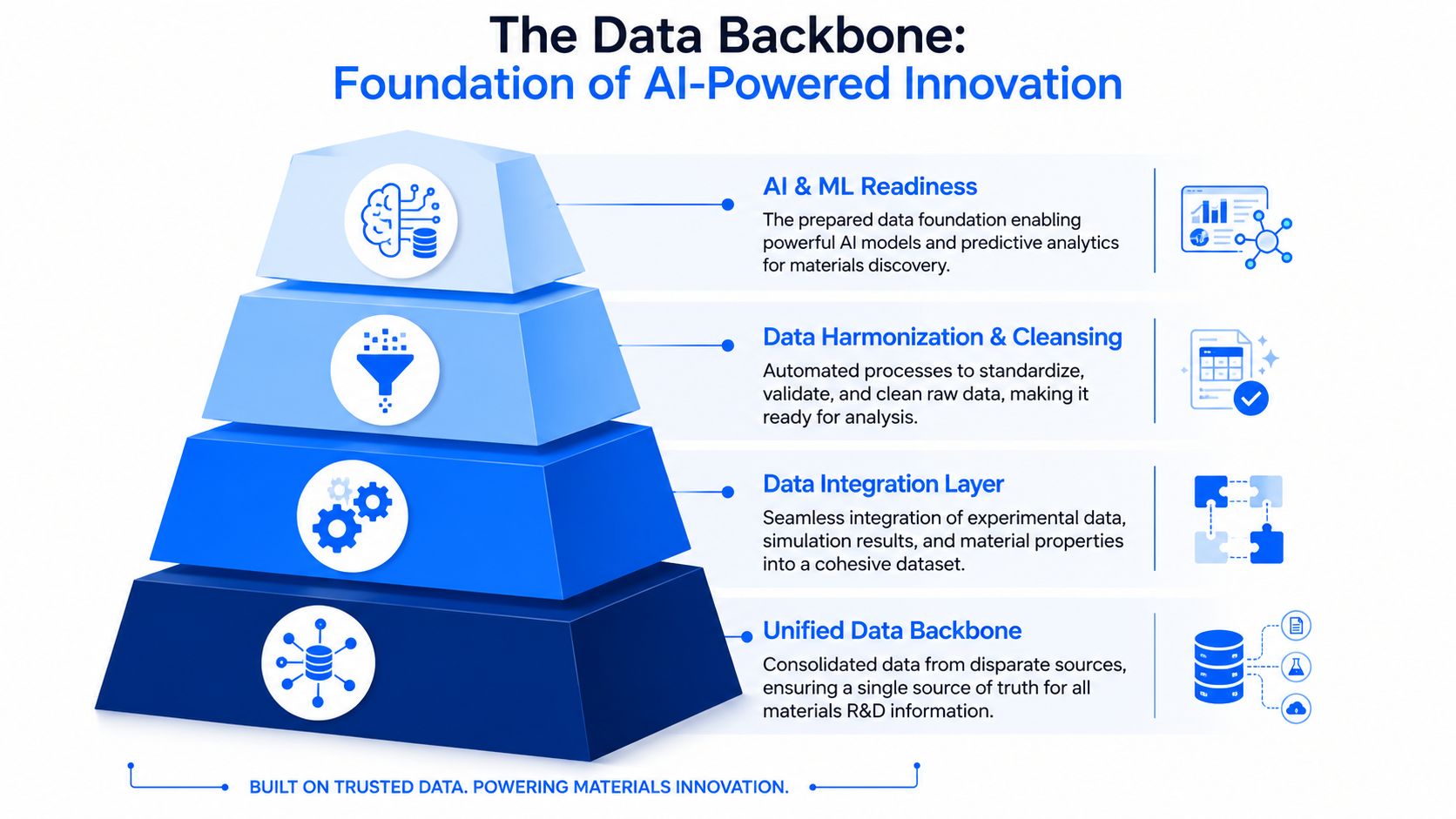
Most innovation software fails for a boring reason, the data underneath it is a mess. Dashboards don't create value on their own, they only reflect whether the platform can unify experimental records, formulation history, and process data into something a scientist can trust. For materials R&D, the data layer is the product.
What the backbone has to do
A credible platform needs native connectors for the systems your team already uses, especially ELN and LIMS. It also needs a schema that can handle formulation components, process conditions, test methods, and outcome data without turning every record into a custom field jungle. If the vendor says “we can ingest anything,” ask how much mapping work is required, who does it, and what happens when your schemas drift over time.
That's the part buyers underestimate. Historical data matters as much as live data, because a model trained on a thin slice of recent experiments will struggle to produce useful guidance in the first six months. If a tool can't ingest the old runs, failed trials, and oddball edge cases already sitting in spreadsheets, its predictive value will be shallow.
A unified intelligence layer is the difference between tool sprawl and usable intelligence. In the materials space, that means a system that consolidates scattered records into a single source of truth, then feeds analysis, search, and decision support from there. Polymerize Connect is one example of that kind of centralized R&D data management layer, because it organizes experimental and R&D information in one place rather than scattering it across disconnected systems.
The right integration question isn't “Does it have an API?” It's “How much of my real historical data can it normalize without manual cleanup?”
The vendor questions that matter
Ask vendors these directly:
- Which systems are supported natively? Don't accept a generic yes if the connector is custom-built for every deployment.
- How do you handle schema drift? Materials data changes constantly, and rigid models break fast.
- Can the platform preserve provenance? Scientists need to know where each number came from.
- What happens to spreadsheet history? If the answer is “import the latest file,” walk away.
- Can the system support downstream AI use cases? If not, you'll outgrow it quickly.
If the backbone is weak, the rest of the stack becomes decoration. If it's solid, AI, portfolio tracking, and experimentation workflows finally have a common language.
AI and ML Capabilities That Actually Matter for Materials Work
Most vendors slap AI-powered on a homepage and hope nobody asks what the model does. In materials R&D, that approach doesn't survive contact with a senior scientist. The only useful AI is the kind that helps you choose the next experiment, explain why a result happened, or reduce the noise in a crowded portfolio.
Meaningful capability versus marketing language
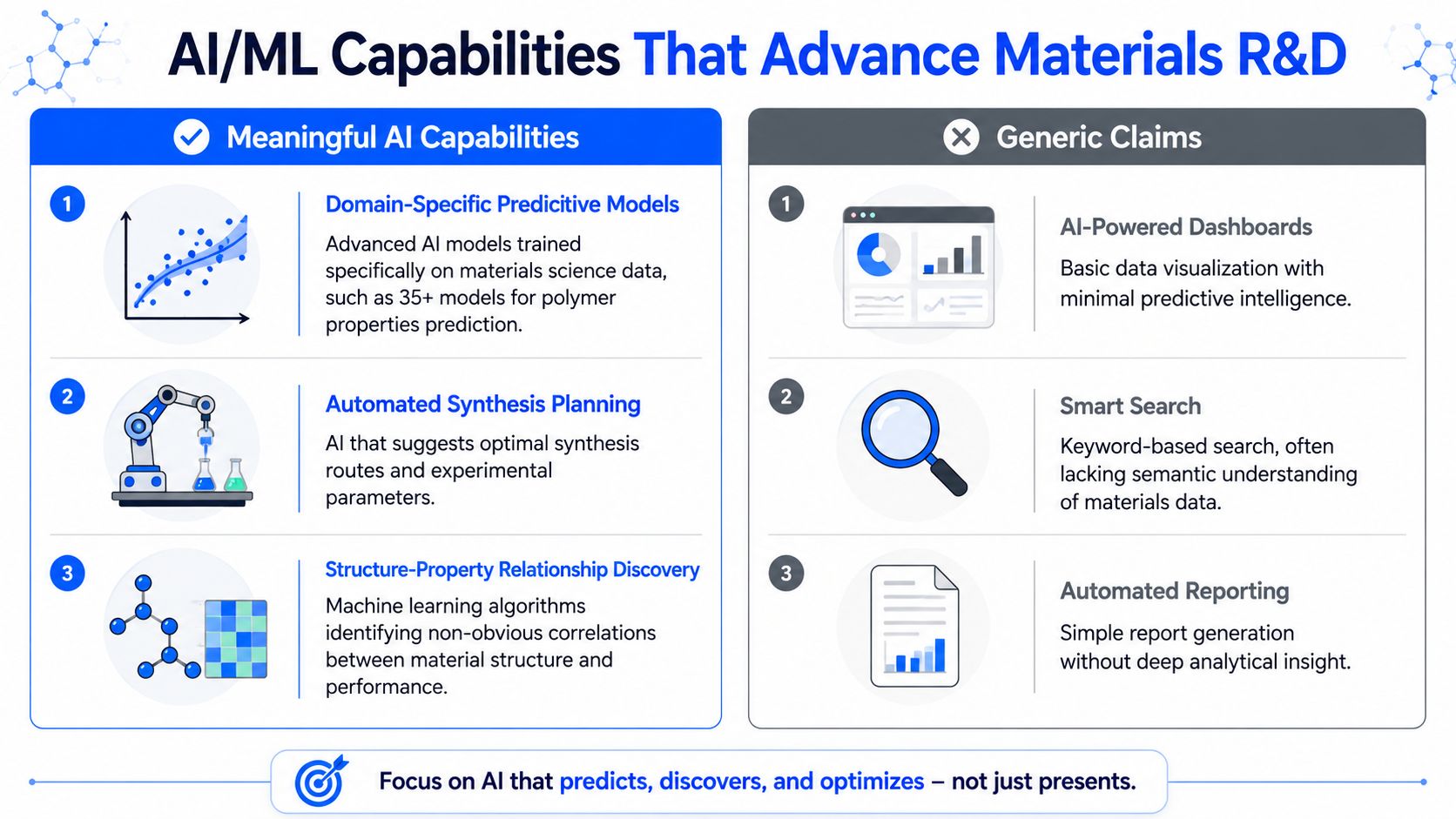
The useful side of the aisle includes domain-specific predictive models, formulation optimization, and causal driver analysis. Those are the features that can tell a chemist which variable is likely pushing performance in the wrong direction. The weak side is full of AI dashboards, keyword search, and report generation, all convenient, none sufficient.
Explainability becomes critical. A black-box score without context is a dead end for experts who need to defend a decision in a technical review. Confidence scores, historical precedents, and counterfactual suggestions matter because they let scientists judge whether a model is helping or hallucinating.
The question to keep asking is simple, does the system tell you what to do next, or does it just summarize what already happened? If it only summarizes, it belongs in reporting software, not an innovation management stack.
What to insist on in a materials context
A serious platform should support predictions that are tied to materials properties and should expose the reasoning behind them. It should also let the user see which prior experiments are most relevant, not just return a generic ranked list. If the tool can't show why it favored one formulation over another, scientists will keep treating it as optional.
The MLOps side matters too. If your models can't be monitored, updated, and deployed cleanly, the AI will rot after the first novelty cycle. A useful overview of the operational side is MLOps lifecycle and deployment from Ryware, because the problem isn't just building a model, it's keeping it useful after the pilot.
For teams evaluating AI depth, ask these questions:
- Does the AI cover the full lifecycle? Idea capture alone isn't enough.
- Are scores tied to strategic priorities? Prioritization should reflect business goals, not generic novelty.
- Can scientists inspect confidence and precedents? If not, adoption will stall.
- Does the model help reduce noise? Prioritization is the job.
The strongest platforms don't promise magic. They give scientists a cleaner way to decide, test, and learn.
Security, Compliance, and the Vendor Evaluation Checklist
Security is the first filter, not the last one. Materials R&D data is intellectual property, and no amount of slick UX can compensate for a weak control environment. If a vendor can't answer security questions crisply, the conversation should end there.
Pass or fail questions
Use this checklist to screen vendors before you get lost in feature tours.
| Category | Question | Pass Criterion |
|---|---|---|
| Security certification | Do you hold ISO 27001 and SOC 2? | Vendor can provide current evidence of both or a clear equivalent security posture |
| Access control | Do you support role-based access control? | Users only see data and models appropriate to their role |
| Auditability | Are audit logs available for records, edits, and approvals? | The platform records who did what and when |
| Encryption | Is data encrypted at rest and in transit? | Vendor confirms both controls are in place |
| Privacy compliance | Do you support GDPR and CCPA obligations? | Vendor can explain how personal data rights are handled |
| Data residency | Can you specify where customer data is stored? | Vendor provides a clear residency answer |
| Model training | Is customer data used to train shared models? | Vendor states yes or no clearly, with opt-out if applicable |
| IP protection | How is model and customer IP separated? | Customer data is isolated and not exposed across tenants |
Red flags that should end the discussion
If a vendor dodges questions about shared model training, that's a problem. If they can't explain data isolation, that's a bigger one. If the answer to auditability is “we can build that later,” don't let them near your lab data.
Materials teams also need to understand whether a platform trains on their proprietary data by default, and whether they can opt out. That question is easy to ignore in a demo and expensive to regret later. The same goes for model IP protection, because a system that blurs ownership boundaries creates legal and technical risk.
The 2018 review of innovation management techniques and tools found that project management was used by 82% of surveyed actors, business plan development by 67%, corporate intranets by 66%, and benchmarking/portfolio analysis by 60%. It also found that only 43% said they had successfully used IMTs in their own organization, which is a strong reminder that adoption capability matters as much as feature breadth (2018 IMT review). In other words, a platform that looks strong on paper can still fail if it can't be governed safely.
Why this checklist works
It forces the vendor to talk about controls, not slogans. It also gives your legal, security, and R&D teams a common language for rejecting weak options early, before anyone gets attached to a dashboard.
Designing a Pilot That Proves Value Without Lock-In
A pilot that tries to cover every workflow proves nothing. Keep it narrow, or you'll spend the trial period debugging governance instead of validating value. For materials R&D, the right pilot is usually one workflow, one formulation family, and one outcome that the team already cares about.
Scope the pilot like a scientist, not a steering committee
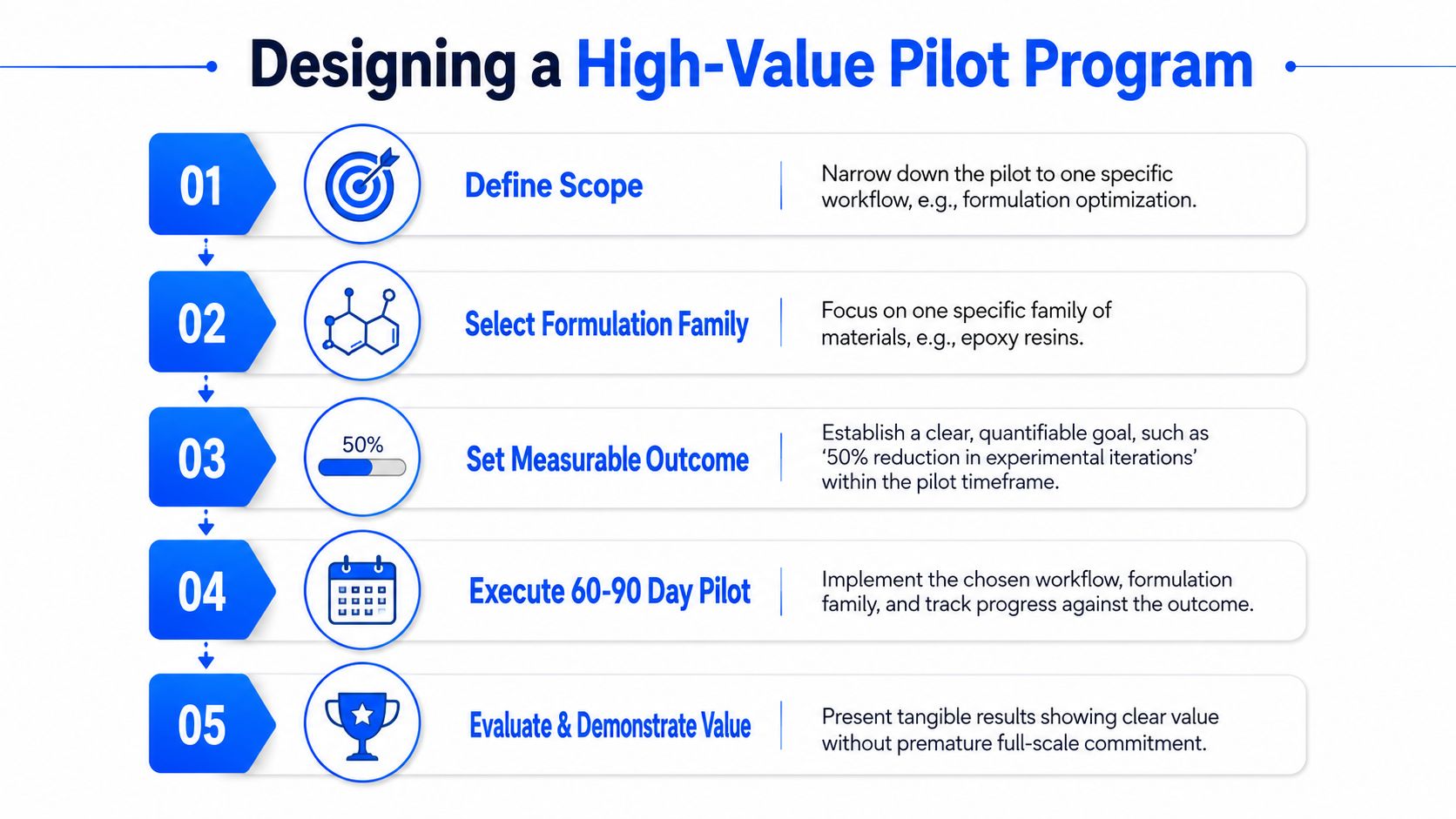
Pick a workflow such as formulation optimization, then choose one family like epoxy resins or a similarly bounded material set. Baseline the current state before the pilot starts, especially how many experimental iterations the team is burning to reach a usable answer. Without a baseline, you'll have opinions instead of evidence.
Set a clean exit criteria before kickoff. If the platform can't integrate the chosen workflow, support the selected data types, and produce a defensible decision trail, the pilot should end fast. That's not failure, that's procurement discipline.
Own it jointly
The pilot needs two owners. One is a scientist champion who knows the work at bench level. The other is the digital transformation lead who can keep the scope tight and the data honest. If either owner disappears, the pilot will drift into a generic software trial.
A useful pilot structure looks like this:
- Define scope: one workflow only, no feature sprawl.
- Choose the formulation family: keep the chemistry bounded.
- Set the outcome: use a measurable, agreed business or lab objective.
- Run 60 to 90 days: long enough to test the workflow, short enough to stop waste.
- Review the evidence: decide whether the platform earned expansion.
A strong pilot also tests the off-ramp. If the software can't be removed cleanly or if the data export story is weak, that's a lock-in risk disguised as convenience. Good vendors make it easy to prove value without forcing a permanent commitment.
Rollout Best Practices and the Decision Framework That Closes the Loop
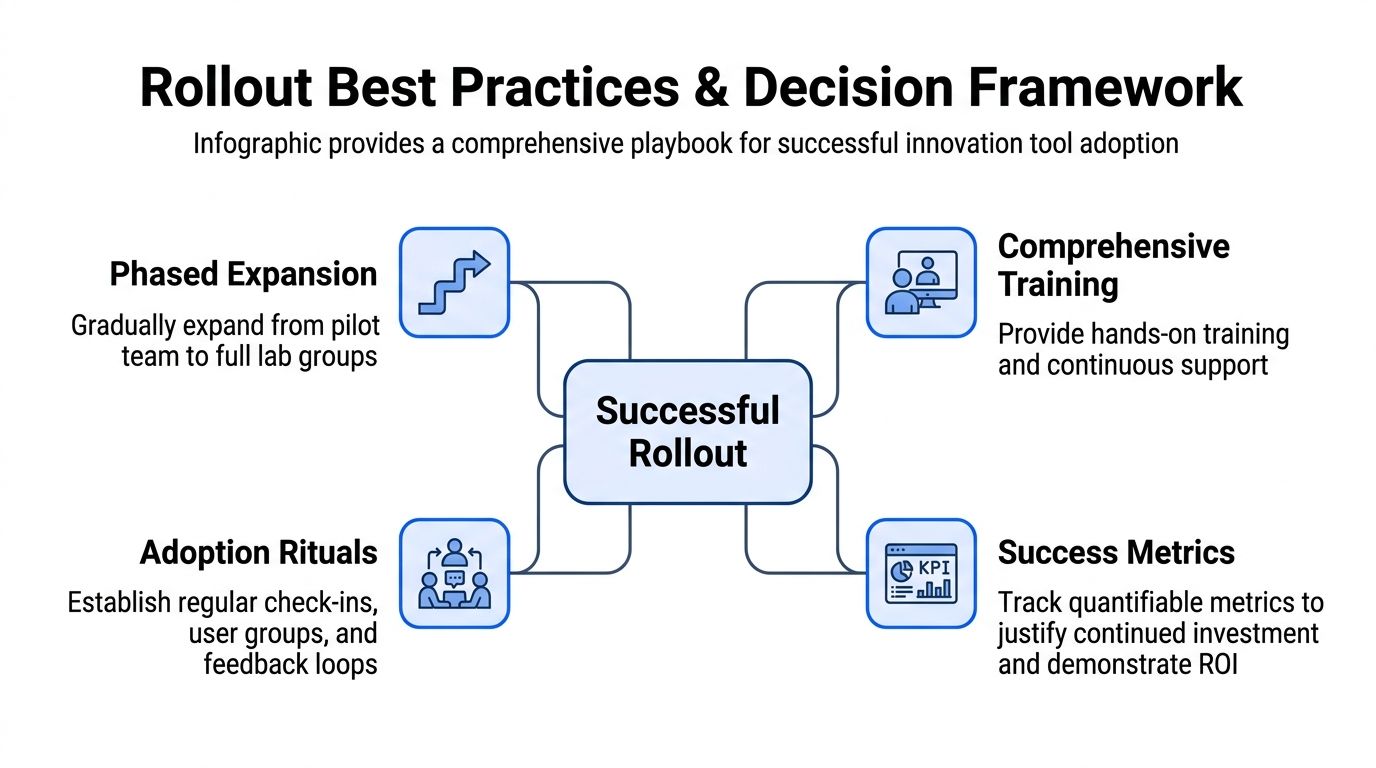
Rollout wins or loses on habits, not announcements. Start with the pilot team, expand to adjacent lab groups, then move into broader R&D only after the workflow is stable and the data model is trusted. Skip the big bang.
What good rollout looks like
Training can't be a one-time webinar. People need hands-on sessions, role-specific guidance, and a place to ask awkward questions after week one. Adoption rituals matter too, meaning regular check-ins, user groups, and visible feedback loops so the system keeps improving instead of stalling after launch.
Track success with a short list of metrics the business cares about. Focus on adoption, data completeness, decision cycle time, and whether the platform is helping the team spend less time searching and more time testing. If the platform isn't changing how the lab works, it's not embedded yet.
How to decide between point tools and a system of intelligence
Use this decision rule. If you need a narrow feature and no real data backbone, a point tool may be enough. If you need experimentation data, explainable AI, and portfolio decisions in one place, you want a system that connects those layers instead of scattering them.
That's where bundled offerings can make sense, especially when software is paired with expert support and prototyping networks. Polymerize One is one example of that combined approach, bringing software together with support and prototyping pathways for organizations that need to move from concept to validated material faster. Choose that path only when your workflow really needs more than a standalone app.
The broader market signal is clear. Innovation management software is no longer a sidecar to R&D, it's becoming part of the operating system for teams that want structure, traceability, and better decisions. The winners will be the teams that treat data backbone, AI explainability, and rollout discipline as one program, not three separate purchases.
If you're evaluating innovation management tools for materials R&D, talk to Polymerize about a platform that unifies experimental data, applies explainable AI to formulation decisions, and supports the path from lab work to portfolio outcomes. Visit Polymerize to see how their system fits your workflow and to start a conversation about your pilot scope.
Put your R&D data to work
See how materials teams use Polymerize to plan fewer experiments and reach target properties faster.