

A formulation scientist opens the lab dashboard and sees a promising recommendation: a new polymer blend predicted to deliver stronger performance than the current formulation. The model assigns a confident score, but it doesn't show which experiments shaped that prediction, which variables mattered most, or whether the recommendation resembles a known success or an unexplored outlier. The scientist still has to decide whether the result deserves a costly experiment.
That situation captures a central challenge in materials R&D. Prediction is useful only when a team can evaluate its reasoning. A recommendation with no traceable lineage may accelerate a decision, or it may hide a failure mode that experienced scientists would have recognized immediately. The history of precedent offers a practical framework for closing that gap. Courts developed methods for using earlier decisions to guide later judgments, while scientists built cumulative knowledge by comparing new observations with prior evidence. Data-driven materials discovery can combine both lessons.
Table of Contents
When AI Predicts Without Explanation
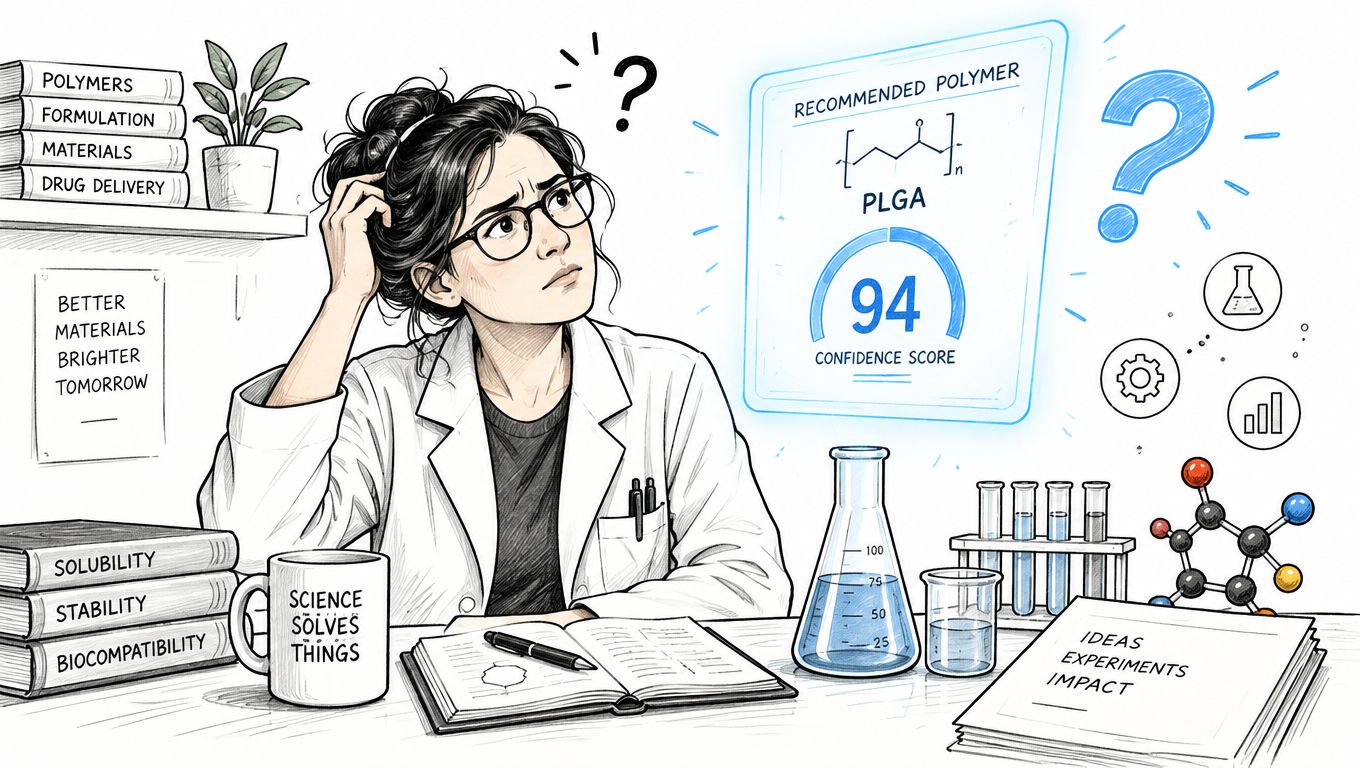
The scientist doesn't need an AI system to repeat the result. The system already supplies a prediction. What the scientist needs is a defensible path from evidence to recommendation.
A useful explanation might identify earlier formulations with similar polymer chemistry, processing conditions, and target properties. It might show that the proposed change resembles a group of experiments that performed well under comparable temperatures, while also flagging that the catalyst differs from the historical examples. That distinction changes the next action. The scientist may approve a targeted validation experiment, adjust the catalyst first, or reject the recommendation because the apparent similarity is superficial.
A score isn't a scientific argument
A confidence score can help rank options, but it doesn't establish relevance. Two formulations may share a polymer family yet behave differently because of molecular weight, curing conditions, moisture exposure, or measurement method. A model that surfaces only a numerical output leaves the team to reconstruct that context manually.
Precedent adds an evidence trail. It asks which earlier cases, experiments, or decisions resemble the present one, what rule or pattern those examples support, and where the comparison breaks down. In legal reasoning, that process became a disciplined way to distinguish authoritative decisions from merely informative ones. In materials R&D, the same logic can make an AI recommendation reviewable without pretending that scientific evidence is mechanically binding.
Practical rule: Treat every AI recommendation as a proposed next experiment, not as a conclusion. Require the system to show the historical evidence that makes the proposal plausible.
The history of precedent therefore matters beyond legal education. It shows how institutions turned memory into a repeatable decision process. A materials team can apply the same principle by connecting each prediction to identifiable prior work, preserving the conditions behind that work, and giving scientists enough context to challenge the result.
The Medieval Roots of Binding Authority
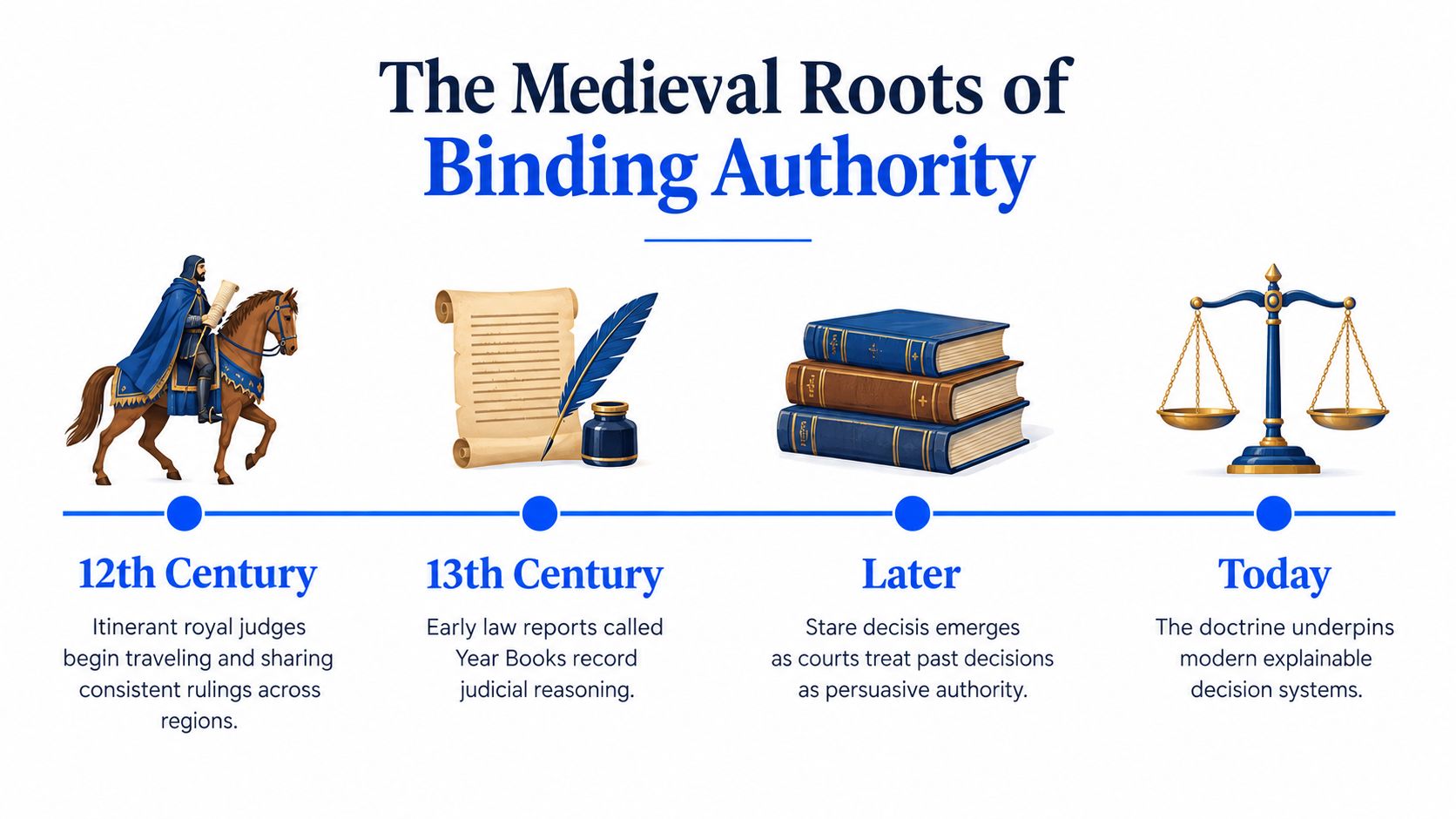
The modern doctrine of legal precedent emerged from England's common-law tradition during the 12th and 13th centuries. After the Norman Conquest of 1066, royal courts increasingly replaced locally varied customs with centrally administered rules, and itinerant royal judges carried similar legal principles across different regions. The system grew through repeated practice rather than through a single code or one legislative act. (Common law)
That institutional change solved a practical coordination problem. If each locality relied only on its own custom, people faced uncertainty when disputes crossed regional boundaries. Royal courts created a shared body of reasoning, and earlier decisions gradually became evidence that later judges could consult. By the late medieval period, judges and lawyers increasingly treated prior decisions as authoritative, although the authority of a case depended on reasoning, institutional position, and later treatment.
From repeated practice to doctrine
The phrase commonly associated with this development is stare decisis, the expectation that courts should follow established legal rules when later cases present materially similar facts. That expectation wasn't absolute from the beginning. English courts used earlier decisions as guidance before the modern doctrine of binding precedent became substantially more rigid, particularly through the 19th century. (Historical development of precedent)
That sequence prevents a common misunderstanding. A decision isn't controlling merely because it's old. Its force depends on the court that issued it, the legal rule necessary to the outcome, the reporting and citation practices that preserve it, and later decisions that may limit, distinguish, or reject it. The history of precedent is therefore a history of institutional filtering, not passive accumulation.
Printed law reports expanded access to earlier cases, particularly from the 16th century onward, helping lawyers and judges work with a more stable record of prior reasoning. Later legal systems distinguished binding authority from persuasive authority and developed clearer relationships between higher and lower courts. The English model was later exported widely through the British Empire, influencing legal systems in the United States, Canada, Australia, India, and other jurisdictions. (Common law tradition)
For teams working with technical evidence, this institutional history offers a useful analogy. A historical experiment isn't automatically a valid precedent. Its value depends on provenance, comparability, and the rules used to determine whether it should guide a new decision. Readers who want a related perspective on how authority is established and represented can consult this discussion of entity authority.
How Scientific Practice Adopted Precedent
Scientific precedent works differently from legal precedent, but the underlying problem is familiar. A researcher needs to decide how much weight to give earlier work when the current experiment contains both known and unfamiliar conditions.
In a laboratory, prior results become useful through repeatability, documentation, and comparison. A formulation that performed well under one set of conditions can guide a new trial, but it doesn't compel the outcome. Researchers ask whether the materials, process, test method, and environmental conditions are sufficiently comparable to justify the inference.
Four questions for evaluating earlier evidence
What was tested?
A paper, notebook entry, or electronic laboratory record may describe a material family without preserving every processing detail. Scientists need the complete experimental context before treating the result as a meaningful reference.Which variable drove the result?
A change in catalyst, temperature, particle size, or mixing sequence can alter the outcome. Similar names or shared ingredients don't prove that two formulations will behave alike.Was the observation reproduced?
Repeated observations generally increase confidence, while an isolated result deserves more cautious interpretation. Scientific precedent remains probabilistic because new evidence can weaken or overturn an earlier conclusion.What differs in the present experiment?
A historical result becomes more informative when the team can state both the similarities and the differences. Scientists shouldn't hide those differences only because they complicate the prediction.
Legal systems developed hierarchy to determine whether a prior decision must be followed. Scientific communities use evidence quality, replication, peer review, and methodological fit to determine how strongly an earlier finding should influence current work. Citation practices make intellectual lineage visible, but a citation alone doesn't guarantee that the cited result applies to a new material or process.
A useful precedent doesn't eliminate uncertainty. It tells the team which uncertainty deserves the next experiment.
For materials R&D, this distinction is essential. Polymer chemistry often involves interacting variables, and a model can identify a pattern without establishing a mechanism. An explainable system should therefore surface the historical experiments behind a prediction, identify the conditions that align, and expose the variables that remain untested. That approach gives scientists a reasoned starting point while preserving room for expert judgment.
Legal Versus Scientific Precedent Compared
Legal and scientific communities both consult the past, but they assign authority through different mechanisms. A lower court may be required to follow a higher court's applicable holding, unless later authority changes the rule or distinguishes the facts. A scientist, by contrast, can use a prior result as strong evidence and still reject it when new testing, improved methods, or different conditions point elsewhere.
The comparison becomes clearer when the decision process is made explicit.
| Dimension | Legal Precedent | Scientific Precedent |
|---|---|---|
| Primary purpose | Maintain consistency in decisions and clarify applicable legal rules | Build cumulative knowledge and guide new investigations |
| Source of authority | Court hierarchy, the holding, procedural rules, and later treatment | Experimental evidence, replication, peer review, and methodological fit |
| Force | Binding or persuasive, depending on jurisdiction and court level | Probabilistic, with influence varying according to evidence quality |
| Core unit | The legal rule necessary to the outcome, often called ratio decidendi | The observed relationship, method, dataset, or experimental result |
| Treatment of differences | A court may distinguish a case when material facts differ | A scientist may treat changed conditions as a reason to run a new test |
| Change mechanism | Later decisions can limit, distinguish, or overrule earlier authority | New evidence can replicate, refine, qualify, or contradict an earlier finding |
| Practical output | A reasoned judgment with an identifiable legal basis | A testable hypothesis, design choice, or next-experiment recommendation |
What materials teams should borrow
Materials teams shouldn't impose legal rigidity on scientific exploration. A prior polymer experiment shouldn't become a command just because it appears similar to the current formulation. The useful lesson is the discipline of traceability. Every recommendation should reveal its supporting evidence, its relevant differences, and the confidence the team should place in the comparison.
That is close to the logic of structured case research. Tools such as AI case law search illustrate how retrieval can help users locate relevant prior decisions, but retrieval alone doesn't determine which reasoning controls. In materials R&D, an AI system can likewise find similar experiments, while scientists must judge whether the similarity is chemically and operationally meaningful.
A precedent-aware model combines scientific flexibility with legal-style accountability. It can rank historical examples by similarity and confidence, but it should also preserve the record that allows a formulation chemist to inspect, challenge, and validate the recommendation.
Precedent as Explainable AI Infrastructure
The history of precedent reveals three requirements for trusted decision systems: a reliable record, a method for ranking prior cases, and a process for reviewing the reasoning. Courts developed these requirements over time through reporting, hierarchy, and judicial interpretation. Materials R&D teams can use the same architecture without treating experiments as legal rulings.
A recommendation becomes more useful when it answers four questions:
- Which earlier experiments resemble this proposal?
- Which variables create the strongest similarity?
- What result did each precedent produce?
- Where does the current proposal depart from that evidence?
From prediction to lineage
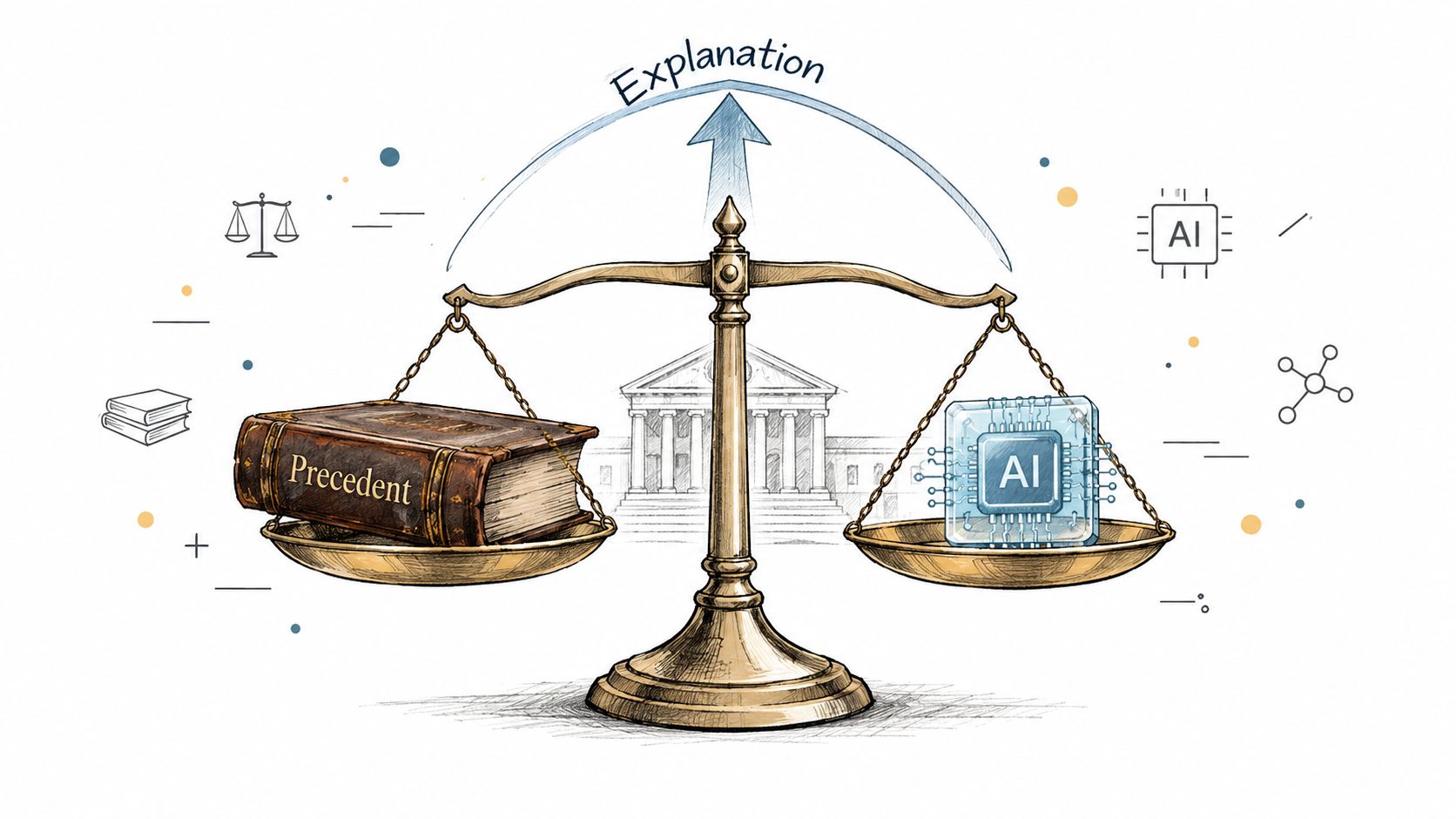
Consider an AI system assessing a polymer formulation. Instead of returning only a predicted property value, it could identify historical formulations with related composition, processing conditions, and measured outcomes. It could then show which variables support the prediction and assign a confidence indicator that reflects the quality and relevance of the historical evidence.
That explanation doesn't prove the recommendation will work. It gives the scientist a way to evaluate whether the model has found a meaningful precedent or a misleading correlation. A formulation chemist might accept the proposal when the cited experiments match the intended process, or request a validation study when the model relies on chemically similar materials tested under different conditions.
Why the record matters
A precedent-aware workflow also preserves the reasoning behind past decisions. If a scientist changed a formulation after an unexpected failure, that revision can be as valuable as the original successful result. Without the failed attempt and its context, a model may repeatedly recommend a path that the team already tested and rejected.
Explainability becomes operational rather than cosmetic here. The team doesn't need a long technical description of the model's internal calculations. It needs reviewable evidence connected to the decision. Scientists can check the cited experiments, confirm that measurements are comparable, and record whether the recommendation was accepted, modified, or rejected.
A system with this design turns historical data into decision infrastructure. It helps a team plan a focused experiment, capture the outcome, and make that outcome available for future comparisons. The process resembles the development of legal authority, where decisions gain practical weight through reporting and later reasoning, but scientific teams retain the freedom to revise conclusions when evidence changes.
Building a Precedent-Aware Workflow
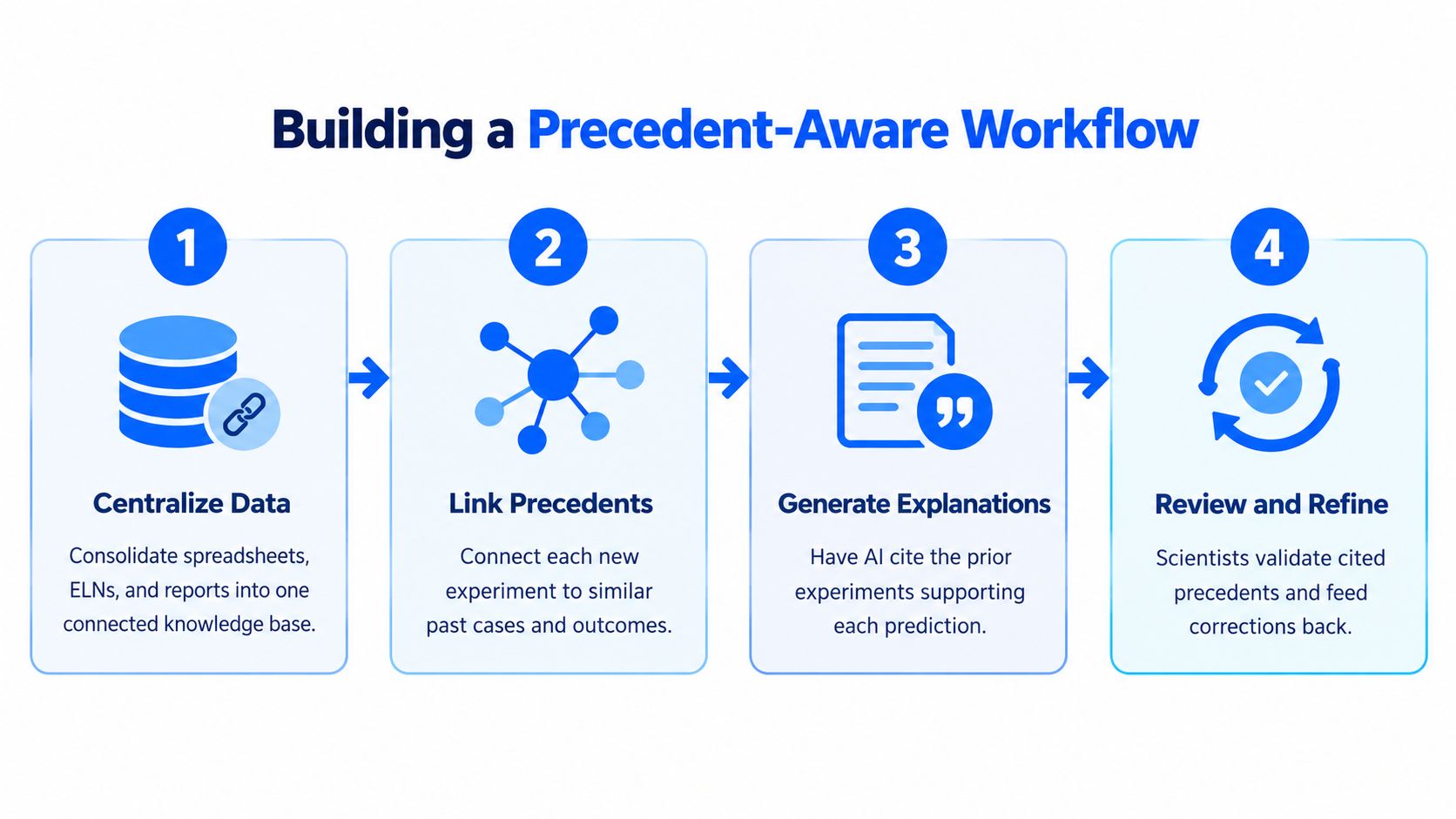
A precedent-aware workflow starts before the model makes a prediction. It begins with the condition of the data. If experimental results remain scattered across spreadsheets, ELNs, reports, and personal records, the team can't reliably compare a new formulation with the work that came before it.
The first priority is to create a connected evidence base. That doesn't mean forcing every historical record into a perfect format before scientists can use it. It means preserving source context, material identifiers, test conditions, units, revisions, and known gaps so the system can distinguish a complete comparison from a weak one.
Four practical stages
Centralize the record. Connect spreadsheets, ELNs, reports, and approved production information in a controlled knowledge base. Preserve the original record rather than replacing it with a simplified summary.
Link each new experiment to prior cases. Use material composition, processing conditions, test method, and target property to identify comparable work. Let scientists inspect why the system considers two cases similar.
Generate an explanation with the prediction. Ask the model to cite the historical experiments supporting its recommendation and to identify the variables that weaken the comparison. A confidence value should accompany that evidence, not replace it.
Review, validate, and feed back. Scientists should record whether the cited precedent was relevant, whether the experiment confirmed the prediction, and what the model missed. Those corrections improve the usefulness of future retrieval and help the team distinguish established patterns from unresolved anomalies.
Review standard: No recommendation should enter formulation planning without a visible connection to the evidence that supports it.
The workflow also changes how meetings run. Instead of debating an unexplained score, a cross-functional team can review the proposed formulation, the nearest historical cases, the differences between them, and the next experiment needed to resolve uncertainty. That structure gives scientists, process engineers, quality teams, and business stakeholders a shared basis for discussion.
The result isn't automation for its own sake. It is a repeatable method for turning years of experimental history into targeted decisions while keeping expert validation in the loop.
Common Misconceptions About Precedent
The history of precedent is often simplified into a story about old decisions controlling new ones. That summary creates problems in both legal reasoning and materials science.
Misconception one
Precedent is always binding. It isn't. Legal systems distinguish between binding and persuasive authority, and the force of a decision depends on jurisdiction, court level, the rule necessary to the outcome, and later treatment. The development of formal binding precedent was gradual, not an ancient rule applied uniformly from the start. (Development of binding precedent)
In scientific work, the distinction is even sharper. A previous result can guide a new experiment without determining its outcome. Teams should label evidence according to relevance and strength rather than treating every historical record as equally authoritative.
Misconception two
Older precedent is automatically better. Age can show that an idea has persisted, but it doesn't prove that the underlying conditions match the current problem. A recent experiment may be more relevant if it uses the same polymer grade, process window, measurement method, and scale.
Misconception three
AI can replace scientific judgment. Retrieval and prediction can surface patterns that a busy team might miss, but they can't decide whether a difference in catalyst or processing history invalidates the comparison. Scientists still need to interpret mechanism, assess risk, and choose the experiment that can discriminate between competing explanations.
Misconception four
Historical data must be perfect before it becomes useful. Imperfect records can still help if the system exposes their limitations. Mark uncertain measurements, missing conditions, inconsistent naming, and failed trials instead of hiding them behind a clean but misleading summary.
A practical daily routine is straightforward:
- Before planning: inspect the nearest historical experiments and note the variables that differ.
- Before approval: ask whether the AI explanation cites actual evidence rather than only a similarity score.
- After testing: record the result, the unexpected behavior, and the scientist's assessment of the cited precedent.
- During review: separate a model error from a genuinely novel material response.
That discipline keeps precedent useful without making it rigid.
Conclusion - Why Precedent Matters for Future Innovation
The history of precedent traces a movement from local judgment toward shared, reviewable reasoning. English courts gradually built authority through repeated decisions, institutional hierarchy, and more accessible reports. The modern doctrine became influential because later judges could examine earlier reasoning, determine its scope, and decide whether it applied to materially similar facts. (Stare decisis and the development of precedent)
The same principle helps materials R&D teams make better use of AI. A model shouldn't ask scientists to trust an isolated prediction. It should connect that prediction to earlier formulations, experiments, and outcomes, then show which similarities matter and which differences remain unresolved. That structure turns a black-box recommendation into a hypothesis that a scientist can review.
Precedent also preserves a healthy respect for change. The United States Supreme Court has treated precedent as highly authoritative without treating it as permanently immune from revision. Its historical record includes exceptional but consequential overrulings, including Brown v. Board of Education rejecting the constitutional framework associated with Plessy v. Ferguson, and Erie Railroad v. Tompkins displacing an older rule about federal common-law authority. (Supreme Court precedent history)
Materials teams need the same balance. Historical evidence should guide discovery, not suppress novelty. Explainable AI can help scientists move faster while preserving the ability to challenge assumptions, investigate anomalies, and revise conclusions when new experiments demand it.
The practical objective is clear. Use the past to make the next decision more intelligible, not to make it automatic.
Polymerize provides an AI-native system of intelligence for materials R&D, connecting fragmented experimental data with explainable models, causal drivers, confidence scores, and historical precedents for next-experiment planning. Visit Polymerize to explore how your team can turn experimental history into a reviewable workflow for developing and scaling polymers, chemicals, and advanced materials.
Put your R&D data to work
See how materials teams use Polymerize to plan fewer experiments and reach target properties faster.