



Most R&D teams don't have an ideas problem. They have a throughput problem.
A chemist runs a formulation. It looks promising. Another variable changes the next day. Then a different solvent, catalyst, additive, temperature window, or processing condition goes into the queue. Weeks later, the team has a handful of answers, a larger pile of ambiguity, and very little confidence that they explored the space well enough to make the right decision.
That serial model is expensive in ways leaders feel immediately. Scientists spend too much time setting up low-information experiments. Programs move slowly because each result determines the next step. Portfolio decisions get made on narrow datasets. By the time a team finds a viable path, a competitor may already be validating theirs.
High throughput experimentation changes that operating model. Instead of running one experiment at a time, teams design and execute many experiments in parallel, using automation, miniaturization, and structured data capture to learn faster. More importantly, they stop treating experimentation as isolated lab work and start treating it as a scalable decision engine.
For materials, chemicals, and polymer development, that shift matters even more now. The companies pulling ahead aren't just running more tests. They're building the data foundation that makes AI-guided discovery possible, while keeping one eye on the harder question frequently overlooked until too late: whether the result will still hold when it leaves the lab.
Table of Contents
- Introduction The End of Trial-and-Error R&D
- The three pillars
- Why HTE produces better decisions
- What it looks like on the bench
Introduction The End of Trial-and-Error R&D
Traditional R&D still runs on a familiar pattern. A scientist forms a hypothesis, runs a small batch of experiments, reviews the outcome, and decides what to test next. That sounds disciplined, but in practice it often becomes a slow sequence of educated guesses.
The problem isn't scientific rigor. It's the structure of the work. Serial experimentation creates bottlenecks because every result waits on setup time, instrument availability, analyst review, and human interpretation. When material systems are complex, that model explores only a thin slice of the actual design space.
Leadership teams usually see the symptoms before they name the cause:
- Cycle times stretch: projects linger because each round of learning is narrow.
- Material use stays high: teams consume valuable reagents while still learning slowly.
- Knowledge remains fragmented: results sit in notebooks, spreadsheets, and local drives.
- Decisions stay tentative: teams don't know whether a “good” result is the best result available.
Practical rule: If your team can't test broad combinations of variables quickly, it will overvalue anecdotal wins and undervalue systematic learning.
High throughput experimentation is the answer because it changes the unit of progress. Instead of asking, “What single experiment should we run next?” teams ask, “What experimental space should we interrogate in parallel?” That sounds like a lab efficiency upgrade, but it's really a strategic change in how discovery happens.
Once an organization adopts that mindset, experimentation stops being a sequence of isolated events and becomes a repeatable engine for faster decisions, stronger datasets, and more defensible development choices. That is why high throughput experimentation has become a competitive necessity, not a specialist capability for a few advanced labs.
What Is High Throughput Experimentation?
High throughput experimentation means running a very large number of experiments simultaneously under specified conditions. In practice, it transforms chemical discovery from a serial process into a parallel one and lets researchers evaluate whole arrays of reaction conditions quickly while using minimal amounts of precious agents, which increases both efficiency and output, as described by Mettler Toledo's overview of high throughput experimentation.
That definition matters, but it's not enough. To implement HTE well, leadership teams need to understand the operating principles behind it.
The three pillars
Think of a traditional lab like a single cook preparing one dish from start to finish. High throughput experimentation is a commercial kitchen with stations working at once, standardized prep, shared timing, and a coordinated service model. The goal isn't just speed. It's consistent execution across many combinations.
The model rests on three pillars:
- Parallelization: multiple conditions are tested at the same time rather than one after another.
- Miniaturization: experiments run in smaller formats, which conserves scarce materials and allows broader search.
- Automation: instruments handle repetitive tasks such as dispensing, weighing, reaction setup, and screening.
Each pillar supports the others. Without miniaturization, parallel runs become too expensive. Without automation, parallel designs become too labor-intensive. Without parallelization, you're still trapped in the same slow learning loop.
Why HTE produces better decisions
The biggest misconception is that HTE is mainly about velocity. Speed is part of the value, but the deeper advantage is coverage.
A serial workflow tends to test variables in narrow sequences. Teams might compare catalyst A versus catalyst B, then later test solvent changes, then later revisit temperature. That approach often misses interaction effects between variables. HTE is better suited to exploring those interactions because it lets teams interrogate combinations directly.
In materials R&D, that changes what the organization can know. Instead of a few disconnected data points, the team gets a map of behavior across formulations, reagents, and conditions. That makes trade-offs visible earlier.
Good HTE programs don't just find winners. They reveal why certain regions of the design space work and why others don't.
What it looks like on the bench
The practical workflow is more grounded than many executives expect. HTE commonly starts with a designed experimental plan, followed by powder weighing into small vials stored in SBS plates, then reaction execution in reactor blocks under defined conditions. Because many experiments run at once, scientists can evaluate a broad array of conditions in a short time using very small amounts of material.
That's why HTE has become so important in pharmaceutical and chemical discovery. It supports rapid optimization, compound library screening, and fast synthesis of derivative collections for biological or physical-chemical evaluation. The same logic applies in advanced materials work, where teams need to search large formulation spaces without committing full production resources to each idea.
Anatomy of an HTE Workflow in Materials R&D
An HTE program only works when the workflow is tightly connected from design through decision. A fragmented setup with good robots and poor data discipline still produces friction. What matters is how the full chain operates.
A simple visual helps clarify the flow:

How the work actually moves
Most materials HTE workflows begin with Design of Experiments (DoE). In this stage, the team decides which variables matter, which ranges are practical, and how much of the design space to explore in the first pass. A weak DoE creates noise at scale. A strong one creates interpretable learning.
Next comes sample creation. Depending on the environment, that may involve liquid handlers, powder dosing systems, balance integration, vial handling, and plate-based workflows. Teams working in formulations may use automated dispensing for resins, additives, solvents, fillers, or catalysts. Teams in synthetic chemistry may rely on small-vial reaction arrays in reactor blocks.
The operational sequence usually follows a pattern:
- Plan the array: define factors, constraints, and success criteria.
- Prepare materials: dispense liquids and solids with automation where possible.
- Run reactions or formulations: maintain controlled conditions across many samples.
- Characterize outputs: connect to analytics suited to the property of interest.
- Capture context: store not just results, but parameters, provenance, and exceptions.
- Decide the next move: expand, refine, or terminate based on evidence.
The instrument mix changes by application, but the workflow logic stays surprisingly consistent.
A short demonstration is useful here:
Where teams lose momentum
The most common failure point isn't reaction execution. It's the handoff between steps.
One team can set up plates efficiently, but if analytical readouts arrive with inconsistent naming, delayed metadata, or manual reconciliation, the throughput gain disappears. Another team can generate a clean screening panel, but if no one defined decision thresholds before the campaign, they end up debating results instead of acting on them.
A mature HTE workflow protects against that by making roles explicit.
| Workflow stage | What strong teams do | What weak teams do |
|---|---|---|
| Experimental design | Bound the problem before automation begins | Overload the first campaign with too many variables |
| Sample prep | Standardize formats, labels, and plate logic | Rely on ad hoc operator conventions |
| Characterization | Align test methods with the real decision | Measure what is easy, not what is valuable |
| Data capture | Record parameters and outcomes together | Store results separately from conditions |
| Iteration | Narrow or expand based on signal quality | Repeat broad screens without learning discipline |
Throughput without interpretation is just faster accumulation of uncertainty.
The best materials R&D groups treat the HTE workflow as a production system for insight. Every step is designed to preserve comparability, context, and decision speed. That's what turns a parallel lab into a strategic capability.
HTE Data Strategy The AI-Ready Foundation
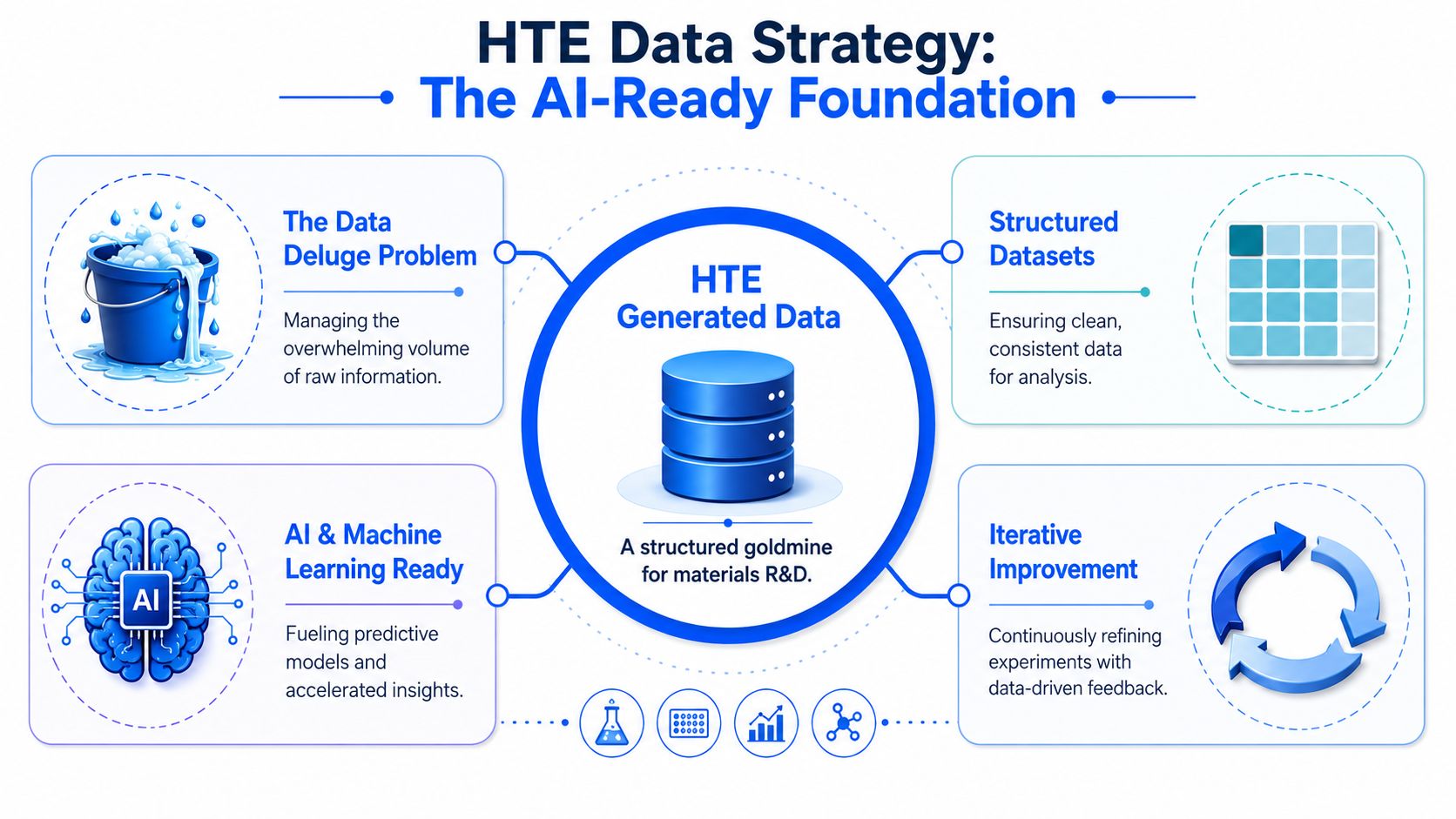
The most valuable output of high throughput experimentation usually isn't a single winning sample. It's the structured dataset behind that result.
That distinction is where many HTE programs either become highly effective or remain expensive automation projects. If the organization sees HTE only as a faster way to run experiments, it will optimize for hardware utilization. If it sees HTE as a data engine, it will optimize for reusable learning.
Why raw throughput is not enough
HTE creates a volume and diversity of information that traditional spreadsheet habits can't manage well. You're not just storing pass or fail outcomes. You're handling experimental design choices, material identities, lot data, instrument settings, environmental conditions, analytical outputs, derived properties, and operator notes.
The scientific payoff of that structure is substantial. Researchers have shown that high throughput experimentation can improve understanding of organic chemistry by systematically interrogating reactivity across diverse chemical spaces and yielding interpretable correlations between starting materials, reagents, and outcomes. The Nature paper on the high-throughput experimentation analyser is especially important because it focuses on statistically rigorous handling of HTE datasets and on revealing hidden relationships and dataset bias.
That point matters beyond organic synthesis. In materials R&D, the same principle applies. If your data model is weak, your organization can't distinguish a clear trend from a local artifact. It can't connect formulation inputs to downstream properties with confidence. And it definitely can't train reliable predictive models later.
What AI-ready data actually looks like
AI-ready data is not just digital data. It is contextualized, standardized, and connected data.
A practical stack usually includes ELNs for experiment records, LIMS for sample and process tracking, and direct instrument integrations for analytical outputs. But many teams stop there and still end up with silos. The missing layer is a unified intelligence environment that links all of those records around the experiment, the sample, and the decision.
That requires discipline in a few areas:
- Consistent identifiers: samples, formulations, plates, and batches need stable naming conventions.
- Structured metadata: conditions must be captured in machine-readable form, not buried in comments.
- Traceable lineage: teams need to know what was made, from which materials, under which settings.
- Decision context: outcomes should connect to project goals, not just sit as isolated measurements.
The model is only as good as the experimental context around the measurement.
Once that foundation is in place, HTE data becomes useful far beyond the original campaign. It can support property prediction, formulation optimization, anomaly detection, and experiment recommendation. That's the strategic shift. The company is no longer just recording lab activity. It is building a compounding knowledge asset.
For teams modernizing their broader technical infrastructure, cloud support can become part of the equation, especially when large datasets and collaborative analytics enter the workflow. Early-stage companies exploring that path may find this guide to Google Cloud funding for founders useful when evaluating how to support data-heavy experimentation programs without overcommitting infrastructure upfront.
Best Practices for Implementing an HTE Program
Most failed HTE initiatives don't fail because the science is wrong. They fail because the operating model is wrong. Leadership buys automation before the team has a clear problem definition, a realistic pilot, or a data plan that survives contact with the bench.
The right way to implement HTE is gradual, targeted, and disciplined.
Start with a pilot that matters
A good pilot sits in the overlap between technical pain and strategic importance. It should address a real bottleneck, not a side project chosen only because it looks easy to automate.
Strong pilot candidates often share a few traits:
- The problem has clear variables: formulation ratios, catalyst choices, additives, temperatures, or curing conditions.
- The current workflow is repetitive: scientists already spend time on manual setup across similar conditions.
- The decision criteria are known: the team can define what counts as a useful outcome before screening begins.
- The result matters commercially: if the pilot works, leaders can connect it to cycle time, quality, or portfolio progress.
Avoid the temptation to start with the broadest possible technical challenge. HTE works best when the first program is scoped tightly enough to prove operational value and broad enough to demonstrate learning advantage.
Start where repeatability exists. Then expand into complexity.
A pilot also needs a cross-functional owner group. In practice, that means at minimum a bench scientist, someone responsible for automation or lab operations, and someone accountable for data structure. In more advanced organizations, process engineering and data science should be involved early as well.
Build the operating system, not just the lab cell
Buying a liquid handler or plate-based reactor setup doesn't create an HTE capability by itself. Teams need the supporting rules that make the workflow scalable and interpretable.
The best implementation plans define a small set of standards early:
- Experimental templates: common formats for campaign setup, variables, and response measures.
- Sample identity rules: a naming system that survives across preparation, analysis, and reporting.
- Exception handling: what operators do when dispensing errors, missing materials, or outlier reads occur.
- Data capture requirements: which fields are mandatory and which systems own them.
- Iteration cadence: who reviews each campaign, when, and how the next round is chosen.
Many organizations underinvest, often assuming SOPs can wait until after the pilot. That usually creates rework because early data becomes hard to compare with later campaigns.
A practical implementation sequence often looks like this:
| Phase | Focus | Leadership question |
|---|---|---|
| Pilot | Prove value in one constrained use case | Did we learn faster and more clearly than before? |
| Stabilization | Standardize workflow and data capture | Can another team reproduce this method? |
| Expansion | Add more chemistries, formulations, or sites | Does the capability scale without losing comparability? |
| Intelligence layer | Use historical data to guide next experiments | Are we moving from automation to prediction? |
What works is restraint. Teams that add capability in layers usually build stronger foundations than teams that try to redesign the entire lab at once.
Measuring Success KPIs and Calculating HTE ROI
Leaders don't fund high throughput experimentation because it sounds modern. They fund it when it improves R&D economics, portfolio quality, and speed of decision-making.
That means success metrics have to move beyond “we ran more plates” or “the automation is busy.” Utilization is not value. Better decisions are value.
The metrics leadership should actually track
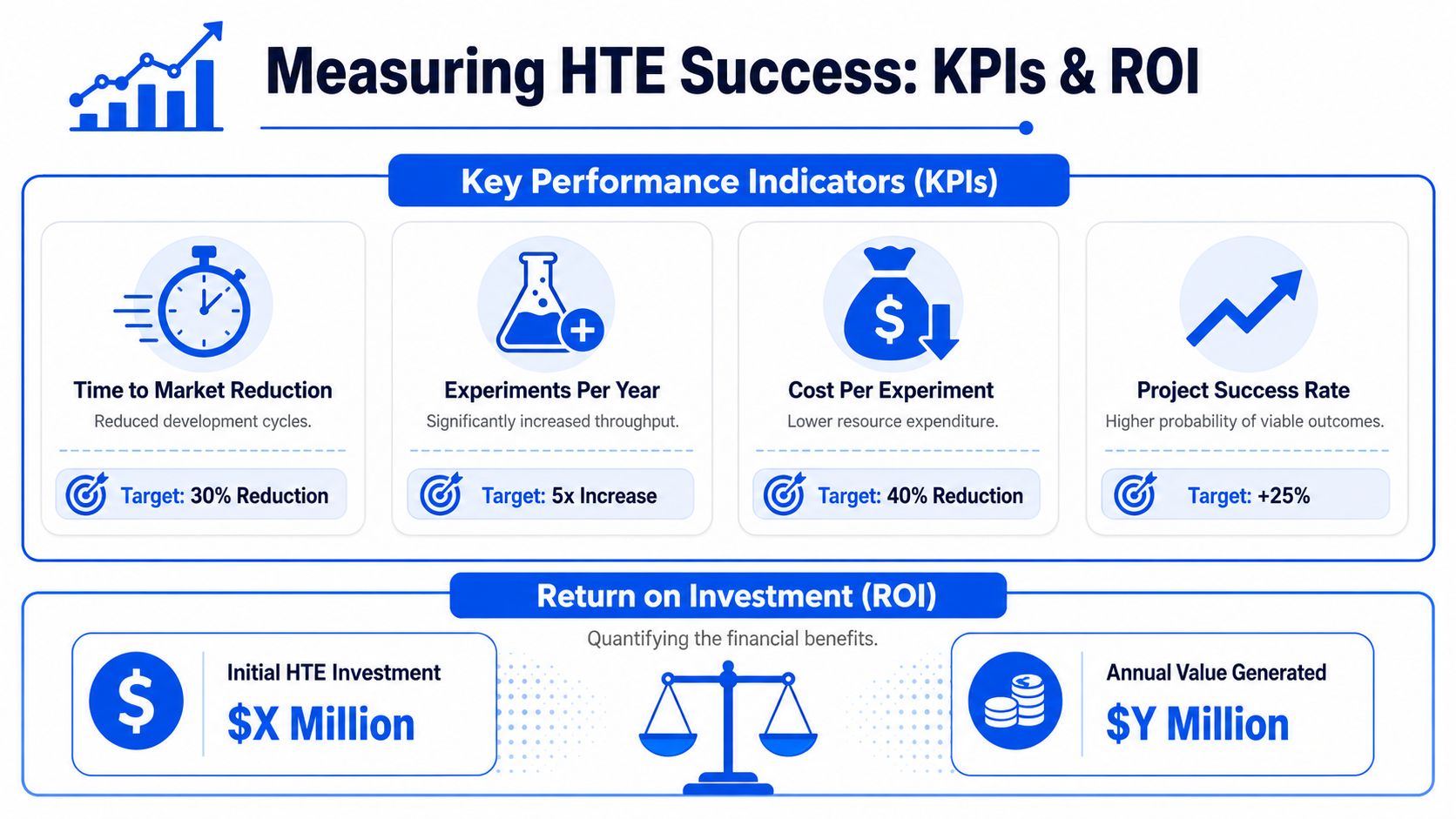
A useful KPI set includes both operational and strategic measures. Operational metrics show whether the HTE system is functioning well. Strategic metrics show whether the business is learning faster and making better portfolio choices.
A practical scorecard often includes:
- Experiments executed per campaign or per scientist: this shows whether throughput is increasing in a meaningful way.
- Cycle time from design to decision: this captures the speed of learning, not just the speed of setup.
- Material consumption per useful data point: this matters when reagents or specialty ingredients are expensive.
- Repeatability across runs: if outputs aren't consistent, the throughput advantage won't hold.
- Decision conversion rate: how often a campaign leads to a clear next action such as scale-up, reformulation, or project stop.
- Data completeness and usability: whether the campaign becomes reusable for future modeling.
For organizations linking HTE to predictive systems, one benchmark stands out. The synergistic value of combining HTE-generated datasets with AI can be substantial. According to this video discussion of AI-native systems of intelligence, such systems can reduce failed experiments by up to 50% within three months when explainable models surface critical formulation parameters with confidence scores.
That metric is powerful because it shifts the conversation from “more experiments” to “fewer wasted experiments.”
How to frame ROI without guesswork
ROI for HTE should be calculated as a portfolio effect, not just a labor-saving exercise. A narrow business case based only on headcount efficiency often undersells the value.
Use a simple framework with three buckets.
First, capture direct operating gains. These include lower material waste from miniaturized experiments, reduced manual setup effort, and less time spent on repetitive screening work.
Second, estimate decision acceleration. Faster identification of viable paths means promising programs move sooner and weak programs stop sooner. That has real value even when it's difficult to reduce to a single accounting line.
Third, measure knowledge compounding. A well-run HTE program leaves behind reusable data assets that improve future campaigns. This becomes especially important once teams begin applying predictive models or experiment recommendation systems.
The strongest ROI case for HTE is usually not labor reduction. It's avoided delay and avoided dead-end work.
One caution is worth stating clearly. Don't present placeholder targets from vendor slides as realized results. Set your own baseline, measure against it, and review trends over time. The leadership question isn't whether HTE looks efficient in theory. It's whether your organization is reducing uncertainty faster than it did before.
The Scale-Up Challenge From Lab Data to Production Reality
The most dangerous assumption in high throughput experimentation is that miniature success will translate cleanly to manufacturing. It often won't.
HTE is excellent at exploring chemical and formulation space quickly, but scale introduces physical effects that small-format systems don't fully reproduce. If leadership treats lab-scale optimization as a direct proxy for production behavior, the organization may move failure later in the process, where it becomes more expensive.

Why miniature success can fail in production
The gap is fundamentally about physics. Micro-reactors and small-vial systems behave differently from larger vessels in heat transfer, mixing efficiency, mass transport, and solvent evaporation. A formulation that looks stable or highly reactive at miniature scale may respond very differently once batch volume, vessel geometry, and process energy change.
This isn't a minor edge case. The translation of miniature HTE data to industrial scale is a major challenge, and Chronect's discussion of HTE scale-up limitations notes that up to 40% of lab-optimized reactions fail during scale-up because of unmodeled physical phenomena such as differences in heat transfer and mixing efficiency.
That single fact should shape how leaders evaluate HTE programs. A fast discovery engine is valuable, but only if the organization also builds a disciplined bridge from screening to production reality.
How to de-risk the handoff
The answer isn't to distrust HTE. It's to use it correctly.
Teams that scale well usually add at least one intermediate validation layer between miniature screening and full production. They also involve process engineers earlier, not after the “winning” lab result is already socially locked in.
A practical de-risking playbook includes:
- Screen for reliability, not just peak performance: favor conditions that tolerate process variation.
- Capture process-relevant metadata: mixing method, residence time, thermal profile, and handling conditions matter.
- Design intermediate-scale confirmation runs: these help reveal whether the apparent winner is physically realistic.
- Integrate process modeling: use engineering judgment alongside screening results to assess transfer risk.
- Flag scale-dependent variables early: some formulation parameters behave differently once energy input and geometry change.
A formulation is not production-ready because it won in a plate. It's production-ready when it survives translation.
This is also where AI can become more useful than brute-force screening alone. When historical HTE and scale-up outcomes are linked, teams can start identifying which variables are likely to remain stable across scales and which ones need targeted validation. That creates a more realistic path from discovery to commercialization.
Organizations that ignore scale-up until late usually pay for speed twice. They move fast in the lab, then lose time in re-optimization. Organizations that design HTE with scale translation in mind keep more of the time advantage they earned upfront.
Conclusion HTE as the Engine for Smart Innovation
High throughput experimentation is no longer just a lab automation concept. It is the operating foundation for modern discovery in chemicals, polymers, and advanced materials.
Its real value comes from three shifts happening together. Teams move from serial work to parallel learning. They treat experiments as a source of structured, reusable data rather than isolated outcomes. And they connect that data to predictive systems that help scientists choose better next steps.
The organizations that benefit most also stay realistic about scale-up. They don't confuse miniature screening success with manufacturing readiness, and they build validation into the workflow early.
That's the broader lesson. HTE works best when it is treated as both a scientific method and a strategic system. Done well, it helps companies move beyond trial-and-error and toward discovery by design.
If your team is building an HTE-driven R&D model and wants the data backbone, explainable AI, and scale-up intelligence to make it work in practice, Polymerize is built for that challenge. It helps materials teams unify fragmented experimental data, generate AI-ready knowledge from lab activity, and make faster, higher-confidence decisions across discovery, development, and scale-up.
Put your R&D data to work
See how materials teams use Polymerize to plan fewer experiments and reach target properties faster.