



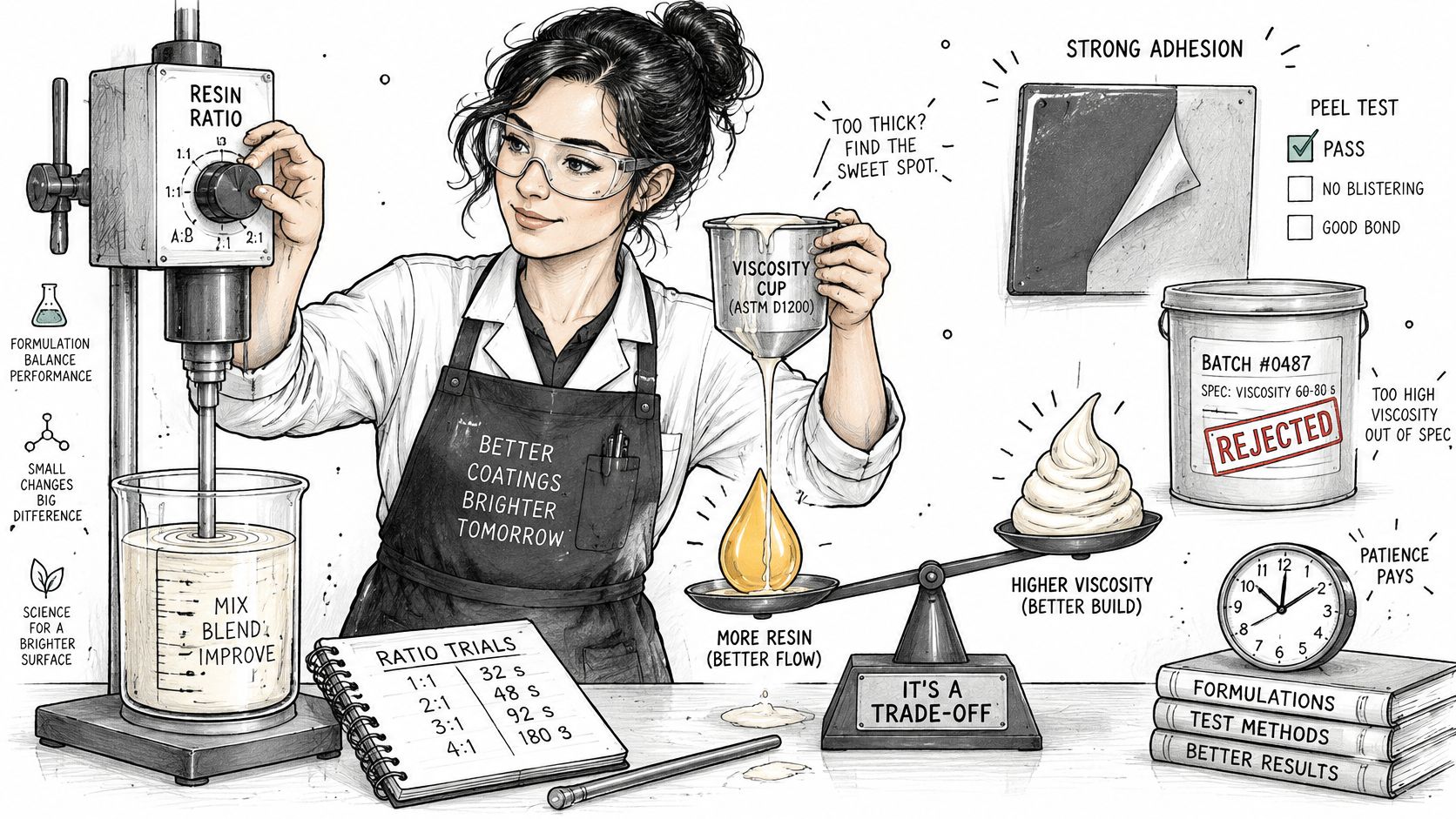
You change a resin ratio to improve coating adhesion. The adhesion result looks promising, but viscosity jumps, application becomes difficult, and the batch misses specification. Your team has a better result on one test, not a better product.
That's the practical challenge behind formulation optimization: finding a composition and a manufacturing route that work together. A laboratory winner is only a candidate until you can trust the measurements and reproduce its performance under production conditions.
Table of Contents
- What Formulation Optimization Solves in Materials R&D
- Choosing a Design That Fits Your Mixture
- How to Run an Optimization Cycle Step by Step
- Data Quality Limits in AI-Driven Optimization
- Letting Data Choose Your Next Experiment
- Why a Lab Optimum Can Fail at Scale-Up
- Worked Examples from Coatings and Adhesives
- Deciding Whether to Start a Formulation Optimization Program
What Formulation Optimization Solves in Materials R&D
Formulation optimization means finding the blend and process settings that meet several requirements simultaneously. For a coating, those requirements might include viscosity, adhesion, cure time, durability, and cost. Improving any property in isolation can leave you farther from a usable product.
Think of a baking recipe expressed as proportions of the total batch. Adding a larger share of flour means reducing the relative share of something else. Materials formulations follow the same compositional logic, so an apparent resin effect may also reflect a reduction in solvent, filler, or another ingredient.
The laboratory work makes those trade-offs tangible.
From isolated changes to planned experiments
The statistical foundation runs from Ronald Fisher's development of Design of Experiments in the 1920s to George Box and John Wilson's introduction of response-surface methodology in 1951, as described in this review of experimental-design methods. These methods let scientists vary factors together, estimate interactions, and describe how measured properties change across an experimental region.
An interaction means that an ingredient's effect changes with another ingredient or processing condition. A catalyst might shorten cure time at one temperature but provide little practical benefit at another. Testing each factor separately can obscure that relationship.
In polymer and chemical development, relevant variables include monomer ratios, catalyst loading, additive concentrations, curing conditions, and processing temperature. Scientists need to distinguish variables that change composition from variables that change how the composition is processed.
Practical rule: Define a successful product before designing an experiment. Otherwise, you'll optimize whichever property is easiest to measure.
Write a short target sheet with a specification, test method, and acceptance rule for every critical response. Separate hard constraints, such as an application viscosity limit, from preferences, such as lower cost. That distinction prevents a strong average score from disguising an unacceptable failure.
Choosing a Design That Fits Your Mixture
An ordinary factorial design treats factors as independently adjustable. Mixture proportions aren't independent: increasing one requires compensating changes elsewhere. A conventional grid can therefore generate impossible recipes or make ingredient effects difficult to interpret.
A quadratic Scheffé mixture model represents component contributions and pairwise blending interactions, helping identify synergy or antagonism among resin, filler, compatibilizer, stabilizer, and lubricant, as explained in this mixture-design study. Its coefficients describe behavior within the chosen composition region, not universal ingredient properties.
Experimental designs compared for formulation work
| Design | Best for | Typical runs | Watch-out |
|---|---|---|---|
| Simplex-lattice, quadratic | Screening component proportions | Component vertices plus pairwise midpoint blends | Mixture-only; needs check blends |
| Simplex-centroid | Blends with interaction effects | A blend for every nonempty subset of components | Add replicates to estimate error |
| Full factorial | Process factors such as temperature and time | Product of the numbers of levels assigned to each factor | Not valid as an independent grid for mixture proportions |
| Central composite | Process curvature and locating an optimum | Factorial points plus axial points and replicated center points | Axial settings must remain physically feasible |
| Box-Behnken | Quadratic process-response surfaces without extreme corners | Edge-midpoint combinations plus center points | Process-factor design, not a substitute for mixture design |
Read the table by identifying what you're changing, rather than choosing the design with the most familiar name. A simplex-lattice is a starting point when ingredient proportions are the variables. Use computer-generated constrained designs when minimum loadings, solubility limits, or processing restrictions exclude parts of the simplex.
A published amoxicillin-trihydrate polymer-formulation investigation used nine experimental trials at each stage with a 3² full-factorial design, according to the International Journal of Chemical Engineering study. That run count belongs to that particular factor-level structure, not to formulation optimization generally.
Budget the complete design
Don't equate the minimum model-fitting set with a finished experimental program. Add check blends, replicated preparations, and independent confirmation runs before estimating material demand and instrument time.
- Composition questions: Use a mixture design that respects ingredient bounds and the total.
- Processing questions: Use an appropriate factorial or response-surface design.
- Coupled questions: Combine mixture and process factors when processing could change which blend performs best.
Before ordering ingredients, count the model terms, confirm that the proposed design can estimate them, and reserve capacity for validation. A design that consumes the entire budget before confirmation is incomplete.
How to Run an Optimization Cycle Step by Step
A useful optimization cycle produces both candidate formulations and evidence about whether their predicted performance is credible. Agree on the execution plan before the first batch, including what happens when a run fails.
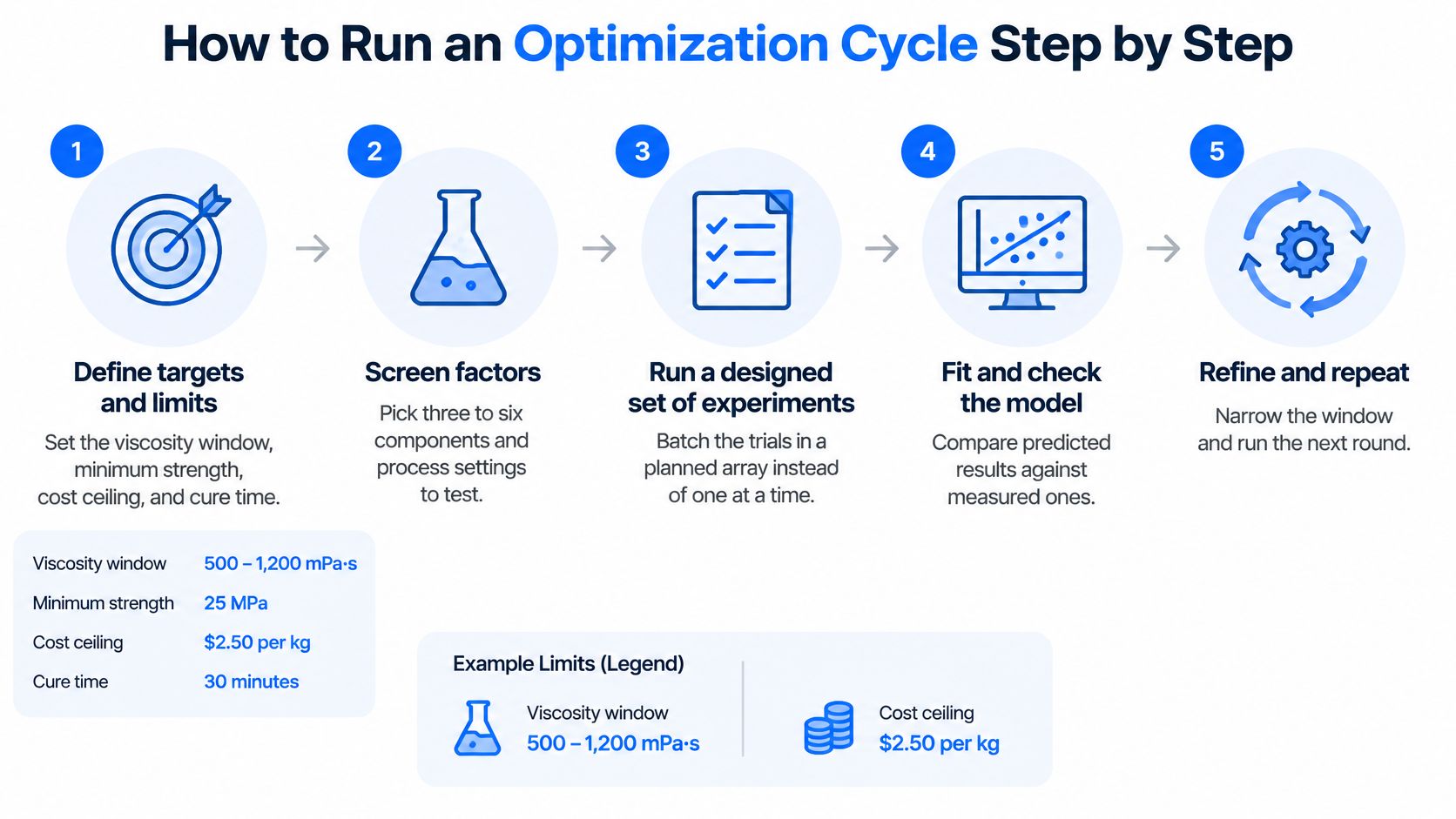
The overview below groups the work into broad stages; the operating checklist adds the checks needed between them.
Set up the experiment
Define targets and limits. Enter the actual viscosity window, minimum strength, cost ceiling, and acceptable cure time from the product specification, with units and test conditions. The common slip is using directions such as “stronger” or “faster” without an acceptance threshold.
Screen plausible factors. Use batch records and chemical understanding to select ingredients and process settings that could explain meaningful performance differences. Avoid changing every available variable, which spreads the experimental budget across questions the team may not need answered.
Build a feasible starting design. Use constrained simplex points for composition and suitable space-filling points for continuous process settings, checking every proposed recipe before release. A frequent mistake is checking ingredient bounds individually while missing an invalid total or an incompatible combination.
Prepare and test with replication. Randomize run order where practical, block unavoidable day or equipment changes, and distinguish independent batch preparations from repeated readings of the same specimen. Repeated instrument readings alone won't reveal preparation variability.
Turn measurements into decisions
Fit and diagnose the model. Use a Scheffé model for blending behavior or an appropriate process-response model, then inspect residuals against predictions, run order, and operating conditions. Don't accept a high fit score while ignoring structured errors or influential outliers.
Run independent confirmations. Prepare fresh blends near the predicted optimum and near relevant constraint boundaries, using the same acceptance rules established before testing. Reusing the training batches as confirmation only checks whether the model remembers its inputs.
Test the operating margin. Deliberately perturb the settings that operators and suppliers can't hold perfectly, then check whether the candidate remains acceptable. The common slip is choosing a sharp predicted peak without measuring how quickly performance deteriorates around it.
Update and decide. Add the new results, revise the experimental region, and investigate disagreements larger than the observed experimental error. Don't keep narrowing the search if the disagreement suggests an omitted factor, an unstable method, or a misleading model.
A useful stopping decision is supported by confirmation results and operating margin, not by a software optimizer returning a maximum.
Keep a decision log alongside the results. Record why each candidate advanced, which constraints rejected alternatives, and what uncertainty remains. That record becomes especially valuable when a process engineer later asks why the team selected a formulation that wasn't the strongest specimen in the laboratory.
Data Quality Limits in AI-Driven Optimization
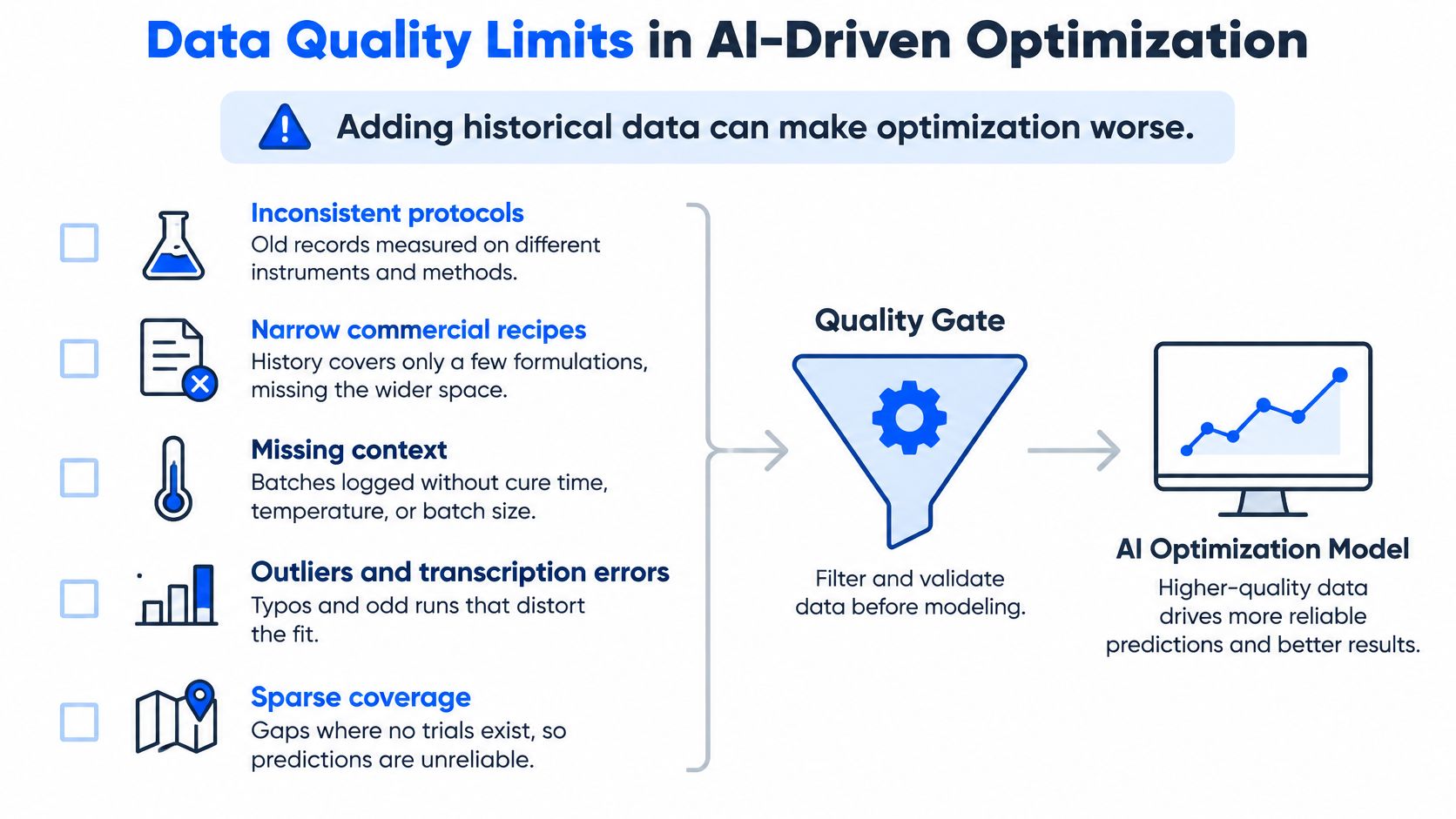
Adding historical data can make optimization worse when records combine incompatible protocols or cover only a narrow family of commercial recipes. A model can learn differences between instruments or procedures instead of useful composition-property relationships.
The Dataintelo materials-discovery AI market report identifies constraints involving scarce structured datasets and polymer representation. For an R&D team, the immediate task is to establish which records are comparable before selecting an algorithm.
Use a quality gate rather than importing every spreadsheet indiscriminately.
Minimum metadata for every formulation run
| Field | Why it matters | Minimum entry |
|---|---|---|
| Raw-material lot | Changing lots can shift results | Supplier, grade and lot number |
| Instrument and calibration | Unlinked readings may not be comparable | Instrument ID and calibration date |
| Test method and temperature | Nonidentical conditions undermine comparisons | Standard method name and test temperature |
| Operator and date | Helps trace procedure drift | Operator ID and run date |
| Failed runs | Missing failures bias the model | Every failed run with the reason |
Also preserve the complete recipe, preparation sequence, batch size, and relevant processing history. Don't convert an unmeasurable specimen into a missing value: distinguish processing failure, instrument failure, and a property outside the measurement range.
Define when the model must abstain
An applicability-domain check asks whether a candidate resembles the chemistry and conditions represented in the training set. Outside that domain, request an exploratory test rather than presenting the prediction as a dependable production recommendation.
Check uncertainty calibration by comparing prediction intervals with held-out experimental outcomes. Set human-review criteria before deployment, including excessive uncertainty, unfamiliar ingredient combinations, and unresolved method changes.
Abstention means the model declines to recommend when those checks fail. Audit the current dataset against these requirements before spending time comparing model architectures.
Letting Data Choose Your Next Experiment
Every experiment consumes material, technician time, equipment capacity, and analysis effort. Sequential optimization is useful when the team needs each new run to answer a specific question rather than fill another row in a grid.
Automated execution is only part of that workflow.
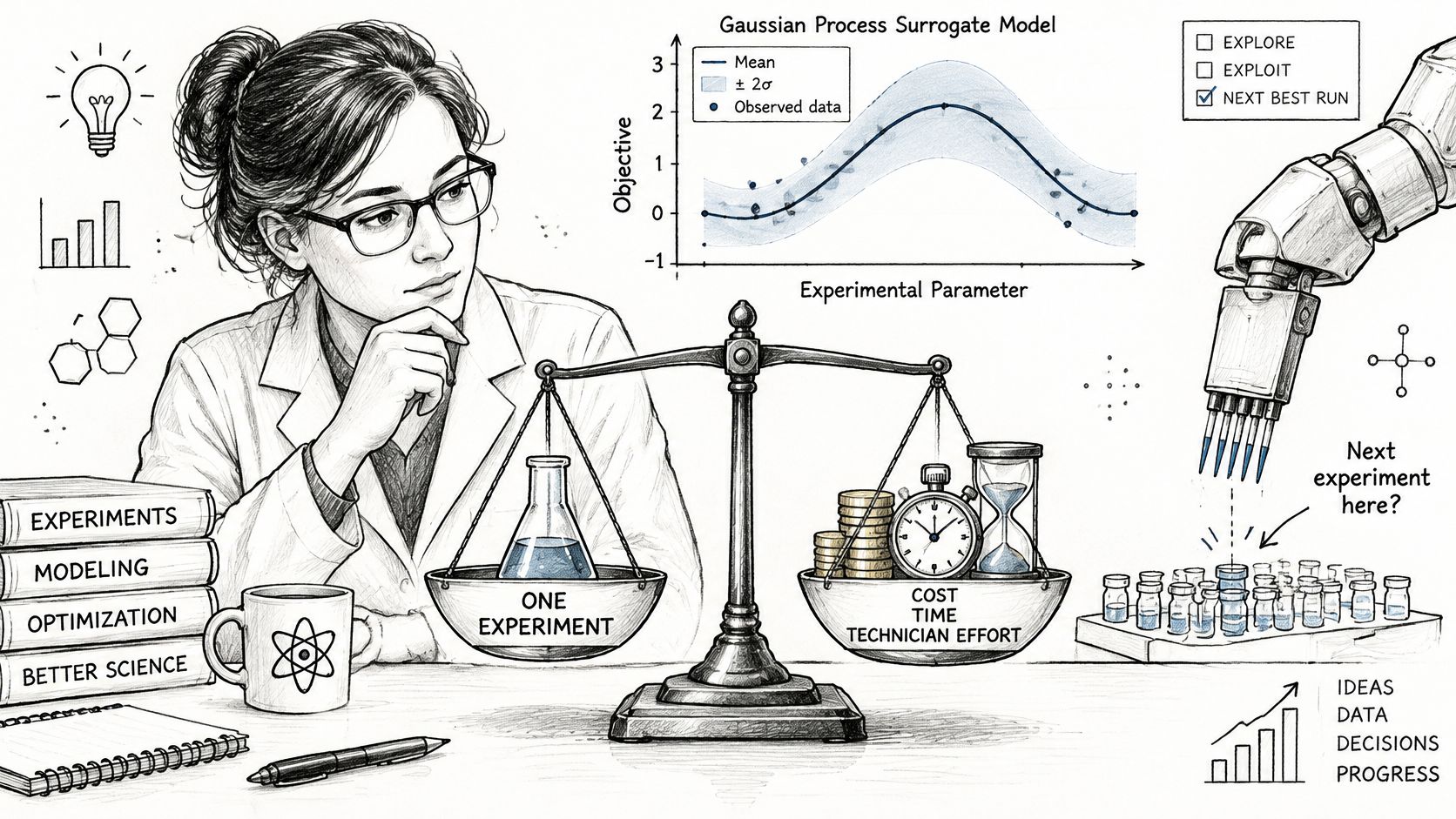
Bayesian optimization uses a surrogate model, commonly a Gaussian process, to estimate performance and uncertainty. An acquisition rule such as expected improvement uses those estimates to choose between testing a promising region and investigating an uncertain one.
The polymer-electrolyte optimization manuscript describes uncertainty-aware sequential selection and discusses a related radical-polymerization investigation that evaluated 314 copolymers across five variables using Latin-hypercube sampling and Bayesian optimization: initiator concentration, feed composition, styrene proportion, reaction temperature, and residence time. The important lesson is the sequence, broad initial coverage followed by informed selection, rather than copying that experimental count.
Make recommendations executable
Begin with space-filling runs across the feasible region. Move to sequential selection once the surrogate provides useful guidance, and attach a confidence estimate and constraint check to every proposed experiment.
For competing objectives, retain the trade-offs explicitly. A candidate with higher conductivity but unacceptable viscosity shouldn't reach the bench merely because a combined score ranks it highly.
For teams connecting recommendations to laboratory execution, Rite NRG's resource lets you explore AI monitoring and human controls as part of planning the review process.
Use the accompanying video as a discussion prompt for how experimental selection fits your team's workflow.
The economic test is straightforward: use this approach when experiments are expensive and nonlinear interactions make exhaustive searches impractical. For a small, well-understood experimental space, a transparent designed experiment may be easier to execute and defend.
Why a Lab Optimum Can Fail at Scale-Up
The highest bench result isn't automatically the best production choice. A slightly less performant formulation can be preferable if operators can manufacture it consistently without working against narrow processing limits.
A review of highly filled polymer manufacturing identifies process-induced porosity, poorly understood solid-liquid interfaces, equipment limitations, insufficient in-situ measurement, and large-batch throughput constraints. These barriers make recipe transfer a process-development problem, not merely a weighing exercise.
Scale-up factors and how to check them
| Factor | Bench check | Production check |
|---|---|---|
| Mixing energy | Measure power input on the lab mixer | Compare power per unit mass at full batch size |
| Shear history | Record mixing speed and time for each batch | Log or estimate the shear profile along the production line |
| Residence time | Record blending and hold times before testing | Measure time through the extruder or reactor |
| Temperature gradients | Probe multiple vessel locations | Map temperatures across the full vessel |
| Batch variability | Repeat independent blend preparations | Test production batches using different raw-material lots |
| Equipment geometry | Note vessel shape and impeller type | Assess geometric similarity and differences in flow behavior |
Matching mixer speed alone doesn't establish equivalent processing. Different impellers and vessel geometries can produce different circulation, dispersion, and heat-transfer behavior even when the displayed speed matches.
Treat power per unit mass as a useful comparison, not a complete scale-up law. Likewise, a production shear profile may require an engineering estimate rather than a directly measured signal.
Choose the formulation with a defensible manufacturing window, not simply the highest laboratory property value.
Make transfer a separate acceptance decision
Include process variables in the optimization objective when they could alter performance. Challenge the candidate at contrasting batch sizes and investigate which physical factors explain any change.
Distinguish controllable settings from causal mechanisms. Mixing time is a setting; dispersion state may be the mechanism that affects performance. Transferring the mechanism can matter more than preserving the original setting.
Run a production-relevant pilot before declaring the formulation final. Record which predictions held, which failed, and whether the discrepancy arose from composition, processing, sampling, or measurement.
Worked Examples from Coatings and Adhesives
A 2024 study in Advances in Polymer Technology identified 0.4% nano-SiO₂ as the optimal dosage for rapid-curing polyurea composite insulating spray coatings, according to the published coating study. That result belongs to the materials, preparation conditions, and responses evaluated in that investigation. It isn't a universal loading recommendation for polyurea coatings.
To develop a dosage recommendation for your own coating, test a designed loading range and measure the required responses under controlled conditions. Fit the response, identify acceptable candidates, and compare their costs separately rather than assuming the published optimum accounts for your purchasing or application conditions.
An illustrative adhesive case
Consider an adhesive made from resin, filler, and tackifier. This is an illustrative scenario, not a reported experimental result: the team has a peel-strength minimum, a viscosity ceiling, and a cost limit.
The chemist uses a constrained simplex design, adds check blends, and measures each response. Increasing filler reduces ingredient cost, but the fitted viscosity response indicates that filler-rich candidates cross the application ceiling.
- Reject the apparent bargain: The lowest-cost blend is unusable with the intended application equipment.
- Examine the acceptable band: Compare candidates that satisfy peel strength and viscosity before ranking their costs.
- Challenge the selection: Prepare fresh batches and test modest composition changes around the preferred blend.
The strongest adhesive might also be too viscous, while the easiest-to-apply blend might miss peel strength. Neither deserves selection merely because it leads an individual response.
Translate the example into a testable question
The useful output is a feasible region, followed by a candidate selected for its operating margin and commercial requirements. A single optimal number hides those decisions.
Write down a formulation your team currently develops. Name its responses, adjustable ingredients, process settings, and rejection limits, then identify which unknown relationship is preventing a confident decision.
Deciding Whether to Start a Formulation Optimization Program
Start when experiments are costly, ingredient interactions complicate decisions, and the team can recover enough experimental context to compare results. Hold off on model deployment when raw-material identity or test conditions are missing. Repairing those records is part of the program, not administrative work to postpone.
Choose a product with a clear decision owner and measurable acceptance criteria. Write the target sheet, select an appropriate design, and reserve resources for independent confirmation and a production-relevant trial.
Scope a pilot you can evaluate
For solvent-containing products, resolve sourcing and specification questions alongside the experimental plan. Teams considering ethanol inputs can review ETHRA Ingredients' grain neutral spirits services, then define the grade and supplier documentation required for their own application.
At Polymerize, our AI engine requires customer data to predict formulations and experiments and self-optimize over time. Polymerize Labs offers multi-objective optimization, inverse design, and synergy detection for nonlinear ingredient interactions; our stated reduction in reformulation cycles is 75% with first-time-right formulations. Treat that performance figure as a claim to verify against your own baseline, not as the pilot's assumed outcome.
Define success through measured evidence: confirmation properties agree with predictions within experimental error, and the selected candidate remains acceptable when batch scale changes. Record the outcome before expanding to other products.
- Choose the product: Select a formulation with a consequential, bounded development problem.
- Choose the design: Match the experimental structure to composition and processing questions.
- Choose the success measure: Specify what evidence will justify broader adoption next quarter.
We offer AI-guided formulation optimization, property prediction, and experimental planning to help materials teams make better-supported development decisions. Visit Polymerize to discuss a pilot around your target properties, available experimental data, and scale-up acceptance criteria.
Put your R&D data to work
See how materials teams use Polymerize to plan fewer experiments and reach target properties faster.