


Explainable AI (XAI) pairs a property prediction with the formulation or process factors, confidence, and knowledge limits a scientist can check before acting. Its explanation should be testable against the model's behavior, not merely convincing to the person reading it.
Your team may already have a model that predicts tensile strength from ingredient ratios and cure conditions. The validation results look acceptable, but the next formulation meeting still ends with competing suggestions: increase filler, change resin grade, or adjust the cure. The missing piece isn't another predicted value. It's a defensible reason to choose the next experiment.
Table of Contents
- Why a Strong Property Prediction Still Falls Short
- Four Tests Every Materials Explanation Must Pass
- What Each Explanation Layer Can and Cannot Claim
- How to Test Whether the Explanation Is Faithful
- When a Clear Explanation Makes a Wrong Call Convincing
- Lab Decisions an Explanation Should Change
- Decide the Next Experiment From the Explanation
Why a Strong Property Prediction Still Falls Short
Say your model recommends a formulation with higher predicted tensile strength than the current candidate. The formulation chemist wants to know whether the improvement comes from resin fraction or filler loading. The process engineer suspects the cure schedule matters more. Neither can resolve that disagreement from the property number alone.
A black-box prediction tells the team what the model expects. A useful explanation gives them something they can challenge: which inputs influenced that expectation, which historical batches support it, and whether the proposed recipe resembles anything the model has learned from.
The decision behind the prediction
The practical question isn't whether the model can generate another promising candidate. It's whether the team should spend material, instrument time, and operator attention making that candidate.
Consider a micrograph reviewed only as a visual impression. Without connecting the visible structure to measured behavior, the team can miss the structure–property relationship. A property prediction left as a single number creates a similar problem: the result is visible, but the basis for acting remains hidden.
Practical rule: Before accepting a recommendation, name the experimental decision its explanation is supposed to change.
For formulation chemists, process engineers, and R&D leaders, that decision might be choosing a paired formulation study instead of a filler sweep, or confirming a processing condition before scale-up. The useful standard combines understandable reasons, checks on model behavior, interaction analysis, and explicit boundaries.
That makes explainability a scientific-validation and oversight practice, not a dashboard widget. A polished chart is useful only if the team can use it to challenge, revise, or reject the proposed experiment.
Four Tests Every Materials Explanation Must Pass
Explainable AI means the model provides a prediction and an understandable account of how it produced that output, including where the account should no longer support a decision.
The collaboration problem isn't new: DARPA launched its XAI program in 2016, while the NIST publication on explainable AI formalized four principles in 2021: explanation, meaningfulness, explanation accuracy, and knowledge limits. For a materials team, these are separate acceptance tests, not interchangeable descriptions of transparency.
Four tests for a materials XAI explanation
| Principle | What it requires | Materials R&D check | Fails when |
|---|---|---|---|
| Explanation | A reason accompanies the output | Shows formulation, process, or precedent drivers of the predicted property | Only a property number is returned |
| Meaningfulness | The intended user can understand it | A chemist can act without reading model code | The chart is legible only to the data scientist |
| Explanation accuracy | The reason matches model behavior | Stated drivers agree with how the prediction was produced | The story is plausible but not faithful |
| Knowledge limits | The system signals uncertainty and extrapolation | Confidence and domain limits are visible beside the number | An out-of-data recipe is shown as a discovery |
A reason must be usable, not merely available
Explanation is the starting point. If the model predicts improved thermal stability, it should expose the inputs or observations behind that output. A generic statement that composition matters doesn't help distinguish the recommended formulation from its alternatives.
Meaningfulness asks whether the intended scientist can interpret that account. A formulation chemist needs ingredient identities, units, process settings, and a clear reference point. A feature labeled with an internal database code might be technically accurate yet operationally useless.
Ask the chemist to describe what they would change after reading the explanation. If they need the model author to translate every label, the explanation hasn't passed.
A plausible account can still fail
Explanation accuracy concerns fidelity to the model, not agreement with familiar chemistry. A claim that increased crosslinking drove the prediction may sound reasonable. It still fails if the model relied on a batch identifier associated with stronger samples.
Knowledge limits require a visible boundary around the recommendation. A familiar ingredient list doesn't guarantee a familiar formulation: the combination of concentrations and processing conditions may be unsupported.
A defensible explanation names the relevant formulation variables, process conditions, or historical observations, communicates confidence, and refuses to present unsupported extrapolation as a reliable discovery.
Score a current prediction against every row before debating technique names. SHAP, saliency, or an interpretable model architecture can contribute to the system, but none of those labels alone establishes that the explanation passes.
What Each Explanation Layer Can and Cannot Claim
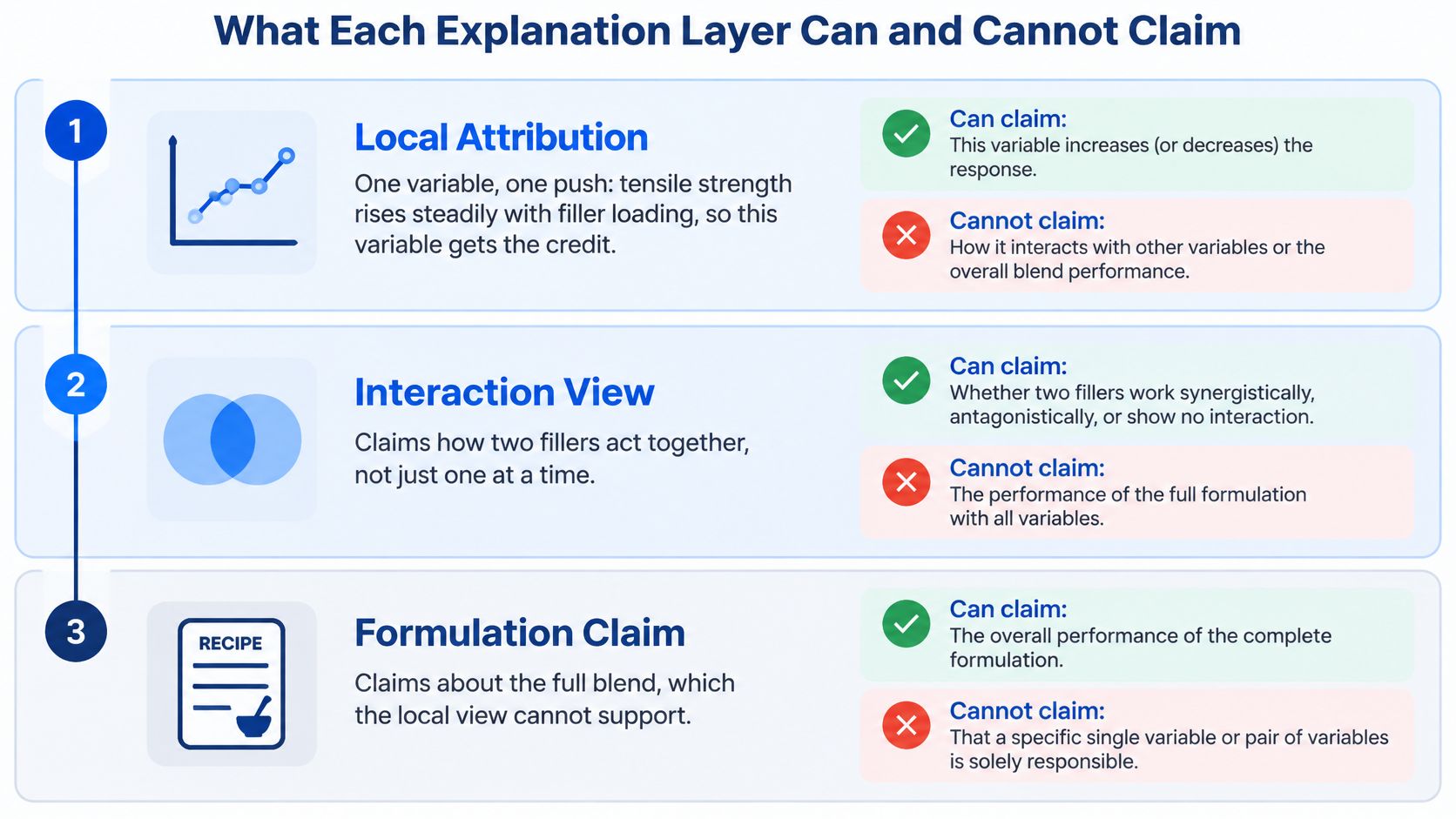
In a hypothetical linear blend model, tensile strength rises steadily with filler loading. A local attribution can describe how filler moved the prediction relative to a stated baseline. That's a useful account of this recipe, but it doesn't establish how filler behaves across every blend.
A formulation with a plasticizer introduces a harder question. The model might predict a filler benefit only within a compatible plasticizer range. Outside that range, the predicted gain could disappear, even though filler still receives a prominent position in a feature chart.
The hierarchy below separates a narrow attribution from a claim about the complete formulation.
Additive shares aren't an experiment plan
Many post-hoc explanations summarize a complex response through additive contributions. Exact synthetic benchmarks described in the feature-attribution study identify failures involving nonlinear relationships, cancellations, and absence-based effects, including highlighting inputs that don't contribute.
This matters when catalyst loading works differently at different cure temperatures, or when a predicted benefit depends on leaving an incompatible ingredient out. A ranked list can obscure those conditions. An additive accounting of a prediction is not the same thing as an additive physical response.
Treat the explanation methods as a stack. Local attribution identifies the inputs credited for a particular output. Interaction analysis examines joint effects. A counterfactual check recomputes the model after a feasible change rather than inferring the result from the ranking.
Three explanation layers for formulation models
| Layer | Question it answers | Materials example | Failure it catches |
|---|---|---|---|
| Local attribution | Which inputs moved this prediction? | Resin fraction share of predicted tensile strength | A score with no stated drivers |
| Interaction analysis | Which inputs matter only together? | Catalyst loading coupled with cure temperature | A synergy hidden by moderate main effects |
| Counterfactual check | What does the prediction do after a constrained change? | Increase additive while preserving a valid composition | A high attribution that doesn't match the recomputed property |
| Precedent and proxy check | Is the apparent driver a stand-in? | Supplier or line grade correlated with performance | Acting on a historical association |
Separate a model intervention from a physical cause
Suppose a resin grade appears repeatedly in successful historical batches. If that grade was processed mainly on a particular production line, the model may use grade as a proxy for unrecorded operating conditions. Switching grade elsewhere needn't reproduce the historical result.
Even a counterfactual establishes only what the model predicts after an input change. It doesn't prove what the physical material will do. Likewise, a precedent check can reveal a confounder, but it cannot certify causality by itself.
For a closed formulation, specify the balancing rule when changing an ingredient. Increasing additive while holding every other mass fraction fixed may produce an invalid recipe. Hold process conditions fixed where appropriate, preserve composition constraints, and record which component is displaced.
Rank feasible candidates by predicted improvement, uncertainty reduction, constraint feasibility, and precedent coverage. The best next run may be the one that separates competing explanations, rather than the one with the highest predicted strength.
How to Test Whether the Explanation Is Faithful
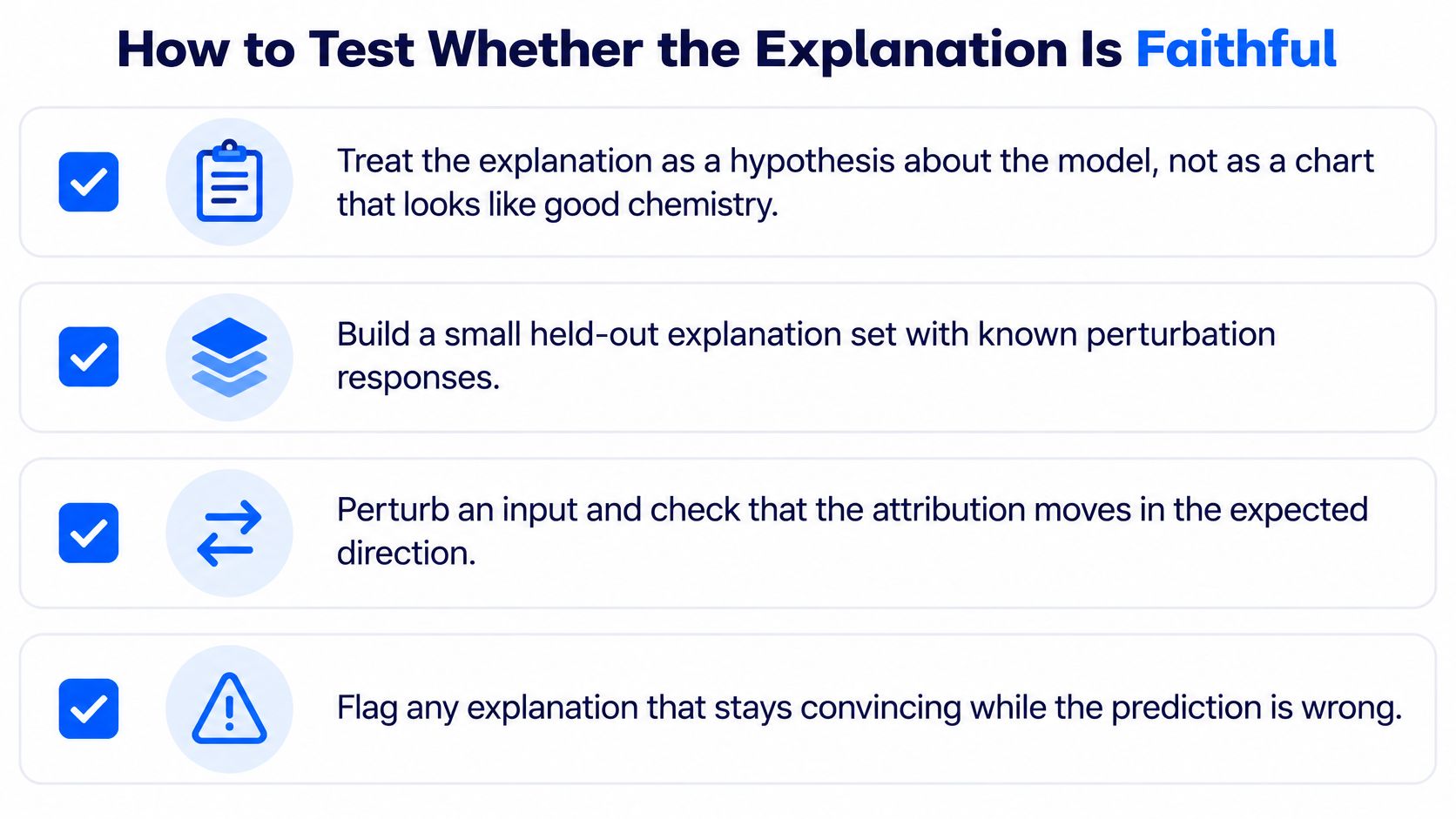
Treat an explanation as a hypothesis about model behavior. If it says catalyst loading drives the output, a suitable perturbation should produce behavior consistent with that claim. Chemical plausibility alone isn't enough.
The NeurIPS M4 benchmark organizes faithfulness evaluation into methods without ground truth, methods using pseudo-ground truth, and synthetic datasets with known attribution values. That framework supports testing explanations instead of accepting their appearance as evidence.
Use this checklist to separate preparation from validation.
Build a held-out explanation test set
Keep explanation test cases separate from model fitting and explainer tuning. Include synthetic formulations with predefined resin, catalyst, and temperature contributions, alongside physically feasible perturbations of representative recipes.
Record the expected response, the permitted perturbation, and what would count as failure. Then run these checks:
Deletion or insertion. Remove, replace, or introduce the claimed driver using a valid reference formulation. Check whether the output changes in the expected direction and broadly consistent magnitude. For ingredients, avoid treating deletion as an empty cell; rebalance the formulation explicitly. This blocks experiments justified by an attribution the model doesn't reproduce.
Sensitivity. Make small, feasible changes to inputs and inspect both the prediction and explanation. A scrambled ranking needs investigation unless the model contains a steep response in that region. This blocks committing a batch based on an unstable interpretation.
Agreement with known contributions. On synthetic cases, compare the explanation with the contributions deliberately built into the response. Include correlated stand-ins so an explainer can't pass merely by selecting an associated variable. This blocks choosing an ingredient change for credit that belongs elsewhere.
Carry the test result into the recommendation
For a hypothetical increase of additive A by 2 wt%, recompute the property using the declared balancing rule. The change should be consistent with the explanation's scope and remain within the model's supported domain; a local contribution isn't automatically a slope that can be extrapolated.
Present the live recommendation with a confidence interval, data-support indicator, and constrained counterfactual. Specify what the interval represents and how it was assessed, rather than displaying an unexplained uncertainty band.
The accompanying video offers another format for exploring the topic.
If a check fails, revise the model, investigate the explainer, or collect targeted data. Don't promote a failed explanation into a pilot-batch justification. Passing establishes evidence about model fidelity, not proof that the predicted material property is correct.
When a Clear Explanation Makes a Wrong Call Convincing
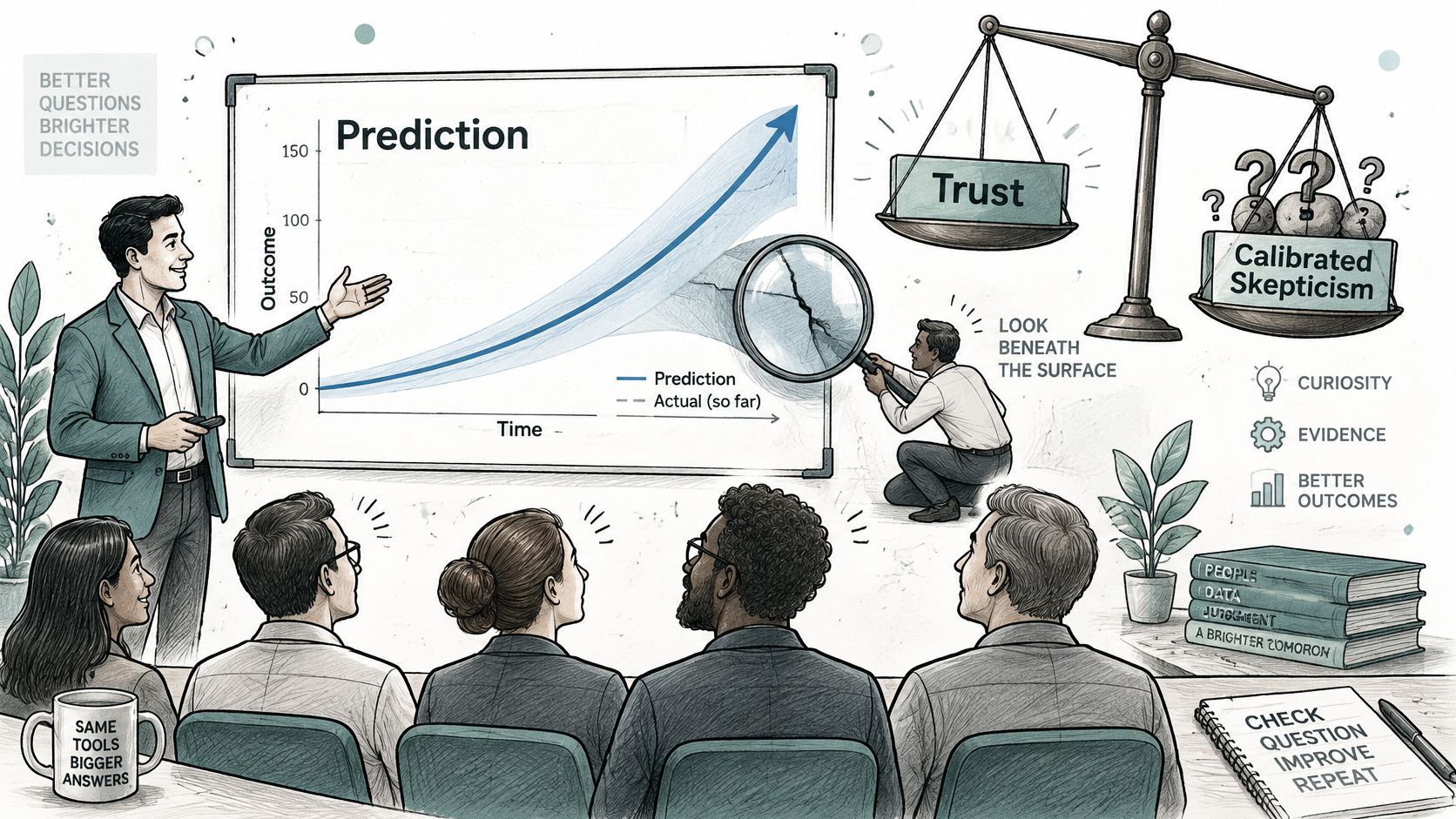
The useful question isn't how explanations build trust. It's how they create calibrated skepticism: accepting a recommendation when evidence supports it and withholding acceptance when it doesn't.
Empirical findings summarized in the study of XAI trust and implementation barriers indicate that people can overtrust AI classifications and rely on explanations instead of checking underlying facts; reported results also found that raw confidence scores improved appropriate trust while percentage-based presentations reduced it despite conveying the same information. Those findings concern the studied settings, not a proven effect in formulation laboratories.
The practical lesson is to evaluate how scientists interpret the display, rather than assuming a clear interface produces sound judgment.
Make contradictory evidence visible
A ranked list of familiar ingredients can make an unfamiliar recipe feel routine. A chemist may recognize the names and accept the accompanying mechanism without checking whether the proposed processing conditions resemble the supporting experiments.
Don't make the scientist open separate screens to discover the reasons for caution. Put these beside the recommendation:
- Uncertainty range. Identify the property, units, and meaning of the range.
- Out-of-distribution warning. Name the unsupported composition or process condition.
- Explainer disagreement. Flag conflicting accounts rather than selecting the most persuasive chart.
- Precedent provenance. Show the source experiment and relevant preparation and measurement conditions.
- Rejection condition. State what evidence disqualifies the proposed action.
Disagreement between explainers is a diagnostic signal, not a majority vote on chemistry. Ask whether the methods use different reference populations, perturbations, or definitions of importance before deciding which interpretation is useful.
Write rejection rules before reviewing the result
For a hypothetical recommendation, the team should stop if the composition leaves the supported training window, if the constrained counterfactual contradicts the claimed benefit, or if a comparable past experiment failed at the proposed process settings without an explanation for the difference.
A stop doesn't mean abandoning the chemistry. It means changing the purpose of the next run from performance optimization to verification or information gathering. That distinction prevents an exploratory result from being treated as a production-ready recommendation.
An explanation earns its place when it changes the next experiment correctly and can be checked on the bench, not when it produces the most elaborate chart.
Have a chemist review deliberately difficult cases, including failed batches and unsupported recipes. Assess whether the interface helps them notice the problem, not merely whether they find it understandable or reassuring.
Lab Decisions an Explanation Should Change
Use the following hypothetical cases to judge usefulness. Each starts with a plausible recommendation, but the explanation changes what the team makes or measures.
Formulation and process decisions
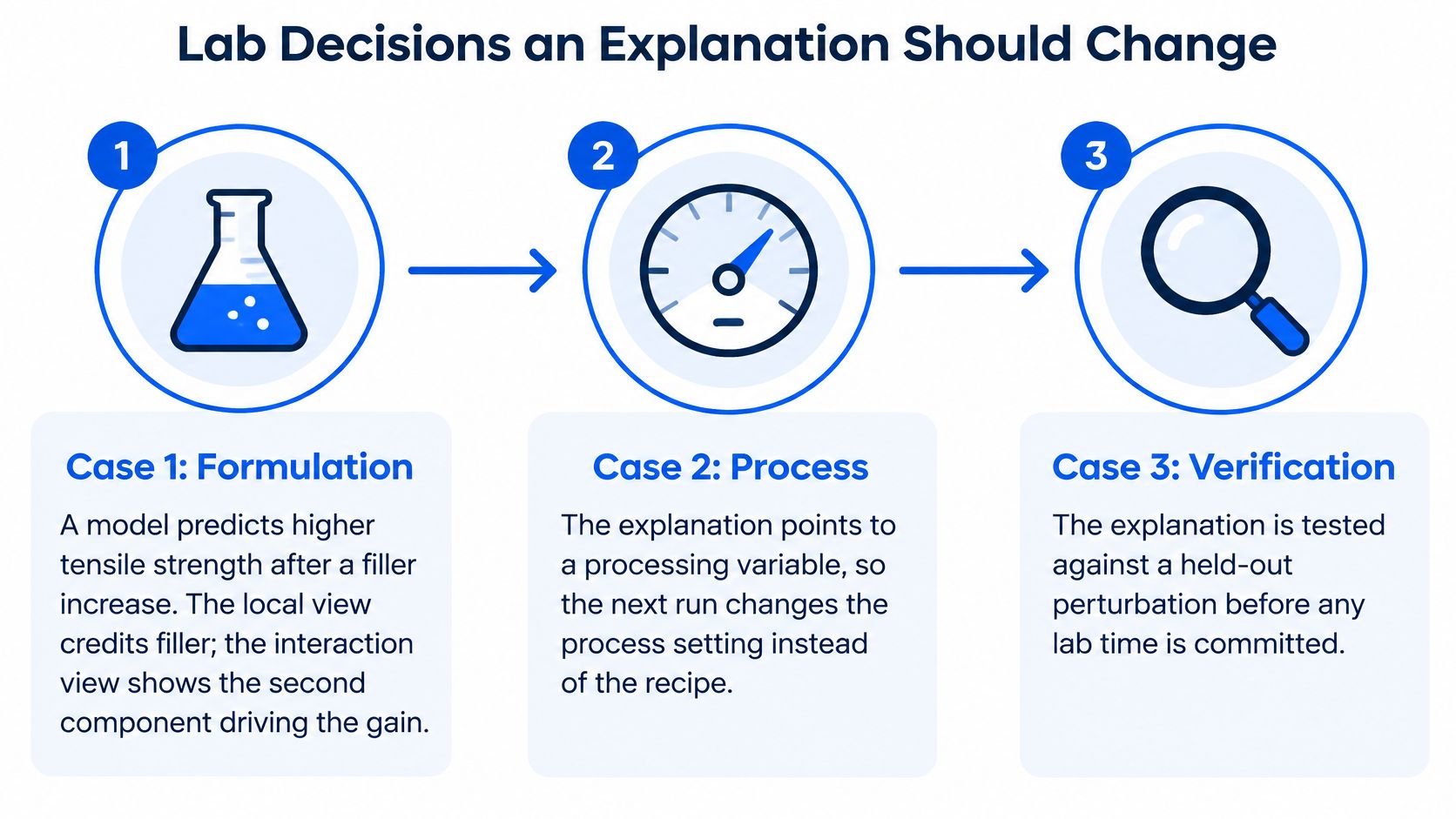
Formulation case. A model predicts higher tensile strength after increasing filler. The tempting reading is to schedule a filler sweep. Interaction analysis instead indicates that the benefit occurs only below a plasticizer threshold, while constrained recomputation predicts little gain at the current plasticizer level.
The replacement experiment varies filler and plasticizer together within feasible limits, with a reference formulation retained for comparison. The property target hasn't changed. The experiment now distinguishes a joint effect from a filler-only story.
Process case. A viscosity explanation credits resin grade. Reviewing the supporting records reveals that the grade was mostly run on a particular production line, so the team can't yet separate material identity from processing history.
Instead of buying another grade immediately, the team holds grade fixed and varies temperature and shear under controlled preparation and measurement conditions. That experiment tests whether the apparent ingredient effect belongs to the process.
The diagram summarizes how explanation review can redirect experimental work.
Scale-up and the operational scorecard
Scale-up case. Predicted adhesion meets the target, but the support indicator flags production temperature as outside the training range. The misleading reading is that an on-target laboratory property justifies locking the production window.
The team replaces that plan with a narrow confirmation study around the intended operating conditions. They record adhesion alongside the processing history so the result can inform both the scale-up decision and the model update.
A review of explainable-AI evaluation reports that fewer than 1% of XAI papers validate explanations with human users and identifies a lack of standardized materials-science benchmarks. Teams therefore need a local scorecard that tests usefulness with the scientists making decisions:
- Experiment-selection quality. Did the chosen run resolve the stated question or improve the candidate?
- Calibration. Did later measurements behave consistently with the expressed uncertainty?
- Reproducibility. Could another laboratory reconstruct the rationale and conditions?
- Time-to-decision. Could the team reach a defensible choice without an unnecessary interpretation exercise?
- Scale-up outcome. Did the recommendation remain useful under the intended production conditions?
Record these outcomes with the recommendation, including rejected suggestions. A simpler explanation that correctly redirects the next batch is more valuable than an account nobody can verify.
Decide the Next Experiment From the Explanation
Use a go-or-no-go gate before committing a recommendation to a pilot batch. Require the following alongside the predicted property:
- An understandable driver account. A chemist can identify the proposed change and why the model favors it.
- A faithfulness result. The relevant checks are recorded, or the untested gap is explicitly labeled.
- A confidence range and domain flag. The team can distinguish supported interpolation from exploration.
- A historical precedent or an explicit absence. Scientists can inspect a comparable experiment or see that none exists.
A labeled gap isn't an automatic pass. If it affects the proposed decision, collect the missing information or revise the model before committing the pilot. An exploratory bench experiment can still proceed, but its purpose and uncertainty should be recorded as such.
Keep the decision record with the experiment
Save the model version, input formulation, operating conditions, explanation, proposed intervention, and scientist's disposition together. After testing, add the measured outcome and the reason for any disagreement. That creates a reviewable connection between recommendation and result.
The governance context reinforces this discipline: the European Commission's AI Act implementation timeline states that the Act entered into force on 1 August 2024, with obligations introduced in stages. Applicability depends on the system and its use; a materials prediction model shouldn't automatically be treated as high risk.
Documentation, human oversight, and recorded operating limits are useful regardless of classification. They help another laboratory understand why a candidate advanced and help scale-up reviewers distinguish measured evidence from model expectations.
Put the evidence beside the prediction
In Polymerize Labs, we show feature attribution maps, causal pathway analysis, and confidence scoring, with contributing factors and similar historical experiments accompanying each prediction. Every recommendation includes feature importance, confidence scores, and historical precedents scientists can verify. Those views support review; causal pathway analysis still needs experimental validation before it establishes a physical mechanism.
A Japanese TPU manufacturer hit precise targets for 10 material properties across two process flows, with over 95% prediction accuracy. That outcome is specific to the manufacturer's application, not a substitute for validating another team's model.
Choose a live formulation recommendation and apply the gate before approving its next run. Record which evidence supports the decision and which observation would make the team reverse it.
We offer materials-focused predictions and formulation guidance with explanations scientists can inspect, including contributing factors, confidence scores, and historical precedents. Visit Polymerize to explore how your team can review the next recommended experiment with evidence beside the property prediction.
Put your R&D data to work
See how materials teams use Polymerize to plan fewer experiments and reach target properties faster.