


You're three weeks into a formulation project and the data lives in four places. One chemist has the latest trials in a spreadsheet, another logged results in the ELN with different column names, and the batch that worked is described in an email thread nobody can find. The next experiment gets picked in a meeting, mostly from memory and intuition, and two weeks later you're repeating a run a sister site already tried.
That's the normal state of materials R&D in most organizations, and it's not a people problem. It's a planning problem. Experiment planning software exists to close the gap between what a team already knows and what it tests next, but only if the tool does more than rank candidates. The hard parts are validated outcomes, secure integration, and whether scientists trust a recommendation enough to spend lab time on it.
Table of Contents
- Data Integration and Provenance
- Design Generation and Bayesian Optimization
- Orchestration, Explainability, and Security
- Start With a Pilot That Can Prove Something
- Govern the Data and the Access
- Close the Validation Gap Deliberately
- Metrics Worth Tracking
- Scenario One Polymer Formulation Optimization
- Scenario Two Chemical Process Scale-Up
What Is Experiment Planning Software
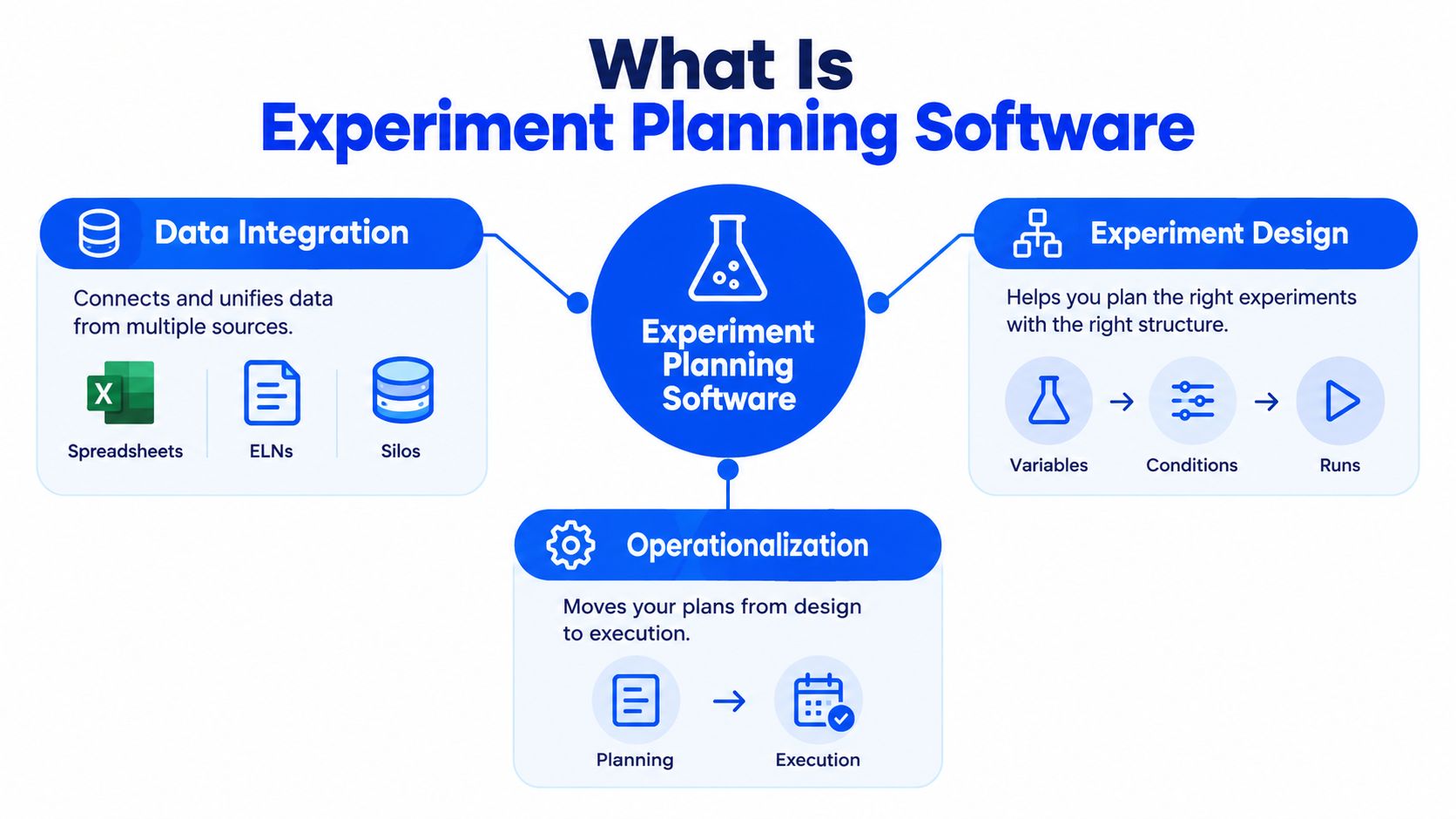
Experiment planning software is a decision system, not a calendar. Lab scheduling tools book equipment and log who ran what. Planning software answers a different question: given everything you've already measured, which experiment should you run next, and why?
The concept map below frames the three pieces that make that possible.
Roots in Design of Experiments
The discipline comes from the Design of Experiments (DoE) framework developed by Ronald A. Fisher during the 1920s and 1930s at Rothamsted Agricultural Experimental Station in England, as documented in Fisher's foundational work on field experiment design. Fisher tackled a practical failure mode: results distorted by uncontrolled variation, poor treatment allocation, and analysis improvised after the data arrived. His 1926 book, The Arrangement of Field Experiments, and his 1935 book, The Design of Experiments, set out principles you still see in modern tools.
- Randomization: Assign treatments so background noise doesn't masquerade as an effect
- Replication and blocking: Repeat runs and group similar conditions to separate signal from variation
- Factorial designs and analysis of variance: Test multiple factors together and estimate how they interact
In 1951, George E. P. Box and K. B. Wilson added response surface methodology, which let researchers model and optimize outcomes across several continuous variables at once. That milestone matters for formulators because composition and process variables rarely act alone.
Structured Study Versus One Factor at a Time
A structured study extracts more information from a single planned set of runs than a sequence of isolated one-factor-at-a-time tests. Change the catalyst loading this week, the temperature next week, and the solvent the week after, and you'll never learn whether temperature only helps at high catalyst loading. A factorial plan tests those combinations deliberately, so interactions show up in the data instead of hiding in it.
Modern experiment planning software operationalizes that logic digitally. It generates designs, tracks factors and responses, estimates interactions, and helps you pick informative next experiments. It's nearly a century of statistical method made usable at the bench, extended from agriculture into manufacturing, chemicals, medicine, and engineering.
Practical rule: If a tool can't tell you what you'll learn from a run before you execute it, it's a scheduler, not a planner.
Core Capabilities That Matter in Materials R&D
Vendors list dozens of features. Six capabilities determine whether a platform survives contact with real formulation work, and they only deliver value when they connect into one loop.
The sketch below is familiar to anyone who's tried to map a lab's data flows on paper before automating them.

Data Integration and Provenance
Everything starts with getting spreadsheets, ELNs, and siloed files into one structured backbone with consistent factor and response names. If viscosity is recorded under three labels, no model will rescue you. Equally important, every record needs lineage: who ran it, on what equipment, with which raw material lot. Without provenance, you can't explain why a repeated run behaved differently, and you can't defend a result during scale-up or audit.
Design Generation and Bayesian Optimization
Static DoE tables are a starting point. The stronger pattern is pool-based Bayesian optimization, where each result updates a surrogate model that estimates both expected performance and uncertainty, and an acquisition function picks the next candidate by balancing exploitation of promising regions against exploration of poorly characterized ones, as shown in benchmarking across five experimental materials domains. That benchmark covered carbon nanotube and polymer blends, silver nanoparticles, lead halide perovskites, and additively manufactured polymers.
Two findings from that work should shape your requirements. Gaussian process models with automatic relevance determination (ARD) and random forest surrogates performed comparably, while both beat conventional Gaussian processes without ARD. ARD learns different relevance scales for composition and process variables instead of assuming every input moves the response at the same rate, which fits polymer formulation reality. Demand software that exposes surrogate selection and acquisition configuration, preserves categorical and mixed variable constraints, and reports performance against a random sampling baseline.
Orchestration, Explainability, and Security
- Lab orchestration: Turn a chosen design into executable batches that respect equipment capacity and ingredient availability
- Explainability: Surface causal drivers, confidence scores, and historical precedents behind each recommendation, so a chemist can argue with it productively
- Security and compliance: Role based access and audit trails that protect proprietary formulations across sites
Context from outside core materials work helps here too. A guide to vape cartridge formulation from Gold Coast Terpenes walks through disciplined product development practices in a regulated consumer formulation space, and it's a useful reminder that documented, repeatable formulation logic matters in any category where consistency and compliance are on the line.
A platform that designs well but can't orchestrate execution, or predicts well but can't explain itself, creates a new handoff problem instead of solving the old one.
The Real Benefits for R&D Teams
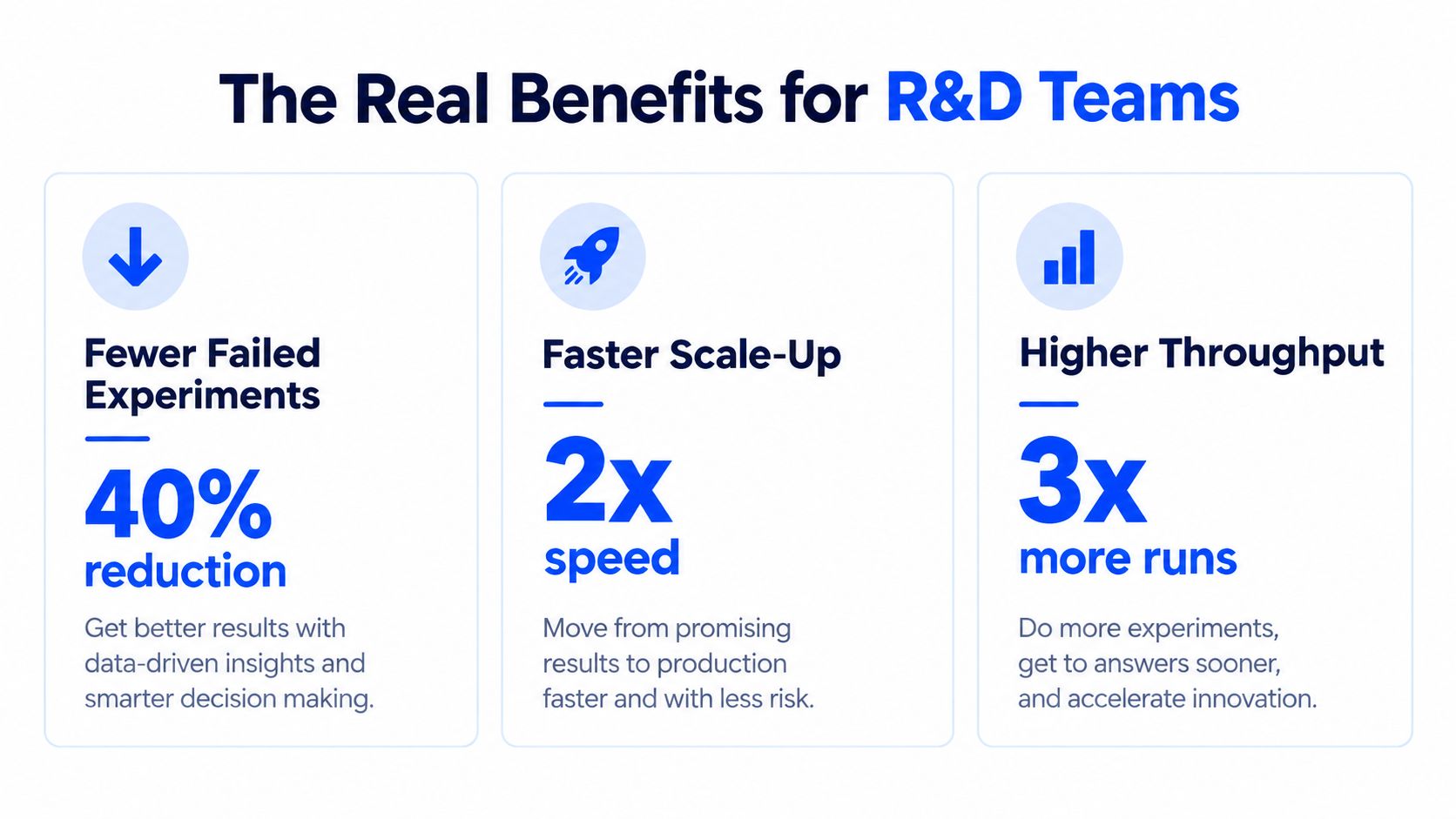
The business case isn't cheaper software. It's fewer wasted runs, faster confidence, and a cleaner path from lab results to production decisions.
The summary graphic below frames the three outcome areas teams usually track first.
Fewer Measurements to Reach an Optimum
Sequential learning planners fit models as data arrives and propose the next trial using a utility function that combines predicted performance with uncertainty. That uncertainty aware decision logic matters more than raw prediction accuracy, because it steers measurements toward high performing regions or toward unexplored regions where one run teaches you the most. Across four materials science test cases, this approach found the optimal candidate with three times fewer measurements on average than random guessing, according to published sequential learning methodology for materials discovery.
Fewer measurements means less raw material consumed, less instrument time queued, and fewer dead end batches for technicians to prepare and dispose of. It also means failed runs still earn their keep, because a well chosen failure in an uncertain region updates the model more than a redundant success in a region you already understand.
Executable Recommendations and Auditable History
Savings evaporate when the planner recommends experiments you can't run. Effective systems let scientists impose feasibility constraints such as ingredient availability, operating windows, safety limits, and batch capacity, so optimization targets real candidates instead of mathematically attractive ones.
The video below gives additional context on how structured experimentation changes day to day R&D work.
Auditable history compounds the benefit. When the software records observations, model versions, uncertainty estimates, acquisition scores, and outcomes for every iteration, you can reproduce why a formulation was recommended months later. That traceability helps teams separate genuine process and property relationships from noise, and it flags distribution shift when lab conditions give way to production conditions, which is exactly where scale-up surprises are born.
Return on investment follows from those mechanics. Each avoided redundant run frees budget and capacity, each documented decision shortens technology transfer, and each uncertainty driven trial reduces the risk of committing pilot resources to a fragile optimum.
A Decision Checklist for Enterprise Buyers
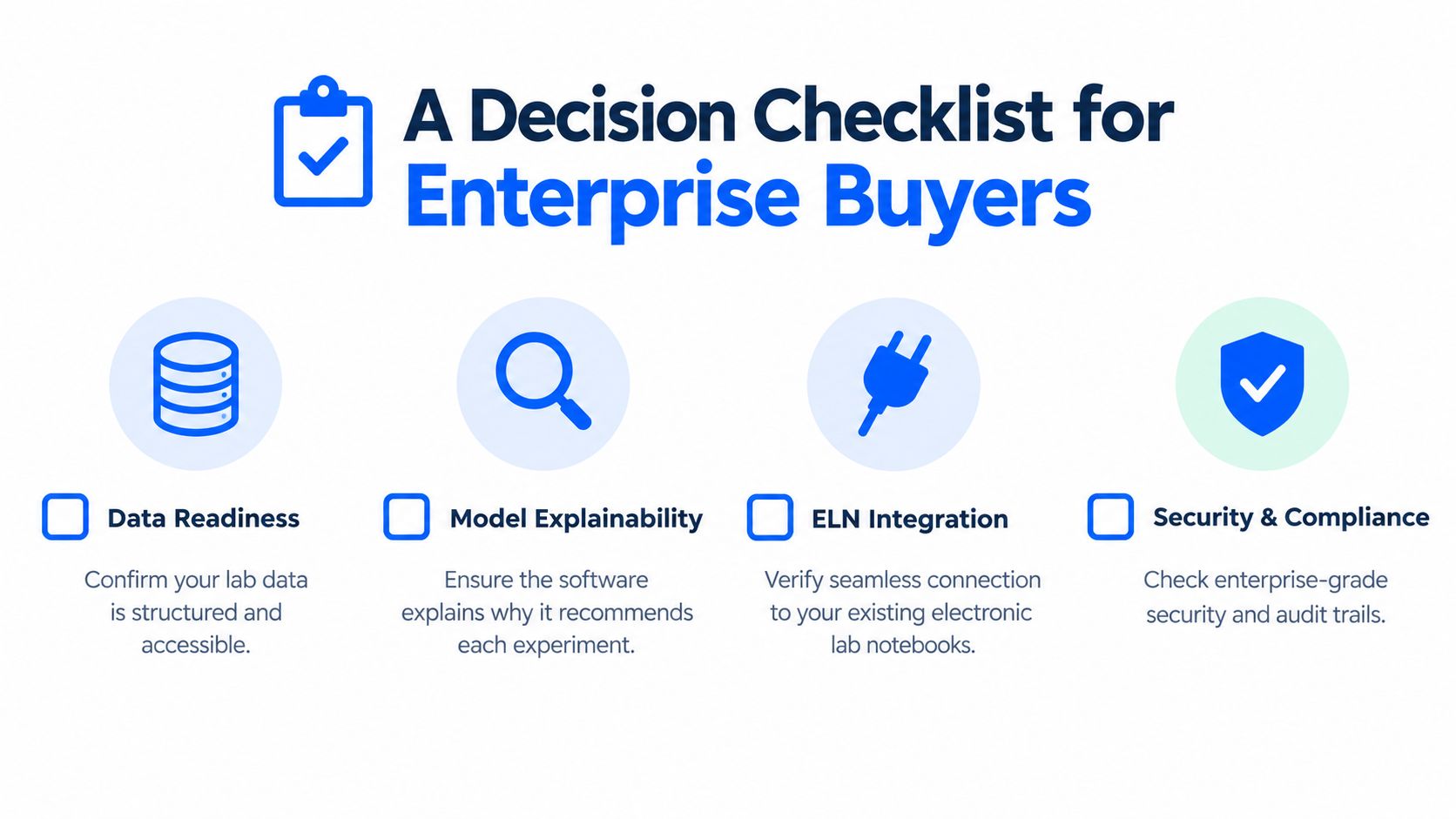
Demos are designed to look effortless. Your job is to make the vendor work with your messy data, your constraints, and your security requirements. Bring real historical experiments to every evaluation and score the platform against the items below.
The checklist graphic summarizes the four areas that deserve the most scrutiny.
Questions That Expose Weak Platforms
- Data readiness: Can the tool ingest your actual spreadsheets and ELN exports, harmonize inconsistent units and names, and flag missing values without a months long cleanup project first?
- Model explainability: For each recommended run, does it show the drivers, the uncertainty, and comparable historical experiments, or just a ranked list you're expected to accept?
- Integration depth: Does it write results back to your ELN and pull new data automatically, or does someone retype values between systems?
- Mixed variable handling: Can it optimize continuous process settings alongside categorical choices like resin grade or additive package, under real constraints?
- Provenance and auditability: Can you reconstruct the full decision trail for a recommendation made six months ago, including model version and input data?
The Security and Confidence Gap
Enterprise reality intrudes quickly. In a survey of 300 U.S. materials professionals, 94% abandoned at least one project in the prior year because simulations exceeded available time or computing resources, 46% of simulation workloads already used AI or machine learning, yet only 14% felt very confident in AI simulation accuracy, and every surveyed team expressed concern about protecting intellectual property in external or cloud tools, per survey findings on simulation and AI adoption in materials teams.
If scientists don't trust the accuracy and IT doesn't trust the data handling, adoption stalls no matter how good the demo looks.
Ask vendors directly about deployment options, data residency, access controls, and what happens to your formulations if you terminate the contract. Ask how the system behaves when compute is unavailable. A planner that halts your program during an outage isn't enterprise ready.
Score each item with evidence from a proof of concept on your own data, not with slideware. The cheapest platform that fails the explainability or provenance test will cost you the most in repeated experiments.
Implementation and Change Management
Most rollouts fail on trust, not technology. Scientists who've spent years building formulation intuition won't hand decisions to a black box because leadership bought licenses. Plan adoption as a phased shift in how decisions get made.
Start With a Pilot That Can Prove Something
Pick one active project with decent historical data, a measurable target property, and a chemist who's curious rather than coerced. Run the planner alongside the team's normal judgment for the first iterations. When the software and the chemist disagree, treat that as the interesting case, run the experiment that resolves the disagreement, and review the outcome together. Trust builds when the model is allowed to be wrong in the open and improves visibly.
Don't wait for perfect data before starting. A pilot on imperfect but real records reveals your naming inconsistencies, missing process parameters, and unit problems faster than any data audit. Teams that insist on a flawless database first usually spend a year cleaning and never reach the modeling stage.
Govern the Data and the Access
As usage spreads across sites, governance stops being optional. Define who owns factor definitions, who can edit historical records, and how new data types get added. The data governance framework implementation tips from digna offer a practical reference for structuring those ownership and quality controls before inconsistencies multiply across teams.
Set role based permissions so a site can see shared learnings without exposing restricted formulations. Preserve experiment and model lineage as records move between systems, and agree on failure recovery procedures for when integrations or compute go down, including how in flight batches get documented manually and reconciled later.
Close the Validation Gap Deliberately
The deepest adoption risk is the gap between AI generated plans and physically validated outcomes. Data quality, data availability, and accessibility remain persistent barriers, and theoretical AI predictions frequently don't hold when tested with physical materials, as noted in a recent review of AI barriers in materials research. Polymers and formulations are unforgiving here, since processing conditions, impurities, scale effects, and ingredient interactions can invalidate a confident prediction.
Build the countermeasures into your workflow from day one. Flag recommendations that extrapolate beyond the training domain. Preserve failed experiments with the same care as successes, because they're what teach the model its boundaries. Schedule validation runs designed to challenge model assumptions, not just confirm them. Sometimes the best next experiment reduces uncertainty instead of maximizing predicted performance, and your process should reward scientists for choosing it.
KPIs, Workflows, and Real-World Scenarios
You can't manage what you don't count, but teams often count the wrong things. Counting total experiments run rewards activity. Counting experiments needed to reach a decision rewards learning.
Metrics Worth Tracking
Key Performance Indicators for Experiment Planning Software
| KPI | What It Measures | Typical Target |
|---|---|---|
| Experiments to target property | Runs required to first hit a defined specification | Steady reduction versus your historical baseline |
| Failed experiment rate | Share of runs that produce no usable learning or result | Downward trend across comparable projects |
| Lab to pilot cycle time | Elapsed time from first lab hit to pilot confirmation | Shorter handoff with fewer repeat runs |
| Prediction versus validation alignment | How often physical results fall within model confidence ranges | Improving alignment as data volume grows |
| Recommendation acceptance rate | Share of suggested runs scientists execute as proposed | Rising trend paired with documented overrides |
| Data reuse rate | Historical records actually used in new models | Majority of eligible past work incorporated |
Set numeric targets from your own baseline during the pilot, not from vendor benchmarks. Your formulation space, equipment, and data quality determine what's realistic.
Scenario One Polymer Formulation Optimization
A polymer team needs higher impact strength without sacrificing melt flow. Historical trials sit in spreadsheets from two sites. The team harmonizes the data, fits a surrogate model, and discovers the model is confident about filler loading but uncertain about the interaction between plasticizer level and processing temperature. Instead of running the top predicted formulation, the planner proposes a small batch spanning that uncertain interaction. Results show the predicted optimum only works in a narrow temperature window, a finding that would have surfaced painfully at pilot scale. The next iteration targets a stable region, and the team reaches specification with a formulation that tolerates normal process drift.
Scenario Two Chemical Process Scale-Up
A process group moves a reaction from lab to pilot. The planner carries forward lab data, constraints on residence time and safety limits, and the full audit trail of earlier decisions. When pilot yields dip, engineers compare conditions against the recorded lab envelope and spot that a raw material lot change coincided with the shift, because provenance was captured at both scales. They run targeted confirmation experiments instead of restarting development.
Measurement habit: Review overrides. When a scientist rejects a recommendation, log the reason. Override patterns are the fastest diagnostic you have for model blind spots and missing constraints.
Choosing the Right Platform and Integration
Generic data science tools can fit a model. Purpose built materials platforms handle the surrounding reality: mixed variables, formulation constraints, sparse and noisy data, and scientists who need reasons, not just scores.
Architecture Trade-Offs to Weigh
Cloud accessibility speeds deployment and collaboration across sites, but it raises governance, access control, auditability, and data residency questions your security team will ask anyway. Hybrid deployment can keep sensitive formulation data inside your boundary while still giving distributed teams a shared planning environment. Decide this based on your IP posture and regulatory exposure, not on vendor convenience.
Compare platforms on integration behaviour, not connector logos. A strong platform pulls from spreadsheets and ELNs, writes structured results back, and maintains one lineage record per experiment. A weak one becomes another silo with nicer charts. Polymerize is one example of an AI native option built for this pattern, unifying fragmented experimental data into a central backbone and layering explainable models that surface causal drivers with confidence scores and historical precedents. Evaluate it the same way you'd evaluate any contender, on your data and your constraints.
Structure a Proof of Concept That Can Fail
Give each finalist the same historical dataset with a portion of results held back. Ask the platform to plan the next experiments, then check its recommendations against the outcomes you withheld. Require explanations for every suggestion and test at least one infeasible scenario to confirm constraints are honored. Involve IT security and a skeptical senior chemist from the start, since both can veto your choice later at higher cost.
Judge the winner on four outcomes: whether the recommendation can be trusted, reproduced, secured, and operationalized across your teams. A platform that wins on prediction but loses on those four will stall after the pilot. The right choice makes the next experiment obvious, defensible, and executable, which is the whole point of planning software in the first place.
If your next experiment is still being chosen from memory and scattered spreadsheets, Polymerize gives your team a secure data backbone, explainable AI models, and guided experiment planning built specifically for polymers, chemicals, and advanced materials. Bring a real formulation challenge, see how the platform plans against your own historical data, and judge the recommendations the way you'd judge any scientist on your team.
Put your R&D data to work
See how materials teams use Polymerize to plan fewer experiments and reach target properties faster.