

A polymer can pass every mechanical and processing test in your laboratory, then fail a sustainability review because its feedstock, additives, production route, or end-of-life pathway transfers stress to land, water, soil, or biodiversity. That failure isn't separate from materials innovation. It means the material was designed with an incomplete performance specification.
Environmental degradation affects almost 2 billion hectares worldwide and impacts about 3.2 billion people, roughly 40% of the global population, according to the Food and Agriculture Organization's assessment of land degradation. For materials R&D teams, that figure reframes sustainability from a reporting exercise into a design constraint. Polymer formulation choices influence extraction, energy use, emissions, contamination, durability, recyclability, and disposal.
A useful response isn't to reject complex materials. It's to treat environmental performance like any other coupled engineering requirement. Tensile strength, barrier performance, cost, processability, toxicity, carbon intensity, and end-of-life behavior must be evaluated together, early enough to change the formulation.
This approach also changes how teams use data. An early screening LCA can identify burdens before pilot scale. Structured experimental records can connect formulation variables to environmental indicators. Explainable AI can help scientists select the next experiment rather than repeat low-value trial and error. The result is a development workflow that considers both material function and the conditions required to produce, use, recover, or safely retire that material.
Table of Contents
- Why Environmental Degradation Matters to Materials Innovators
- Why resilience matters to materials teams
- Start with chemistry and feedstock choices
- Design the recovery route before the product
- Close the loop with data and models
Why Environmental Degradation Matters to Materials Innovators
A polymer blend can meet its stiffness target, survive accelerated aging, and run on existing equipment with minor adjustments. Procurement may have a viable feedstock route, while commercial teams prepare customer samples. The conventional laboratory specification appears complete.
A sustainability screen can still expose system-level failure. The preferred raw material may depend on land under ecological stress. An additive or catalyst may create difficult contamination questions. A recovery route may work only for a narrow waste stream, while the product architecture makes separation impractical. Technical recyclability does not guarantee recovery in practice.
For R&D leaders, environmental degradation is a materials design problem because materials depend on environmental systems. Bio-based feedstocks rely on productive soils and dependable water. Recycled polymers rely on collection, sorting, decontamination, and reprocessing infrastructure. Solvent-based coatings require emission controls and waste treatment. A material with strong use-phase performance can still create upstream or downstream burdens that appear only across its full life cycle.
The pressure is already substantial. The FAO reports that 34% of agricultural lands are affected by degradation, and that degradation was reducing the status of 5,670 million hectares of land by 2015, including 1,660 million hectares attributed to human activity (FAO land degradation assessment). These conditions can affect the availability, quality, and reliability of biological and mineral inputs used by industry.
The design response is to define environmental constraints during concept selection, before formulation lock. A team can connect feedstock, processing, use, and end-of-life choices to measurable ecosystem indicators, then apply LCA at a level suited to the project stage. Early screening need not deliver a final answer. It should reveal which trade-offs deserve experiments.
That requires data practices as well as chemistry. Experimental records should retain formulation context, process conditions, measured properties, and environmental indicators. With those links in place, AI can help prioritize the next experiment and support a closed-loop development process, while scientists remain responsible for interpreting uncertainty and practical constraints.
The goal is a material specification that includes function, production conditions, resource dependence, and recovery or retirement pathways. Teams can then act on environmental risks while formulation choices are still changeable.
Understanding Environmental Degradation and How It Unfolds
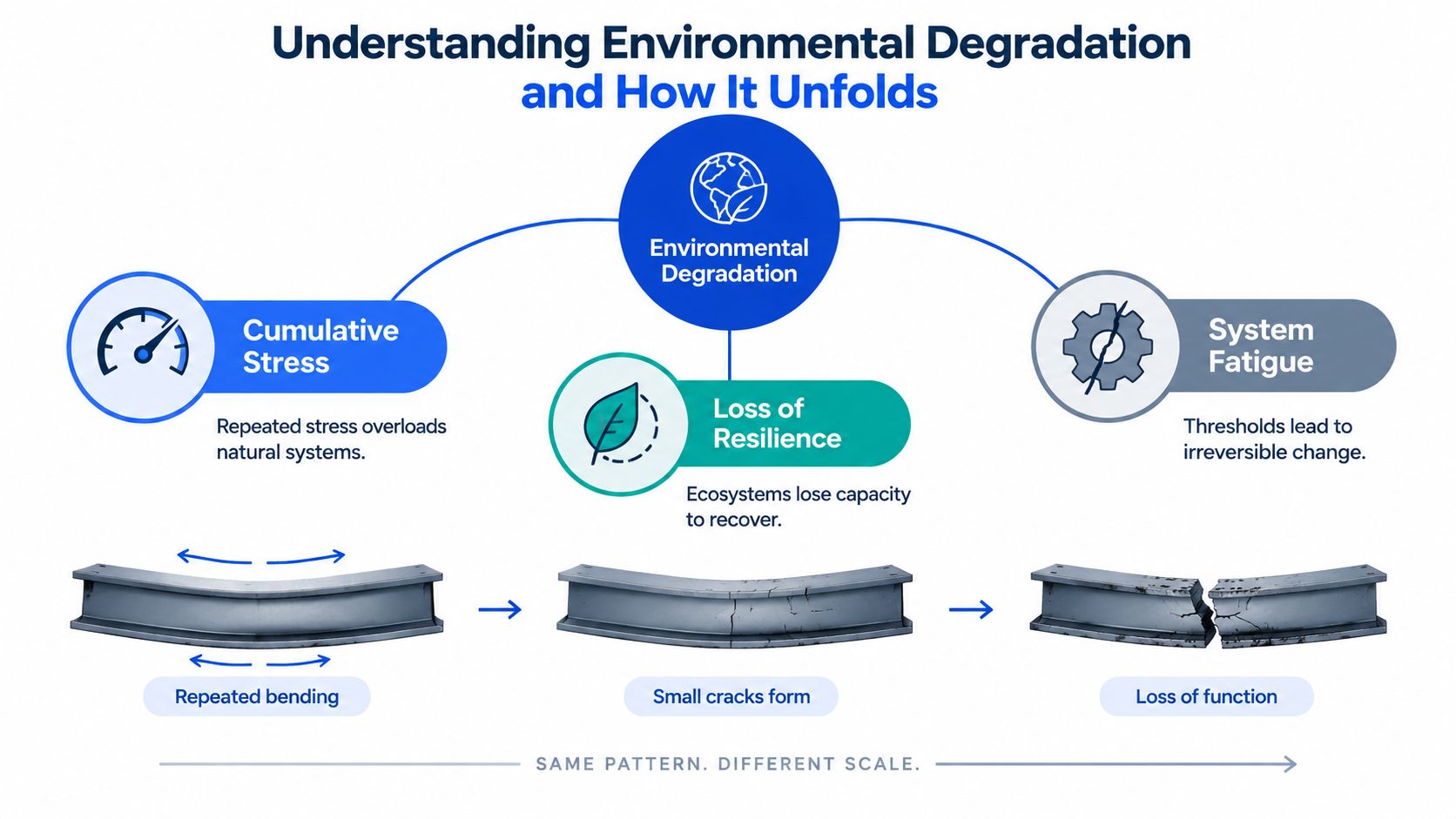
Think about a metal beam exposed to repeated loading. A single bend may leave it apparently unchanged. Repeated cycles create microscopic cracks, reduce its tolerance for additional stress, and eventually produce a visible fracture. The failure doesn't come from one isolated event. It comes from accumulated loading combined with declining resilience.
Ecosystems behave differently from metals, but the engineering analogy is useful. A forest, watershed, soil community, or coastal habitat can absorb disturbance, recover, and continue delivering functions. Repeated extraction, contamination, land conversion, altered water flows, and climate stress can reduce that recovery capacity. At some point, the system may cross a threshold and shift into a state that no longer supports the same functions.
Core concept: Environmental degradation is the progressive loss of ecological structure, function, and recovery capacity under cumulative stress.
The word environmental covers several connected domains:
- Land and soil: Soil structure, nutrient cycling, biological activity, and water retention can decline under poor management or contamination.
- Water: Pollution, altered flows, and untreated discharges can reduce water quality and aquatic function.
- Air and climate: Emissions change atmospheric chemistry and climate conditions, which then place additional stress on ecosystems.
- Biodiversity: Habitat loss and ecological disruption reduce the variety and interdependence of organisms that support ecosystem processes.
Why resilience matters to materials teams
A degraded system isn't always visibly destroyed. A soil may still produce crops, but with weaker water-holding capacity. A river may still carry industrial discharge, but with reduced biological productivity. A recycling stream may still accept a polymer, but contamination and additive complexity can make recovery less reliable.
That distinction resembles reversible and irreversible damage in materials. Reversible damage may respond to changed loading or treatment. Irreversible damage involves permanent chemical changes, structural collapse, species loss, or contamination that requires extensive remediation and may never restore the original function.
Scale matters as well. A local solvent release and a global land-use pattern differ in reach, but both can be evaluated through stress, response, and recovery. Materials teams should ask where a burden occurs, which system absorbs it, how long the effect lasts, and whether the proposed intervention shifts the burden elsewhere.
This framing prevents a common mistake: treating sustainability as a single score. A lower carbon result doesn't automatically mean lower water, toxicity, land, or biodiversity pressure. Design decisions need a multidimensional view of system fatigue.
Key Drivers Behind Environmental Degradation Today
Environmental degradation develops through connected causal chains. A land-use decision can remove habitat, expose soil, alter water movement, and increase chemical inputs. An industrial process can emit pollutants, consume water for treatment, and transfer residues into soil or sediment. For materials teams, the practical task is to trace these effects back to feedstocks, formulation chemistry, equipment, and recovery routes.
Human activity drives many current pressures. Land degradation affects up to 40% of the world's land and more than 3 billion people, while approximately 100 million hectares become degraded every year, according to the UNCCD desertification, drought, and land degradation factsheet. The same source estimates annual global economic losses of about US$878 billion from land degradation, desertification, and drought.
From extraction to ecosystem stress
Land-use change converts or fragments habitats for agriculture, infrastructure, mining, housing, and industrial facilities. Resource extraction removes biomass or minerals faster than ecological systems can recover. Transport and processing then add energy demand, emissions, and waste. Where treatment and enforcement are weak, industrial releases can change air, water, and soil conditions.
Climate variability can intensify these pressures. Changes in temperature and precipitation may increase erosion, raise drought sensitivity, or slow the recovery of disturbed habitats. Invasive species add another mechanism of stress by competing with local organisms or changing habitat conditions.
Soil management deserves close attention in polymer and chemical development. The FAO explains that unsustainably managed soils emit CO2 and N2O, linking land degradation with greenhouse-gas emissions and climate change in its global assessment of soil pollution. Soil pollution can also reduce biological productivity and ecological complexity, which weakens ecosystem services and increases remediation requirements.
For formulation teams, the design question is direct: does a feedstock or process reduce one burden while increasing another? A bio-based input may reduce reliance on fossil carbon, yet require careful review of land, water, fertilizer, transport, and end-of-life conditions. Recycled content can avoid virgin extraction, while contamination, washing, drying, and repeated thermal processing introduce different burdens. A compostable polymer may fit a specific disposal route, but its value depends on material performance and access to suitable infrastructure. A practical overview of compostable alternatives to banned plastics helps frame that assessment.
Translate drivers into design variables
Use a causal map before selecting the final formulation:
- Source: Identify the origin of each monomer, filler, pigment, solvent, additive, and processing aid.
- Transformation: Record energy, water, emissions, waste, and hazardous intermediates associated with conversion.
- Use: Define durability, release, wear, migration, and maintenance behavior.
- Recovery: Test whether the material can be separated, reprocessed, chemically recycled, composted, or safely managed in the intended system.
Connect these variables to LCA stages and ecosystem indicators, then use laboratory data to refine the map. AI can accelerate closed-loop development by screening formulations, predicting trade-offs, and prioritizing experiments, but its recommendations still require measured performance, recovery, and environmental data.
Natural variability belongs in the model. Human choices determine how strongly ecosystems experience it.
How Environmental Degradation Impacts Ecosystems and Industry
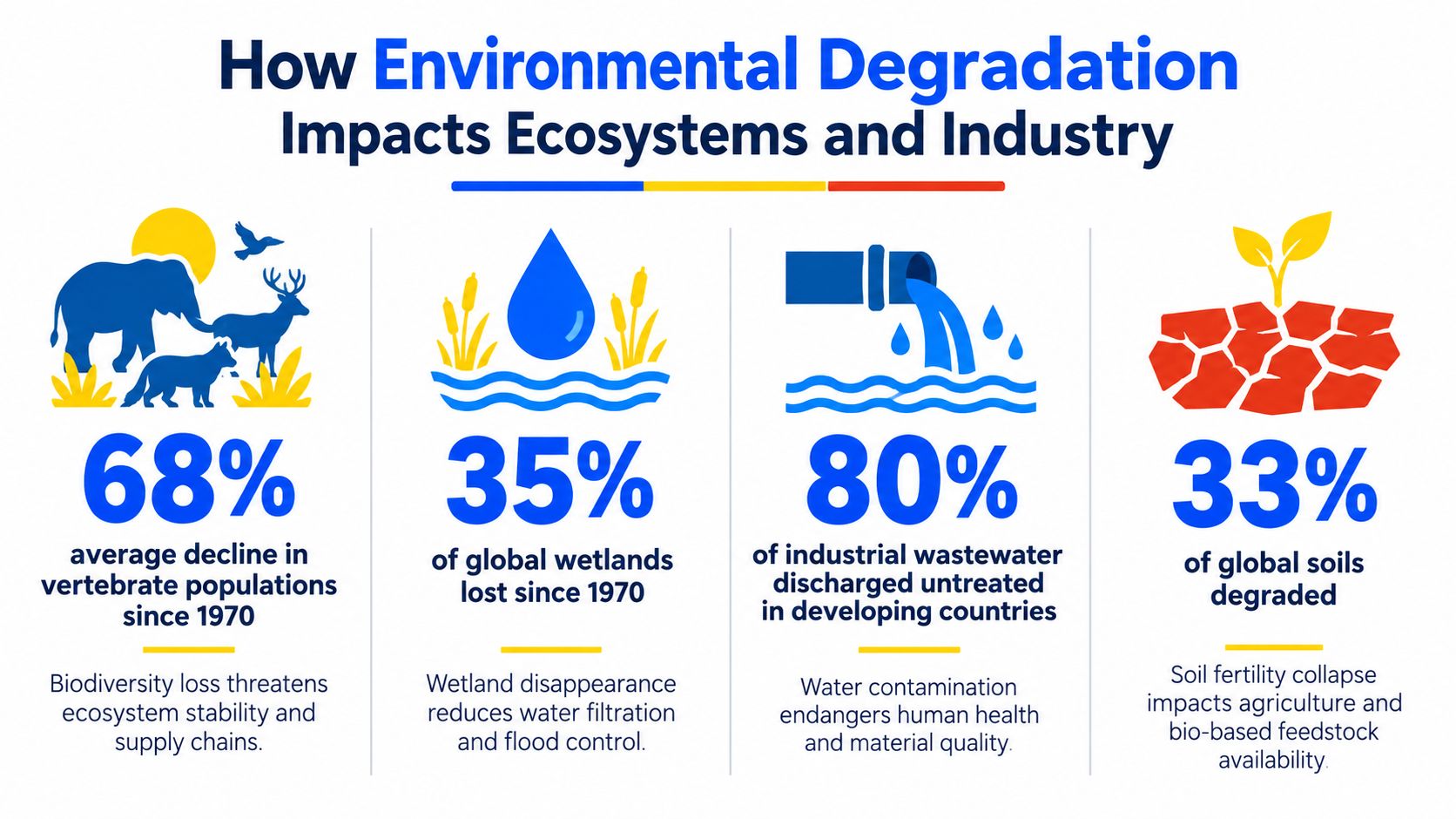
UNEP reports that 75% of terrestrial environments and 66% of marine environments are severely altered by human actions (UNEP ecosystem and biodiversity overview). The same overview states that more than 85% of wetlands have been lost in 300 years, while over 80% of global wastewater is discharged untreated into the environment. These figures describe more than ecological decline. They indicate changing boundary conditions for materials production, from water quality and feedstock availability to site resilience and waste management.
What the supply chain experiences
Wetlands function like biological treatment and storage systems. Their loss can increase demand for engineered water treatment while raising exposure to flooding and variable influent quality. Soil degradation changes structure, water-holding capacity, and nutrient cycling, reducing the consistency of agricultural production and increasing sensitivity to drought, as noted earlier.
Those shifts matter for starches, oils, cellulose, natural fibers, agricultural residues, and other biological inputs. A polymer formulation may meet its target properties in the laboratory yet become difficult to reproduce if feedstock composition varies by region or season. The same environmental dependence extends to energy, packaging, logistics, and facility operations.
Soil contamination creates a separate materials risk. Land affected by pollutants may become unsuitable or less reliable for cropland, pasture, forests, or woodlands. For producers, that can change site selection, remediation requirements, feedstock sourcing, and the acceptability of a manufacturing location. It also belongs in LCA boundaries, because land usability and cleanup can shift the burden between production options.
Electronic and advanced-materials value chains add further complexity. A product may combine polymers with metals, flame retardants, coatings, adhesives, and embedded electronics. Teams evaluating recovery should include health and environmental pathways described in how e-waste affects our health and environment, rather than assessing the primary polymer alone.
Turn ecosystem impacts into engineering controls
A design review can convert ecological exposure into four testable questions:
- Availability: Could degradation reduce the reliability of a feedstock, water source, or mineral input?
- Quality: Could contamination or ecological variability change purity, molecular weight, additive content, or final performance?
- Compliance: Could the chemistry create restrictions during production, use, or disposal?
- Recovery: Does the product architecture support its stated end-of-life route under actual collection and processing conditions?
The UNCCD reports that recovering 15% of degraded or converted land in key areas could sequester up to 300 gigatons of carbon and avoid up to 60% of expected species extinctions. For R&D, the implication is practical: prioritize interventions that improve both ecosystem conditions and material-system performance, then verify the trade-offs with LCA data.
AI can support this closed loop by screening formulations, predicting conflicts between durability and recoverability, and ranking experiments. Its recommendations still require measured evidence from formulation, processing, use, and recovery tests.
Early mitigation exposes dependencies before pilot production, customer qualification, and regulatory review. That timing reduces technical surprises and gives teams more room to redesign the material rather than retrofit the process.
Measuring Environmental Degradation With Indicators and LCA
Measurement should match the decision. A discovery team doesn't need the same evidence package as a process group preparing a commercial change. The first needs directional signals that can eliminate poor options. The second needs traceable boundaries, consistent assumptions, and data quality strong enough to support external decisions.
LCA provides the system boundary. Indicators provide resolution within that boundary. Soil organic matter, erosion risk, water quality, land-use change, toxicity, greenhouse-gas emissions, and biodiversity proxies each describe different parts of environmental degradation. None should be treated as a universal substitute for the others.
Select metrics by development question
| Indicator Framework | What It Measures | Best Use in R&D |
|---|---|---|
| Soil health indicators | Soil structure, biological productivity, nutrient cycling, and water-holding behavior | Screen bio-based feedstocks, agricultural inputs, and land-dependent supply chains |
| Land degradation indicators | Declining land condition, conversion pressure, and restoration opportunity | Compare sourcing regions and identify location-sensitive risks |
| Water quality indicators | Pollution burden, treatment requirements, and aquatic-system pressure | Evaluate water-intensive processing, washing, dyeing, and discharge controls |
| Biodiversity proxies | Habitat disturbance, ecological complexity, and species-related exposure | Flag land-use and sourcing decisions that may create ecosystem risk |
| Screening LCA | Directional impacts across sourcing, production, use, and end of life | Rank concepts before detailed process data exists |
| Full LCA | More complete, documented life-cycle impacts using defined assumptions and data quality controls | Support scale-up, customer disclosure, procurement decisions, and formal comparisons |
A screening LCA works best when the team is comparing architectures, feedstocks, or process routes. It can use conservative assumptions and ranges, provided the assumptions are visible. A fuller, ISO-aligned study becomes more appropriate when the functional unit, system boundary, inventory, allocation rules, and end-of-life scenario need formal review.
Build an evidence chain from the lab
The most valuable environmental dataset isn't a disconnected carbon number. It links formulation and process variables to material performance and environmental indicators. Capture batch identity, raw-material origin, composition, solids content, cure or reaction conditions, energy use, solvent recovery, yield, scrap, test results, and end-of-life assumptions.
Then preserve uncertainty. A recycled resin may have variable contamination. A bio-based feedstock may vary by season or supplier. A degradation test may represent a controlled laboratory condition rather than a municipal or industrial environment. Recording those limitations prevents false precision and makes later model updates easier.
Practical rule: Use indicators to expose mechanisms, and use LCA to prevent burden shifting between life-cycle stages.
For AI-ready development, structure the data so a model can distinguish a true formulation effect from a batch, operator, instrument, or supplier effect. That foundation supports explainable optimization rather than opaque scoring.
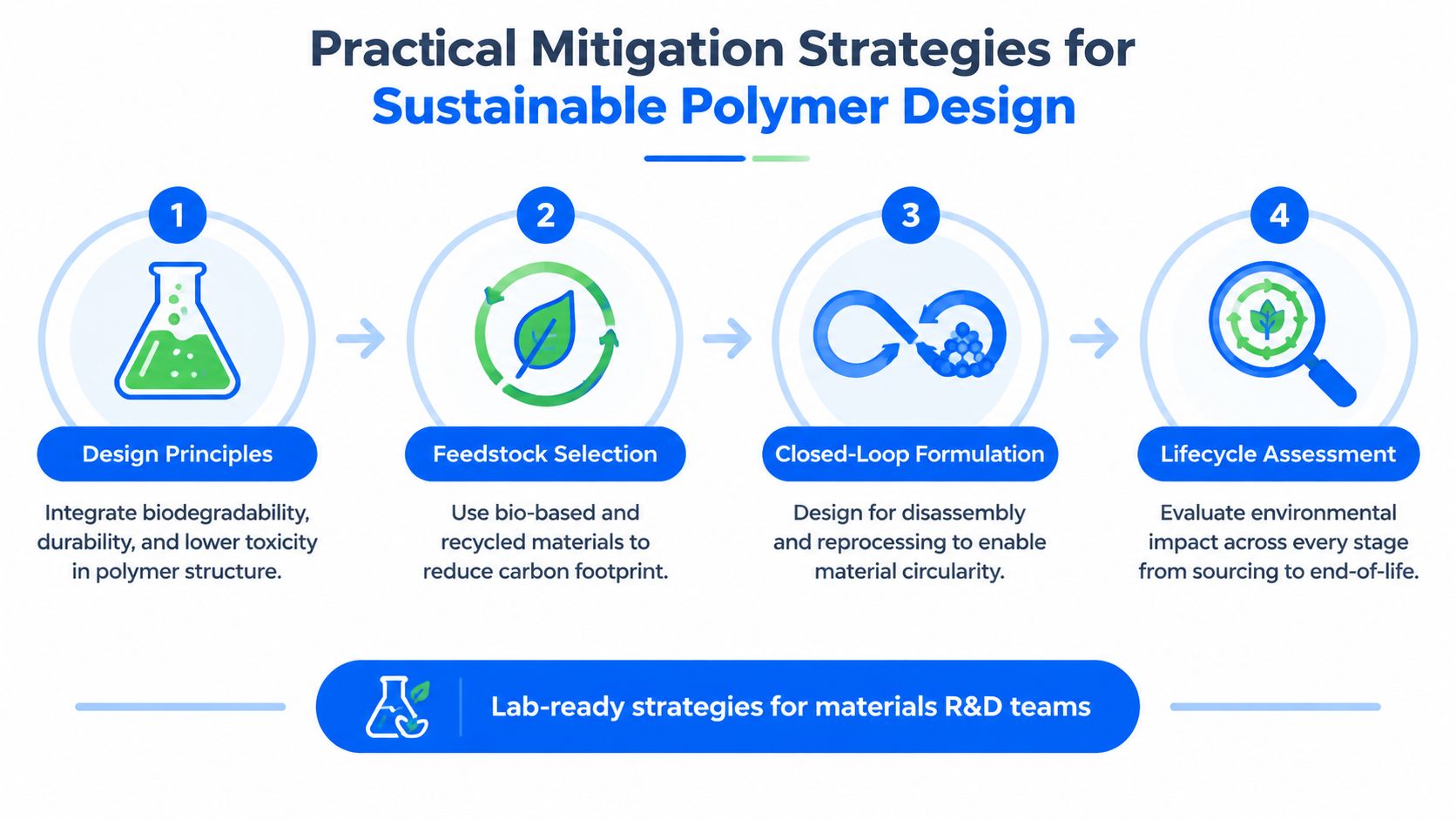
Practical Mitigation Strategies for Sustainable Polymer Design
Mitigation works best as a formulation workflow, not as a final label applied to an existing product. Start by defining the required function and the environmental constraints together. A polymer that fails prematurely may create more replacement, waste, and processing burdens than a more durable alternative, while excessive durability can complicate recovery. The design target must balance service life, toxicity, resource demand, recyclability, and realistic end of life.
Start with chemistry and feedstock choices
Screen monomers, additives, pigments, fillers, and processing aids for hazard, persistence, migration, and recovery implications. Then compare virgin, recycled, and bio-based feedstocks using the same functional unit and performance requirements. Don't assume that one feedstock category is automatically superior. Test the complete route, including preprocessing, purification, transport, processing, and disposal.
A practical formulation matrix can include:
- Polymer architecture: Adjust molecular weight, branching, copolymer structure, crosslink density, or blend compatibility to meet performance without unnecessary material complexity.
- Additive package: Minimize components that block recycling, create hazardous residues, or complicate separation, while retaining the stabilizers needed for safe service.
- Recycled content: Characterize contamination, thermal history, odor, color, and mechanical variability before setting a fixed inclusion target.
- Bio-based content: Verify land, water, agricultural, and conversion assumptions instead of relying on feedstock labels alone.
Design the recovery route before the product
A recyclable material needs a credible collection and sorting pathway, not only a theoretically recoverable polymer backbone. A compostable material needs a suitable biological process and clear separation from conventional recycling streams. A multilayer package, thermoset composite, or bonded assembly may require redesign for disassembly, selective dissolution, reversible bonding, or chemical recovery.
Process optimization can reduce waste at the source. Track yield, off-specification material, solvent losses, cure time, energy demand, cleaning frequency, and rework. Use designed experiments to identify which variables control both quality and resource intensity. A faster reaction isn't automatically better if it increases defects or creates a difficult purification step.
Close the loop with data and models
Connect LCA results to the formulation and processing dataset so environmental indicators update as the material changes. An AI-native platform such as Polymerize can unify experimental records from spreadsheets and ELNs, apply explainable models to predict material properties, and help teams choose targeted next experiments. Used with human review and documented assumptions, that workflow can reduce redundant experimentation and make sustainability trade-offs visible alongside performance.
The closed loop is straightforward:
- Define: Set performance, compliance, sourcing, and end-of-life requirements.
- Explore: Generate formulations and process windows across competing material routes.
- Test: Measure properties, process behavior, emissions, waste, and recovery performance.
- Learn: Update the model and LCA with observed results and uncertainty.
- Decide: Select the next experiment or eliminate the route.
AI doesn't remove the environmental footprint of computation or experimentation. It makes the workflow valuable only when the data is representative, the models are explainable, and the team measures whether fewer physical iterations reduce material and process waste.
Building Resilient Materials Innovation for a Sustainable Future
Environmental degradation becomes actionable when teams connect four layers: system condition, causal driver, material consequence, and design response. Land and soil indicators reveal whether a feedstock area is losing function. Process and chemical data show how a formulation contributes to emissions or contamination. LCA places those results across the full product system. Controlled experiments then test whether a lower-impact option still meets technical requirements.
R&D leaders can operationalize this with a compact checklist:
- Set constraints early: Include land, water, toxicity, emissions, circularity, and end-of-life requirements in the concept brief.
- Map causal pathways: Link every major ingredient and process step to its environmental exposure.
- Use staged evidence: Apply screening LCA during exploration, then strengthen inventories and assumptions before scale-up.
- Design recovery deliberately: Validate collection, separation, reprocessing, biodegradation, or safe disposal under realistic conditions.
- Unify the dataset: Connect ELN records, formulation history, process settings, test results, supplier information, and LCA assumptions.
- Apply explainable AI: Use models to identify causal drivers and prioritize experiments, not to hide uncertainty behind a score.
The competitive advantage comes from making sustainability part of technical learning. Teams that can compare performance and environmental burden in the same decision cycle are better positioned to avoid late redesign, protect supply continuity, and develop materials that work within ecological limits.
Polymerize helps materials R&D teams unify fragmented experimental data, predict properties, optimize formulations, and prioritize targeted experiments that reduce unnecessary lab work and material waste. Visit Polymerize to see how an AI-native development workflow can connect LCA-informed decisions with faster, more responsible polymer innovation.
Put your R&D data to work
See how materials teams use Polymerize to plan fewer experiments and reach target properties faster.