



A formulation scientist has a promising AI recommendation on screen and a lab slot booked for tomorrow morning. The model suggests a composition outside the team's usual range. That's exactly where value should come from, and it's also where governance stops being abstract. If nobody can show which data supported the prediction, who approved the model for that chemistry, or what happens when the result disagrees with precedent, the team isn't operating a governed system. It's improvising around one.
Table of Contents
- Start Where the Data Actually Lives
- Govern the Model as a Released Artifact
- Close the Loop After Release
Why Materials R&D AI Needs Governance
The scientist asks practical questions before running the experiment. Which batches trained this model? Were failed runs included? Does the recommendation sit inside the validated domain, or does it extrapolate into a region where the underlying chemistry changes behavior? The answers live in different places, a spreadsheet from one site, an ELN entry from another, a version note someone kept locally. Nobody's acted in bad faith. The evidence chain was never built.

That gap is common across industries. Only 23% of surveyed organizations had implemented AI use-case intake, development, and management processes, while 14% performed AI assurance at the enterprise level. In materials R&D, the gap has physical consequences. A weak recommendation doesn't just waste analyst time, it consumes raw materials, instrument capacity, and scientist attention, and a weak scale-up decision can affect quality, safety, and customer qualification.
What a Policy Can't Prove
A policy document can state that AI must be transparent, secure, and human-supervised. It can't, by itself, prove any of those things for a specific formulation decision made last quarter. Teams sometimes fill the gap with informal trust in a capable data scientist or a familiar tool. That works until that person changes roles, the vendor updates the model, or a customer, auditor, or internal quality team asks for the record.
The same pattern appears in adjacent functions. Support teams can embed AI chatbots in minutes, and that speed is useful, but deployment speed answers a different question than whether the organization knows what data the system uses, who owns its errors, and when it should stop. In the lab, fast access without those answers creates hidden debt.
Maturity isn't having a committee. It's being able to reconstruct a consequential decision without relying on memory.
A Test You Can Apply This Week
Pick your most consequential AI-assisted decision and ask five questions:
- Ownership: Who's accountable for this use case, by name?
- Lineage: Can you trace the recommendation to specific measurements and experimental conditions?
- Validation: What evidence shows the model works for this chemistry, not just in general?
- Monitoring: What threshold would tell you performance has degraded?
- Escalation: What's the documented stop, override, or rollback path?
If two or more answers depend on asking around, you don't have a governance problem in principle. You have missing evidence in practice, and that's fixable with an operating system, not another statement of values.
Core Principles of an Enterprise AI Governance Framework
Governance gets confused with four neighboring disciplines, and the confusion produces real gaps. Compliance asks what obligations apply. Risk management asks what could go wrong and how seriously. Model validation asks whether the system works as claimed. Everyday management asks whether work gets done today. Governance asks a prior question that connects them, who's authorized to decide, under what rules, and with what evidence when those disciplines disagree.
The concept map below separates those questions so teams stop expecting one function to do all five jobs.
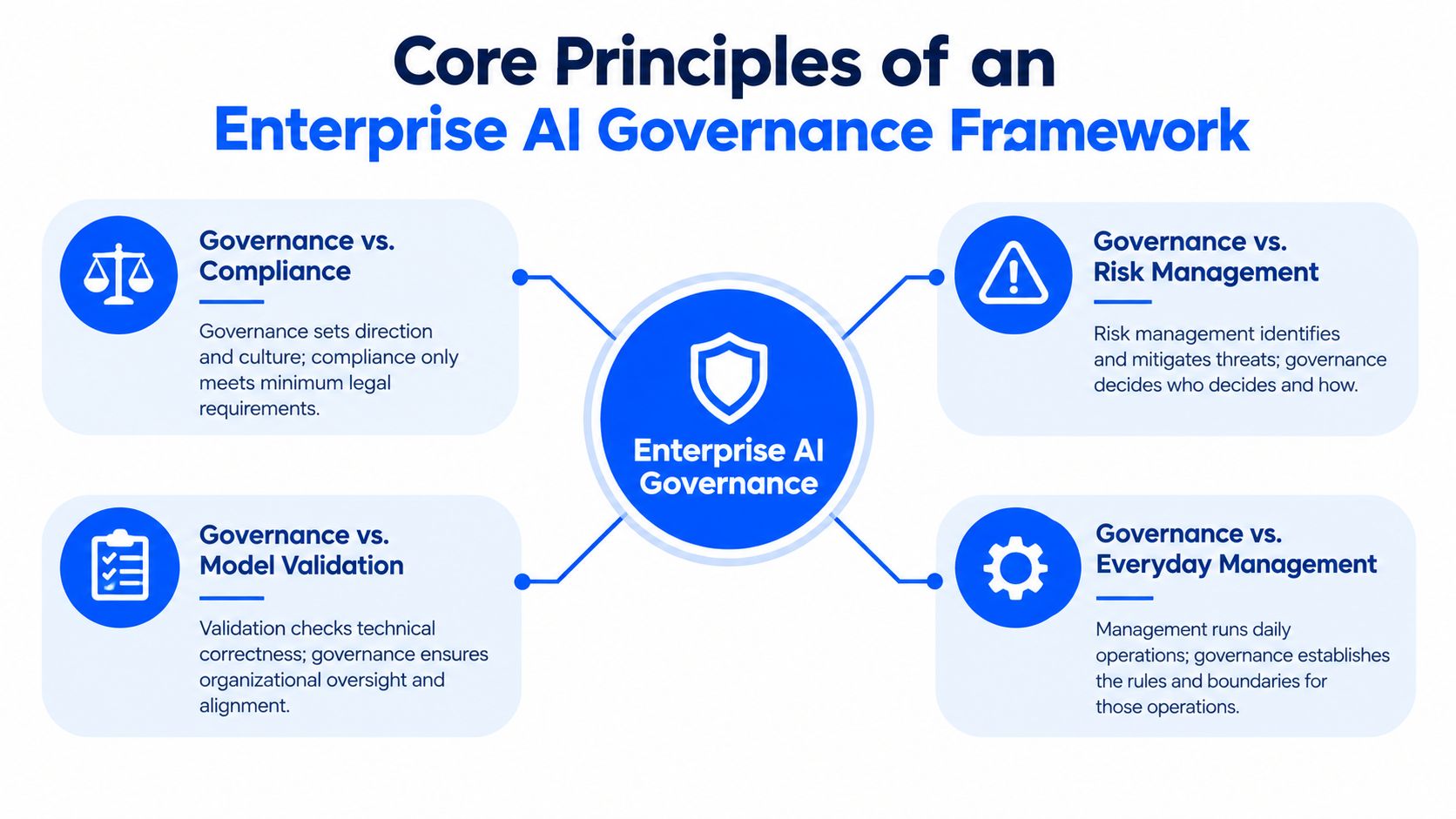
Consider a validated viscosity model that later receives data from a new raw material supplier. Validation was sound at release. Compliance may still be satisfied. Daily management wants throughput maintained. Governance is the mechanism that decides whether the supplier change triggers revalidation, who can approve continued use, and what residual risk the organization accepts in the meantime. Without that layer, each function assumes another one decided.
Principles That Have to Operate, Not Decorate
Accountability means a named owner, not a team alias. Proportionality means controls scale with consequence, so an exploratory literature summary doesn't carry the same burden as a scale-up recommendation. Traceability means data, model version, user, and decision can be linked later. Human oversight means a qualified person can intervene before harm, not merely review a log afterward. Transparency, fairness, security, and privacy matter in materials contexts too, although they often appear as intellectual property protection, access to proprietary formulations, consistent treatment across sites, and protection of customer-specific development data.
These principles become useful only when they produce artifacts. Accountability produces a decision record. Proportionality produces a risk tier. Traceability produces lineage. Oversight produces an approval or override entry.
The Lifecycle That Connects Them
The U.S. National Institute of Standards and Technology gives enterprises a practical structure for that connection. NIST released the voluntary AI Risk Management Framework 1.0 on January 26, 2023, organized around the GOVERN, MAP, MEASURE, and MANAGE functions, covering design, development, deployment, and evaluation. It's not law and it isn't a certification scheme. Its value is that it turns broad principles into a repeatable lifecycle.
- Govern: Set policies, accountability, risk tolerance, and competence requirements.
- Map: Document intended use, context, affected stakeholders, and plausible harms.
- Measure: Test the system and produce evidence about trustworthiness.
- Manage: Apply mitigations, accept or reduce residual risk, and restrict or retire the system when needed.
The following video offers useful context on how these functions fit together in practice.
As AI agents and connected tools enter enterprise workflows, the same decision rights logic extends beyond models to the systems acting on their behalf, which is why discussions of MCP server controls for sellers are relevant reading for teams defining what automated systems may access or execute. The principle stays constant. Authority must be explicit before automation acts.
Assign Governance Roles and Decision Rights
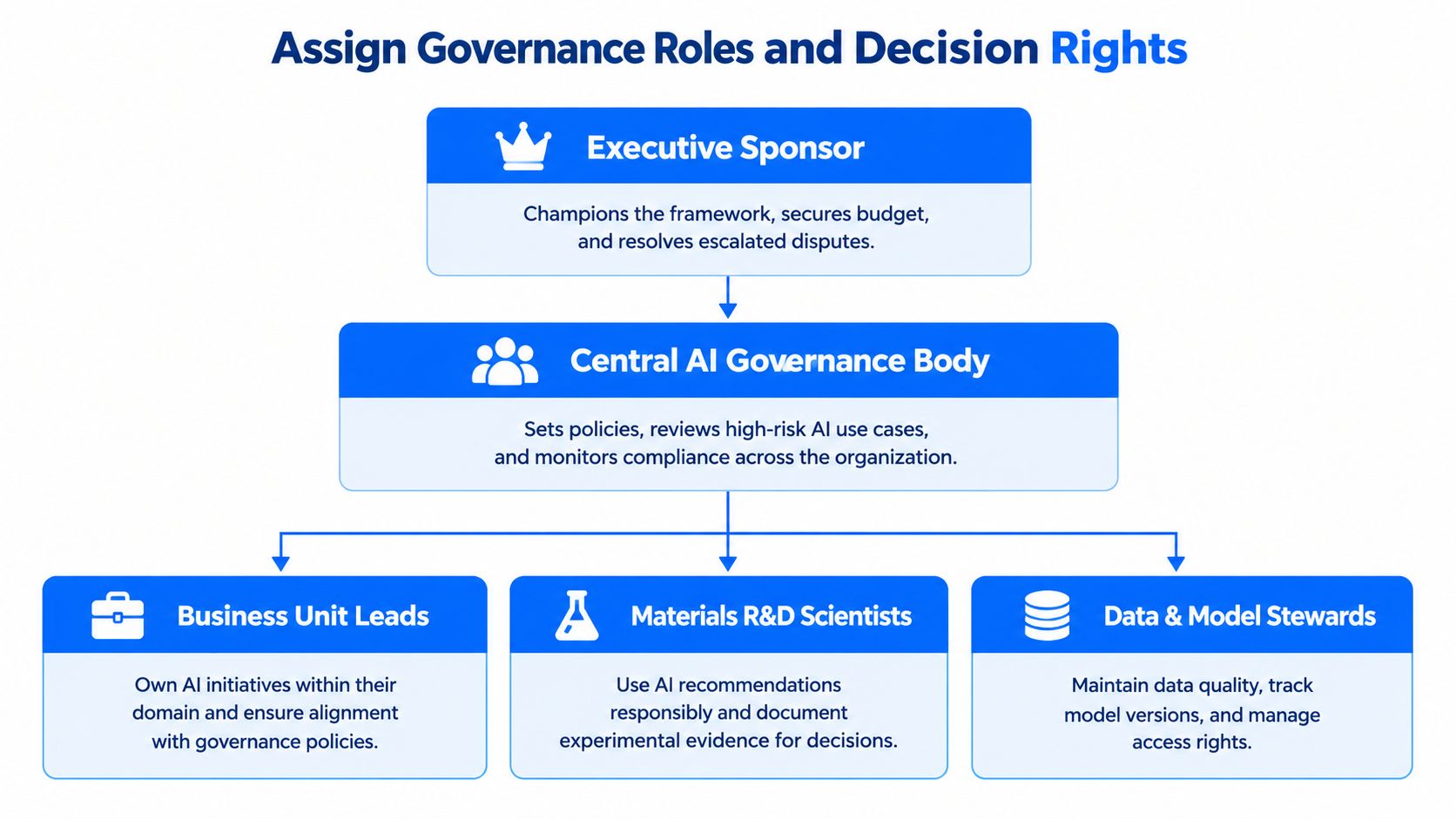
Committees don't make most consequential decisions. People do, often under time pressure, and governance fails when those people can't tell whether a decision is theirs to make. Start by assigning roles around the work that exists in a materials organization, then define which decisions each role can make alone, which need concurrence, and which must escalate.
The hierarchy below shows a workable reporting structure, provided the boxes come with real authority rather than advisory titles.
Roles That Need Named Owners
The executive sponsor owns risk appetite, funding, and unresolved disputes between speed and control. The central AI governance body sets minimum policies, reviews high-consequence use cases, and checks that controls operate across sites. It shouldn't approve every model experiment, or it becomes a queue that scientists route around.
The laboratory or business owner owns the use case outcome. If a model shapes a formulation program, that owner can't delegate accountability to the data science team. The data owner controls provenance, quality standards, access, and retention for experimental datasets. The model owner controls intended use, versioning, applicability limits, and change decisions. A validation lead independent of model development checks evidence before release. Security, privacy, legal, and compliance teams define constraints and review exceptions, while independent review tests whether the whole system works, not whether individual documents exist.
Decision Rights by Consequence
- Approve a model for a defined chemistry domain: Model owner proposes, validation lead concurs, laboratory owner accepts residual risk.
- Restrict a model after drift or failed checks: Model owner can suspend immediately without waiting for a committee cycle.
- Permit use outside the validated domain: Laboratory owner and validation lead both approve, with the rationale recorded.
- Escalate before scale-up: Business owner decides, informed by quality, process engineering, and safety review where relevant.
- Accept a vendor model with limited visibility: Governance body reviews contractual evidence, access controls, and exit provisions.
Practical rule: Whoever can approve a high-consequence use must also be reachable when the evidence turns against it.
Avoid building a generic RACI chart with dozens of rows nobody consults. A short decision register works better. For each major decision, record the accountable role, required concurrers, evidence needed, and escalation trigger. Then test it against uncomfortable cases. A scientist disagrees with a model owner about domain limits. A site leader wants an exception during a customer deadline. A vendor pushes an update mid-program. If the register doesn't resolve those cases, it isn't finished.
Decision rights also need expiry. Approvals should name the model version, data scope, users, and conditions covered, and they should lapse when any of those change materially. Permanent approval for a changing system isn't governance. It's an assumption that ages unobserved.
Govern Data Models and AI-Assisted Decisions
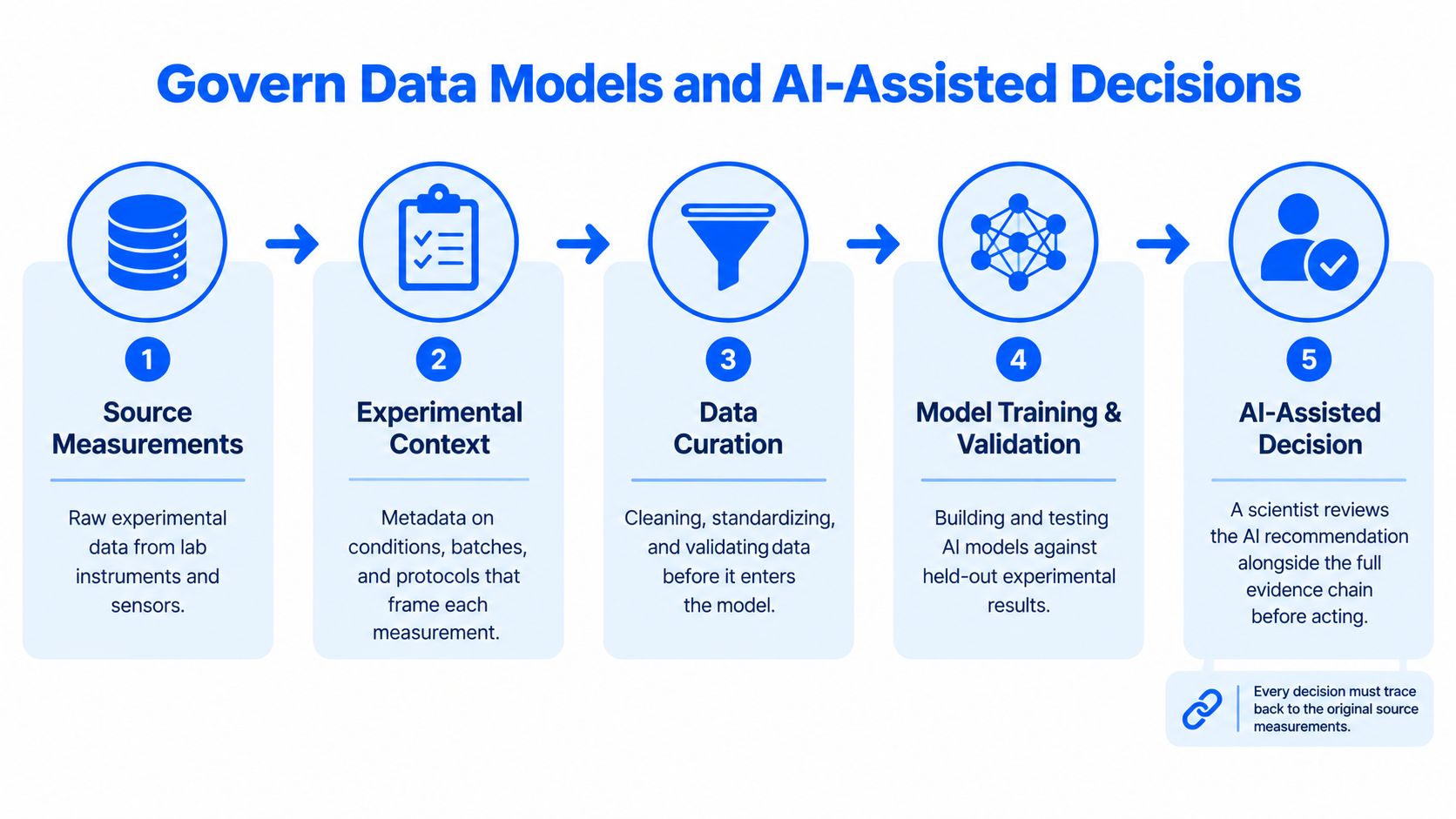
Treat the evidence chain as the product. A recommendation that can't be traced back through model version, training data, transformations, and source measurements may still be correct, but the organization can't defend it, reproduce it, or learn from it when it's wrong. That distinction matters most when a formulation moves from a scientist's notebook toward pilot production.
The five-stage flow below captures the minimum chain, from raw measurement to human decision.
Start Where the Data Actually Lives
Materials data rarely begins in a clean warehouse. It lives in instrument exports, spreadsheets, ELN entries, LIMS records, supplier certificates, and local files named by convention rather than standard. Governance that ignores that reality produces elegant policies and broken lineage.
For each source, preserve the measurement, units, method, instrument or protocol, batch and material identifiers, operator context where relevant, and the date and conditions of collection. Record transformations separately from raw values. If a scientist excludes an outlier, the record should show the original value, the exclusion, and the reason. Silent cleaning destroys future validation because reviewers can't distinguish a genuine material effect from a data preparation choice.
Access control is part of lineage, not a separate IT concern. Proprietary formulations, customer programs, and supplier-specific results need role-based access and retention rules that reflect intellectual property sensitivity. Broad internal access may speed collaboration, but it also means you can't show who could have seen or exported a dataset. Narrow access too aggressively and scientists create local copies. The workable middle is tiered access tied to program membership, with exports logged and reviewed.
Govern the Model as a Released Artifact
NIST guidance supports mapping intended use, affected stakeholders, data provenance, and plausible harms, measuring trustworthiness before deployment and during operation, and managing mitigations, residual risk, incidents, or decommissioning when risk exceeds tolerance. Translate that into a release gate with concrete evidence:
- Intended use statement: The decision the model may inform, and decisions it may not.
- Training data lineage: Dataset versions, inclusion criteria, and known gaps.
- Applicability limits: Chemistry, composition, process, and property ranges where validation applies.
- Validation record: Test design, held-out results, uncertainty behavior, and out-of-distribution checks.
- Approval scope: Authorized users, sites, model version, and review date.
Change control then protects that release. A retrained model, new feature, expanded data source, or vendor update creates a new version that needs proportionate revalidation. Minor changes may need regression checks against fixed benchmark experiments. Material changes need fresh domain review. Don't let production systems update without warning because a pipeline ran on schedule.
Close the Loop After Release
Monitoring should track input drift, prediction distributions, agreement with new experimental results, override rates, and incidents reported by users. Overrides are especially valuable. If experienced scientists repeatedly reject a class of recommendation, that pattern is governance evidence, not resistance to innovation.
Define incident response before you need it. Specify who can suspend a model, how users are notified, which decisions need review, and how the team rolls back to a prior version or manual process. Retirement deserves the same care. Archive the model, data references, validation evidence, and decision logs so past recommendations remain reconstructable after the system is gone.
Set Explainability and Human Review Standards
A polished explanation can still mislead. Feature importance charts tell a scientist which inputs influenced a prediction, but they don't prove the relationship is causal, stable outside the training domain, or relevant under new process conditions. Explainability standards should therefore specify what each audience needs to decide, not merely what the interface can display.
A formulation scientist needs plausible drivers, similar historical experiments, points of disagreement with prior results, and a clear statement of uncertainty. A process or quality engineer needs evidence about reliability, sensitivity to raw material variation, and behavior near specification limits. An auditor needs something different again, the model version, input data, reviewer, approval, and any override, preserved in a record that doesn't change when the dashboard is redesigned.
Make Confidence Decision-Relevant
Polymerize Labs illustrates one approach in this category, layering 35+ domain-specific, explainable models that predict properties, optimize formulations, and surface causal drivers with confidence scores and historical precedents. Those two elements are useful because they support a concrete judgment. High confidence with strong precedent inside the validated domain supports a routine next experiment. Low confidence, weak precedent, or inputs outside the domain should change the review path, even if the predicted property looks attractive.
Don't treat a confidence score as self-explanatory. Define how it's calculated, how well it's calibrated against observed experimental outcomes, and what action each range permits. A score that users can't interpret becomes decoration, and a score that's poorly calibrated is worse than no score because it manufactures assurance.
An explanation should help a qualified person disagree intelligently. If it only helps them agree faster, it's persuasion, not evidence.
Set Review by Consequence, Not Model Type
- Exploratory idea generation: Scientist review, with domain and uncertainty visible.
- Next-experiment recommendation: Scientist approval plus checks against precedent, safety constraints, and material availability.
- Formulation selection for customer evaluation: Laboratory owner review, documented rationale, and retention of supporting experiments.
- Scale-up or production-relevant decision: Cross-functional approval involving process, quality, and safety functions as the risk requires.
- Out-of-domain or conflicting recommendation: Mandatory escalation, regardless of how the model is classified in the inventory.
Prohibit overreach explicitly. A model validated for screening shouldn't become the basis for release decisions because it performed well in screening. That boundary belongs in the intended use statement, in user permissions, and in training. Reviewers also need a genuine ability to reject outputs without career or schedule penalties. Human in the loop means little if the human is expected to rubber-stamp.
Map Standards and Compliance Obligations
Enterprises often ask which framework to adopt, as if one choice resolves the others. It doesn't. Each instrument answers a different question, and an enterprise AI governance framework uses them in combination without pretending they're interchangeable. Certification, legal compliance, and effective operation are three separate claims, each needing its own evidence.
The EU AI Act entered into force on August 1, 2024, its general provisions began applying on February 2, 2025, and most provisions are scheduled to apply on August 2, 2026. For prohibited practices, fines can reach €35 million or 7% of worldwide annual turnover, whichever is higher. Obligations for many high-risk systems follow on later phased dates, so a single compliance deadline misrepresents the task. Multinational manufacturers need a timetable by system and jurisdiction, not a company-wide countdown.
How Governance Frameworks and Requirements Differ
| Framework or requirement | Primary purpose | Useful enterprise evidence | What it does not establish |
|---|---|---|---|
| NIST AI RMF | Voluntary risk lifecycle across design to evaluation | Risk maps, measurement records, mitigation decisions | Legal compliance or certification |
| ISO/IEC 42001 | Auditable AI management system | Policy, objectives, audits, corrective actions, management review | That a specific model is technically valid |
| ISO 27001 | Information security management | Access controls, security risk treatment, control audits | AI-specific fairness, validity, or oversight |
| SOC 2 | Control evidence over security and related criteria | Independent control reports for service providers | Lawfulness of a particular AI use case |
| GDPR and CCPA | Privacy and personal data rights | Data inventories, purpose records, rights handling, transfer controls | Overall AI risk governance for non-personal data |
| EU AI Act | Binding, risk-based AI legal obligations | Classification, technical documentation, oversight and monitoring records | Compliance in non-EU jurisdictions by itself |
Build a Baseline, Then Add Overlays
Trying to write one global rulebook usually produces either the strictest rule everywhere, which slows low-risk work, or vague language that satisfies nobody. A stronger model sets a global minimum control baseline and layers jurisdiction-specific requirements on top.
The baseline should cover identity and access, AI inventory, data provenance, intended use, validation, explainability appropriate to the user, human oversight, monitoring, incident response, vendor obligations, and record retention. Regional overlays then add risk classification, transparency, privacy, data residency, and reporting duties that differ by place. Local laboratory or business owners remain accountable for context the center can't see, such as site-specific safety constraints or customer contractual limits.
Vendor governance belongs inside that structure. Contracts should specify whether customer data trains external models, where data is processed and retained, what subprocessors are involved, how security evidence is provided, how model changes are notified, and how data and records are returned at exit. A vendor's certification can support your assessment, but it doesn't transfer your accountability for deciding whether the service is appropriate for proprietary experimental data.
Keep the mapping operational. For each obligation, name the control, the artifact that proves it, the owner, and the review frequency. A matrix that maps laws to policy titles looks complete and proves very little. A matrix that maps them to inspectable evidence gives legal, quality, and R&D teams the same object to work from.
Apply Governance to Materials R&D Decisions
The same framework should feel light in one setting and demanding in another. That's not inconsistency, it's proportionality working as intended. Four common scenarios show where the gates move.
First, picture an exploratory property prediction. A scientist uses a model to rank candidate polymers before any synthesis. The accountable owner is the scientist's laboratory lead, the evidence threshold is modest, and the main controls are visible applicability limits, uncertainty, and a note that predictions are hypotheses. The stop condition is simple. If candidates fall outside the validated chemistry, the output can inform curiosity but shouldn't prioritize scarce lab capacity without additional review.
Next, consider formulation optimization for the next experiment. Now the model influences real consumption of materials and instrument time. The reviewer should compare the recommendation with historical precedents, check confidence calibration, and confirm that suggested components and conditions are safe, available, and measurable. The record should link the recommendation to the experiment run, including any scientist modification. That link is what lets the team learn whether disagreement improved or harmed outcomes.
When the Consequence Changes
A model supporting manufacturing scale-up sits in a different category. Process variability, equipment differences, raw material lots, quality specifications, and safety constraints can all invalidate a lab-scale relationship. Evidence should include validation testing near operating limits, sensitivity analysis, pilot data where available, and approval from process and quality owners. Monitoring continues after transfer because feedstock and equipment behavior drift. A clear stop condition matters here, for example, repeated prediction misses against production measurements trigger suspension pending revalidation.
The fourth scenario is a vendor-provided AI service handling proprietary experimental data. Governance starts before any data moves. The team needs to know who can access the data, whether it's used to train models for others, where it's processed, and what records the vendor will provide after an incident or at contract exit. That concern is well founded. Only 28% of business leaders knew what data sources their organizations used to train or deploy AI, and only 22% restricted unauthorized employee AI use. In a materials company, unknown data sources and unrestricted tool use can expose the formulation knowledge that constitutes competitive advantage.
- Low confidence: Run a discriminating experiment or escalate, don't average the concern away.
- Outside the chemistry domain: Treat the output as unvalidated until domain evidence exists.
- Conflict with laboratory evidence: Preserve both records and investigate the discrepancy before retraining.
- Performance degradation: Restrict or suspend use while the model owner determines cause and scope.
What these scenarios share isn't a single approval form. It's a consistent logic, consequence determines evidence, evidence determines who must review, and predefined conditions determine when use stops.
Build an Implementation Roadmap and Assurance Loop
Start narrow enough to finish. Enterprises that announce a broad program before governing one consequential workflow usually produce templates faster than they produce evidence. Pick a small set of high-value materials use cases, build the full chain for those, and expand only after the controls survive real laboratory pressure.
A Phased Sequence With Artifacts
- Inventory and ownership: Register AI systems, vendor tools, embedded features, and known informal use. Assign a business owner, model owner, and data owner to each consequential entry.
- Risk tiers and decision rights: Classify by consequence, reversibility, data sensitivity, and regulatory exposure. Publish who approves, restricts, and retires systems at each tier.
- Lineage mapping: For priority use cases, trace source measurements through transformations, training datasets, model versions, recommendations, and decisions. Fix breaks where they occur, don't document around them.
- Validation and release gates: Require intended use, applicability limits, calibration or uncertainty evidence, out-of-distribution checks, and approval scope before production or scale-up use.
- Monitoring and incident handling: Set drift and performance thresholds, log overrides, assign suspension authority, and rehearse rollback to a prior model or manual method.
- Vendor and jurisdictional coverage: Apply the global baseline to external services and contract laboratories, then add regional overlays where systems or data cross borders.
Make Assurance a Loop, Not an Event
ISO/IEC 42001 requires an Artificial Intelligence Management System with a Plan-Do-Check-Act structure, including AI policy, risk management, data governance, lifecycle controls, transparency, performance evaluation, monitoring, audits, corrective action, and continual improvement. You don't need to pursue certification to benefit from that discipline. Plan the controls, operate them, check them with internal audit and performance evidence, then act on what you find.
Management review should examine uncomfortable indicators, overdue revalidations, models used beyond approval scope, rising override rates, unresolved incidents, vendors with stale security evidence, and use cases discovered outside the inventory. If reviews only count completed forms, they'll report health while risk accumulates elsewhere.
Assurance test: Select a past decision at random and ask the owner to produce its full evidence chain. The time and improvisation required tell you more than any maturity score.
Use a concise maturity checklist to judge readiness:
- Ownership: Every consequential use case has named accountable owners.
- Provenance: Raw data, transformations, and dataset versions are traceable.
- Validation: Domain limits, uncertainty, and test evidence are current.
- Oversight: Human review scales with consequence and overrides are logged.
- Monitoring: Thresholds, incident routes, and rollback paths are defined and tested.
- Coverage: Vendor and regional obligations map to inspectable artifacts.
Launch with one pilot that matters, perhaps a formulation model approaching wider laboratory use. Run it through intake, lineage mapping, validation, release, monitoring, and a simulated suspension. Then keep what produced evidence, remove steps that only produced signatures, and extend the pattern. That restraint is what makes an enterprise AI governance framework credible to scientists and auditors alike.
If you're building that evidence chain across fragmented experimental data, model recommendations, and scale-up decisions, Polymerize offers a secure, AI-ready backbone for materials R&D with explainable model guidance designed for scientist review. Visit Polymerize to see how governed data, traceable recommendations, and human-led experimentation can work together in your laboratory.
Put your R&D data to work
See how materials teams use Polymerize to plan fewer experiments and reach target properties faster.