

Only 5% of scientists surveyed said they could analyze results independently inside their electronic lab notebook without informatics help, while 62% said their ELN let them work efficiently, according to a 2026 survey of 150 scientists in US and European laboratories reported by IntuitionLabs' ELN software analysis. That gap changes how materials and formulation teams should conduct an electronic lab notebooks review. The core issue is whether a platform captures experiments. It's whether scientists can connect recipes, batches, instruments, samples, properties, and prior results well enough to choose the next experiment without rebuilding the evidence manually.
For procurement leaders, an ELN is therefore part of a broader informatics architecture. It may sit beside a LIMS, SDMS, instrument systems, property databases, and AI or machine learning tools. A polished notebook interface can still create expensive rework if its data model is shallow, its APIs are restrictive, or its compliance controls only become usable after professional services work.
Table of Contents
Why Materials R&D Teams Need a Real Electronic Lab Notebooks Review
The ELN market has moved well beyond niche scientific software. One estimate valued it at USD 659.8 million in 2023 and projects USD 966.2 million by 2030, implying a 5.7% CAGR from 2024 to 2030, while another estimate places the market at USD 0.68 billion in 2024 and USD 1.03 billion by 2030, with a 7.3% CAGR from 2025 to 2030. These estimates differ, but both point to sustained expansion, as documented by Grand View Research's electronic lab notebook market analysis.
The technology itself isn't new. Custom ELN implementations appeared in the 1990s, including early systems built for specific organizations. Adoption accelerated after electronic records and signatures gained regulatory recognition, linking ELN demand to auditability, digitization, and searchable research data rather than to convenience alone.
The buying problem is cross-functional
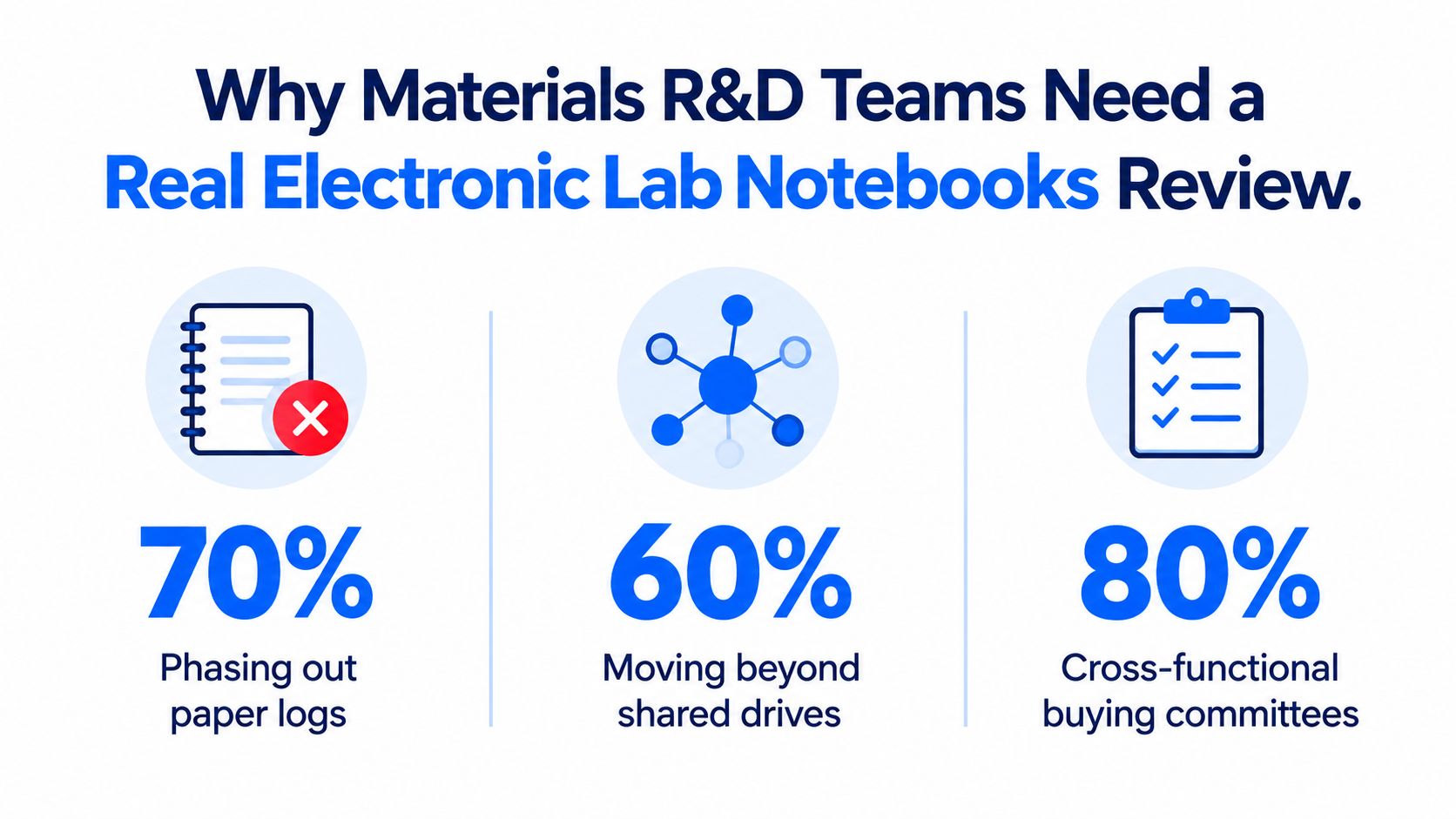
Materials R&D purchases usually involve scientists, lab managers, quality, IT, legal, data teams, and procurement. Each group sees a different risk. Formulation scientists need fast capture and flexible experimentation. QA needs controlled records and traceable changes. IT needs identity management, integration, security, and predictable administration. Finance needs a credible total-cost model rather than a seat price.
That makes a feature checklist inadequate. A platform can offer templates, signatures, inventory, dashboards, and APIs, yet still fail the formulation workflow if it can't represent a batch genealogy or connect a measured property to the exact recipe and process conditions that produced it.
Practical rule: Review the ELN against the work scientists must complete, not the modules the vendor can list.
What a credible review should measure
A serious comparison should test five dimensions:
- Capture depth: Can the system structure recipes, raw materials, lots, process conditions, characterization files, deviations, and conclusions?
- Integration depth: Can it exchange usable data with LIMS, SDMS, instruments, property databases, and AI environments?
- Compliance scope: Can administrators demonstrate permissions, signatures, audit trails, retention, and validation evidence?
- Time to insight: Can scientists search, compare, interpret, and reuse experiments without informatics intervention?
- Ownership burden: How much configuration, migration, integration maintenance, training, and validation work remains with the customer?
Academic adoption history reinforces why implementation matters. A 2016 review found that only a tiny fraction of university laboratories used ELNs at the time and identified limited practical knowledge, constrained options, and resources as barriers. The review also traces early implementations to 1997, including Kodak's Lotus Notes-based ELN, and a web-based notebook that followed in 1998, as described in the PubMed Central review of ELN adoption.
For materials teams, the conclusion is straightforward. The best ELN isn't automatically the one with the most features or the lowest apparent license cost. It's the one that preserves scientific context while making that context reusable.
What an ELN Actually Does for a Formulation Lab
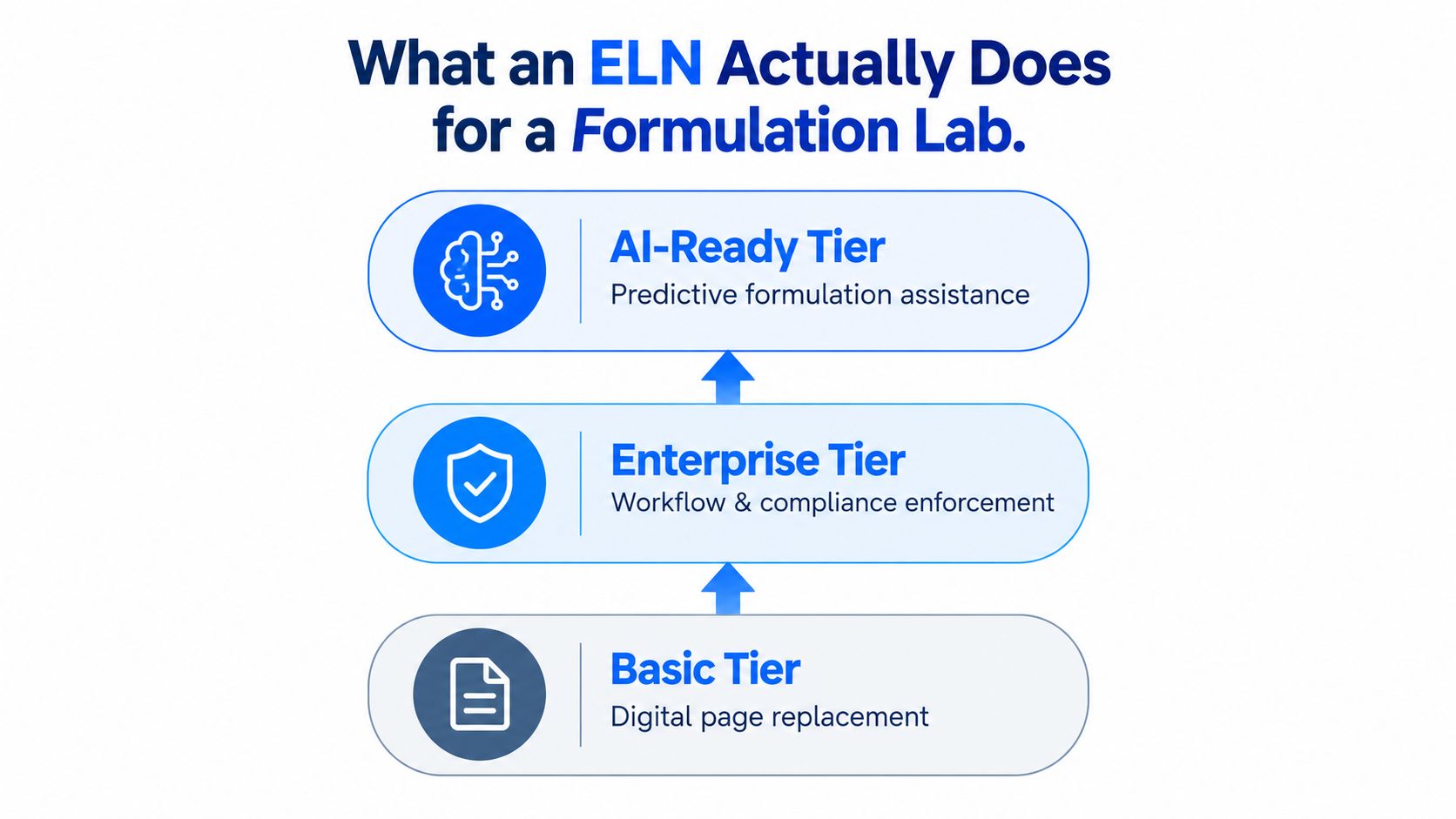
A basic ELN replaces a paper page with a digital page. A formulation-grade ELN should do considerably more. It should capture the experimental object as a connected record, not as a document that happens to contain text and attachments.
Consider a coating experiment identified as PI-1234. A weak implementation stores a narrative, a spreadsheet, and a few instrument files. A stronger implementation connects PI-1234 to the formulation version, raw-material lots, mixing sequence, temperature profile, operator, samples, characterization results, deviations, and approval status. That structure allows a scientist to search for comparable formulations and investigate why a property changed.
Basic, enterprise, and AI-ready tiers
The basic tier focuses on documentation. Scientists create entries, add protocols, upload files, and record observations. This can remove paper and scattered folders, but it often leaves the scientific meaning buried in free text.
The enterprise tier adds controlled workflows. It typically introduces role-based permissions, record review, electronic signatures, audit trails, inventory relationships, sample tracking, and structured templates. These controls matter when several sites or departments need to follow the same method while preserving local responsibilities.
The AI-ready tier depends on more than an AI assistant placed on top of an existing notebook. Predictive or conversational tools need consistent fields, stable identifiers, linked samples, comparable measurements, and clear provenance. If one scientist writes “high shear” and another records a numeric process condition in an unrelated attachment, an AI system may have little reliable structure to interpret.
The formulation data model matters
A formulation workflow should represent:
- Recipes and versions, including component identity, quantity, concentration, and substitution history.
- Batch and lot context, including the materials used and their genealogy.
- Process parameters, such as order of addition, mixing conditions, curing, drying, or thermal treatment.
- Characterization evidence, including instrument outputs, microscopy, spectroscopy, rheology, mechanical testing, and supporting files.
- Interpretation, including conclusions, anomalies, failed runs, and the rationale for the next experiment.
Inventory and sample modules deserve particular scrutiny. A spreadsheet may list a material, but it rarely enforces the relationship between a specific lot, expiry status, aliquot, sample, experiment, and disposition. A mature system can make those relationships explicit, while a lighter ELN may require a separate LIMS or inventory product.
Compliance also has layers. Native signatures and witnessing workflows can support controlled records, but they don't eliminate the need for procedures, validation, access governance, and appropriate system configuration. Buyers should ask where the ELN ends and the connected quality or document systems begin.
A useful demonstration should start with a real experiment, not a blank notebook. Ask the vendor to take PI-1234 from recipe creation through sample registration, instrument attachment, result review, signature, search, and reuse. That sequence reveals capture depth far faster than a feature tour.
The following video provides additional context for evaluating ELN capabilities in practice.
Leading ELN Platforms Compared Side by Side
No single platform is the natural choice for every materials organization. Benchling is often considered where configurable research data models and broader R&D workflows matter. LabArchives can suit teams prioritizing accessible notebook use. Dotmatics offers a broad enterprise scientific software portfolio, while Revvity Signals, formerly associated with PerkinElmer Signals, targets structured scientific data and analytics. IDBS E-WorkBook and LabVantage ELN are more likely to enter regulated or execution-heavy evaluations. SciNote can appeal to teams seeking a more approachable documentation and task environment.
The matrix below is an analyst's directional assessment for materials and formulation work. It isn't a substitute for a sandbox test, because the practical result depends on configuration, modules, services, and existing systems.
ELN Platform Feature Matrix for Materials R&D
| Vendor | Formulation Templates | Inventory & Samples | Analytics / AI | Compliance (21 CFR Part 11 / GLP) | Deployment | Notable Trade-off |
|---|---|---|---|---|---|---|
| Benchling | High configurability, though materials fit must be tested | Strong registry and sample context, with scope depending on configuration | Stronger in connected research workflows than generic notebook search | Broad enterprise controls, requiring validation assessment | Cloud-led | Developer-friendly data model can bring price and administration overhead |
| LabArchives | Accessible notebook templates, less specialized for complex formulation genealogy | Available capabilities depend on edition and connected tools | More focused on organization and retrieval than advanced formulation intelligence | Review exact controls and validation evidence by deployment | Cloud | Lower friction can mean more reliance on adjacent systems |
| Dotmatics | Broad scientific application coverage and configurable workflows | Strong potential across portfolio products | Broad analytics and scientific application ecosystem | Enterprise compliance posture requires product-specific verification | Cloud and enterprise deployment options | Portfolio breadth can increase integration and governance complexity |
| Revvity Signals | Structured experiment and scientific data workflows | Stronger where connected to broader scientific data products | Strong analytics orientation, with AI scope to verify in context | Assess regulated-use evidence and validation package | Cloud-led enterprise options | Product and ownership transitions require stability due diligence |
| IDBS E-WorkBook | Strong template-driven execution and structured capture | Suitable for controlled sample relationships when configured | Analytics depend on connected modules and data architecture | Strong regulated-lab heritage, with implementation burden | Enterprise, including private deployment options | Deeper controls can require heavier implementation |
| LabVantage ELN | Strong where ELN and LIMS workflows are designed together | Strong LIMS-oriented sample and inventory context | Analytics benefit from the wider LIMS environment | Strong regulated-lab orientation, requiring validation planning | Enterprise deployment options | LIMS coupling may increase project scope |
| SciNote | Practical templates for structured documentation | Inventory and sample functions available, with enterprise depth to test | Basic analytics and integrations should be tested for formulation use | Core audit and permission functions, with compliance scope to verify | Cloud and other options to confirm | Affordability and approachability may come with thinner enterprise controls |
Benchling's advantage is often its extensibility and structured data approach. The trade-off is that configuration, governance, and administration can become a program of work rather than a simple software rollout.
Dotmatics and Revvity Signals deserve special procurement attention because broad portfolios can solve more of the surrounding scientific workflow, but they can also introduce product overlap, connector dependencies, and ownership-transition questions. Teams should request a current product roadmap, support model, and named responsibility for integration maintenance.
IDBS E-WorkBook and LabVantage may fit organizations that value regulated execution and LIMS adjacency. Their strength can become a burden for a small formulation group that needs rapid adoption without a large validation or implementation team.
SciNote and LabArchives can be reasonable candidates when the first job is disciplined digital documentation. They require a closer test of formulation genealogy, cross-system data exchange, advanced analytics, and multi-site governance.
The important distinction is between feature presence and workflow completeness. A vendor may show inventory, analytics, and signatures in separate modules. The buyer must verify whether a scientist can use them together in one formulation lifecycle.
Security, Compliance, and Audit Readiness
An ELN becomes a controlled business system when it contains regulated records, proprietary recipes, unpublished results, or evidence used for quality decisions. Security and compliance therefore need separate evaluation. A platform can have strong authentication and still produce weak scientific records if audit exports omit context or if permissions are too broad.
For regulated teams, the demonstration should cover the full record lifecycle. Ask the vendor to create a record, change a controlled value, route it for review, apply an electronic signature, revoke access, export the audit history, and restore the record in a test environment. The aim is to see what an investigator or auditor would receive, not what appears on a compliance slide.
ELN Security and Compliance Comparison
| Vendor | 21 CFR Part 11 | E-Signatures | SOC 2 / ISO 27001 | Validation Package |
|---|---|---|---|---|
| Benchling | Support should be verified against intended use and configuration | Available in controlled workflows, with signature behavior to test | Request current certification evidence | Typically requires customer validation planning |
| LabArchives | Edition and use case need confirmation | Verify signature, witnessing, and record-lock behavior | Request current evidence | Assess available documentation and service scope |
| Dotmatics | Product-specific scope must be confirmed | Test across the selected application set | Request current portfolio and product evidence | May require substantial services across integrations |
| Revvity Signals | Verify regulated deployment and intended use | Test signature and audit behavior in the selected configuration | Request current evidence after product transitions | Confirm package ownership and maintenance |
| IDBS E-WorkBook | Regulated-lab orientation, with validation assessment required | Structured signature workflows to verify in the configured process | Request current evidence | Often requires formal validation work |
| LabVantage ELN | Strong potential through LIMS-oriented controls, subject to scope | Verify signatures across ELN and LIMS workflows | Request current evidence | Confirm IQ/OQ documentation and responsibilities |
| SciNote | Verify exact compliance scope and deployment | Test signatures, audit trails, and record locking | Request current evidence | Confirm whether documentation meets the intended use |
21 CFR Part 11 support isn't the same as compliance by installation. The organization still needs validated intended use, controlled procedures, user training, access reviews, data retention, and change management. The same principle applies to Annex 11 environments, where computerized systems require risk-based governance and evidence appropriate to their use.
Buyers should also inspect:
- Identity controls: SSO, multifactor authentication, role separation, joiner and leaver processes.
- Data protection: Encryption in transit and at rest, backup design, recovery testing, and tenant isolation.
- Audit trails: Coverage of edits, deletions, workflow transitions, signatures, timestamps, and administrative actions.
- Residency and access: Hosting location, support access, subcontractors, and cross-border data transfers.
- Validation support: IQ/OQ materials, traceability matrices, release notes, testing responsibilities, and change notification.
- Exportability: Whether the organization can retrieve readable records, metadata, attachments, and audit history without vendor intervention.
Teams building or integrating regulated systems can use Bridge Global's guide to building compliant healthcare software as a supplementary reference for audit-ready design principles. It doesn't replace an ELN vendor assessment, but it helps frame questions around evidence, controls, and accountability.
The hidden cost is often validation support. If the vendor exposes configuration history, audit evidence, and test documentation directly to administrators, the customer may reduce dependence on paid services. If every change requires vendor intervention, the initial quote understates the operating burden.
Integrations With LIMS, SDMS, and AI Platforms
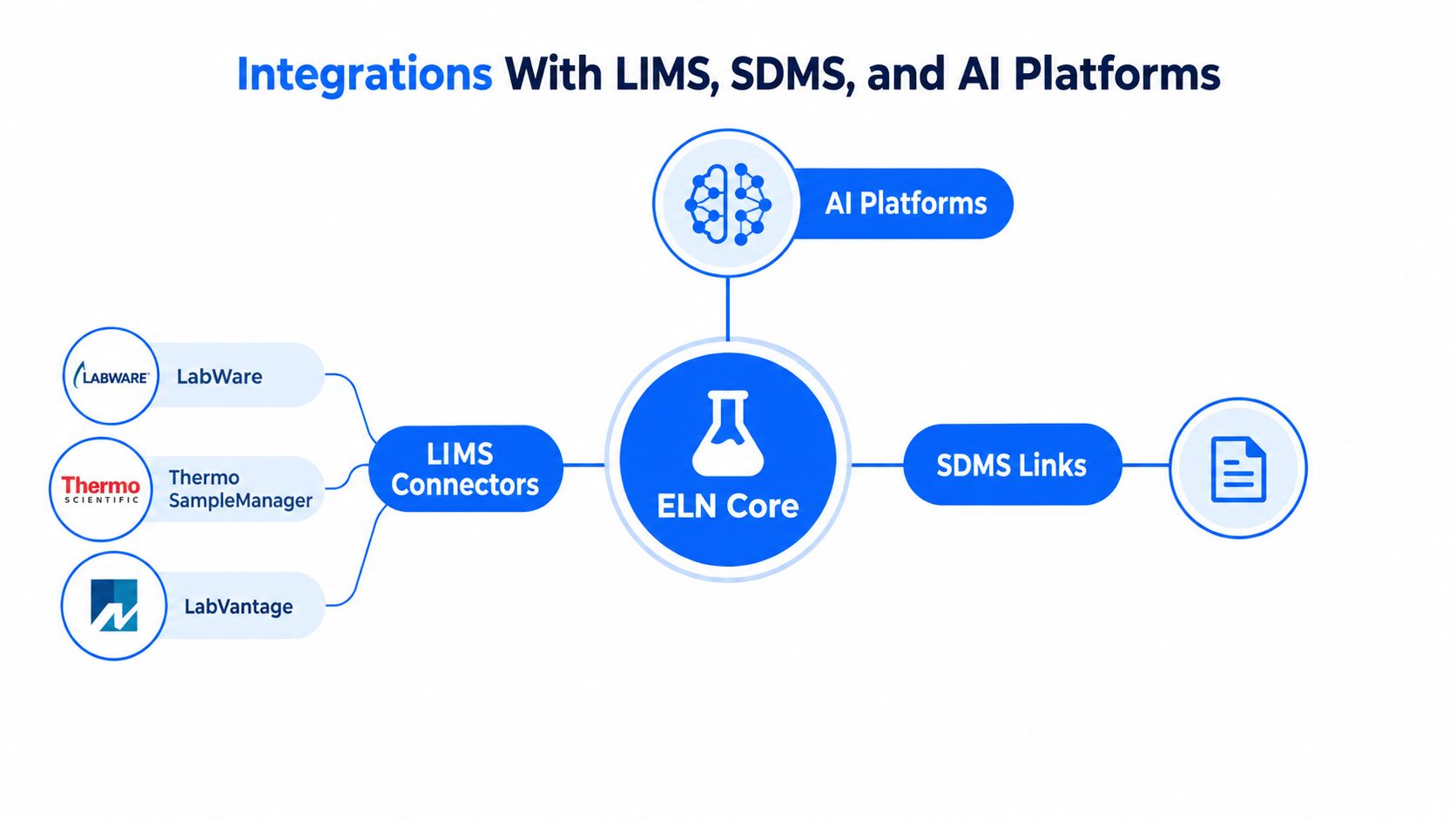
Integration depth determines whether an ELN becomes a usable data backbone or another isolated repository. Materials and formulation teams may need to connect it with systems such as LabWare, Thermo SampleManager, LabVantage, instrument software, chromatography and spectroscopy platforms, SDMS repositories, design of experiments tools, and property databases. The relevant question is not how many connectors a vendor lists. It is whether the platform preserves experiment context across each handoff.
Test the data path, not the connector list
REST APIs, webhooks, SDKs, and prebuilt connectors establish technical access, not integration quality. Transferring an instrument PDF into an ELN is materially different from transferring structured measurements, sample identifiers, method metadata, processing status, and provenance.
Ask every shortlisted vendor to demonstrate a complete workflow:
- A sample or batch is created in the system of record.
- The ELN references that identifier without duplicate manual entry.
- Instrument results arrive with method context and provenance.
- Approved results flow into a property or formulation dataset.
- An AI or Python environment retrieves the structured data.
- The recommendation or model output links back to the source experiment.
Exception handling is the more revealing test. Change a sample identifier, reject an instrument result, revise a formulation version, and export the complete history. The buyer should see how the system records failures, corrections, approvals, and relationships between linked objects.
Open data models create strategic options
Formulation teams often connect ELN records to DOE software, optimization tools, causal analysis, and internal Python workflows. Open APIs, stable identifiers, and structured exports reduce the risk of rebuilding research history when the organization changes analytical tools.
Benchling's integration and developer orientation may suit organizations with internal engineering resources. Dotmatics and Revvity Signals may provide broader application ecosystems, but buyers should establish which connectors are first-party, which rely on partners, and who maintains them after upgrades. IDBS and LabVantage may fit environments where execution and LIMS relationships are central, although their integration projects can require more formal governance.
SciNote and LabArchives should be assessed for API depth, export structure, and connector maintenance in practice. An endpoint that omits version history, attachments, audit records, or experiment-to-sample relationships does not provide a complete research interface.
AI requires separate scrutiny. As noted earlier, only a small minority of surveyed scientists could analyze results independently inside an ELN without informatics support. Buyers should therefore test whether AI features use governed, structured data and expose supporting evidence. A conversational interface alone does not demonstrate experiment insight.
Polymerize describes connecting ELNs, Excel files, and databases into a centralized materials R&D data backbone that can support predicted outcomes and next-best-experiment recommendations. The procurement test is architectural: whether that layer complements the selected ELN, preserves provenance, and reduces manual data preparation instead of creating another system to reconcile. A platform that only stores records may improve traceability, while one that exposes linked, reusable experiment data can support formulation decisions across the research process.
Pricing, Implementation, and Total Cost of Ownership
Per-user pricing is the least reliable way to compare ELNs. Enterprise-grade products are often sold by custom quote, while published pricing can range from free academic tiers to about USD 1,425 per user per year for a regulated-lab edition, according to SciSure's 2026 ELN comparison. That spread reflects more than software access. It can reflect validation scope, compliance controls, integration depth, support, hosting, and the amount of configuration required.
The same analysis reports a shortest time to ROI of 8 months for one platform, paired with a 3-month implementation. Those figures come from public review data and should be treated as a reference point, not a promise for a materials organization with complex LIMS and instrument integrations.
Build the cost model around work
A defensible TCO model should separate:
- Licensing: Named users, concurrent users, read-only users, administrators, external collaborators, and module fees.
- Implementation: Workflow design, templates, configuration, migration, training, and rollout support.
- Validation: Risk assessment, test scripts, execution, deviations, approvals, and periodic review.
- Integration: LIMS, SDMS, instruments, identity systems, data warehouses, APIs, and AI pipelines.
- Operations: Internal administrators, support, release testing, user provisioning, and template governance.
- Data services: Storage, backups, exports, archival, retention, and sandbox environments.
- Adoption: Refresher training, local champions, process redesign, and recovery from low usage.
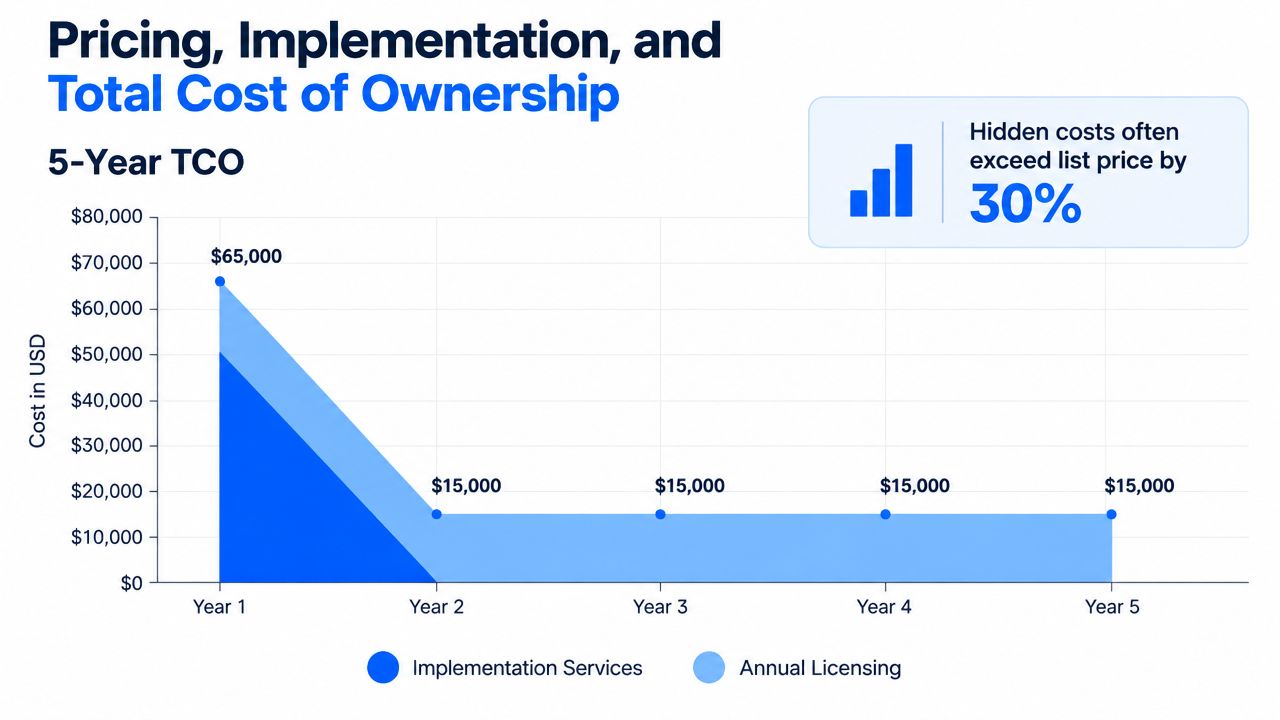
The infographic supplied for this review illustrates a scenario with USD 50,000 in initial implementation services and USD 15,000 per year in licensing. Those figures belong to that illustrative visualization, not to a universal market quote. The callout about hidden costs should also be treated as a budgeting warning, not as verified research evidence.
Time to value needs a definition
A vendor may define value as go-live, activated users, completed records, reduced reconciliation, or financial payback. These are different milestones. Procurement should require a written value framework tied to the formulation workflow.
Useful measures include:
- Time required to reconcile notebook entries with batch and sample records.
- Time required to locate comparable experiments and supporting files.
- Manual effort needed to prepare audit evidence.
- Reuse of approved templates and prior results.
- Reduction in duplicate data entry between the ELN and LIMS.
- Time from experiment completion to a decision about the next run.
Quote-only vendors aren't necessarily expensive, and transparent pricing isn't necessarily cheaper. The important question is whether the supplier discloses the assumptions behind implementation, validation, integrations, storage, and ongoing administration.
Matching an ELN to Your Materials R&D Scenario
The right recommendation changes with scientific complexity, compliance pressure, existing architecture, and internal technical capacity. A small coatings startup shouldn't buy the same operating model as a global materials enterprise, even if both need formulation templates and sample traceability.
ELN Recommendation Matrix by Materials R&D Scenario
| Team Profile | Recommended ELN Category | Must-Have Modules | 12-Month Cost Band (USD) | Top Implementation Risk |
|---|---|---|---|---|
| 10-scientist coatings startup | Accessible cloud ELN with formulation structure | Recipe templates, batch records, sample links, search, exports, basic API | Obtain vendor quote; do not assume a market band without team-specific scope | Choosing a simple notebook that can't preserve formulation genealogy |
| Mid-market specialty chemicals group with audit pressure | Validated enterprise ELN or ELN-LIMS platform | Controlled templates, signatures, audit trails, inventory, sample management, validation documentation | Obtain a scoped quote covering validation and integrations | Treating Part 11 support as a complete compliance program |
| Global materials enterprise with an existing LIMS stack | Configurable enterprise ELN with open integration layer | LIMS connector, SDMS links, instrument exchange, role model, migration, API governance | Obtain a multi-site quote with integration and operating costs | Duplicating master data or creating conflicting systems of record |
| AI-forward battery research group | Structured ELN plus governed materials intelligence layer | High-quality metadata, property links, API access, model provenance, next-experiment workflows | Obtain a quote covering data engineering and AI integration | Adding AI before cleansing and standardizing experimental records |
For the coatings startup, speed and adoption should dominate the first evaluation. A platform such as SciNote or LabArchives may be worth testing if scientists can capture recipes, lots, process conditions, and test results without excessive administration. The startup should also ask how it will export structured records if its needs expand.
The specialty chemicals group should place compliance and audit evidence ahead of visual polish. IDBS E-WorkBook, LabVantage ELN, Dotmatics, or Revvity Signals may enter the shortlist, but the team must scope validation, signatures, audit exports, and change control before selecting a vendor.
The global enterprise should start with architecture. If LabWare, Thermo SampleManager, or LabVantage already controls samples and test results, the ELN shouldn't create a parallel inventory truth. Benchling, Dotmatics, Revvity Signals, IDBS, and LabVantage all require a detailed integration workshop in this scenario.
The AI-forward battery group should resist buying an AI feature before defining the data contract. It needs structured recipes, property measurements, failed experiments, uncertainty, and provenance. The ELN may capture the work, while a connected intelligence layer handles modeling and experiment prioritization.
Five questions for the final demo
- Can you model one real formulation from raw-material lot through characterization and decision?
- Which system owns each identifier, and what happens when a record changes or fails validation?
- Can an administrator export the full experiment, attachments, metadata, signatures, and audit trail?
- Which integrations are maintained by the vendor, and which depend on partners or customer code?
- What measurable value will you demonstrate before full deployment, and how will you calculate it?
A strong electronic lab notebooks review ends with evidence from those tests, not with a winner chosen from a feature grid. Materials teams need records that remain connected, interpretable, and reusable as programs move from discovery toward scale-up.
Polymerize helps materials R&D teams unify data from ELNs, spreadsheets, and other silos, then apply explainable models to formulation and property data for next-experiment planning. Visit Polymerize to see how its materials intelligence layer can complement an ELN-centered informatics strategy.
Put your R&D data to work
See how materials teams use Polymerize to plan fewer experiments and reach target properties faster.