


81% of scientists in a 2025 survey of 150 researchers in the United States and Europe said their ELN records data but doesn't help interpret it, according to The Scientist's reporting on ELN usability. For a materials R&D lead, that's the distinction that matters: a notebook can contain every experiment and still leave the team unable to explain which formulation and processing conditions produced a result.
Table of Contents
Why Notebooks Record Experiments but Do Not Reuse Them
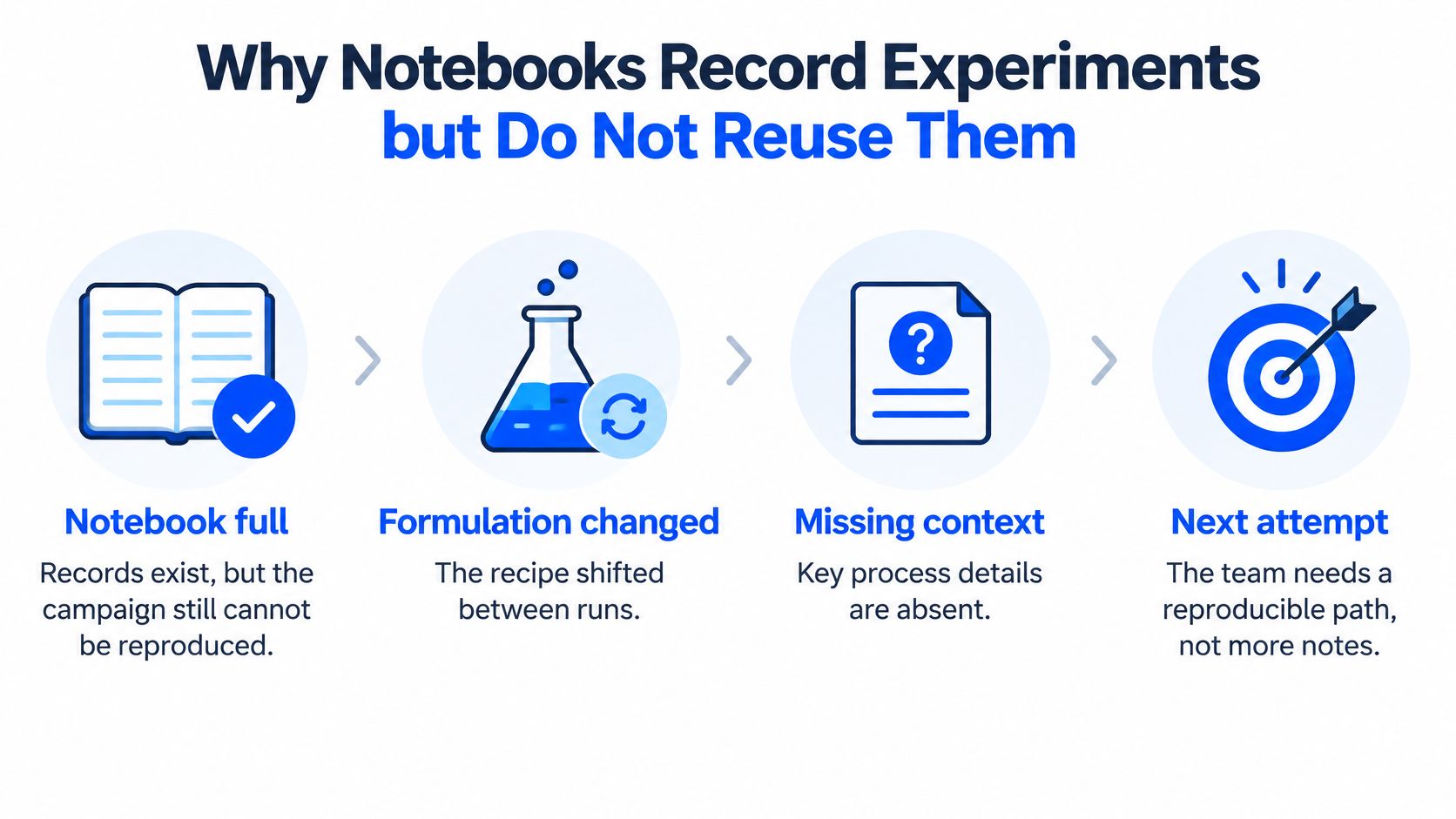
A formulation campaign can look well documented until someone tries to reproduce its most promising sample. The recipe is attached, the property result is plotted, and the conclusion sounds convincing. But the ingredient grade lives in a purchasing spreadsheet, the mixing history is in an operator's notes, and the cure profile sits beside the instrument rather than beside the experiment.
The same survey reported 65% repeating experiments because earlier results were difficult to find or reuse, while 51% spent too much time importing and exporting data. Those findings describe different symptoms of the same problem: researchers have records, but they can't reliably connect the evidence needed for a decision.
The distinction between a full notebook and a reusable experiment is straightforward.
Design for the question after the experiment
In materials development, the useful question usually isn't whether a run occurred. It's whether the team can compare that run with another without guessing what changed.
A development lead should be able to distinguish a formulation change from a processing change, identify whether results used comparable test methods, and locate the evidence behind a scale-up decision. If the researcher must reopen unrelated files and interpret naming conventions to answer those questions, the record isn't ready for reuse.
- Formulation decisions: Which ingredient identity, grade, and concentration belong to the tested sample?
- Process decisions: Which mixing sequence and thermal history occurred?
- Property decisions: Which method, settings, and sample conditioning produced the reported value?
- Next-experiment decisions: What remains uncertain, and which change would help resolve it?
A polished narrative isn't a substitute for a traceable relationship between formulation, process, sample, and result.
That's the practical starting point for electronic lab notebook best practices. Templates, audit trails, and FAIR principles are useful only when researchers apply them to materials-specific meaning. Adding more free-text fields won't resolve an ambiguous sample lineage.
Treat narrative as the place to explain scientific judgment. Treat structured relationships as the means of retrieving, comparing, and analyzing the evidence behind that judgment. Both belong in the record, but they serve different jobs.
Capture Formulation and Process Context at the Bench
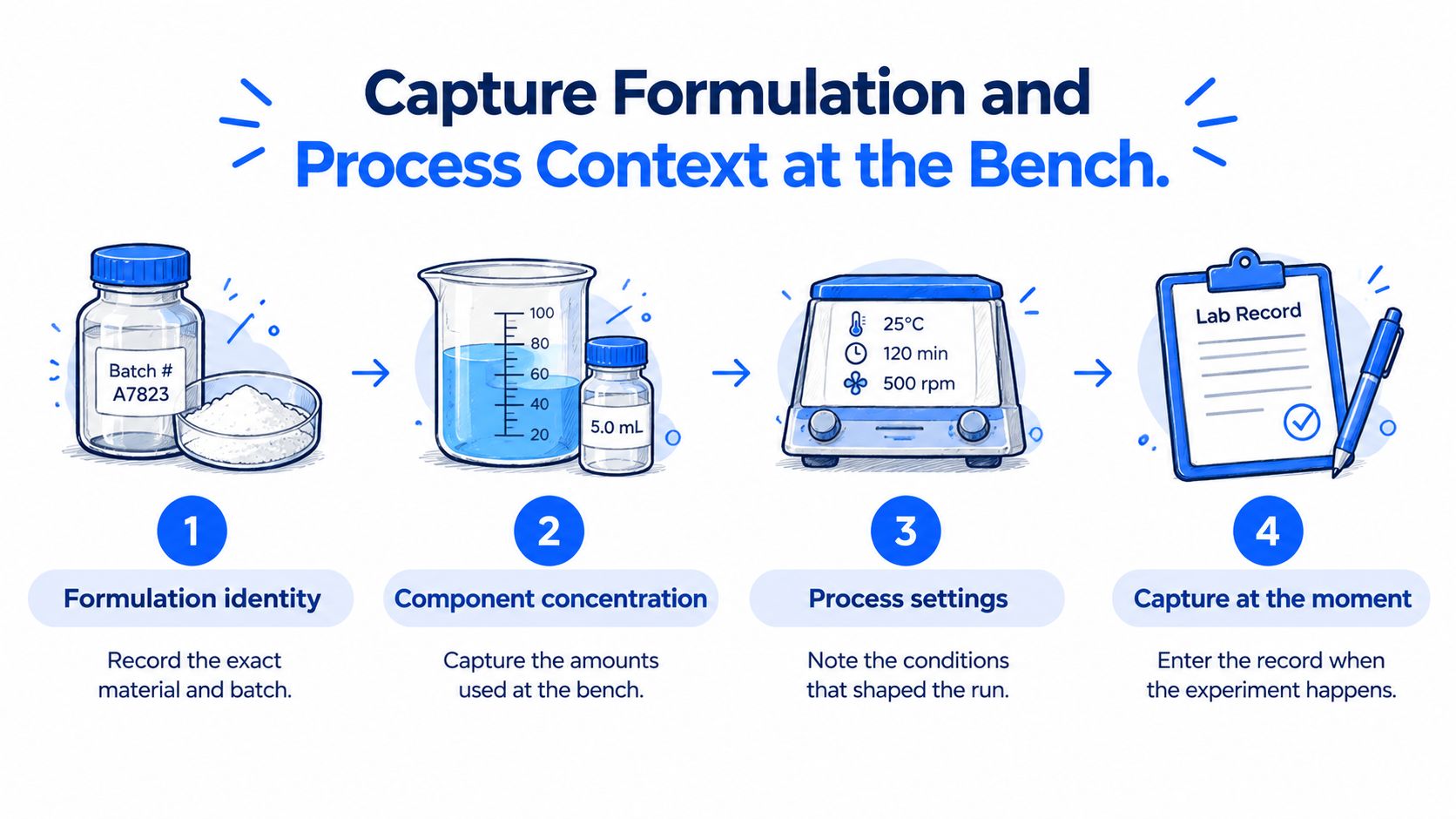
Start with an adaptive experiment schema, not a blank page and not an exhaustive form that every researcher must complete regardless of relevance. Require the metadata that makes an experiment identifiable, then add fields appropriate to formulation preparation, reaction, curing, characterization, or scale-up.
The bench record should make the actual work easy to document before anyone begins interpreting it.
Make the required fields scientifically useful
Use this field structure as a starting point for the next formulation campaign. These practices align with materials-focused guidance on ELNs, data management, and AI analysis.
| Record group | Fields to capture |
|---|---|
| Formulation | Formulation identity, ingredient identity and grade, component concentration, concentration basis, units |
| Material lineage | Component batch and lot numbers, prepared-batch identity, sample identifiers |
| Processing | Mixing order, temperature profile, shear or mixing energy, cure or reaction time |
| Testing | Sample conditioning, instrument identity, method version, calibration status, relevant settings |
| Execution | Operator, environmental conditions, exact protocol, deviations, instrument output |
| Interpretation | Response variables, calculations, derived results, uncertainty, conclusions |
Units need meaning, not just symbols. A concentration field should identify its basis, rather than leaving the next analyst to infer whether the researcher meant a mass fraction, volume fraction, or another convention. Preserve both the entered value and any approved normalized representation.
Controlled vocabularies should resolve ambiguity without hiding scientific nuance. Let researchers choose an approved method name, then provide space to document a deviation. Don't force an unusual observation into an inaccurate dropdown merely to complete the form.
Separate campaign planning from execution
Before work begins, define the response variables, acceptance criteria, statistical model, and exclusion rules. Researchers shouldn't decide which unsuccessful runs count only after seeing the results.
Give each experiment and sample a unique identifier. Use those identifiers to connect the prepared formulation, processing record, characterization output, and eventual scale-up batch rather than relying on a similar filename.
The accompanying video provides another reference point for the documentation workflow.
The trade-off is bench usability. Requiring every conceivable field encourages workarounds, while requiring too little leaves analysts reconstructing context later. Test the template during actual execution and remove fields that don't support reproducibility, interpretation, or a defined downstream decision.
Keep mandatory core metadata stable. Extend the template when the experiment type requires different scientific context, rather than creating an unrelated record structure for every project.
Preserve Versions Raw Files and the Original Record
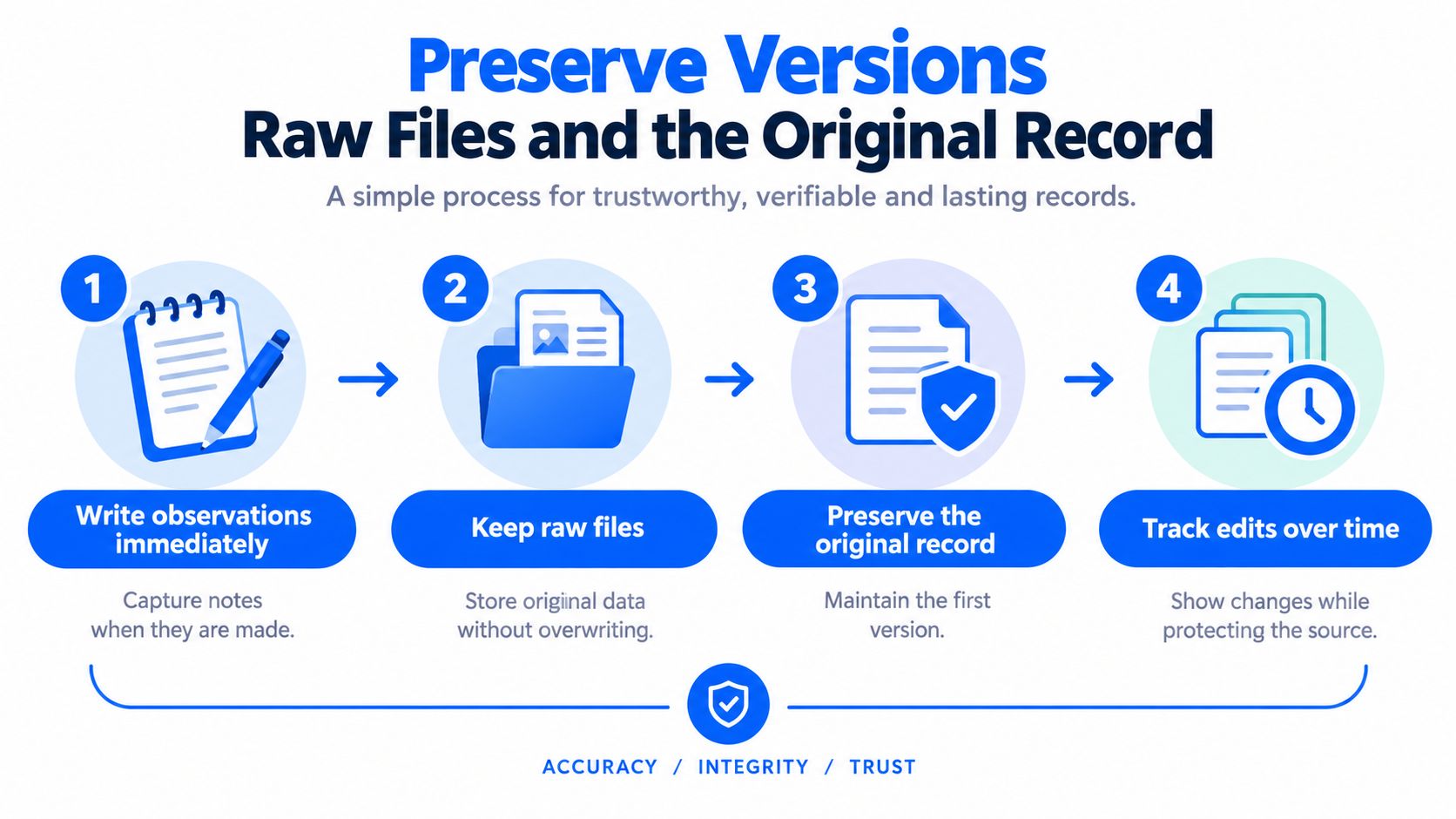
An experiment record must survive correction without losing its history. Record observations when they're made, preserve the original raw data and metadata, and prohibit silent overwriting. The OECD's GLP data-integrity guidance26/en/pdf) places these controls within a risk-based lifecycle approach, not merely a final archiving task.
The preservation workflow should remain understandable from initial capture through retirement.
Keep corrections distinguishable from originals
Suppose a researcher discovers that an entered material lot was wrong. The appropriate action is an amendment identifying the corrected lot, the author, the timestamp, and the reason for change. The original entry must remain recoverable.
Apply the same distinction to analysis. A recalculated property value should point to the raw input and the processing version that generated it. Don't replace the original instrument output with a cleaned spreadsheet and assume the final number contains enough evidence.
- Raw-file references: Use immutable identifiers rather than a researcher's current desktop path.
- Integrity checks: Where provenance warrants them, retain cryptographic hashes alongside file references.
- Version history: Preserve changes through review, correction, export, and archive.
- Late additions: Identify information added retrospectively instead of presenting it as contemporaneous capture.
For teams comparing documentation workflows across research settings, AIDictation's research documentation for clinical teams is a complementary resource to consider. Any capture method should still fit the laboratory's own rules for attribution, review, confidentiality, and retention.
Test reconstruction rather than storage alone
An archive should preserve the relationship between the record, metadata, audit trail, and electronic signatures. A collection of readable documents isn't sufficient if reviewers can no longer determine which approval belongs to which version.
Before deployment, assign responsibility for retention, backups, export, offboarding, and disaster recovery. Define what happens when a researcher leaves, an instrument is retired, or the organization changes systems.
Practical rule: Ask a colleague to reconstruct a completed experiment from the exported archive without access to the original application.
That exercise exposes problems a successful backup job won't answer. Can the colleague locate the raw evidence, distinguish original from transformed results, and identify the reviewed version?
Free-text-only capture, delayed entry, missing metadata, and uncontrolled exports can undermine an otherwise sound schema. Treat preservation as an operational responsibility with an owner, not a feature that becomes relevant only after a disputed result.
Define Access Signatures and Review Gates First
A signature should state what the signer is taking responsibility for. A generic approval button doesn't distinguish the researcher who performed the experiment from the colleague who checked the calculations or the manager who authorized the next development step.
The FDA issued its final 21 CFR Part 11 rule in March 1997, effective August 20, 1997, establishing conditions for accepting electronic records and signatures as equivalents to paper records and handwritten signatures, as described in its Part 11 scope and application guidance. Its signature requirements include the signer's printed name, signing date and time, and the meaning of the signature.
Configure distinct responsibilities
For materials R&D, Part 11 is a useful historical benchmark even when a project isn't directly FDA-regulated. It doesn't follow that every materials experiment falls under FDA requirements. The practical lesson is to define accountability before configuring the interface.
| Role | Meaning of the action |
|---|---|
| Experiment author | Confirms responsibility for the recorded execution and observations |
| Peer reviewer | Checks scientific completeness and the supporting evidence |
| Supervisory approver | Authorizes a defined project decision |
| Quality release authority | Performs the release action required by the applicable quality process |
These roles shouldn't become mandatory bureaucracy for every exploratory run. Match the approval burden to record criticality, project stage, and applicable obligations. A critical formulation decision deserves a different review path from an early screening observation.
Establish access before onboarding
Require unique user identities and role-based permissions. Give each researcher or project an owner-controlled workspace, and teach users how authorship, amendments, review, and approval work before they create primary records.
Shared accounts defeat individual attribution. Optional final signatures leave teams uncertain about whether an experiment was merely recorded, scientifically reviewed, or approved for use.
- After execution: Assign a reviewer to check that the record is complete enough to proceed.
- Before analysis: Confirm that the evidence and intended analytical approach are suitable.
- Before a formulation decision: Require the appropriate independent review for critical records.
The configuration should make these states visible without implying that every completed field has been scientifically verified. Completion, review, and approval are different events.
Write the access matrix and signature meanings in operational language, then have researchers and reviewers test them together. If people disagree about what signing means, the workflow isn't ready to go live.
Connect the ELN to LIMS and Polymerize
An all-in-one replacement can look attractive during procurement because it promises fewer interfaces. A federated design starts with a different question: which systems already perform valuable work, and what information must remain connected across them?
The ELN interoperability report identifies technical and semantic barriers between data models and discusses JSON, JSON-LD, RO-Crate, APIs, standardization, and semantic mapping as emerging remedies. File exchange alone doesn't resolve meaning. Teams still need to agree on what a material, batch, method, property, and unit represent.
What Each System Should Own
Treat the following as an allocation of responsibilities to evaluate, not a requirement to buy another application.
| System | Primary job | Must stay linked |
|---|---|---|
| ELN | Experiment narrative, observations, rationale, and decision record | Experiment, formulation, sample, protocol, and reviewed version |
| LIMS | Sample registration and managed testing workflows | Sample, batch, requested test, method, and result status |
| Instrument software | Acquisition and original instrument output | Instrument, sample, settings, method, and raw-file identity |
| Spreadsheets | Governed legacy calculations or specialist working analysis | Source records, formula version, units, and transformed outputs |
| Repository or production system | Retention or manufacturing execution within its defined remit | Approved material definition, process lineage, and relevant batch |
| Polymerize Connect | Centralized materials-data backbone across spreadsheets, ELNs, and silos | Shared identities, experimental context, results, and provenance |
| Polymerize Labs | Explainable modeling for property prediction and formulation optimization | Approved modeling inputs, model outputs, and supporting experimental evidence |
This approach lets the ELN remain the scientific decision record while a connected data layer supports reuse. It doesn't require scientists to recreate instrument acquisition or sample-management workflows inside a notebook.
Define the handoff contract
For every integration, document the sending system, receiving system, record identifier, required metadata, update behavior, and rejection rules. Distinguish a missing value from an unavailable measurement and from a field that doesn't apply.
Legacy spreadsheet mapping needs scientific review, not just column matching. A column labeled concentration may require a basis; a property name may need its test method; a material nickname may refer to several grades.
- Canonical ownership: Assign a named steward for material, method, batch, property, and unit definitions.
- Change control: Decide who approves schema revisions and how dependent systems learn about them.
- Quality checks: Reject or quarantine records with unresolved identities or incompatible units.
- Transformation boundaries: Keep source evidence distinct from normalized or derived results.
Don't migrate a functioning specialist workflow merely to make the architecture look simpler. Migrate when the team can explain what becomes easier to govern, retrieve, or reuse. Otherwise, preserve the specialist system and improve the handoff.
Use Review Gates to Stop Repeated Failed Runs
A failed experiment and an unusable experiment aren't the same thing. A failed run can inform the next decision when researchers preserve what happened. An apparently successful run with missing context may be unsuitable for comparison.
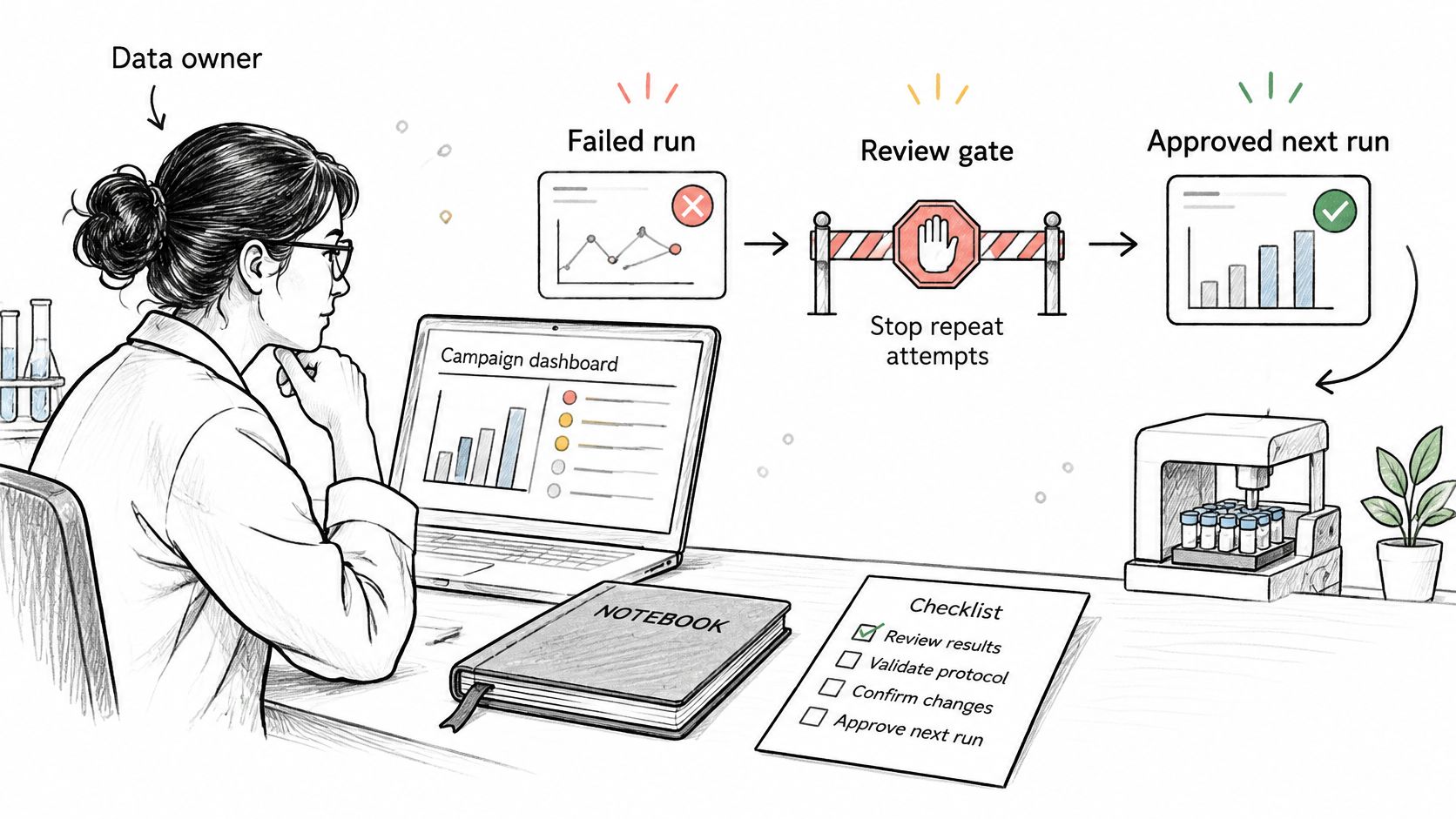
The NIH's ELN best-practice guidance places ultimate responsibility for data integrity with the principal investigator and recommends regular review of primary data. In an industrial campaign, assign that responsibility explicitly to the project's data owner rather than assuming the software administrator will provide scientific oversight.
Use a campaign checklist to make that responsibility actionable.
Give each gate a decision
Before execution starts, the data owner should define how researchers will collect, label, edit, exclude, analyze, and share campaign data. The gates then test whether the team followed those rules and whether the next action is justified.
- Execution gate: Can the reviewer reconstruct the objective, actual procedure, deviations, and location of evidence? Return the record for clarification when essential context is absent.
- Analysis gate: Are calculations traceable, methods appropriate, and exclusions consistent with the campaign plan? Hold unresolved records outside the comparison dataset without deleting them.
- Decision gate: Does the evidence support the proposed formulation change or repeat? Require the lead to state what the next run is intended to resolve.
A gate needs an owner and an outcome. Avoid review states that indicate someone opened an entry but don't say whether work can proceed.
Make a repeat scientifically deliberate
Before authorizing another run, classify why the previous attempt didn't answer the question. Was the formulation unacceptable, the execution compromised, the measurement unsuitable, or the documentation incomplete? Those are different problems and call for different responses.
Don't approve a repeat until the team can state what it will learn that the previous run couldn't establish.
Keep unsuccessful experiments visible in the campaign history. Apply predefined exclusion rules to analysis eligibility, not to whether an experiment continues to exist.
For scale-up, evaluate whether the evidence supports transfer beyond the original bench conditions. The decision record should identify what is known, what remains uncertain, and which process assumptions need verification. That gives the receiving process engineer a scientific handoff rather than a favorable property value with an incomplete history.
Judge the workflow by whether researchers can explain their next experiment using retrievable evidence. A notebook alone can't guarantee fewer failures, but a disciplined review process can make repeated work intentional rather than accidental.
Put the Next Campaign on a Reusable Record
Choose an active formulation campaign with a named scientific owner and a real downstream decision. Don't begin by redesigning the entire organization's notebook estate. Begin by testing whether someone outside the campaign can follow its evidence.
Use the relationships already defined to connect the campaign's ELN entries, spreadsheets, and instrument files. Resolve ambiguous identities before adding another template, and agree on the export contract before introducing a modeling workflow.
Keep the pilot bounded
- Name the decision: Specify the formulation or process choice the campaign must support.
- Assign the owner: Give someone authority to resolve definitions and reject incomplete handoffs.
- Test the transfer: Verify that the connected record retains scientific meaning outside its originating system.
- Set acceptance conditions: Require reconstructable evidence, usable exports, and an explainable next-experiment recommendation.
Enterprise teams should also request evidence for their security baseline, including applicable ISO 27001 and SOC 2 controls, role-based access, and GDPR and CCPA obligations. Verify scope and responsibilities rather than treating a procurement checklist as proof that the deployed workflow is governed.
If bench access is part of the pilot, assess the physical workspace too. Labs USA's furniture planning resources for lab managers can support that separate planning exercise, alongside decisions about where researchers can safely capture observations during work.
Finish the pilot with a clear handoff: the scientist owns the experiment's meaning, the data steward owns shared definitions, and the connected workflow supplies traceable evidence for the next decision.
Polymerize offers a connected materials-data backbone and explainable modeling tools for teams moving beyond isolated notebook records. Bring an active campaign's ELN entries, spreadsheets, and instrument files to a discussion about shared identifiers, metadata requirements, and the handoff into next-experiment planning.
Put your R&D data to work
See how materials teams use Polymerize to plan fewer experiments and reach target properties faster.