


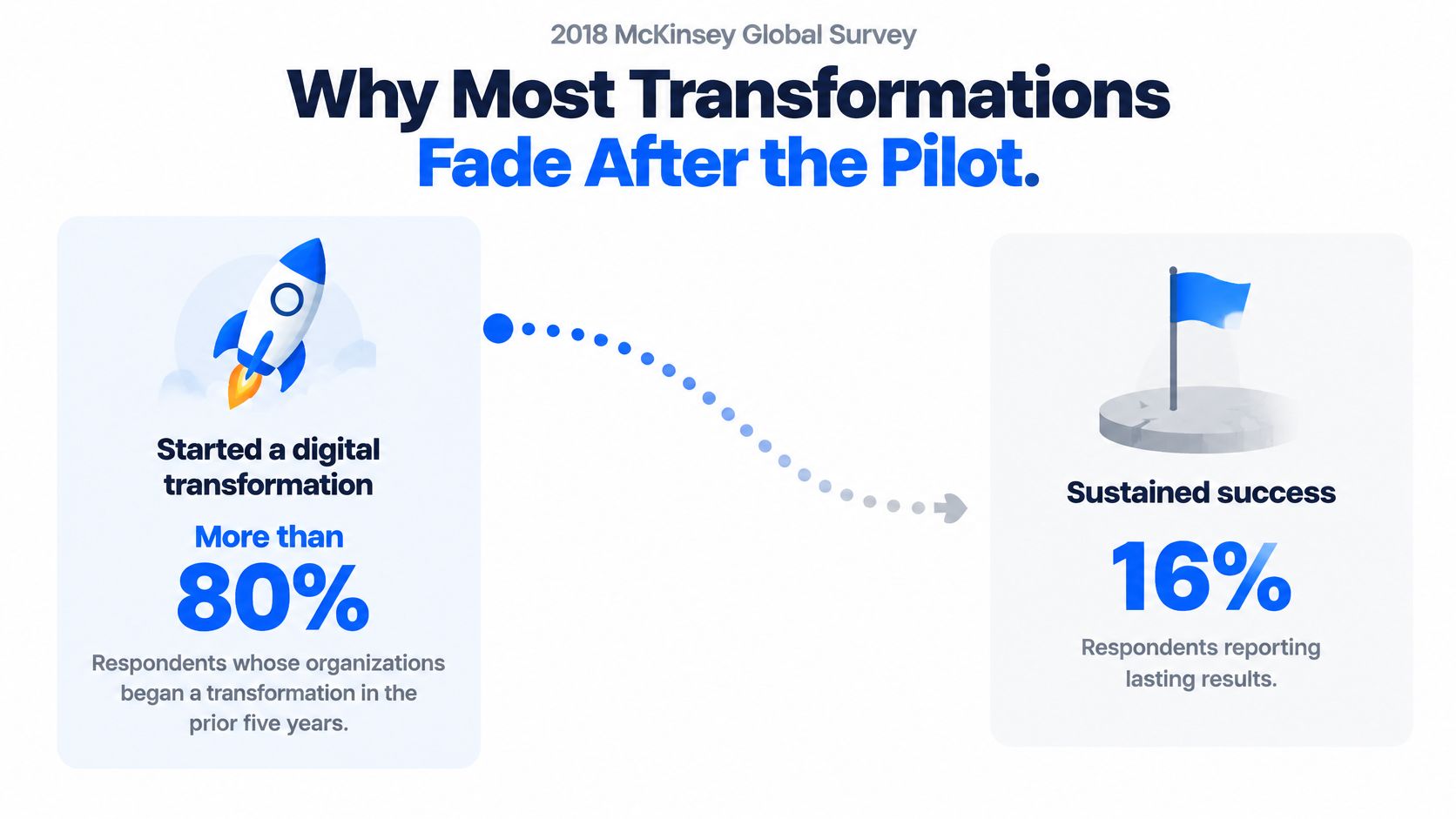
Only 16% of respondents in the 2018 McKinsey Global Survey said their organizations' digital transformations both improved performance and sustained the changes over the long term. For a materials R&D leader, that's a useful warning: buying software is a milestone, but changing how scientists, engineers, and production teams make decisions is the central challenge.
Table of Contents
- Why Most Transformations Fade After the Pilot
- Five Parts Every Strategy Has to Name
- The Data Backbone AI Can Trust
- Stage Infrastructure Before Models
- What Faster Materials Programs Actually Changed
- Make the New Way the Default Decision
- Choose One Outcome and Start the Backbone
Why Most Transformations Fade After the Pilot
Say a polymer laboratory installs a new instrument and connects it to an analytics dashboard. Scientists can inspect results faster, and the pilot demonstration looks convincing. Yet formulation decisions still depend on a spreadsheet whose ingredient names don't match the laboratory notebook, while manufacturing tracks batches under different identifiers.
When a promising formulation fails during scale-up, nobody can confidently reconstruct which raw-material lot, processing history, and test method produced the original result. The instrument works. The decision process hasn't changed.
The gap between installation and impact
A digital transformation strategy is the coordinated plan connecting technology, leadership priority, workforce skills, operating practices, and a measurable business outcome. In materials R&D, that outcome might be shorter formulation cycles, fewer avoidable failed experiments, or more reliable transfer into production.
Digitizing an individual step isn't enough. A searchable test report helps someone find a result, but it doesn't establish whether that result is comparable with another laboratory's measurement.
The distinction between starting a transformation and sustaining it is stark.
Follow the decision across departments
Before approving another pilot, trace an actual formulation decision from request to production handoff:
- The scientist needs comparable experiments and enough context to explain a recommendation.
- The process engineer needs the processing conditions and equipment assumptions behind the result.
- The quality team needs the approved method, acceptance criteria, and traceable evidence.
- The executive sponsor needs an accountable owner and evidence that the business outcome improved.
If these people can't work from a consistent record, a more advanced model won't resolve the disagreement. The strategy must specify what changes between their handoffs, not merely which applications each department receives.
Practical rule: Judge a pilot by the decision it changes, not the demonstration it delivers.
Five Parts Every Strategy Has to Name
Five parts of a materials R&D digital transformation strategy
| Part | Question it answers | What good looks like | If it is skipped |
|---|---|---|---|
| Business outcome | Which result must move? | Named metric with baseline and owner, such as cycle time, first-pass yield, failed experiments, or qualification speed | Tools ship with no scoreboard |
| Governed data | Can the next model trust the record? | Shared identity for materials, formulations, process conditions, methods, units, and batch genealogy | Models train on noisy or conflicting labels |
| Use-case portfolio | Which decisions get support first? | Capture and interoperability, then prediction, then closed-loop experiment choice | An isolated AI pilot never reaches a standard method |
| Workflow adoption | Who changes a daily habit? | Scientists, process, quality, and production use one record, with competency time and exception rates tracked | A dashboard is built and ignored |
| Operating model | Who funds and reprioritizes? | Executive owner, review cadence, and gates for science, regulation, and production | Funding ends after the demo |
Start with the outcome, not the application
These parts depend on one another. Suppose a coatings team wants to shorten qualification. The outcome owner must first define when qualification starts and ends, which product families count, and how waiting for external testing is handled.
Without that definition, a software team might celebrate faster report preparation while the customer still waits just as long for an approved material. A usable metric describes the business process, not just the activity that became easier to measure.
The outcome also determines the data scope. If the delay comes from inconsistent adhesion testing across sites, migrating unrelated historical experiments won't resolve it. Start with the methods, substrate preparation, formulation versions, and results that explain that delay.
The use-case portfolio should follow the bottleneck. Searchable, comparable test results may be more valuable initially than predicting a property the team already measures quickly.
Make ownership practical
Workflow adoption connects the technical work to a person's responsibilities. A formulation chemist needs to know when to enter an experiment, which fields are mandatory, and what happens when the result falls outside the expected range. The quality reviewer needs a clear route for disputing a record without creating an unofficial replacement.
The operating model resolves disagreements that individual teams can't settle. Someone must decide whether fixing a test-method mapping takes priority over adding another predictive feature, and someone must protect the time scientists spend validating either change.
Security ownership belongs in that discussion, too. ISO Security's ISO 27001 certification roadmap is a useful planning resource when defining the information-security work around shared experimental records. Keep that work connected to access decisions and operational responsibilities, rather than treating it as a separate paperwork exercise.
A practical strategy review asks the team to complete these statements:
- We will improve a defined outcome, measured against an agreed baseline.
- We will trust records that meet explicit scientific and data-quality requirements.
- We will support named decisions in a deliberate order.
- We will change specified working habits across the affected roles.
- We will govern funding, priorities, exceptions, and release decisions through named owners.
Mark which statements your current program can complete in a sentence. An empty answer identifies strategy work that a platform purchase can't substitute for.
The Data Backbone AI Can Trust
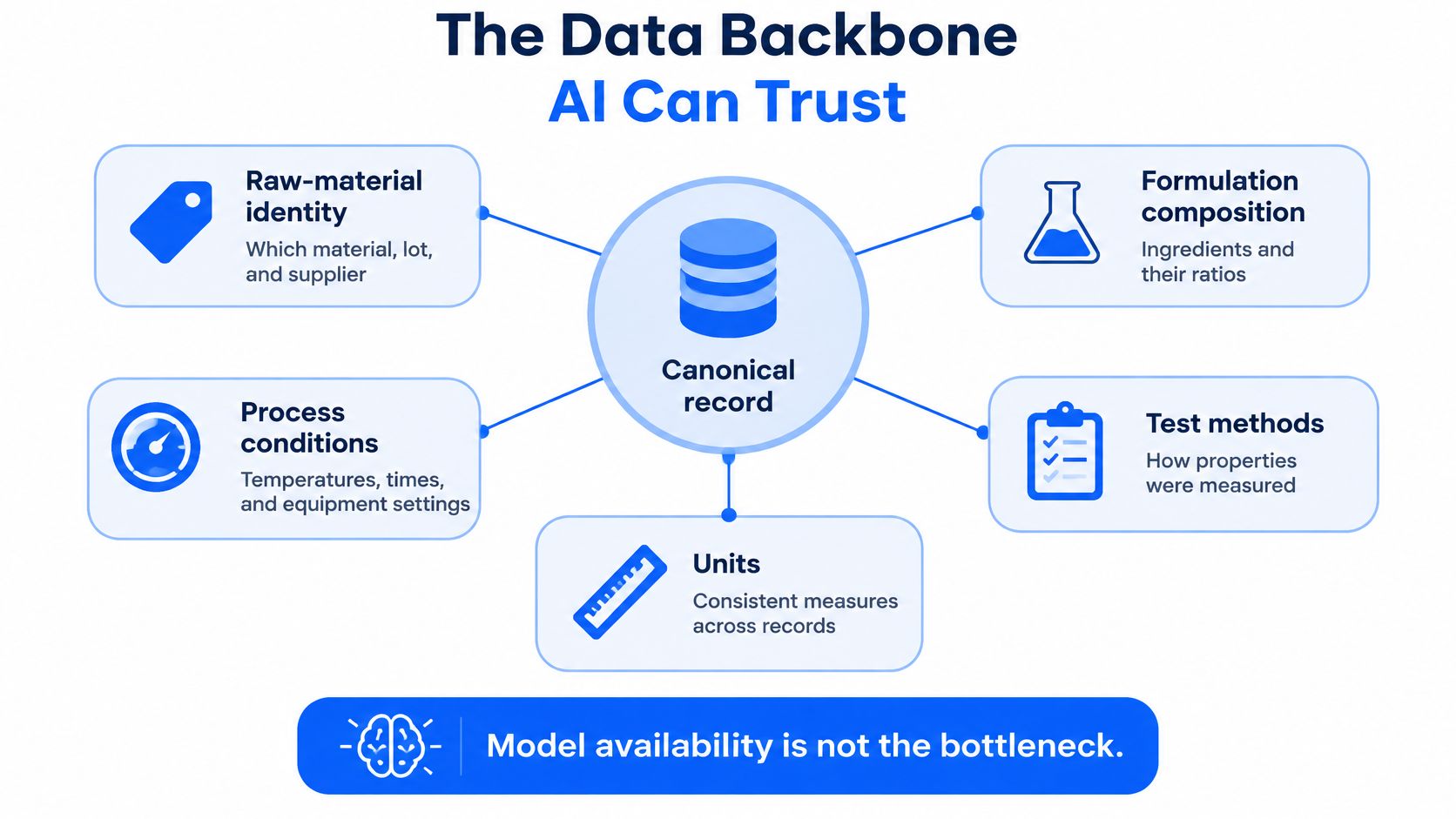
Model availability isn't the first readiness test. Ask whether another scientist can reconstruct the experiment behind a training example. If they can't distinguish a changed formulation from a changed test method, the model may learn a relationship the team cannot defend.
The McKinsey Digital Quotient benchmark found that only 13% of companies had a digital strategy systematically linked to corporate strategy. For R&D leaders, the practical response is to design the experimental record around decisions the business needs to make.
Start by specifying what belongs together.
Build a record scientists can reconstruct
A canonical record is an agreed representation of an experiment, not necessarily a replacement for every source application. Include raw-material identity and lot, formulation composition, process conditions, test methods, units, instrument provenance, batch genealogy, and property outcomes.
Preserve source-system identifiers so reviewers can trace imported values back to the electronic laboratory notebook, instrument export, or production record. Add machine-readable metadata and version history so a corrected concentration doesn't overwrite the value used to train an earlier model.
At ingestion, apply explicit checks:
- Units and basis: Distinguish mass fraction from volume fraction, and record the basis of a reported concentration.
- Missing values: Separate not measured from below detection limit and failed measurement.
- Outliers: Flag unusual results for review rather than automatically deleting scientifically meaningful observations.
- Naming mappings: Reconcile local material and method names against approved shared definitions.
Centralizing files doesn't accomplish this. A governed data product also needs quality thresholds and a named person responsible for resolving disputed records.
Close the loop without losing control
New experimental results should update the approved record. Model owners should evaluate candidate versions against held-out experiments and relevant production observations, then release only versions that pass the agreed scientific checks.
Keep formulations protected through role-based access and audit trails. At Polymerize, we're ISO 27001, SOC 2, and GDPR/CCPA compliant. Those credentials support enterprise evaluation, but each R&D team must still decide which collaborators may view compositions, export results, or approve changes.
For the financial review, Doczen's resource on measuring ROI on transformation initiatives provides a useful companion to the technical discussion. Track the cost of preparing usable records alongside the operational benefit of retrieving and applying them.
Use this video as an additional discussion prompt for the team.
Can teams at different sites retrieve the same experiment, understand its units and method, and explain its history without calling the original scientist?
Stage Infrastructure Before Models
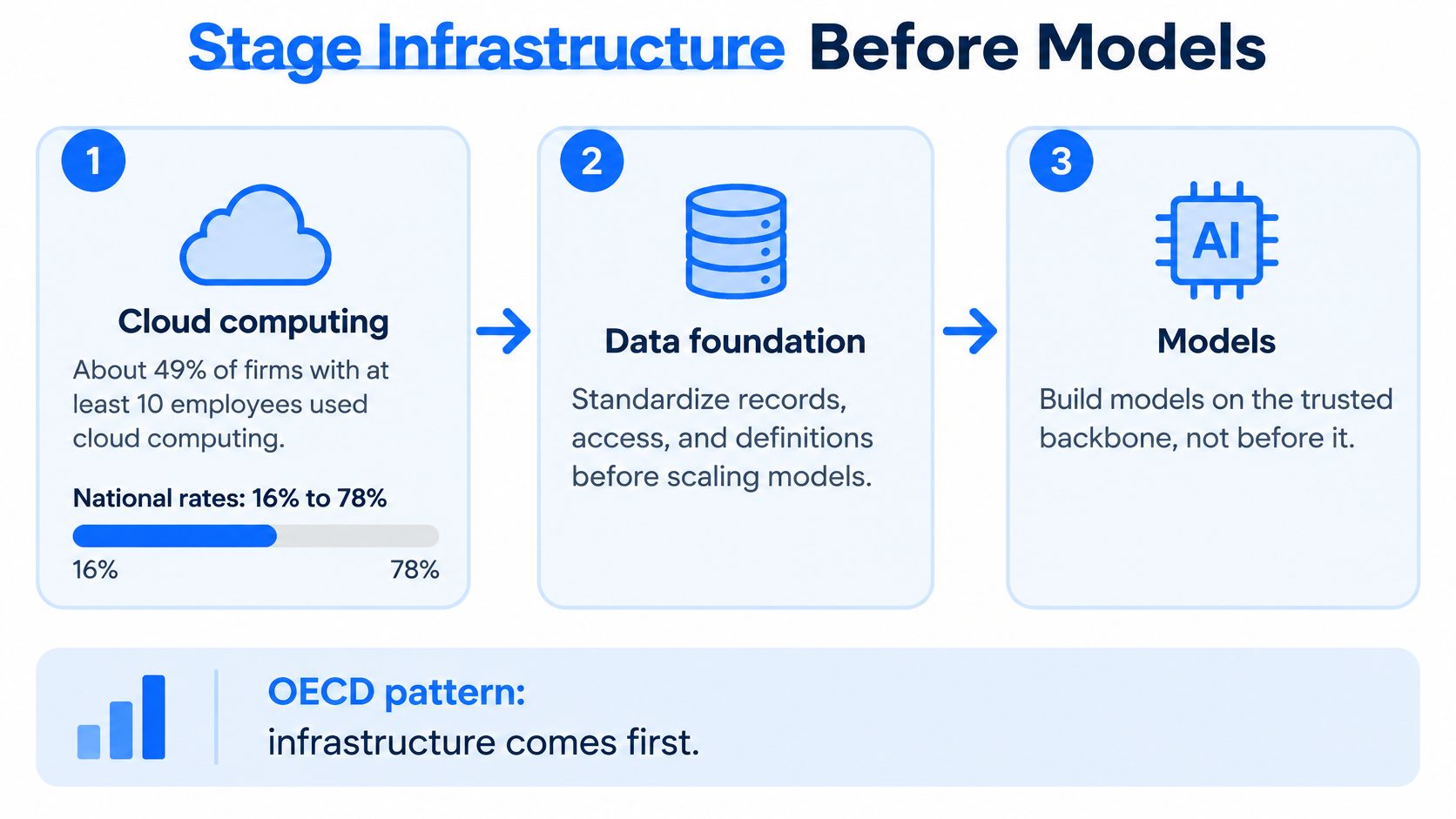
A shared record is the foundation; cloud hosting alone does not make experimental data usable. For materials teams, the sequence matters because models inherit the inconsistencies in the records they receive. Treat infrastructure as a path from governed data to analysis, then to predictions that scientists can assess.
Use this sequence as a planning aid, not as a rule that cloud migration must precede every useful analysis. Renting compute can simplify provisioning, but it cannot make experimental labels comparable.
Give each stage an exit condition
Three stages from shared data to AI
| Stage | Core work | Governance gate | Exit signal |
|---|---|---|---|
| 1 Shared governed data | Canonical record of materials, formulations, process conditions, methods, units, and batch genealogy | Named owner for bad data, access controls, and audit trail | Two teams retrieve the same experiment with units and method |
| 2 Analytics on existing questions | Find which process factors move a target property | Scientists review each result before action | Recurring analysis is used in lab review |
| 3 AI for next experiments or scale-up risk | Validated model versions guide decisions | Scientific, regulatory, and production gates | Model recommendations are accepted inside standard review |
Start with one experimental family, not an enterprise-wide migration. Before expanding, have the data owner show that imports, corrections, and permissions work for that family.
Then analyze questions scientists already recognize. For example, examine whether a property varies with cure temperature, separating results measured under different methods. Scientists should challenge possible confounding factors before the relationship guides a decision.
Introduce predictions or next-experiment recommendations after the underlying records and review habits are established. Define the model's applicability domain, which uncertainty requires escalation, and who can authorize an experiment outside familiar conditions.
Keep iteration accountable
McKinsey's transformation analysis reports that transformations were 1.5 times more likely to beat performance expectations when senior leaders made them a top organizational priority, while organizations using agile practices were nearly twice as likely to exceed expectations.
Put that into practice with an executive-owned review cadence. Each initiative needs an owner, a baseline, and a decision to continue, revise, or stop.
Agile reviews can change which pipeline or workflow the team tackles next. They should preserve scientific accuracy, applicable regulatory requirements, and production-readiness checks.
An AI pilot is a later-stage use case, not the digital transformation strategy itself.
What Faster Materials Programs Actually Changed
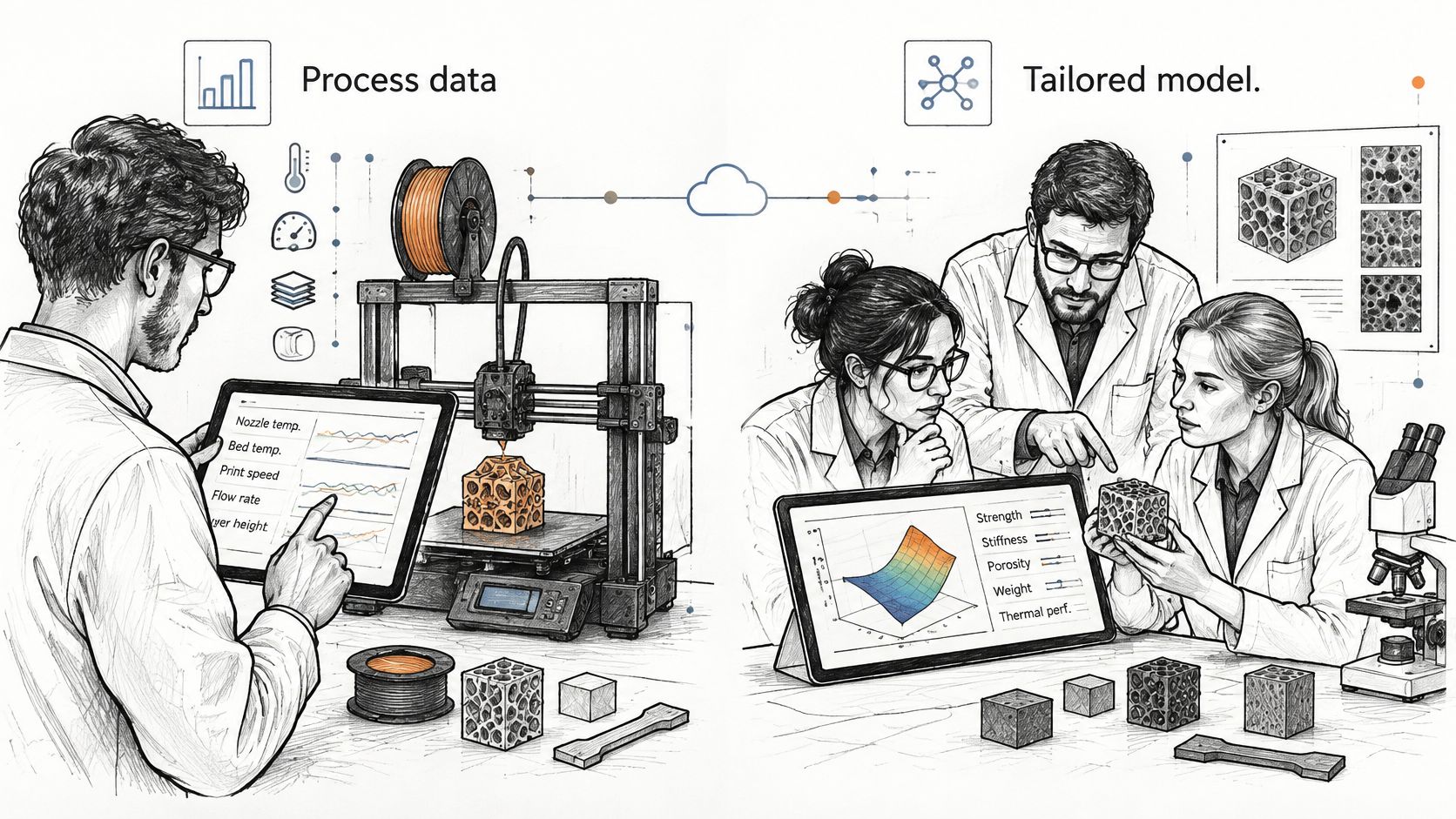
An additive-manufacturing company digitized its fused deposition modeling (FDM) process data and used custom machine-learning models to optimize material properties 60% faster than conventional methods.
Separate the result from the transferable practice
The practical sequence is clear: capture process data, connect it to the properties being studied, then use models suited to that relationship. Before comparing a speed-up with your own program, define the timing window's start and finish, including whether it covers specimen preparation, conditioning, and testing.
A resin-industry customer reduced new-polymer development lead time by 50% using a global network of national research institutes and outsourcing testing and prototyping. That result concerns the full development timeline, not prediction accuracy or laboratory labor alone. Define which stages count as development in your own baseline so the comparison reflects the bottleneck you want to change.
Organize around the constraint
The resin example shows how access to experimental capacity can shape program speed. If work is waiting on specialist testing or prototype equipment, improving a model alone will not clear the queue. Coordinate external work, sample information, and acceptance criteria around the development objective.
The practices are concrete:
- Measure the relevant delay: Separate experiment execution, interpretation, external testing, and approval time.
- Connect evidence to the objective: Collect the process variables or test results needed to address the delay.
- Retain scientific authority: Have scientists assess whether a proposed experiment or externally generated result is valid for the intended decision.
Image-heavy programs need the same data discipline. An electron micrograph becomes more useful for analysis when the team records specimen preparation, imaging conditions, quantified features, and links to formulation and processing history. Without that context, a folder of images is a weak basis for model training.
A reported speed improvement is evidence to investigate an approach, not a target to copy without matching its measurement boundaries.
Which portfolio metric has a documented baseline and a traceable path from experiment to decision?
Make the New Way the Default Decision
A better platform doesn't finish the strategy. In the TEKsystems State of Digital Transformation 2025 report, nine in ten organizations reported lacking the talent required for successful transformation, particularly in AI, machine learning, cybersecurity, and data analytics.
For a laboratory leader, that gap isn't just a recruitment problem. A domain expert needs enough understanding to recognize when a prediction is relevant, when its uncertainty is unacceptable, and when the historical examples don't resemble the proposed formulation.
Measure behavior alongside technical delivery
Software deployment, successful imports, and model validation are technical milestones. Adoption metrics answer a different question: are people using the new process when the decision matters?
Track measures that expose operational friction:
- Workflow coverage: Count eligible decisions completed through the approved process, not just user logins.
- Time to competency: Observe when a scientist can complete the workflow and explain the output without assistance.
- Exception rate: Record when users bypass the system and why, distinguishing justified exceptions from missing functionality.
- Decision-cycle time: Measure the interval between a review-ready request and an authorized next action.
- Realized outcome: Compare operational results with the original business baseline, accounting for changes in project mix.
Don't punish every exception. A chemist who rejects a recommendation because it violates a known processing constraint has supplied valuable feedback. Require a recorded reason so the team can improve the model, the constraints, or the interface.
Teach judgment inside the working meeting
Train scientists using experiments they recognize. Ask them to inspect the prediction, uncertainty, relevant historical examples, and proposed next action. Have process and quality colleagues identify what additional evidence they need before accepting the result.
Keep this learning inside the existing laboratory review rather than creating a separate AI discussion that never affects project decisions. Assign responsibility for resolving challenged outputs, and make the approved record the place where those resolutions live.
Recognition should reinforce useful behavior. Reward complete experimental records and well-supported challenges to model errors, not only successful formulations. Otherwise, teams have an incentive to omit negative results that could help define where a model should not be used.
For a practical 90-day adoption check, select a workflow and observe it from request through review. Compare actual usage, bypass reasons, competency, and the business outcome with the starting position.
If scientists still prepare a side spreadsheet to trust the recommendation, investigate the missing context before buying another capability. Executive support should protect the time needed to resolve those defects, not merely insist on higher login counts.
Choose One Outcome and Start the Backbone
Choose a business outcome for the next quarter before choosing another model. Reducing reformulation, avoiding preventable failed experiments, or shortening a specific scale-up handoff gives the team a boundary it can act on.
Name the owner and document the current measurement method. Keep the initial experimental slice small enough that scientists can inspect its completeness and defend its relevance.
Run a bounded workflow end to end
Start with the formulations, processing conditions, methods, units, and results that feed the chosen decision. Don't wait until every historical file has been cleaned.
Use a short execution checklist:
- Define the boundary: Specify the material family, participating teams, decision, and exclusions.
- Prepare the evidence: Resolve the fields and inconsistencies that would prevent a scientific comparison.
- Test the handoff: Put a recommendation and its supporting experiments into the existing review meeting.
- Record the decision: Capture acceptance or rejection, the reason, and the resulting experimental outcome.
For this initial slice, Polymerize Connect provides a centralized backbone that unifies experiments, formulations, and results in an AI-native platform accessible to teams across geographies. Our design-of-experiments capabilities can support the same review loop, with scientists retaining responsibility for what gets tested.
Expand only when the workflow earns it
Treat vendor-reported results as evidence to evaluate, not as your performance commitment. Your baseline, material complexity, experimental capacity, and approval requirements determine what constitutes a meaningful improvement.
At the end of the adoption check, ask whether the chosen metric is moving and whether target scientists use the approved record without maintaining a competing spreadsheet. Review rejected recommendations as carefully as accepted ones, because they can expose missing constraints or unreliable labels.
If the workflow isn't working, fix the specific obstacle before adding use cases. A smaller program with trusted records and sustained use gives leadership a sounder basis for expansion than a collection of disconnected demonstrations.
Polymerize combines a governed experimental-data backbone with AI-guided materials development, domain expertise, and global prototyping support. Visit Polymerize to discuss a bounded R&D workflow, the records it needs, and the business outcome your team will use to evaluate success.
Put your R&D data to work
See how materials teams use Polymerize to plan fewer experiments and reach target properties faster.