

You're staring at a familiar mess. The lab has strong scientists, the ELN is half-used, older experiments live in spreadsheets, image files sit on shared drives, and every team swears its data is “somewhere.” Meanwhile, leadership wants AI to accelerate formulation discovery, reduce rework, and make scale-up decisions less painful. That pressure is exactly why a digital transformation roadmap has to be treated as a measurement-and-governance framework, not a shopping list for new software.
Table of Contents
Why Most Materials R&D Roadmaps Stall Before They Start
A formulation lead can usually tell within minutes whether a transformation effort is serious. If the first slide is a vendor stack, the roadmap is already in trouble. The harder reality is that materials R&D teams don't fail because they lack tools, they fail because the organization hasn't defined what success looks like, who owns each change, or how outcomes will be measured when experiments behave unpredictably.
The OECD's work on measuring digital transformation is useful here because it treats digital change as something that has to be made visible in data, not assumed from adoption alone. It calls for better measurement infrastructure, attention to economic impacts, and redesigned data collection methods, while also highlighting priority areas like key technologies, data and data flows, digital-era skills, trust in online environments, and government digital strengths. For a lab environment, that logic maps cleanly to transformation work that starts with baseline assessment and measurable operating outcomes, then moves into initiative sequencing and governance. The framework matters because roadmaps in R&D can't be built on vague enthusiasm. They have to survive long cycles, ambiguous results, and competing priorities.
What a real starting point looks like
A credible roadmap starts by asking where the current experiment data lives, how often it can be traced back to source conditions, and which parts of the workflow are still driven by manual handoffs. That's the point where assessment becomes more important than ambition. Independent roadmap guidance commonly follows assessment, planning, implementation, and optimization, with milestones and KPIs used to steer execution rather than just report progress.
Practical rule: if you can't name the baseline, you can't tell whether the roadmap is working.
That's why tool selection should come after operating-model design. McKinsey's transformation guidance emphasizes senior-management commitment, a clear change story, early sequencing for quick returns, and a new operating model. In practice, that means the roadmap should answer three questions before any implementation budget is released. What's broken in the current lab workflow, who owns the fix, and how will progress be judged when the first results are messy rather than impressive?
The organizations that stall usually confuse activity with change. They run a few pilots, buy a platform, and then discover that the actual constraint was never software. It was measurement discipline, governance, and the willingness to redesign how scientists work.
Assessing Your Current R&D Data Landscape
Before a single AI model is trained, the team needs an honest map of the data ecosystem. In materials R&D, that usually means four core buckets: formulation records, process parameters, characterization outputs, and image data from microscopes or visual inspection systems. Each bucket tends to have its own owner, file format, and level of trust, which is why transformation plans often break at the first handoff between one lab group and another.
The best baseline assessment is simple but unsparing. First, list where data lives, spreadsheets, ELNs, ERP exports, local drive folders, instrument software, and legacy databases. Then document how each source is accessed, how often it is updated, and whether it is machine-readable without cleanup. The purpose isn't inventory for its own sake. It's to expose the bottlenecks that keep scientists from reusing historical experiments.
What to measure in the baseline
Use criteria that connect directly to lab work, not generic IT language.
- Data accessibility: can a scientist retrieve the right run, formulation, or image without asking three people?
- Experiment traceability: can you reconstruct the sequence of materials, settings, and outcomes for a prior trial?
- Machine readability: how much of the historical record is structured enough to support analysis without manual re-entry?
- Orphaned data volume: which workflows generate results that never make it back into a searchable system?
These are not vanity metrics. They tell you whether your data backbone can support AI-guided experimentation later. A lab that still depends on tribal knowledge will struggle to scale any model, no matter how good it looks in a demo.
The other thing to document is search friction. If scientists spend time hunting for old experiment records, the roadmap should treat that as lost cycle time, not a minor annoyance. That search burden is often where the first measurable gain sits, because better retrieval improves both reuse and decision speed. It also reveals where standardization is weakest, which helps you prioritize the first data sources to connect.
A baseline assessment is useful only if it changes the next decision. If it doesn't alter scope, timeline, or ownership, it's just a report.
This is also the moment to note governance constraints. Which datasets carry IP sensitivity. Which results require role-based access. Which teams are subject to external compliance expectations. The OECD's emphasis on trust, skills, and data flows is relevant here, because materials R&D transformations often fail when the organization builds visibility without building controls. You need both from the start.
Building a Data Strategy That Supports AI Adoption
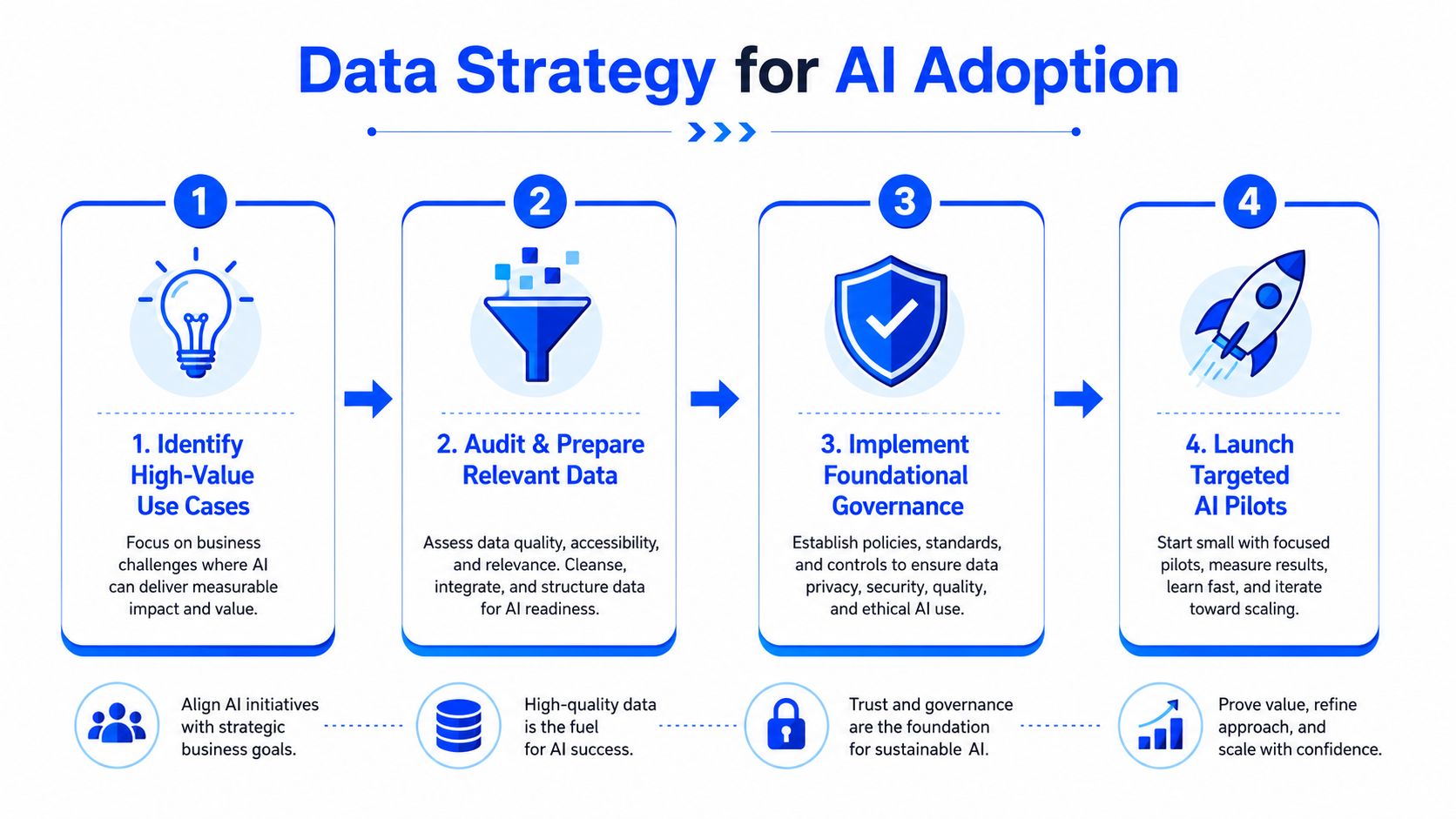
Most R&D teams make the same mistake. They wait for a perfect data estate before they let AI touch anything. That sounds disciplined, but it usually delays value and keeps the organization stuck in cleanup mode. A better approach is to build the data backbone in parallel with use-case delivery, starting with the experimental records that matter most to prediction quality and decision speed.
The strategic move is to reverse the usual sequence. Instead of asking, “What platform should we buy?”, ask, “Which workflows would benefit first if we standardized just enough data to support one high-value use case?” That keeps the roadmap tied to operational outcomes. It also reduces the common failure mode McKinsey warns about, where organizations treat transformation as a technology purchase instead of a business redesign.
Data architecture should follow use-case priority
A practical data strategy for materials R&D usually starts with the highest-value combinations of formulation ratios, process conditions, and characterization outputs. Those are the records AI models need to detect patterns, compare trials, and explain why one route outperformed another. If those inputs are fragmented, the model can't help much, and the team ends up debugging the data stack instead of improving the science.
This is where metadata matters. Materials experiments need consistent naming for materials, batches, instruments, conditions, and outcomes. Without that structure, even a centralized repository stays messy. With it, the same repository becomes a searchable, reusable asset rather than a storage location.
Practical rule: standardize the data fields that drive decisions first, then expand outward.
Governance has to be part of the data strategy, not bolted on later. Role-based access, IP protection, and compliance controls need to be visible in the design, because lab data is rarely just operational data. In enterprise settings, teams also need controls that satisfy frameworks such as ISO 27001 and SOC 2, along with clear permissions for who can view raw experiments, compare formulations, or export results. That's especially important when engineers, chemists, and external partners all need different levels of access.
The most useful data strategy is incremental. Start with one workflow, one dataset family, and one decision pathway. Then connect adjacent sources as the use case proves value. That avoids the trap of building a grand data architecture nobody uses, while still moving the organization toward a real AI-ready foundation.
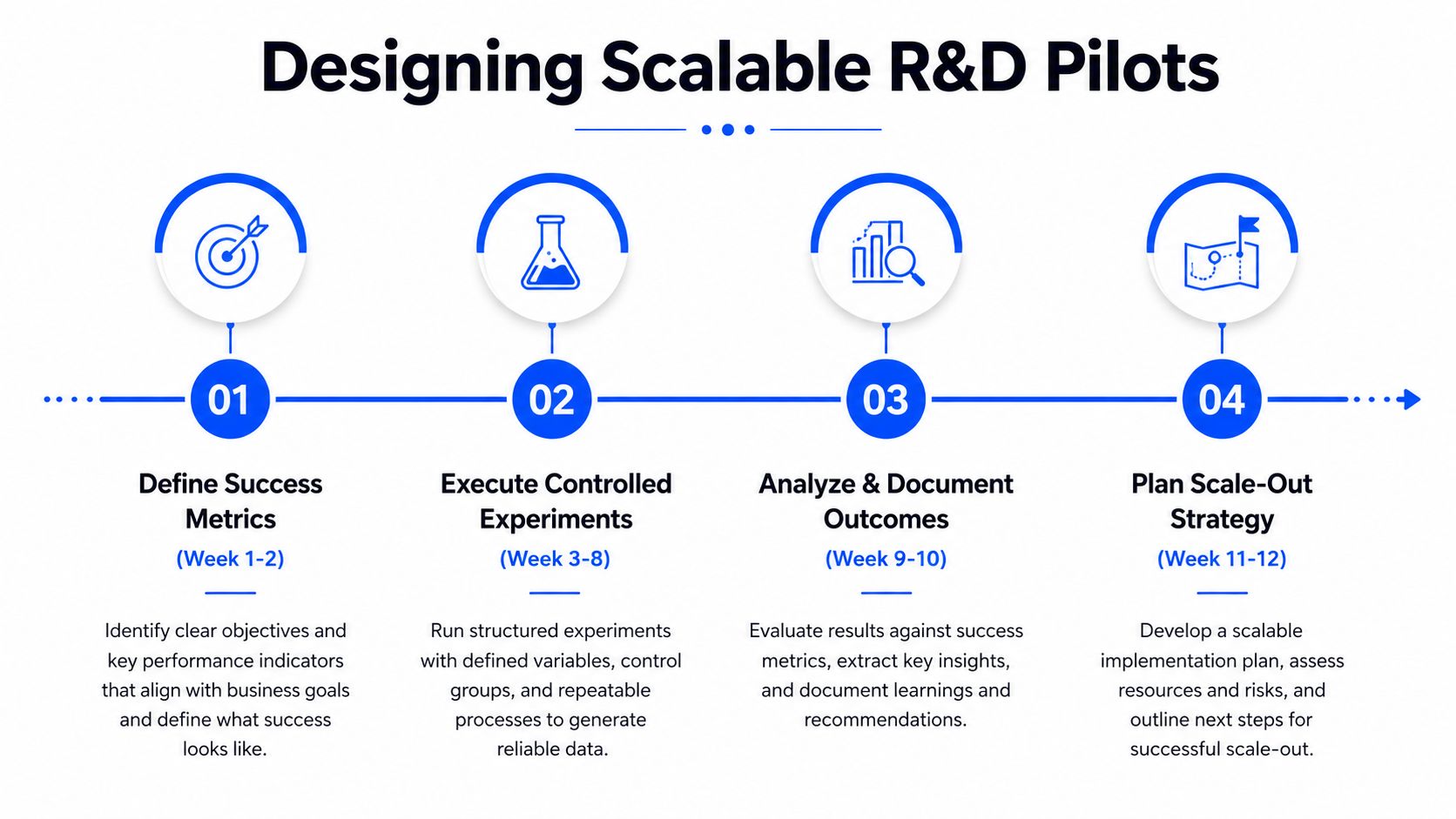
The included timeline below is useful because it keeps the execution sequence explicit, define success metrics first, then controlled experiments, then analysis, then scale-out planning.
Designing Pilots That Actually Scale Beyond the Lab
Pilot purgatory happens when teams keep learning but never decide. In materials R&D, that often looks like a promising model, a handful of enthusiastic scientists, and a pilot that runs long enough to convince everyone the idea is interesting but not long enough to prove anything operational. The fix is not more experimentation. The fix is tighter pilot design.
A pilot should begin with a defined scope that is small enough to control and large enough to matter. One useful benchmark is to limit the first deployment to about 10% to 15% of the target user population, using representative workflows so the results are meaningful without exposing the whole organization to execution risk. That keeps the signal clean. It also makes the rollout politically survivable if the workflow needs adjustment.
Build the pilot like a decision gate, not a science fair
A strong pilot needs three things before launch. First, a success definition tied to the business outcome and the user behavior you want to change. Second, a time-boxed delivery cycle, often a 90-day sprint structure with clear milestones. Third, an explicit rule for what counts as “enough proof” to scale.
The most useful pilot rhythm is simple.
- Define success metrics early. Choose the operational and adoption outcomes before the pilot begins.
- Run representative experiments. Don't pick the easiest workflow. Pick the one that reflects real lab complexity.
- Document outcomes carefully. Capture what changed, what didn't, and what had to be adapted.
- Plan the scale-out path. Decide what needs to be standardized before the next wave.
That last step is where many pilots go wrong. Teams celebrate the demo, but they never translate the lessons into a rollout design. A pilot only matters if it creates a decision about scale.
The strongest guidance here aligns with what McKinsey and BCG highlight in different ways, initiative leaders, transformation-office leadership, integrator roles, and executive commitment all improve the odds that a pilot becomes operational change rather than a one-off event. In lab settings, that means pairing a technical owner with a workflow owner and a change lead. No single person can carry all three.
Don't scale the pilot because people like it. Scale it because the team has evidence that the workflow, the controls, and the adoption pattern can survive broader use.
That's the boundary between promising experimentation and transformation. If the pilot hasn't shown repeatable value in a controlled setting, scaling it only multiplies the confusion.
Preventing Roadmap Collapse During Execution
Most roadmap failures don't happen because the strategy was wrong. They happen because the team didn't model the dependencies that decide whether work can move forward. In a materials R&D environment, one delayed instrument integration can block model training, which blocks validation, which blocks leadership approval. The timeline then looks fine on paper while delivery slips.
Dependency mapping should happen before dates get locked. Identify the initiatives that depend on one another, then look at the most constrained items first. If an upstream project slips, run the delay scenario immediately and adjust the rest of the roadmap instead of pretending the dates still hold. That sounds obvious, but many plans never revisit the sequence after the first planning meeting.
Governance needs named people and real budget
A roadmap survives execution when each stream has a named owner and a visible change-management budget. Those two things sound administrative, but they're the mechanism that protects the roadmap from becoming everyone's side project. The ITONICS guidance on roadmap survival points to exactly this gap: many public guides describe what to include, but fewer explain how to prevent the plan from collapsing under organizational constraints.
The handoff from planning to delivery is where fragility shows up. Teams have to move from “we agree” to “who is doing what by when.” If ownership is vague, work drifts. If the change-management workstream has no budget, adoption gets treated as an afterthought. If integrator roles don't exist, nobody is responsible for resolving conflicts across lab, IT, and quality teams.
The practical countermeasures are straightforward.
- Map dependencies early: don't confirm timelines until upstream and downstream links are visible.
- Assign integrator roles: use people who can coordinate between functions, not just within them.
- Separate delivery and adoption work: put change management in the plan with its own owner.
- Stress-test the sequence: run delay scenarios on the most constrained initiatives before committing publicly.
One more thing matters in R&D. Don't scale several initiatives at once if the first pilot hasn't proven value. That creates fatigue, especially in labs already under pressure to keep experiments moving. Sequencing for quick returns keeps executive sponsorship alive because leaders can see progress without asking the same team to absorb too much change at once.
The roadmap breaks when everyone assumes someone else is holding the dependencies together.
That's why governance is not bureaucracy in this context. It's the operating system that lets science, software, and process change move together.
A Sample Digital Transformation Roadmap for Materials R&D
A usable roadmap for materials R&D usually works better when it's built as a sequence of phases, not a master plan frozen for the year. The phases below are intentionally simple. They reflect the common assessment, foundation, pilot, and scale pattern, but they also add the governance checkpoints that keep the plan from drifting.
| Phase | Timeline | Key Activities | Success Metrics | Common Risks |
|---|---|---|---|---|
| Assessment | Weeks 1 to 4 | Map data sources, identify workflow bottlenecks, assign executive sponsor and transformation lead | Baseline established, priority workflows chosen, owners named | Underestimating data fragmentation, unclear sponsorship |
| Foundation Building | Weeks 5 to 8 | Standardize key metadata, set access controls, define pilot scope, confirm KPI design | Data fields agreed, governance rules documented, pilot ready | Overbuilding the platform, broad scope creep |
| Pilot Execution | Weeks 9 to 20 | Run the first controlled workflow, review results in short cycles, capture adoption feedback | Pilot completion, measurable workflow use, validated decision criteria | Pilot purgatory, incomplete user adoption |
| Enterprise Scaling | Weeks 21 and beyond | Extend to adjacent teams, formalize operating model, institutionalize review cadence | Broader rollout, stable governance, sustained use in lab decisions | Scaling before readiness, fatigue, weak handoff |
How the phases work in practice
The first phase should feel like a diagnostic, not a project launch. The team needs to know which workflows are worth changing and which data sets are ready enough to support the first use case. The second phase is where the backbone gets built, but only around the fields and permissions the pilot needs. That keeps the effort focused.
The third phase is where the roadmap becomes real. The pilot should be run on a 90-day rhythm, with phase gates and a clear rule for what qualifies as success. The final phase should not be a generic “rollout” moment. It should be a controlled expansion to adjacent use cases, with the operating model updated so the new way of working becomes routine.
If you want a compact reference for a broader business audience, the digital transformation roadmap for SMBs is a helpful contrast, because it highlights how the same sequencing logic still applies outside the lab, even if the technical depth is lower.
What to keep flexible
Materials work is uncertain, so the roadmap should allow for experiment results to redirect priorities mid-cycle. That isn't a sign of failure. It's a sign that the roadmap is being governed like an R&D system instead of a fixed IT rollout. The key is to preserve the cadence, the ownership, and the KPI discipline even when the scientific direction shifts.
Starting Now with Imperfect Data
Waiting for perfect data readiness is one of the most expensive habits in materials R&D. The team keeps cleaning, standardizing, and debating schemas while the organization misses the chance to learn from live work. A better approach is to start with a narrow, high-value use case, prove that the workflow improves, and use the resulting momentum to justify the next layer of data investment.
That reverse approach is especially powerful in lab environments because the first gains often come from better reuse of what already exists, not from building a flawless enterprise data model. If a workflow has enough historical data to support analysis, enough traceability to trust the comparisons, and enough ownership to make decisions stick, it is ready enough to start. The point is not perfection. The point is a measured first move that expands the backbone as value appears.
A practical path is to begin where the pain is most obvious, repeated experiment failures, slow handoffs, or poor visibility into prior results. Those are the places where scientists feel the friction every day, and where leadership can see whether the roadmap is translating into real execution change. The top digital transformation companies 2026 often emphasize scale and platform maturity, but in materials R&D, the organizations that move fastest usually do the opposite first. They pick one constrained workflow, instrument it well, and let the learning shape the next wave.
The roadmap that wins is the one that starts moving now. It measures the baseline, aligns the owners, and uses real lab outcomes to justify each next step instead of waiting for a theoretical finish line that never comes.
Polymerize gives materials R&D teams a practical way to turn this roadmap into execution, by unifying fragmented experimental data, supporting AI-guided experimentation, and adding the governance controls enterprise teams need. If your lab is trying to move from scattered records to measurable transformation, visit Polymerize and see how a purpose-built materials intelligence platform can help you start with the data you already have.
Put your R&D data to work
See how materials teams use Polymerize to plan fewer experiments and reach target properties faster.