

You can usually spot the problem before the plant manager says it out loud. The line is running, the dashboards look fine enough, and yet every week someone in R&D is still reopening old Excel sheets, checking whether the latest formulation behaved the way they expected, and asking why scale-up still feels like a reset button instead of a continuation. That's the trap in digital transformation manufacturing. The factory may look instrumented, but the lab still runs on fragments, memory, and a few people who know where the bodies are buried in the data.
The bigger issue is that the most expensive decisions in manufacturing are often made before a machine ever turns. Materials teams decide chemistry, process windows, additive packages, and test plans long before the plant sees a batch. If that work stays trapped in spreadsheets, ELN exports, and side conversations, the entire transformation program gets capped by the weakest handoff in the chain. The plant gets more sensors, but the organization never really learns faster.
Table of Contents
When the Lab Becomes the Bottleneck
A materials team can have excellent scientists and still move slowly because the operating model is broken. One lab keeps formulation history in spreadsheets, another archives results in an ELN, a third has instrument exports sitting in folders with filenames nobody wants to touch, and the scale-up engineer keeps a separate copy of the “real” recipe because the official version is missing context. By the time anyone tries to compare what worked, half the reasoning is gone.
That's why many transformation programs stall. They focus on equipment connectivity or plant dashboards, then wonder why new insights don't travel upstream or downstream. The lab is where the organization decides what to make, how to make it, and which hypotheses deserve another round. If those decisions aren't connected to production learning, the transformation becomes a reporting layer instead of an operating system.
The hidden cost of disconnected formulation work
R&D teams don't just lose time to data entry. They lose decision quality when every experiment has to be reconstructed from memory, copy-paste, and informal notes. Scale-up suffers because the process team inherits a result without the experimental context that explains why it happened.
A serious digital transformation manufacturing program treats the lab as part of the value chain, not a side room. That means linking experiment design, raw data, analysis, and the next decision in one loop so each run carries forward what was learned instead of forcing people to rediscover it.
Practical rule: if the team can't trace a formulation choice from hypothesis to result to next action, the transformation hasn't started yet.
The organizations that get this right stop asking whether they've “digitized the lab.” They ask whether the lab now produces decisions that production can use. That's a different bar, and it's the one that matters.
What Digital Transformation Actually Means in Manufacturing
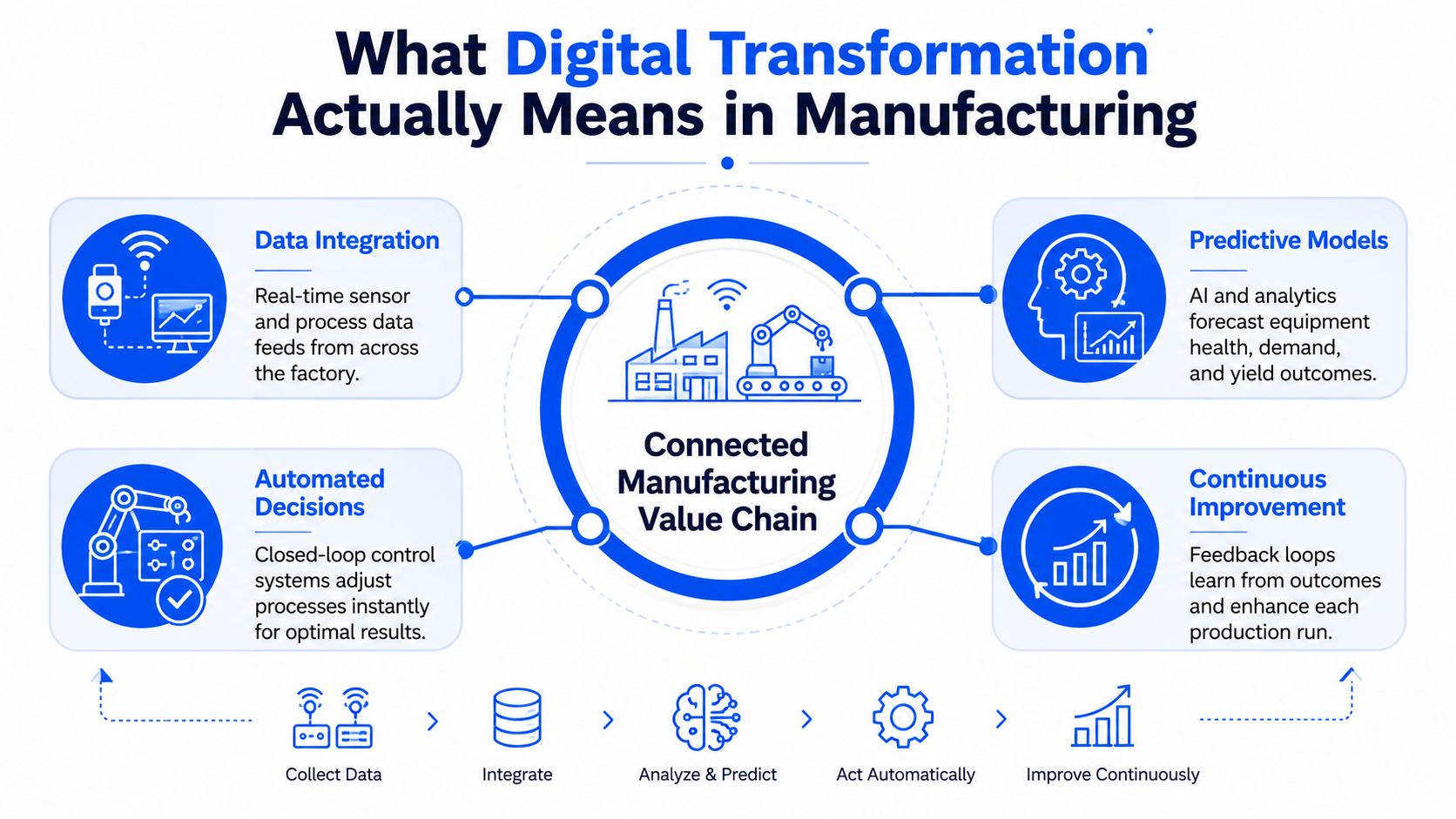
In manufacturing, digital transformation is not the same thing as digitization, automation, or IT modernization. Digitization turns paper into digital records. Automation lets machines or workflows run with less manual intervention. IT modernization refreshes enterprise systems. Transformation connects data, models, and decisions so the organization learns faster at every step of the value chain.
McKinsey's Industry 4.0 framing groups the core enablers into data, computing, connectivity, analytics, human-machine interaction, and digital-to-physical conversion Industry 4.0 framework. That matters because the goal isn't a prettier dashboard. The goal is a shorter, cleaner path from observation to action.
Closed-loop decisions beat data collection
A lab team that only collects more data can still make slow decisions. A team that uses data to decide the next experiment, the next process setting, or the next release gate is transforming. That difference shows up in materials work especially clearly, because the cost of a wrong formulation or a missed scale-up insight is so much higher than the cost of a missing chart.
The shift is simple: data collection tells you what happened, closed-loop decision making tells you what to do next.
That's the right mental model for materials R&D inside manufacturing. A formulation experiment shouldn't end when the report is saved. It should end when the result changes the next test, the next process window, or the next scale-up decision.
A useful starting point is a vendor evaluation guide that forces the team to anchor tools to actual decisions, not generic “digital” promises. A good example is find vendor decisions guide, because the primary question is always which decision the system improves first.
Why the architecture matters
The infographic above makes a simple point. Data integration, predictive models, automated decisions, and continuous improvement only work when they sit in the same loop. If any one of those pieces is missing, the organization ends up with isolated analytics rather than transformation.
A lot of programs fail here because they buy tools by category. They buy a dashboard here, a workflow tool there, and an AI pilot somewhere else. What they don't buy is the connection between them. That connection is the transformation.
The Data Backbone That Makes Everything Else Possible
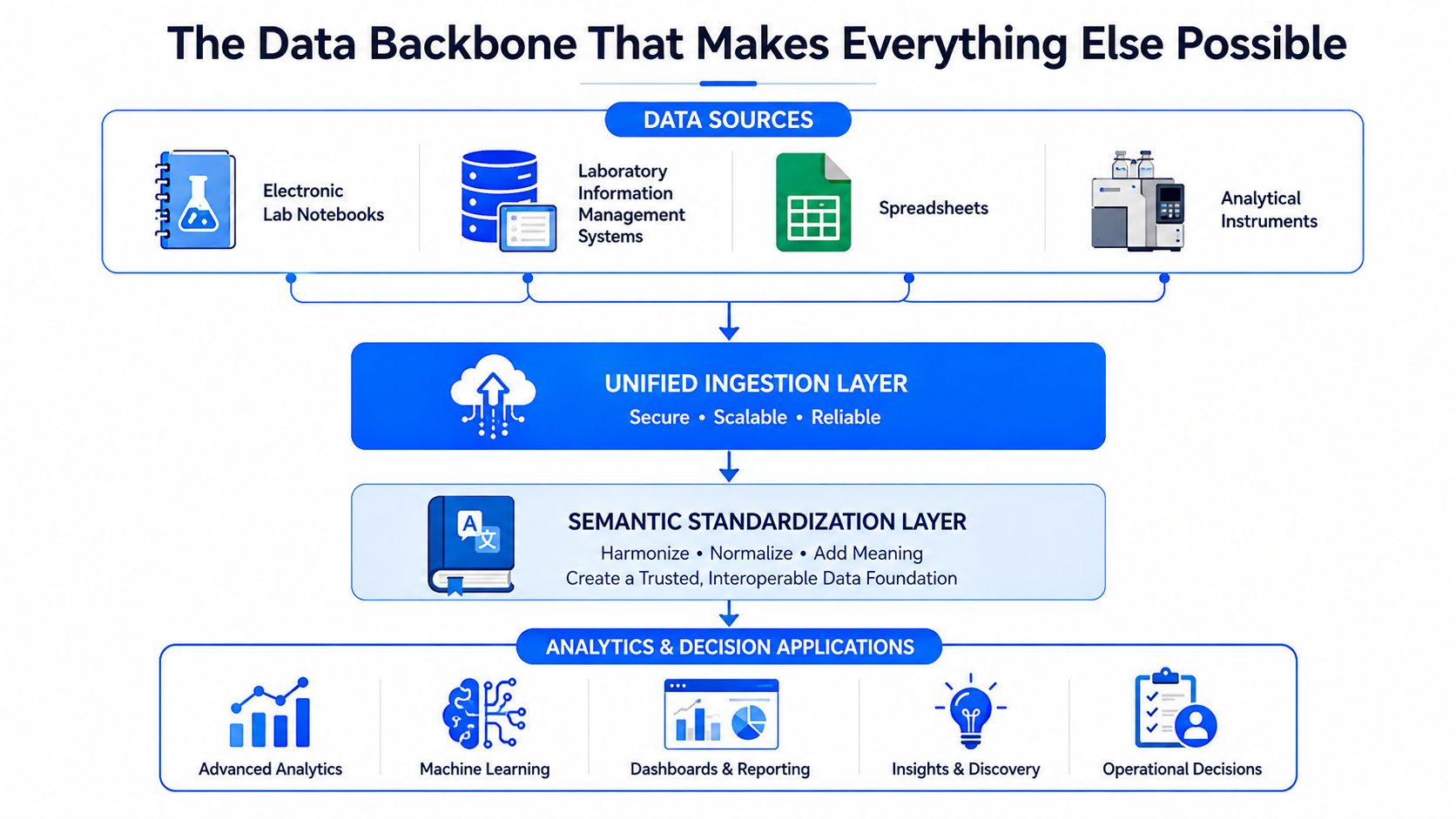
A materials-first transformation starts with the boring part people like to skip. You need a data backbone that can ingest from ELNs, LIMS, spreadsheets, and instruments, then normalize the mess enough that models and workflows can use it without handholding. If the data layer isn't reliable, every AI promise becomes an expensive demo.
That backbone usually has three jobs. First, it gathers the raw experimental record. Second, it standardizes the meaning of the record, so “same additive” or “same cure cycle” doesn't vary by site, lab, or spreadsheet author. Third, it exposes the data to analytics, model training, and downstream systems such as MES and PLM, so lab learning reaches production instead of dying in a slide deck.
Why AI-ready data is a discipline
“AI-ready” isn't a badge you slap on a database. It's the outcome of structuring formulations, processes, and properties so they can be compared over time and across teams. That usually means a semantic layer, not just more storage.
The reason this matters is simple. Models are only as useful as the consistency of the inputs they see. If one site records temperature one way and another site records it another way, the model may still run, but it won't deserve trust. In manufacturing, trust is part of adoption.
If data can't be compared, it can't be learned from.
A materials platform that centralizes experimental data without forcing a rip-and-replace can remove the spreadsheet patchwork while leaving existing tools in place. That approach is far more practical than demanding every scientist abandon the ELN or every lab technician learn a new workflow overnight. The point is not to replace everything. The point is to stop losing context at every handoff.
The other reason to build the backbone first is downstream compliance. If product passport workflows, traceability, and regulated documentation matter to your organization, the data structure has to support them from the start. A useful reference for that operational angle is compliance workflow for product passports, because the same backbone that supports R&D can also support proof of provenance and traceability later on.
Build in the right order
Start with ingestion, then standardization, then model access. Teams often reverse that order and wonder why the analytics group is waiting on missing metadata. The sequencing matters because every layer depends on the layer beneath it.
A strong backbone usually lets an organization do three things well. It preserves experiment context. It makes data reusable across projects and sites. It reduces the time scientists spend translating between systems and the time engineers spend cleaning up after bad handoffs.
From Experiment to Insight with Explainable AI and ML
The best AI in materials R&D doesn't replace scientists. It narrows the search space. That's the practical value of explainable AI in manufacturing, it helps teams decide which formulation, process condition, or test path deserves the next round of attention, while keeping the scientist in control.
Polymerize Labs is described as using 35+ domain-specific, explainable models with confidence scores and historical precedents, which is exactly the kind of design pattern that makes R&D teams willing to use the output. A black box might impress in a demo. It rarely survives a real lab meeting.
The next best experiment is the real product
The highest-value workflow is not “predict everything.” It's “recommend the next best experiment.” The model looks at what's already been tried, suggests the next conditions with the highest learning value, and shows why those conditions deserve attention. The scientist still decides whether the suggestion makes sense.
That handoff matters because formulation work is full of trade-offs. Improve one property and you may compromise another. Change an additive package and you may fix processability while hurting long-term performance. Models help surface those trade-offs earlier, before the team spends another week on a dead end.
Here's how that can look in practice. A polymer team is tuning an additive package for a new compound. The early experiments show acceptable strength but inconsistent process behavior. Instead of guessing the next change, the model compares prior runs, identifies which additive ranges have historically improved stability, and flags where the confidence is higher because the same pattern appeared in earlier materials families. The scientist then chooses whether to test that range, reject it, or run a confirmation experiment first.
Why causal context matters
Prediction alone is not enough in R&D. Scientists need to know why a result likely happened, not just whether it will happen again. That's where causal analysis and historical precedent become useful. They help separate a real material effect from noise, operator variation, or a one-off batch issue.
A good model speeds up judgment, it doesn't replace it.
When teams use models this way, the lab becomes a learning system. Each run improves the next one, and the organization stops treating experimentation as isolated labor. That's the main advantage in digital transformation manufacturing, especially for materials teams that live with long iteration cycles.
Choosing the Right Technology Stack Without Creating Spaghetti
The stack should follow the decision, not the other way around. IIoT exists to capture high-frequency machine signals and support condition-based monitoring. MES exists to execute, trace, and coordinate production. ELN captures experimental context. LIMS governs samples, methods, and test results. Data pipelines connect them to the model layer.
| Layer | Primary Purpose | Main User | Key Data It Owns |
|---|---|---|---|
| IIoT | Capture machine and process signals | Maintenance and operations teams | Sensor streams, equipment states, alarms |
| MES | Run and trace production execution | Production and process engineers | Work orders, batch steps, genealogy |
| ELN | Record experiment context | Scientists and formulation teams | Hypotheses, protocols, observations |
| LIMS | Manage lab samples and test workflow | Lab operations and quality teams | Sample IDs, results, methods, chain of custody |
| Data pipelines | Move and shape data for analytics | Data and digital teams | Normalized records, features, model inputs |
The trap is integration debt. A lot of organizations buy tools that are individually good and collectively painful. Every new platform adds another login, another data map, and another custom connector someone has to maintain.
Ask vendors the questions that expose the truth
Before signing anything, ask whether the platform can ingest data without flattening the meaning out of it. Ask how it handles versioning for formulas, protocols, and models. Ask what happens when a second site uses different nomenclature. Ask who owns integration maintenance after go-live.
You should also ask how explainability works, not just whether the platform “has AI.” If a system can't show historical precedent, confidence, or feature relevance in language scientists can inspect, adoption will stay shallow. That's especially true in materials, where teams won't trust a recommendation they can't challenge.
A useful platform may centralize experiments, property data, and workflows without forcing a rip-and-replace of the tools the lab already uses. Polymerize Connect is one example of that centralization pattern, but the broader rule is what matters. Keep the stack modular enough to scale, but unified enough that data doesn't fracture every time the organization adds a new plant or lab.
Governance, Security, and Compliance as Speed Levers
Security often gets framed as the thing that slows teams down. In practice, mature controls are what let data move safely across labs, plants, and regions without creating IP leaks or compliance chaos. ISO 27001, SOC 2, role-based access, and alignment with GDPR and CCPA are not after-the-fact paperwork. They're the reason enterprise teams can share data at all.
The access model should reflect real work. Scientists need formulation and experiment detail. Process engineers need relevant process context, not every design note. External partners may need a narrow view of validated data or a specific project workspace. If everyone sees everything, trust drops. If nobody can see enough, collaboration dies.
Governance belongs in the architecture. It is not an audit step you bolt on later.
That principle matters most in materials R&D because IP is concentrated in the formulation record. A strong platform should support role-based access at the level of projects, experiments, properties, and models. It should also log who accessed what, when, and why, because traceability is what allows internal teams and external partners to work without constant manual policing.
What to require from the platform
- Role-based permissions: Different views for scientists, process engineers, quality teams, and external collaborators.
- Auditability: Clear logs for access, changes, and approvals.
- Compliance posture: Documented support for ISO 27001, SOC 2, GDPR, and CCPA.
- Data segregation: The ability to isolate projects, sites, or partner workspaces.
- Export control: Practical mechanisms for limiting sensitive formulation transfer.
The useful mindset here is that controls reduce friction later. They make it possible to connect systems without creating a security review for every minor workflow change. In a transformation program, that's a speed gain, not a tax.
KPIs and ROI Patterns That Actually Convince a CFO
Leadership doesn't buy “transformation.” It buys shorter cycles, better quality, and fewer expensive mistakes. The strongest ROI story is one that ties the model or workflow change directly to an operating metric. That's why digital transformation manufacturing needs a KPI spine from day one.
The most convincing metrics in materials R&D are usually the ones that connect lab activity to scale-up impact. If a system helps teams design fewer dead-end experiments, the lab saves time. If it helps the organization move a validated formulation into production faster, the business sees it. If quality losses fall, the CFO pays attention.
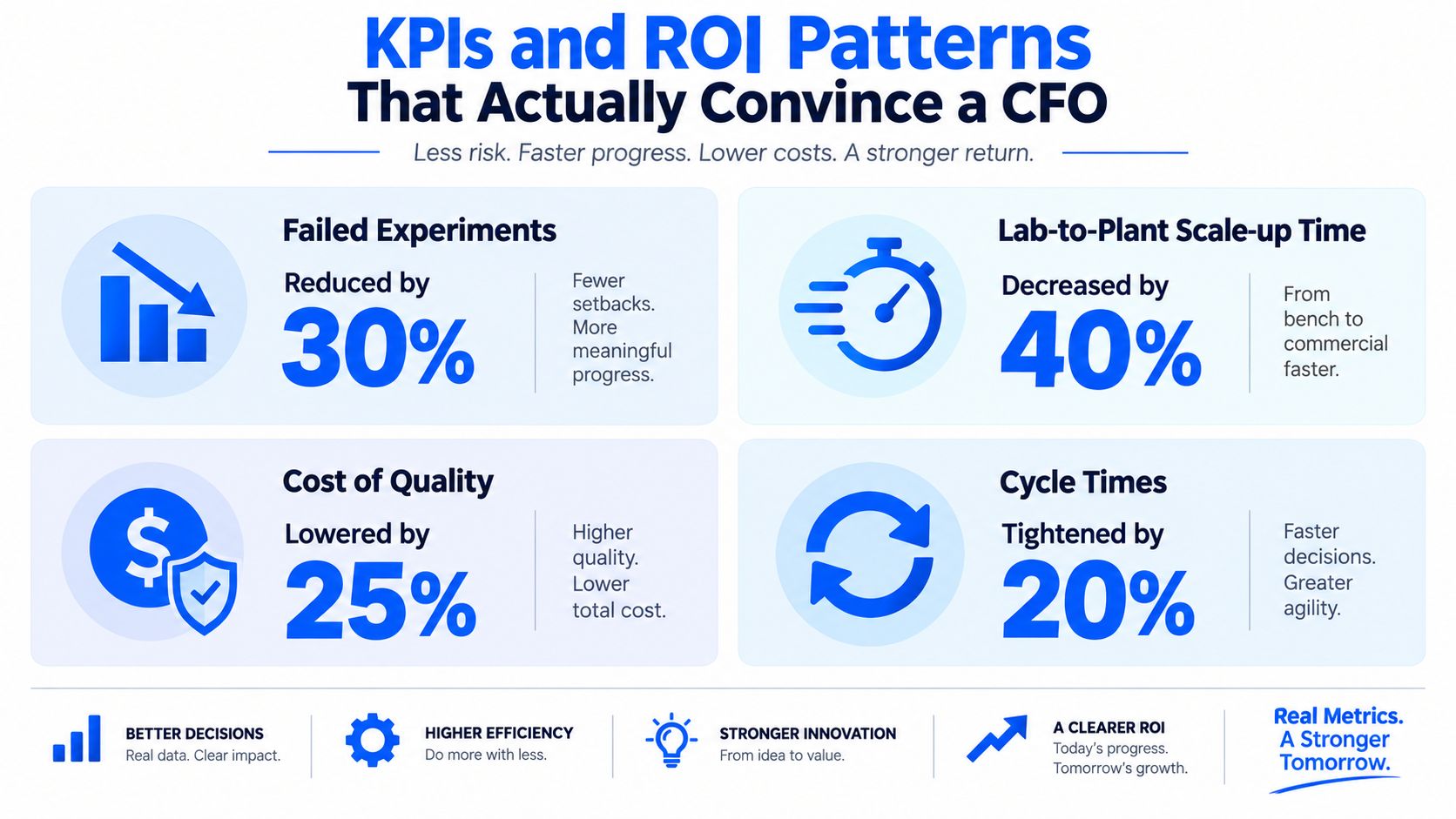
Metrics that actually move the conversation
| KPI | What Changes It | Why It Matters |
|---|---|---|
| Failed experiments | Better experiment ranking, model-guided selection, cleaner data context | Cuts wasted lab effort |
| Lab-to-plant scale-up time | Shared formulation history, process context, and decision traceability | Speeds transfer to production |
| Cost of quality | Earlier defect detection, tighter process windows, better handoffs | Reduces scrap and rework |
| Cycle times | Faster feedback loops between test, analysis, and decision | Improves throughput and responsiveness |
The most useful ROI pattern is not a one-time project saving. It's a recurring operational improvement that keeps paying back as the system is used. Polymerize reports customers seeing up to 50% fewer failed experiments within three months, faster scale-up from lab to production, and rapid ROI, which is the kind of pattern CFOs understand because it connects software use to repeated avoidance of wasted work.
How to present the case internally
Start with one workflow that already costs time and money, then measure it before and after. Use the same definitions across the pilot and the rollout, or the numbers won't hold up in review. If a metric can't be traced back to a data action and a model or workflow decision, it's not a business metric yet.
The point is to build a chain leadership can follow. Data goes in. A recommendation or workflow change happens. An operational metric moves. That chain is what turns a pilot into a budget line.
Implementation Pitfalls and How to Avoid Pilotitis
Most programs don't fail because the idea was wrong. They fail because teams treat transformation like an IT install, choose tools before defining the decision, or celebrate a pilot that never had a path to production in the first place. That's classic pilotitis, and it kills momentum.
The first mistake is buying software before deciding which operational question it's supposed to answer. The second is ignoring change management, which leaves scientists or plant teams bypassing the new system the moment pressure rises. The third is underestimating integration work, which is where many programs accumulate hidden delay.
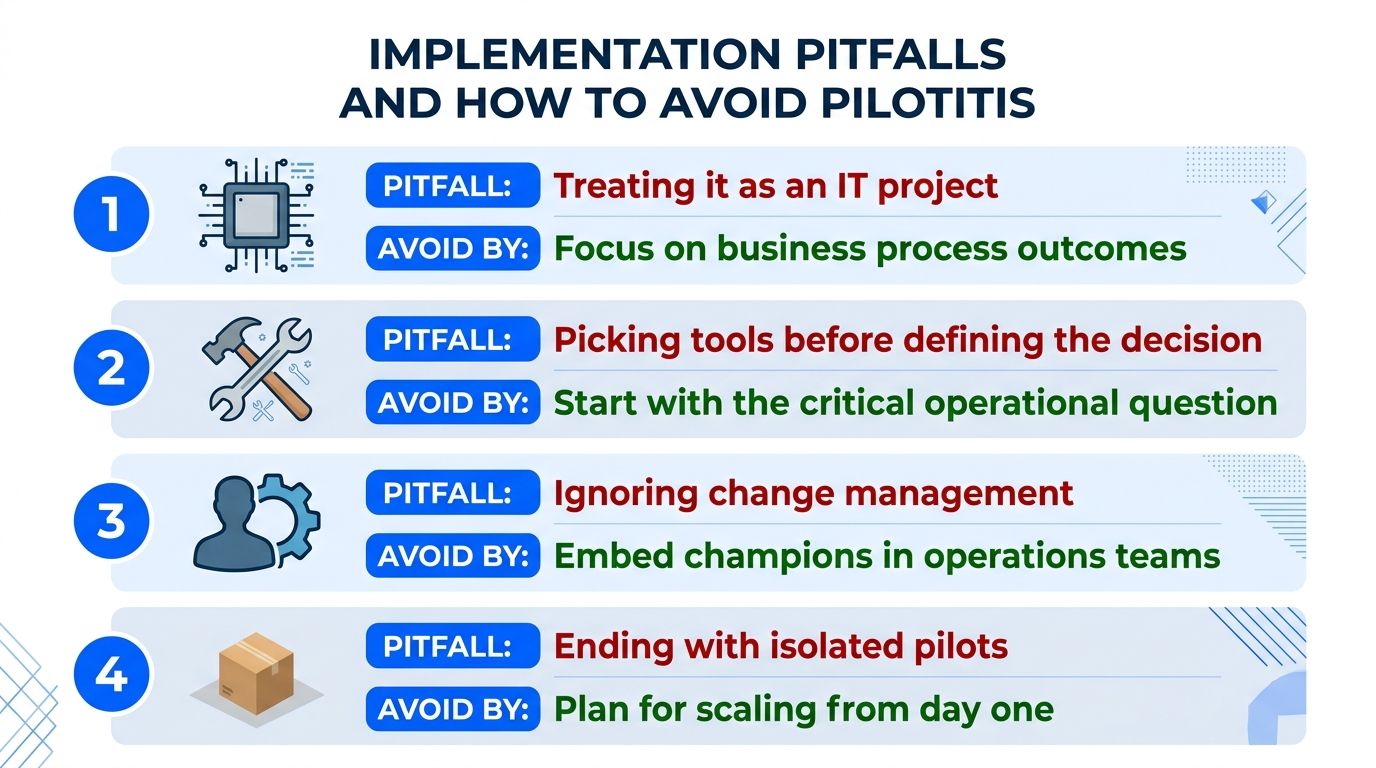
What to look for in a platform and a rollout plan
A credible vendor should be able to show explainable models, broad ingestion coverage, a serious security posture, and a path from one use case to multiple sites. If the pitch is all interface polish and no discussion of data semantics, versioning, or governance, keep walking.
The rollout should be phased, but not timid. Start with one high-value use case where the data is good enough and the decision is expensive enough to matter. Prove the loop. Then expand to adjacent formulations, adjacent lines, or adjacent plants only after the operating model is stable.
Polymerize One is one way to combine software, expert support, and global prototyping networks when organizations need more than a point solution. That kind of pairing matters because many manufacturing teams don't just need a platform, they need help turning a lab win into a production-ready result.
The video below is worth watching if you want a quick visual on how pilot mistakes show up in real programs.
If you're trying to turn materials R&D into a real operating advantage, Polymerize gives teams a way to centralize experimental data, apply explainable AI to formulations, and connect lab learning to scale-up work without losing governance. Visit Polymerize to see how that approach fits your materials, chemistry, or advanced manufacturing workflow.
Put your R&D data to work
See how materials teams use Polymerize to plan fewer experiments and reach target properties faster.