

A formulation scientist uploads an old spreadsheet, an instrument export lands in a shared folder, and an AI model consumes both before anyone confirms who owns the data or whether the recipe can be reused. The team gains speed, but the same workflow may expose confidential formulations, obscure the origin of training records, and leave no defensible explanation for why a model recommended a particular experiment.
That's the practical challenge facing materials R&D leaders. Data security and governance must protect trade secrets without making scientists wait days for access, and it must make AI experimentation auditable without turning every research task into a compliance project. A secure R&D platform therefore needs more than perimeter controls. It needs clear ownership, resource-level permissions, complete lineage, controlled reuse, and operating processes that fit the way laboratories operate.
Table of Contents
Understanding the Data Security Landscape in Materials R&D
The financial stakes are substantial. IBM's 2025 Cost of a Data Breach study analyzed incidents at 600 organizations across 17 industries and reported a global average breach cost of USD 4.44 million. The United States recorded the highest country-level average at USD 10.22 million, while healthcare had the highest sector average at USD 7.42 million. IBM also found that organizations using AI and automation extensively had an average breach cost of USD 3.62 million, compared with USD 5.52 million among organizations that didn't use those technologies.
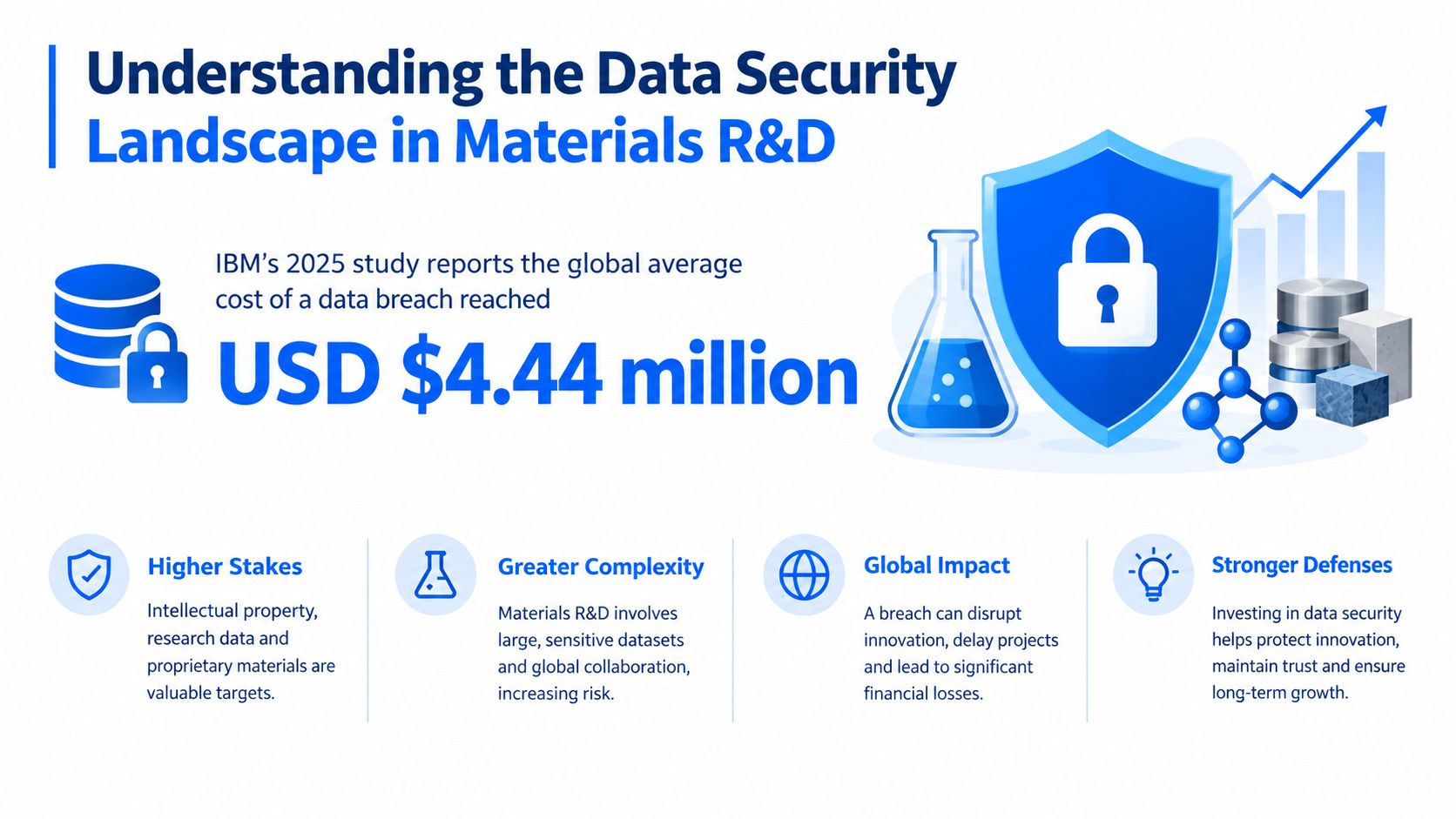
For materials companies, the loss extends beyond remediation invoices. A stolen formulation can reveal years of experimental learning, supplier relationships, process constraints, and commercial priorities. An attacker who accesses an experimental database may not need to copy every record. A small set of high-value recipes, model inputs, or scale-up observations can expose a competitive strategy.
The risk has moved inside the ecosystem
Verizon's 2025 Data Breach Investigations Report examined 22,052 security incidents, including 12,195 confirmed breaches. Credential abuse accounted for 22% of breaches, vulnerability exploitation accounted for 20%, and third-party involvement reached 30%. Ransomware appeared in 44% of reviewed breaches, which makes recovery planning and supplier governance as important as network defense.
That pattern maps closely to modern R&D. Scientists, contractors, cloud services, instrument vendors, and manufacturing partners may all touch the same knowledge chain. A compromised identity or supplier connection can bypass assumptions built around a trusted corporate network.
Practical rule: Treat every formulation, experimental result, model input, and derived recommendation as an asset with an owner, sensitivity level, permitted purpose, and observable access history.
Traditional IT controls still matter, but they don't answer the central R&D questions. Who may export a recipe? Which records can enter a training dataset? Can a supplier see a derived property without seeing the underlying formulation? What happens when an engineer changes projects? Governance turns those questions into enforceable operating rules.
Designing a Secure Data Backbone for R&D Platforms
Materials teams rarely start with a clean data estate. Experimental history may sit in spreadsheets, ELNs, instrument systems, shared drives, laboratory notebooks, and production databases. A secure data backbone should connect these sources without flattening every record into one broadly accessible pool.
The first design decision is centralized storage versus federated access. Centralized storage can improve search, standardization, and model development, but a large undifferentiated lake can also magnify the impact of one compromised credential. Federated access keeps sensitive source records under tighter control while allowing approved applications to use masked, transformed, or derived data.
Build around classification and ownership
A useful backbone separates data by both business meaning and risk. A generic experimental observation may support broad internal discovery, while an exact formulation, customer-linked record, or process recipe requires narrower controls. Classification should attach to fields and artifacts, not only to folders.
A practical architecture includes:
- Source connectors: Ingest spreadsheets, ELNs, instruments, and production systems while preserving source identifiers and timestamps.
- A governed catalog: Record owners, permitted purposes, retention requirements, sensitivity, and quality status.
- Segmentation: Isolate raw recipes, regulated information, supplier data, model-training inputs, and derived features.
- Controlled transformation: Produce masked or aggregated datasets for wider analysis without exposing unnecessary detail.
- Auditability: Log ingestion, edits, exports, model reuse, permission decisions, and administrative actions.
The backbone should also support collaboration without assuming that every collaborator needs raw access. A scientist might view a property trend, a process engineer might edit scale-up observations, and a supplier might receive a limited result set. Their workflows can remain connected while their permissions differ.
A platform such as Polymerize is positioned around unifying fragmented materials R&D data into a secure foundation and supporting AI-guided experimentation. Whatever platform an organization selects, the architectural test is the same: can it preserve source context, separate sensitive records, enforce policy at the resource level, and provide evidence of how data moved through the system?
Implementing Zero-Trust Access Controls
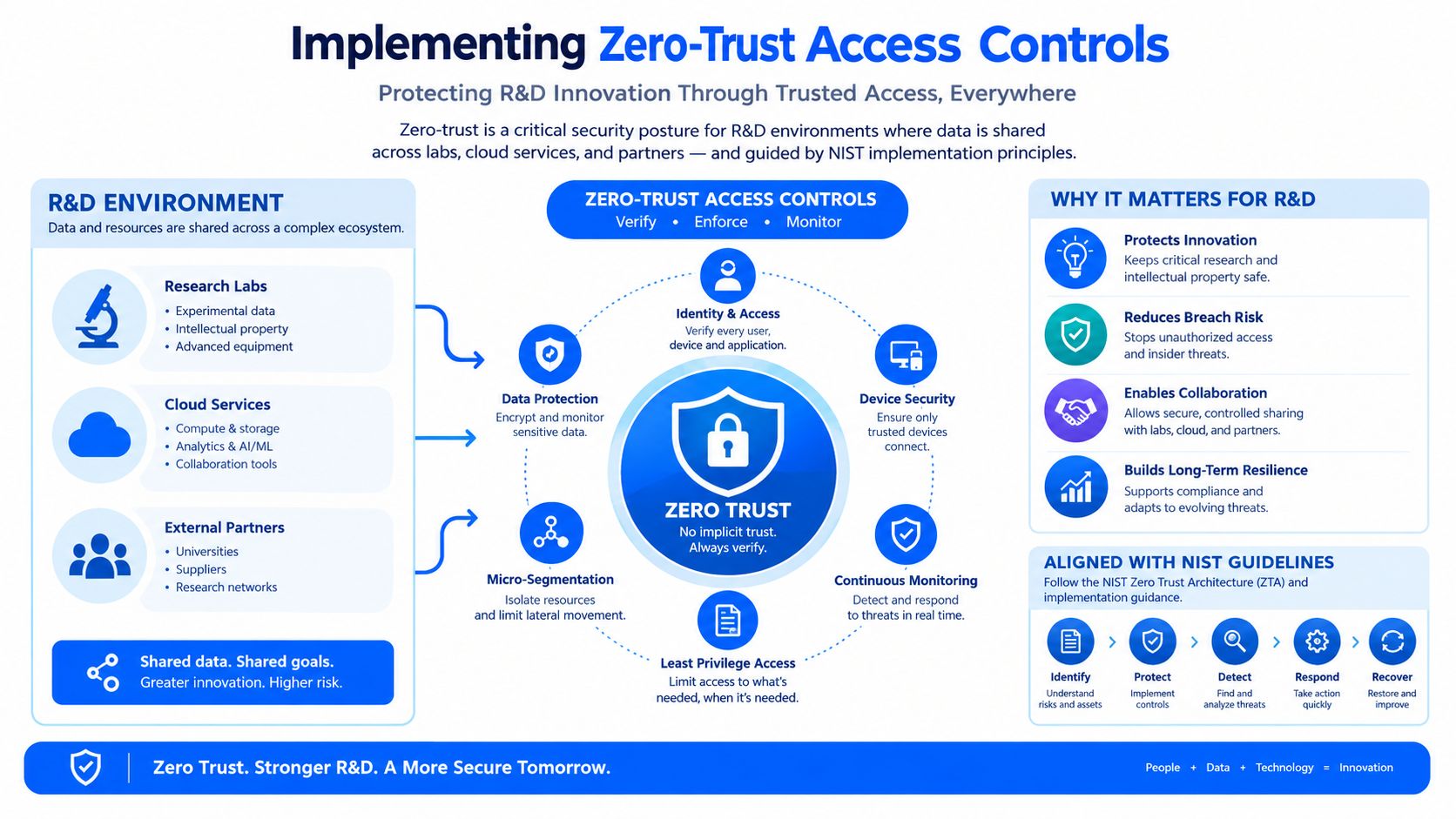
A formulation scientist, contract laboratory, and AI service may work on the same research program while facing different risks. Zero-trust controls keep those workflows connected without treating network location as proof of trust. NIST's zero-trust implementation guidance calls for access decisions based on attributes of both the requesting subject and the resource.
Begin with decisions, not infrastructure. For each role and dataset class, define whether the person may view, edit, export, retrain, and delete. These actions carry different consequences. Reading an experimental result does not automatically justify copying a formulation or adding it to a new model.
Combine baseline roles with context
Role-based access control gives administrators a maintainable starting point. A scientist can work with records assigned to a program. A lab manager can approve changes. A process engineer can access scale-up observations without seeing raw supplier formulations. An administrator can configure the platform without receiving unrestricted access to scientific records.
Context then narrows each permission. Attribute-based policies can evaluate:
- Identity, role, project, and employment status.
- Resource sensitivity and ownership.
- Authentication method and session conditions.
- Whether the request exports data, retrains a model, or deletes records.
- Location, access time, and partner relationship.
A derived property may be available through the normal session. Downloading a formulation dataset can require stronger authentication, a documented business purpose, and an approval record. Controls should also separate duties, manage roles, support access reviews, and record audit activity, analytics, and reporting.
Permission reviews belong in routine operations. Trigger them when a contributor changes roles, leaves a project, or moves between sites. This reduces the chance that a former collaborator retains the ability to export sensitive materials data.
Ensuring Data Lineage and Encryption for AI Readiness
A model can produce a plausible recommendation and still be untrustworthy if the organization can't explain where its inputs came from. Materials R&D needs lineage that follows data from the original observation through transformations, model use, and scientific decisions.
NIST's zero-trust architecture guidance separates data-security policy from identity governance and addresses protection for data at rest and in transit. That separation matters because authenticated users can still misuse data, and encrypted storage alone can't establish whether a dataset was appropriate for training.
Capture the chain of scientific meaning
Every experimental observation and derived artifact should carry machine-readable metadata such as:
- Source system and original record identifier.
- Material or formulation identifier.
- Operator, timestamp, and laboratory context.
- Transformation history, including cleaning and feature engineering.
- Version, sensitivity classification, permitted purpose, and retention period.
- Model, training dataset, prediction, and downstream decision references.
Lineage should cover spreadsheet or ELN ingestion, normalization, feature creation, model training, prediction, and formulation decisions. Immutable records make it possible to reproduce a result without granting every reviewer access to the underlying recipe.
Encryption and lineage solve different problems. Encryption reduces exposure if storage or transmission is compromised. Lineage shows what happened to the data and whether its use was authorized. Pair both with managed keys, least-privilege service identities, immutable audit logs, approval gates for dataset reuse, and alerts for unusual bulk exports or cross-tenant access.
Proving provenance without disclosing the recipe
Article 10 of the EU AI Act requires governance of high-risk AI datasets covering origin, collection, preparation, bias detection, relevance, representativeness, and completeness. The requirement applies to training, validation, and testing data, including datasets not used for model training.
That creates a practical design challenge. Regulators and customers may need evidence of provenance, but they don't necessarily need unrestricted access to commercial formulas. Field-level classification, controlled scientific context, derived features, and narrowly scoped review access allow an organization to demonstrate governance while protecting trade secrets.
Navigating Compliance, ISO 27001, SOC 2, and the EU AI Act
Compliance frameworks overlap, but they don't answer the same questions. ISO 27001 helps establish an information security management system. SOC 2 provides assurance around controls and trust-service criteria. GDPR and CCPA focus on privacy rights and personal information. The EU AI Act adds obligations for certain AI systems and datasets.
A materials R&D platform should translate each framework into operational controls rather than treating certification language as a substitute for architecture.
| Framework | Primary focus | Key requirements for R&D |
|---|---|---|
| ISO 27001 | Information security management | Risk assessment, control ownership, access management, incident response, supplier governance, and continual review |
| SOC 2 | Control design and operating effectiveness | Evidence that security, availability, confidentiality, and related controls operate as described |
| GDPR | Personal data protection and individual rights | Lawful processing, purpose limitation, minimization, retention, access handling, deletion, and breach response |
| CCPA | California consumer privacy rights | Personal-information transparency, access and deletion processes, and controls over applicable sharing and use |
| EU AI Act | Governance and safety for covered AI systems | Dataset origin, collection, preparation, relevance, representativeness, bias detection, completeness, and traceability |
Map obligations to technical evidence
A platform should be able to show who owns a dataset, who accessed it, what changed, why it was reused, and when permissions were revoked. For privacy obligations, the same environment may need to locate personal data, apply retention rules, fulfill access or deletion requests, and document processing purposes.
For AI governance, a catalog entry isn't enough. Teams need lineage from source records to model artifacts, documented validation and testing data, quality checks, and approval gates for reuse. An AI compliance audit guide can help teams structure broader audit preparation, but the evidence still has to come from actual controls and operating records.
ISO 27001 and SOC 2 are often most useful as management and assurance foundations. GDPR and CCPA require more specific treatment of personal information. The EU AI Act introduces a distinct scientific-data question: can the organization demonstrate that the dataset was suitable, governed, and traceable for its intended AI use?
The right response isn't to build separate systems for every framework. Establish shared controls, then add framework-specific evidence where the obligations diverge.
Operational Governance Processes for Daily R&D Workflows
Governance earns trust through routine work. A scientist submits an experiment, a reviewer checks the result, an approved model consumes selected records, and an administrator can reconstruct the sequence without searching email archives.
A formulation program may combine legacy spreadsheets with new laboratory observations. During ingestion, the platform should assign ownership, preserve the source record, classify sensitive fields, and flag missing context. Before model use, the data owner approves the purpose and confirms that transformation history remains visible. These controls protect formulations and intellectual property while keeping AI development usable under compliance requirements such as the EU AI Act.
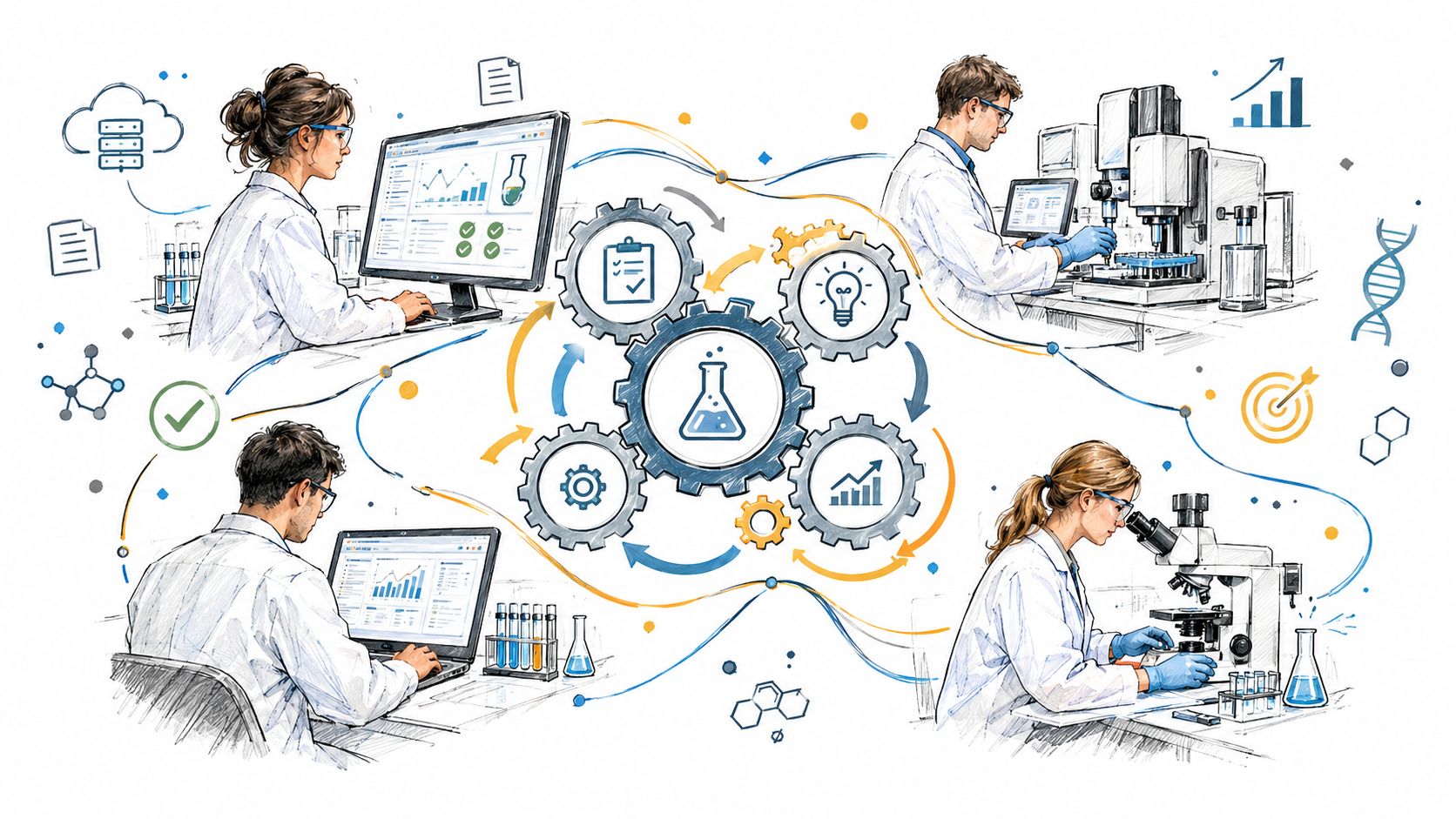
Controls work best when they match the decisions people already make:
- Access recertification: Managers confirm that each person still needs assigned datasets and actions.
- Immediate revocation: Role changes, project departures, and supplier offboarding remove permissions without waiting for a scheduled review.
- Incident rehearsal: Teams practice isolating an account, preserving logs, assessing affected records, and communicating decisions.
- Retention enforcement: Owners define how long raw observations, derived artifacts, and personal information remain available.
- Anomaly monitoring: Alerts identify unusual bulk exports, repeated failed access attempts, and cross-tenant activity.
- Change accountability: The system records edits to recipes, metadata, model versions, and approval states.
Automation should remove routine friction while leaving scientific judgment with accountable owners. A policy can block an export automatically, but a legitimate collaboration may justify an exception. That exception should have a defined end date, documented reasoning, and a review record.
Deletion requires the same operational discipline as access. Teams must specify how records leave active systems, backups, derived datasets, and applicable model pipelines. Organizations retiring devices or information can consult this secure data destruction guidance.
Challenging the Centralization Myth in Data Security
A single repository can simplify search and model operations, yet it can also concentrate risk. Combining raw experiments, proprietary formulations, supplier records, and model inputs in one lake creates an attractive target and makes purpose limitation harder to prove. Materials R&D platforms need access patterns that reflect both scientific collaboration and the commercial value of the underlying IP.
Federated access often provides that balance. Laboratories or business units retain sensitive source records, while approved programs receive the specific derived features or masked datasets they need. A model can learn from useful signals without exposing an entire recipe to every scientist or service.
The control boundary should follow the data:
- Raw formulations remain with the owning laboratory or business unit.
- Curated observations move to approved research programs.
- Masked or derived features support model development.
- Restricted records require a defined purpose and explicit approval.
- Reviewers can inspect audit evidence without seeing commercial content.
Federation introduces real costs. Discovery becomes less convenient, integrations require more engineering, and metadata must remain consistent across jurisdictions. Centralization can reduce those burdens and simplify governance reporting. The right choice depends on sensitivity, collaboration requirements, regulatory conditions, and the likely impact of compromised credentials.
Centralize policy, metadata, and auditability, not automatically every raw record. A shared access model can govern distributed repositories while local owners retain custody of commercially sensitive material. This arrangement gives AI teams usable data while preventing broad analytical access from becoming unrestricted access to formulations. It also makes exceptions visible, because access remains tied to a defined source, purpose, and owner.
Conclusion, Security as a Strategic Enabler for Innovation
Materials R&D leaders can support rapid discovery without weakening data protection. A governed backbone connects fragmented sources, zero-trust controls restrict access at the resource level, lineage shows how experimental records become model inputs, and operational reviews keep permissions aligned with actual work.
The economics favor governed platforms. IBM's research indicates that extensive use of AI and automation correlates with materially lower breach costs, but those tools deliver value only when governance makes controls consistent, measurable, and accountable. Automation does not replace decisions about ownership, access, retention, or model use.
Trusted data foundations will shape the next generation of materials discovery. Teams that can prove provenance, protect formulations, constrain access, and explain model recommendations can collaborate with greater confidence. Teams that leave governance until an audit will continue trading exposure against delay, especially when AI systems draw on sensitive experimental data.
Start with an inventory of sensitive datasets, assign accountable owners, map actions by role, and trace one representative experiment from ingestion through model output. The exercise exposes gaps in controls, metadata, and workflow automation before they affect production research or compliance evidence.
Polymerize provides an AI-native materials R&D environment that unifies fragmented experimental data and supports controlled access, lineage, and AI-guided experimentation. Visit Polymerize to evaluate how a governed data backbone can help your team protect formulations while moving from experimental records to trusted innovation.
Put your R&D data to work
See how materials teams use Polymerize to plan fewer experiments and reach target properties faster.