

The certificate is framed in the lobby. The audit closed three months ago with no findings, the risk register is signed, and the security questionnaire from your largest customer has been answered and filed. Then a formulator emails herself a spreadsheet of catalyst ratios so she can finish a report at home, and no control was ever designed to notice.
That gap sits at the centre of data security and compliance for materials R&D. It isn't a document you produce once a year for an assessor. It's the set of operating controls that decide who can open a formulation, what happens when someone exports it, and what evidence you can produce six months later when a customer, a regulator or a partner asks how it was protected.
Table of Contents
- Why Data Security and Compliance Now Costs Real Money
- Which Standards Apply to Your R&D Data
- Classifying R&D Data Before You Lock It Down
- Access Controls That Keep Formulations Out of the Wrong Hands
- Managing Suppliers, Contractors and Cloud Providers
- How to Keep Controls Working Between Audits
- Build the Evidence Trail Before Your Next Audit
Why Data Security and Compliance Now Costs Real Money
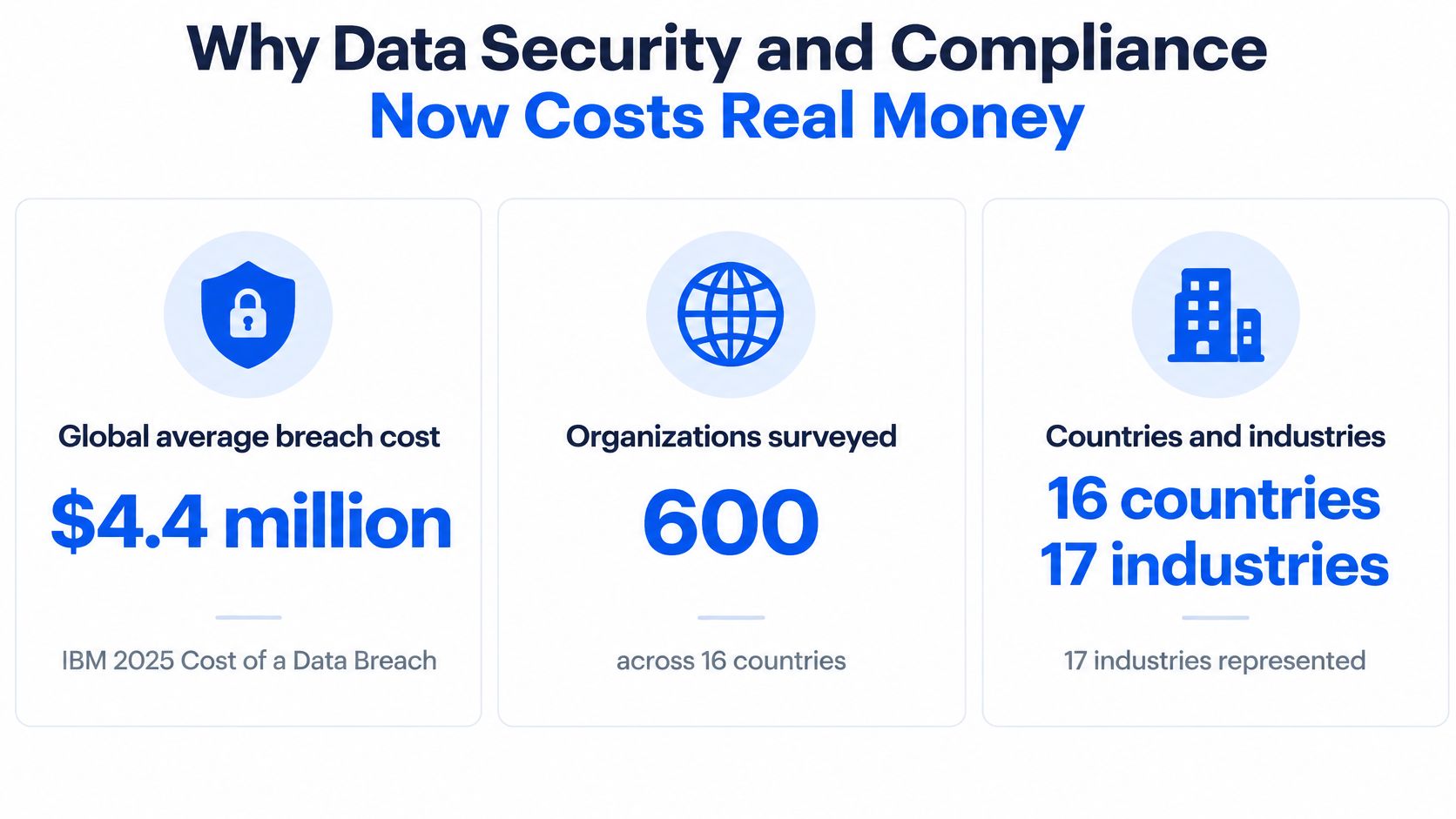
The figure that gets security work funded is the one IBM and the Ponemon Institute publish each year, and the 2025 edition puts the global average cost of a data breach at USD 4.44 million, down 9% from USD 4.88 million in 2024. The study covered 600 organizations across 16 countries and regions and 17 industries, with breaches ranging from 2,960 to 113,620 compromised records, so the average isn't one outlier dragging the number (IBM Cost of a Data Breach Report 2025).
Detection speed decides the bill
Geography moves the number more than most R&D leaders expect. The United States recorded the highest regional average at USD 10.22 million, a 9% increase and the highest figure reported for any region. Inside that total, detection and escalation alone averaged USD 1.47 million, which is precisely the slice a compliance program can influence.
Time is the cleanest cost lever in the same research. Breaches that took more than 200 days to identify and contain cost USD 5.01 million on average, against USD 3.87 million for those resolved faster. A control that shortens an investigation by a month is worth more than a binder of signed policies.
Think about how a formulation is protected in a working lab. The notebook goes into a locked cabinet at night, which feels like control. The loss happens in the corridor: the shared drive with no sign-out sheet, the instrument computer where everyone logs in with the same account, the PDF sent to a contractor who left the project in March.
The question that matters: not "do we have a policy for this" but "can we show, with a dated record, who opened this formulation and who approved it leaving the building".
Automation tracks the same relationship. Organizations using AI and automation extensively reported an average breach cost of USD 3.62 million, against USD 5.52 million among organizations that didn't use these technologies, a gap of USD 1.9 million, and they cut identification and containment time by an average of 80 days. Read those figures as design targets. Faster detection, narrower access and defensible incident response are the same controls that generate audit evidence, which is why treating data security and compliance as paperwork misses the economics entirely.
Which Standards Apply to Your R&D Data
Which standards reach your data depends on who your customers are, where your staff sit, and whether your formulations cross a border. Three kinds of regime come up in almost every review: privacy law asks what you may do with a person's name, a management-system standard asks whether your security process is documented and followed, and an export regime asks who may see the technical data at all. This table maps each one to what it governs and the proof an auditor will sample.
| Standard | Covers | Evidence auditors request | Usual trigger |
|---|---|---|---|
| GDPR | Personal data of people in the EU and UK | Records of processing, lawful basis, deletion workflows | Personal data from EU or UK staff or contacts |
| CCPA/CPRA | Personal information of California residents | Access, correction and deletion request handling | California consumers or employees in scope |
| ISO/IEC 27001 | Information security management system | Risk assessment, statement of applicability, internal audit records | Customers requiring a certified security management system |
| SOC 2 | Security, availability and confidentiality criteria | Independent attestation report and control test results | Enterprise buyers requesting third-party assurance |
| ISO/IEC 27017 and 27018 | Cloud security and protection of personal data in the cloud | Cloud-specific control mapping | Cloud-hosted platforms holding customer data |
| EAR and ITAR | Export-controlled technical data | Export classification, licence records and foreign-person access logs | Controlled technology shared with foreign staff or sent abroad |
Where the standards overlap
The overlap is larger than the table suggests, and that's the useful part. A quarterly access review, run in a ticketing tool, signed by the lab manager and retained as a PDF, satisfies an ISO 27001 internal audit sample, a SOC 2 control test and GDPR accountability simultaneously. Map each control to every standard it supports once, and you stop rebuilding identical evidence in a different template for each framework.
Cloud hosting adds a layer that catches teams out. ISO/IEC 27017 extends the ISO 27001 approach to cloud-specific security controls, and 27018 addresses protection of personal data held by a cloud provider. Suppliers holding those certifications have had the controls tested by an independent auditor rather than described on a marketing page. Polymerize, for example, holds ISO 27001, ISO 27017, ISO 27018 and SOC 2 certifications.
A three-step way to decide what you actually need
- List where the data lives. The ELN, shared drives, instrument PCs, the formulation spreadsheet the quality team keeps locally, supplier portals and every SaaS tool holding a sample result.
- Tag each store with the laws that reach it. A store holding only internal test data carries a different obligation from one holding customer specifications alongside EU employee names.
- Pick the standard your customers name. If enterprise buyers send a SOC 2 questionnaire, that's your first attestation. If a European distributor asks, GDPR records come first.
Classifying R&D Data Before You Lock It Down
Encryption without classification is a locked box with one key for the whole building. Most R&D teams encrypt first and define data classes later, which is the harder order to work in. Encryption tells you a file is unreadable; classification tells you who should have been able to read it, how long you keep it, and what you must produce when a customer asks. IBM's 2025 breach guidance names data discovery and classification, access control, encryption and key management as the foundational controls, and recommends encrypting personally identifiable information both at rest and in transit (IBM on the cost of a data breach).
Six classes cover what a materials R&D platform holds. Trade-secret formulations carry the tightest export rules. Raw experimental records need reproducibility retention. Model outputs need version history. Customer data follows contract terms. Personal data needs the strongest key separation and a deletion workflow. Operational metadata needs broad read access and an immutable log.
| Data class | Example | Access rule | Encryption and logging |
|---|---|---|---|
| Trade-secret formulations | Recipe ratios and catalyst choices | Named project members only; export needs step-up | Tenant-scoped keys; every decrypted read logged |
| Raw experimental records | Instrument files and microscope images | Lab team read and write; no external download by default | TLS in transit; keys rotated on schedule; access logged |
| Model outputs | Predicted properties and confidence scores | Approved users read; changes versioned | Encrypted at rest; version history retained |
| Customer data | Customer specifications and contract samples | Account team and named engineers only | Customer-scoped keys; retention set by contract |
| Personal data | Employee and contact names | HR and compliance roles only | Strongest key separation; documented deletion workflow |
| Operational metadata | Lab schedules and system logs | Broader internal read access | TLS in transit; immutable audit logs |
Key custody is where encryption quietly fails
Encryption only holds if the key lives somewhere the application administrator can't reach. Separate key custody from admin rights, rotate and revoke keys through a written process, and log every access to decrypted data. A key sitting in the same vault as the database turns an access review into theatre.
Tenant-scoped keys go further: one customer's data cannot be decrypted with another customer's key even if a service identity is compromised. Add TLS on every service connection, immutable audit logs and deletion workflows tied to retention periods, and those choices become evidence a SOC 2 or GDPR review can sample rather than a statement of intent.
The label only earns its keep when it's applied at creation. If a formulator has to guess a record's class after the fact, classification becomes an audit-week archaeology project. Push the class onto the notebook entry, the instrument export template and the API field, so the rule travels with the data. For a deeper walkthrough of tagging schemes and retention rules, this data protection guidance for compliance managers covers how to build a classification framework that survives real workflows.
Access Controls That Keep Formulations Out of the Wrong Hands
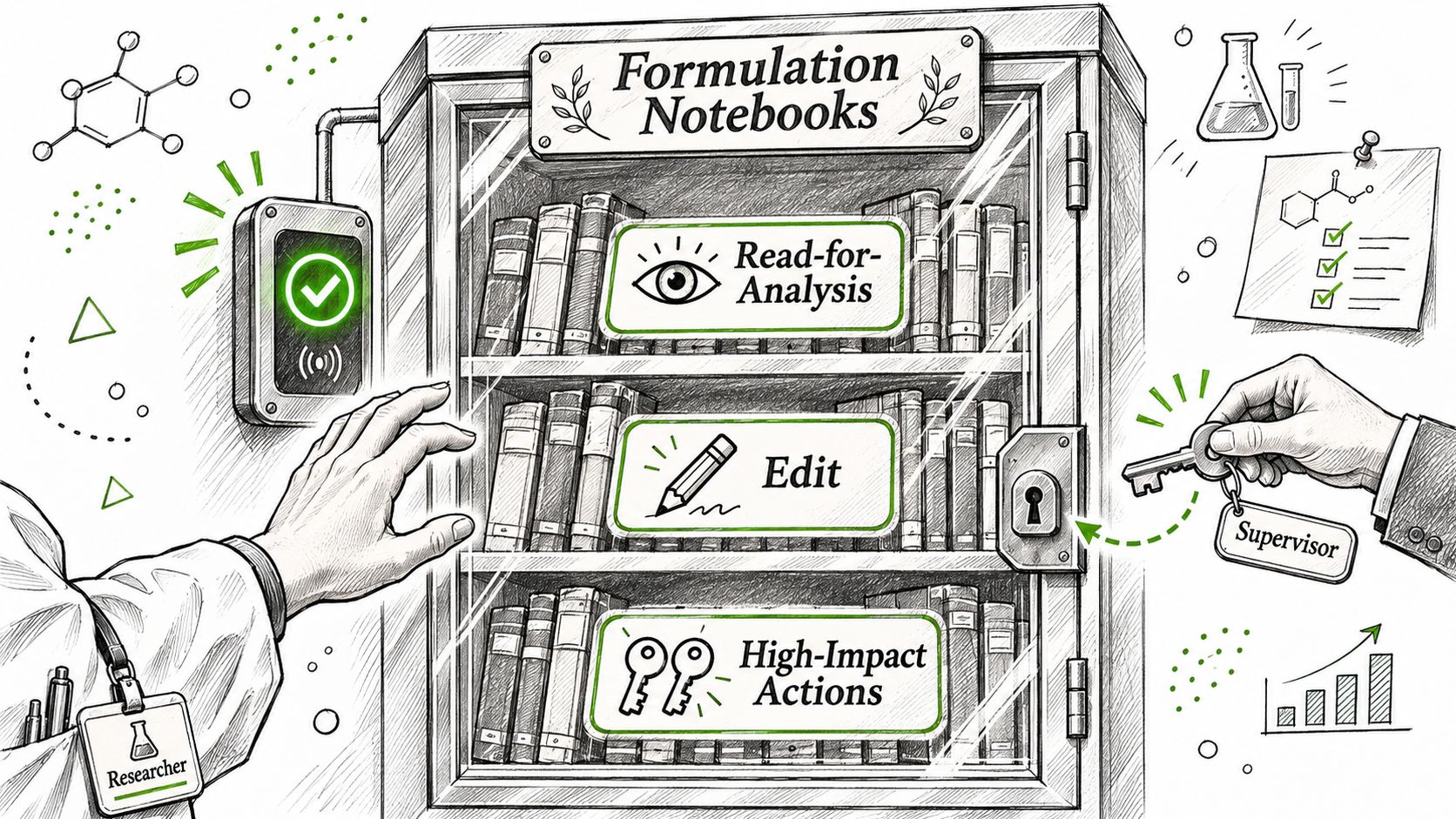
Every access decision in a materials R&D platform comes back to one rule: give each person the least access their role needs, and demand stronger proof when the action can't be undone. Here's how a lab looks once that rule is written into the system rather than into a policy appendix.
Three tiers, one example each
- Read for analysis. A process engineer opens a baseline formulation to compare viscosity. Access is read-only and scoped by project attribute, not by site, so the baseline is visible without exposing unrelated programmes.
- Edit for recording results. The chemist who owns the experiment writes results and attaches instrument files. Every edit is versioned, so an earlier formulation can be reconstructed after a failed trial.
- Export or change permissions. Bulk download, sharing outside the tenant, or altering a role requires step-up authentication and a named approver who is recorded against the transaction.
Role-based rules handle job titles; attribute-based rules handle everything else. A senior chemist and a junior chemist may share a title-based role, but project, site and clearance attributes decide whether one programme's catalyst system is visible to someone staffed on another. Without that attribute layer, a promotion widens access.
For a plain-language overview of how authentication, authorisation and session controls fit together, the video below is a reasonable starting point.
What AAL3 actually requires
For administrators and anyone who can export formulations, NIST Authentication Assurance Level 3 is the right bar. AAL3 requires phishing-resistant cryptographic authentication, a non-exportable private key protected in hardware or an isolated execution environment, approved cryptography, authenticated protected communication channels and rate limiting for failed attempts (NIST SP 800-63B). One-time passwords and manually entered out-of-band codes don't qualify, because they aren't cryptographically bound to the session the user is in.
In practice that means hardware-backed passkeys or security keys for privileged users, step-up authentication before bulk export or a permission change, and authentication events logged so they can be pulled as ISO 27001 or SOC 2 evidence. Say a scientist requests 500 formulations at once: a second check fires, the approver is named, and the export lands in the log with a timestamp.
Recertify quarterly. Each manager confirms in writing that every person on the list still needs the permission, and the confirmation is filed. That routine catches most stale access, and it's the artefact auditors ask for first. For the wider vocabulary of authentication, authorisation and privileged access, these identity and access management basics are a useful reference.
Managing Suppliers, Contractors and Cloud Providers
The perimeter story is one most R&D security plans still tell, and the evidence has moved against it. Verizon's 2025 Data Breach Investigations Report analysed 22,052 real-world security incidents, including 12,195 confirmed data breaches, and found human involvement in approximately 60% of them. The proportion of breaches involving a third party doubled from 15% to 30% in one year (Verizon 2025 DBIR executive summary).
Credential abuse was the leading initial attack vector at 22% of breaches, followed by exploitation of vulnerabilities at 20%, which increased 34% compared with the prior reporting period. Both are access-control failures before they're anything else.
The uncomfortable version: your formulation is only as protected as the least careful account that can reach it, and that account may belong to a contract lab you onboarded for a single campaign.
Exposure for a materials team arrives as contract research organisations, instrument vendors running remote support sessions, cloud hosts and freelance chemists. Governance that holds looks like this:
- Due diligence before onboarding. A questionnaire that asks who will touch the data, from where, on what device, and what happens to copies at the end.
- Security clauses in the contract. Breach notice timelines, audit rights, deletion obligations at termination and named security contacts on both sides.
- Named accounts, never shared. Each contractor gets an individual identity with multi-factor authentication and an expiry date tied to the statement of work.
A contract lab handed a shared login for a three-month campaign keeps that login for two years, because nobody owns the removal. A named account with a 90-day expiry fails closed instead.
Offboarding needs the same discipline as onboarding: revoke accounts on the contract end date, retrieve copies of files, and confirm deletion in writing. Keep that confirmation next to the contract, because it's the record you'll want when a customer asks who has held their specifications.
How to Keep Controls Working Between Audits
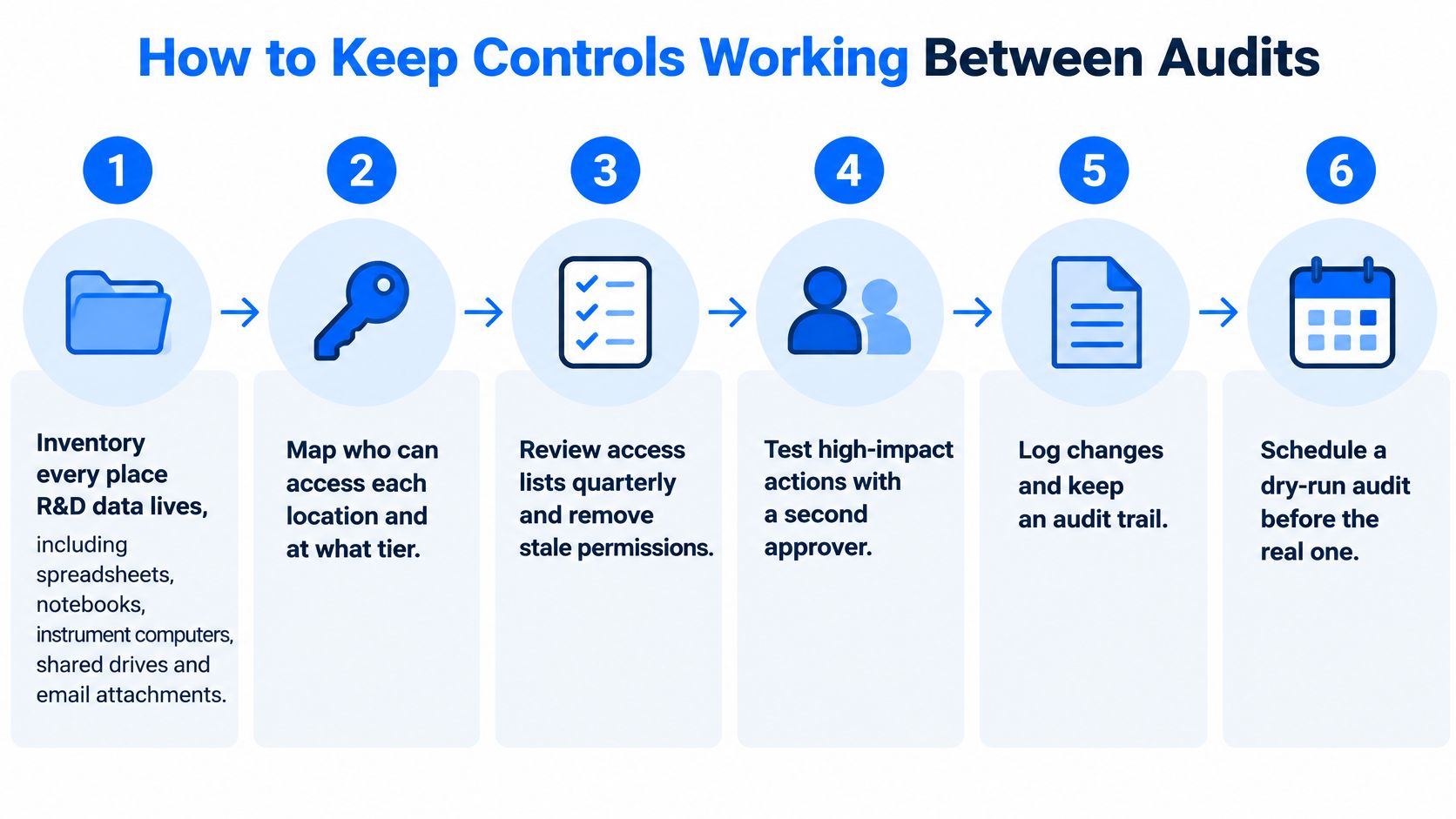
An audit is a photograph of one week. Formulations move every day, so the controls need a routine that runs whether or not an assessor is booked.
The gap between a certificate and a secure system isn't hypothetical. Organizations that pass audits tend to report fewer breaches than those that fail, and the incidents that do occur most often trace back to human error: a workaround, a shared password, a copy left somewhere convenient. A pass correlates with better posture. It says nothing about the state of your data on the Tuesday between audits.
What fills that gap is a routine small enough to run.
A seven-step routine that fits a working lab
- Inventory every place R&D data lives. Spreadsheets, ELN entries, instrument computers, shared drives, email attachments and supplier portals. If a location isn't on the list, nobody is reviewing it.
- Give each location an owner and a class. The owner answers for the access list; the class sets the retention and export rule applied to it.
- Compare access lists to current roles every month. Remove anyone who left the company or moved projects. A few minutes per system prevents the stale permissions that audit sampling always finds.
- Restore a sample of backups each quarter. A backup you've never restored is an assumption. Restoring one folder proves the process and leaves a dated record.
- Read the export logs. Look for unusual volumes, off-hours downloads, or one account pulling records across projects it has no business touching.
- Record incidents and near misses. Include the scientist who copied data to personal storage to work around an access limit. That workaround is the failure you can fix, and the log of it shows an assessor the routine is real.
- Generate evidence automatically. Export logs, approval records and access reviews should be produced on a schedule, dated, and stored where an auditor can pull them without emailing you.
Notification deserves rehearsal too. Decide in advance which regulator and which customer contracts start a clock after a confirmed incident, who makes the call, who notifies, and which evidence gets preserved before machines are rebuilt. Walk it once a year like a fire drill: one scenario, one afternoon, the people who would make the calls in the room. A team that has never run that sequence discovers its gaps at the worst possible hour.
You know the routine is working when the inventory matches the access list, no unclassified copy of a formulation exists outside the platform, and every export in last month's log carries a named approver.
Build the Evidence Trail Before Your Next Audit
AI changes what evidence means. A formulation recommendation accepted last quarter has to be reconstructible, not just approved. Surveys of enterprise leaders keep ranking data privacy and security as the top concern around AI adoption, ahead of legal and regulatory compliance, and few report a mature governance model for autonomous agents. A large majority believe humans must retain authority to validate AI decisions. Meanwhile, Gartner's 2026 outlook on internal audit priorities places cybersecurity, data governance and regulatory compliance at the top of what auditors plan to examine.
That combination raises the bar. An auditor who expects human validation of AI output will not accept a checkbox that says a model was supervised. They will ask who validated which recommendation, on what data, with what right to override.
Five checks to run before the auditor arrives
- Classification covers every R&D store. Spot-check three records from last month and confirm each one carries a class and an owner.
- Privileged and export roles meet AAL3. Hardware-backed keys, step-up before bulk export, and authentication events present in the log.
- Each requested standard maps to named controls. One row per control, listing the ISO 27001 clause, the SOC 2 criterion and the privacy obligation it satisfies.
- Every AI-assisted decision leaves a trail. Dataset lineage, formulation version, model and feature versions, confidence scores, historical precedents, the named approver, any human override, and a record of which sensitive sources were excluded.
- The monthly and quarterly routine ran. Dated evidence, not a commitment to start next month.
A nominal approval click is weak evidence if the reviewer couldn't inspect the recommendation. The test is whether a different person, six months later, can reconstruct why a suggested formulation was accepted using only what was retained.
When you evaluate a platform, ask for current certificates and the most recent audit report, then confirm the encryption and access claims you're relying on appear inside that report rather than on a web page. The security model has to match what was tested: Polymerize encrypts data end to end with role-based access and isolated data environments, and an organization's data is encrypted in the database so nobody on the Polymerize team can view it.
A decision you can make this week: pull one export from the last month and confirm it traces back to a classified, approved request with a logged reviewer decision. If you can't follow it end to end, you've found the gap the next audit will find for you.
If the evidence trail described here is the standard you want for your own formulations, Polymerize is built so daily scientific work produces most of it. Experimental data sits in one encrypted backbone with role-based access and isolated environments, backed by ISO 27001, SOC 2 and GDPR/CCPA compliance, which gives your team a defensible basis for the access and confidentiality records an audit asks for. Visit Polymerize to see how polymers, chemicals and advanced materials teams keep their R&D data protected and audit-ready on one platform.
Put your R&D data to work
See how materials teams use Polymerize to plan fewer experiments and reach target properties faster.