

Data Quality Assurance in Materials R&D: A Complete Guide
A formulation campaign can look perfectly healthy on the surface. The samples are prepared, the instrument files are exported, and the results are copied into an ELN or a shared spreadsheet. Weeks later, a scientist notices that one result doesn't fit the trend. A closer review reveals a transposed value, an unrecorded unit conversion, or a sample identifier that changed between systems.
That kind of failure rarely belongs to one careless person. It usually reflects a workflow that lets data move from instruments to ELNs, spreadsheets, LIMS, and models without enough context or control. Data quality assurance therefore isn't a spreadsheet-cleanup exercise. It's the operating discipline that keeps experimental data reliable from creation through analysis, reuse, and archival.
Table of Contents
- Accuracy asks whether the value reflects reality
- Completeness protects the experimental context
- Consistency exposes disagreements between systems
- Timeliness keeps decisions connected to current work
- Validity and provenance make values defensible
- Start with sample entry
- Place validation before analysis
- Treat spreadsheets as controlled interfaces
- Archive with lineage intact
- Assign decisions to named people
- Govern exceptions instead of hiding them
- Build standards that survive system changes
- Rules find known failures
- Models identify relationships
- Lineage makes intervention possible
- Feedback turns corrections into better controls
- Map one high-impact data stream
- Establish the minimum governance layer
- Build checkpoints into the path
- Measure the response, not just the score
When Bad Data Costs You Expensive Experiments
A materials scientist may begin with a sensible hypothesis: adjust a formulation, cure a batch, measure its mechanical properties, and compare the result with earlier work. The experiment fails to reproduce the expected trend. The team checks the synthesis protocol first, then the instrument, then the sample preparation. Eventually, someone discovers that one spreadsheet records viscosity in one unit while a downstream file assumes another.
The immediate damage is obvious. The team may repeat a synthesis, reserve instrument time again, consume scarce materials, and delay a decision about the next formulation. The less visible damage is worse. If the flawed result enters a training dataset, future recommendations can inherit the same distortion. Scientists then spend time challenging model outputs that were never trustworthy in the first place.
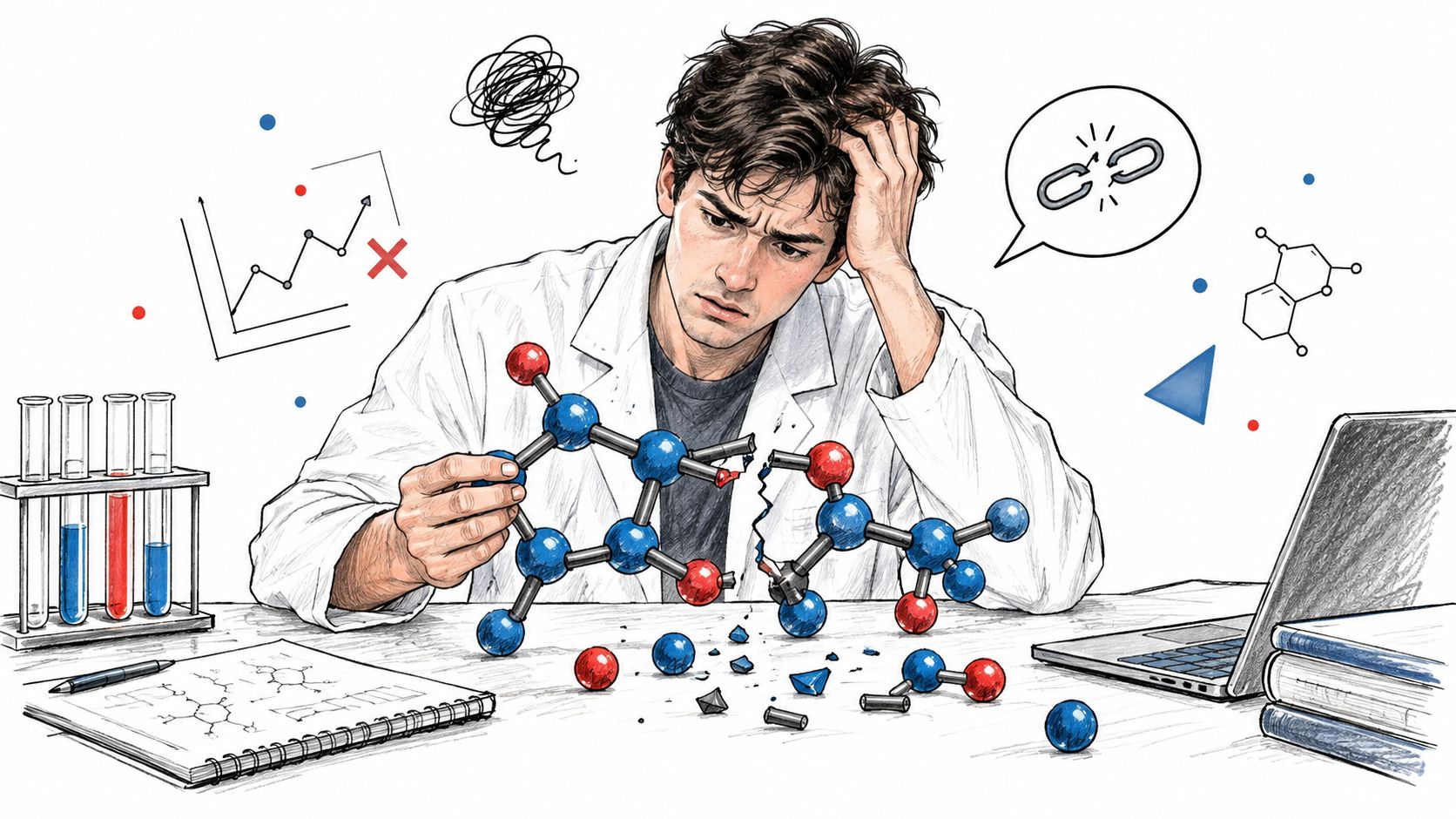
The error rarely starts where you find it
Data quality problems often appear at the point of analysis, but originate much earlier. A technician may enter a sample identifier manually. An instrument export may omit a unit. An ELN template may make a critical field optional. A scientist may merge two spreadsheets using a material name instead of a stable identifier. Each decision seems manageable in isolation, yet together they make reconstruction difficult.
Statistics Canada's framework is useful because it treats quality as fitness for the original objective, not as a vague impression of cleanliness. It distinguishes sampling and non-sampling error, and shows that non-sampling error can arise during planning, design, collection, coding, capture, editing, estimation, analysis, or dissemination in its framework for evaluating survey data quality. Materials R&D has different experiments, but the principle transfers directly: quality controls must follow the entire data lifecycle.
Practical rule: If a scientist can't explain where a value came from, what it means, and which conditions produced it, the value isn't ready for reuse.
Cheap corrections happen close to the source
A required unit field can prevent an ambiguous record at entry. A controlled vocabulary can stop “PAA,” “polyacrylic acid,” and an internal abbreviation from becoming three apparently different materials. A plausibility check can route an unusual measurement to review before it enters a model.
This approach changes the economics of QA. A correction at sample entry takes little effort. A correction after multiple transformations may require tracing lineage, identifying affected analyses, reviewing related records, and deciding whether experiments need to be repeated. The purpose of data quality assurance is not to eliminate every anomaly. It's to catch consequential errors while their causes are still visible.
The Five Dimensions of Data Quality You Can Actually Measure
Accuracy alone doesn't tell a materials team whether a dataset is fit for use. A tensile-strength value can be accurate as recorded and still be unusable if the specimen geometry is missing. A complete dataset can still be inconsistent if different systems apply different units. A valid record can lose its value when nobody can establish which protocol or instrument produced it.
The WHO data quality framework uses completeness, internal consistency, external cross-checks, and denominator consistency, with benchmarks or cut-offs that help teams turn review into operational decisions in its data quality framework and metrics guidance. For materials R&D, those ideas can be organized into five practical dimensions.
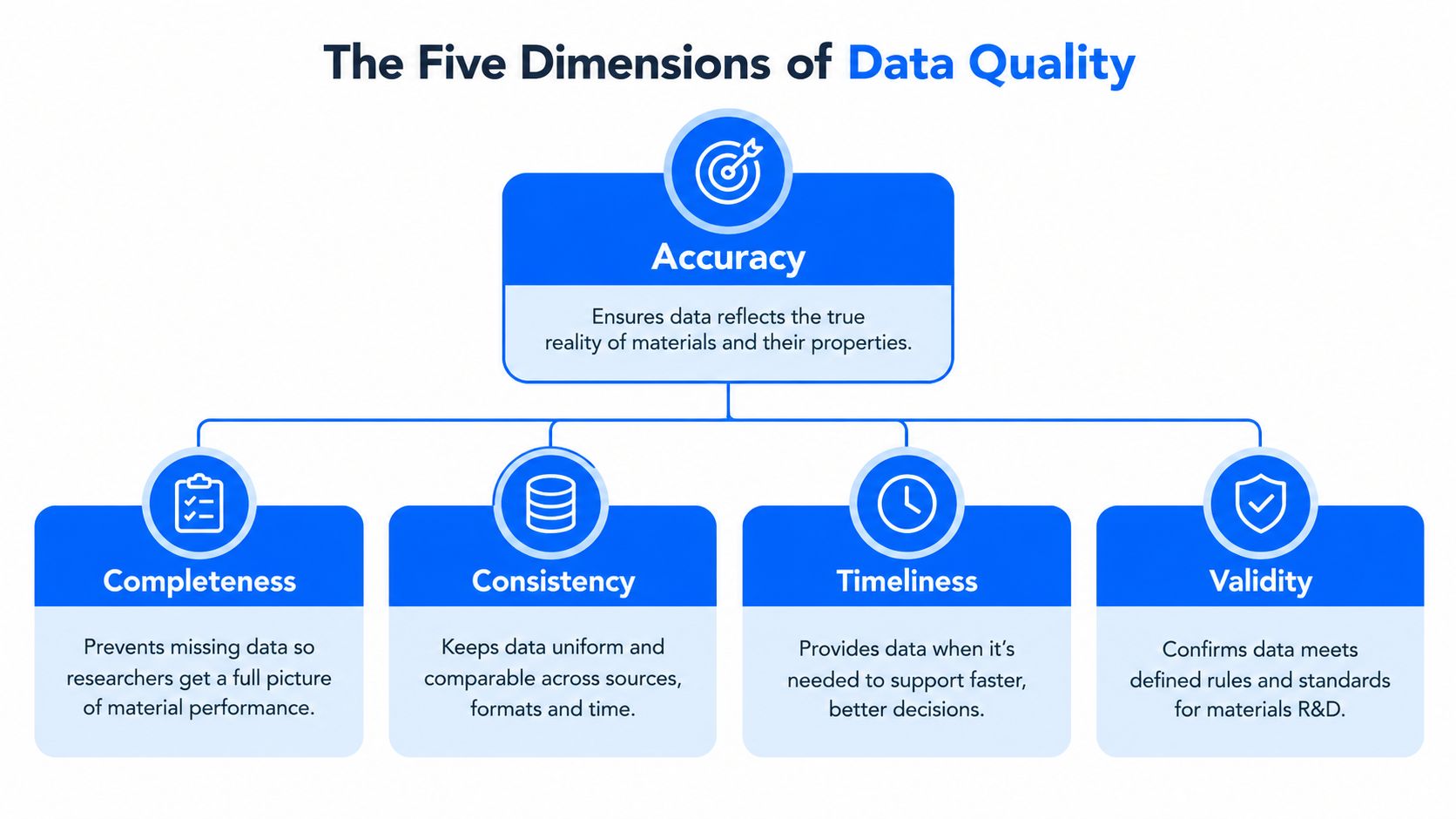
Accuracy asks whether the value reflects reality
Accuracy depends on more than a correctly typed number. It includes instrument calibration, sample identity, test conditions, operator technique, and the relationship between the recorded result and the physical material. A modulus value without temperature, strain rate, or specimen information may be numerically correct but scientifically misleading.
Use accuracy checks where the system has meaningful reference points. Compare instrument output with approved calibration records, reconcile repeated measurements, and require the test context needed to interpret the result. Don't automatically discard an outlier. Route it for scientific review, because an unusual value may indicate either a valuable discovery or a bad record.
Completeness protects the experimental context
A missing formulation ratio, cure condition, lot number, or environmental setting can make an otherwise polished record impossible to reproduce. Mandatory fields should focus on decision-critical context, not every conceivable field. If a field affects interpretation, model training, safety, or compliance, make its absence visible and assign an owner for resolution.
Completeness should be measured by data element and use case. A formulation-screening dataset may require all ingredient identities and concentrations, while a process dataset may prioritize residence time, temperature, and equipment state. One global completeness score hides those differences.
Consistency exposes disagreements between systems
Consistency means related records agree with one another and follow the same definitions. Check units, decimal conventions, material identifiers, date formats, formulation totals, and links between samples and experiments. A spreadsheet may call a field “density,” while an ELN stores “specific gravity,” even though the two values aren't interchangeable.
Cross-record checks are particularly valuable. If a sample is marked as cured in one system and uncured in another, the discrepancy should create a review task rather than get resolved through a last-write-wins rule.
Timeliness keeps decisions connected to current work
A result entered long after the experiment may still be accurate, but delayed entry increases the risk of lost context, duplicate transcription, and mistaken sample association. Define the point at which a result must become available for the next workflow step. Timeliness should serve the experiment, not create a bureaucratic target that scientists bypass.
Validity and provenance make values defensible
Validity checks whether a value follows an allowed format, range, relationship, or domain rule. Provenance answers a different question: where did it come from? Store the source instrument, operator, protocol version, sample identifier, transformation, and review status wherever possible.
Teams comparing monitoring products should distinguish a dashboard that reports a failure from a system that connects the failure to its source and downstream impact. A practical starting point is this guide to compare data observability platforms, especially when evaluating lineage, alerting, and pipeline visibility.
Building a QA Workflow for Materials R&D
A useful workflow puts a control at every transition where meaning can be lost. The controls shouldn't all look alike. Some belong in the instrument or ELN, some in the integration layer, and some in scientific review. The design question is simple: what can go wrong here, and what is the cheapest reliable way to detect it?
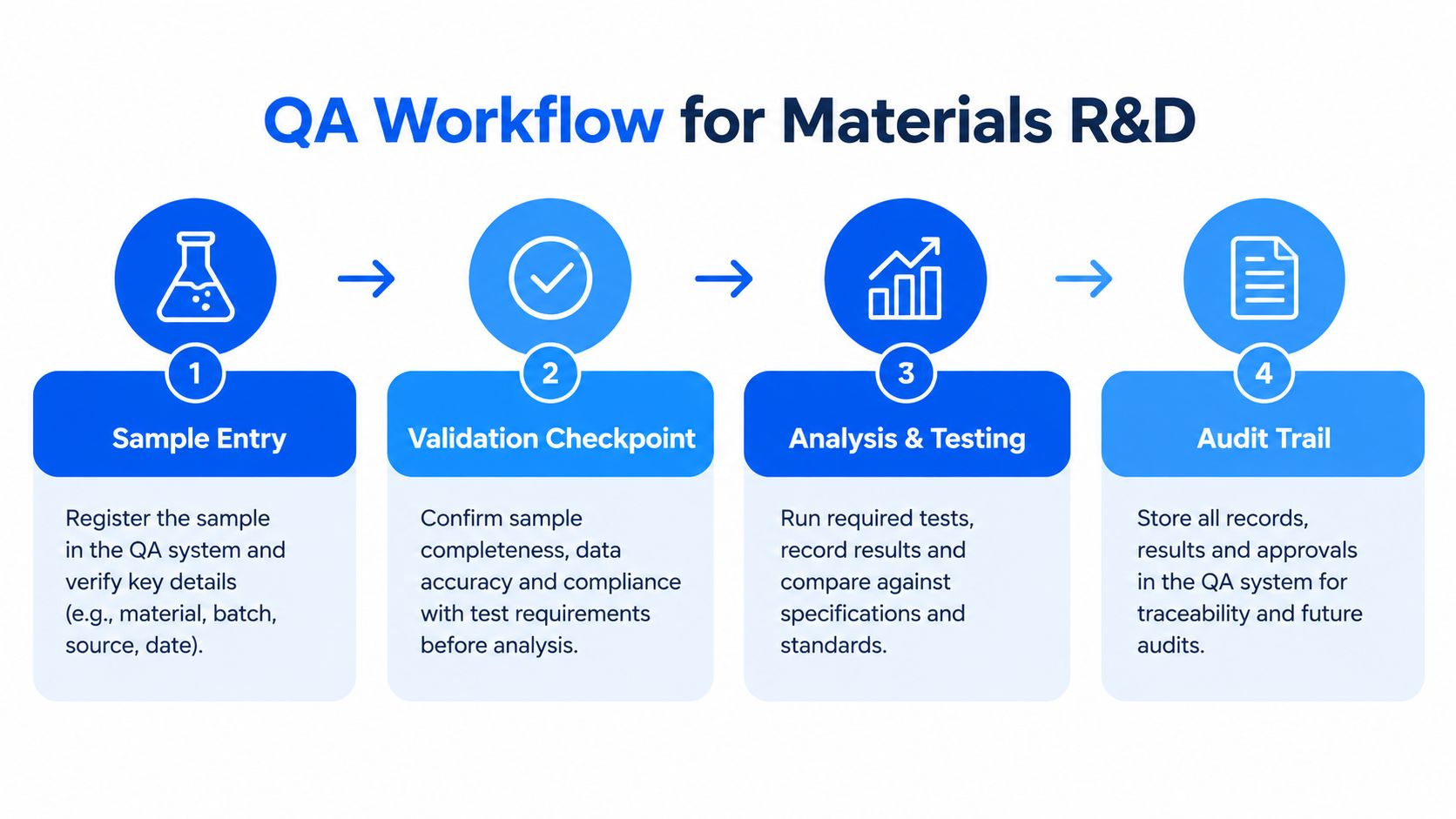
Start with sample entry
Create a stable identity before collecting measurements. A sample record should connect the material, formulation, batch or lot, preparation method, responsible person, and parent experiment. Avoid relying on names that scientists can edit freely. Use controlled identifiers, then allow descriptive names as additional metadata.
At entry, validate fields that can be checked without scientific judgment:
- Required context: Block progression when critical formulation, preparation, or test fields are missing.
- Controlled terms: Standardize material names, units, instrument types, and protocol versions.
- Duplicate detection: Flag a sample identifier that already exists or appears in an unexpected experiment.
- Relationship checks: Confirm that a child sample points to a valid parent batch or formulation.
Don't make every field mandatory. Excessive friction encourages workarounds, shared logins, and later bulk entry. Require what downstream users truly need, and explain why the field matters.
Place validation before analysis
When data leave an instrument or ELN, run structural and scientific checks before consolidation. Structural checks can identify malformed files, missing columns, invalid dates, duplicate records, and unexpected schema changes. Scientific checks can evaluate unit conformity, allowed ranges, formulation totals, and relationships between measurements.
A rule should produce an actionable outcome. “Failed” isn't enough. The system should show the record, the violated rule, the source, the owner, and the permitted next action. If a value is outside the expected range, route it to a qualified reviewer instead of replacing it automatically.
Field audits can strengthen automated checks. J-PAL describes back-checks as a way to detect programming errors, surveyor errors, fabrication, and misunderstood questions, and identifies a discrepancy rate above 10% as a red flag for systemic problems or possible fabrication in its guidance on data quality checks. The domain differs from laboratory work, but the operational lesson is relevant: use high-frequency checks, back-checks, and spot-checks as complementary controls instead of trusting one score.
Treat spreadsheets as controlled interfaces
Spreadsheets won't disappear from materials R&D, and banning them usually drives work underground. Control their role instead. Provide approved templates, protect calculation cells, define accepted units, preserve the original file, and record who imported the data and when.
During import, check column names, data types, units, identifiers, missingness, and duplicate rows. Never overwrite an existing dataset without retaining the prior version. If scientists need to correct a record, capture the correction and reason rather than changing the value without trace.
Archive with lineage intact
The LIMS or central repository should preserve raw files, normalized records, derived values, protocol versions, and review decisions. A transformed value without its original source can't support a defensible scientific conclusion. A model-ready table should therefore retain links back to the experiment and the transformations applied.
For teams formalizing these controls, a broader QA guide from F1Group can help frame assurance as a system of planned controls rather than a final inspection. In practice, the best workflow is the one scientists can follow without duplicating the same data across several systems.
Why Governance Maturity Matters More Than Perfect Data
A clean dataset today can become unreliable tomorrow if nobody owns the rules that made it clean. Governance defines who can change a schema, who approves a unit conversion, who resolves a failed validation, and who decides whether an exception is scientifically acceptable. Without those decisions, teams apply local fixes and create new inconsistencies downstream.
A 2026 survey reported that 61% of respondents still rank data quality as a top challenge, while only 15% report mature data governance. The same source reports incomplete data as a recurring problem for 62% of respondents and capture inconsistencies for 58% in its discussion of data management trends. These figures describe an organizational gap, not a shortage of cleansing scripts.
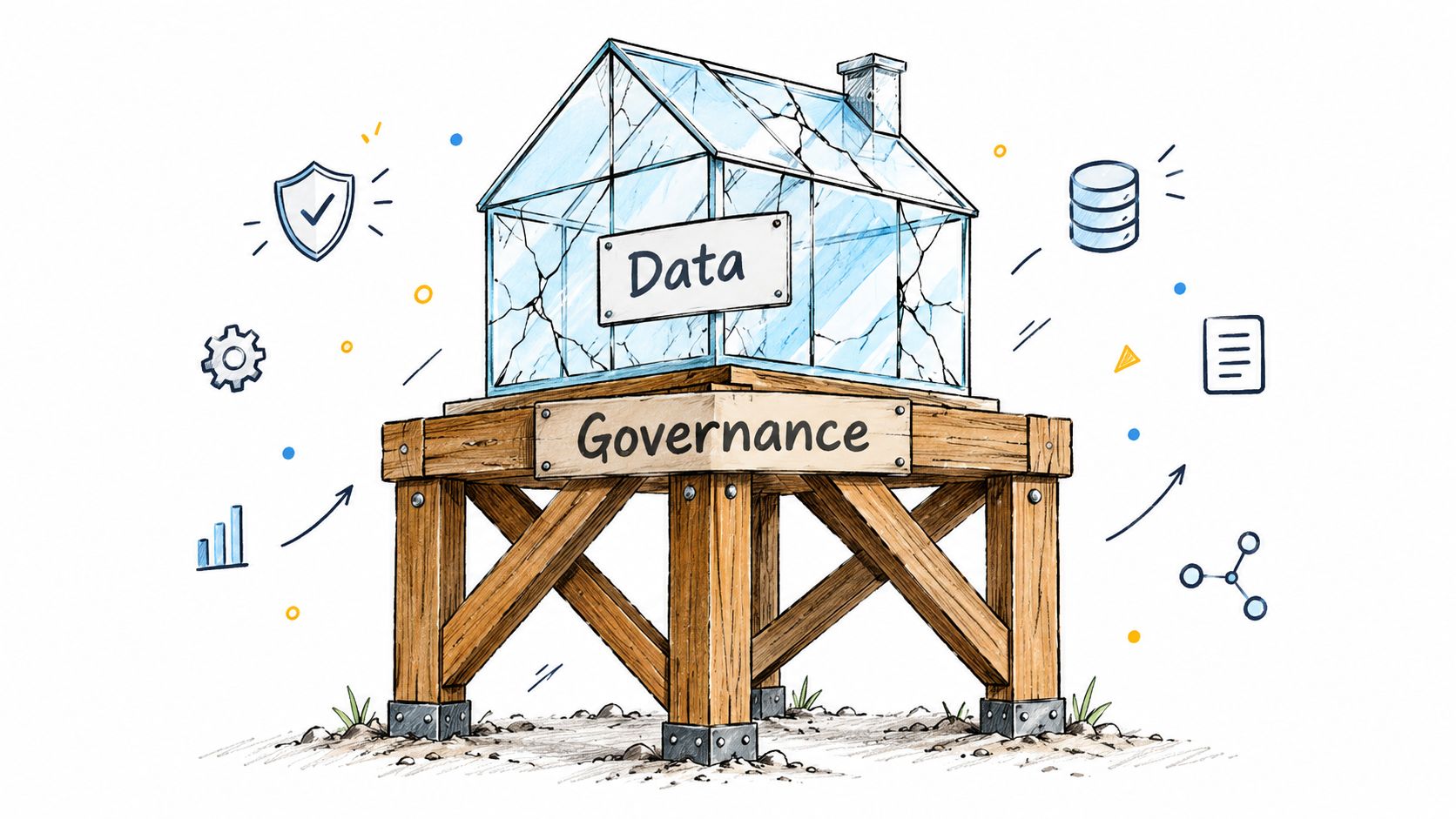
Assign decisions to named people
A governance program becomes practical when responsibilities are explicit:
- Data owners decide what a dataset means, which uses are permitted, and what quality standard applies.
- Data stewards maintain definitions, investigate recurring defects, and coordinate corrections with laboratory teams.
- System owners implement validation, access, versioning, and lineage controls.
- Scientists and technicians capture context at the source and report records that don't reflect the experiment.
- Model owners define what data can enter training, validation, and production workflows.
One person may hold several roles in a small team. That's acceptable. Unassigned decisions aren't.
Govern exceptions instead of hiding them
Materials science depends on legitimate exceptions. A result outside a historical range may be a breakthrough, an instrument problem, or a sample mix-up. A rigid rule that rejects every anomaly can suppress useful science. A weak rule that accepts everything makes the check decorative.
Use a review state with a reason, reviewer, timestamp, and supporting evidence. Separate unusual from invalid. That distinction lets scientists investigate novelty without allowing unexplained values to pass as ordinary observations.
Build standards that survive system changes
An ELN migration, new instrument, or revised protocol can change field names and data shapes. Governance should define canonical concepts independently of one vendor's interface. For example, store the scientific meaning of a curing temperature separately from the label used by a particular instrument export.
Keep a change log for schemas, controlled vocabularies, calculation methods, and protocol versions. When a rule changes, identify which historical records it affects. This turns governance into institutional memory rather than a collection of undocumented preferences.
Data quality improves when the person closest to the error can fix its cause, not when a downstream analyst becomes better at hiding the symptom.
How AI-Native Platforms Close the QA Feedback Loop
Automation is valuable only when it understands the difference between a formatting defect and a scientific risk. A generic check can identify a blank field. It usually can't determine whether that blank prevents a property result from being interpreted, whether two records refer to the same material, or whether a value conflicts with the rest of the experiment.
An AI-native approach starts by unifying fragmented records while preserving their source context. The platform should map spreadsheet columns, ELN fields, instrument outputs, and LIMS records into a shared scientific vocabulary. It should then apply rules and models that combine schema validation, unit checks, missingness detection, duplicate identification, referential integrity, and plausibility review.
Rules find known failures
Deterministic rules remain essential. Use them for conditions with clear answers:
- A concentration must use an approved unit.
- A required formulation component can't be absent.
- A sample must point to an existing batch.
- A test result must include the protocol and conditions needed for interpretation.
- A record can't contain two active values for the same measurement without a version or replicate designation.
These controls are transparent and easy to audit. They also provide a stable foundation for more adaptive methods.
Models identify relationships
Domain-aware models can examine relationships that simple field rules miss. They may flag a property value that conflicts with related measurements, a formulation that falls outside known material constraints, or a sudden shift associated with one instrument, operator, or protocol. The system shouldn't present its inference as proof. It should expose the evidence and send the record to a scientist for review.
Explainability matters here. A useful alert might show the historical records used for comparison, the unit normalization applied, the relevant protocol, and the reason the value was considered unusual. A black-box score without context creates another review burden.
Lineage makes intervention possible
A quality alert has limited value if the team can't locate the source. Lineage should connect a model-ready value to its raw instrument file, sample, formulation, operator, protocol version, transformation, and downstream use. That connection helps a scientist correct the source record rather than patching one copy in an analysis table.
It also supports impact assessment. If a unit conversion was wrong, the team can identify the affected experiments, models, reports, and decisions. Without lineage, the safest response is often to distrust a much larger dataset than necessary.
Feedback turns corrections into better controls
The feedback loop begins when a scientist reviews an alert. The system should capture whether the value was corrected, accepted as a valid exception, linked to an instrument problem, or caused by a mapping error. Those decisions can improve future suggestions and reveal where workflow design needs attention.
Automation doesn't remove scientific accountability. It moves repetitive inspection to software, while scientists spend their time on ambiguous cases and experimental meaning. When evaluating platforms, ask whether they can preserve raw data, show transformations, support human review, learn from resolutions, and enforce a governed path into AI workflows.
The financial stakes extend beyond failed experiments. IBM reports that 43% of chief operations officers identify data quality issues as their most significant data priority, that more than a quarter of organizations estimate annual losses above USD 5 million from poor data quality, and that 7% report losses of USD 25 million or more in its 2026 analysis of the cost of poor data quality. The same analysis describes data quality as a direct concern for AI readiness, not merely reporting hygiene.
Your Action Plan for Data Quality in Materials R&D
A practical program starts with the workflow you already have, including its workarounds. Don't begin by buying a dashboard or attempting to cleanse every historical record. Begin by finding the points where bad data enters, changes meaning, or becomes expensive to correct.
Map one high-impact data stream
Choose a stream such as formulation records, mechanical testing, or accelerated aging. Follow one record from sample creation through analysis and archival. Record every handoff, transformation, manual entry, unit conversion, and approval. Ask scientists where they copy information because the official system doesn't support the work.
Then classify failures by consequence. A missing comment may slow interpretation. A wrong unit may invalidate a comparison. A broken sample relationship may contaminate an entire model-ready dataset. Prioritize controls around the errors that can change scientific decisions.
Establish the minimum governance layer
Name the data owner and steward. Define canonical names for materials, properties, units, protocols, and sample relationships. Document which fields are required, which rules block progression, which alerts require review, and who can approve an exception.
Create a lightweight issue process. Every defect should have a status, owner, root cause, correction, and prevention action. If the same error returns, treat it as a workflow defect rather than repeatedly cleansing the symptom.
Build checkpoints into the path
Implement controls in sequence:
- At creation, validate identifiers, required context, units, and allowed formats.
- At integration, detect schema changes, duplicates, missing links, and cross-system conflicts.
- Before analysis, review plausibility, completeness for the intended use, and protocol compatibility.
- Before model training, separate approved, unresolved, excluded, and exploratory records.
- At archival, retain raw files, transformations, versions, decisions, and lineage.
Don't wait for perfect automation. A well-designed manual review queue is better than an invisible exception. Improve the rules as reviewers resolve cases.
Measure the response, not just the score
A single quality score can create false confidence. Track which error classes appear, where they originate, how long they remain unresolved, how often reviewers accept exceptions, and whether the same defect recurs. Also monitor the time required to trace a result back to its source and the proportion of records that can be reused without manual reconstruction.
The empirical case for prioritization is strong. One study of 75 data quality assessments found that 47% of recently created records contained at least one critical error, while only 3% of data quality scores reached an acceptable threshold of 97% or higher in its analysis of enterprise data quality. The same source describes a multicenter clinical dataset in which semi-automated validation identified 79 real data quality issues across 19 institutions, including 14 high-impact problems affecting at least half of the records. For a materials team, the lesson is to automate high-impact checks first, then expand coverage based on observed failure patterns.
Data quality assurance becomes strategic when it protects experimental decisions, not when it produces another compliance report. Each validated record improves the next analysis, each documented exception strengthens institutional knowledge, and each source-level correction prevents downstream rework. Materials R&D leaders who treat governance and workflow as part of scientific infrastructure can make their data more reusable without asking scientists to become database administrators.
Polymerize connects fragmented materials R&D data across spreadsheets, ELNs, and other silos, then supports validation for units, ranges, missing fields, identifiers, and cross-record relationships. Visit Polymerize to explore a governed, AI-ready foundation for more traceable experiments and better data quality assurance.