

The most repeated advice in this debate is to pick one. Choose the lake, the argument goes, because object storage is cheap, schema-on-read is flexible, and the warehouse is legacy. That advice survives right up to the moment a formulation scientist asks why two dashboards report different values for the same batch and nobody can trace which transformation produced either number.
A data lake vs data warehouse vs data mart comparison isn't a product shortlist. The three terms describe different scopes of data use, and in most enterprises they run at the same time, over the same data, for different readers. The decision that matters is which data stays raw, which gets curated, and whether provenance survives the trip between them.
Get that wrong and you buy flexibility you can't audit, or governance your scientists can't use. Get it right and the layers reinforce each other instead of competing for the same budget line.
Table of Contents
- Data Lake, Data Warehouse and Data Mart at a Glance
- How the Three Architectures Differ in Daily Work
- The Cost of Preparation and Governance Nobody Budgets For
- Performance Trade-offs Across Query Workloads
- Matching Each Architecture to Your Situation
- Build a Layered Materials Data Foundation Next
Data Lake, Data Warehouse and Data Mart at a Glance
Most of the confusion comes from treating these as three storage products bidding for the same money. They aren't. A data mart answers one department's questions, a data warehouse integrates cleaned, structured data for enterprise reporting, and a data lake keeps data in its original form until someone needs it. The table below puts the same three side by side.
| Architecture | Primary purpose | Data stored | Schema approach | Main users |
|---|---|---|---|---|
| Data lake | Keep raw data for later exploration, AI and processing | Structured, semi-structured and unstructured files | Schema-on-read | Data scientists and engineers |
| Data warehouse | Governed enterprise reporting and repeatable SQL | Cleaned, structured, conformed tables | Schema-on-write | Analysts, finance and executives |
| Data mart | Answer a defined set of questions for one function | Curated subset from a warehouse or source systems | Schema-on-write | One team such as R&D, quality or sales |
The scope runs from broad to narrow. A mart is a subject- or department-specific subset built to answer a limited set of business questions, a warehouse integrates cleaned and structured data for enterprise reporting, and a lake holds structured, semi-structured and unstructured data in its original form for later processing. Each sits on different infrastructure too: low-cost object storage for the lake, a governed SQL engine for the warehouse, and a small curated subset fed from one of the other two for the mart.
Which column matters most depends on what's breaking this quarter. For a materials team, the two that decide most arguments are Data stored and Schema approach, because that pair controls the flexibility and auditability trade every R&D program eventually faces. If the warehouse row is the one you care about, start with the business decisions rather than the tool; designing a data warehouse around business decisions covers how to order that work before a single table gets built.
None of the three is a universal replacement for the others. That isn't a diplomatic answer. It's the one the adoption data supports, and the sections below show where each layer earns its place and where it costs more than the demo suggested.
How the Three Architectures Differ in Daily Work
The vocabulary is older than the argument. Data-warehouse architectures were established across large enterprises by the 1990s, while the data-lake concept arrived when Pentaho CTO James Dixon introduced it in 2010. Reviews of the two designs draw the dividing line at schema-on-write for warehouses and marts, where data is modeled and transformed before loading, against schema-on-read for lakes, where raw data gets interpreted at query time (an academic review of data lake and warehouse architectures).
The distinction looks tidy on a diagram. Here it is laid out side by side.
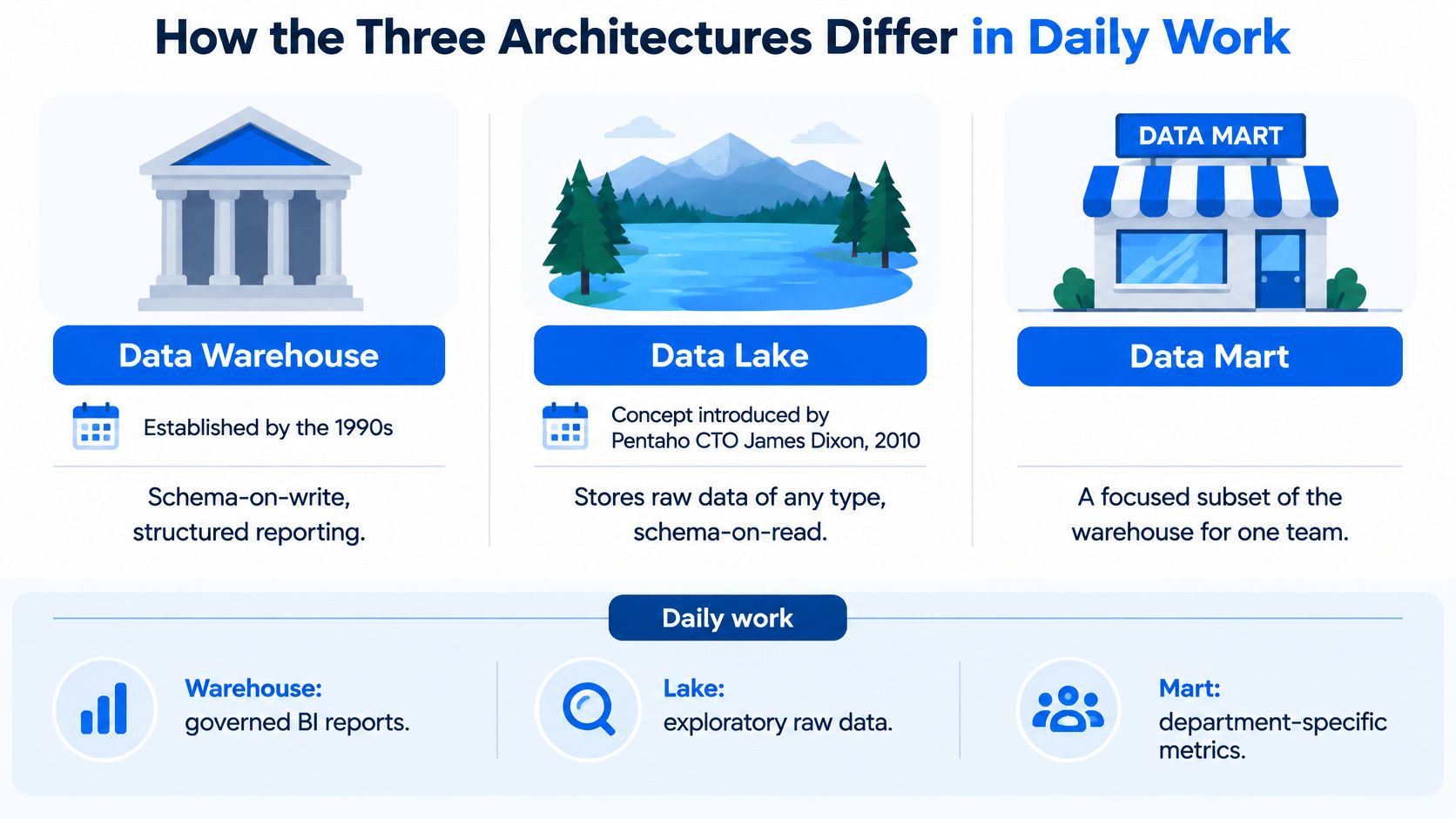
Postponing transformation preserved source detail, which is valuable when the source is an instrument file nobody fully understands yet. It also moved responsibility. Metadata, governance and data quality stopped being the pipeline's problem at load time and became the analyst's problem at query time. In materials R&D, where experiment records, instrument files, formulation tables, images and process logs each want a different structure, that shift shows up every single week.
One Batch Travels Three Paths
Take a single formulation batch, call it BF-2291, with a monomer ratio recorded as a mass percentage in one file and a molar ratio in another, a supplier trade name in a spreadsheet, and a chromatogram nobody has parsed yet. Watch what each architecture demands of the team.
- Warehouse first. The team agrees a model, maps mass percentage and molar ratio to defined fields, resolves the trade name against an internal registry and loads the batch. Reporting stays consistent and fast, but a question the model didn't anticipate, such as whether the two monomer suppliers behave differently, needs a pipeline change before anyone can answer it.
- Lake first. Raw files land exactly as they arrived, and each analyst applies their own interpretation when querying. Week one, this beats any modeling project on speed. Month six, two analysts report different monomer ratios for the same batch, both can point to a defensible source file, and nobody owns the definition.
- Mart first. The mart exposes stable entities, so a scientist queries named concepts such as material, formulation, batch, test method and property rather than re-deriving mappings per question. The cost is that someone has to curate those entities and keep them current, which is real work and usually the piece that gets deferred until it breaks.
A short walkthrough of where each layer fits in practice:
The test that decides this for you isn't which architecture is modern. It's two questions: how often will the questions change, and who maintains the definitions when they do? Frequent, unpredictable questions over messy sources favor the lake. Stable questions that auditors and executives read favor the warehouse and its marts.
A rule that survives reorganizations: the layer that owns a definition should be the layer that answers for it. If nobody can name that owner, you're about to build an expensive lake.
The Cost of Preparation and Governance Nobody Budgets For
Storage price is the wrong comparison. A lake looks cheap because object storage is cheap. A warehouse looks easy to govern because the model is written before load. The invoice that arrives is preparation and governance, and that work is what business cases leave out.
A 2025 survey of 563 IT decision-makers named governance and security as the leading obstacle to AI data preparation, cited by 36% of respondents, with high data-preparation costs close behind at 33% (Dremio's 2025 State of the Data Lakehouse in the AI Era report). Those two figures sit next to each other for a reason. Governance is not a separate tax you pay after the architecture is chosen. It is the cost of making a definition reusable, and data preparation is how that definition gets built.
Treat the three stores as layers that split the same bill, not as substitutes that cancel it. The lake keeps the raw file and postpones interpretation. The warehouse pays modeling cost once so repeated questions share one answer. The mart copies only the slice one function needs. If each layer invents its own meaning for batch, formulation, or property, you have paid for storage three times and still cannot reproduce last year's number.
| Cost driver | Data lake | Data warehouse | Data mart |
|---|---|---|---|
| Storage | Low-cost object storage for raw files | Higher cost per unit of managed, structured storage | Smallest footprint, holds curated tables only |
| Compute | Pay per job; scans grow costly with poor partitioning | Scaled compute for repeated SQL and dashboards | Small, scoped compute for one team's queries |
| Data preparation | Heavy, and often deferred to query time or later | Done once before loading into governed models | Limited to the entities one function needs |
| Governance effort | High; needs catalog, metadata and lineage tooling | Built in through modelling and access control | Moderate; risk of duplicate definitions across marts |
Where the Cost Lands Differently
Compute is the line item that surprises lake-first teams. Object storage stays cheap. A query that scans a badly partitioned pile of instrument files pays for every byte it touches, and the total climbs each time another analyst writes a fresh scan of the same files.
A mart fails on a different line. It is fast, cheap to run, and easy to justify, so organizations stand up several. Each one carries its own copy of material and batch definitions. That duplication does not show up as storage. It shows up as two teams defending different numbers in the same review.
The measure to replace terabytes: governed reuse. How many teams read the same curated definition, and can someone who did not build it reproduce that definition a year later? A mart that satisfies one team and contradicts another is not progress.
Senior stakeholders rarely get a straight answer on who owns the semantic layer that makes any of these trustworthy. In materials organizations that means mapping inconsistent chemical names, units, batch identifiers, test conditions, failed experiments, and instrument metadata without destroying the original evidence. The lake holds that evidence. The warehouse and its marts are only cheaper in practice when they reuse one governed reading of it.
Performance Trade-offs Across Query Workloads
Performance is a property of the workload and the table format, not of the label on the architecture. A warehouse earns its speed through schema-on-write, columnar execution, indexing, statistics and workload management for governed SQL. A lake serves scan-heavy exploration over raw files. A mart narrows the serving layer to one function such as R&D, quality, finance or supply chain.
The benchmark evidence should change how you read vendor claims. In an academic Lakehouse benchmark using 3 TB of TPC-DS data, with each query run three times and median runtimes reported, average read-only performance varied by 1.7× across Delta Lake, Hudi and Iceberg, and individual queries differed by as much as 10×. Hudi loading was almost 10× slower than Delta or Iceberg, while aggregate TPC-DS execution ran 1.4× faster on Delta than Hudi and 1.7× faster than Iceberg (Lakehouse benchmark study, CIDR 2023).
Read that carefully. The data sat in a lake in all three cases, and the table-management layer alone moved average performance by the margin above. The corollary is just as important: a warehouse running ad hoc scans over unmodeled data will disappoint, because the engine isn't what makes a governed model fast.
Vendor results need the same skepticism. A 100 TB TPC-DS result published by Databricks claims a 2.2× advantage over the prior official record, and a Barcelona Supercomputing Center comparison the company cites reports 2.7× faster than Snowflake with more than an order of magnitude lower cost for the tested workload (Databricks press release on its TPC-DS result). Both are vendor-published rather than neutral comparisons, and engines, cluster sizes, caching, data layout, concurrency and pricing differ enough that neither number transfers to your workload.
What to Benchmark Before You Commit
Build a test set from your own queries, not from a standard schema. The ones that matter in a materials platform are representative joins across batch and property tables, formulation-history filters, time-series measurements and incremental ingestion of new instrument files.
Two workloads, two targets: optimize scan-heavy discovery separately from repeated KPI queries. A single blended benchmark tells you nothing about either.
Record p50 and p95 latency, concurrent user counts, incremental-load time, schema-evolution handling, lineage completeness and cost per 1,000 queries before you sign anything. A domain mart should expose stable scientist-facing entities so query complexity drops without duplicating every raw artifact.
Matching Each Architecture to Your Situation
Enterprises don't pick one universal replacement. In a 2021 TDWI survey of 244 respondents, 71% reported using an on-premises data warehouse, 57% a cloud data warehouse, 45% a cloud data lake, 43% an on-premises mart or cube and 23% a cloud mart or cube (TDWI's 2021 data integration survey). A Ventana Research analysis in the same survey found that only 22% of organizations had adopted a data lake to replace an existing warehouse, while 73% ran lake and warehouse environments side by side. Among those, 13% operated the systems independently, 26% used the warehouse as a source for the lake, and 35% used the lake as a source for the warehouse.
That's not indecision. It's layering. The warehouse keeps governed, repeatable reporting, the lake expands storage to raw and diverse data, and marts or cubes tailor trusted information to a department's workload.
| Situation | Starting architecture | Reason |
|---|---|---|
| Raw instrument files, images and ELN exports must be kept | Data lake | Preserves original evidence and supports schema-on-read |
| Repeatable executive KPIs and governed reporting | Data warehouse | Consistent, governed metrics with predictable SQL performance |
| One team needs fast access to a defined dataset | Data mart | Narrow scope and simple access for one function |
| Several teams and AI models reuse the same data | Layered: lake, warehouse and marts | Raw data kept, curated data shared, scoped views for each team |
| Small team with limited, structured data | Single warehouse or mart | Avoids the overhead of running a lake |
The direction of travel is worth noting, with the sponsorship caveat attached. Dremio's 2024 State of the Data Lakehouse survey of 500 enterprise IT and data professionals found 65% already running a majority of their analytics on lakehouses (Dremio's 2024 lakehouse survey findings), and 42% reporting they had moved from a cloud data warehouse to a data lakehouse (Dremio's 2024 survey press release). Dremio sponsors the survey and sells lakehouse tooling, so read those figures as a signal about workload movement rather than a verdict on governance.
Two Edge Cases Worth Naming
A small team with limited, structured data should not build a lake. One warehouse or one mart gets a chemical startup to answers faster, with a fraction of the overhead, and it can be extended later when raw instrument data arrives.
A regulated environment shifts the weight differently. Governed warehouse tables carry the audit burden because access control, versioning and lineage are enforced before data lands, which is exactly what a submission package needs.
For mid-market teams assembling their first governed layer, a finance data warehouse built for mid-market scale shows how far a narrow, well-modeled scope can go before any lake enters the picture.
Read the table by picking the row closest to your most important use, then add a layer only when a second use needs data the first cannot supply. Adding all three at once is how programs stall in month four.
Build a Layered Materials Data Foundation Next
A materials program stalls when the lake, the warehouse, and the mart are scored as rival purchases. They are complementary layers with different jobs. Judge the stack by governed reuse and by whether a result can be reproduced from the stored record, not by the price of storage.
A 2025 survey of 1,574 IT leaders across the U.S., EMEA and APAC found 24% already running a data lakehouse, with 34% of lakehouse users citing operational efficiency as the main advantage and 22% citing improved governance and compliance (Cloudera's 2025 enterprise AI and data architecture report). Those respondents are describing a mix of raw retention and governed serving. The mix only works if each layer is built in order and can still be traced.
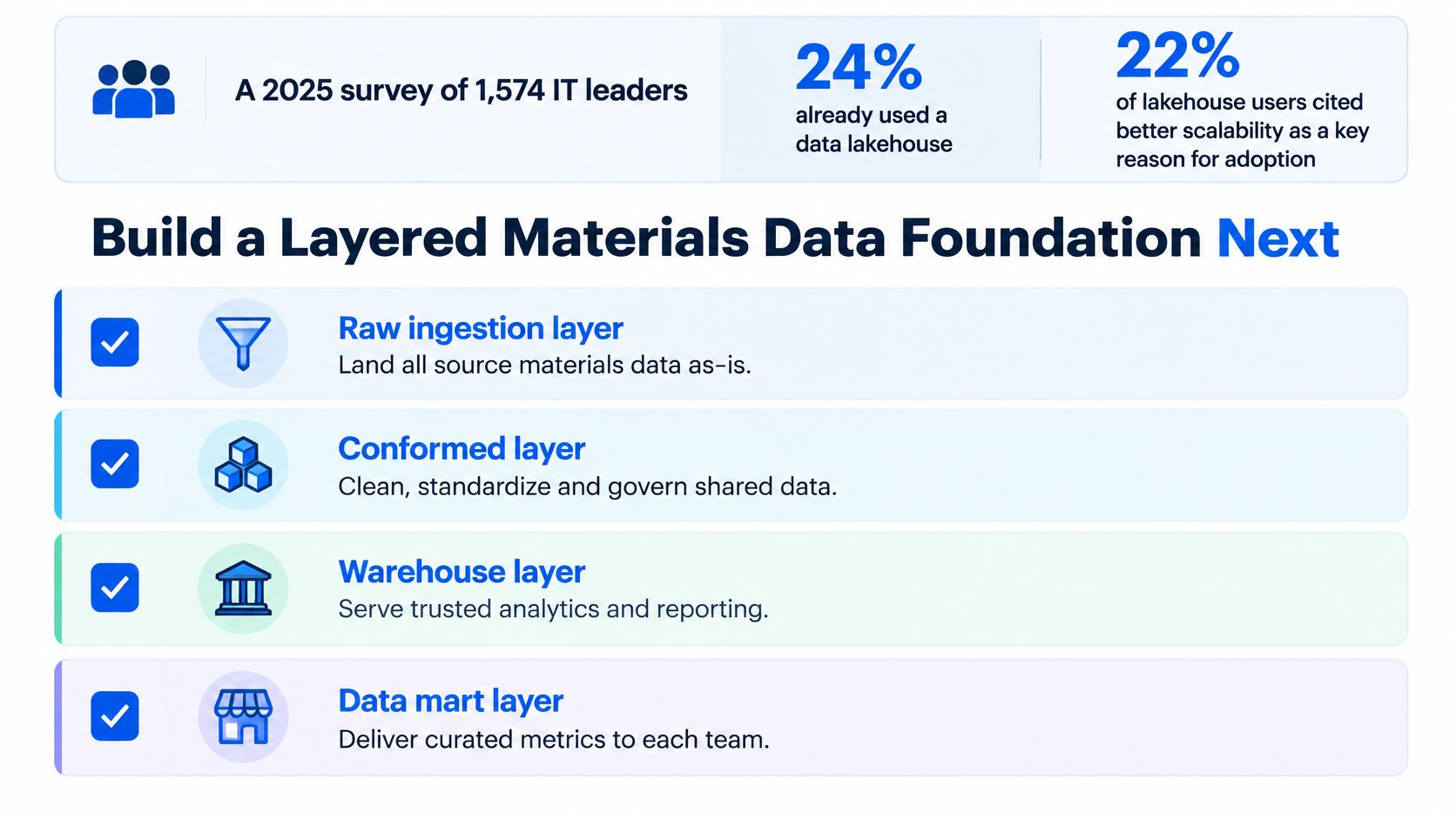
For a materials organization, sequence decides whether later queries stay trustworthy.
- Land everything raw first. ELN exports, instrument files, images, process logs, and the spreadsheets holding ten years of formulation history go into the lake as they arrived, with original filenames, timestamps, instrument IDs, and operator notes intact. Strip that metadata and a raw file stops being evidence.
- Curate the entities decisions hang on. For most materials teams that means material, formulation, batch, test method, and property, living in governed warehouse tables, versioned and mapped back to the files they came from. This conformed set is what later marts can reuse.
- Build role-specific marts last, for formulation, process engineering, and quality. A mart built on ungoverned sources is a silo with a nicer interface. A mart built on the warehouse reuses one definition of batch and property instead of inventing a third.
- Check that provenance survives every hop. Versioning, access controls, and lineage have to travel with the data. When a value in a mart cannot be walked back to the instrument file behind it, the layer above has become a separate truth.
- Prove reproducibility once, deliberately. Pick an experiment from last year and reconstruct it from the stored record alone. That single exercise tests every layer at once: raw retention, conformed entities, warehouse tables, and the mart a scientist opens.
Skip the conformed middle and the mart cannot be audited. Stop at the lake and scientists still assemble answers by hand. The cost that shows up is rework, not the storage bill.
Polymerize Connect is built as that backbone: a centralized data foundation that unifies every experiment, formulation, and result into one AI-native platform every team in every geography can reach. Polymerize Labs then analyzes the generated data to build predictive models, using domain-guided machine learning to uncover patterns and insights in customers' datasets, so the curated layer informs the next experiment rather than only reporting the last one.
The test to run this week is small and unforgiving. Load one real dataset through all three layers, then time how long a scientist takes to trace a reported value back to its source file and rerun the experiment that produced it. That elapsed time is what the architecture is delivering.
If you are rebuilding a materials data foundation and need provenance to survive from the first raw instrument file to the final dashboard, Polymerize Connect unifies every experiment, formulation, and result into one AI-native backbone your teams can reach from any geography. Polymerize Labs then layers domain-guided machine learning on that backbone to build predictive models from your own experimental history. Start a free trial at Polymerize and run the trace-and-rerun test on one real dataset before you commit to an architecture.
Put your R&D data to work
See how materials teams use Polymerize to plan fewer experiments and reach target properties faster.