
The popular advice is to choose between data integration and ETL as if they were competing products or architectural philosophies. That framing creates tidy diagrams and poor decisions. ETL is a specific pattern within the broader discipline of data integration, so the underlying question is not which acronym wins. It's where transformation should happen, how quickly data must move, and who needs the data next.
That distinction matters in materials R&D, where experimental records, instrument outputs, ELNs, spreadsheets, and enterprise systems rarely share the same schema or refresh cycle. A warehouse-bound pipeline may be exactly right for historical analysis, while a streaming or API-based connection may be necessary for instrument telemetry or operational coordination. The architecture should follow the workload, not the vocabulary.
Table of Contents
Why Data Integration vs ETL Is the Wrong Question
The phrase data integration vs ETL suggests a binary choice. In practice, data integration is the architectural scope, while ETL is one implementation method used within that scope. A team can use ETL for curated warehouse models, APIs for application synchronization, streaming for event data, and virtualization when it needs federated access without immediately moving every record.
The more useful questions are practical:
- What needs to be transformed? Decide whether the source, integration layer, warehouse, or consuming application should apply the business logic.
- When must the data arrive? A scheduled analytical refresh has different requirements from instrument events that drive an operational decision.
- Who consumes the result? Analysts, laboratory scientists, machine-learning pipelines, enterprise applications, and dashboards don't need identical representations.
- What must remain traceable? In regulated or IP-sensitive environments, lineage, access control, provenance, and reproducibility matter as much as movement speed.
Modern integration includes real-time synchronization, API connections, data virtualization, replication, and reverse ETL, while ETL remains primarily focused on extracting data, transforming it, and loading a prepared result into an analytical target. This broader scope is also reflected in the modern data integration architecture perspective from dbt, which frames the challenge around changing sources, multiple consumers, and adaptable workflows rather than terminology alone.
Architectural rule: Don't ask whether ETL or integration is correct until you've identified the next consumer and the freshness that consumer requires.
The industry has moved beyond warehouse-only estates because organizations now manage more source systems, cloud applications, and varied data flows. For a scientific organization, that shift is especially important. A single experiment may produce structured formulation data, free-text observations, instrument files, batch metadata, and manufacturing context. Treating all of it as a nightly warehouse extract can preserve history while still failing the people who need a connected view during active development.
Definitions and How the Concepts Overlap
Data integration is the broader discipline of connecting data from multiple systems so people and applications can access a consistent, trustworthy view. It may use batch processing, APIs, streaming, replication, or data virtualization. The objective isn't merely to move records. It's to make data usable across its intended destinations while preserving the context needed for interpretation and control.
Consider a materials laboratory with an ELN, a formulation database, instrument software, an ERP system, and a reporting environment. An integration architecture might expose formulation status through an API, replicate approved batch metadata into an analytical store, stream selected instrument events, and provide a virtual query across systems while migration is still underway. Each connection serves a different timing and consumption requirement.
ETL, by contrast, describes a defined sequence:
- Extract records from one or more sources.
- Transform them into a target schema, applying cleaning, mapping, validation, and business rules.
- Load the prepared result into a warehouse, lakehouse, or other destination.
A typical ETL workflow might extract historical experiment records from spreadsheets and an ELN, standardize units and material identifiers, resolve duplicate sample names, join results to batch metadata, and load a curated analytical model. The output is controlled and useful for trend analysis, reporting, and model training.
The overlap is where many explanations become confusing. ETL can be one component of a larger integration platform, and an integration program may contain many ETL pipelines. But integration can also connect systems without a conventional extract-transform-load sequence. This comparison of data integration and ETL distinguishes the broader set of timing and connection methods from ETL's structured analytical workflow.
The transformation boundary
The key design choice is the transformation boundary. Transform too early, and you may lose source detail or create a dataset that only serves one destination. Transform too late, and every consumer must interpret inconsistent raw data independently.
For a warehouse model, centralized transformation is often sensible because analysts need stable definitions and repeatable outputs. For operational synchronization, preserving a canonical event or source representation may be better, with consumer-specific projections created downstream. Scientific teams often need both: standardized core entities such as materials, batches, properties, and experiments, plus source-level evidence that supports auditability and future analysis.
Modern Data Architecture Patterns Explained
Modern architecture isn't a ladder where every organization must graduate from ETL to the newest pattern. It's a spectrum of movement, transformation, reuse, and latency choices. Traditional batch ETL remains valuable for controlled analytical preparation. ELT shifts transformation into a warehouse or lakehouse. Streaming keeps changes in motion, virtualization provides logical access without immediate movement, and data fabric approaches add metadata and policy capabilities across distributed systems.
The historical direction is clear: enterprise architectures have expanded from batch-oriented ETL stacks, including many built in the early 2010s, toward real-time, API-driven, and cloud-native integration fabrics. Legacy batch systems are increasingly being replaced or complemented by streaming and multi-cloud approaches, as described in Grand View Research's data integration market analysis.
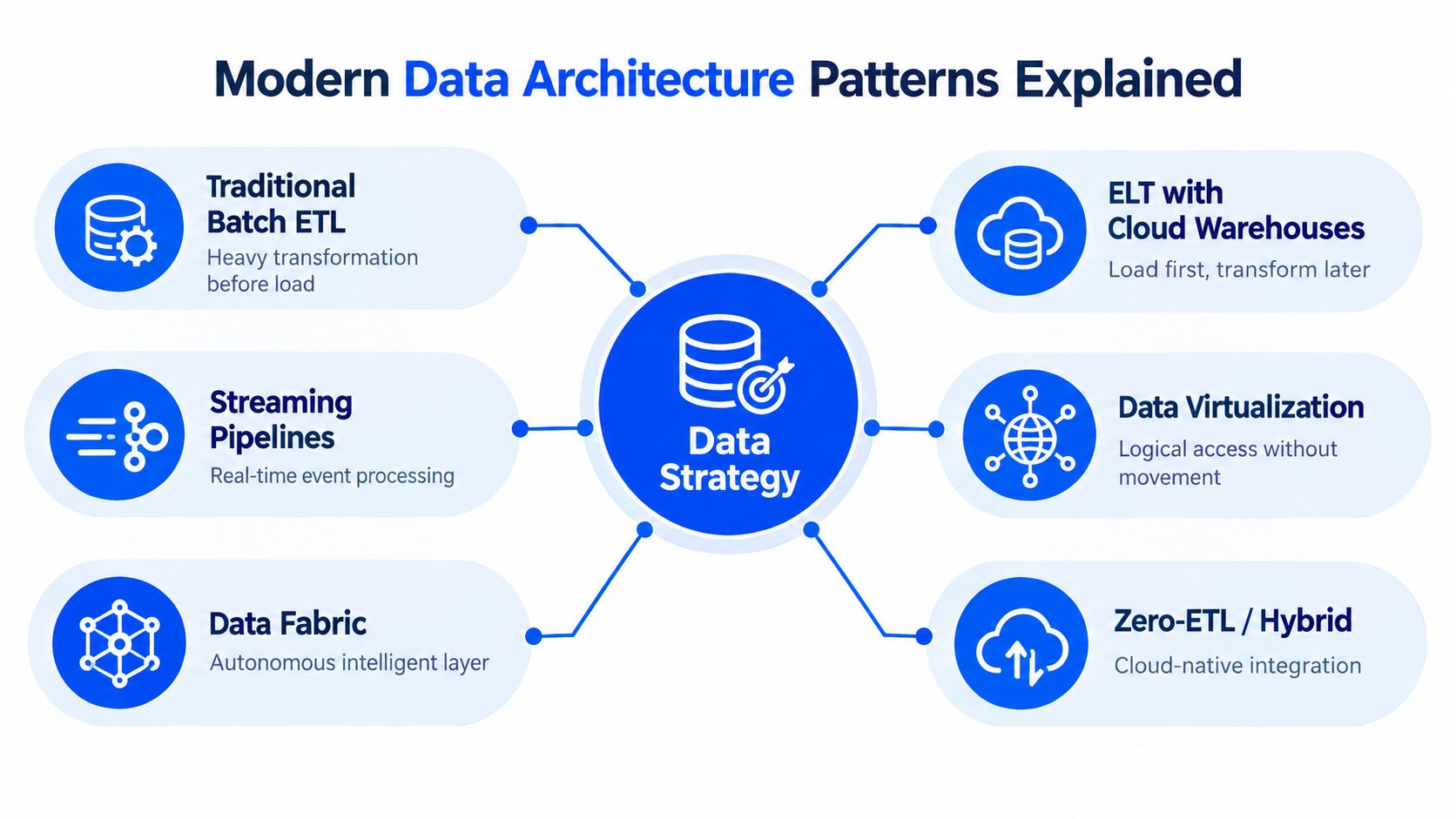
The main patterns
| Pattern | Best-Fit Workload | Timing | Primary Trade-Off |
|---|---|---|---|
| Traditional batch ETL | Curated warehouse reporting and historical analysis | Scheduled | Strong control, limited freshness and flexibility |
| ELT with cloud warehouses | Iterative analytics, BI, and machine-learning preparation | Batch or frequent incremental loads | Flexible transformation, but compute and governance need control |
| Streaming pipelines | Event-driven operations and live telemetry | Near real time | Low latency, higher operational complexity |
| Data virtualization | Federated access, prototypes, and data that shouldn't move immediately | Query dependent | Fast access without migration, but joins and performance can be fragile |
| Data fabric | Distributed environments requiring metadata, policy, and discovery | Mixed | Broad visibility, substantial implementation and governance demands |
| Zero-ETL or hybrid | Cloud-native synchronization and mixed operational-analytical flows | Mixed | Reduced movement friction, but transformation responsibilities can become unclear |
Traditional batch ETL works best when the target is known and the refresh window is acceptable. It creates a controlled point where teams can validate schemas, standardize units, and reject malformed records before loading them into a warehouse. Its weakness appears when sources change frequently or consumers need the same data in several different forms.
ELT loads source data first and transforms it inside a warehouse or lakehouse. That approach preserves more raw context and supports iterative modeling, which is useful when scientists and analysts are still learning which variables matter. It can also move the transformation burden into shared cloud compute, so teams must monitor permissions, model ownership, cost, and conflicting definitions.
Streaming treats changes as events rather than waiting for a scheduled extract. It fits instrument telemetry, process monitoring, and application synchronization when consumers need current state or event history quickly. The price is operational discipline around schemas, ordering, retries, replay, observability, and failure recovery.
Virtualization avoids copying data by presenting a logical access layer over multiple systems. It can help a team validate a use case before committing to migration, or query data that can't easily be moved. It isn't a substitute for a curated analytical foundation when joins are frequent, workloads are heavy, or users need predictable performance.
A data fabric adds capabilities across the ecosystem, such as discovery, metadata, lineage, policy, and automation. It should be treated as an operating model and architectural layer, not a magic connector that eliminates source-system complexity. Hybrid and zero-ETL approaches blur the traditional boundaries further, while reverse ETL sends curated warehouse data back into operational tools.
For teams building retrieval-augmented AI applications, the same principle applies: the quality of ingestion, metadata, chunking, permissions, and retrieval paths often matters more than the model choice. A practical reference on designing RAG system architecture can help teams think through those downstream requirements.
Strengths and Weaknesses Where It Matters
ETL wins when the destination deserves more attention than the source. A team can define a target schema, apply transformations in a known order, validate the result, and publish a dataset that analysts can use consistently. That control suits financial reporting, historical experiment analysis, regulatory extracts, and other workloads where reproducibility matters more than immediate freshness.
The trade-off is coupling. A pipeline built around one warehouse table can embed assumptions about source fields, business rules, and consumer needs. When an instrument adds a field, an ELN changes its export format, or a scientist needs finer detail, the team may have to revise and rerun several dependent steps. ETL remains manageable when sources and targets are stable. It becomes expensive when requirements change frequently.
Broader integration covers more ways to connect and deliver data. APIs can synchronize selected records between applications, streams can distribute events to several consumers, and virtualization can provide access before a migration is complete. This flexibility supports operational and AI-ready workflows, but it spreads responsibility across more boundaries. Teams must define identity, authorization, lineage, schema-evolution rules, reliability checks, and ownership for each path.
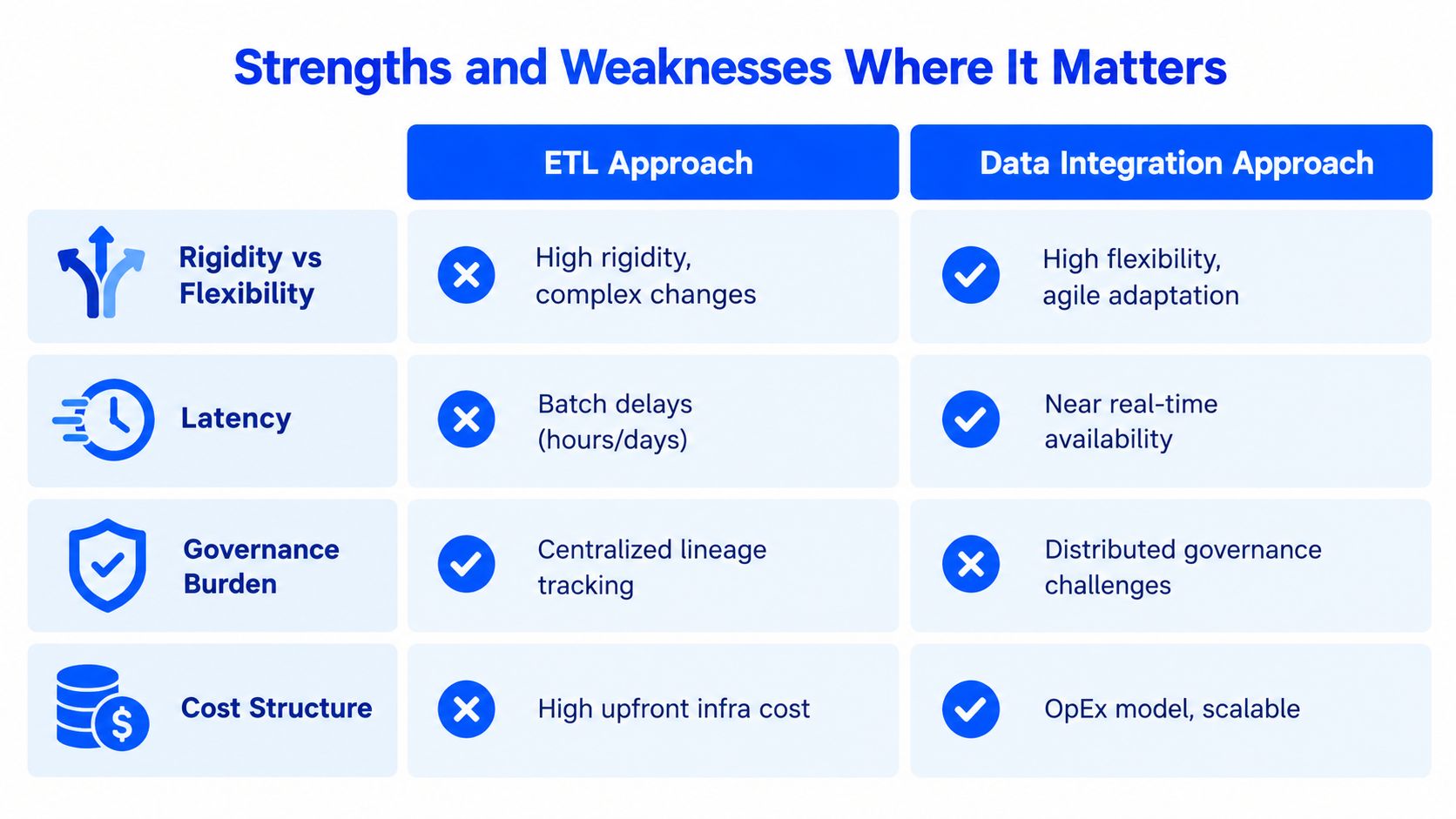
The criteria that decide the architecture
| Criterion | ETL | Broader integration |
|---|---|---|
| Flexibility | Clear target mappings, but changes can require pipeline redesign | Supports multiple connection and delivery patterns |
| Latency | Well suited to scheduled refreshes | Can support operational synchronization and streaming |
| Governance | Centralized transformation can simplify review and lineage | Distributed flows require stronger policy and observability |
| Analytical fit | Strong for curated warehouse and lakehouse models | Useful when analytical data also feeds applications or AI services |
| Operational fit | Often awkward for fast-changing state | Better suited to APIs, events, replication, and synchronized views |
| Maintenance | Familiar, but many point-to-point jobs can accumulate | More reusable in principle, but platform operations are more demanding |
The differentiator isn't movement alone. It's whether the architecture preserves enough context for reuse while applying enough standardization for trustworthy consumption.
Choose ETL when a small number of stable sources feed a well-defined analytical target. It is less suitable when each new consumer requires a specialized extraction, or when operational systems need updates faster than a batch cycle allows.
Choose broader integration when one source must serve several destinations, or when the organization needs a shared data backbone. The approach does not remove governance work. Without access controls, lineage, reliability checks, and clear ownership, a flexible integration layer can distribute inconsistent definitions across applications, analytical models, and AI services.
Performance depends on pipeline design as much as on product selection. An ETL optimization framework reported 76.8% processing-time reductions overall, with additional sector-specific results. An enterprise-scale study reported latency falling from 180 ms to 12 ms and throughput rising from 0.34 million events per second to 3.2 million events per second. These findings appear in the ETL optimization research paper. The practical lesson is clear: removing blocking, transfer, and access bottlenecks can matter more than choosing a fashionable tool.
Real-World Use Case in Materials R&D
A materials R&D organization often starts with a deceptively simple request: connect experimental data so scientists can identify promising formulations faster. The range of data sources makes that difficult. Spreadsheets contain historical measurements, ELNs capture experimental context, instruments produce files and telemetry, and ERP systems hold batch, supplier, and production information.
The first mistake is to treat every source as a warehouse table. Instrument outputs may need parsing and event handling. ELN records may require semantic mapping. Spreadsheets may contain valuable historical context but inconsistent units and naming. ERP data may be authoritative for production status but irrelevant to the scientist's formulation logic.
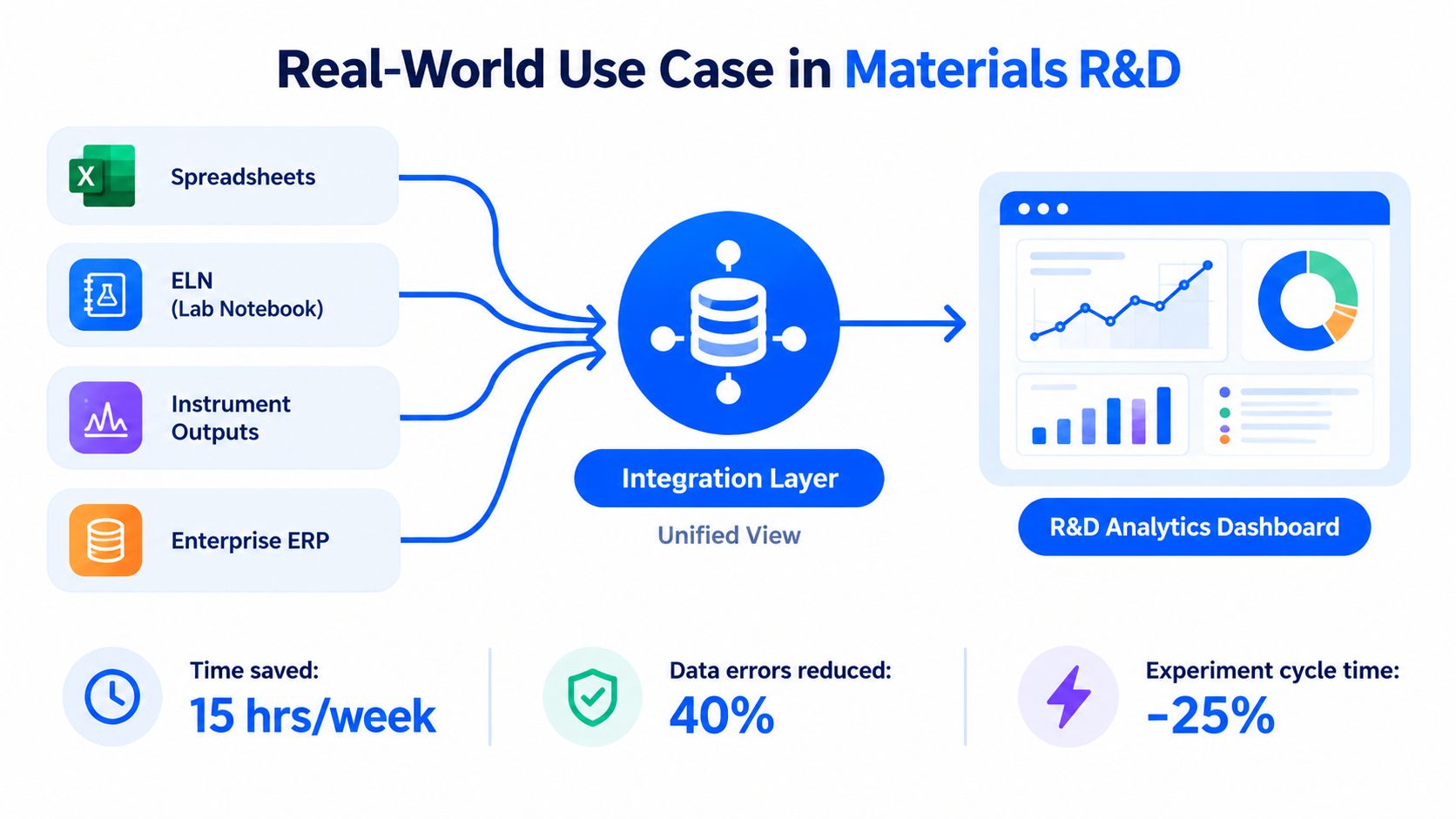
Match the pattern to the laboratory problem
For historical experiment records, batch ETL or ELT is usually the sensible starting point. The team can extract files and ELN data, standardize material identifiers, normalize measurement units, validate required fields, and load a curated analytical model. This creates a dependable base for comparing formulations across projects.
Instrument telemetry presents a different requirement. If a process engineer needs to monitor changing conditions or detect an event during a run, a streaming path can capture updates without waiting for a warehouse refresh. The stream can preserve event context while downstream systems create views for monitoring, analysis, or alerts.
Virtualization can help before the organization commits to a full migration. A scientist may need to query formulation records alongside ERP metadata while source owners resolve ownership and retention rules. A logical access layer can expose those relationships temporarily, although repeated heavy joins should eventually move into a governed analytical store.
The integration layer should preserve more than a final prediction-ready table. It needs links between experiment, material, formulation, process condition, instrument observation, result, and source provenance. Advanced modeling depends on standardized data, but scientists also need to inspect the evidence behind a value and understand whether it came from a controlled instrument output, a manual entry, or a derived calculation.
The result is a unified data backbone rather than a single giant pipeline. Batch processing prepares historical records, event flows handle time-sensitive information, and governed models expose consistent entities to analytics and AI services. That is the architectural shift described in industry analysis of data integration in R&D contexts, where fragmented experimental and enterprise data must become standardized and reusable across analytics, AI, governance, and collaboration.
Building an AI-Ready Data Backbone
AI initiatives expose weak integration decisions quickly. A model can accept a large volume of records and still produce unreliable recommendations if material names don't resolve consistently, units vary by source, missing values lack context, or the pipeline can't distinguish measured results from inferred ones.
The financial risk of poor quality is also material. Organizations estimate that poor data quality costs an average of about $12.9 million per year, according to the reporting summarized in Rivery's analysis of data integration and data quality. That figure is not a reason to centralize every transformation. It is a reason to make quality ownership, validation, and traceability explicit.
A useful backbone separates canonical data from consumer-specific views. Canonical entities can include materials, ingredients, experiments, samples, batches, properties, and process conditions. Consumers then receive the representation they need, whether that's a scientist-facing application, a model feature set, a dashboard, or an operational system.
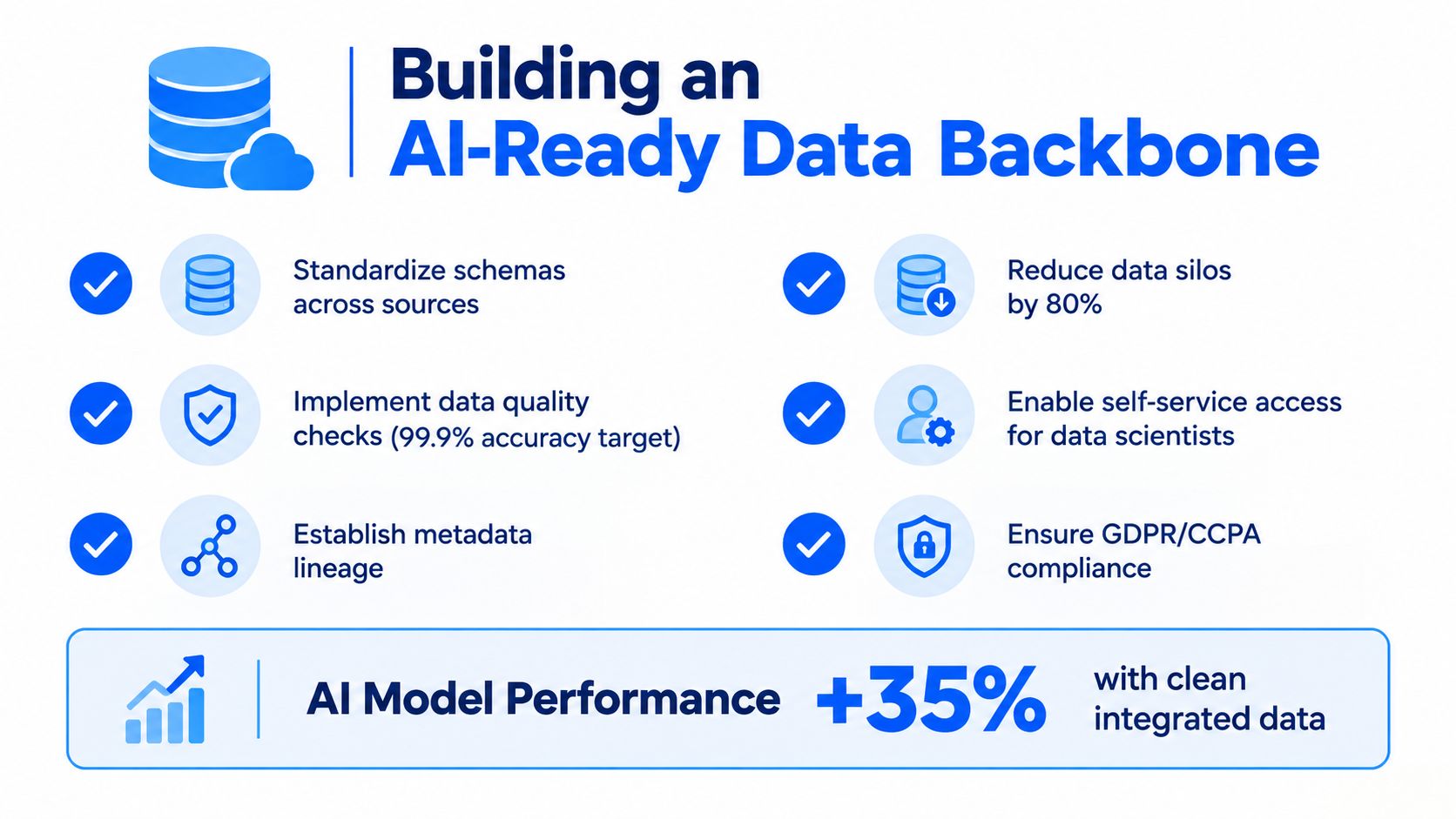
Decide what belongs in the shared layer
Centralize transformations when they define shared meaning. Material identity resolution, unit normalization, experiment status, controlled vocabularies, and provenance are poor candidates for every downstream team to reinvent.
Keep transformations close to the source when they are source-specific or operationally necessary. An instrument adapter may need to parse a proprietary file format before publishing a usable event. An ERP connector may need to translate internal status codes without forcing the entire enterprise to adopt those codes.
The controls should exist from the start:
- Access control: Restrict sensitive formulas, supplier information, and proprietary results according to role and project.
- Lineage: Record where each value came from, which transformations changed it, and which models or reports use it.
- Quality checks: Validate schemas, units, ranges, referential relationships, and freshness before data reaches a model.
- Reliability: Design for retries, replay, duplicate handling, partial failures, and source downtime.
- Compliance: Apply retention, consent, regional handling, and audit requirements to both copied and virtualized data.
Generative AI increases the value of these controls because teams need to understand which information enters prompts, retrieval indexes, training datasets, and generated recommendations. Ad hoc pipelines can produce a working prototype, but an auditable backbone supports repeatable experimentation and defensible decisions.
Recommendations by Team and Workload
Teams with fragmented R&D data and an early AI program should start by cataloguing sources, resolving identities, and defining a governed canonical layer. Use ETL or ELT to consolidate historical records. Add streaming or APIs only when an operational requirement justifies the extra complexity.
A mature analytics team with a dependable warehouse does not need to replace ETL because broader integration is fashionable. Keep curated transformations for stable analytical products, then add CDC, APIs, reverse ETL, or virtualization when warehouse data must reach operational applications or batch freshness is insufficient.
Real-time synchronization calls for a different delivery path. Design around events, APIs, or replication when applications need changes quickly, rather than forcing every requirement through warehouse jobs. Hybrid architectures usually fit best: controlled ETL prepares analytical data, while operational consumers receive updates through paths suited to their latency and interaction needs.
Treat performance work as a workload design task. Profile blocking points, partitioning, data movement, and repeated transformations before evaluating new tooling. The right diagnosis may lead to a pipeline change, a scheduling adjustment, or a different delivery pattern, not a platform replacement.
Before production deployment, audit sources, name the next consumer for each dataset, decide where transformations belong, assign batch or streaming timing to each workload, and define access and lineage controls. For materials organizations assessing a domain-specific backbone, Polymerize offers Polymerize Connect to ingest and standardize data from ELNs, spreadsheets, databases, instruments, and laboratory silos for centralized R&D use. Visit the platform to assess whether its integration approach fits your experimental data, governance requirements, and AI roadmap.
Put your R&D data to work
See how materials teams use Polymerize to plan fewer experiments and reach target properties faster.