

Your team may already have an encrypted database. That doesn't mean your formulation IP is properly protected.
A familiar pattern in materials R&D looks like this. Formulation records live in an ELN, instrument outputs land in shared folders, supplier specifications arrive through vendor portals, and scale-up notes still move through email and spreadsheets. The central system may be encrypted, yet a scientist exports a CSV for analysis, an analyst copies results into a slide deck, or a workstation caches temporary files in plaintext. The security gap isn't theoretical. It's built into the way experimental data moves.
That's why data encryption standards matter, but not as a narrow algorithm debate. In a materials organization, encryption has to follow the full lifecycle of formulations, experimental results, process parameters, and archived know-how. If it only protects one repository, it misses the places where people work.
Table of Contents
- Symmetric encryption as the vault door
- Public-key encryption as the secure handoff
- Hashing as the tamper check
- Why AES-256 is commonly chosen for R&D repositories
- The part many deployments get wrong
- What to actually configure
- How the main frameworks differ in practice
- What evidence satisfies more than one framework
- What matters for materials platforms
- Why migration is mostly an inventory problem
- Post-Quantum Migration Priorities for Materials R&D Data
- A roadmap that won't break the lab
- Decide what your vendors must support
- Decide which data deserves the strongest lifecycle controls
- Decide who controls decryption
- Decide how you'll audit without slowing experiments
- Decide how you'll prove trust externally
Why Materials R&D Data Demands Real Encryption Strategy
Materials R&D leaders rarely struggle to understand that their data is valuable. They struggle to protect it consistently across the day-to-day mess of real operations.
A single project can involve polymer recipes in an ELN, rheology data from instruments, supplier documents on a file share, and pilot-scale observations in a notebook or spreadsheet. That mix creates a false sense of safety. Teams hear that the platform is encrypted at rest, so they assume the problem is solved. It isn't.
Where the leaks usually happen
The harder question is whether encryption follows the data after it leaves the primary system. IBM's overview of encryption notes that encryption can protect data at rest, in transit, and in use, while the same source emphasizes encryption alongside data discovery and classification, access control, and key management as part of the security foundation. For an R&D environment, that means the weak point may be an exported spreadsheet, API log, unmanaged instrument PC, or broad permission set rather than the core database itself.
Practical rule: If a scientist can make an unmanaged plaintext copy of a formulation record, your encryption program is incomplete, even if the main repository is fully encrypted.
Generic explainers on data encryption standards often fail R&D teams. They compare cipher names but skip the operational details that matter to laboratories and pilot plants.
What encryption standards actually do for R&D teams
At a practical level, encryption standards give you a common technical baseline for protecting confidential information. They define how data should be transformed, how keys should work, and how systems should establish trust. In a materials business, those standards shape whether only the right service can decrypt a catalyst ratio, whether instrument traffic is protected in transit, and whether archived experiment histories remain defensible years from now.
The key point isn't “pick the strongest algorithm.” It's this. Your formulation histories and process records often need confidentiality that lasts for years, and that lifetime usually outlasts any single application, instrument, or IT project. A real encryption strategy has to reflect that.
Foundations of Modern Encryption Standards
Most encryption architecture uses several building blocks together, not one magic control. If you keep three models in mind, the rest of the decisions become much easier.
A simple visual helps:
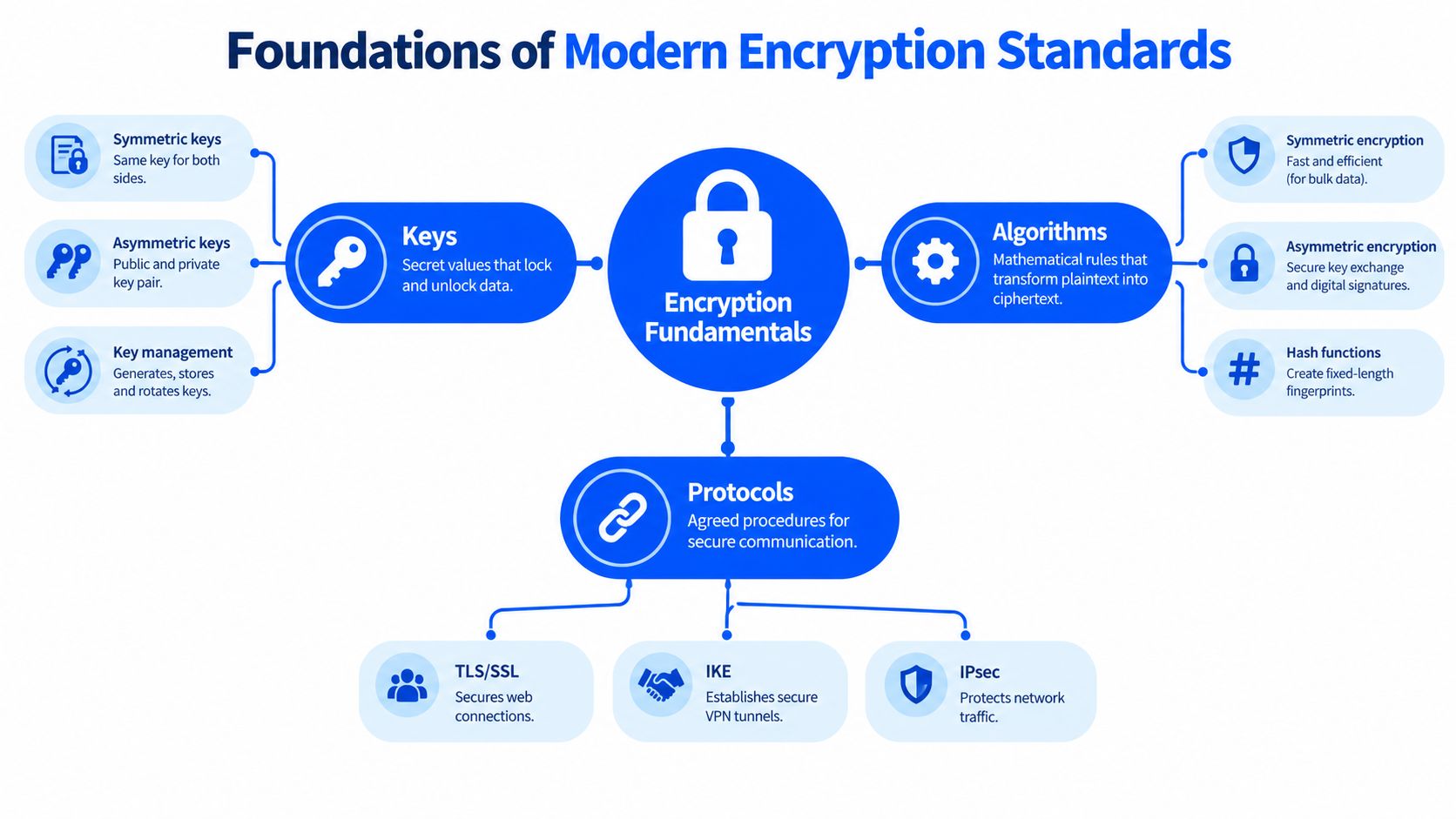
Symmetric encryption as the vault door
Symmetric encryption uses one shared secret to encrypt and decrypt data. In plain terms, it's the vault door for your lab's digital records. If the system has the right key, it can lock and open the contents efficiently. That's why symmetric encryption is used for high-volume protection of databases, files, and backups.
For materials R&D, think of a formulation table, a model-training dataset, or a repository of experimental files. These are large, active data stores. You don't want a slow cryptographic method for every read and write. You want an efficient one with strong confidentiality and integrity controls.
Public-key encryption as the secure handoff
Asymmetric encryption uses a public key and a private key. The easiest analogy is a locked drop-box. Anyone can place a package into it using the public side, but only the holder of the private key can open it. This model is useful for key establishment, identity, and secure exchange, especially across untrusted networks.
That's why secure communications typically combine methods. Public-key techniques help two systems agree on secrets safely. Symmetric encryption then protects the actual traffic and stored data. If your instrument gateway sends data to an ELN over a network, the secure setup and the bulk data protection don't usually rely on the same primitive.
For teams building broader device and media handling policies, this companion guide on IT asset data protection is useful because it connects encryption choices to the overlooked problem of where data physically resides when systems are reused, retired, or transferred.
After the concepts click, it helps to see them explained visually in motion:
Hashing as the tamper check
A hash function is different. It isn't for decrypting data later. It creates a one-way fingerprint that helps verify integrity. In an R&D workflow, that's like a chain-of-custody check on a lab notebook or result file. If the file changes, the fingerprint changes.
- Use symmetric encryption when you need to protect stored or streamed data efficiently.
- Use asymmetric methods when systems need to establish trust or exchange secrets securely.
- Use hashing when you need to detect tampering or verify integrity.
Good security design combines these tools. It doesn't force one algorithm to do every job.
Where Encryption Must Protect Data Across the Lifecycle
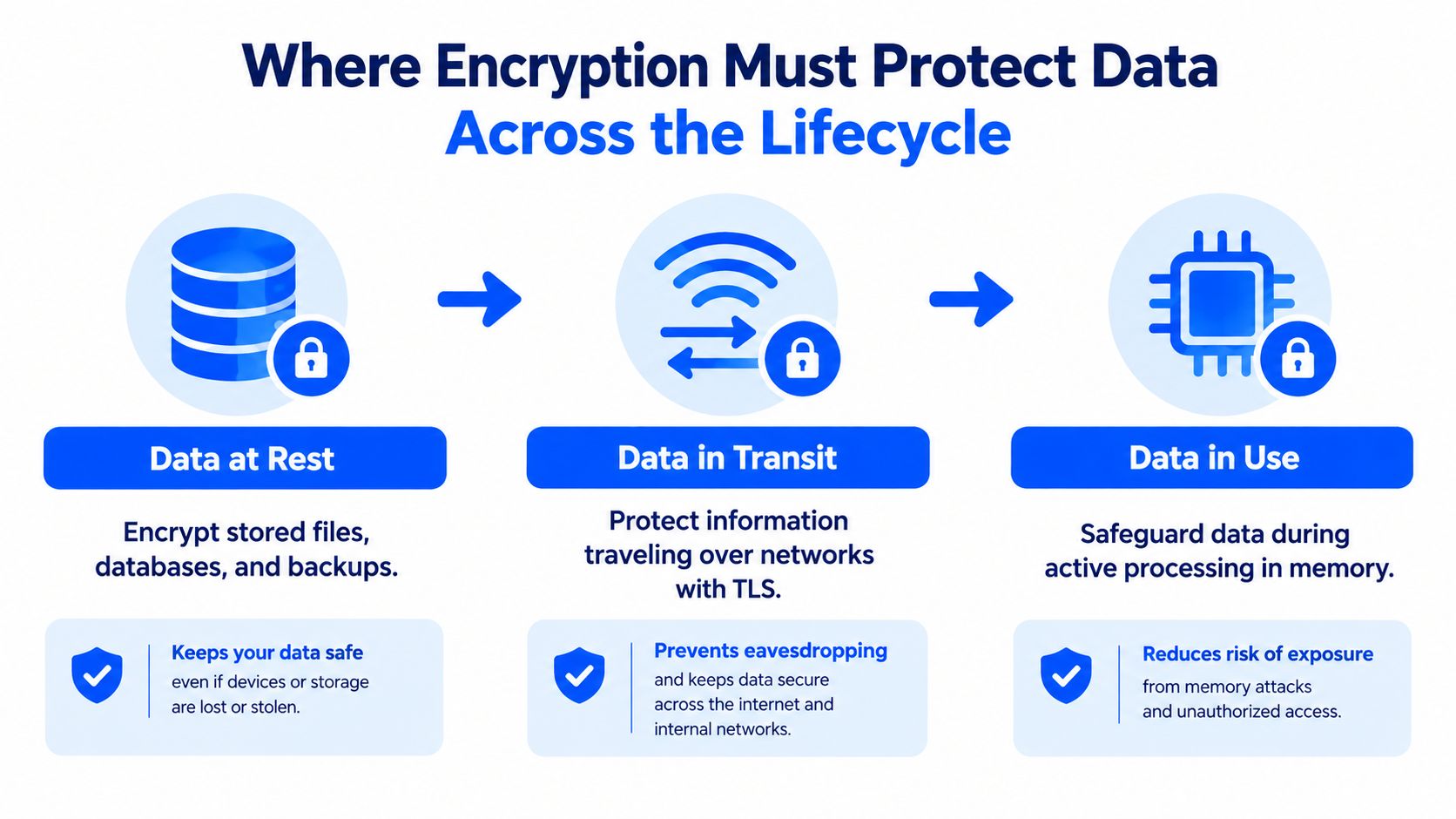
A formulation record can move through several security states in one afternoon. An instrument writes results to storage, an ELN receives the file over a network, and an analyst later queries or models the content. Each step creates a different protection problem.
The practical question for data encryption standards is therefore not just which cipher is strongest. Ask where the data is, who can reach it, and what control protects it at that point in the experimental-data lifecycle.
Data at rest in repositories and backups
Data at rest includes formulation databases, instrument logs, archived notebooks, object storage, and backups. Procurement questionnaires ask about this state first, because stored intellectual property needs protection that remains in place after a session ends.
A materials platform may also require field-level encryption for particularly sensitive values, such as proprietary ratios, process settings, or supplier-linked formulation attributes. Full-database encryption protects the storage layer, but it does not automatically limit what privileged users or downstream integrations can read. Teams should identify which fields require narrower access and ensure exports do not recreate plaintext copies.
Data in transit between systems
Data in transit covers traffic between browsers, ELNs, APIs, cloud services, vendor tunnels, and laboratory integrations. If an instrument sends results to a central platform, the route matters as much as the destination. A protected database cannot compensate for an exposed transfer path.
Teams frequently treat “we use HTTPS” as the end of the discussion. Configuration still requires clear answers about which services initiate sessions, how each side establishes trust, how certificates are issued and renewed, and which vendor-managed links sit outside normal monitoring. Instrument gateways and legacy connectors deserve particular attention because they may not follow the same controls as browser traffic.
Data in use during analysis
Data in use is being queried, transformed, modeled, or visualized. Encryption guidance from IBM's encryption guidance describes protection across these three states, but analysis exposes the operational limit. Scientists must search records, compare experiments, and train models. At some point, an authorized system needs access to usable content.
A workable design combines access and processing controls:
| Data state | Typical R&D example | What works well | Common failure |
|---|---|---|---|
| At rest | Formulation database, backups | Volume, database, or field-level encryption | Plaintext exports |
| In transit | ELN to analytics API, browser sessions | Strong transport protection and certificate hygiene | Unmanaged vendor channels |
| In use | Modeling, search, scientist analysis | Least-privilege access, isolated processing, governed outputs | Temporary files and copied datasets |
A spreadsheet export can undo an otherwise compliant encryption design in minutes.
Sensitive workflows may need tighter access boundaries, tokenization, isolated compute environments, and controlled result-export paths. These measures protect the places where formulation IP leaves the primary system, which is often where lifecycle designs fail.
AES-256 and Practical Symmetric Encryption Choices
A materials R&D team that needs to protect formulation histories, experiment records, and process notes usually starts with AES, often AES-256.
The standards basis is straightforward. The NIST FIPS 197 specification for AES defines AES as a symmetric block cipher standardized by NIST. It uses 128-bit data blocks and supports 128-, 192-, and 256-bit keys. The “256” in AES-256 refers to key length, not block size, which is a common point of confusion.
Why AES-256 is commonly chosen for R&D repositories
For stored intellectual property, AES-256 is often selected because it gives a larger brute-force security margin while keeping the same 128-bit block structure as AES-128 in FIPS 197. That matters when the data may need long confidentiality lifetimes, such as formulation histories, experimental results, and process records that remain valuable well after capture.
The quantum question on the symmetric side is also more settled than many teams assume. Guidance tied to this standard notes that the UK National Cyber Security Centre states that symmetric cryptography with at least 128-bit keys, including AES, is not significantly impacted by quantum computers. For planning purposes, that keeps AES in the running as a long-term symmetric option.
The part many deployments get wrong
The cipher alone does not secure storage. The implementation does.
NIST-grounded guidance for AES use makes three operational points especially important for R&D platforms:
- Use authenticated encryption: An authenticated-encryption mode such as AES-GCM combines confidentiality with integrity protection.
- Never reuse a GCM nonce under the same key: NIST SP 800-38D specifies GCM and warns that nonce reuse under one key can expose authentication relationships and, in severe cases, enable plaintext recovery or forgery.
- Keep keys out of applications: NIST SP 800-57 separates key-encryption keys from data-encryption keys, supports rotation through a centralized KMS or HSM, and treats key version metadata as part of practical key management.
What to actually configure
In a materials R&D environment, the baseline configuration should be direct.
- Encrypt at rest and in transit. Protect formulation records, experimental results, and proprietary process parameters in both states.
- Control decryption through access policy. Let users or services request decryption through controlled permissions instead of handing raw keys to applications.
- Attach key version metadata to datasets. That makes re-encryption, rollback review, and audit checks easier.
- Treat exported files as part of the system. A spreadsheet export, a local temp file, or a copied analyst dataset can carry the same IP risk as the source repository.
The practical goal is not just to choose AES-256. It is to make sure the keys, modes, and access paths match how instruments, ELNs, analytics tools, and ad hoc exports move experimental data through the lab.
When Stronger Algorithms Are Not the Right Answer
A materials R&D team can choose a strong cipher and still leave the main exposure untouched. The harder question is where sensitive experimental data enters the lab workflow, where it gets copied, and who can trigger a decrypt operation.
Discovery beats theory
If you cannot identify where formulation IP resides, you cannot protect it well. NIST SP 800-213 ties device security to discovery, classification, access control, and continuous management, which is a better fit for R&D than treating encryption as a one-time algorithm choice. Legacy instrument software is a common blind spot. Some systems write to fixed export paths, local caches, or vendor folders that sit outside normal governance, so the sensitive copy survives even when the central repository is encrypted correctly.
That is why discovery has to include the messy parts of the lab, not just the clean systems on the architecture diagram. Vendor-managed tools may limit what security teams can change. Analysts may rely on local workstations for quick review. Scientists may keep a working export near the instrument software because the process is faster than waiting for a controlled transfer.
The higher-value control question
The practical question is not only which cipher is in use. It is who can make decryption happen, under what conditions, and what evidence is left behind.
That usually gives R&D teams more value than chasing a stronger label:
- Classify high-value IP first: Separate formulation records, catalyst recipes, supplier-linked data, and scale-up notes from routine operational files.
- Define decryption authority: Decide which roles and services may request decryption, rather than exposing secrets broadly.
- Map unmanaged copies: Include instrument export paths, logs, backup restores, and analyst workstations in the discovery sweep.
A strong algorithm protects the bytes. A good operating model protects the workflow around them.
For materials organizations, that means starting with discovery, classification, and key custody design. Once those are clear, the choice of algorithm becomes easier to make, because it is tied to the actual paths experimental data follows from instrument to ELN to analysis to archive.
Compliance Frameworks That Define Enterprise Encryption Requirements
Encryption decisions in enterprise R&D don't live in a vacuum. They're shaped by customer audits, regulatory obligations, procurement questionnaires, and internal governance. The useful way to read compliance frameworks is not as competing checklists, but as overlapping demands for the same core evidence.
How the main frameworks differ in practice
NIST FIPS standards define approved technical standards for U.S. federal contexts and heavily influence enterprise expectations. In encryption discussions, they matter because they anchor algorithm choices and implementation rigor.
ISO 27001 is broader. It asks whether you operate an information security management system that identifies risk, assigns controls, and produces repeatable evidence. For an R&D platform, that means auditors will care about your encryption policy, key handling, access management, and exceptions process, not just whether a database checkbox is turned on.
SOC 2 focuses on whether controls were designed and operated effectively over time. Buyers often use it to judge whether your encryption controls are real operational practices rather than design claims.
GDPR and CCPA add privacy obligations that shape where data is stored, who can access it, how incidents are handled, and how personal data tied to research workflows is governed.
What evidence satisfies more than one framework
The good news is that one disciplined operating model can satisfy several frameworks at once. The same evidence often serves multiple audiences:
- Access logs that show who invoked decryption or accessed sensitive systems
- Key rotation records that demonstrate lifecycle control
- Encryption-at-rest and encryption-in-transit attestations tied to actual systems
- Penetration test results and remediation records
- Data classification and retention policies connected to sensitive R&D information
For security managers building team capability around this work, these kinds of certifications that boost IT careers can help staff understand the audit language and control models that enterprise customers expect.
What matters for materials platforms
If your environment serves global customers, you'll often need to satisfy multiple regimes at once. A materials R&D platform such as Polymerize may therefore need to show ISO 27001 and SOC 2 controls, role-based access, and GDPR/CCPA-aligned governance in the same customer review process. The operational answer isn't to build separate security programs. It's to create one encryption and key-management model that can be evidenced cleanly to all of them.
Planning a Post-Quantum Migration Without Disrupting Labs
A formulation archive from 2015 may still be commercially sensitive in 2045. That single fact is why post-quantum migration has moved from theory to planning for materials R&D organizations. Historical experiment archives, formulation histories, and scale-up records outlive the software, instruments, and vendors that created them, and an adversary who harvests that data today could decrypt it once capable quantum machines arrive.
NIST's 2024 post-quantum standards announcement introduced ML-KEM, specified in FIPS 203, as a standardized key-establishment mechanism built on module-lattice cryptography. The distinction matters more than the acronym. ML-KEM is not a replacement for bulk encryption such as AES. It lets two parties agree on a shared secret over an untrusted network, and a symmetric cipher then protects the actual data stream. Think of it as agreeing on a lock combination over the phone, then using that combination on a strong safe.
Why migration is mostly an inventory problem
Teams often hear "post-quantum encryption" and assume the task is swapping one cipher for another. NIST's guidance describes a different reality. Migration starts with inventorying TLS libraries, VPNs, service-to-service protocols, certificates, archived datasets, and vendor dependencies before anything is rolled out. In a lab context, that inventory includes instrument control software, ELN integrations, and data pipelines that nobody has touched since installation.
NIST also advises organizations to begin migration now, and its NIST post-quantum cryptography program highlights the continuing urgency of "harvest now, decrypt later" risk for long-lived secrets. In March 2025, NIST selected HQC as a backup algorithm for general encryption, giving implementers a second lattice-based option if ML-KEM ever needs to be retired.
The biggest blocker usually isn't cryptography. It's the number of systems that quietly depend on old cryptography.
Post-Quantum Migration Priorities for Materials R&D Data
| Data Category | Confidentiality Lifetime | Migration Priority | Recommended Action |
|---|---|---|---|
| Formulation histories | Long-lived | High | Inventory transport paths, tag by secrecy duration, prioritize hybrid key-establishment testing |
| Experimental datasets | Often long-lived | High | Record algorithm and key-version metadata, define re-encryption procedures |
| Scale-up process records | Long-lived and operationally sensitive | High | Review plant and lab network dependencies, require vendor upgrade commitments |
| Routine collaboration data | Shorter-lived | Moderate | Move after high-value IP paths are mapped and validated |
| Legacy instrument integrations | Often hard to replace | High difficulty | Test interoperability early, document exceptions and staged replacement plans |
A roadmap that won't break the lab
The near-term controls NIST emphasized in the 2024 announcement are practical rather than exotic:
- Require crypto-agility: Contracts and architecture should allow algorithm changes without major redesign.
- Store algorithm and key-version metadata: You'll need it for migration, audit, and re-encryption.
- Use short-lived transport keys: Reduce long-term exposure.
- Document re-encryption procedures: Especially for archived, high-value IP.
- Adopt validated implementations of FIPS 203: Don't rely on ad hoc libraries.
For lab environments, hybrid deployment is usually the safest path. Use ML-KEM, potentially alongside an established classical key exchange during migration, to derive session or data-encryption keys, while retaining AES-GCM for high-volume files, databases, and API traffic. This keeps the day-to-day work of instruments and ELNs untouched while the key-establishment layer is upgraded underneath. Start with one well-understood data path, validate interoperability, and expand from there.
A Decision Framework for Encryption That Protects Materials IP
Good encryption architecture for materials R&D isn't a list of products. It's a set of decisions that line up standards, data lifecycles, and operating reality.
If I were briefing an R&D leadership team before an architecture review, I'd push five decisions to the top of the agenda.
Decide what your vendors must support
Start with required capabilities, not vendor marketing. For stored and high-volume data, require modern symmetric protection and authenticated encryption. For future migration, require crypto-agility, algorithm metadata, and support for validated post-quantum key-establishment paths where applicable. If a vendor can't tell you how keys are rotated, versioned, and separated from application administration, treat that as a design weakness.
Decide which data deserves the strongest lifecycle controls
Not every dataset carries the same confidentiality lifetime. Formulation IP, proprietary process conditions, and historical experiment archives usually deserve tighter handling than routine collaboration files.
A practical tagging model should identify:
- Long-lived trade secrets that need durable protection and migration planning
- Operationally sensitive data that affects scale-up and supplier exposure
- Lower-sensitivity working data that still needs governance, but not the same depth of control
Decide who controls decryption
This is usually the most important architectural choice. Access controls should determine which users or services can invoke decryption, rather than handing raw keys to applications. That principle follows directly from the NIST-grounded implementation guidance discussed earlier and tends to separate mature programs from cosmetic ones.
Architecture test: Can a platform administrator read sensitive formulation values directly, or can they only manage the system that brokers controlled access?
Decide how you'll audit without slowing experiments
An audit-ready encryption program should produce evidence as a byproduct of normal operation. That means logging key events, recording key versions with encrypted datasets, keeping clear access histories, and documenting exceptions for legacy instruments or vendor-managed systems.
A lightweight operating checklist helps:
| Decision area | What to verify |
|---|---|
| Algorithm policy | Approved standards for storage, transport, and key establishment |
| Data classification | Which R&D records need field-level or stronger lifecycle protection |
| Key custody | Separation between key administrators, platform admins, and end users |
| Operational evidence | Logs, rotation records, configuration attestations, exception tracking |
| Migration readiness | Crypto-agility, metadata, re-encryption process, vendor commitments |
Decide how you'll prove trust externally
Customers, regulators, and internal boards don't just want assurance. They want evidence. The strongest posture usually combines encrypted-by-default storage, least-privilege decryption rights, defined key rotation processes, separation of key custody from data custody, and continuous audit logging. When those are aligned, standards and frameworks stop feeling fragmented. They reinforce each other.
If your team adopts that mindset, data encryption standards become far more useful. They stop being abstract cryptography terminology and start functioning as a practical control system for the full experimental-data lifecycle.
If you're trying to bring this discipline into a fragmented R&D environment, Polymerize offers an AI-native materials R&D platform that unifies data across spreadsheets, ELNs, and silos into a centralized backbone with enterprise controls suited to sensitive formulation and experimental records. It's a practical option for teams that want to connect encryption, access control, and AI-ready experimental data governance without treating security as a separate afterthought.
Put your R&D data to work
See how materials teams use Polymerize to plan fewer experiments and reach target properties faster.