



The most common advice on circular economy materials is also the most limiting: recycle more. That framing is too narrow for any R&D team that cares about performance, margin, and scale. Recycling matters, but in many material systems it is a lower-value loop that can erode molecular integrity, narrow application windows, and create a false sense of progress.
That matters because the macro picture is moving in the wrong direction. The global economy is only 7.2% circular as of 2024, down from 9.1% five years prior, according to the Circularity Gap Report. In practice, that means most materials still move through extraction, use, and waste with very limited value recovery.
For materials leaders, the implication is straightforward. Incremental recycled-content targets won't be enough. The harder and more useful question is this: how do you design materials that can survive multiple high-value loops such as reuse, repair, and remanufacture, while still meeting processing and cost constraints? That's an R&D problem, not a branding exercise.
Table of Contents
- Designing for Reuse and Repairability
- Designing for Remanufacturing
- Designing for High-Quality Recycling
Beyond Recycling Rethinking Circular Materials
A recycling-first mindset usually pushes teams to optimize the wrong thing. It treats end-of-life handling as the main design objective, when the actual objective should be retaining material value for as long as possible.
That distinction is not philosophical. It shows up in the lab. If a polymer loses critical properties after one loop, or if a multilayer structure can only be recovered into low-grade output, the material may be technically recyclable but strategically weak. Many teams discover this late because they ask, “Can it be recycled?” instead of “What is the highest-value next life this material can support?”
Why recycling alone underdelivers
Most coverage of circularity overemphasizes recycling, even though the R-framework ranks recycling as a low-value loop relative to reuse, repair, and refurbishment, as outlined in SUMAS's discussion of circular economy hierarchy. For polymer systems, that ranking matters because material value often sits in molecular structure, additive balance, and retained performance, not just in mass recovery.
Practical rule: If the next loop requires major property sacrifice, you've recovered mass but not value.
A circular material, then, involves more than just recycled content. It's a material deliberately designed so that its chemistry, architecture, and joining methods support another useful life with minimal performance loss.
What R&D teams should optimize for instead
The best development programs define circularity as a set of engineering targets:
- Durability: Can the material keep its properties through longer use cycles?
- Serviceability: Can a product using it be opened, repaired, cleaned, or upgraded without damage?
- Separable construction: Can material streams be recovered without creating contamination?
- Reformulation tolerance: Can recycled or returned feedstock be reincorporated without destabilizing performance?
These questions move circular economy materials from sustainability language into design control.
A useful mental shift is to stop treating waste as the first circularity problem. The first problem to address is designing out irreversible value loss. Once you do that, recycling becomes one option in a broader material strategy instead of the default answer to everything.
What Exactly Are Circular Economy Materials
Circular economy materials aren't a fixed class of products. They are the result of a design philosophy. The job is to create materials and systems that stay useful, recoverable, and economically relevant across multiple life cycles.

A simple way to explain this inside an organization is to think of a material library rather than a disposal pipeline. In a linear system, you take raw inputs, process them, sell them, and lose control of value after use. In a circular system, materials are selected and built so they can be returned, refurbished, disassembled, or reprocessed with enough integrity to matter commercially.
A shift in design logic
That changes what “good material selection” means. A resin, additive package, barrier layer, or adhesive is no longer judged only by initial cost and first-life performance. It also has to earn its place in a recovery pathway.
For packaging teams, broad environmental claims often prove problematic. A product can sound sustainable and still be difficult to recover in practice. If your team needs a grounded comparison of end-of-life language before setting specifications, this guide to eco-friendly packaging choices is useful because it separates terms that are often blurred in procurement discussions.
Here is the commercial backdrop. The global circular economy market was valued at USD 638.57 billion in 2024 and is projected to reach USD 2,204.39 billion by 2034, growing at a 13.20% CAGR, according to the World Circular Economy Forum fact set. That isn't just a sustainability signal. It's a strategic signal that procurement, regulation, and product development priorities are changing together.
What circular materials look like in practice
Teams usually make better decisions when they translate circularity into design intent:
| Design intent | What it means in practice |
|---|---|
| Keep products in use | Favor durable polymers, replaceable parts, and reversible joining methods |
| Preserve material quality | Avoid combinations that contaminate recovery streams |
| Enable return pathways | Design formats that fit collection, sorting, and reprocessing realities |
| Support verification | Build traceability and composition data into development records |
A product team may still choose a recyclable structure. Another may prioritize refill, refurbishment, or component replacement. Both can count as circular economy materials if the material decisions preserve value rather than merely defer waste.
Later in the process, teams often need a shared baseline before debating specifications. This short video works well for cross-functional alignment because it frames circularity as a systems issue rather than only a recycling issue.
Key Design Strategies for True Circularity
The most effective circular design work follows a value hierarchy. Start with the loop that preserves the most value. Only move down the ladder when the higher-value option is unrealistic for the product, channel, or regulatory context.

Designing for Reuse and Repairability
For many categories, the strongest circular move is to keep the product in service longer. That changes material priorities immediately. You start favoring fatigue resistance, cleanability, dimensional stability, and joining methods that can be reversed without damaging substrates.
A lot of packaging and household-goods teams miss this because they focus on disposal before they fix the use model. Some of the clearest operational thinking in this area comes from closed-loop refill concepts. Fillaree's amazing zero waste soaps is a good example of how return logic and packaging design have to work together instead of being treated as separate sustainability projects.
For R&D, the practical checks are simple:
- Select for repeated handling: Materials should tolerate abrasion, cleaning agents, and thermal cycling.
- Design joints intentionally: Use fasteners, clips, or debondable interfaces where service access matters.
- Control cosmetic aging: Users reject reusable products quickly when haze, odor retention, or surface damage accumulates.
A circular material that users won't reuse is just a short-delay waste stream.
Designing for Remanufacturing
Remanufacturing sits between direct reuse and recycling. The product or component comes back, gets restored, and returns to service with controlled replacement of worn elements. Material selection here is less about one-time excellence and more about predictable refurbishment behavior.
That affects fillers, coatings, reinforcement systems, and the way components are bonded. If a housing, seal, or molded part can't be separated without fracture, remanufacturing economics collapse. If the material can't survive cleaning, inspection, and selective rework, the theoretical loop exists only on slides.
A useful design review for remanufacturing asks:
- Which parts are expected to fail first?
- Can those parts be replaced without damaging adjacent materials?
- Will the base material still meet performance requirements after refurbishment steps?
- Can technicians identify grades and compositions quickly and reliably?
Designing for High-Quality Recycling
Recycling still matters. It just works best when teams design for high-quality recovery rather than broad recyclability claims.
In flexible packaging, compatibility with polyethylene mechanical recycling depends heavily on composition. To achieve full compatibility while maintaining recyclate quality and value, the structure must contain a minimum of 90% PE by weight, according to the CEFLEX technical guidance summarized by Swiss Recycle. Below that threshold, contamination from non-PE fractions can degrade the resulting polymer stream.
That kind of threshold should change formulation behavior. It means teams need to challenge every tie layer, coating, and compatibility compromise that drifts a structure out of an established recycling window.
A practical comparison helps:
| Recycling route | Best fit | Main limitation |
|---|---|---|
| Mechanical recycling | Cleaner, more compositionally consistent streams | Sensitive to contamination and property degradation |
| Chemical or advanced recycling | Mixed or difficult streams where mechanical routes struggle | Economics and scale remain harder to justify |
High-quality recycling also depends on design for disassembly. IEC Technical Specification 63428:2024 requires design strategies that prioritize separability and disassembly, and the specification is described as correlating with a 30% to 40% increase in material recovery efficiency for complex electro-polymers compared to monolithic designs in Electronic Design's overview of circular economy standards. The principle is broader than electronics. Mixed streams become low-value streams very quickly when products can't be taken apart cleanly.
The R&D Workflow for Developing Circular Materials
Circularity becomes manageable when teams treat it like any other engineering program. Define the target, set constraints, run experiments against measurable criteria, and document what works.

Start with the end state, not the formulation
Many teams still begin with a preferred resin family or a recycled-content target. That usually leads to circularity by retrofit. A better starting point is the intended next loop. Are you designing for refill, repair, remanufacture, controlled disassembly, or a defined recycling stream?
Once that is clear, build the workflow around decision gates:
- End-of-life definition: Specify the preferred recovery pathway before lab work expands.
- Material screening: Remove candidates that require incompatible additives, irreversible bonding, or unclear traceability.
- Prototype architecture: Test not just the material, but the assembly logic. In circular systems, interfaces matter as much as chemistry.
- Validation plan: Include durability, separability, contamination risk, and reprocessing behavior in the test matrix.
Build measurement into development
Teams struggle when circularity stays qualitative for too long. The solution isn't to invent a single universal score. It's to create a controlled measurement stack that reflects the product's actual recovery pathway.
The strongest current baseline for quantifying circular material content in Europe is the EN 4555X series. The Interoperable Europe overview of circular economy standards notes that EN 45557:2020 is a key method for assessing the proportion of recycled material in energy-related products under the EU Ecodesign for Sustainable Products Regulation, and EN 45558:2019 addresses declaration of critical raw material usage. In practical terms, these standards push teams toward traceable evidence rather than vague sustainability claims.
Lab discipline matters more than ambition: if composition, source, and reprocessing history aren't traceable, circularity claims won't survive scale-up or audit.
A useful internal scorecard often includes:
| Metric area | What to track |
|---|---|
| Circular content | Verified recycled or recovered input with traceability |
| Recovery fit | Compatibility with the intended reuse, repair, or recycling pathway |
| Disassembly readiness | Ease of separating components and material streams |
| Property retention | Whether the material still performs after the next loop |
| Compliance readiness | Evidence needed for customer, regulator, or procurement review |
Teams don't need perfect metrics on day one. They do need a workflow where circularity decisions are testable, documented, and linked to product performance.
Overcoming Common Lab-to-Scale Challenges
Most circular material programs don't stall because the science is uninteresting. They stall because the trade-offs get sharper as soon as the work leaves the bench.
Performance drops rarely come from one variable
Recycled or recovered feedstocks often introduce several problems at once. Molecular weight distribution shifts. Residual contaminants interfere with processing. Additive histories are unknown. Color, odor, and thermal stability drift outside what product teams can tolerate.
The mistake is to treat this as a single formulation issue. It is usually a system issue involving feedstock quality, sorting assumptions, product architecture, and too much optimism about process latitude. When teams say a circular material “didn't scale,” the root cause is often that they never defined which variables had to be controlled upstream for the formulation to succeed downstream.
Critical raw materials make that tension worse in electronics and batteries. The EASAC report on critical materials and circular economy notes that recovery rates for many rare earth elements are below 5% despite technical feasibility. In those systems, durability and material efficiency aren't side benefits. They are the short-term practical path when recovery infrastructure and yields still lag.
Economics and feedstock reality
Even when the lab data is promising, economics can stop the project. According to McKinsey's analysis of circularity and sustainable materials, scaling advanced recycling technologies to become cost-competitive with virgin materials remains a major challenge, and many enterprises still lack a clear ROI timeline.
That uncertainty affects four decisions:
- Capital planning: Operations teams hesitate when reprocessing economics depend on unstable feedstock assumptions.
- Portfolio selection: R&D leaders prioritize projects with clearer line-of-sight to margin.
- Specification risk: Commercial teams resist materials that may pass in pilot but fail under supply variability.
- Procurement alignment: Buyers need confidence that circular inputs will be available in the right grade and consistency.
If your business case depends on perfect feedstock, it isn't a scale-up plan. It's a lab result.
Regulation adds one more layer. Different markets expect different declarations, thresholds, and proof points. That forces teams to design not just for performance, but for documentation and auditability from the beginning.
How AI Accelerates Circular Material Innovation
AI won't fix bad feedstock, weak collection systems, or unrealistic business cases. What it can do is reduce the amount of blind experimentation that circular material programs usually carry.
Where AI actually helps
The first gain comes from unifying fragmented experimental knowledge. Most enterprises already have relevant data for circular design, but it sits in spreadsheets, ELNs, supplier files, pilot reports, and individual scientists' notebooks. That makes it hard to answer basic questions such as which additives repeatedly caused odor issues in recovered streams, or which bond systems blocked disassembly in prior prototypes.
Once data is structured, predictive models become useful in three specific ways:
- Virtual screening: Teams can evaluate candidate formulations for likely durability, processability, or compatibility before running full lab programs.
- Trade-off optimization: Models can help identify combinations that balance circularity goals with mechanical, thermal, and manufacturability constraints.
- Scale-up guidance: Historical process data can highlight which variables are most likely to break when moving from controlled lab conditions into pilot or production environments.
The practical benefit is not automation for its own sake. It is better experiment selection. Circular materials development often fails because teams test too broadly, too slowly, and with poor memory of what earlier programs already taught them.
What a usable data backbone looks like
For circular R&D, a usable data backbone has to connect composition, processing history, test outcomes, and intended recovery route. If those fields are disconnected, prediction quality drops and scientists stop trusting recommendations.
A strong setup usually includes:
| Capability | Why it matters for circular materials |
|---|---|
| Centralized experiment history | Prevents repeated dead ends and makes prior learning searchable |
| Formulation lineage | Shows how changes in additives or ratios affected downstream recovery or performance |
| Recovery-path metadata | Distinguishes between designs meant for reuse, disassembly, or recycling |
| Explainable modeling | Helps scientists see why a model prefers one option over another |
The teams that benefit most from AI aren't the ones chasing a black-box answer. They're the ones using models to narrow option space, expose hidden drivers, and make circularity targets testable earlier. In that role, AI becomes less of a buzzword and more of a decision-support layer for materials strategy.
Actionable Steps for Your Materials Team
If you want progress this quarter, keep the scope tight and operational.
Audit the data you already have. Pull formulation records, pilot reports, processing notes, failure logs, and supplier specs into one searchable structure. Teams often possess more reusable knowledge than they realize, though it is scattered.
Rewrite one design brief around a high-value loop. Don't start with “add recycled content.” Start with a harder question such as “make this component repairable” or “make this package compatible with a defined recovery stream.”
Choose one material family for a focused pilot. Pick a product line where the recovery pathway is realistic and commercially relevant. Circularity work stalls when teams spread effort across too many disconnected prototypes.
Add circular metrics to the test plan. Include separability, property retention after reprocessing or reuse, contamination sensitivity, and traceability requirements alongside your usual performance testing.
Review economics before scale-up enthusiasm takes over. A technically elegant formulation is still the wrong project if collection, sorting, or return assumptions don't hold.
Build cross-functional ownership early. Materials, process engineering, procurement, quality, and regulatory teams all affect whether circular economy materials survive outside the lab.
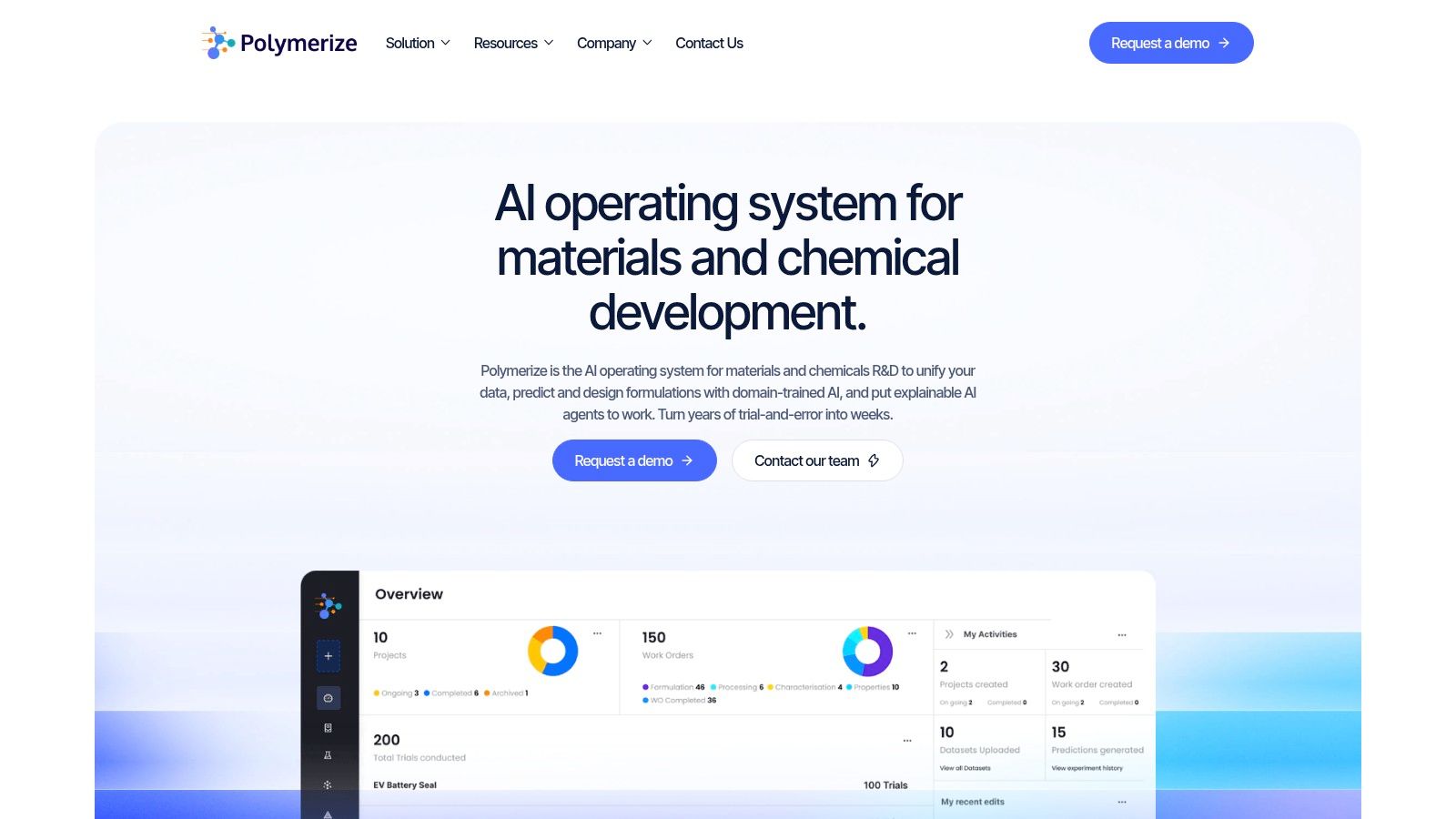
If your team is trying to turn circular material goals into a real R&D system, Polymerize is worth a close look. It helps materials organizations centralize fragmented experimental data, apply explainable AI models to formulation and property prediction, and move from trial-and-error toward faster, more disciplined development of polymers, chemicals, and advanced materials.
Put your R&D data to work
See how materials teams use Polymerize to plan fewer experiments and reach target properties faster.