

You already know the pattern. The AI pilot looked strong in the lab, the steering committee liked the slide deck, and then the work hit the reality of materials R&D. The formulation team had data in spreadsheets, ELNs, and local folders. Scientists didn't trust the model outputs enough to change their next experiment. The handoff from lab to pilot plant exposed missing context no one had captured upfront.
That's where a change readiness assessment earns its keep. In practice, it's not a soft exercise or an HR formality, it's a risk-control mechanism that tells you whether a transformation can survive contact with daily work. The historical benchmark matters here, because the median success rate for all types of change is less than 33% according to the change-management literature summarized by Harris in the LTU paper, which is exactly why readiness deserves attention before launch. When a change stacks new technology on top of new process, with fragmented data and skeptical users in the middle, you need an honest diagnostic before anyone promises scale. (Harris summary in LTU paper)
Table of Contents
- Use a multi-method design, not a single instrument
- Segment by stakeholder group
- Don't collapse everything into one number
Why Most Materials R&D Transformations Stall Before They Start
The failure usually doesn't happen when the model is trained. It happens when a senior scientist asks a simple question, the process engineer gives a different answer, and the team realizes the “future state” was never tested against how the lab really works. That's the hidden gap in a lot of materials R&D programs. Leaders see sponsorship, budget, and an approved timeline, then assume the organization is ready. The field tells a different story, because the median success rate for all types of change is less than 33% in the benchmark summarized by Harris, which is why readiness assessment exists as a practical diagnostic, not a nice-to-have.
Readiness failures look different in materials R&D
In a plant or enterprise software rollout, the problem is often adoption. In materials R&D, it's adoption plus scientific credibility, experimental continuity, and the lab-to-production handoff. A model can be technically strong and still fail if the research team can't trace why it recommends one formulation over another. A digital workflow can be elegant on paper and still collapse if it creates extra entry work or doesn't fit the cadence of experimental cycles. That's why the assessment has to look at awareness, sponsorship, capacity, and capability before launch.
Practical rule: if a readiness discussion never touches fragmented data, workflow handoffs, and scientist trust, it's too generic to be useful.
The best leaders treat the assessment as a pre-flight check. It surfaces where the program is likely to underperform, where the team needs rework, and where the rollout sequence itself needs to change. That's especially important in enterprise materials organizations, where technology changes rarely arrive alone. They land on top of existing SOPs, legacy data structures, and local lab habits that already absorb a lot of friction.
Why the risk is higher than it looks
Materials R&D transformations often fail. The pilot works with a motivated group, but the broader organization never fully adopts the tool. Or the scientists use the platform for logging, then keep making decisions in spreadsheets because they don't trust the black box. That's not a product problem alone. It's a readiness problem.
A readiness assessment gives leaders a way to separate genuine enthusiasm from durable readiness. That distinction matters when the initiative touches multiple functions, because low readiness in one group can stall the whole program. The earlier you see that mismatch, the easier it is to fix the plan before launch instead of blaming the users after the fact.
The Five Dimensions Every Readiness Assessment Must Cover
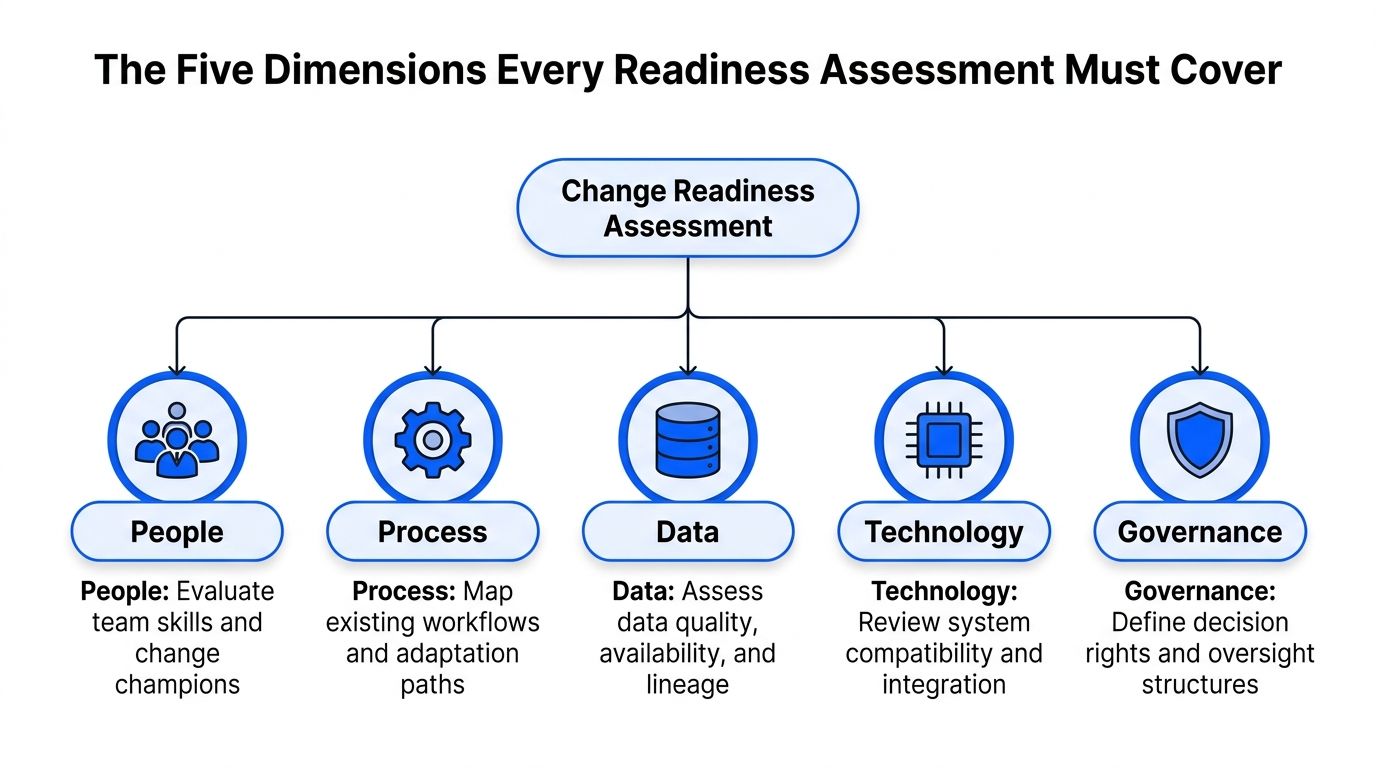
A solid assessment in materials R&D has to cover five dimensions together, because the gaps usually overlap. A scientist may trust the idea but not the model. The data may be promising but inaccessible. Governance may be unclear enough to make everyone wait. If you only score one dimension, you'll miss the blockage that stops adoption.
People readiness
People readiness is about trust, skill, and willingness to change behavior. In polymer and chemical R&D, the key question is whether formulation chemists and lab scientists believe the new approach will improve their judgment or replace it. If they see AI-guided experimentation as a threat to their expertise, they'll comply superficially and work around it in private. If they see it as a tool that sharpens their next decision, adoption is far more likely to stick.
Look for signs that champions exist inside the lab, not only in leadership meetings. Ask whether scientists can explain the new workflow in their own words. If they can't, the program has probably not moved from sponsorship to ownership.
Process readiness
Process readiness is about whether the current workflow can absorb change without creating a new bottleneck. In a materials environment, that means checking the path from experiment design to data capture to scale-up review. If the new process adds duplicate entry, creates more approvals, or shifts work to a function that lacks capacity, it will slow everything down.
A useful comparison is a PEO deal readiness review, because it shows how readiness thinking becomes concrete when a decision depends on whether the organization can absorb change. The same logic applies in R&D. A process can look complete on paper and still fail in practice if handoffs are unclear.
Data readiness
Data readiness is often the sharpest gap in materials R&D. Experimental records live in ELNs, spreadsheets, local drives, and informal notes. That fragmentation makes it hard to unify history, lineage, and context into a foundation an AI system can use. The assessment should ask whether the team can identify the source of truth, whether data definitions are consistent, and whether historical experiments are structured enough to be reused.
Practical rule: if the model team spends most of its time reconciling records instead of learning from experiments, data readiness is still weak.
Technology readiness
Technology readiness covers infrastructure, integration, access control, and security. In enterprise materials work, that means checking whether the platform can connect to the current lab stack, whether users can access what they need without friction, and whether controls are strong enough for sensitive R&D data. If the environment can't support role-based use, the system may be technically live but operationally unusable.
Governance readiness
Governance readiness is about decision rights, oversight, and IP protection. Scientists need to know who can approve data use, who can override a recommendation, and how sensitive formulations are protected across teams and partners. If governance is vague, people hesitate. If governance is too restrictive, collaboration stalls. The right balance gives teams confidence without exposing proprietary knowledge.
Designing Measurement Instruments That Surface Real Gaps
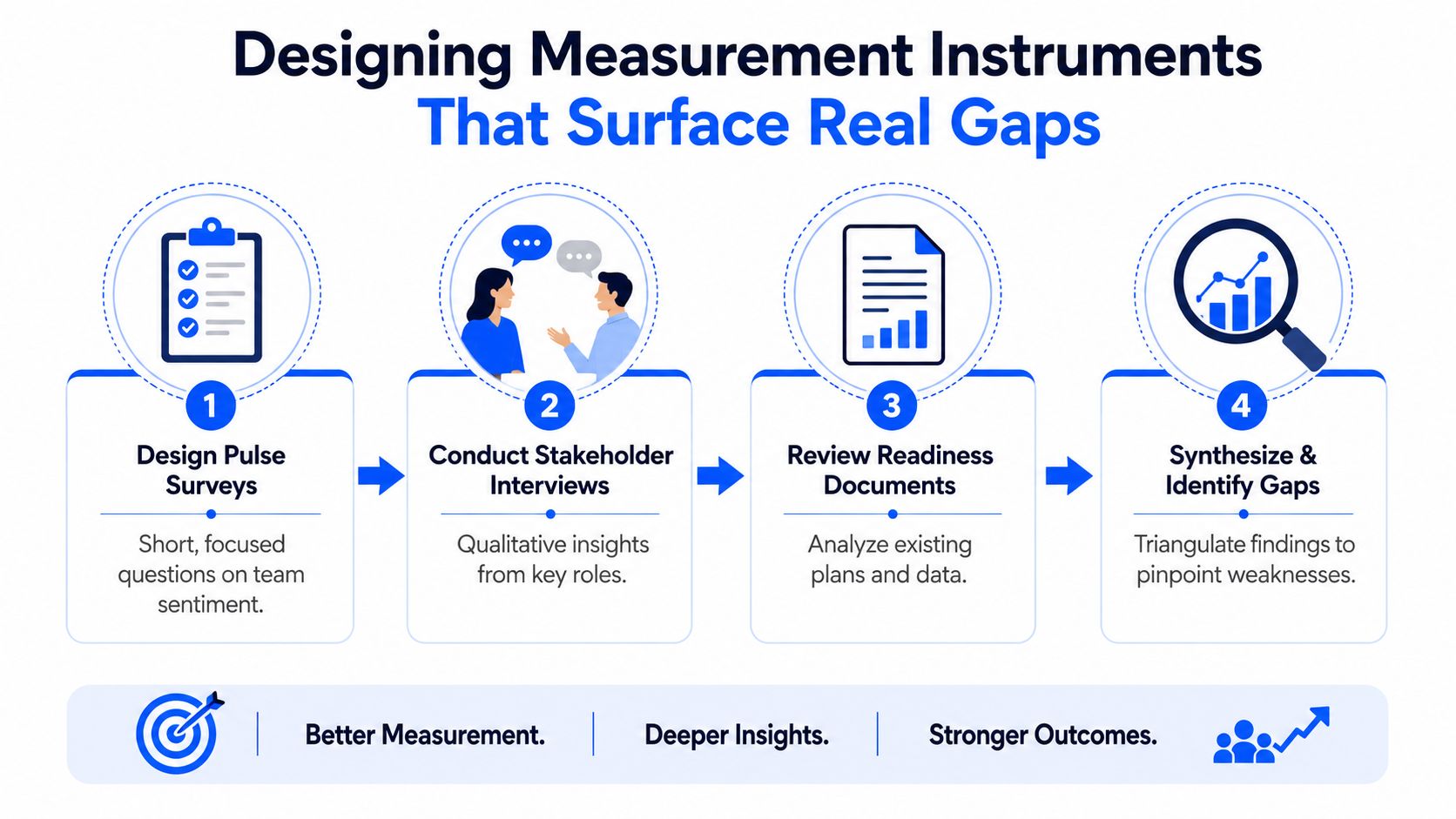
A useful instrument doesn't try to impress people with complexity. It tries to expose the truth fast enough to act on it. Bain's Change Power Index starts with a 5- to 10-minute employee survey and benchmarks the results against data drawn from nearly 2,000 employees across industries, roles, and tenure levels, which is a good reminder that short tools can still be rigorous when they're designed well. Bain also says the index measures nine dimensions of “changeability,” and that high Change Power correlates with higher financial performance and greater employee engagement. (Bain Change Power Index)
Use a multi-method design, not a single instrument
Short pulse surveys are useful, but they're not enough on their own. Pair them with stakeholder interviews, document review, and operational or capacity data so the numbers have context. In materials R&D, that means combining what scientists say with what the workflow and data show. If the survey says “we're ready” but the ELN structure is inconsistent, the answer is more complicated.
A well-built survey usually uses 5-point Likert scales, 3 to 5 items per dimension, and 15 to 20 total questions so it can be completed in about 5 to 7 minutes. That keeps response fatigue low and makes it easier to repeat the assessment later. The point is not to collect more questions, it's to collect the right signals before people start guessing.
Segment by stakeholder group
One averaged score hides too much. Lab scientists, process engineers, and R&D leaders do not experience readiness in the same way. A leadership group may feel the initiative is clear while frontline scientists still don't know how their day-to-day work changes. That's why the assessment should be segmented by stakeholder group rather than collapsed into one organizational number.
Readiness is only real when the weakest high-risk group is visible.
That segmentation also makes the intervention plan sharper. If scientists trust the direction but don't trust model transparency, the mitigation is different from a process issue or a governance issue. If process engineers understand the tools but don't have time to absorb the new handoffs, you've got a capacity problem, not a communication problem.
For teams that want a structured way to extend this logic into workforce planning, a practical reference on how to conduct a skills gap analysis can help connect readiness scores to actual capability gaps.
Don't collapse everything into one number
A single score is tempting because it looks tidy. It's also dangerous because it hides the exact dimension that will fail first. The better approach is to score each dimension separately, then interpret the pattern. If data is weak and governance is unclear, the transformation needs different support than a case where people are skeptical but the workflow is otherwise intact.
That's the practical value of short-cycle measurement. It makes readiness visible at the employee level, creates a baseline for intervention, and gives leaders a way to compare groups before they scale the program.
Building a Scoring Matrix and Gap Mitigation Plan
The most effective scoring matrix starts with the required readiness state, not the observed one. That keeps leaders from mistaking optimism for preparedness. If the transformation depends on scientists trusting model recommendations, then trust belongs in the required state. If scale-up depends on clean experimental lineage, that belongs there too. Only after that should you score what the organization looks like today.
| Dimension | Required State | Observed Score (1-5) | Gap Severity | Mitigation Action | Owner |
|---|---|---|---|---|---|
| People | Scientists understand the change and trust the new workflow | ||||
| Process | Lab and scale-up handoffs are defined and workable | ||||
| Data | Experimental data is usable, traceable, and accessible | ||||
| Technology | Tools integrate with the current R&D stack | ||||
| Governance | Decision rights and IP controls are clear |
Turn scores into decisions
Once the matrix is filled in, average scores by dimension and across the full instrument, then map the results to a risk heatmap. The average matters less than the pattern. A weak governance score can outweigh a decent technology score if decision rights are blocking adoption. A data weakness can turn into a launch problem even when users are enthusiastic.
The strongest workflow is straightforward. Define the needed state, measure the observed state, then map each gap to a specific mitigation action. Don't let a single composite score flatten everything into a vague “green, yellow, red” label. That's how teams miss the one issue that matters most.
Assign owners and timelines
Every mitigation item needs one accountable owner. In a materials R&D setting, that might be a platform lead, a lab operations manager, a data steward, or a sponsor who can clear policy blockers. If no one owns the fix, the score will stay interesting and remain unresolved.
Practical rule: no mitigation action should exist without a deadline and a proof signal.
Use the mitigation plan to sequence work before go-live. Some issues need structural change first, like governance and data access. Others can be handled in parallel, like targeted scientist enablement or workflow refinement. The roadmap should reflect absorption capacity, not just calendar pressure.
Keep the matrix operational
The template only works if it changes behavior. That means revisiting it during launch planning, using it to justify delays when needed, and checking whether the intervention improved the weak dimension. The point is not to create a report for the archive. The point is to make sure the transformation is ready enough to survive scale-up.
Tracking Readiness KPIs and Validating Predictions
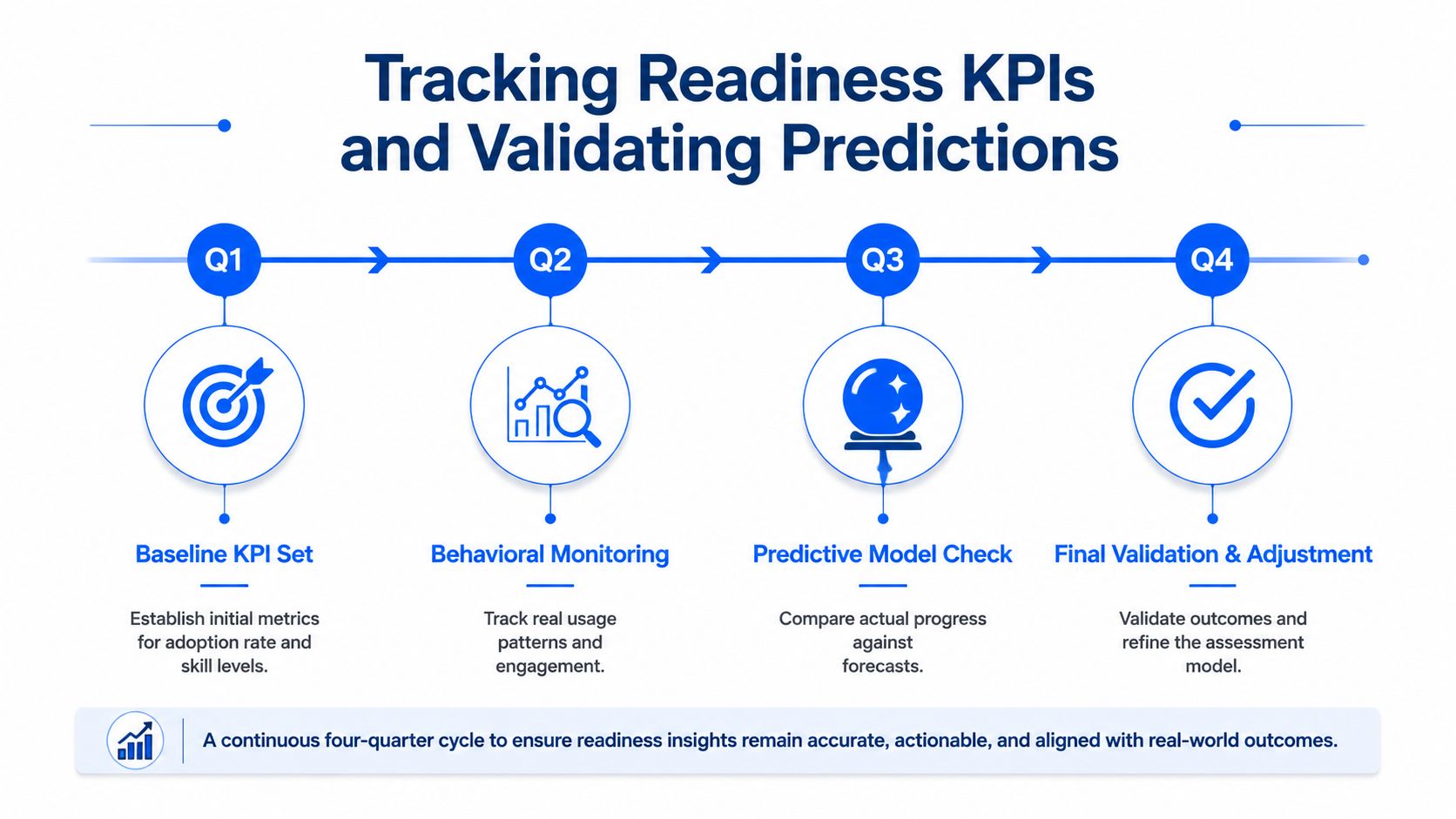
A readiness assessment that ends at launch is incomplete. The test is whether the score predicted actual adoption. Bain's benchmarked survey model matters here because it shows how readiness can be made visible at the employee level, but the same discipline has to continue after rollout, not stop at the first snapshot. If the team says it's ready and then avoids the new workflow, the assessment wasn't wrong to ask. It was wrong to stop asking.
Track behavior, not just sentiment
Sentiment can improve without adoption moving. That's why the KPI set needs behavioral indicators. In materials R&D, watch whether scientists use the new system when planning experiments, whether they rely on its predictions, and whether they keep defaulting to old spreadsheets for decisions. Those signals tell you whether the readiness score matches real behavior.
Pilot groups are the fastest validation layer. If a small group shows strong use and clean handoff behavior, that supports broader rollout. If the pilot group stalls, the model probably surfaced a real readiness gap that the launch plan needs to address.
Reassess on a cycle
Repeated measurement is more useful than a one-time survey because readiness changes as people learn, leaders communicate, and the workflow settles. A quarterly rhythm works well for a transformation that stretches across lab, pilot, and scale-up phases. In the first cycle, set the baseline. In the next, look for behavior change. Later, test whether the changes hold under pressure.
That cycle also lets you connect readiness to downstream outcomes like experiment throughput, scale-up speed, and whether the program starts generating value on time. If behavior improves but adoption is uneven, the mitigation plan needs more local support. If adoption is strong but execution quality is weak, the issue may sit in process or data, not in willingness.
Readiness is a moving target, so the KPI system has to move with it.
Use the score to refine the model
Validation is not a pass or fail exercise. If a readiness dimension didn't predict what happened, the instrument may need adjustment. Maybe the survey item was too abstract. Maybe the stakeholder group was too broad. Maybe a hidden dependency mattered more than the tool captured. Those are useful findings, not failures.
A good readiness KPI system keeps the assessment honest. It proves which dimensions matter most for your transformation and which signals are just noise. That's how readiness becomes a living management tool instead of a document that only gets read once.
Common Readiness Pitfalls and How to Avoid Them
The biggest mistake in materials R&D is waiting for perfect data before you begin. That sounds responsible, but it usually delays the work that would make the data usable in the first place. Start with what you have, identify the gaps, and build the AI-ready foundation incrementally. That approach fits the nature of experimental environments where the data is fragmented but still valuable.
The four traps that keep showing up
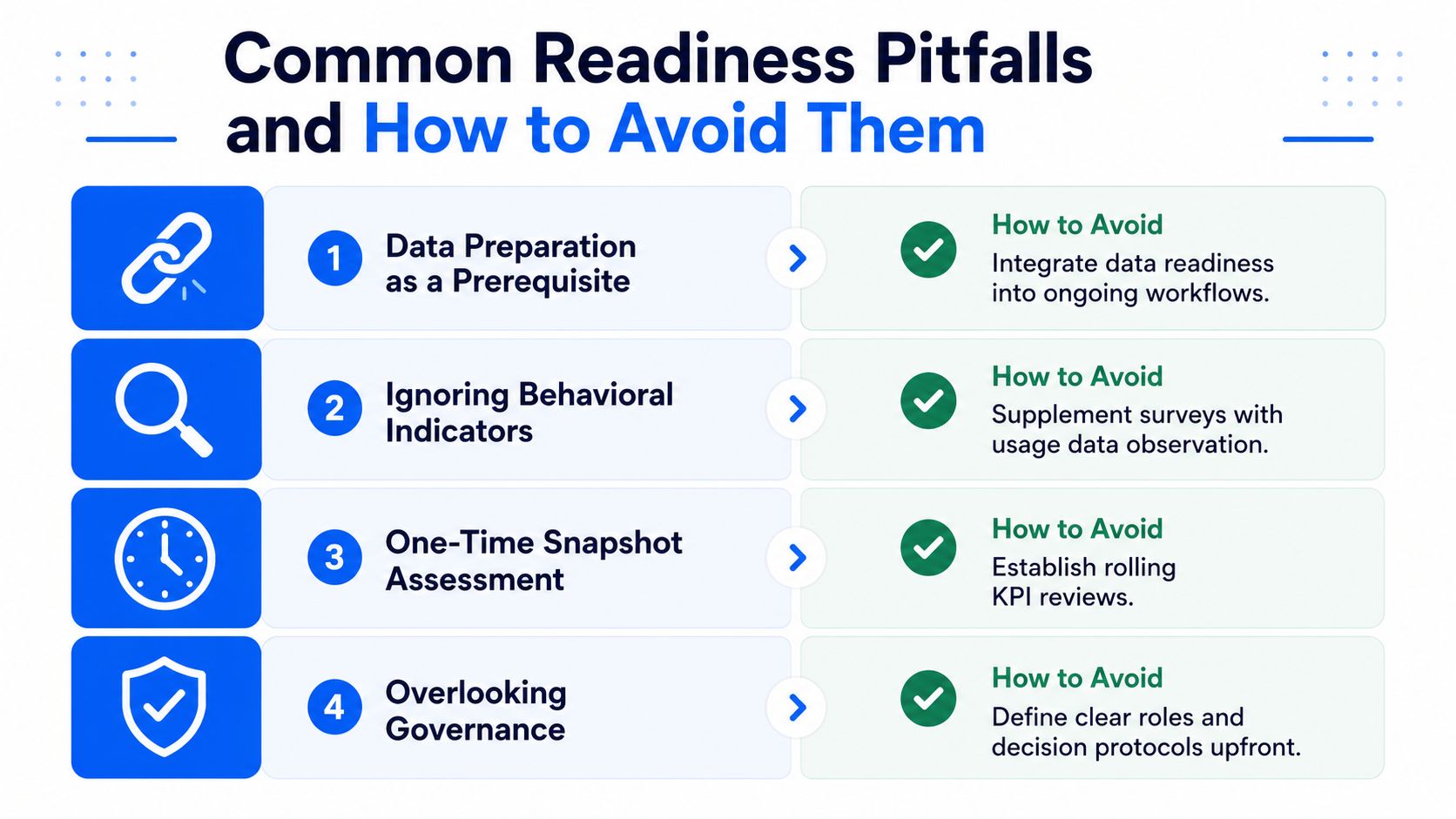
Data Preparation as a Prerequisite. Treating data cleanup as a gate instead of an ongoing workflow slows the program and hides learning. The better move is to integrate data readiness into the operating rhythm so the foundation improves while the team works.
Ignoring Behavioral Indicators. Surveys tell you what people believe, but they don't prove what they'll do. Supplement sentiment with usage data, observation, and pilot behavior so you know whether the change is landing.
One-Time Snapshot Assessment. Readiness changes as the transformation advances. Rolling KPI reviews keep leaders from making decisions off stale information.
Overlooking Governance. Scientists won't place sensitive formulation data into any platform if decision rights and IP protections are vague. Clear roles and decision protocols have to be in place early.
What earns trust in materials R&D
Scientists move faster when the model is explainable. A black box can look clever and still lose credibility in the lab. Confidence scores, historical precedents, and traceable recommendations help people see why the model is pointing them in a certain direction. That's usually more persuasive than a generic claim of accuracy.
Governance needs the same level of attention. If role-based access, compliance controls, and IP protection aren't credible, adoption will stall no matter how good the model is. In materials work, trust is operational. It's built by making the platform safe enough and useful enough that scientists want to keep using it.
A simple pressure test
If the assessment can't tell you who owns the weak point, what behavior proves improvement, and when you'll review it again, it isn't ready.
That's the standard I use before any launch. It forces the team to connect readiness to real execution, which is the only version that matters in R&D.
If your materials R&D team is trying to move from scattered experimental data to an AI-ready workflow, Polymerize is built for that exact problem. It helps enterprises unify fragmented data, validate material decisions with explainable models, and protect sensitive R&D knowledge with enterprise-grade controls. Visit Polymerize to see how a readiness-first foundation can turn pilot enthusiasm into scalable materials innovation.
Put your R&D data to work
See how materials teams use Polymerize to plan fewer experiments and reach target properties faster.